HUMAN NUTRITION

  DIGESTIVE SYSTEM
THE ALIMENTARY CANAL
• INGESTION: taking substances (e.g. food, drink) into the body
  through the mouth.
• DIGESTION: the break-down of large, insoluble food
  molecules into small, water-soluble molecules using
  mechanical and chemical processes.
• ABSORPTION: the movement of digestive food
  moleculesthrough the wall of the intestine into the blood or
  lymph.
• ASSIMILATION: the movement of digestive food molecules
  into the cells of the body where they are used, becoming part
  of the cells.
• EGESTION: the passing out of food that has not been
  digested, as faeces, through the anus.
Name the layers of tissue that make
 up the alimentary canal, starting
          from the inside
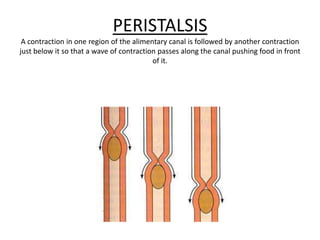
PERISTALSIS
 A contraction in one region of the alimentary canal is followed by another contraction
just below it so that a wave of contraction passes along the canal pushing food in front
                                          of it.
DIGESTION:
     -Physical: teeth and churning
movements of the alimentary canal
     -Chemical: enzymes
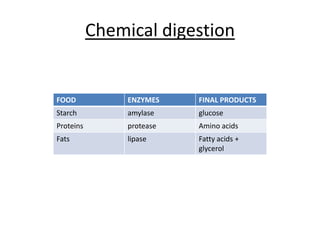
Chemical digestion


FOOD            ENZYMES    FINAL PRODUCTS
Starch          amylase    glucose
Proteins        protease   Amino acids
Fats            lipase     Fatty acids +
                           glycerol
MOUTH
           -Ingestion
           -Digestion
Food is chewed and mixed with
            saliva.
How to reduce the risk of tooth
           decay
   -Eating food with a low sugar content.

 - Regular and effective brushing of teeth at
 least twice a day to prevent the build up of
                    plaque.

  - Use a fluoride toothpaste regularly. It
 makes your teeth more resistant to decay
Chemical digestion (mouth)
• Saliva: contains salivary amylase

           starch → maltose
SWALLOWING
• Ensures that food does not enter the windpipe
  (trachea) and cause choking.

• Beginning: voluntary
• Then: involuntary
STOMACH
STOMACH
• Functions:
 - stores food from a meal.
 - turns food into a liquid (peristaltic
  movements)
 - releases food in small quantities at a time to
  the rest of the alimentary canal (pyloric
  sphincter)
Chemical digestion:
• Production of gastric juice (glands in the
  lining)

      - Enzyme: pepsin (protease)
                 Proteins → peptides
       - Hydrochloric acid: provides the best degree of
         acidity for pepsin to work in and kills many bacteria
         of food.
THE SMALL INTESTINE

             Duodenum   Ileum

• Chemical digestion

      Enzymes from:
1. Pancreatic juices
2. Bile
3. Intestinal juices
Liver, gall bladder, duodenum and
               pancreas
PANCREAS
• Secretion of pancreatic juice:delivered to the
  duodenum by the pancreatic duct.
      i) Enzymes:
          -Proteases:
                 Proteins → peptides → aa
          - Pancreatic amylase:
                 Starch → maltose
           - Lipase:
                  Fats → fatty acids + glycerol

      ii) Sodium hydrogencarbonate: neutralizes the acid liquid from
         the stomach so that pancreatic enzymes work correctly. (alkaline conditions)
BILE
•   Produced by the liver.
•   Stored in the gall bladder.
•   Delivered to the duodenum by the bile duct.
•   No enzymes
•   Bile pigment:from the break down of haemoglobin in the
    liver.
• Bile salts: Emulsify the fats: they break them up into
    small drops which are more easily digested by lipase.
INTESTINAL JUICES
• The epithelial cells of the villi produce
  enzymes which complete the breakdown of:
   - Maltose → glucose
   - Peptides → aa
   - Fats → fatty acid and glycerol
  before they are absorbed.
     By -Maltase
        -Peptidase
FINAL PRODUCTS OF DIGESTION
           FOOD       FINAL PRODUCTS
Starch            Glucose
Proteins          Amino acids
Fats              Fatty acids + glycerol
ABSORPTION: ILEUM
VILLI: Hystology
Structure of a villus
Molecules

Epithelial cells       → a large proportion of
        ↓                     fatty acid + glycerol
capillaries (bloodstream )                  ↓
         ↓                         form fats again
                                    pass to lacteals
 Hepatic Portal Vein                       ↓


            ↓                   lymphatic system
             LIVER
               ↓
General circulation (vena cava)
LARGE INTESTINE
                 Colon and rectum
• Material that reaches it contains:
     i) water with undigested matter
     ii) cellulose
     iii) fibre: digested partly by bacteria
     iv) mucus
     v) dead cells from the lining of the alimentary canal
• Function: absorption of water.
    semisolid waste → faeces → rectum → anus (EGESTION)
ASSIMILATION
• Glucose
     Respiration              energy
• Fats
     -Are built into cell membranes and other cell structures
       - Source of energy
• Amino acids
      - Built up into proteins.   Functions??
STORAGE OF DIGESTED FOOD
• Glucose
   - Changed in the liver to glycogen
   - Some of the glycogen is stored in liver
  (short- term store) and muscles.
  - LIVER: If ↓ blood sugars       Glycogen → glucose → circulation
  - MUSCLES: glucose: for muscular activity

  - Excessof glucose: converted to fat and
  stored in fats depots
STORAGE OF DIGESTED FOOD
• Fats
  - There is no limit to storage of fats
  - Long- term store as fat depots in:
        -abdomen
        - round the kidneys       (adipose tissue)
        - under the skin
STORAGE OF DIGESTED FOOD
• Amino acids
  - They are not stored in the body
  - Those not used in protein formation are
  deaminated (in the liver)
DEAMINATION (in the liver)
                     aa
 non nitrogen compound    nitrogen compound


      glucose                  UREA

     respiration           excreted by the kidneys

                               urine
LIVER
                   Functions
•   Regulation of blood sugars.
•   Production of bile.
•   Deamination
•   Storage of iron.
•   Manufacture of plasma proteins.
•   Detoxication.
•   Storage of vitamins
Powerpoint digestive system

Powerpoint digestive system

  • 1.
    HUMAN NUTRITION DIGESTIVE SYSTEM
  • 2.
    THE ALIMENTARY CANAL •INGESTION: taking substances (e.g. food, drink) into the body through the mouth. • DIGESTION: the break-down of large, insoluble food molecules into small, water-soluble molecules using mechanical and chemical processes. • ABSORPTION: the movement of digestive food moleculesthrough the wall of the intestine into the blood or lymph. • ASSIMILATION: the movement of digestive food molecules into the cells of the body where they are used, becoming part of the cells. • EGESTION: the passing out of food that has not been digested, as faeces, through the anus.
  • 4.
    Name the layersof tissue that make up the alimentary canal, starting from the inside
  • 5.
    PERISTALSIS A contractionin one region of the alimentary canal is followed by another contraction just below it so that a wave of contraction passes along the canal pushing food in front of it.
  • 6.
    DIGESTION: -Physical: teeth and churning movements of the alimentary canal -Chemical: enzymes
  • 8.
    Chemical digestion FOOD ENZYMES FINAL PRODUCTS Starch amylase glucose Proteins protease Amino acids Fats lipase Fatty acids + glycerol
  • 9.
    MOUTH -Ingestion -Digestion Food is chewed and mixed with saliva.
  • 13.
    How to reducethe risk of tooth decay -Eating food with a low sugar content. - Regular and effective brushing of teeth at least twice a day to prevent the build up of plaque. - Use a fluoride toothpaste regularly. It makes your teeth more resistant to decay
  • 14.
    Chemical digestion (mouth) •Saliva: contains salivary amylase starch → maltose
  • 15.
    SWALLOWING • Ensures thatfood does not enter the windpipe (trachea) and cause choking. • Beginning: voluntary • Then: involuntary
  • 17.
  • 18.
    STOMACH • Functions: -stores food from a meal. - turns food into a liquid (peristaltic movements) - releases food in small quantities at a time to the rest of the alimentary canal (pyloric sphincter)
  • 19.
    Chemical digestion: • Productionof gastric juice (glands in the lining) - Enzyme: pepsin (protease) Proteins → peptides - Hydrochloric acid: provides the best degree of acidity for pepsin to work in and kills many bacteria of food.
  • 20.
    THE SMALL INTESTINE Duodenum Ileum • Chemical digestion Enzymes from: 1. Pancreatic juices 2. Bile 3. Intestinal juices
  • 21.
    Liver, gall bladder,duodenum and pancreas
  • 22.
    PANCREAS • Secretion ofpancreatic juice:delivered to the duodenum by the pancreatic duct. i) Enzymes: -Proteases: Proteins → peptides → aa - Pancreatic amylase: Starch → maltose - Lipase: Fats → fatty acids + glycerol ii) Sodium hydrogencarbonate: neutralizes the acid liquid from the stomach so that pancreatic enzymes work correctly. (alkaline conditions)
  • 23.
    BILE • Produced by the liver. • Stored in the gall bladder. • Delivered to the duodenum by the bile duct. • No enzymes • Bile pigment:from the break down of haemoglobin in the liver. • Bile salts: Emulsify the fats: they break them up into small drops which are more easily digested by lipase.
  • 24.
    INTESTINAL JUICES • Theepithelial cells of the villi produce enzymes which complete the breakdown of: - Maltose → glucose - Peptides → aa - Fats → fatty acid and glycerol before they are absorbed. By -Maltase -Peptidase
  • 25.
    FINAL PRODUCTS OFDIGESTION FOOD FINAL PRODUCTS Starch Glucose Proteins Amino acids Fats Fatty acids + glycerol
  • 27.
  • 28.
  • 29.
  • 30.
    Molecules Epithelial cells → a large proportion of ↓ fatty acid + glycerol capillaries (bloodstream ) ↓ ↓ form fats again pass to lacteals Hepatic Portal Vein ↓ ↓ lymphatic system LIVER ↓ General circulation (vena cava)
  • 31.
    LARGE INTESTINE Colon and rectum • Material that reaches it contains: i) water with undigested matter ii) cellulose iii) fibre: digested partly by bacteria iv) mucus v) dead cells from the lining of the alimentary canal • Function: absorption of water. semisolid waste → faeces → rectum → anus (EGESTION)
  • 32.
    ASSIMILATION • Glucose Respiration energy • Fats -Are built into cell membranes and other cell structures - Source of energy • Amino acids - Built up into proteins. Functions??
  • 33.
    STORAGE OF DIGESTEDFOOD • Glucose - Changed in the liver to glycogen - Some of the glycogen is stored in liver (short- term store) and muscles. - LIVER: If ↓ blood sugars Glycogen → glucose → circulation - MUSCLES: glucose: for muscular activity - Excessof glucose: converted to fat and stored in fats depots
  • 34.
    STORAGE OF DIGESTEDFOOD • Fats - There is no limit to storage of fats - Long- term store as fat depots in: -abdomen - round the kidneys (adipose tissue) - under the skin
  • 35.
    STORAGE OF DIGESTEDFOOD • Amino acids - They are not stored in the body - Those not used in protein formation are deaminated (in the liver)
  • 36.
    DEAMINATION (in theliver) aa non nitrogen compound nitrogen compound glucose UREA respiration excreted by the kidneys urine
  • 37.
    LIVER Functions • Regulation of blood sugars. • Production of bile. • Deamination • Storage of iron. • Manufacture of plasma proteins. • Detoxication. • Storage of vitamins