HUMAN NUTRITIONDIGESTIVE SYSTEM
THE ALIMENTARY CANALINGESTION: takingsubstances (e.g.food, drink) intothebodythroughthemouth.DIGESTION: the break-down of large, insoluble foodmoleculesintosmall, water-soluble moleculesusingmechanical and chemicalprocesses.ABSORPTION:themovement of digestivefoodmoleculesthroughthewall of theintestineintothebloodorlymph.ASSIMILATION: themovement of digestivefoodmoleculesintothecells of thebodywherethey are used, becomingpart of thecells.EGESTION: the ´passingout of foodthat has notbeendigeste, as faeces, throughtheanus.
Namethelayers of tissuethatmake up thealimentary canal, startingfromtheinside
PERISTALSISA contraction in oneregion of thealimentary canal isfollowedbyanothercontractionjustbelowit so that a wave of contractionpassesalongthe canal pushingfood in front of it.
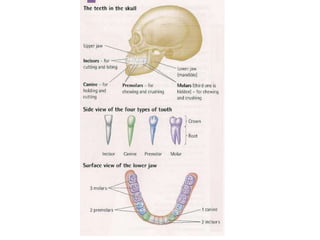
DIGESTION:Physical:teethChemical: enzymes
Chemicaldigestion
MOUTH   -Ingestion    -DigestionFoodischewed and mixedwithsaliva.
Howto reduce therisk of toothdecay-Eatingfoodwith a lowsugarcontent. Regular and effectivebrushing of teeth at leasttwice a daytopreventthebuild up of plaque.- Use a fluoridetoothpasteregularly. Itmakesyourteeth more resistanttodecay
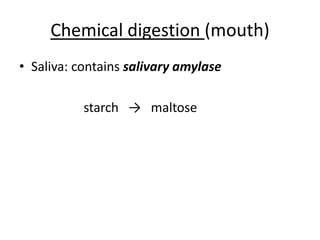
Chemicaldigestion(mouth)Saliva: containssalivaryamylasestarch   ->   maltose
SWALLOWINGEnsuresthatfooddoesnotenterthewindpipe (trachea) and cause choking.Beginning: voluntaryThen: involuntary
STOMACH
STOMACHFunctions:  - storesfoodfrom a meal.  - turnsfoodinto a liquid (peristalticmovements)  - releasesfood in smallquantities at a time totherest of thealimentary canal (pyloricsphincter)
Chemicaldigestion:Production of gastricjuice(glands in thelining)             - Enzyme: pepsin (protease)Proteins  ->   peptides- Hydrochloricacid: providesthebestdegree of        acidityforpepsintowork in and killsmany bacteria                      of food.
THE SMALL INTESTINEDuodenumIleumChemicaldigestionEnzymesfrom:PancreaticjuicesBileIntestinal juices
Liver, gallbladder, duodenum and pancreas
PANCREASSecretion of pancreaticjuice:deliveredtotheduodenumbythepancreaticduct.          i) Enzymes:-Proteases:Proteins -> peptides -> aa- Pancreaticamylase:Starch -> maltose- Lipase:Fats -> fattyacids + glycerolii) Sodiumhydrogencarbonate: neutralizestheacidliquidfromthestomach so thatpancreaticenzymesworkcorrectly. (alkalineconditions)
BILEProducedbytheliver.Stored in thegallbladder.Deliveredtotheduodenumbythebileduct.No enzymesBilepigment:fromthe break down of haemoglobin in theliver.Bilesalts: Emulsifythefats: they break them up intosmalldropswhich are more easilydigestedbylipase.
INTESTINAL JUICESTheepithelialcells of thevilli produce enzymeswhichcompletethebreakdown of:       - Maltose       - Peptidesbeforethey are absorbed.Maltose  ->  glucosePeptides ->   aa
FINAL PRODUCTS OF DIGESTION
ABSORPTION: ILEUM
VILLI: Hystology
Structure of a villus
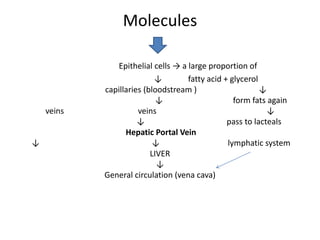
MoleculesEpithelialcells -> a largeproportion of                                              ↓             fattyacid + glycerolcapillaries (bloodstream )                               ↓                                                                              ↓                                   formfatsagainveinsveins                                                       ↓                                                                                                                                           ↓                                         passtolactealsHepatic Portal Vein↓                                                        ↓                                  lymphaticsystemLIVER↓General circulation (vena cava)
LARGE INTESTINEColon and rectumMaterial thatreachesitcontains:i) waterwithundigestedmatterii) celluloseiii) fibre: digestedpartlyby bacteriaiv) mucus            v) deadcellsfromthelining of thealimentary canalFunction: absorption of water.semisolidwaste -> faeces -> rectum -> anus (EGESTION)
ASSIMILATIONGlucoseRespirationenergyFats          -Are builtintocellmembranes and othercellstructures              - Source of energyAmino acids             -  Built up intoproteins.      Functions??
STORAGE OF DIGESTED FOODGlucose     - Changed in thelivertoglycogen     - Some of theglycogenisstored in liver (short- termstore) and muscles.-  LIVER: If ↓ bloodsugarsGlycogen -> glucose -> circulation        - MUSCLES:  glucose: for muscular activity       - Excess of glucose: convertedtofat and stored in fatsdepots
STORAGE OF DIGESTED FOODFats    - Thereis no limittostorage of fats    - Long- termstore as fatdepots in:-abdomen               - round thekidneys       (adiposetissue)               - undertheskin
STORAGE OF DIGESTED FOODAmino acids    - They are notstored in thebody    - Thosenotused in proteinformation are deaminated(in theliver)
LIVERFunctionsRegulation of bloodsugars.Production of bile.DeaminationStorage of iron.Manufacture of plasma proteins.Detoxication.Storage of vitamins
Powerpint digestive system

Powerpint digestive system