Pancreas: Anatomy
Presented by: IRFAN UL HAQ
MBBS Final Year
GMC Srinagar
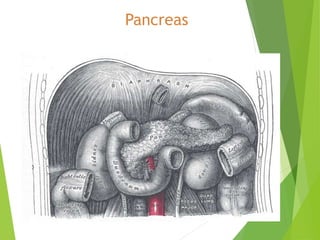
Pancreas
• Pancreas – derived from the Greek
pan, “all”, and kreas, “flesh”,
probably referring to the organ’s
homogenous appearance.
Pancreas
Pancreas
• Gland with both exocrine and endocrine
functions.
• 15-20cm in length.
• 60-100 gram in weight.
• Location: retro-peritoneum, 2nd lumbar
vertebral level.
• Extends in an oblique, transverse position.
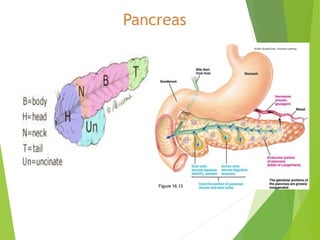
• Parts of pancreas: head, neck, body and tail.
Gross Anatomy
• Is a retroperitoneal structure
• It has a distinctive yellow/tan/pink color and is multilobulated.
• The gland is divided into four portions:
 The head
 The neck
 The body and
 The tail.
• The pancreas has an extensive arterial system arising from multiple
sources
• The venous drainage parallels arterial anatomy
• Multiple lymph nodes drain the pancreas
• Neural function is controlled by dual sympathetic and parasympathetic
innervation.
Pancreas
Head of Pancreas
• Includes uncinate process:
• Lower part of the posterior surface of the head that wraps
behind the superior mesenteric artery and superior mesenteric
vein.
• Flattened structure, 2 – 3 cm thick.
• Attached to the 2nd and 3rd portions of duodenum on the
right.
• Emerges into neck on the left.
• Broadest part.
• SPDA and IPDA anastamose b/w the duodenum and the rt.
lateral border.
• Moulded into the C shaped concavity of duodenum.
• Lies over the inferior vena cava, the right and left renal
veins at the level of L2.
• Posterior surface is indented by the terminal part of the bile
duct.
Neck of Pancreas
• 2.5 cm in length
• Lies in front of the superior mesenteric and portal veins
• Posteriorly it is related to aorta.
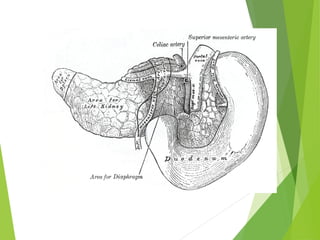
Body of Pancreas
• Elongated triangular structure.
• Anterior surface, separated from stomach by lesser sac
• Posterior surface, related to aorta, lt. adrenal gland, lt. renal vessels
and upper 1/3rd of lt. kidney.
• Splenic vein runs embedded in the posterior surface.
• Inferior surface is covered by peritoneum.
• Anterior border is attached to root of transverse mesocolon.
• Upper border crosses the aorta at the origin of the celiac trunk.
• Splenic artery passes to the left along the upper border.
• Lower border crosses the origin of the superior mesenteric artery.
Tail of Pancreas
• Narrow, short segment.
• Lies at the level of the 12th thoracic vertebra.
• Lies in the lieno-renal ligament along with splenic artery, vein,
lymphatics .
• End of tail of pancreas touches the hilum of spleen.
• Anteriorly, close to splenic flexure of colon.
• Passes forward from the anterior surface of the left kidney at the
level of hilum.
Pancreatic Duct
• Main duct (Duct of Wirsung) runs the entire length of
pancreas
• Herring bone pattern.
• Joins Bile Duct at the ampulla of Vater.
• 2 – 4 mm in diameter, 20 secondary branches.
• Major duodenal papilla.
• Lesser duct (Duct of Santorini) empties separately into 2nd
portion of duodenum
• Drains the uncinate process and lower part of head.
Pancreatic duct (contd…)
• The pancreatic arteries derive mainly from the branches of the
splenic artery.
• The anterior and posterior superior pancreaticoduodenal
arteries, branches of the gastroduodenal artery.
• The anterior and posterior inferior pancreaticoduodenal arteries,
branches of the SMA.
Blood supply
Venous drainage
• Splenic vien.
• Superior mesentric vien.
• Portal vien.
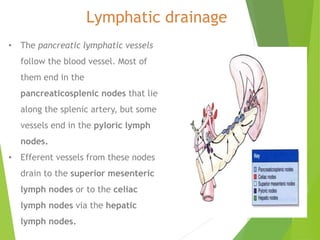
• The pancreatic lymphatic vessels
follow the blood vessel. Most of
them end in the
pancreaticosplenic nodes that lie
along the splenic artery, but some
vessels end in the pyloric lymph
nodes.
• Efferent vessels from these nodes
drain to the superior mesenteric
lymph nodes or to the celiac
lymph nodes via the hepatic
lymph nodes.
Lymphatic drainage
• The nerves of the pancreas are derived from
the vagus and abdominopelvic splanchnic
nerves.
Nerve supply
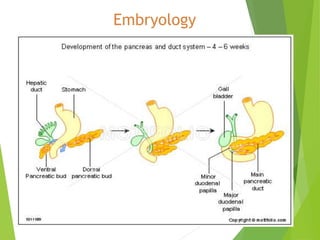
Embryology
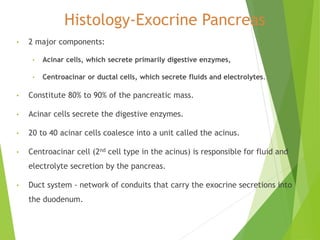
Histology-Exocrine Pancreas
• 2 major components:
• Acinar cells, which secrete primarily digestive enzymes,
• Centroacinar or ductal cells, which secrete fluids and electrolytes.
• Constitute 80% to 90% of the pancreatic mass.
• Acinar cells secrete the digestive enzymes.
• 20 to 40 acinar cells coalesce into a unit called the acinus.
• Centroacinar cell (2nd cell type in the acinus) is responsible for fluid and
electrolyte secretion by the pancreas.
• Duct system - network of conduits that carry the exocrine secretions into
the duodenum.
Histology-Endocrine Pancreas
• Accounts for only 2% of the pancreatic mass.
• Nests of cells - islets of Langerhans.
• Four major cell types:
• Alpha (A) cells secrete glucagon,
• Beta (B) cells secrete insulin,
• Delta (D) cells secrete somatostatin,
• F cells secrete pancreatic polypeptide.
Histology-Endocrine Pancreas
 B cells are centrally located
within the islet and constitute
70% of the islet mass.
 PP, A, and D cells are located at
the periphery of the islet.
Conclusions
• Pancreas is a composite gland,
• Has exocrine and endocrine functions,
• Plays major role in digestion and glucose
homeostasis.

Pancreas

  • 1.
    Pancreas: Anatomy Presented by:IRFAN UL HAQ MBBS Final Year GMC Srinagar
  • 2.
    Pancreas • Pancreas –derived from the Greek pan, “all”, and kreas, “flesh”, probably referring to the organ’s homogenous appearance.
  • 3.
  • 4.
    Pancreas • Gland withboth exocrine and endocrine functions. • 15-20cm in length. • 60-100 gram in weight. • Location: retro-peritoneum, 2nd lumbar vertebral level. • Extends in an oblique, transverse position. • Parts of pancreas: head, neck, body and tail.
  • 5.
    Gross Anatomy • Isa retroperitoneal structure • It has a distinctive yellow/tan/pink color and is multilobulated. • The gland is divided into four portions:  The head  The neck  The body and  The tail. • The pancreas has an extensive arterial system arising from multiple sources • The venous drainage parallels arterial anatomy • Multiple lymph nodes drain the pancreas • Neural function is controlled by dual sympathetic and parasympathetic innervation.
  • 6.
  • 7.
    Head of Pancreas •Includes uncinate process: • Lower part of the posterior surface of the head that wraps behind the superior mesenteric artery and superior mesenteric vein. • Flattened structure, 2 – 3 cm thick. • Attached to the 2nd and 3rd portions of duodenum on the right. • Emerges into neck on the left. • Broadest part. • SPDA and IPDA anastamose b/w the duodenum and the rt. lateral border. • Moulded into the C shaped concavity of duodenum. • Lies over the inferior vena cava, the right and left renal veins at the level of L2. • Posterior surface is indented by the terminal part of the bile duct.
  • 8.
    Neck of Pancreas •2.5 cm in length • Lies in front of the superior mesenteric and portal veins • Posteriorly it is related to aorta.
  • 9.
    Body of Pancreas •Elongated triangular structure. • Anterior surface, separated from stomach by lesser sac • Posterior surface, related to aorta, lt. adrenal gland, lt. renal vessels and upper 1/3rd of lt. kidney. • Splenic vein runs embedded in the posterior surface. • Inferior surface is covered by peritoneum. • Anterior border is attached to root of transverse mesocolon. • Upper border crosses the aorta at the origin of the celiac trunk. • Splenic artery passes to the left along the upper border. • Lower border crosses the origin of the superior mesenteric artery.
  • 11.
    Tail of Pancreas •Narrow, short segment. • Lies at the level of the 12th thoracic vertebra. • Lies in the lieno-renal ligament along with splenic artery, vein, lymphatics . • End of tail of pancreas touches the hilum of spleen. • Anteriorly, close to splenic flexure of colon. • Passes forward from the anterior surface of the left kidney at the level of hilum.
  • 12.
    Pancreatic Duct • Mainduct (Duct of Wirsung) runs the entire length of pancreas • Herring bone pattern. • Joins Bile Duct at the ampulla of Vater. • 2 – 4 mm in diameter, 20 secondary branches. • Major duodenal papilla. • Lesser duct (Duct of Santorini) empties separately into 2nd portion of duodenum • Drains the uncinate process and lower part of head.
  • 13.
  • 14.
    • The pancreaticarteries derive mainly from the branches of the splenic artery. • The anterior and posterior superior pancreaticoduodenal arteries, branches of the gastroduodenal artery. • The anterior and posterior inferior pancreaticoduodenal arteries, branches of the SMA. Blood supply
  • 15.
    Venous drainage • Splenicvien. • Superior mesentric vien. • Portal vien.
  • 16.
    • The pancreaticlymphatic vessels follow the blood vessel. Most of them end in the pancreaticosplenic nodes that lie along the splenic artery, but some vessels end in the pyloric lymph nodes. • Efferent vessels from these nodes drain to the superior mesenteric lymph nodes or to the celiac lymph nodes via the hepatic lymph nodes. Lymphatic drainage
  • 17.
    • The nervesof the pancreas are derived from the vagus and abdominopelvic splanchnic nerves. Nerve supply
  • 18.
  • 19.
    Histology-Exocrine Pancreas • 2major components: • Acinar cells, which secrete primarily digestive enzymes, • Centroacinar or ductal cells, which secrete fluids and electrolytes. • Constitute 80% to 90% of the pancreatic mass. • Acinar cells secrete the digestive enzymes. • 20 to 40 acinar cells coalesce into a unit called the acinus. • Centroacinar cell (2nd cell type in the acinus) is responsible for fluid and electrolyte secretion by the pancreas. • Duct system - network of conduits that carry the exocrine secretions into the duodenum.
  • 20.
    Histology-Endocrine Pancreas • Accountsfor only 2% of the pancreatic mass. • Nests of cells - islets of Langerhans. • Four major cell types: • Alpha (A) cells secrete glucagon, • Beta (B) cells secrete insulin, • Delta (D) cells secrete somatostatin, • F cells secrete pancreatic polypeptide.
  • 21.
    Histology-Endocrine Pancreas  Bcells are centrally located within the islet and constitute 70% of the islet mass.  PP, A, and D cells are located at the periphery of the islet.
  • 22.
    Conclusions • Pancreas isa composite gland, • Has exocrine and endocrine functions, • Plays major role in digestion and glucose homeostasis.