Liver and Gallbladder
DR. SSEKAWU CHARLES
Liver
• made up of many lobes called hepatic lobes
• hepatic lobules is the structural and functional
unit of liver
• lobule is a honeycomb-like structure and it is
made up of liver cells called hepatocytes
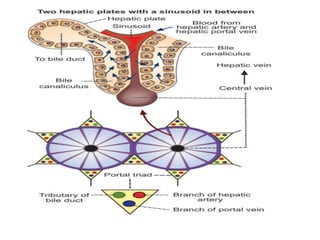
• Hepatocytes are arranged in columns to form
hepatic plates.
• Each plate is made up of two columns of cells.
• Between the two columns of each plate lies a
– Bile canaliculus
– blood space called sinusoid
Portal Triads
• Each lobule is surrounded by many portal
triads.
• Each portal triad consists of three vessels:
– A branch of hepatic artery
– A branch of portal vein
– A tributary of bile duct.
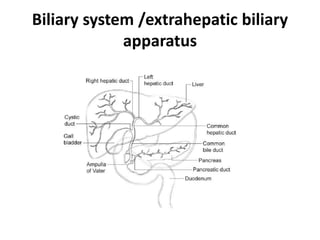
Biliary system /extrahepatic biliary apparatus
• formed by gallbladder and extrahepatic bile ducts (bile
ducts outside the liver).
• Right and left hepatic bile ducts from the liver join to
form common hepatic duct which unites with the
cystic duct from gallbladder to form common bile
duct
• Common bile duct unites with pancreatic duct to form
the common hepatopancreatic duct or ampulla of
Vater, which opens into the duodenum.
• a sphincter called sphincter of Oddi at the lower part
of common bile duct, before it joins the pancreatic
duct.
• formed by smooth muscle fibers of common bile duct.
• It is normally kept closed(secreted bile from liver
enters gallbladder where it is stored) .
• Upon appropriate stimulation, the sphincter opens and
allows flow of bile from gallbladder into the intestine.
Biliary system /extrahepatic biliary
apparatus
BLOOD SUPPLY TO LIVER
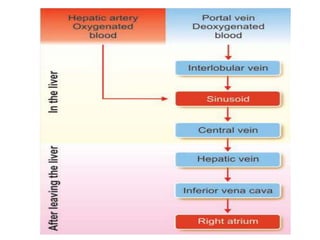
• It receives blood from two sources (the hepatic artery
and portal vein)
• HEPATIC ARTERY
– Arises directly from aorta
– Supplies oxygenated blood to liver
– After entering the liver, the divides into many branches.
– Each branch enters a portal triad
• PORTAL VEIN
– Formed by superior mesenteric vein and splenic vein. It
brings deoxygenated blood from stomach, intestine,
spleen and pancreas. ‘
– Portal blood is rich in monosaccharides and amino acids,
bile salts, bilirubin, urobilinogen and GI hormones.
– The oxygen content is less in portal blood
• PORTAL VEIN
– Flow of blood from intestine to liver through portal vein is
known as enterohepatic circulation
– The blood from hepatic artery mixes with blood from
portal vein in hepatic sinusoids.
– Hepatic cells obtain oxygen and nutrients from the
sinusoid.
• HEPATIC VEIN
– Substances synthesized by hepatic cells, waste products
and carbon dioxide are discharged into sinusoids.
– Sinusoids drain them into central vein of the lobule.
– Central veins from many lobules unite to form bigger veins,
– which ultimately form hepatic veins (right and left)
– which open into inferior vena cava.
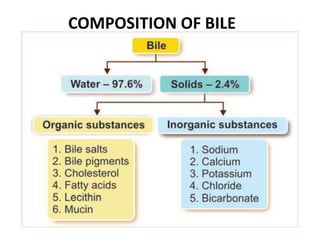
COMPOSITION OF BILE
SECRETION OF BILE
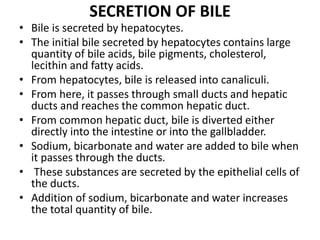
• Bile is secreted by hepatocytes.
• The initial bile secreted by hepatocytes contains large
quantity of bile acids, bile pigments, cholesterol,
lecithin and fatty acids.
• From hepatocytes, bile is released into canaliculi.
• From here, it passes through small ducts and hepatic
ducts and reaches the common hepatic duct.
• From common hepatic duct, bile is diverted either
directly into the intestine or into the gallbladder.
• Sodium, bicarbonate and water are added to bile when
it passes through the ducts.
• These substances are secreted by the epithelial cells of
the ducts.
• Addition of sodium, bicarbonate and water increases
the total quantity of bile.
STORAGE OF BILE
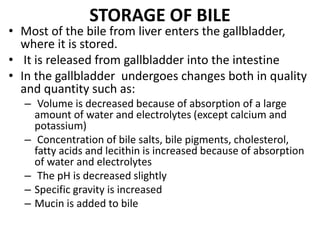
• Most of the bile from liver enters the gallbladder,
where it is stored.
• It is released from gallbladder into the intestine
• In the gallbladder undergoes changes both in quality
and quantity such as:
– Volume is decreased because of absorption of a large
amount of water and electrolytes (except calcium and
potassium)
– Concentration of bile salts, bile pigments, cholesterol,
fatty acids and lecithin is increased because of absorption
of water and electrolytes
– The pH is decreased slightly
– Specific gravity is increased
– Mucin is added to bile
BILE SALTS
• Bile salts are the sodium and potassium salts
of bile acids, which are conjugated with
glycine or taurine.
FUNCTIONS OF BILE SALTS
• Emulsification of Fats
• Absorption of Fats
– combine with fats and make complexes of fats
called micelles
• Choleretic Action- stimulate secretion of bile
• Cholagogue Action-causes contraction of
gallbladder and release of bile into the
intestine by stimulating the secretion of
hormone cholecystokinin
• Laxative Action by stimulating peristaltic
movements of the intestinewhich induces
defecation
FUNCTIONS OF BILE SALTS
• Prevention of Gallstone Formation
– by keeping the cholesterol and lecithin in solution.
In the absence of bile salts, cholesterol
precipitates along with lecithin and forms
gallstone
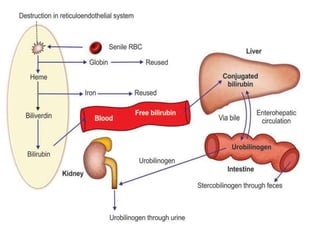
FORMATION AND EXCRETION OF BILE PIGMENTS
• Senile erythrocytes are destroyed in reticuloendothelial system
and hemoglobin is released from them
• Hemoglobin is broken into globin and heme
• Heme is split into iron and the pigment biliverdin
• Iron goes to iron pool and is reused
• First formed pigment biliverdin is reduced to bilirubin.
• Bilirubin is released into blood from the reticuloendothelial
cells
• In blood, the bilirubin is transported by the plasma protein,
albumin.
• Bilirubin circulating in the blood is called free bilirubin or
unconjugated bilirubin
• Within few hours after entering the circulation, the free
bilirubin is taken up by the liver cells
• In the liver, it is conjugated with glucuronic acid to form
conjugated bilirubin
• Conjugated bilirubin is then excreted into intestine through bile.
FATE OF CONJUGATED BILIRUBIN
Stages of excretion of conjugated bilirubin:
• In intestine, 50% of the conjugated bilirubin is converted
into urobilinogen by intestinal bacteria.
• First the conjugated bilirubin is deconjugated into free
bilirubin, which is later reduced into urobilinogen.
• Remaining 50% of conjugated bilirubin from intestine is
absorbed into blood and enters the liver through portal vein
(enterohepatic circulation).
• From liver, it is reexcreted in bile
• Most of the urobilinogen from intestine enters liver via
enterohepatic circulation. Later, it is reexcreted through bile
• About 5% of urobilinogen is excreted by kidney through
urine.
• In urine, due to exposure to air, the urobilinogen is
converted into urobilin by oxidation
• Some of the urobilinogen is excreted in feces as
stercobilinogen.
• In feces, stercobilinogen is oxidized to stercobilin.
FUNCTIONS OF BILE
Most of the functions of bile are due to the bile salts.
„1. DIGESTIVE FUNCTION
„2. ABSORPTIVE FUNCTIONS
„3. EXCRETORY FUNCTIONS
– Bile pigments are the major excretory products of the bile. Other substances excreted in bile
are:
• Heavy metals like copper and iron
• Some bacteria like typhoid bacteria
• Some toxins
• Cholesterol
• Lecithin
• Alkaline phosphates.
4. LAXATIVE ACTION
„5. ANTISEPTIC ACTION
– Bile inhibits the growth of certain bacteria in the lumen of intestine by its natural detergent
action.
6. CHOLERETIC ACTION
7.AINTENANCE OF pH IN GASTROINTESTINAL TRACT
– As bile is highly alkaline, it neutralizes the acid chym which enters the intestine from stomach.
Thus, an optimum pH is maintained for the action of digestive enzymes.
8. PREVENTION OF GALLSTONE FORMATION
„9. LUBRICATION FUNCTION
– The mucin in bile acts as a lubricant for the chyme in intestine.
10. CHOLAGOGUE ACTION
FUNCTIONS OF LIVER
1. METABOLIC FUNCTION as metabolism of carbohydrates, proteins, fats, vitamins and
many hormones are carried out.
„2. STORAGE FUNCTION like glycogen, amino acids, iron, folic acid and vitamins A, B12
and D are stored in liver.
3. SYNTHETIC FUNCTION
– Liver produces glucose by gluconeogenesis.
– It synthesizes all the plasma proteins and other proteins (except immunoglobulins) such as clotting
factors, complement factors and hormone binding proteins.
– It also synthesizes steroids, somatomedin and heparin.
4. SECRETION OF BILE
– Liver secretes bile which contains bile salts, bile pigments, cholesterol, fatty acids and lecithin.
5. EXCRETORY FUNCTION
– Liver excretes cholesterol, bile pigments, heavy metals (like lead, arsenic and bismuth), toxins, bacteria
and virus (like that of yellow fever) through bile.
6. HEAT PRODUCTION
– Enormous amount of heat is produced in the liver because of metabolic reactions. Liver is the organ
where maximum heat is produced.
7. HEMOPOIETIC FUNCTION
– In fetus (hepatic stage), liver produces the blood cells
• It stores vitamin B12 necessary for erythropoiesis and iron necessary for synthesis of
hemoglobin.
• Liver produces thrombopoietin that promotes production of thrombocytes.
FUNCTIONS OF LIVER
8. HEMOLYTIC FUNCTION
– The senile RBCs after a lifespan of 120 days are destroyed by
reticuloendothelial cells (Kupffer cells) of liver.
„9. INACTIVATION OF HORMONES AND DRUGS
• Liver catabolizes the hormones such as growth hormone,
parathormone, cortisol, insulin, glucagon and estrogen.
• It also inactivates the drugs, particularly the fat soluble drugs are
converted into water soluble substances, which are excreted through
bile orurine.
„10. DEFENSIVE AND DETOXIFICATION FUNCTIONS
• Reticuloendothelial cells (Kupffer cells) of the liver play an important
role in the defense of the body.
• Liver is also involved in the detoxification of the foreign bodies.
• Reticuloendothelial cells of liver also produce substances like
interleukins and tumor necrosis factors, which activate the immune
system of the body
• Liver cells are involved in detoxification, Detoxification in liver occurs
in two ways:
– Total destruction of the substances by means of metabolic degradation.
– Conversion of toxic substances into nontoxic materials by means of
conjugation with glucuronic acid or sulfates.
GALLBLADDER
• Major functions of gallbladder are the storage and concentration of bile.
1. Storage of Bile
2. Concentration of Bile
3. Alteration of pH of Bile
• The pH of bile decreases from 8 – 8.6 to 7 – 7.6 and it becomes less
alkaline when it is stored in gallbladder.
4. Secretion of Mucin
• Gallbladder secretes mucin and adds it to bile. When bile is released into
the intestine, mucin acts as a lubricant for movement of chyme in the
intestine.
5. Maintenance of Pressure in Biliary System
• Due to the concentrating capacity, gallbladder maintains a pressure of
about 7 cm H2O in biliary system.
• This pressure in the biliary system is essential for the release of bile into
the intestine.
FILLING AND EMPTYING OF GALLBLADDER
• The sphincter of Oddi is closed during fasting and the
pressure in the biliary system is only 7 cm H2O.
• Because of this pressure, the bile from liver enters the
gallbladder.
• While taking food or when chyme enters the intestine,
gallbladder contracts along with relaxation of
sphincter of Oddi. Now, the pressure increases to
about 20 cm H2O.
• Because of the increase in pressure, the bile from
gallbladder enters the intestine.
• Contraction of gallbladder is influenced by neural and
hormonal factors.
• 1. Neural Factor
Stimulation of parasympathetic nerve (vagus)
causes
contraction of gallbladder by releasing
acetylcholine.
• The vagal stimulation occurs during the cephalic
phase
• and gastric phase of gastric secretion.
• 2. Hormonal Factor
• When a fatty chyme enters the intestine from
stomach,
• the intestine secretes the cholecystokinin, which
causescontraction of the gallbladder.
REGULATION OF BILE SECRETION
• Secretion of bile from liver and release of bile
from the gallbladder are influenced by some
chemical factors, which are categorized into
three groups:
1. Choleretics
2. Cholagogue
3. Hydrocholeretic agents
1. Choleretics
• Substances which increase the secretion of
bile from liver are known as choleretics.
• Effective choleretic agents are:
i. Acetylcholine
ii. Secretin
iii. Cholecystokinin
iv. Acid chyme in intestine
v. Bile salts.
2. Cholagogue
• Cholagogue is an agent which increases the release of
bile into the intestine by contracting gallbladder
• Common cholagogues are:
i. Bile salts
ii. Calcium
iii. Fatty acids
iv. Amino acids
v. Inorganic acids
• All these substances stimulate the secretion of
cholecystokinin, which in turn causes contraction of
gallbladder and flow of bile into intestine
Hydrocholeretic Agents
• Hydrocholeretic agent is a substance which
causes the secretion of bile from liver, with
large amount of water and less amount of
solids.
• Hydrochloric acid is a hydrocholeretic agent
APPLIED PHYSIOLOGY
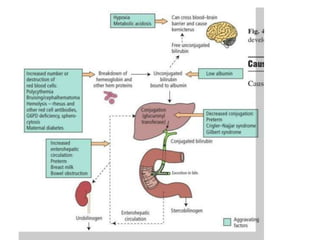
JAUNDICE OR ICTERUS
• is the condition characterized by yellow
coloration of the skin, mucous membrane and
deeper tissues due to increased bilirubin level in
blood
Types of Jaundice
• Jaundice is classified into three types:
1. Prehepatic or hemolytic jaundice
2. Hepatic or hepatocellular jaundice
3. Posthepatic or obstructive jaundice.
1. Prehepatic or Hemolytic Jaundice
• Due to excessive destruction of RBCs resulting in increased
blood level of free (unconjugated) bilirubin
Causes
• Any condition that causes hemolytic anemia can lead to
hemolytic jaundice.
• Common causes of hemolytic jaundice are:
i. Renal disorder
ii. Hypersplenism
iii. Burns
iv. Infections such as malaria
v. Hemoglobin abnormalities such as sickle cell anemia or
thalassemia
vi. Drugs or chemical substances causing red cell damage
vii. Autoimmune diseases.
2. Hepatic or Hepatocellular or
Cholestatic Jaundi
• is the type of jaundice that occurs due to the
damage of hepatic cells. Because of the damage,
the conjugated bilirubin from liver cannot be
excreted and it returns to blood.
Causes
i. Infection (infective jaundice) by virus, resulting in
hepatitis (viral hepatitis)
ii. Alcoholic hepatitis
iii. Cirrhosis of liver
iv. Exposure to toxic materials
3. Posthepatic or Obstructive or
Extrahepatic Jaundice
• occurs because of the obstruction of bile flow
at any level of the biliary system.
• The bile cannot be excreted into small
intestine. So, bile salts and bile pigments enter
the circulation.
Causes
i. Gallstones
ii. Cancer of biliary system or pancreas.
HEPATITIS
• Causes and Types
1. Viral infection (viral hepatitis)
2. Bacterial infection like leptospirosis and Q fever
3. Excess consumption of alcohol
4. Excess administration of drugs like paracetamol
5. Poisons like carbon tetrachloride and aflatoxin
6. Wilson disease
7. Circulatory insufficiency
8. Inheritance from mother during parturition
HEPATITIS
• Viral Hepatitis
• Is the type of hepatitis caused by viruses.
• It is caused by two types of viruses, hepatitis A and
hepatitis B.
Causes of viral hepatitis
i. Mainly by intake of water and food contaminated with
hepatitis virus
ii. Sharing needles with infected persons
iii. Accidental prick by infected needle
iv. Having unprotected sex with infected persons
v. Inheritance from mother during parturition
vi. Blood transfusion from infected donors.
Hepatitis caused by hepatitis B virus is more common and
considered more serious because it may lead to
cirrhosis and cancer of liver.
Features of Hepatitis
1. Fever
2. Nausea
3. Vomiting, diarrhea and loss of appetite
4. Headache and weakness
5. In addition, chronic hepatitis is characterized by
i. Stomach pain
ii. Paleness of skin
iii. Darkcolored
urine and pale stool
iv. Jaundice
v. Personality changes.
CIRRHOSIS OF LIVER
• refers to inflammation and damage of parenchyma of liver. It results
in degeneration of hepatic cells and dysfunction of liver
Causes
1. Infection
2. Retention of bile in liver due to obstruction of ducts of biliary system
3. Enlargement of liver due to intoxication
4. Inflammation around liver (perihepatitis)
5. Infiltration of fat in hepatic cells.
Features
1. Fever, nausea and vomiting
2. Jaundice
3. Increased heart rate and cardiac output
4. Portal hypertension
5. Muscular weakness and wasting of muscles
6. Drowsiness
7. Lack of concentration and confused state of mind
8. Coma in advanced stages.
GALLSTONES
• Gallstone is a solid crystal deposit that is
formed by cholesterol, calcium ions and bile
pigments in the gallbladderor bile duct.
• Cholelithiasis is the presence of gallstones in
gallbladder.
• Choledocholithiasis is the presence of
gallstones in the bile ducts.
Read about
• Formation of Gallstones
• Causes for Gallstone Formation
• Diagnosis of Gallstone
• Features

Liver and gallbladder

  • 1.
  • 2.
    Liver • made upof many lobes called hepatic lobes • hepatic lobules is the structural and functional unit of liver • lobule is a honeycomb-like structure and it is made up of liver cells called hepatocytes • Hepatocytes are arranged in columns to form hepatic plates. • Each plate is made up of two columns of cells. • Between the two columns of each plate lies a – Bile canaliculus – blood space called sinusoid
  • 3.
    Portal Triads • Eachlobule is surrounded by many portal triads. • Each portal triad consists of three vessels: – A branch of hepatic artery – A branch of portal vein – A tributary of bile duct.
  • 5.
    Biliary system /extrahepaticbiliary apparatus • formed by gallbladder and extrahepatic bile ducts (bile ducts outside the liver). • Right and left hepatic bile ducts from the liver join to form common hepatic duct which unites with the cystic duct from gallbladder to form common bile duct • Common bile duct unites with pancreatic duct to form the common hepatopancreatic duct or ampulla of Vater, which opens into the duodenum. • a sphincter called sphincter of Oddi at the lower part of common bile duct, before it joins the pancreatic duct. • formed by smooth muscle fibers of common bile duct. • It is normally kept closed(secreted bile from liver enters gallbladder where it is stored) . • Upon appropriate stimulation, the sphincter opens and allows flow of bile from gallbladder into the intestine.
  • 6.
  • 7.
    BLOOD SUPPLY TOLIVER • It receives blood from two sources (the hepatic artery and portal vein) • HEPATIC ARTERY – Arises directly from aorta – Supplies oxygenated blood to liver – After entering the liver, the divides into many branches. – Each branch enters a portal triad • PORTAL VEIN – Formed by superior mesenteric vein and splenic vein. It brings deoxygenated blood from stomach, intestine, spleen and pancreas. ‘ – Portal blood is rich in monosaccharides and amino acids, bile salts, bilirubin, urobilinogen and GI hormones. – The oxygen content is less in portal blood
  • 8.
    • PORTAL VEIN –Flow of blood from intestine to liver through portal vein is known as enterohepatic circulation – The blood from hepatic artery mixes with blood from portal vein in hepatic sinusoids. – Hepatic cells obtain oxygen and nutrients from the sinusoid. • HEPATIC VEIN – Substances synthesized by hepatic cells, waste products and carbon dioxide are discharged into sinusoids. – Sinusoids drain them into central vein of the lobule. – Central veins from many lobules unite to form bigger veins, – which ultimately form hepatic veins (right and left) – which open into inferior vena cava.
  • 10.
  • 11.
    SECRETION OF BILE •Bile is secreted by hepatocytes. • The initial bile secreted by hepatocytes contains large quantity of bile acids, bile pigments, cholesterol, lecithin and fatty acids. • From hepatocytes, bile is released into canaliculi. • From here, it passes through small ducts and hepatic ducts and reaches the common hepatic duct. • From common hepatic duct, bile is diverted either directly into the intestine or into the gallbladder. • Sodium, bicarbonate and water are added to bile when it passes through the ducts. • These substances are secreted by the epithelial cells of the ducts. • Addition of sodium, bicarbonate and water increases the total quantity of bile.
  • 12.
    STORAGE OF BILE •Most of the bile from liver enters the gallbladder, where it is stored. • It is released from gallbladder into the intestine • In the gallbladder undergoes changes both in quality and quantity such as: – Volume is decreased because of absorption of a large amount of water and electrolytes (except calcium and potassium) – Concentration of bile salts, bile pigments, cholesterol, fatty acids and lecithin is increased because of absorption of water and electrolytes – The pH is decreased slightly – Specific gravity is increased – Mucin is added to bile
  • 13.
    BILE SALTS • Bilesalts are the sodium and potassium salts of bile acids, which are conjugated with glycine or taurine.
  • 14.
    FUNCTIONS OF BILESALTS • Emulsification of Fats • Absorption of Fats – combine with fats and make complexes of fats called micelles • Choleretic Action- stimulate secretion of bile • Cholagogue Action-causes contraction of gallbladder and release of bile into the intestine by stimulating the secretion of hormone cholecystokinin • Laxative Action by stimulating peristaltic movements of the intestinewhich induces defecation
  • 15.
    FUNCTIONS OF BILESALTS • Prevention of Gallstone Formation – by keeping the cholesterol and lecithin in solution. In the absence of bile salts, cholesterol precipitates along with lecithin and forms gallstone
  • 16.
    FORMATION AND EXCRETIONOF BILE PIGMENTS • Senile erythrocytes are destroyed in reticuloendothelial system and hemoglobin is released from them • Hemoglobin is broken into globin and heme • Heme is split into iron and the pigment biliverdin • Iron goes to iron pool and is reused • First formed pigment biliverdin is reduced to bilirubin. • Bilirubin is released into blood from the reticuloendothelial cells • In blood, the bilirubin is transported by the plasma protein, albumin. • Bilirubin circulating in the blood is called free bilirubin or unconjugated bilirubin • Within few hours after entering the circulation, the free bilirubin is taken up by the liver cells • In the liver, it is conjugated with glucuronic acid to form conjugated bilirubin • Conjugated bilirubin is then excreted into intestine through bile.
  • 18.
    FATE OF CONJUGATEDBILIRUBIN Stages of excretion of conjugated bilirubin: • In intestine, 50% of the conjugated bilirubin is converted into urobilinogen by intestinal bacteria. • First the conjugated bilirubin is deconjugated into free bilirubin, which is later reduced into urobilinogen. • Remaining 50% of conjugated bilirubin from intestine is absorbed into blood and enters the liver through portal vein (enterohepatic circulation). • From liver, it is reexcreted in bile • Most of the urobilinogen from intestine enters liver via enterohepatic circulation. Later, it is reexcreted through bile • About 5% of urobilinogen is excreted by kidney through urine. • In urine, due to exposure to air, the urobilinogen is converted into urobilin by oxidation • Some of the urobilinogen is excreted in feces as stercobilinogen. • In feces, stercobilinogen is oxidized to stercobilin.
  • 20.
    FUNCTIONS OF BILE Mostof the functions of bile are due to the bile salts. „1. DIGESTIVE FUNCTION „2. ABSORPTIVE FUNCTIONS „3. EXCRETORY FUNCTIONS – Bile pigments are the major excretory products of the bile. Other substances excreted in bile are: • Heavy metals like copper and iron • Some bacteria like typhoid bacteria • Some toxins • Cholesterol • Lecithin • Alkaline phosphates. 4. LAXATIVE ACTION „5. ANTISEPTIC ACTION – Bile inhibits the growth of certain bacteria in the lumen of intestine by its natural detergent action. 6. CHOLERETIC ACTION 7.AINTENANCE OF pH IN GASTROINTESTINAL TRACT – As bile is highly alkaline, it neutralizes the acid chym which enters the intestine from stomach. Thus, an optimum pH is maintained for the action of digestive enzymes. 8. PREVENTION OF GALLSTONE FORMATION „9. LUBRICATION FUNCTION – The mucin in bile acts as a lubricant for the chyme in intestine. 10. CHOLAGOGUE ACTION
  • 21.
    FUNCTIONS OF LIVER 1.METABOLIC FUNCTION as metabolism of carbohydrates, proteins, fats, vitamins and many hormones are carried out. „2. STORAGE FUNCTION like glycogen, amino acids, iron, folic acid and vitamins A, B12 and D are stored in liver. 3. SYNTHETIC FUNCTION – Liver produces glucose by gluconeogenesis. – It synthesizes all the plasma proteins and other proteins (except immunoglobulins) such as clotting factors, complement factors and hormone binding proteins. – It also synthesizes steroids, somatomedin and heparin. 4. SECRETION OF BILE – Liver secretes bile which contains bile salts, bile pigments, cholesterol, fatty acids and lecithin. 5. EXCRETORY FUNCTION – Liver excretes cholesterol, bile pigments, heavy metals (like lead, arsenic and bismuth), toxins, bacteria and virus (like that of yellow fever) through bile. 6. HEAT PRODUCTION – Enormous amount of heat is produced in the liver because of metabolic reactions. Liver is the organ where maximum heat is produced. 7. HEMOPOIETIC FUNCTION – In fetus (hepatic stage), liver produces the blood cells • It stores vitamin B12 necessary for erythropoiesis and iron necessary for synthesis of hemoglobin. • Liver produces thrombopoietin that promotes production of thrombocytes.
  • 22.
    FUNCTIONS OF LIVER 8.HEMOLYTIC FUNCTION – The senile RBCs after a lifespan of 120 days are destroyed by reticuloendothelial cells (Kupffer cells) of liver. „9. INACTIVATION OF HORMONES AND DRUGS • Liver catabolizes the hormones such as growth hormone, parathormone, cortisol, insulin, glucagon and estrogen. • It also inactivates the drugs, particularly the fat soluble drugs are converted into water soluble substances, which are excreted through bile orurine. „10. DEFENSIVE AND DETOXIFICATION FUNCTIONS • Reticuloendothelial cells (Kupffer cells) of the liver play an important role in the defense of the body. • Liver is also involved in the detoxification of the foreign bodies. • Reticuloendothelial cells of liver also produce substances like interleukins and tumor necrosis factors, which activate the immune system of the body • Liver cells are involved in detoxification, Detoxification in liver occurs in two ways: – Total destruction of the substances by means of metabolic degradation. – Conversion of toxic substances into nontoxic materials by means of conjugation with glucuronic acid or sulfates.
  • 23.
    GALLBLADDER • Major functionsof gallbladder are the storage and concentration of bile. 1. Storage of Bile 2. Concentration of Bile 3. Alteration of pH of Bile • The pH of bile decreases from 8 – 8.6 to 7 – 7.6 and it becomes less alkaline when it is stored in gallbladder. 4. Secretion of Mucin • Gallbladder secretes mucin and adds it to bile. When bile is released into the intestine, mucin acts as a lubricant for movement of chyme in the intestine. 5. Maintenance of Pressure in Biliary System • Due to the concentrating capacity, gallbladder maintains a pressure of about 7 cm H2O in biliary system. • This pressure in the biliary system is essential for the release of bile into the intestine.
  • 24.
    FILLING AND EMPTYINGOF GALLBLADDER • The sphincter of Oddi is closed during fasting and the pressure in the biliary system is only 7 cm H2O. • Because of this pressure, the bile from liver enters the gallbladder. • While taking food or when chyme enters the intestine, gallbladder contracts along with relaxation of sphincter of Oddi. Now, the pressure increases to about 20 cm H2O. • Because of the increase in pressure, the bile from gallbladder enters the intestine. • Contraction of gallbladder is influenced by neural and hormonal factors.
  • 25.
    • 1. NeuralFactor Stimulation of parasympathetic nerve (vagus) causes contraction of gallbladder by releasing acetylcholine. • The vagal stimulation occurs during the cephalic phase • and gastric phase of gastric secretion. • 2. Hormonal Factor • When a fatty chyme enters the intestine from stomach, • the intestine secretes the cholecystokinin, which causescontraction of the gallbladder.
  • 26.
    REGULATION OF BILESECRETION • Secretion of bile from liver and release of bile from the gallbladder are influenced by some chemical factors, which are categorized into three groups: 1. Choleretics 2. Cholagogue 3. Hydrocholeretic agents
  • 27.
    1. Choleretics • Substanceswhich increase the secretion of bile from liver are known as choleretics. • Effective choleretic agents are: i. Acetylcholine ii. Secretin iii. Cholecystokinin iv. Acid chyme in intestine v. Bile salts.
  • 28.
    2. Cholagogue • Cholagogueis an agent which increases the release of bile into the intestine by contracting gallbladder • Common cholagogues are: i. Bile salts ii. Calcium iii. Fatty acids iv. Amino acids v. Inorganic acids • All these substances stimulate the secretion of cholecystokinin, which in turn causes contraction of gallbladder and flow of bile into intestine
  • 29.
    Hydrocholeretic Agents • Hydrocholereticagent is a substance which causes the secretion of bile from liver, with large amount of water and less amount of solids. • Hydrochloric acid is a hydrocholeretic agent
  • 30.
    APPLIED PHYSIOLOGY JAUNDICE ORICTERUS • is the condition characterized by yellow coloration of the skin, mucous membrane and deeper tissues due to increased bilirubin level in blood Types of Jaundice • Jaundice is classified into three types: 1. Prehepatic or hemolytic jaundice 2. Hepatic or hepatocellular jaundice 3. Posthepatic or obstructive jaundice.
  • 31.
    1. Prehepatic orHemolytic Jaundice • Due to excessive destruction of RBCs resulting in increased blood level of free (unconjugated) bilirubin Causes • Any condition that causes hemolytic anemia can lead to hemolytic jaundice. • Common causes of hemolytic jaundice are: i. Renal disorder ii. Hypersplenism iii. Burns iv. Infections such as malaria v. Hemoglobin abnormalities such as sickle cell anemia or thalassemia vi. Drugs or chemical substances causing red cell damage vii. Autoimmune diseases.
  • 32.
    2. Hepatic orHepatocellular or Cholestatic Jaundi • is the type of jaundice that occurs due to the damage of hepatic cells. Because of the damage, the conjugated bilirubin from liver cannot be excreted and it returns to blood. Causes i. Infection (infective jaundice) by virus, resulting in hepatitis (viral hepatitis) ii. Alcoholic hepatitis iii. Cirrhosis of liver iv. Exposure to toxic materials
  • 33.
    3. Posthepatic orObstructive or Extrahepatic Jaundice • occurs because of the obstruction of bile flow at any level of the biliary system. • The bile cannot be excreted into small intestine. So, bile salts and bile pigments enter the circulation. Causes i. Gallstones ii. Cancer of biliary system or pancreas.
  • 34.
    HEPATITIS • Causes andTypes 1. Viral infection (viral hepatitis) 2. Bacterial infection like leptospirosis and Q fever 3. Excess consumption of alcohol 4. Excess administration of drugs like paracetamol 5. Poisons like carbon tetrachloride and aflatoxin 6. Wilson disease 7. Circulatory insufficiency 8. Inheritance from mother during parturition
  • 35.
    HEPATITIS • Viral Hepatitis •Is the type of hepatitis caused by viruses. • It is caused by two types of viruses, hepatitis A and hepatitis B. Causes of viral hepatitis i. Mainly by intake of water and food contaminated with hepatitis virus ii. Sharing needles with infected persons iii. Accidental prick by infected needle iv. Having unprotected sex with infected persons v. Inheritance from mother during parturition vi. Blood transfusion from infected donors. Hepatitis caused by hepatitis B virus is more common and considered more serious because it may lead to cirrhosis and cancer of liver.
  • 36.
    Features of Hepatitis 1.Fever 2. Nausea 3. Vomiting, diarrhea and loss of appetite 4. Headache and weakness 5. In addition, chronic hepatitis is characterized by i. Stomach pain ii. Paleness of skin iii. Darkcolored urine and pale stool iv. Jaundice v. Personality changes.
  • 37.
    CIRRHOSIS OF LIVER •refers to inflammation and damage of parenchyma of liver. It results in degeneration of hepatic cells and dysfunction of liver Causes 1. Infection 2. Retention of bile in liver due to obstruction of ducts of biliary system 3. Enlargement of liver due to intoxication 4. Inflammation around liver (perihepatitis) 5. Infiltration of fat in hepatic cells. Features 1. Fever, nausea and vomiting 2. Jaundice 3. Increased heart rate and cardiac output 4. Portal hypertension 5. Muscular weakness and wasting of muscles 6. Drowsiness 7. Lack of concentration and confused state of mind 8. Coma in advanced stages.
  • 38.
    GALLSTONES • Gallstone isa solid crystal deposit that is formed by cholesterol, calcium ions and bile pigments in the gallbladderor bile duct. • Cholelithiasis is the presence of gallstones in gallbladder. • Choledocholithiasis is the presence of gallstones in the bile ducts.
  • 39.
    Read about • Formationof Gallstones • Causes for Gallstone Formation • Diagnosis of Gallstone • Features