Syed Hamza Kazmi
GTE – Electrical
Batch 11
FINAL PRESENTATION
Syed Hamza Kazmi (GTE) 1
Presentation Geography - Comprehensive
Syed Hamza Kazmi (GTE) 2
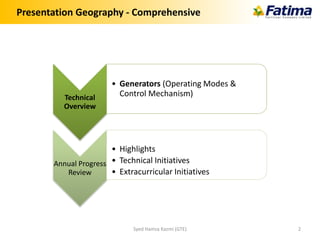
Technical
Overview
• Generators (Operating Modes &
Control Mechanism)
Annual Progress
Review
• Highlights
• Technical Initiatives
• Extracurricular Initiatives
Generators
Operating Modes & Control Mechanisms
Syed Hamza Kazmi (GTE) 3
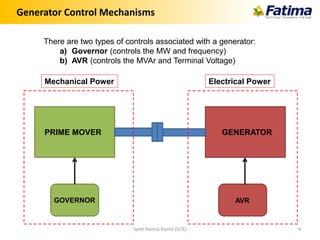
PRIME MOVER GENERATOR
GOVERNOR AVR
Generator Control Mechanisms
There are two types of controls associated with a generator:
a) Governor (controls the MW and frequency)
b) AVR (controls the MVAr and Terminal Voltage)
Syed Hamza Kazmi (GTE) 4
Mechanical Power Electrical Power
Presentation Geography
• In the next 25 minutes we shall go through the following:
Operating
Schemes
• Islanded Operating Scheme
• Parallel Operating Scheme
Governor
Control
• Droop Mode
• Isochronous Mode
• Case Studies (Practical Considerations)
Excitation
Control
• Fundamentals & Types
• Capability Diagrams & V-Curves
• Case Studies (Practical Considerations)
Syed Hamza Kazmi (GTE) 5
GENERATOR OPERATING SCHEMES
Brief description of control modes
Syed Hamza Kazmi (GTE) 6
Generator Operating Schemes
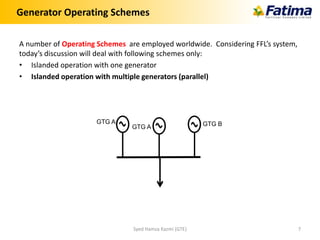
A number of Operating Schemes are employed worldwide. Considering FFL’s system,
today’s discussion will deal with following schemes only:
• Islanded operation with one generator
• Islanded operation with multiple generators (parallel)
Syed Hamza Kazmi (GTE) 7
GTG A GTG BGTG A
Syed Hamza Kazmi (GTE) 8
Operating Schemes
Islanded Operation with Single GTG
Islanded Operation (Single GTG)
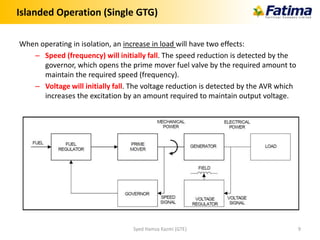
When operating in isolation, an increase in load will have two effects:
– Speed (frequency) will initially fall. The speed reduction is detected by the
governor, which opens the prime mover fuel valve by the required amount to
maintain the required speed (frequency).
– Voltage will initially fall. The voltage reduction is detected by the AVR which
increases the excitation by an amount required to maintain output voltage.
Syed Hamza Kazmi (GTE) 9
Syed Hamza Kazmi (GTE) 10
Operating Schemes
Islanded Operation with Multiple Sources
Parallel Operation
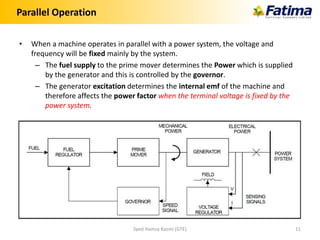
• When a machine operates in parallel with a power system, the voltage and
frequency will be fixed mainly by the system.
– The fuel supply to the prime mover determines the Power which is supplied
by the generator and this is controlled by the governor.
– The generator excitation determines the internal emf of the machine and
therefore affects the power factor when the terminal voltage is fixed by the
power system.
Syed Hamza Kazmi (GTE) 11
Points to Remember
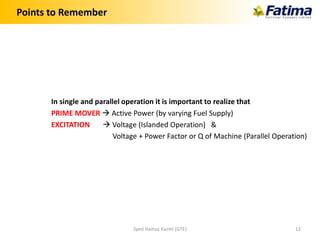
In single and parallel operation it is important to realize that
PRIME MOVER  Active Power (by varying Fuel Supply)
EXCITATION  Voltage (Islanded Operation) &
Voltage + Power Factor or Q of Machine (Parallel Operation)
Syed Hamza Kazmi (GTE) 12
GOVERNOR CONTROL
Modes of Operation, Case Studies and Practical Examples
Syed Hamza Kazmi (GTE) 13
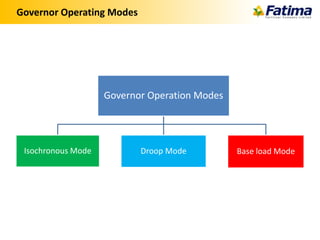
Governor Operating Modes
Governor Operation Modes
Isochronous Mode Droop Mode Base load Mode
Governor
Droop Mode
Syed Hamza Kazmi (GTE) 15
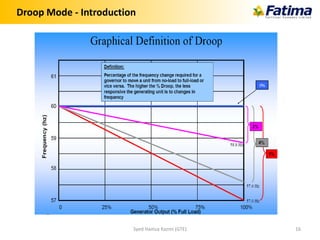
Droop Mode - Introduction
What does a droop of 3, 4 or 5% indicate ?
Syed Hamza Kazmi (GTE) 16
The percentage of frequency change required to move a
unit from no-load to full load is called Percentage Droop
Droop Mode - Explanation
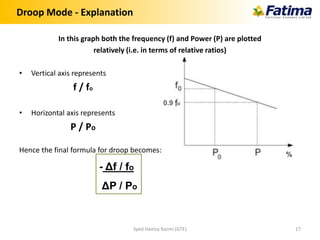
In this graph both the frequency (f) and Power (P) are plotted
relatively (i.e. in terms of relative ratios)
• Vertical axis represents
f / fo
• Horizontal axis represents
P / Po
Hence the final formula for droop becomes:
0.9 o
%
- Δf / fo
ΔP / Po
Syed Hamza Kazmi (GTE) 17
Droop Mode – Explanation (Contd…)
• Droop of 4 % :
– A change in 25% of the rated load of the machine results in a change of 1% in
its rated speed (Frequency)
– A change in 100% of the rated load of the machine results in a change of 4%
in its rated speed (Frequency)
– A 4 % change in frequency, means
• 50 Hz x 0.04 = 2 Hz or for a 4 pole generator, 1500 rpm x 0.04 = 60 rpm.
50 Hz
f [%]
60 rpm, 2Hz or
4%
P [%]
100%
Syed Hamza Kazmi (GTE) 18
Droop Mode – Explanation (Contd…)
• Droop of 5 % :
– A change in 20% of the rated load of the machine results in a change of 1% in
its rated speed (Frequency)
– A change in 100% of the rated load of the machine results in a change of 5%
in its rated speed (Frequency)
– A 5 % change in frequency, means
• 50 Hz x 0.05 = 2.5 Hz or for a 4 pole generator, 1500 rpm x 0.05 = 75 rpm.
50 Hz
f [%]
75 rpm, 2.5Hz
or 5%
P [%]
100%
Syed Hamza Kazmi (GTE) 19
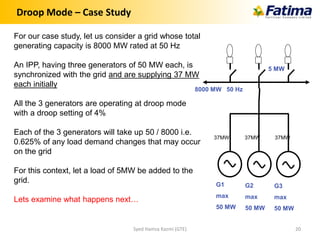
Droop Mode – Case Study
8000 MW 50 Hz
G1
max
50 MW
G2
max
50 MW
G3
max
50 MW
For our case study, let us consider a grid whose total
generating capacity is 8000 MW rated at 50 Hz
An IPP, having three generators of 50 MW each, is
synchronized with the grid and are supplying 37 MW
each initially
All the 3 generators are operating at droop mode
with a droop setting of 4%
Each of the 3 generators will take up 50 / 8000 i.e.
0.625% of any load demand changes that may occur
on the grid
For this context, let a load of 5MW be added to the
grid.
Lets examine what happens next…
5 MW
37MW 37MW 37MW
Syed Hamza Kazmi (GTE) 20
4%
4%
f [%]
P [%]
100%
RAISE LOWERRAISE
Droop Mode – Case Study
G1
max
50 MW
8000 MW 50 Hz
50 Hz
For any demand load, each generator must increase
50 MW / 8000 MW = 0.625% = 0.00625 of that demand
For 5 MW increase in demand
G1 = 0.00625 x 5 MW = 0.03125 MW  37.03125 MW
G2 = 0.00625 x (5- 0.03125) MW = 0.03105 MW  37.03105 MW
G3 = 0.00625 x (5- 0.03125- 0.03105) MW = 0.03086 MW  37.03086 MW
G2
max
50 MW
G3
max
50 MW
37 MW 37 MW 37 MW
What happens to frequency ?
50 Hz - (0.04 x 50 Hz x 5 MW / 8000 MW) = 49.9987 Hz
How?
Lets revisit the formula we just studied
5 MW
OPERATOR
Syed Hamza Kazmi (GTE) 21
Governor
Isochronous Mode
Syed Hamza Kazmi (GTE) 22
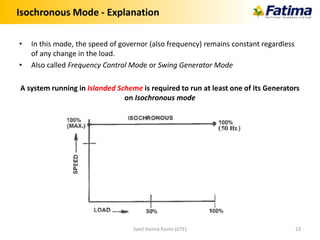
Isochronous Mode - Explanation
• In this mode, the speed of governor (also frequency) remains constant regardless
of any change in the load.
• Also called Frequency Control Mode or Swing Generator Mode
A system running in Islanded Scheme is required to run at least one of its Generators
on Isochronous mode
Syed Hamza Kazmi (GTE) 23
f [Hz]
P [%]
100%50%
RAISE LOWER
SP Regulator
RAISE
Isochronous Mode – Case Study
Referring to previous case, with one
of the three generators being
operated in Isoch mode
Syed Hamza Kazmi (GTE) 24
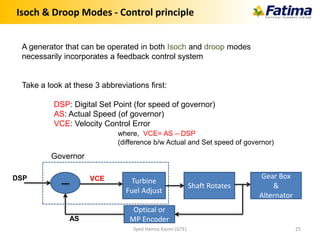
Isoch & Droop Modes - Control principle
A generator that can be operated in both Isoch and droop modes
necessarily incorporates a feedback control system
Take a look at these 3 abbreviations first:
DSP: Digital Set Point (for speed of governor)
AS: Actual Speed (of governor)
VCE: Velocity Control Error
where, VCE= AS – DSP
(difference b/w Actual and Set speed of governor)
Shaft Rotates
Turbine
Fuel Adjust
DSP VCE
Governor
Gear Box
&
Alternator
Optical or
MP EncoderAS
Syed Hamza Kazmi (GTE) 25
Isoch & Droop Modes - Control principle
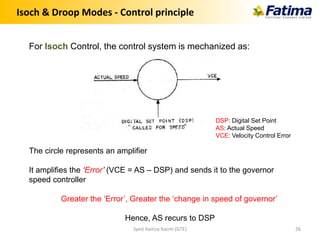
For Isoch Control, the control system is mechanized as:
DSP: Digital Set Point
AS: Actual Speed
VCE: Velocity Control Error
The circle represents an amplifier
It amplifies the ‘Error’ (VCE = AS – DSP) and sends it to the governor
speed controller
Greater the ‘Error’, Greater the ‘change in speed of governor’
Hence, AS recurs to DSP
Syed Hamza Kazmi (GTE) 26
Isoch & Droop Modes - Control principle
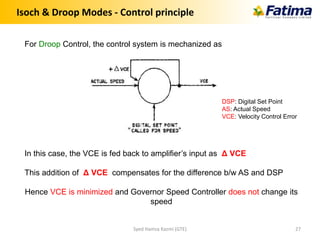
For Droop Control, the control system is mechanized as
In this case, the VCE is fed back to amplifier’s input as Δ VCE
This addition of Δ VCE compensates for the difference b/w AS and DSP
Hence VCE is minimized and Governor Speed Controller does not change its
speed
DSP: Digital Set Point
AS: Actual Speed
VCE: Velocity Control Error
Syed Hamza Kazmi (GTE) 27
Case Study
The Generation system at FFL is currently in Island Mode
Let us simplify the generation system by considering GTG-A & GTG-B only
Let the GTGs be rated to a capacity of 20 MW each which accounts to a total
generation capacity of 40 MW (considering STG is not being operated)
We shall discuss the following 3 cases:
Case 1: Both the GTGs are operated in Isoch mode
Case 2: Both the GTGs are operated in Droop mode
Case 3: GTG-A in Isoch mode & GTG-B in Droop mode
Syed Hamza Kazmi (GTE) 28
Case 1: Both the GTGs are operated in Isoch mode
Syed Hamza Kazmi (GTE) 29
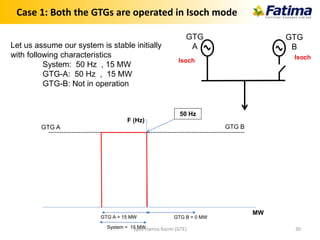
Case 1: Both the GTGs are operated in Isoch mode
Isoch
GTG
A
GTG
B
Isoch
Let us assume our system is stable initially
with following characteristics
System: 50 Hz , 15 MW
GTG-A: 50 Hz , 15 MW
GTG-B: Not in operation
GTG A GTG B
F (Hz)
MW
GTG B = 0 MWGTG A = 15 MW
System = 15 MW
50 Hz
Syed Hamza Kazmi (GTE) 30
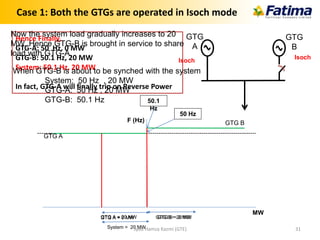
Hence Finally,
GTG-A: 50 Hz, 0 MW
GTG-B: 50.1 Hz, 20 MW
System: 50.1 Hz, 20 MW
In fact, GTG-A will finally trip on Reverse Power
Case 1: Both the GTGs are operated in Isoch mode
Isoch
GTG
A
GTG
B
Isoch
Now the system load gradually increases to 20
MW. Hence GTG-B is brought in service to share
load with GTG-A
GTG A
GTG BF (Hz)
MW
GTG B = 0 MWGTG A = 20 MW
System = 20 MW
GTG B = 20 MWGTG A = 0 MW
50 Hz
When GTG-B is about to be synched with the system
System: 50 Hz , 20 MW
GTG-A: 50 Hz , 20 MW
GTG-B: 50.1 Hz 50.1
Hz
Syed Hamza Kazmi (GTE) 31
Case 1: Both the GTGs are operated in Isoch mode
Explanation
Since frequency setting of GTG-B is above System’s frequency, it gains more
load and keeps on gaining until System’s frequency becomes equal to GTG-B
(which happens when GTG-B serves the entire load of the System)
Consecutively, GTG-A will loose its entire load while GTG-B begins to
feed the entire load. (GTG-A may reach the point of Reverse Power Trip
as well)
Conclusion
Since the frequency of the Incoming generator will be greater than that
of the system (for synchronism), this method of operation is strictly
unfeasible
Syed Hamza Kazmi (GTE) 32
Case 2: Both the GTGs are operated in Droop mode
Syed Hamza Kazmi (GTE) 33
Droop
GTG
A
GTG
B
Droop
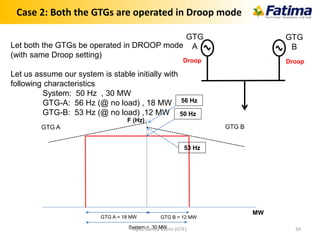
Let both the GTGs be operated in DROOP mode
(with same Droop setting)
Let us assume our system is stable initially with
following characteristics
System: 50 Hz , 30 MW
GTG-A: 56 Hz (@ no load) , 18 MW
GTG-B: 53 Hz (@ no load) ,12 MW
GTG A GTG B
F (Hz)
MW
GTG B = 12 MWGTG A = 18 MW
System = 30 MW
50 Hz
Case 2: Both the GTGs are operated in Droop mode
56 Hz
53 Hz
Syed Hamza Kazmi (GTE) 34
Droop
GTG
A
GTG
B
Droop
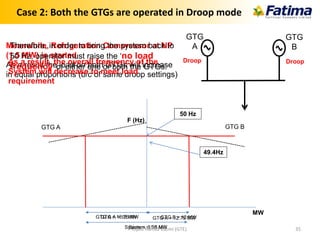
Meanwhile, Refrigeration Compressor at NP
(1.5 MW) is started
As a result the load on both GTGs will increase
in equal proportions (b/c of same droop settings)
GTG A GTG B
F (Hz)
MW
GTG B = 12 MWGTG A = 18 MW
System = 30 MW
50 Hz
Case 2: Both the GTGs are operated in Droop mode
GTG A = 18.75 MW GTG A = 12.75 MW
System = 31.5 MW
As a result, the overall frequency of the
System will decrease to meet load
requirement
49.4Hz
Therefore, in order to bring the system back to
50 Hz, operator must raise the ‘no load
frequency’ of either one or both the GTGs.
Syed Hamza Kazmi (GTE) 35
Case 2: Both the GTGs are operated in Droop mode
Explanation
In this case, an increase in system load will decrease its frequency
(operator will have to increase the ‘no load frequency set point’ of either
both GTGs or any one)
While, a decrease in system load will increase its frequency
(operator will have to decrease the ‘no load frequency set point’ of either
both GTGs or any one)
Conclusion
Hence, this method of operation is feasible in load stable systems
(where load doesn’t vary in large proportions). Otherwise continuous
load monitoring is necessary.
Syed Hamza Kazmi (GTE) 36
Case 3: GTG-A in Isoch mode & GTG-B in Droop mode
Syed Hamza Kazmi (GTE) 37
Droop
GTG
A
GTG
B
Isoch
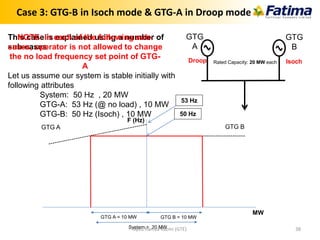
This case is explained using a number of
sub-cases
Let us assume our system is stable initially with
following attributes
System: 50 Hz , 20 MW
GTG-A: 53 Hz (@ no load) , 10 MW
GTG-B: 50 Hz (Isoch) , 10 MW
GTG A GTG B
F (Hz)
MW
GTG B = 10 MWGTG A = 10 MW
System = 20 MW
50 Hz
53 Hz
Case 3: GTG-B in Isoch mode & GTG-A in Droop mode
Rated Capacity: 20 MW each
NOTE: In each of the following sub-
cases, operator is not allowed to change
the no load frequency set point of GTG-
A
Syed Hamza Kazmi (GTE) 38
Droop
GTG
A
GTG
B
Isoch
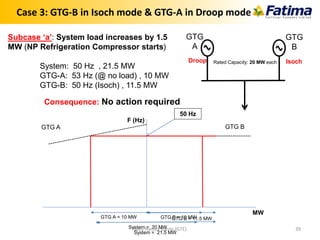
Subcase ‘a’: System load increases by 1.5
MW (NP Refrigeration Compressor starts)
System: 50 Hz , 21.5 MW
GTG-A: 53 Hz (@ no load) , 10 MW
GTG-B: 50 Hz (Isoch) , 11.5 MW
GTG A GTG B
F (Hz)
MW
GTG B = 10 MWGTG A = 10 MW
System = 20 MW
50 Hz
Case 3: GTG-B in Isoch mode & GTG-A in Droop mode
GTG B = 11.5 MW
System = 21.5 MW
Rated Capacity: 20 MW each
Consequence: No action required
Syed Hamza Kazmi (GTE) 39
Droop
GTG
A
GTG
B
Isoch
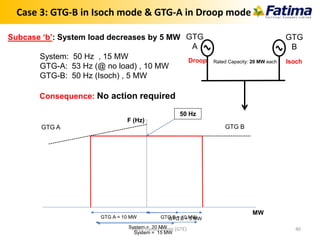
Subcase ‘b’: System load decreases by 5 MW
System: 50 Hz , 15 MW
GTG-A: 53 Hz (@ no load) , 10 MW
GTG-B: 50 Hz (Isoch) , 5 MW
GTG A GTG B
F (Hz)
MW
GTG B = 10 MWGTG A = 10 MW
System = 20 MW
50 Hz
Case 3: GTG-B in Isoch mode & GTG-A in Droop mode
GTG B = 5 MW
System = 15 MW
Rated Capacity: 20 MW each
Consequence: No action required
Syed Hamza Kazmi (GTE) 40
Droop
GTG
A
GTG
B
Isoch
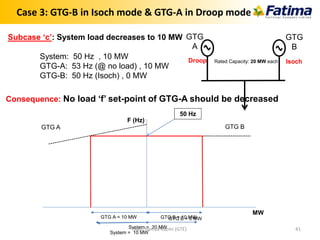
Subcase ‘c’: System load decreases to 10 MW
System: 50 Hz , 10 MW
GTG-A: 53 Hz (@ no load) , 10 MW
GTG-B: 50 Hz (Isoch) , 0 MW
GTG A GTG B
F (Hz)
MW
GTG B = 10 MWGTG A = 10 MW
System = 20 MW
50 Hz
Case 3: GTG-B in Isoch mode & GTG-A in Droop mode
GTG B = 0 MW
System = 10 MW
Consequence: No load ‘f’ set-point of GTG-A should be decreased
Rated Capacity: 20 MW each
Syed Hamza Kazmi (GTE) 41
Droop
GTG
A
GTG
B
Isoch
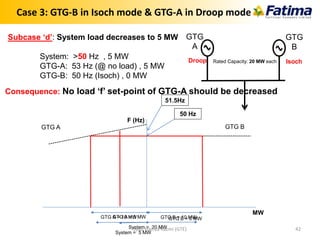
Subcase ‘d’: System load decreases to 5 MW
System: >50 Hz , 5 MW
GTG-A: 53 Hz (@ no load) , 5 MW
GTG-B: 50 Hz (Isoch) , 0 MW
GTG A GTG B
F (Hz)
MW
GTG B = 10 MWGTG A = 10 MW
System = 20 MW
50 Hz
Case 3: GTG-B in Isoch mode & GTG-A in Droop mode
GTG B = 0 MW
System = 5 MW
GTG A = 5 MW
51.5Hz
Consequence: No load ‘f’ set-point of GTG-A should be decreased
Rated Capacity: 20 MW each
Syed Hamza Kazmi (GTE) 42
Droop
GTG
A
GTG
B
Isoch
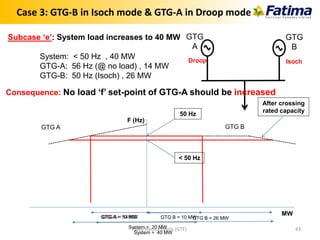
Subcase ‘e’: System load increases to 40 MW
System: < 50 Hz , 40 MW
GTG-A: 56 Hz (@ no load) , 14 MW
GTG-B: 50 Hz (Isoch) , 26 MW
GTG A GTG B
F (Hz)
MW
GTG B = 10 MWGTG A = 10 MW
System = 20 MW
50 Hz
Case 3: GTG-B in Isoch mode & GTG-A in Droop mode
GTG B = 26 MW
System = 40 MW
After crossing
rated capacity
GTG A = 14 MW
< 50 Hz
Consequence: No load ‘f’ set-point of GTG-A should be increased
Syed Hamza Kazmi (GTE) 43
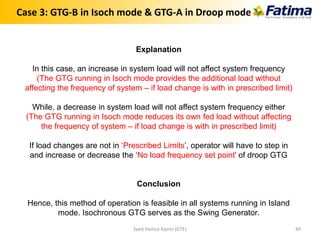
Explanation
In this case, an increase in system load will not affect system frequency
(The GTG running in Isoch mode provides the additional load without
affecting the frequency of system – if load change is with in prescribed limit)
While, a decrease in system load will not affect system frequency either
(The GTG running in Isoch mode reduces its own fed load without affecting
the frequency of system – if load change is with in prescribed limit)
If load changes are not in ‘Prescribed Limits’, operator will have to step in
and increase or decrease the ‘No load frequency set point’ of droop GTG
Conclusion
Hence, this method of operation is feasible in all systems running in Island
mode. Isochronous GTG serves as the Swing Generator.
Case 3: GTG-B in Isoch mode & GTG-A in Droop mode
Syed Hamza Kazmi (GTE) 44
EXCITATION CONTROL
Control Functions, Types, Capability Curves & Case Study
Syed Hamza Kazmi (GTE) 45
Functions of Excitation Systems
Syed Hamza Kazmi (GTE) 46
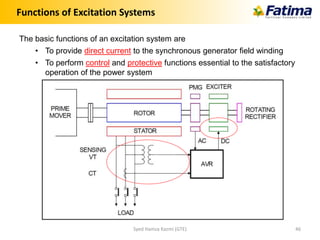
The basic functions of an excitation system are
• To provide direct current to the synchronous generator field winding
• To perform control and protective functions essential to the satisfactory
operation of the power system
Performance Requirements of AVR
Syed Hamza Kazmi (GTE) 47
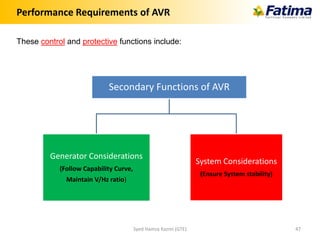
These control and protective functions include:
Secondary Functions of AVR
Generator Considerations
(Follow Capability Curve,
Maintain V/Hz ratio)
System Considerations
(Ensure System stability)
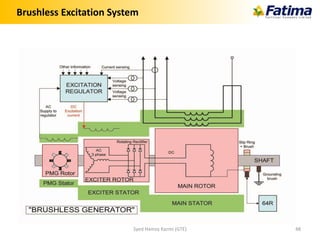
Brushless Excitation System
Syed Hamza Kazmi (GTE) 48
AVR Operation Principle
Syed Hamza Kazmi (GTE) 49
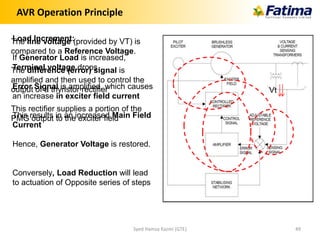
The line voltage (provided by VT) is
compared to a Reference Voltage.
The difference (error) signal is
amplified and then used to control the
output of a thyristor rectifier
This rectifier supplies a portion of the
PMG output to the exciter field
Load Increment:
If Generator Load is increased,
Terminal voltage drops.
Error Signal is amplified, which causes
an increase in exciter field current
This results in an increased Main Field
Current
Hence, Generator Voltage is restored.
Conversely, Load Reduction will lead
to actuation of Opposite series of steps
Vt
AVR Operation Principle – Parallel Scheme
Syed Hamza Kazmi (GTE) 50
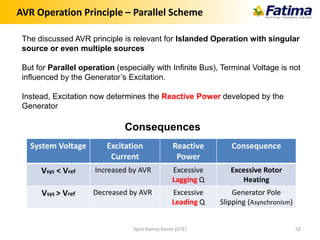
The discussed AVR principle is relevant for Islanded Operation with singular
source or even multiple sources
But for Parallel operation (especially with Infinite Bus), Terminal Voltage is not
influenced by the Generator’s Excitation.
Instead, Excitation now determines the Reactive Power developed by the
Generator
Consequences
System Voltage Excitation
Current
Reactive
Power
Consequence
Vsys < Vref Increased by AVR Excessive
Lagging Q
Excessive Rotor
Heating
Vsys > Vref Decreased by AVR Excessive
Leading Q
Generator Pole
Slipping (Asynchronism)
AVR Operation Principle - QCC
Syed Hamza Kazmi (GTE) 51
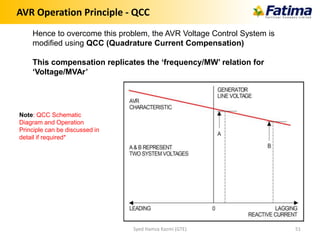
Hence to overcome this problem, the AVR Voltage Control System is
modified using QCC (Quadrature Current Compensation)
This compensation replicates the ‘frequency/MW’ relation for
‘Voltage/MVAr’
Note: QCC Schematic
Diagram and Operation
Principle can be discussed in
detail if required*
QCC Operation (Islanded Scheme with Multiple
Machines)
Syed Hamza Kazmi (GTE) 52
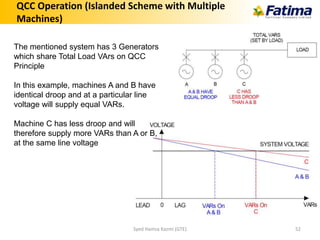
The mentioned system has 3 Generators
which share Total Load VArs on QCC
Principle
In this example, machines A and B have
identical droop and at a particular line
voltage will supply equal VARs.
Machine C has less droop and will
therefore supply more VARs than A or B,
at the same line voltage
Practical Experiment
Comprehensive Governor & Excitation
Response
Syed Hamza Kazmi (GTE) 53
Comprehensive Governor & Excitation Behavior
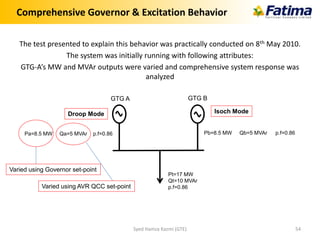
The test presented to explain this behavior was practically conducted on 8th May 2010.
The system was initially running with following attributes:
GTG-A’s MW and MVAr outputs were varied and comprehensive system response was
analyzed
Syed Hamza Kazmi (GTE) 54
GTG A GTG B
Pa=8.5 MW Qa=5 MVAr p.f=0.86 Pb=8.5 MW Qb=5 MVAr p.f=0.86
Pt=17 MW
Qt=10 MVAr
p.f=0.86
Isoch ModeDroop Mode
Varied using Governor set-point
Varied using AVR QCC set-point
Comprehensive Governor & Excitation Behavior
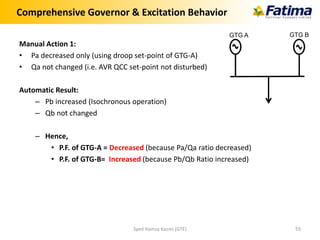
Manual Action 1:
• Pa decreased only (using droop set-point of GTG-A)
• Qa not changed (i.e. AVR QCC set-point not disturbed)
Automatic Result:
– Pb increased (Isochronous operation)
– Qb not changed
– Hence,
• P.F. of GTG-A = Decreased (because Pa/Qa ratio decreased)
• P.F. of GTG-B= Increased (because Pb/Qb Ratio increased)
Syed Hamza Kazmi (GTE) 55
GTG A GTG B
Comprehensive Governor & Excitation Behavior
Syed Hamza Kazmi (GTE) 56
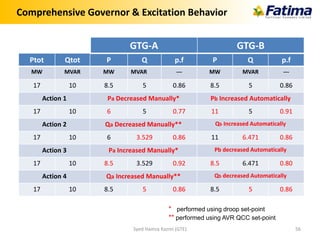
Ptot Qtot P Q p.f P Q p.f
MW MVAR MW MVAR --- MW MVAR ---
17 10 8.5 5 0.86 8.5 5 0.86
Action 1 Pa Decreased Manually* Pb Increased Automatically
17 10 6 5 0.77 11 5 0.91
Action 2 Qa Decreased Manually** Qb Increased Automatically
17 10 6 3.529 0.86 11 6.471 0.86
Action 3 Pa Increased Manually* Pb decreased Automatically
17 10 8.5 3.529 0.92 8.5 6.471 0.80
Action 4 Qa Increased Manually** Qb decreased Automatically
17 10 8.5 5 0.86 8.5 5 0.86
GTG-A GTG-B
* performed using droop set-point
** performed using AVR QCC set-point
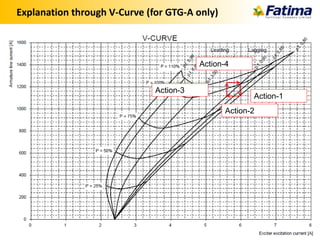
Explanation through V-Curve (for GTG-A only)
Syed Hamza Kazmi (GTE) 57
Action-1
Action-2
Action-3
Action-4
CAPABILITY CURVE
Generator Limitations,
Syed Hamza Kazmi (GTE) 58
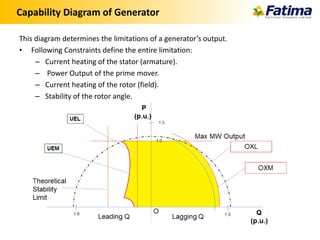
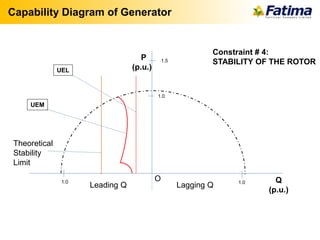
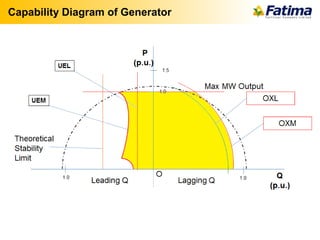
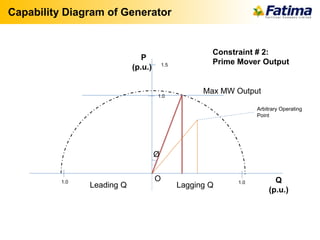
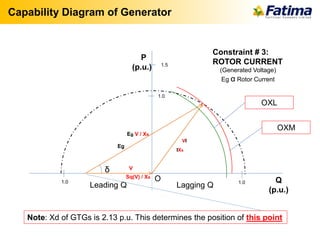
Capability Diagram of Generator
This diagram determines the limitations of a generator’s output.
• Following Constraints define the entire limitation:
– Current heating of the stator (armature).
– Power Output of the prime mover.
– Current heating of the rotor (field).
– Stability of the rotor angle.
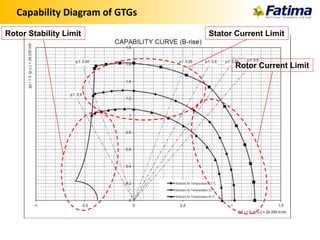
Capability Diagram of GTGs
Stator Current Limit
Rotor Current Limit
Rotor Stability Limit
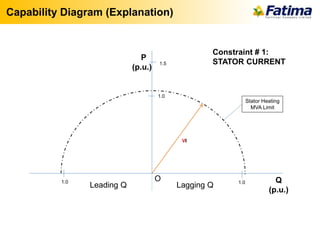
Capability Diagram (Explanation)
P
(p.u.)
Q
(p.u.)
Lagging QLeading Q
Constraint # 1:
STATOR CURRENT
1.0
1.5
1.01.0 O
VI
Stator Heating
MVA Limit
Ø
P
(p.u.)
Q
(p.u.)
Lagging QLeading Q
Constraint # 2:
Prime Mover Output1.5
O
1.0
1.01.0
Max MW Output
Arbitrary Operating
Point
Capability Diagram of Generator
P
(p.u.)
Q
(p.u.)
Lagging QLeading Q
Constraint # 3:
ROTOR CURRENT
(Generated Voltage)
Eg α Rotor Current
1.5
O
1.0
1.01.0
VI
Eg V / Xs
Sq(V) / Xs
ᵟ
Capability Diagram of Generator
IXs
Eg
V
OXL
OXM
Note: Xd of GTGs is 2.13 p.u. This determines the position of this point
P
(p.u.)
Q
(p.u.)
Lagging QLeading Q
Constraint # 4:
STABILITY OF THE ROTOR1.5
O
1.0
1.01.0
Capability Diagram of Generator
UEL
UEM
Theoretical
Stability
Limit
P
(p.u.)
Q
(p.u.)
Lagging QLeading Q
1.5
O
1.0
1.01.0
Capability Diagram of Generator
OXL
OXM
UEL
UEM
Theoretical
Stability
Limit
Max MW Output
Queries?
Syed Hamza Kazmi (GTE) 66
Thank you !
Syed Hamza Kazmi (GTE) 67

Hamza Kazmi (GTE)

  • 1.
    Syed Hamza Kazmi GTE– Electrical Batch 11 FINAL PRESENTATION Syed Hamza Kazmi (GTE) 1
  • 2.
    Presentation Geography -Comprehensive Syed Hamza Kazmi (GTE) 2 Technical Overview • Generators (Operating Modes & Control Mechanism) Annual Progress Review • Highlights • Technical Initiatives • Extracurricular Initiatives
  • 3.
    Generators Operating Modes &Control Mechanisms Syed Hamza Kazmi (GTE) 3
  • 4.
    PRIME MOVER GENERATOR GOVERNORAVR Generator Control Mechanisms There are two types of controls associated with a generator: a) Governor (controls the MW and frequency) b) AVR (controls the MVAr and Terminal Voltage) Syed Hamza Kazmi (GTE) 4 Mechanical Power Electrical Power
  • 5.
    Presentation Geography • Inthe next 25 minutes we shall go through the following: Operating Schemes • Islanded Operating Scheme • Parallel Operating Scheme Governor Control • Droop Mode • Isochronous Mode • Case Studies (Practical Considerations) Excitation Control • Fundamentals & Types • Capability Diagrams & V-Curves • Case Studies (Practical Considerations) Syed Hamza Kazmi (GTE) 5
  • 6.
    GENERATOR OPERATING SCHEMES Briefdescription of control modes Syed Hamza Kazmi (GTE) 6
  • 7.
    Generator Operating Schemes Anumber of Operating Schemes are employed worldwide. Considering FFL’s system, today’s discussion will deal with following schemes only: • Islanded operation with one generator • Islanded operation with multiple generators (parallel) Syed Hamza Kazmi (GTE) 7 GTG A GTG BGTG A
  • 8.
    Syed Hamza Kazmi(GTE) 8 Operating Schemes Islanded Operation with Single GTG
  • 9.
    Islanded Operation (SingleGTG) When operating in isolation, an increase in load will have two effects: – Speed (frequency) will initially fall. The speed reduction is detected by the governor, which opens the prime mover fuel valve by the required amount to maintain the required speed (frequency). – Voltage will initially fall. The voltage reduction is detected by the AVR which increases the excitation by an amount required to maintain output voltage. Syed Hamza Kazmi (GTE) 9
  • 10.
    Syed Hamza Kazmi(GTE) 10 Operating Schemes Islanded Operation with Multiple Sources
  • 11.
    Parallel Operation • Whena machine operates in parallel with a power system, the voltage and frequency will be fixed mainly by the system. – The fuel supply to the prime mover determines the Power which is supplied by the generator and this is controlled by the governor. – The generator excitation determines the internal emf of the machine and therefore affects the power factor when the terminal voltage is fixed by the power system. Syed Hamza Kazmi (GTE) 11
  • 12.
    Points to Remember Insingle and parallel operation it is important to realize that PRIME MOVER  Active Power (by varying Fuel Supply) EXCITATION  Voltage (Islanded Operation) & Voltage + Power Factor or Q of Machine (Parallel Operation) Syed Hamza Kazmi (GTE) 12
  • 13.
    GOVERNOR CONTROL Modes ofOperation, Case Studies and Practical Examples Syed Hamza Kazmi (GTE) 13
  • 14.
    Governor Operating Modes GovernorOperation Modes Isochronous Mode Droop Mode Base load Mode
  • 15.
  • 16.
    Droop Mode -Introduction What does a droop of 3, 4 or 5% indicate ? Syed Hamza Kazmi (GTE) 16 The percentage of frequency change required to move a unit from no-load to full load is called Percentage Droop
  • 17.
    Droop Mode -Explanation In this graph both the frequency (f) and Power (P) are plotted relatively (i.e. in terms of relative ratios) • Vertical axis represents f / fo • Horizontal axis represents P / Po Hence the final formula for droop becomes: 0.9 o % - Δf / fo ΔP / Po Syed Hamza Kazmi (GTE) 17
  • 18.
    Droop Mode –Explanation (Contd…) • Droop of 4 % : – A change in 25% of the rated load of the machine results in a change of 1% in its rated speed (Frequency) – A change in 100% of the rated load of the machine results in a change of 4% in its rated speed (Frequency) – A 4 % change in frequency, means • 50 Hz x 0.04 = 2 Hz or for a 4 pole generator, 1500 rpm x 0.04 = 60 rpm. 50 Hz f [%] 60 rpm, 2Hz or 4% P [%] 100% Syed Hamza Kazmi (GTE) 18
  • 19.
    Droop Mode –Explanation (Contd…) • Droop of 5 % : – A change in 20% of the rated load of the machine results in a change of 1% in its rated speed (Frequency) – A change in 100% of the rated load of the machine results in a change of 5% in its rated speed (Frequency) – A 5 % change in frequency, means • 50 Hz x 0.05 = 2.5 Hz or for a 4 pole generator, 1500 rpm x 0.05 = 75 rpm. 50 Hz f [%] 75 rpm, 2.5Hz or 5% P [%] 100% Syed Hamza Kazmi (GTE) 19
  • 20.
    Droop Mode –Case Study 8000 MW 50 Hz G1 max 50 MW G2 max 50 MW G3 max 50 MW For our case study, let us consider a grid whose total generating capacity is 8000 MW rated at 50 Hz An IPP, having three generators of 50 MW each, is synchronized with the grid and are supplying 37 MW each initially All the 3 generators are operating at droop mode with a droop setting of 4% Each of the 3 generators will take up 50 / 8000 i.e. 0.625% of any load demand changes that may occur on the grid For this context, let a load of 5MW be added to the grid. Lets examine what happens next… 5 MW 37MW 37MW 37MW Syed Hamza Kazmi (GTE) 20
  • 21.
    4% 4% f [%] P [%] 100% RAISELOWERRAISE Droop Mode – Case Study G1 max 50 MW 8000 MW 50 Hz 50 Hz For any demand load, each generator must increase 50 MW / 8000 MW = 0.625% = 0.00625 of that demand For 5 MW increase in demand G1 = 0.00625 x 5 MW = 0.03125 MW  37.03125 MW G2 = 0.00625 x (5- 0.03125) MW = 0.03105 MW  37.03105 MW G3 = 0.00625 x (5- 0.03125- 0.03105) MW = 0.03086 MW  37.03086 MW G2 max 50 MW G3 max 50 MW 37 MW 37 MW 37 MW What happens to frequency ? 50 Hz - (0.04 x 50 Hz x 5 MW / 8000 MW) = 49.9987 Hz How? Lets revisit the formula we just studied 5 MW OPERATOR Syed Hamza Kazmi (GTE) 21
  • 22.
  • 23.
    Isochronous Mode -Explanation • In this mode, the speed of governor (also frequency) remains constant regardless of any change in the load. • Also called Frequency Control Mode or Swing Generator Mode A system running in Islanded Scheme is required to run at least one of its Generators on Isochronous mode Syed Hamza Kazmi (GTE) 23
  • 24.
    f [Hz] P [%] 100%50% RAISELOWER SP Regulator RAISE Isochronous Mode – Case Study Referring to previous case, with one of the three generators being operated in Isoch mode Syed Hamza Kazmi (GTE) 24
  • 25.
    Isoch & DroopModes - Control principle A generator that can be operated in both Isoch and droop modes necessarily incorporates a feedback control system Take a look at these 3 abbreviations first: DSP: Digital Set Point (for speed of governor) AS: Actual Speed (of governor) VCE: Velocity Control Error where, VCE= AS – DSP (difference b/w Actual and Set speed of governor) Shaft Rotates Turbine Fuel Adjust DSP VCE Governor Gear Box & Alternator Optical or MP EncoderAS Syed Hamza Kazmi (GTE) 25
  • 26.
    Isoch & DroopModes - Control principle For Isoch Control, the control system is mechanized as: DSP: Digital Set Point AS: Actual Speed VCE: Velocity Control Error The circle represents an amplifier It amplifies the ‘Error’ (VCE = AS – DSP) and sends it to the governor speed controller Greater the ‘Error’, Greater the ‘change in speed of governor’ Hence, AS recurs to DSP Syed Hamza Kazmi (GTE) 26
  • 27.
    Isoch & DroopModes - Control principle For Droop Control, the control system is mechanized as In this case, the VCE is fed back to amplifier’s input as Δ VCE This addition of Δ VCE compensates for the difference b/w AS and DSP Hence VCE is minimized and Governor Speed Controller does not change its speed DSP: Digital Set Point AS: Actual Speed VCE: Velocity Control Error Syed Hamza Kazmi (GTE) 27
  • 28.
    Case Study The Generationsystem at FFL is currently in Island Mode Let us simplify the generation system by considering GTG-A & GTG-B only Let the GTGs be rated to a capacity of 20 MW each which accounts to a total generation capacity of 40 MW (considering STG is not being operated) We shall discuss the following 3 cases: Case 1: Both the GTGs are operated in Isoch mode Case 2: Both the GTGs are operated in Droop mode Case 3: GTG-A in Isoch mode & GTG-B in Droop mode Syed Hamza Kazmi (GTE) 28
  • 29.
    Case 1: Boththe GTGs are operated in Isoch mode Syed Hamza Kazmi (GTE) 29
  • 30.
    Case 1: Boththe GTGs are operated in Isoch mode Isoch GTG A GTG B Isoch Let us assume our system is stable initially with following characteristics System: 50 Hz , 15 MW GTG-A: 50 Hz , 15 MW GTG-B: Not in operation GTG A GTG B F (Hz) MW GTG B = 0 MWGTG A = 15 MW System = 15 MW 50 Hz Syed Hamza Kazmi (GTE) 30
  • 31.
    Hence Finally, GTG-A: 50Hz, 0 MW GTG-B: 50.1 Hz, 20 MW System: 50.1 Hz, 20 MW In fact, GTG-A will finally trip on Reverse Power Case 1: Both the GTGs are operated in Isoch mode Isoch GTG A GTG B Isoch Now the system load gradually increases to 20 MW. Hence GTG-B is brought in service to share load with GTG-A GTG A GTG BF (Hz) MW GTG B = 0 MWGTG A = 20 MW System = 20 MW GTG B = 20 MWGTG A = 0 MW 50 Hz When GTG-B is about to be synched with the system System: 50 Hz , 20 MW GTG-A: 50 Hz , 20 MW GTG-B: 50.1 Hz 50.1 Hz Syed Hamza Kazmi (GTE) 31
  • 32.
    Case 1: Boththe GTGs are operated in Isoch mode Explanation Since frequency setting of GTG-B is above System’s frequency, it gains more load and keeps on gaining until System’s frequency becomes equal to GTG-B (which happens when GTG-B serves the entire load of the System) Consecutively, GTG-A will loose its entire load while GTG-B begins to feed the entire load. (GTG-A may reach the point of Reverse Power Trip as well) Conclusion Since the frequency of the Incoming generator will be greater than that of the system (for synchronism), this method of operation is strictly unfeasible Syed Hamza Kazmi (GTE) 32
  • 33.
    Case 2: Boththe GTGs are operated in Droop mode Syed Hamza Kazmi (GTE) 33
  • 34.
    Droop GTG A GTG B Droop Let both theGTGs be operated in DROOP mode (with same Droop setting) Let us assume our system is stable initially with following characteristics System: 50 Hz , 30 MW GTG-A: 56 Hz (@ no load) , 18 MW GTG-B: 53 Hz (@ no load) ,12 MW GTG A GTG B F (Hz) MW GTG B = 12 MWGTG A = 18 MW System = 30 MW 50 Hz Case 2: Both the GTGs are operated in Droop mode 56 Hz 53 Hz Syed Hamza Kazmi (GTE) 34
  • 35.
    Droop GTG A GTG B Droop Meanwhile, Refrigeration Compressorat NP (1.5 MW) is started As a result the load on both GTGs will increase in equal proportions (b/c of same droop settings) GTG A GTG B F (Hz) MW GTG B = 12 MWGTG A = 18 MW System = 30 MW 50 Hz Case 2: Both the GTGs are operated in Droop mode GTG A = 18.75 MW GTG A = 12.75 MW System = 31.5 MW As a result, the overall frequency of the System will decrease to meet load requirement 49.4Hz Therefore, in order to bring the system back to 50 Hz, operator must raise the ‘no load frequency’ of either one or both the GTGs. Syed Hamza Kazmi (GTE) 35
  • 36.
    Case 2: Boththe GTGs are operated in Droop mode Explanation In this case, an increase in system load will decrease its frequency (operator will have to increase the ‘no load frequency set point’ of either both GTGs or any one) While, a decrease in system load will increase its frequency (operator will have to decrease the ‘no load frequency set point’ of either both GTGs or any one) Conclusion Hence, this method of operation is feasible in load stable systems (where load doesn’t vary in large proportions). Otherwise continuous load monitoring is necessary. Syed Hamza Kazmi (GTE) 36
  • 37.
    Case 3: GTG-Ain Isoch mode & GTG-B in Droop mode Syed Hamza Kazmi (GTE) 37
  • 38.
    Droop GTG A GTG B Isoch This case isexplained using a number of sub-cases Let us assume our system is stable initially with following attributes System: 50 Hz , 20 MW GTG-A: 53 Hz (@ no load) , 10 MW GTG-B: 50 Hz (Isoch) , 10 MW GTG A GTG B F (Hz) MW GTG B = 10 MWGTG A = 10 MW System = 20 MW 50 Hz 53 Hz Case 3: GTG-B in Isoch mode & GTG-A in Droop mode Rated Capacity: 20 MW each NOTE: In each of the following sub- cases, operator is not allowed to change the no load frequency set point of GTG- A Syed Hamza Kazmi (GTE) 38
  • 39.
    Droop GTG A GTG B Isoch Subcase ‘a’: Systemload increases by 1.5 MW (NP Refrigeration Compressor starts) System: 50 Hz , 21.5 MW GTG-A: 53 Hz (@ no load) , 10 MW GTG-B: 50 Hz (Isoch) , 11.5 MW GTG A GTG B F (Hz) MW GTG B = 10 MWGTG A = 10 MW System = 20 MW 50 Hz Case 3: GTG-B in Isoch mode & GTG-A in Droop mode GTG B = 11.5 MW System = 21.5 MW Rated Capacity: 20 MW each Consequence: No action required Syed Hamza Kazmi (GTE) 39
  • 40.
    Droop GTG A GTG B Isoch Subcase ‘b’: Systemload decreases by 5 MW System: 50 Hz , 15 MW GTG-A: 53 Hz (@ no load) , 10 MW GTG-B: 50 Hz (Isoch) , 5 MW GTG A GTG B F (Hz) MW GTG B = 10 MWGTG A = 10 MW System = 20 MW 50 Hz Case 3: GTG-B in Isoch mode & GTG-A in Droop mode GTG B = 5 MW System = 15 MW Rated Capacity: 20 MW each Consequence: No action required Syed Hamza Kazmi (GTE) 40
  • 41.
    Droop GTG A GTG B Isoch Subcase ‘c’: Systemload decreases to 10 MW System: 50 Hz , 10 MW GTG-A: 53 Hz (@ no load) , 10 MW GTG-B: 50 Hz (Isoch) , 0 MW GTG A GTG B F (Hz) MW GTG B = 10 MWGTG A = 10 MW System = 20 MW 50 Hz Case 3: GTG-B in Isoch mode & GTG-A in Droop mode GTG B = 0 MW System = 10 MW Consequence: No load ‘f’ set-point of GTG-A should be decreased Rated Capacity: 20 MW each Syed Hamza Kazmi (GTE) 41
  • 42.
    Droop GTG A GTG B Isoch Subcase ‘d’: Systemload decreases to 5 MW System: >50 Hz , 5 MW GTG-A: 53 Hz (@ no load) , 5 MW GTG-B: 50 Hz (Isoch) , 0 MW GTG A GTG B F (Hz) MW GTG B = 10 MWGTG A = 10 MW System = 20 MW 50 Hz Case 3: GTG-B in Isoch mode & GTG-A in Droop mode GTG B = 0 MW System = 5 MW GTG A = 5 MW 51.5Hz Consequence: No load ‘f’ set-point of GTG-A should be decreased Rated Capacity: 20 MW each Syed Hamza Kazmi (GTE) 42
  • 43.
    Droop GTG A GTG B Isoch Subcase ‘e’: Systemload increases to 40 MW System: < 50 Hz , 40 MW GTG-A: 56 Hz (@ no load) , 14 MW GTG-B: 50 Hz (Isoch) , 26 MW GTG A GTG B F (Hz) MW GTG B = 10 MWGTG A = 10 MW System = 20 MW 50 Hz Case 3: GTG-B in Isoch mode & GTG-A in Droop mode GTG B = 26 MW System = 40 MW After crossing rated capacity GTG A = 14 MW < 50 Hz Consequence: No load ‘f’ set-point of GTG-A should be increased Syed Hamza Kazmi (GTE) 43
  • 44.
    Explanation In this case,an increase in system load will not affect system frequency (The GTG running in Isoch mode provides the additional load without affecting the frequency of system – if load change is with in prescribed limit) While, a decrease in system load will not affect system frequency either (The GTG running in Isoch mode reduces its own fed load without affecting the frequency of system – if load change is with in prescribed limit) If load changes are not in ‘Prescribed Limits’, operator will have to step in and increase or decrease the ‘No load frequency set point’ of droop GTG Conclusion Hence, this method of operation is feasible in all systems running in Island mode. Isochronous GTG serves as the Swing Generator. Case 3: GTG-B in Isoch mode & GTG-A in Droop mode Syed Hamza Kazmi (GTE) 44
  • 45.
    EXCITATION CONTROL Control Functions,Types, Capability Curves & Case Study Syed Hamza Kazmi (GTE) 45
  • 46.
    Functions of ExcitationSystems Syed Hamza Kazmi (GTE) 46 The basic functions of an excitation system are • To provide direct current to the synchronous generator field winding • To perform control and protective functions essential to the satisfactory operation of the power system
  • 47.
    Performance Requirements ofAVR Syed Hamza Kazmi (GTE) 47 These control and protective functions include: Secondary Functions of AVR Generator Considerations (Follow Capability Curve, Maintain V/Hz ratio) System Considerations (Ensure System stability)
  • 48.
  • 49.
    AVR Operation Principle SyedHamza Kazmi (GTE) 49 The line voltage (provided by VT) is compared to a Reference Voltage. The difference (error) signal is amplified and then used to control the output of a thyristor rectifier This rectifier supplies a portion of the PMG output to the exciter field Load Increment: If Generator Load is increased, Terminal voltage drops. Error Signal is amplified, which causes an increase in exciter field current This results in an increased Main Field Current Hence, Generator Voltage is restored. Conversely, Load Reduction will lead to actuation of Opposite series of steps Vt
  • 50.
    AVR Operation Principle– Parallel Scheme Syed Hamza Kazmi (GTE) 50 The discussed AVR principle is relevant for Islanded Operation with singular source or even multiple sources But for Parallel operation (especially with Infinite Bus), Terminal Voltage is not influenced by the Generator’s Excitation. Instead, Excitation now determines the Reactive Power developed by the Generator Consequences System Voltage Excitation Current Reactive Power Consequence Vsys < Vref Increased by AVR Excessive Lagging Q Excessive Rotor Heating Vsys > Vref Decreased by AVR Excessive Leading Q Generator Pole Slipping (Asynchronism)
  • 51.
    AVR Operation Principle- QCC Syed Hamza Kazmi (GTE) 51 Hence to overcome this problem, the AVR Voltage Control System is modified using QCC (Quadrature Current Compensation) This compensation replicates the ‘frequency/MW’ relation for ‘Voltage/MVAr’ Note: QCC Schematic Diagram and Operation Principle can be discussed in detail if required*
  • 52.
    QCC Operation (IslandedScheme with Multiple Machines) Syed Hamza Kazmi (GTE) 52 The mentioned system has 3 Generators which share Total Load VArs on QCC Principle In this example, machines A and B have identical droop and at a particular line voltage will supply equal VARs. Machine C has less droop and will therefore supply more VARs than A or B, at the same line voltage
  • 53.
    Practical Experiment Comprehensive Governor& Excitation Response Syed Hamza Kazmi (GTE) 53
  • 54.
    Comprehensive Governor &Excitation Behavior The test presented to explain this behavior was practically conducted on 8th May 2010. The system was initially running with following attributes: GTG-A’s MW and MVAr outputs were varied and comprehensive system response was analyzed Syed Hamza Kazmi (GTE) 54 GTG A GTG B Pa=8.5 MW Qa=5 MVAr p.f=0.86 Pb=8.5 MW Qb=5 MVAr p.f=0.86 Pt=17 MW Qt=10 MVAr p.f=0.86 Isoch ModeDroop Mode Varied using Governor set-point Varied using AVR QCC set-point
  • 55.
    Comprehensive Governor &Excitation Behavior Manual Action 1: • Pa decreased only (using droop set-point of GTG-A) • Qa not changed (i.e. AVR QCC set-point not disturbed) Automatic Result: – Pb increased (Isochronous operation) – Qb not changed – Hence, • P.F. of GTG-A = Decreased (because Pa/Qa ratio decreased) • P.F. of GTG-B= Increased (because Pb/Qb Ratio increased) Syed Hamza Kazmi (GTE) 55 GTG A GTG B
  • 56.
    Comprehensive Governor &Excitation Behavior Syed Hamza Kazmi (GTE) 56 Ptot Qtot P Q p.f P Q p.f MW MVAR MW MVAR --- MW MVAR --- 17 10 8.5 5 0.86 8.5 5 0.86 Action 1 Pa Decreased Manually* Pb Increased Automatically 17 10 6 5 0.77 11 5 0.91 Action 2 Qa Decreased Manually** Qb Increased Automatically 17 10 6 3.529 0.86 11 6.471 0.86 Action 3 Pa Increased Manually* Pb decreased Automatically 17 10 8.5 3.529 0.92 8.5 6.471 0.80 Action 4 Qa Increased Manually** Qb decreased Automatically 17 10 8.5 5 0.86 8.5 5 0.86 GTG-A GTG-B * performed using droop set-point ** performed using AVR QCC set-point
  • 57.
    Explanation through V-Curve(for GTG-A only) Syed Hamza Kazmi (GTE) 57 Action-1 Action-2 Action-3 Action-4
  • 58.
  • 59.
    Capability Diagram ofGenerator This diagram determines the limitations of a generator’s output. • Following Constraints define the entire limitation: – Current heating of the stator (armature). – Power Output of the prime mover. – Current heating of the rotor (field). – Stability of the rotor angle.
  • 60.
    Capability Diagram ofGTGs Stator Current Limit Rotor Current Limit Rotor Stability Limit
  • 61.
    Capability Diagram (Explanation) P (p.u.) Q (p.u.) LaggingQLeading Q Constraint # 1: STATOR CURRENT 1.0 1.5 1.01.0 O VI Stator Heating MVA Limit
  • 62.
    Ø P (p.u.) Q (p.u.) Lagging QLeading Q Constraint# 2: Prime Mover Output1.5 O 1.0 1.01.0 Max MW Output Arbitrary Operating Point Capability Diagram of Generator
  • 63.
    P (p.u.) Q (p.u.) Lagging QLeading Q Constraint# 3: ROTOR CURRENT (Generated Voltage) Eg α Rotor Current 1.5 O 1.0 1.01.0 VI Eg V / Xs Sq(V) / Xs ᵟ Capability Diagram of Generator IXs Eg V OXL OXM Note: Xd of GTGs is 2.13 p.u. This determines the position of this point
  • 64.
    P (p.u.) Q (p.u.) Lagging QLeading Q Constraint# 4: STABILITY OF THE ROTOR1.5 O 1.0 1.01.0 Capability Diagram of Generator UEL UEM Theoretical Stability Limit
  • 65.
    P (p.u.) Q (p.u.) Lagging QLeading Q 1.5 O 1.0 1.01.0 CapabilityDiagram of Generator OXL OXM UEL UEM Theoretical Stability Limit Max MW Output
  • 66.
  • 67.
    Thank you ! SyedHamza Kazmi (GTE) 67

Editor's Notes

  • #47 The performance requirements of the excitation system are determined by Generator considerations: supply and adjust field current as the generator output varies within its continuous capability respond to transient disturbances with field forcing consistent with the generator short term capabilities: rotor insulation failure due to high field voltage rotor heating due to high field current stator heating due to high VAR loading heating due to excess flux (volts/Hz) Power system considerations: contribute to effective control of system voltage and improvement of system stability
  • #48 The performance requirements of the excitation system are determined by Generator considerations: supply and adjust field current as the generator output varies within its continuous capability respond to transient disturbances with field forcing consistent with the generator short term capabilities: rotor insulation failure due to high field voltage rotor heating due to high field current stator heating due to high VAR loading heating due to excess flux (volts/Hz) Power system considerations: contribute to effective control of system voltage and improvement of system stability
  • #50 The voltage transformer (VT) provides a signal proportional to line voltage to the AVR where it is compared to a stable reference voltage. The difference (error) signal is amplified and then used to control the output of a thyristor rectifier which supplies a portion of the PMG output to the exciter field. If the load on the generator suddenly increases the reduction in output voltage produces an error signal which, when amplified, causes an increase in exciter field current resulting in a corresponding increase in rotor current and generator output voltage. Conversely, load reduction will cause the generator voltage to suddenly increase, and in this case the amplified error signal will cause a reduction in exciter field current resulting in a corresponding reduction in rotor current and generator output voltage. Because of the high inductance of the generator field windings, it is difficult to make rapid changes in field current. This introduces a considerable 'lag' in the control system which makes it necessary to include a stabilising circuit in the AVR to prevent instability and optimise the generator voltage response to load changes. Without a stabilising circuit, the regulator would keep increasing and reducing excitation and the line voltage would continuously fluctuate above and below the required value.