Inrush Current
Tutorial Session
Ramsis Girgis
IEEE Standards
Transformers Committee
Oct 15, 2001
Orlando, Florida
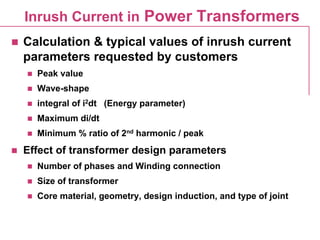
Inrush Current in Power Transformers
n Calculation & typical values of inrush current
parameters requested by customers
n Peak value
n Wave-shape
n integral of i2dt (Energy parameter)
n Maximum di/dt
n Minimum % ratio of 2nd harmonic / peak
n Effect of transformer design parameters
n Number of phases and Winding connection
n Size of transformer
n Core material, geometry, design induction, and type of joint
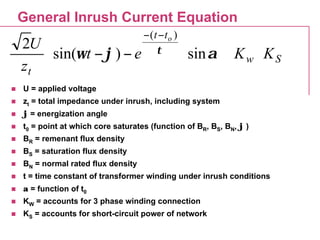
General Inrush Current Equation
n U = applied voltage
n zt = total impedance under inrush, including system
n ϕ = energization angle
n t0 = point at which core saturates (function of BR, BS, BN, ϕ )
n BR = remenant flux density
n BS = saturation flux density
n BN = normal rated flux density
n t = time constant of transformer winding under inrush conditions
n α = function of t0
n KW = accounts for 3 phase winding connection
n KS = accounts for short-circuit power of network
Sw
tt
t
KKet
z
U o
⋅⋅








⋅−−
−−
αϕω τ sin)sin(
2
)(
Calculated Inrush Current Waveshape
0
200
400
600
800
1000
1200
1400
1600
1800
2000
0 5 10 15 20
Time [ms]
Amps
Calculated Peak inrush current
0
200
400
600
800
1000
1200
1400
1600
1800
2000
0 20 40 60 80 100
Cycle
Current[A]
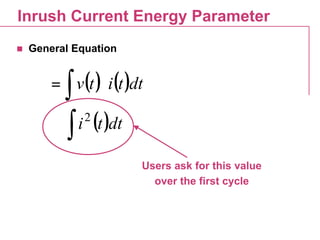
Inrush Current Energy Parameter
n General Equation
( ) ( )
( )∫
∫
∝
⋅=
dtti
dttitv
2
Users ask for this value
over the first cycle
Calculated for RGO Grade∫ dti2
0
5000
10000
15000
20000
25000
30000
0 45 90 135 180 225 270 315 360
Degrees
integralofi2
dt
1.80 T
1.75 T
1.50 T
1.20 T
Flux Density
Minimum % Ratio of 2nd Harmonic / Peak
n Customers use this value to distinguish
between Inrush current and short circuit
current
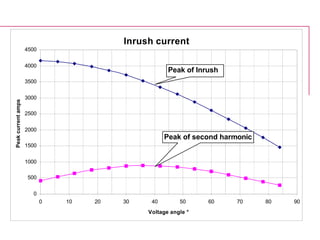
n This minimum % ratio occurs when the
transformer is energized at voltage-angle = 0º ;
which is also the condition that results in the
maximum peak inrush current value
Inrush current
0
500
1000
1500
2000
2500
3000
3500
4000
4500
0 10 20 30 40 50 60 70 80 90
Voltage angle °
Peakcurrentamps
Peak of Inrush
Peak of second harmonic
Inrush Current for First Cycle
-2000
-1500
-1000
-500
0
500
1000
1500
2000
0 5 10 15 20
Time [ms]
Current[A]
-400
-300
-200
-100
0
100
200
300
400
di/dt[A/ms]
Inrush Current 1st Peak
di/dt of 1st Cycle
n Value used in setting size of vacuum switch
Effect of Design Parameters
n Number of Phases and Winding connection
n Inrush current in 3 phase transformers is equal to, or less (by
30-40%), than 1 phase, depending on winding connection
n delta, wye, grounded wye, auto, etc
n winding connection combination of energized and secondary
windings
n Transformer Size (MVA)
n Generally inrush/rated current ratio is lower for larger MVA
n Time constant for inrush current is larger for larger MVA
n Core Steel Material
n HiB materials have lower remenance, but slightly higher
saturation level compared to RGO materials
n Thus, HiB materials are associated with lower peak inrush
currents & higher min % 2nd harmonic / peak ratio
Effect of Design Parameters
n Core Geometry
n affects core remenance
n affects the magnetic field distribution in the core (which
hence affects core air inductance)
n Design induction
n peak inrush increases with induction
n min % 2nd harmonic / peak decreases with induction
n Joint type
n transformer core has lower remenance than material of the
core because of the high reluctance of the joints
n non step lap core has slightly lower peak inrush current
than the step lap core
n lower core remenance

Ieee inrush tutorial

  • 1.
    Inrush Current Tutorial Session RamsisGirgis IEEE Standards Transformers Committee Oct 15, 2001 Orlando, Florida
  • 2.
    Inrush Current inPower Transformers n Calculation & typical values of inrush current parameters requested by customers n Peak value n Wave-shape n integral of i2dt (Energy parameter) n Maximum di/dt n Minimum % ratio of 2nd harmonic / peak n Effect of transformer design parameters n Number of phases and Winding connection n Size of transformer n Core material, geometry, design induction, and type of joint
  • 3.
    General Inrush CurrentEquation n U = applied voltage n zt = total impedance under inrush, including system n ϕ = energization angle n t0 = point at which core saturates (function of BR, BS, BN, ϕ ) n BR = remenant flux density n BS = saturation flux density n BN = normal rated flux density n t = time constant of transformer winding under inrush conditions n α = function of t0 n KW = accounts for 3 phase winding connection n KS = accounts for short-circuit power of network Sw tt t KKet z U o ⋅⋅         ⋅−− −− αϕω τ sin)sin( 2 )(
  • 4.
    Calculated Inrush CurrentWaveshape 0 200 400 600 800 1000 1200 1400 1600 1800 2000 0 5 10 15 20 Time [ms] Amps
  • 5.
    Calculated Peak inrushcurrent 0 200 400 600 800 1000 1200 1400 1600 1800 2000 0 20 40 60 80 100 Cycle Current[A]
  • 6.
    Inrush Current EnergyParameter n General Equation ( ) ( ) ( )∫ ∫ ∝ ⋅= dtti dttitv 2 Users ask for this value over the first cycle
  • 7.
    Calculated for RGOGrade∫ dti2 0 5000 10000 15000 20000 25000 30000 0 45 90 135 180 225 270 315 360 Degrees integralofi2 dt 1.80 T 1.75 T 1.50 T 1.20 T Flux Density
  • 8.
    Minimum % Ratioof 2nd Harmonic / Peak n Customers use this value to distinguish between Inrush current and short circuit current n This minimum % ratio occurs when the transformer is energized at voltage-angle = 0º ; which is also the condition that results in the maximum peak inrush current value
  • 9.
    Inrush current 0 500 1000 1500 2000 2500 3000 3500 4000 4500 0 1020 30 40 50 60 70 80 90 Voltage angle ° Peakcurrentamps Peak of Inrush Peak of second harmonic
  • 10.
    Inrush Current forFirst Cycle -2000 -1500 -1000 -500 0 500 1000 1500 2000 0 5 10 15 20 Time [ms] Current[A] -400 -300 -200 -100 0 100 200 300 400 di/dt[A/ms] Inrush Current 1st Peak di/dt of 1st Cycle n Value used in setting size of vacuum switch
  • 11.
    Effect of DesignParameters n Number of Phases and Winding connection n Inrush current in 3 phase transformers is equal to, or less (by 30-40%), than 1 phase, depending on winding connection n delta, wye, grounded wye, auto, etc n winding connection combination of energized and secondary windings n Transformer Size (MVA) n Generally inrush/rated current ratio is lower for larger MVA n Time constant for inrush current is larger for larger MVA n Core Steel Material n HiB materials have lower remenance, but slightly higher saturation level compared to RGO materials n Thus, HiB materials are associated with lower peak inrush currents & higher min % 2nd harmonic / peak ratio
  • 12.
    Effect of DesignParameters n Core Geometry n affects core remenance n affects the magnetic field distribution in the core (which hence affects core air inductance) n Design induction n peak inrush increases with induction n min % 2nd harmonic / peak decreases with induction n Joint type n transformer core has lower remenance than material of the core because of the high reluctance of the joints n non step lap core has slightly lower peak inrush current than the step lap core n lower core remenance