Postrior Urethral Valve
Evaluation And Management
Prepared by
DR.Osam Al Mogahed
Supervised by
Dr. ABDULKAREEM AL HEMIARY
Objectives
Introduction
Definition
Description
Etiology
Pathophysiology
Anatomy
Clinical Presentation
Management
Introduction:
Posterior urethral valves (PUVs) are the most common
cause of lower urinary tract obstruction (LUTO) in
boys, with an incidence of 1 in 5000–8000 male births.1
Although the majority of boys with PUV are diagnosed
antenatally, approximately one-third will be diagnosed
during childhood or adolescence. Once diagnosed and surgically
treated, PUV requires lifelong follow-up since it is the most
common cause of LUTO leading to end-stage
renal disease
(ESRD) in children
Definition:
PUV are derived from an abnormal congenital membrane
arising from the verumontanum and attaching obliquely to
the anterior urethra (beyond the external urethral sphincter),
resulting in LUT obstruction. An alternative term is COPUM
(or congenital obstructive posterior urethral membrane).
Urethral instrumentation or spontaneous partial rupture of
the membrane is thought to cause the classical appearance
of two valve- like folds in the prostatic urethra.
Description
:
Etiology :
A PUV is a congenital obstruction caused by a
malformation of the posterior urethra. The significance
of this obstruction depends on the secondary effects
on the bladder, ureters, and kidneys.
A type I PUV is believed to result from abnormal
insertion and absorption of the most distal aspects of
the wolffian ducts during bladder development. In the
healthy male, the remnants of these ducts are
observed as the plicae colliculi. Type III PUVs are
observed as a membrane in the posterior urethra
believed to originate from incomplete canalization
between the anterior and the posterior urethra.
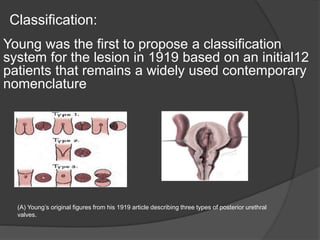
Young was the first to propose a classification
system for the lesion in 1919 based on an initial12
patients that remains a widely used contemporary
nomenclature
Classification:
(A) Young’s original figures from his 1919 article describing three types of posterior urethral
valves.
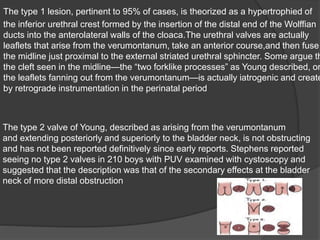
The type 1 lesion, pertinent to 95% of cases, is theorized as a hypertrophied of
the inferior urethral crest formed by the insertion of the distal end of the Wolffian
ducts into the anterolateral walls of the cloaca.The urethral valves are actually
leaflets that arise from the verumontanum, take an anterior course,and then fuse
the midline just proximal to the external striated urethral sphincter. Some argue th
the cleft seen in the midline—the “two forklike processes” as Young described, or
the leaflets fanning out from the verumontanum—is actually iatrogenic and create
by retrograde instrumentation in the perinatal period
The type 2 valve of Young, described as arising from the verumontanum
and extending posteriorly and superiorly to the bladder neck, is not obstructing
and has not been reported definitively since early reports. Stephens reported
seeing no type 2 valves in 210 boys with PUV examined with cystoscopy and
suggested that the description was that of the secondary effects at the bladder
neck of more distal obstruction
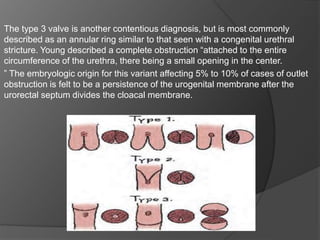
The type 3 valve is another contentious diagnosis, but is most commonly
described as an annular ring similar to that seen with a congenital urethral
stricture. Young described a complete obstruction “attached to the entire
circumference of the urethra, there being a small opening in the center.
” The embryologic origin for this variant affecting 5% to 10% of cases of outlet
obstruction is felt to be a persistence of the urogenital membrane after the
urorectal septum divides the cloacal membrane.
Genetic Basis of Posterior Urethral Valves:
An understanding of the genetic etiology for PUVs is still in its infancy.
Chiarmonte et al. reported a familial incidence of PUVs, identifying that affected
siblings shared a partial duplication in the short arm of chromosome 11 . Other
studies similarly implicated chromosome 11, along with chromosome 1 .
The majority of cases described in the literature are sporadic, but because the
anomaly is known to affect siblings,inheritance of PUVs may be autosomal
recessive, x-linked recessive, or by multifactorial inheritance.
A recent genome-wide populationbased study of copy number variants in
isolated PUV identified novel candidate gene regions in 57% of cases examined
. Faure et al. examined the phenotypic effect of copy number variants in PUVs
and concluded that affected children have a higher nadir creatinine and
increased likelihood of progressing to stage V chronic kidney disease.
EPIDEMIOLOGY:
Congenital anomalies of the urinary tract affect up to 1 in 500 pregnancies, and
obstructive uropathy accounts for most of these cases. A large population-
based registry study from the United Kingdom demonstrated that lower urinary
tract obstruction (LUTO) has an incidence of 2.2 per 10,000 births, of which
PUVs was the most common pathology (1.4/10,000births) followed by urethral
atresia and prune-belly syndrome . Because birth incidence requires the often
inaccurate count of early spontaneous pregnancy loss, a latter study following
a similar cohort based in the West Midlands between 1995 to 2007 calculated a
prevalence ratio of PUVs—number of affected births divided by the total
number of live births and stillbirths—of2.10 per 10,000 births .This prevalence
was also significantly higher in blackand minority ethnic groups when
compared with whit Europeans.
Pathophysiology :
*During the early stages of embryogenesis, the most caudal end of the wolffian duct
is absorbed into the primitive cloaca at the site of the future verumontanum in the
posterior urethra. In healthy males, the remnants of this process are the posterior
urethral folds, called plicae colliculi. Histologic studies suggest that PUVs are formed
at approximately 4 weeks' gestation, as the wolffian duct fuses with the developing
cloaca.
*The morbidity of PUVs is not merely limited to transient urethral obstruction. The
congenital obstruction of the urinary tract at a critical time in organogenesis may
profoundly affect lifelong kidney, ureteral, and bladder function. In a dynamic process,
bladder dysfunction may cause ongoing and progressive renal deterioration. Renal
insufficiency is caused by PUVs in approximately 10-15% of children undergoing
renal transplantation, and approximately one third of patients born with PUVs
progress to end-stage renal disease (ESRD).
Bladder emptying then occurs at high intravesical pressures, which, in turn, can be
transmitted to the ureters and up into the renal collecting system. Ultimately, patients
with PUV may be susceptible to incontinence, infection, and progressive renal
damage.
As patients with PUV age, bladder decompensation may develop, resulting in
detrusor failure and increased bladder capacity. Many boys with PUV will develop
larger-than-expected bladder volumes by age 11 years, possibly as a consequence of
overproduction of urine caused by tubular dysfunction and an inability to concentrate
urine (nephrogenic diabetes insipidus).
Bladder function may change at puberty, resulting in high-pressure, chronic retention
and necessitating the need for lifelong bladder management.Symptoms of bladder
dysfunction may persist into adulthood in as many as one third of patients and include
urinary incontinence in as many as 15% of adults with a history of PUV.
Moreover, as a result of the obstructive process, increased collagen deposition
and muscle hypertrophy can significantly thicken the bladder wall. Hypertrophy
and hyperplasia of the detrusor muscle and increases in connective tissue limit
bladder compliance during filling .
Vesicoureteral Reflux and Dysplasia:
Hoover and Duckett observed that the high-grade vesicoureteral reflux seen
in children with PUVs was usually noted in an ipsilateral poorly functioning
renal unit and that the contralateral renal unit appeared to have preserved
renal function .
They hypothesized that the reflux served as a “pop-off” mechanism in which
the dysplastic kidney with reflux served as a pressure reservoir mitigating
damage to the contralateral kidney and coined the term, “vesicoureteral reflux
and dysplasia (VURD).” This relationship, in that original series, was found in
13% of patients with valves, and the theory that these children
would have better long-term renal function as a result of the pop-off
phenomenon was widely affirmed.
Longer-term studies have confirmed, however, that the VURD does not
improve renal prognosis. Fifteen years after the VURD was first described,
Cuckow et al. found that although 67% of patients affected by VURD during
the second year of life had a normal serum creatinine, only 30% of these
children had normal values between 8 and 10 years of age .
Presentation
Prenatal USS: the majority are diagnosed prenatally, with 60%
identifi ed on USS at 20 weeks. They account for 1% of cases of
antenatal hydronephrosis.
Features include: bilateral hydroureteronephrosis, dilated and
thick-walled bladder, dilated posterior urethra (keyhole sign),
thick-walled bladder, oligohydramnios (reduced amniotic fl uid),
and renal dysplasia.
Early diagnosis is associated with poor prognosis.
*Delayed presentation
Indicators of possible PUVs later in childhood include the following:
1-Urinary tract infection (UTI)
2-Diurnal enuresis in boys older than 5 years
3-Secondary diurnal enuresis
4-Voiding pain or dysfunction
Abnormal urinary stream
PUVs manifest along a spectrum of disease severity. The clinical
significance of minivalves has been debated. Some studies have
indicated that the significance of minor radiographic narrowing in older
boys may be differentiated by means of urodynamic studies. Those with
detrusor/sphincter dyssynergy may have functional or nonanatomic
obstruction, and those with detrusor/sphincter synergy may have true
anatomic obstruction that benefits from surgical incisin
PUVs are sometimes discovered during evaluation of abdominal mass or
renal failure.
Incidental diagnosis*
Hydronephrosis or proteinuria found on examination for unrelated conditions may be the first sign of PUVs.
Physical Examination*
Most patients with PUV have normal findings on physical examination. When present, abnormal physical
findings are the result of severe renal insufficiency.
Neonates may present with severe pulmonary distress caused by lung underdevelopment lung due to
oligohydramnios. An appropriate volume of amniotic fluid (produced by the kidneys) is necessary for complete
and proper branching of the bronchial tree and alveoli. Physical findings can include the following:
Poor fetal breathing movements
Small chest cavity
Abdominal mass (ascites)
Potter facies
Limb deformities (skin dimpling)
Indentation of the knees and elbows due to compression within the uterus
In older children, physical findings can include poor growth, hypertension, and lethargy. An intermittent or weak
urinary stream is an unreliable sign. A large lower abdominal mass may represent a markedly distended urinary
bladder.
Newborn and infants: respiratory distress secondary to pulmonary
hypoplasia, palpable abdominal mass (hydronephrotic kidneys or
distended bladder), ascites, UTI sepsis, electrolyte abnormalities (renal
impairment), failure to thrive
Older children: milder cases may present later with recurrent UTI, poor
urinary stream, incomplete bladder emptying, poor growth and incontinence.
There is a risk of renal failure, VUR, and voiding dysfunction (over or
underactive bladder), also described as ‘valve bladder syndrome’.
Associated features: ‘pop-off valve syndrome’ is seen in 20%. It describes
mechanisms by which high urinary tract pressure is dissipated to allow
normal renal development. It includes leaking of urine from a small bladder
or renal pelvis rupture (urinary ascites), unilateral refl ux into a nonfunctioning
kidney (VUR with renal dysplasia or VURD), and formation of bladder
diverticuli.
Workup:
*Laboratory Studies:
For the first 24 hours after birth, the infant's serum chemistries are the same as
the mother's. Therefore, serum values for creatinine and blood urea nitrogen
(BUN) should be obtained at least 24 hours after birth. In utero, the placenta
functions as the major blood filter for the fetus, with waste passed on to the
mother. Observing serial serum chemistries for several days to weeks is
important to determine the true status of the newborn's renal function.
The normal newborn kidney is still undergoing maturation at birth, and the
infant's glomerular filtration rate (GFR) continues to improve during the first
several months of life. Because of renal immaturity at birth, the newborn is
unable to concentrate urine and is susceptible to dehydration. This defect is
exacerbated by renal dysplasia such as that found with posterior urethral
valves (PUVs).
As renal maturation continues, creatinine clearance normally improves. If
significant renal dysplasia or damage has occurred, the serum creatinine fails
to reach a normal level during the first year of life. Serum creatinine levels
higher than 0.8 (or, according to some, 1.0) mg/dL during the first year of life
have been demonstrated to be associated with poor long-term renal function;
thus, such levels are considered a negative prognostic indicator.
Laboratory Evaluation:
A newborn with a diagnosis of PUV will, as with any newborn,
reflect maternal values and must be interpreted with caution. After
48 hours, the maternal blood mediated through the placenta
should clear, and the infant’s kidney baseline function will be
apparent. Both these values represent the infant’s baseline
values, and subsequent values and trends may be monitored to
infer effective renal function. The nadir creatinine value at various
intervals—1 month of age, 6 months of age, and 1 year of age—
are considered important diagnostic tools, and this value may be
plotted to evaluate immediate response to treatment in the
neonatal period.
But the serum creatinine plateau even in unaffected children may
not be seen until days 65 and 220 of life .
DIAGNOSIS:
A-Antenatal Diagnosis
1-Ultrasonography
With widespread access to antenatal sonography, PUVs and other
LUTOs such as urethral atresia or stenosis are increasingly
detected during the fetal period. PUV is detected in approximately
1/1250 ultrasound screenings, accounting for 10% of significant
antenatally detected genitourinary disease and afflicting one third
of surviving infants with bilateral renal disease .
The pathognomonic ultrasound findings of
a thickened, dilated bladder along with bilateral hydroureter and
pelvicaliectasis do carry a high sensitivity (95%) and specificity
(80%), and oligohydramnios and the dilated posterior urethra
displaying the “keyhole sign” further corroborate the presence of
LUTO.
Renal echogenicity will be increased in PUVs, and is a reliable indicator
to infer renal damage as well.
Although LUTO may be diagnosed prenatally, differentiating
valves from urethral atresia or prune-belly syndrome, high-grade
vesicoureteral reflux or bilateral primary obstructing mega ureters
is much more problematic, reducing the accuracy of diagnosing
PUVs with prenatal sonography alone to as low as 50% .
Still, the antenatal finding of a thickened, enlarged bladder, bilateral ureterectasis
with pelvicaliectasis with or without oligohydramnios in a male infant requires an
early postnatal ultrasound and voiding cystourethrogram before the infant’s
discharge from the postpartum unit .
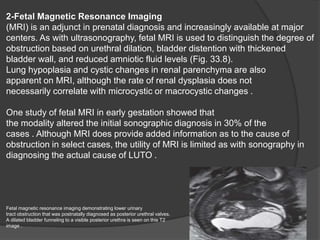
2-Fetal Magnetic Resonance Imaging
(MRI) is an adjunct in prenatal diagnosis and increasingly available at major
centers. As with ultrasonography, fetal MRI is used to distinguish the degree of
obstruction based on urethral dilation, bladder distention with thickened
bladder wall, and reduced amniotic fluid levels (Fig. 33.8).
Lung hypoplasia and cystic changes in renal parenchyma are also
apparent on MRI, although the rate of renal dysplasia does not
necessarily correlate with microcystic or macrocystic changes .
One study of fetal MRI in early gestation showed that
the modality altered the initial sonographic diagnosis in 30% of the
cases . Although MRI does provide added information as to the cause of
obstruction in select cases, the utility of MRI is limited as with sonography in
diagnosing the actual cause of LUTO .
Fetal magnetic resonance imaging demonstrating lower urinary
tract obstruction that was postnatally diagnosed as posterior urethral valves.
A dilated bladder funneling to a visible posterior urethra is seen on this T2
image .
B-Postnatal Diagnosis:
1-Ultrasonography.
Much like the antenatal period, classic findings on ultrasound suggest PUVs
are a distended bladder with thickened bladder wall, presence of bladder
diverticula, dilated posterior urethra, and a high bladder neck with
hyperplasia. The classic “keyhole sign” is often evident as well. These lower
tract changes may be associated with upper tract changes such as a dilated
ureter with or without displastic changes of kidney, which include cyst
proliferation, loss
of corticomedullary differentiation, and abnormal echogenicity.
In the newborn period, a urinoma may be inferred by free fluid around
one or both kidneys. In our practice, we consider a bladder wall to
be thickened if it measures more than 3 mm when it is distended
or more than 5 mm when it is empty .
2-The voiding cystourethrography
Remains the definitive radiologic study in confirming the diagnosis of PUV.
This study should be completed in the early postnatal period after renal and bladder
sonography and as soon as an infant with suspected prenatal findings of valves is
hemodynamically stabilized and able to undergo the contrast study.
The bladder often appears thickened and trabeculated with multiple diverticuli,
mimicking the appearance of a neuropathic bladder.
High-grade vesicoureteral reflux may be seen in approximately 50% of patients with
valves at the time of diagnosis.
Images obtained during the voiding phase will show ntrast traveling across
a hypertrophied, elevated bladder neck and grossly dilated posterior urethra .
The urethra funnels abruptly at a transverse membrane, or cusp, representing
the obstructing valve leaflets seen at cystoscopy. These are the pathognomonic signs
for PUV. The study commences with the insertion of an 8-Fr feeding tube into the
urethra, and this tube may curl within the capacious posterior urethra or hypertrophied
bladder neck, requiring the use of a coudé catheter to advance into the bladder. Often
a catheter may already be in place at the time of the study .
3-Voiding Urosonography (VUS)
Second-generation ultrasound contrast has enabled ultrasound-guided dynamic
imaging of the lower urinary tract. This has been well established in the diagnosis of
reflux with contrast-enhanced voiding ultrasonography (ceVUS) with some studies
reporting sensitivity exceeding the present standard of care of fluoroscopic voiding
cystourethrogram .
This has led to an interest in imaging the urethra to diagnose urethral pathology.
There is significant evidence today to use ceVUS for imaging the urethra and reliably
diagnose PUV and other pathologic conditions such as a urethral diverticulum .
At our institution, a significant proportion of lower urinary tract imaging is completed
using contrast ultrasound–based imaging as a concerted effort to reduce radiation
exposure in children and find it to be a useful modality.
4-Radionuclide Renal Scan
The radionuclide renal scan offers quantification of differential renal function,
and cortical deficits seen on the study may imply renal dysplasia when
completed in the neonatal period.
Mercaptoacetyltriglycine (MAG3) is a useful agent to evaluate renal functional
contribution, although delayed emptying of nuclear tracer from the often dilated
collecting systems should not be necessarily interpreted as ureterovesical
junction obstruction requiring intervention.
Placement of a urinary catheter is essential in a patient with vesicoureteral
reflux to minimize error in the calculation of renal function.
Imaging Studies:
Ultrasonography
Antenatal ultrasonography (US) has been found to be reasonably accurate in
distinguishing PUV from vesicoureteral reflux (VUR).
Every child with antenatal hydronephrosis should be assessed with renal
and bladder US in the immediate postnatal period,[17]with a focus on the
appearance of the renal parenchyma, any evidence of renal collecting
system dilatation, the thickness of the bladder wall, and the presence or
absence of ascites. The quantity (total area) and quality (corticomedullary
differentiation and renal echogenicity) of the renal parenchyma on initial
postnatal US have prognostic value for determining the future risk of stage 5
chronic kidney disease.
Because newborns commonly have relative hypovolemia during the first few
days of life, it is recommended to perform US after the first week of life if
findings from the first US examination were normal in a child with previously
diagnosed antenatal hydronephrosis before making a final determination that
the hydronephrosis has resolved .
Contrast-enhanced serial voiding urosonography has been sugegsted as a
useful complementary test in pediatric patients with PUVs.
Other Tests ;
Urodynamic evaluation provides information about bladder
storage and emptying. In the older child, the mature bladder should
store urine at a low pressure and then completely empty at
appropriate pressures. A newborn's bladder may not empty
completely under normal circumstances.
The term valve bladder is used to describe patients with PUV and a
fibrotic noncompliant bladder. These patients are at risk of
developing hydroureteronephrosis, progressive renal deterioration,
recurrent infections, and urinary incontinence.
Patients with PUV require periodic urodynamic testing throughout
childhood because bladder compliance may further deteriorate over
time.
Procedures:
Cystoscopy serves both diagnostic and therapeutic functions in these infants.
Appropriately-sized cystoscopes (< 8 French) are needed to avoid injury to the
urethra.
**Diagnostic
Confirmation with cystoscopy is required in every child in whom PUV is
suggested after VCUG. In some, the filling defect observed on VCUG may
represent only external sphincter contraction during voiding; in others, the valve
leaflets are confirmed.
**Therapeutic (ie, transurethral incision of PUVs)
Multiple techniques are described for PUV ablation. Disruption of the
obstructing membrane by blind passage of a valve hook is now only of historic
interest. Currently, valves are disrupted under direct vision by cystoscopy using
an endoscopic loop, Bugbee electrocauterization, or laser fulguration. In
extremely small infants (< 2 kg), a 2-French Fogarty catheter may be passed
either under fluoroscopic or direct vision for valve disruption.[21]This is
performed in the least traumatic fashion possible to avoid secondary urethral
stricture or injury to the urethral sphincter mechanism.
Vesicostomy:
In some patients, the urethra may be too small for the
available cystoscopic instrumentation. Fortunately, because of
continued advancements in pediatric endoscopic equipment,
this is an uncommon occurrence. When this situation arises, a
temporary vesicostomy may be performed.
Outpatient intermittent catheterization via a sensate and
dilated posterior urethra and bladder neck may not be feasible
in all patients. A minivesicostomy in the subinguinal region
can allow continued, intermittent passage of a catheter when
the urethra is not available.
Treatment and Management
Approach Considerations
Newborn care
In newborns with (PUVs), the first step in treatment is to relieve
bladder outlet obstruction by placing a urethral catheter.
Cystoscopic valve ablation or vesicostomy can then be
performed when the child is stable. In rare cases, a urethral
catheter cannot be placed, because of hypertrophy of the
bladder neck. These patients require cystoscopy under
anesthesia for catheter placement, suprapubic tube placement,
or primary vesicostomy.
Therefore, care of the newborn depends on having adequate
instrumentation (eg, pediatric cystoscopic equipment) and
expertise (eg, pediatric radiologist, pediatric urologist, pediatric
anesthesiologist). If these services are unavailable, place a
catheter (if possible) and transfer the child to an appropriate
facility.
Care of the older child:
Care of the older child also requires adequate equipment and
expertise. Periodic radiologic and urodynamic evaluation is
important for monitoring the upper urinary tract and bladder
changes. These evaluations occur over an extended period of
time and rarely constitute an emergency. These patients require
a timely referral to a center where appropriate services are
available.
Medical Care:
Medical management of PUVs relates to treatment of the
secondary effects of the valves. Adequate care involves a team
approach that includes a neonatologist, a general pediatrician, a
pediatric urologist, and a pediatric nephrologist. Short-term goals
involve treatment of pulmonary distress, immediate relief of
urethral obstruction (placement of a 5-French feeding tube), and
fluid and electrolyte management. In children who survive the
pulmonary distress, the long-term issues include treatment of
bladder dysfunction and renal insufficiency.
Renal insufficiency
Few patients present with bilateral renal dysplasia at birth. In the
past, if patients did not die of associated pulmonary insufficiency,
they died of progressive renal insufficiency. Advances in
peritoneal dialysis have made it possible for some to may be
treated successfully from birth. If growth is adequate, renal
transplantation is often possible after the first year of life.
Approximately one third of patients with PUVs
eventually progress to end-stage renal disease
(ESRD) and will require dialysis or transplantation.
Progression of ESRD is accelerated at the time of
puberty as a consequence of the increased metabolic
workload placed on the kidneys. Growth in these
children may be significantly below the reference
range for the child's age. Adequate caloric intake and
protein nutrition are essential to growth but may also
accelerate the rise in serum creatinine levels.
Renal dysfunction can be accelerated by recurrent
infections and elevated bladder pressures. Treatment
of the lower urinary tract may influence the
progression of upper urinary tract disease.
Bladder dysfunction:
All male children with antenatal hydronephrosis should undergo voiding
cystourethrography (VCUG) shortly after birth to exclude PUV. While the study results are
being awaited, a 5- or 8-French urethral catheter should be placed to allow for bladder
drainage. If valves are confirmed, they can be incised within the first few days of life.
However, the newborn urethra may be too small to accommodate available equipment. In
these individuals, a vesicostomy can be performed as a temporary solution until urethral
growth has been adequate to allow transurethral incision.
Secondary ureterovesical junction obstruction from bladder hypertrophy is a controversial
issue. Supravesical urinary diversion procedures (eg, cutaneous ureterostomies) are
reserved for patients who appear to have ureterovesical junction obstruction. This is very
uncommon.
Later in childhood, severe or prolonged urethral obstruction can lead to a fibrotic, poorly
compliant bladder. This occurs when the developing bladder is exposed to high pressures
from bladder outlet obstruction, leading to increases in bladder collagen deposition and
detrusor muscle hypertrophy and hyperplasia. These bladders manifest poor compliance,
leading to elevated storage pressures. This, in turn, leads to increased risk of reflux,
hydroureteronephrosis, and urinary incontinence.
Use of urodynamic testing to assess bladder compliance helps identify patients at risk.
Some patients may respond to anticholinergic medication, such as oxybutynin.[25, 26,
27]Institution of clean intermittent catheterization (CIC) may aid some patients in
achieving continence by preventing the bladder from overfilling. In patients who do not
gain adequate bladder capacity and safe compliance despite optimal medical
management, augmentation cystoplasty may be required.
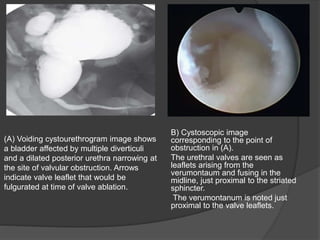
(A) Voiding cystourethrogram image shows
a bladder affected by multiple diverticuli
and a dilated posterior urethra narrowing at
the site of valvular obstruction. Arrows
indicate valve leaflet that would be
fulgurated at time of valve ablation.
B) Cystoscopic image
corresponding to the point of
obstruction in (A).
The urethral valves are seen as
leaflets arising from the
verumontaum and fusing in the
midline, just proximal to the striated
sphincter.
The verumontanum is noted just
proximal to the valve leaflets.
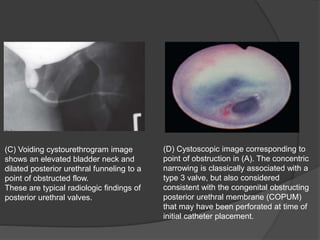
(C) Voiding cystourethrogram image
shows an elevated bladder neck and
dilated posterior urethral funneling to a
point of obstructed flow.
These are typical radiologic findings of
posterior urethral valves.
(D) Cystoscopic image corresponding to
point of obstruction in (A). The concentric
narrowing is classically associated with a
type 3 valve, but also considered
consistent with the congenital obstructing
posterior urethral membrane (COPUM)
that may have been perforated at time of
initial catheter placement.
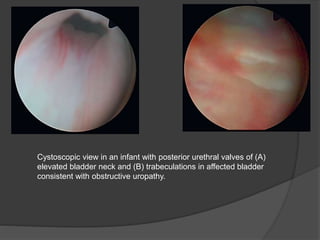
Cystoscopic view in an infant with posterior urethral valves of (A)
elevated bladder neck and (B) trabeculations in affected bladder
consistent with obstructive uropathy.
A) Left renal ultrasound for a newborn with posterior urethral valves. Severe
pelvicaliectasis with thinning of the parenchyma with increased echogenicity,
and loss of corticomeduallary differentiation is seen. (B) Pelvic view of the
same patient, not yet catheterized, shows a distended bladder with dilation
of bilateral distal ureters.
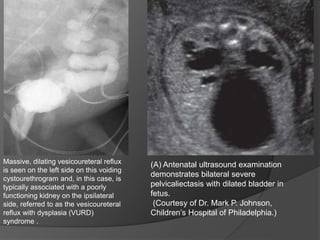
Massive, dilating vesicoureteral reflux
is seen on the left side on this voiding
cystourethrogram and, in this case, is
typically associated with a poorly
functioning kidney on the ipsilateral
side, referred to as the vesicoureteral
reflux with dysplasia (VURD)
syndrome .
(A) Antenatal ultrasound examination
demonstrates bilateral severe
pelvicaliectasis with dilated bladder in
fetus.
(Courtesy of Dr. Mark P. Johnson,
Children’s Hospital of Philadelphia.)
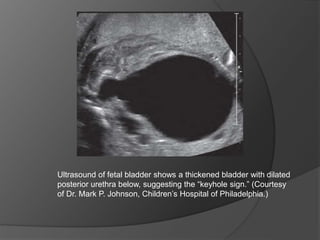
Ultrasound of fetal bladder shows a thickened bladder with dilated
posterior urethra below, suggesting the “keyhole sign.” (Courtesy
of Dr. Mark P. Johnson, Children’s Hospital of Philadelphia.)
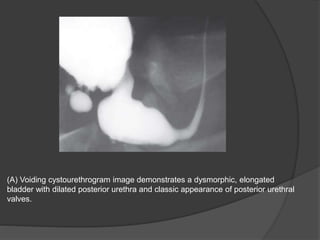
(A) Voiding cystourethrogram image demonstrates a dysmorphic, elongated
bladder with dilated posterior urethra and classic appearance of posterior urethral
valves.
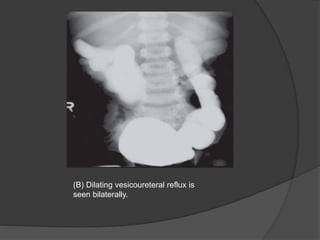
(B) Dilating vesicoureteral reflux is
seen bilaterally.
SURGICAL INTERVENTION
Valve Ablation
Today, cystoscopy with ablation of PUVs is considered the preferred
initial surgical option in any neonate diagnosed with PUVs.
The treatment goal is to restore flow of urine through the urethra and
enable normal cyclic filling and emptying of the bladder, which
is superior to urinary diversion and passive urine drainage.
Experimental models corroborate clinical evidence of the importance of
bladder cycling, and one model of urinary diversion and undiversion
demonstrated the changes that occur in a diverted bladder prevented from
cycling . A fetal sheep model developed an increase in expression of
extracellular matrix elements and apoptosis after a high diversion .
There are several approaches to valve ablation. Historically, it
had even been successfully performed with a crochet hook passed
retrograde into the urethra and feeling the hook catch the obstructing
tissue. Innes Williams first described the engagement of valves with
a hook, and Whitaker and Sherwood modified the hook by insulating
the wire except for the very distal portion of the hook, which measures
6 to 7 Fr and could be passed at the bedside without general anesthesia
while applying a small amount of diathermy when ablating the
valves . With the miniaturization of endoscopes in the age of fiberoptic
and, now, digital technology, cystoscopy can be accomplished in
even the smallest neonate, and endoscopic valve ablation is the
preferred approach at most centers today. Availability of a 7.5-Fr
or 9-Fr infant cystoscope with an offset lens facilitates passage
of a variety of ablating devices, including a Bugbee electrode that
can be used to incise the valves at the ventral 5 o’clock and 7
o’clock positions with or without an incision on the dorsal 12
o’clock position. Alternatively, a 12 o’clock alone might suffice
(Video 33.1). A wire bent at the tip and passed through a 3-Fr
ureteric catheter is another option, as is the visually guided fogarty
embolectomy catheter (Soliman, 2009). In an infant with a normal
caliber urethra, the 9.5-Fr resectoscope may be used with a Collins
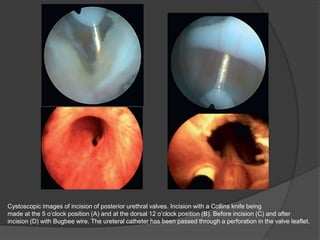
Cystoscopic images of incision of posterior urethral valves. Incision with a Collins knife being
made at the 5 o’clock position (A) and at the dorsal 12 o’clock position (B). Before incision (C) and after
incision (D) with Bugbee wire. The ureteral catheter has been passed through a perforation in the valve leaflet.
Vesicostomy
With miniaturization of endoscopic technology, vesicostomy is reserved
primarily for the very low birth weight infant whose urethra cannot
accommodate an endoscope and for a child with continued impaired renal
function, high bladder urine volumes, and upper tract deterioration after valve
ablation or urethral catheterization. The vesicostomy does reduce bladder
storage pressures and may optimize glomerular filtration rate in some cases.
The argument that the vesicostomy defunctionalizes the bladder and leads to
decreased compliance in the long term has been refuted, as a properly
created vesicostomy allows bladder filling and preserves contractile function
as urine must be expulsed through the stoma, albeit at a reduced leak point
pressure. The vesicostomy is best seen as a temporary diversion in children
with PUVs as it does not alter clinical outcomes as compared with primary
ablation, nor does it prevent a bladder from acting as an adequate reservoir
for renal transplant .
The vesicostomy is classically created with a 2-cm midline
transverse incision made midway between the pubic symphysis and
the umbilicus.
The rectus muscles are separated, the bladder is exposed
with traction sutures, and the peritoneum is mobilized cephalad
and away from the posterior wall and dome of the bladder.
The bladder dome is identified by isolating the urachus, which is ligated,
so that the dome can be exposed through the fascial incision.
The urachus and small portion of the bladder dome are excised, and
then the detrusor is sutured to the fascia 1 cm below the edge of the
cystotomy.
The key operative step in creation of the vesicostomy
is to ensure that the posterior wall of the bladder is taut— accomplished by
bringing the dome of the bladder to the skin—to prevent prolapse of the back
wall of the bladder through the incision .
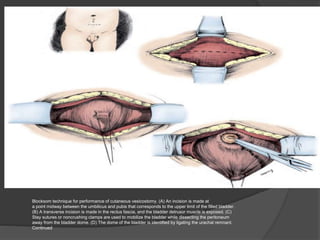
Blocksom technique for performance of cutaneous vesicostomy. (A) An incision is made at
a point midway between the umbilicus and pubis that corresponds to the upper limit of the filled bladder.
(B) A transverse incision is made in the rectus fascia, and the bladder detrusor muscle is exposed. (C)
Stay sutures or noncrushing clamps are used to mobilize the bladder while dissecting the peritoneum
away from the bladder dome. (D) The dome of the bladder is identified by ligating the urachal remnant.
Continued
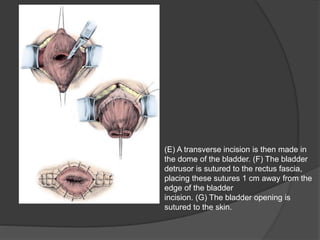
(E) A transverse incision is then made in
the dome of the bladder. (F) The bladder
detrusor is sutured to the rectus fascia,
placing these sutures 1 cm away from the
edge of the bladder
incision. (G) The bladder opening is
sutured to the skin.
Upper Tract Diversion
Proponents of supravesical urinary diversion hold that direct decompression
of the kidney by a cutaneous ureterostomy or pyelostomy
will effectuate direct, low-pressure urinary drainage, allowing optimization
of renal function (Fig. 33.14). High diversion, when renal dilation
and biochemical markers of renal function fail to improve despite
maximal bladder drainage, historically was felt to protect the upper
urinary tract from ureterovesical junction obstruction caused by a

Posterior urethral valve

  • 1.
    Postrior Urethral Valve EvaluationAnd Management Prepared by DR.Osam Al Mogahed Supervised by Dr. ABDULKAREEM AL HEMIARY
  • 2.
  • 3.
    Introduction: Posterior urethral valves(PUVs) are the most common cause of lower urinary tract obstruction (LUTO) in boys, with an incidence of 1 in 5000–8000 male births.1 Although the majority of boys with PUV are diagnosed antenatally, approximately one-third will be diagnosed during childhood or adolescence. Once diagnosed and surgically treated, PUV requires lifelong follow-up since it is the most common cause of LUTO leading to end-stage renal disease (ESRD) in children
  • 4.
    Definition: PUV are derivedfrom an abnormal congenital membrane arising from the verumontanum and attaching obliquely to the anterior urethra (beyond the external urethral sphincter), resulting in LUT obstruction. An alternative term is COPUM (or congenital obstructive posterior urethral membrane). Urethral instrumentation or spontaneous partial rupture of the membrane is thought to cause the classical appearance of two valve- like folds in the prostatic urethra.
  • 5.
  • 6.
    Etiology : A PUVis a congenital obstruction caused by a malformation of the posterior urethra. The significance of this obstruction depends on the secondary effects on the bladder, ureters, and kidneys. A type I PUV is believed to result from abnormal insertion and absorption of the most distal aspects of the wolffian ducts during bladder development. In the healthy male, the remnants of these ducts are observed as the plicae colliculi. Type III PUVs are observed as a membrane in the posterior urethra believed to originate from incomplete canalization between the anterior and the posterior urethra.
  • 7.
    Young was thefirst to propose a classification system for the lesion in 1919 based on an initial12 patients that remains a widely used contemporary nomenclature Classification: (A) Young’s original figures from his 1919 article describing three types of posterior urethral valves.
  • 8.
    The type 1lesion, pertinent to 95% of cases, is theorized as a hypertrophied of the inferior urethral crest formed by the insertion of the distal end of the Wolffian ducts into the anterolateral walls of the cloaca.The urethral valves are actually leaflets that arise from the verumontanum, take an anterior course,and then fuse the midline just proximal to the external striated urethral sphincter. Some argue th the cleft seen in the midline—the “two forklike processes” as Young described, or the leaflets fanning out from the verumontanum—is actually iatrogenic and create by retrograde instrumentation in the perinatal period The type 2 valve of Young, described as arising from the verumontanum and extending posteriorly and superiorly to the bladder neck, is not obstructing and has not been reported definitively since early reports. Stephens reported seeing no type 2 valves in 210 boys with PUV examined with cystoscopy and suggested that the description was that of the secondary effects at the bladder neck of more distal obstruction
  • 9.
    The type 3valve is another contentious diagnosis, but is most commonly described as an annular ring similar to that seen with a congenital urethral stricture. Young described a complete obstruction “attached to the entire circumference of the urethra, there being a small opening in the center. ” The embryologic origin for this variant affecting 5% to 10% of cases of outlet obstruction is felt to be a persistence of the urogenital membrane after the urorectal septum divides the cloacal membrane.
  • 10.
    Genetic Basis ofPosterior Urethral Valves: An understanding of the genetic etiology for PUVs is still in its infancy. Chiarmonte et al. reported a familial incidence of PUVs, identifying that affected siblings shared a partial duplication in the short arm of chromosome 11 . Other studies similarly implicated chromosome 11, along with chromosome 1 . The majority of cases described in the literature are sporadic, but because the anomaly is known to affect siblings,inheritance of PUVs may be autosomal recessive, x-linked recessive, or by multifactorial inheritance. A recent genome-wide populationbased study of copy number variants in isolated PUV identified novel candidate gene regions in 57% of cases examined . Faure et al. examined the phenotypic effect of copy number variants in PUVs and concluded that affected children have a higher nadir creatinine and increased likelihood of progressing to stage V chronic kidney disease.
  • 11.
    EPIDEMIOLOGY: Congenital anomalies ofthe urinary tract affect up to 1 in 500 pregnancies, and obstructive uropathy accounts for most of these cases. A large population- based registry study from the United Kingdom demonstrated that lower urinary tract obstruction (LUTO) has an incidence of 2.2 per 10,000 births, of which PUVs was the most common pathology (1.4/10,000births) followed by urethral atresia and prune-belly syndrome . Because birth incidence requires the often inaccurate count of early spontaneous pregnancy loss, a latter study following a similar cohort based in the West Midlands between 1995 to 2007 calculated a prevalence ratio of PUVs—number of affected births divided by the total number of live births and stillbirths—of2.10 per 10,000 births .This prevalence was also significantly higher in blackand minority ethnic groups when compared with whit Europeans.
  • 12.
    Pathophysiology : *During theearly stages of embryogenesis, the most caudal end of the wolffian duct is absorbed into the primitive cloaca at the site of the future verumontanum in the posterior urethra. In healthy males, the remnants of this process are the posterior urethral folds, called plicae colliculi. Histologic studies suggest that PUVs are formed at approximately 4 weeks' gestation, as the wolffian duct fuses with the developing cloaca. *The morbidity of PUVs is not merely limited to transient urethral obstruction. The congenital obstruction of the urinary tract at a critical time in organogenesis may profoundly affect lifelong kidney, ureteral, and bladder function. In a dynamic process, bladder dysfunction may cause ongoing and progressive renal deterioration. Renal insufficiency is caused by PUVs in approximately 10-15% of children undergoing renal transplantation, and approximately one third of patients born with PUVs progress to end-stage renal disease (ESRD).
  • 13.
    Bladder emptying thenoccurs at high intravesical pressures, which, in turn, can be transmitted to the ureters and up into the renal collecting system. Ultimately, patients with PUV may be susceptible to incontinence, infection, and progressive renal damage. As patients with PUV age, bladder decompensation may develop, resulting in detrusor failure and increased bladder capacity. Many boys with PUV will develop larger-than-expected bladder volumes by age 11 years, possibly as a consequence of overproduction of urine caused by tubular dysfunction and an inability to concentrate urine (nephrogenic diabetes insipidus). Bladder function may change at puberty, resulting in high-pressure, chronic retention and necessitating the need for lifelong bladder management.Symptoms of bladder dysfunction may persist into adulthood in as many as one third of patients and include urinary incontinence in as many as 15% of adults with a history of PUV. Moreover, as a result of the obstructive process, increased collagen deposition and muscle hypertrophy can significantly thicken the bladder wall. Hypertrophy and hyperplasia of the detrusor muscle and increases in connective tissue limit bladder compliance during filling .
  • 14.
    Vesicoureteral Reflux andDysplasia: Hoover and Duckett observed that the high-grade vesicoureteral reflux seen in children with PUVs was usually noted in an ipsilateral poorly functioning renal unit and that the contralateral renal unit appeared to have preserved renal function . They hypothesized that the reflux served as a “pop-off” mechanism in which the dysplastic kidney with reflux served as a pressure reservoir mitigating damage to the contralateral kidney and coined the term, “vesicoureteral reflux and dysplasia (VURD).” This relationship, in that original series, was found in 13% of patients with valves, and the theory that these children would have better long-term renal function as a result of the pop-off phenomenon was widely affirmed. Longer-term studies have confirmed, however, that the VURD does not improve renal prognosis. Fifteen years after the VURD was first described, Cuckow et al. found that although 67% of patients affected by VURD during the second year of life had a normal serum creatinine, only 30% of these children had normal values between 8 and 10 years of age .
  • 15.
    Presentation Prenatal USS: themajority are diagnosed prenatally, with 60% identifi ed on USS at 20 weeks. They account for 1% of cases of antenatal hydronephrosis. Features include: bilateral hydroureteronephrosis, dilated and thick-walled bladder, dilated posterior urethra (keyhole sign), thick-walled bladder, oligohydramnios (reduced amniotic fl uid), and renal dysplasia. Early diagnosis is associated with poor prognosis.
  • 16.
    *Delayed presentation Indicators ofpossible PUVs later in childhood include the following: 1-Urinary tract infection (UTI) 2-Diurnal enuresis in boys older than 5 years 3-Secondary diurnal enuresis 4-Voiding pain or dysfunction Abnormal urinary stream PUVs manifest along a spectrum of disease severity. The clinical significance of minivalves has been debated. Some studies have indicated that the significance of minor radiographic narrowing in older boys may be differentiated by means of urodynamic studies. Those with detrusor/sphincter dyssynergy may have functional or nonanatomic obstruction, and those with detrusor/sphincter synergy may have true anatomic obstruction that benefits from surgical incisin PUVs are sometimes discovered during evaluation of abdominal mass or renal failure.
  • 17.
    Incidental diagnosis* Hydronephrosis orproteinuria found on examination for unrelated conditions may be the first sign of PUVs. Physical Examination* Most patients with PUV have normal findings on physical examination. When present, abnormal physical findings are the result of severe renal insufficiency. Neonates may present with severe pulmonary distress caused by lung underdevelopment lung due to oligohydramnios. An appropriate volume of amniotic fluid (produced by the kidneys) is necessary for complete and proper branching of the bronchial tree and alveoli. Physical findings can include the following: Poor fetal breathing movements Small chest cavity Abdominal mass (ascites) Potter facies Limb deformities (skin dimpling) Indentation of the knees and elbows due to compression within the uterus In older children, physical findings can include poor growth, hypertension, and lethargy. An intermittent or weak urinary stream is an unreliable sign. A large lower abdominal mass may represent a markedly distended urinary bladder.
  • 18.
    Newborn and infants:respiratory distress secondary to pulmonary hypoplasia, palpable abdominal mass (hydronephrotic kidneys or distended bladder), ascites, UTI sepsis, electrolyte abnormalities (renal impairment), failure to thrive Older children: milder cases may present later with recurrent UTI, poor urinary stream, incomplete bladder emptying, poor growth and incontinence. There is a risk of renal failure, VUR, and voiding dysfunction (over or underactive bladder), also described as ‘valve bladder syndrome’. Associated features: ‘pop-off valve syndrome’ is seen in 20%. It describes mechanisms by which high urinary tract pressure is dissipated to allow normal renal development. It includes leaking of urine from a small bladder or renal pelvis rupture (urinary ascites), unilateral refl ux into a nonfunctioning kidney (VUR with renal dysplasia or VURD), and formation of bladder diverticuli.
  • 19.
    Workup: *Laboratory Studies: For thefirst 24 hours after birth, the infant's serum chemistries are the same as the mother's. Therefore, serum values for creatinine and blood urea nitrogen (BUN) should be obtained at least 24 hours after birth. In utero, the placenta functions as the major blood filter for the fetus, with waste passed on to the mother. Observing serial serum chemistries for several days to weeks is important to determine the true status of the newborn's renal function. The normal newborn kidney is still undergoing maturation at birth, and the infant's glomerular filtration rate (GFR) continues to improve during the first several months of life. Because of renal immaturity at birth, the newborn is unable to concentrate urine and is susceptible to dehydration. This defect is exacerbated by renal dysplasia such as that found with posterior urethral valves (PUVs). As renal maturation continues, creatinine clearance normally improves. If significant renal dysplasia or damage has occurred, the serum creatinine fails to reach a normal level during the first year of life. Serum creatinine levels higher than 0.8 (or, according to some, 1.0) mg/dL during the first year of life have been demonstrated to be associated with poor long-term renal function; thus, such levels are considered a negative prognostic indicator.
  • 20.
    Laboratory Evaluation: A newbornwith a diagnosis of PUV will, as with any newborn, reflect maternal values and must be interpreted with caution. After 48 hours, the maternal blood mediated through the placenta should clear, and the infant’s kidney baseline function will be apparent. Both these values represent the infant’s baseline values, and subsequent values and trends may be monitored to infer effective renal function. The nadir creatinine value at various intervals—1 month of age, 6 months of age, and 1 year of age— are considered important diagnostic tools, and this value may be plotted to evaluate immediate response to treatment in the neonatal period. But the serum creatinine plateau even in unaffected children may not be seen until days 65 and 220 of life .
  • 21.
    DIAGNOSIS: A-Antenatal Diagnosis 1-Ultrasonography With widespreadaccess to antenatal sonography, PUVs and other LUTOs such as urethral atresia or stenosis are increasingly detected during the fetal period. PUV is detected in approximately 1/1250 ultrasound screenings, accounting for 10% of significant antenatally detected genitourinary disease and afflicting one third of surviving infants with bilateral renal disease . The pathognomonic ultrasound findings of a thickened, dilated bladder along with bilateral hydroureter and pelvicaliectasis do carry a high sensitivity (95%) and specificity (80%), and oligohydramnios and the dilated posterior urethra displaying the “keyhole sign” further corroborate the presence of LUTO.
  • 22.
    Renal echogenicity willbe increased in PUVs, and is a reliable indicator to infer renal damage as well. Although LUTO may be diagnosed prenatally, differentiating valves from urethral atresia or prune-belly syndrome, high-grade vesicoureteral reflux or bilateral primary obstructing mega ureters is much more problematic, reducing the accuracy of diagnosing PUVs with prenatal sonography alone to as low as 50% . Still, the antenatal finding of a thickened, enlarged bladder, bilateral ureterectasis with pelvicaliectasis with or without oligohydramnios in a male infant requires an early postnatal ultrasound and voiding cystourethrogram before the infant’s discharge from the postpartum unit .
  • 23.
    2-Fetal Magnetic ResonanceImaging (MRI) is an adjunct in prenatal diagnosis and increasingly available at major centers. As with ultrasonography, fetal MRI is used to distinguish the degree of obstruction based on urethral dilation, bladder distention with thickened bladder wall, and reduced amniotic fluid levels (Fig. 33.8). Lung hypoplasia and cystic changes in renal parenchyma are also apparent on MRI, although the rate of renal dysplasia does not necessarily correlate with microcystic or macrocystic changes . One study of fetal MRI in early gestation showed that the modality altered the initial sonographic diagnosis in 30% of the cases . Although MRI does provide added information as to the cause of obstruction in select cases, the utility of MRI is limited as with sonography in diagnosing the actual cause of LUTO . Fetal magnetic resonance imaging demonstrating lower urinary tract obstruction that was postnatally diagnosed as posterior urethral valves. A dilated bladder funneling to a visible posterior urethra is seen on this T2 image .
  • 24.
    B-Postnatal Diagnosis: 1-Ultrasonography. Much likethe antenatal period, classic findings on ultrasound suggest PUVs are a distended bladder with thickened bladder wall, presence of bladder diverticula, dilated posterior urethra, and a high bladder neck with hyperplasia. The classic “keyhole sign” is often evident as well. These lower tract changes may be associated with upper tract changes such as a dilated ureter with or without displastic changes of kidney, which include cyst proliferation, loss of corticomedullary differentiation, and abnormal echogenicity. In the newborn period, a urinoma may be inferred by free fluid around one or both kidneys. In our practice, we consider a bladder wall to be thickened if it measures more than 3 mm when it is distended or more than 5 mm when it is empty .
  • 25.
    2-The voiding cystourethrography Remainsthe definitive radiologic study in confirming the diagnosis of PUV. This study should be completed in the early postnatal period after renal and bladder sonography and as soon as an infant with suspected prenatal findings of valves is hemodynamically stabilized and able to undergo the contrast study. The bladder often appears thickened and trabeculated with multiple diverticuli, mimicking the appearance of a neuropathic bladder. High-grade vesicoureteral reflux may be seen in approximately 50% of patients with valves at the time of diagnosis. Images obtained during the voiding phase will show ntrast traveling across a hypertrophied, elevated bladder neck and grossly dilated posterior urethra . The urethra funnels abruptly at a transverse membrane, or cusp, representing the obstructing valve leaflets seen at cystoscopy. These are the pathognomonic signs for PUV. The study commences with the insertion of an 8-Fr feeding tube into the urethra, and this tube may curl within the capacious posterior urethra or hypertrophied bladder neck, requiring the use of a coudé catheter to advance into the bladder. Often a catheter may already be in place at the time of the study .
  • 26.
    3-Voiding Urosonography (VUS) Second-generationultrasound contrast has enabled ultrasound-guided dynamic imaging of the lower urinary tract. This has been well established in the diagnosis of reflux with contrast-enhanced voiding ultrasonography (ceVUS) with some studies reporting sensitivity exceeding the present standard of care of fluoroscopic voiding cystourethrogram . This has led to an interest in imaging the urethra to diagnose urethral pathology. There is significant evidence today to use ceVUS for imaging the urethra and reliably diagnose PUV and other pathologic conditions such as a urethral diverticulum . At our institution, a significant proportion of lower urinary tract imaging is completed using contrast ultrasound–based imaging as a concerted effort to reduce radiation exposure in children and find it to be a useful modality.
  • 27.
    4-Radionuclide Renal Scan Theradionuclide renal scan offers quantification of differential renal function, and cortical deficits seen on the study may imply renal dysplasia when completed in the neonatal period. Mercaptoacetyltriglycine (MAG3) is a useful agent to evaluate renal functional contribution, although delayed emptying of nuclear tracer from the often dilated collecting systems should not be necessarily interpreted as ureterovesical junction obstruction requiring intervention. Placement of a urinary catheter is essential in a patient with vesicoureteral reflux to minimize error in the calculation of renal function.
  • 28.
    Imaging Studies: Ultrasonography Antenatal ultrasonography(US) has been found to be reasonably accurate in distinguishing PUV from vesicoureteral reflux (VUR). Every child with antenatal hydronephrosis should be assessed with renal and bladder US in the immediate postnatal period,[17]with a focus on the appearance of the renal parenchyma, any evidence of renal collecting system dilatation, the thickness of the bladder wall, and the presence or absence of ascites. The quantity (total area) and quality (corticomedullary differentiation and renal echogenicity) of the renal parenchyma on initial postnatal US have prognostic value for determining the future risk of stage 5 chronic kidney disease. Because newborns commonly have relative hypovolemia during the first few days of life, it is recommended to perform US after the first week of life if findings from the first US examination were normal in a child with previously diagnosed antenatal hydronephrosis before making a final determination that the hydronephrosis has resolved . Contrast-enhanced serial voiding urosonography has been sugegsted as a useful complementary test in pediatric patients with PUVs.
  • 29.
    Other Tests ; Urodynamicevaluation provides information about bladder storage and emptying. In the older child, the mature bladder should store urine at a low pressure and then completely empty at appropriate pressures. A newborn's bladder may not empty completely under normal circumstances. The term valve bladder is used to describe patients with PUV and a fibrotic noncompliant bladder. These patients are at risk of developing hydroureteronephrosis, progressive renal deterioration, recurrent infections, and urinary incontinence. Patients with PUV require periodic urodynamic testing throughout childhood because bladder compliance may further deteriorate over time.
  • 30.
    Procedures: Cystoscopy serves bothdiagnostic and therapeutic functions in these infants. Appropriately-sized cystoscopes (< 8 French) are needed to avoid injury to the urethra. **Diagnostic Confirmation with cystoscopy is required in every child in whom PUV is suggested after VCUG. In some, the filling defect observed on VCUG may represent only external sphincter contraction during voiding; in others, the valve leaflets are confirmed. **Therapeutic (ie, transurethral incision of PUVs) Multiple techniques are described for PUV ablation. Disruption of the obstructing membrane by blind passage of a valve hook is now only of historic interest. Currently, valves are disrupted under direct vision by cystoscopy using an endoscopic loop, Bugbee electrocauterization, or laser fulguration. In extremely small infants (< 2 kg), a 2-French Fogarty catheter may be passed either under fluoroscopic or direct vision for valve disruption.[21]This is performed in the least traumatic fashion possible to avoid secondary urethral stricture or injury to the urethral sphincter mechanism.
  • 31.
    Vesicostomy: In some patients,the urethra may be too small for the available cystoscopic instrumentation. Fortunately, because of continued advancements in pediatric endoscopic equipment, this is an uncommon occurrence. When this situation arises, a temporary vesicostomy may be performed. Outpatient intermittent catheterization via a sensate and dilated posterior urethra and bladder neck may not be feasible in all patients. A minivesicostomy in the subinguinal region can allow continued, intermittent passage of a catheter when the urethra is not available.
  • 32.
  • 33.
    Approach Considerations Newborn care Innewborns with (PUVs), the first step in treatment is to relieve bladder outlet obstruction by placing a urethral catheter. Cystoscopic valve ablation or vesicostomy can then be performed when the child is stable. In rare cases, a urethral catheter cannot be placed, because of hypertrophy of the bladder neck. These patients require cystoscopy under anesthesia for catheter placement, suprapubic tube placement, or primary vesicostomy. Therefore, care of the newborn depends on having adequate instrumentation (eg, pediatric cystoscopic equipment) and expertise (eg, pediatric radiologist, pediatric urologist, pediatric anesthesiologist). If these services are unavailable, place a catheter (if possible) and transfer the child to an appropriate facility.
  • 34.
    Care of theolder child: Care of the older child also requires adequate equipment and expertise. Periodic radiologic and urodynamic evaluation is important for monitoring the upper urinary tract and bladder changes. These evaluations occur over an extended period of time and rarely constitute an emergency. These patients require a timely referral to a center where appropriate services are available.
  • 35.
    Medical Care: Medical managementof PUVs relates to treatment of the secondary effects of the valves. Adequate care involves a team approach that includes a neonatologist, a general pediatrician, a pediatric urologist, and a pediatric nephrologist. Short-term goals involve treatment of pulmonary distress, immediate relief of urethral obstruction (placement of a 5-French feeding tube), and fluid and electrolyte management. In children who survive the pulmonary distress, the long-term issues include treatment of bladder dysfunction and renal insufficiency. Renal insufficiency Few patients present with bilateral renal dysplasia at birth. In the past, if patients did not die of associated pulmonary insufficiency, they died of progressive renal insufficiency. Advances in peritoneal dialysis have made it possible for some to may be treated successfully from birth. If growth is adequate, renal transplantation is often possible after the first year of life.
  • 36.
    Approximately one thirdof patients with PUVs eventually progress to end-stage renal disease (ESRD) and will require dialysis or transplantation. Progression of ESRD is accelerated at the time of puberty as a consequence of the increased metabolic workload placed on the kidneys. Growth in these children may be significantly below the reference range for the child's age. Adequate caloric intake and protein nutrition are essential to growth but may also accelerate the rise in serum creatinine levels. Renal dysfunction can be accelerated by recurrent infections and elevated bladder pressures. Treatment of the lower urinary tract may influence the progression of upper urinary tract disease.
  • 37.
    Bladder dysfunction: All malechildren with antenatal hydronephrosis should undergo voiding cystourethrography (VCUG) shortly after birth to exclude PUV. While the study results are being awaited, a 5- or 8-French urethral catheter should be placed to allow for bladder drainage. If valves are confirmed, they can be incised within the first few days of life. However, the newborn urethra may be too small to accommodate available equipment. In these individuals, a vesicostomy can be performed as a temporary solution until urethral growth has been adequate to allow transurethral incision. Secondary ureterovesical junction obstruction from bladder hypertrophy is a controversial issue. Supravesical urinary diversion procedures (eg, cutaneous ureterostomies) are reserved for patients who appear to have ureterovesical junction obstruction. This is very uncommon. Later in childhood, severe or prolonged urethral obstruction can lead to a fibrotic, poorly compliant bladder. This occurs when the developing bladder is exposed to high pressures from bladder outlet obstruction, leading to increases in bladder collagen deposition and detrusor muscle hypertrophy and hyperplasia. These bladders manifest poor compliance, leading to elevated storage pressures. This, in turn, leads to increased risk of reflux, hydroureteronephrosis, and urinary incontinence. Use of urodynamic testing to assess bladder compliance helps identify patients at risk. Some patients may respond to anticholinergic medication, such as oxybutynin.[25, 26, 27]Institution of clean intermittent catheterization (CIC) may aid some patients in achieving continence by preventing the bladder from overfilling. In patients who do not gain adequate bladder capacity and safe compliance despite optimal medical management, augmentation cystoplasty may be required.
  • 38.
    (A) Voiding cystourethrogramimage shows a bladder affected by multiple diverticuli and a dilated posterior urethra narrowing at the site of valvular obstruction. Arrows indicate valve leaflet that would be fulgurated at time of valve ablation. B) Cystoscopic image corresponding to the point of obstruction in (A). The urethral valves are seen as leaflets arising from the verumontaum and fusing in the midline, just proximal to the striated sphincter. The verumontanum is noted just proximal to the valve leaflets.
  • 39.
    (C) Voiding cystourethrogramimage shows an elevated bladder neck and dilated posterior urethral funneling to a point of obstructed flow. These are typical radiologic findings of posterior urethral valves. (D) Cystoscopic image corresponding to point of obstruction in (A). The concentric narrowing is classically associated with a type 3 valve, but also considered consistent with the congenital obstructing posterior urethral membrane (COPUM) that may have been perforated at time of initial catheter placement.
  • 40.
    Cystoscopic view inan infant with posterior urethral valves of (A) elevated bladder neck and (B) trabeculations in affected bladder consistent with obstructive uropathy.
  • 41.
    A) Left renalultrasound for a newborn with posterior urethral valves. Severe pelvicaliectasis with thinning of the parenchyma with increased echogenicity, and loss of corticomeduallary differentiation is seen. (B) Pelvic view of the same patient, not yet catheterized, shows a distended bladder with dilation of bilateral distal ureters.
  • 42.
    Massive, dilating vesicoureteralreflux is seen on the left side on this voiding cystourethrogram and, in this case, is typically associated with a poorly functioning kidney on the ipsilateral side, referred to as the vesicoureteral reflux with dysplasia (VURD) syndrome . (A) Antenatal ultrasound examination demonstrates bilateral severe pelvicaliectasis with dilated bladder in fetus. (Courtesy of Dr. Mark P. Johnson, Children’s Hospital of Philadelphia.)
  • 43.
    Ultrasound of fetalbladder shows a thickened bladder with dilated posterior urethra below, suggesting the “keyhole sign.” (Courtesy of Dr. Mark P. Johnson, Children’s Hospital of Philadelphia.)
  • 44.
    (A) Voiding cystourethrogramimage demonstrates a dysmorphic, elongated bladder with dilated posterior urethra and classic appearance of posterior urethral valves.
  • 45.
    (B) Dilating vesicoureteralreflux is seen bilaterally.
  • 46.
  • 47.
    Valve Ablation Today, cystoscopywith ablation of PUVs is considered the preferred initial surgical option in any neonate diagnosed with PUVs. The treatment goal is to restore flow of urine through the urethra and enable normal cyclic filling and emptying of the bladder, which is superior to urinary diversion and passive urine drainage. Experimental models corroborate clinical evidence of the importance of bladder cycling, and one model of urinary diversion and undiversion demonstrated the changes that occur in a diverted bladder prevented from cycling . A fetal sheep model developed an increase in expression of extracellular matrix elements and apoptosis after a high diversion .
  • 48.
    There are severalapproaches to valve ablation. Historically, it had even been successfully performed with a crochet hook passed retrograde into the urethra and feeling the hook catch the obstructing tissue. Innes Williams first described the engagement of valves with a hook, and Whitaker and Sherwood modified the hook by insulating the wire except for the very distal portion of the hook, which measures 6 to 7 Fr and could be passed at the bedside without general anesthesia while applying a small amount of diathermy when ablating the valves . With the miniaturization of endoscopes in the age of fiberoptic and, now, digital technology, cystoscopy can be accomplished in even the smallest neonate, and endoscopic valve ablation is the preferred approach at most centers today. Availability of a 7.5-Fr or 9-Fr infant cystoscope with an offset lens facilitates passage of a variety of ablating devices, including a Bugbee electrode that can be used to incise the valves at the ventral 5 o’clock and 7 o’clock positions with or without an incision on the dorsal 12 o’clock position. Alternatively, a 12 o’clock alone might suffice (Video 33.1). A wire bent at the tip and passed through a 3-Fr ureteric catheter is another option, as is the visually guided fogarty embolectomy catheter (Soliman, 2009). In an infant with a normal caliber urethra, the 9.5-Fr resectoscope may be used with a Collins
  • 49.
    Cystoscopic images ofincision of posterior urethral valves. Incision with a Collins knife being made at the 5 o’clock position (A) and at the dorsal 12 o’clock position (B). Before incision (C) and after incision (D) with Bugbee wire. The ureteral catheter has been passed through a perforation in the valve leaflet.
  • 50.
    Vesicostomy With miniaturization ofendoscopic technology, vesicostomy is reserved primarily for the very low birth weight infant whose urethra cannot accommodate an endoscope and for a child with continued impaired renal function, high bladder urine volumes, and upper tract deterioration after valve ablation or urethral catheterization. The vesicostomy does reduce bladder storage pressures and may optimize glomerular filtration rate in some cases. The argument that the vesicostomy defunctionalizes the bladder and leads to decreased compliance in the long term has been refuted, as a properly created vesicostomy allows bladder filling and preserves contractile function as urine must be expulsed through the stoma, albeit at a reduced leak point pressure. The vesicostomy is best seen as a temporary diversion in children with PUVs as it does not alter clinical outcomes as compared with primary ablation, nor does it prevent a bladder from acting as an adequate reservoir for renal transplant .
  • 51.
    The vesicostomy isclassically created with a 2-cm midline transverse incision made midway between the pubic symphysis and the umbilicus. The rectus muscles are separated, the bladder is exposed with traction sutures, and the peritoneum is mobilized cephalad and away from the posterior wall and dome of the bladder. The bladder dome is identified by isolating the urachus, which is ligated, so that the dome can be exposed through the fascial incision. The urachus and small portion of the bladder dome are excised, and then the detrusor is sutured to the fascia 1 cm below the edge of the cystotomy. The key operative step in creation of the vesicostomy is to ensure that the posterior wall of the bladder is taut— accomplished by bringing the dome of the bladder to the skin—to prevent prolapse of the back wall of the bladder through the incision .
  • 52.
    Blocksom technique forperformance of cutaneous vesicostomy. (A) An incision is made at a point midway between the umbilicus and pubis that corresponds to the upper limit of the filled bladder. (B) A transverse incision is made in the rectus fascia, and the bladder detrusor muscle is exposed. (C) Stay sutures or noncrushing clamps are used to mobilize the bladder while dissecting the peritoneum away from the bladder dome. (D) The dome of the bladder is identified by ligating the urachal remnant. Continued
  • 53.
    (E) A transverseincision is then made in the dome of the bladder. (F) The bladder detrusor is sutured to the rectus fascia, placing these sutures 1 cm away from the edge of the bladder incision. (G) The bladder opening is sutured to the skin.
  • 54.
    Upper Tract Diversion Proponentsof supravesical urinary diversion hold that direct decompression of the kidney by a cutaneous ureterostomy or pyelostomy will effectuate direct, low-pressure urinary drainage, allowing optimization of renal function (Fig. 33.14). High diversion, when renal dilation and biochemical markers of renal function fail to improve despite maximal bladder drainage, historically was felt to protect the upper urinary tract from ureterovesical junction obstruction caused by a