Targeted Temperature Management in Critical Care:
   Mechanism of Benefit, Clinical Use and Recommendations, and Relevant Formal Guidelines


                              Bassel Ericsoussi, MD
                 Fellow, Pulmonary and Critical Care Medicine
                 University of Illinois Medical Center at Chicago
Q1
A 35-year-old pregnant woman collapses on the street, and emergency medical
    personnel who are called to the scene find that she is not breathing and that she
    has no pulse. The first recorded cardiac rhythm is ventricular fibrillation.
ACLS measures, including intubation, a total dose of 2 mg of epinephrine, and six
    defibrillation attempts, restore spontaneous circulation (ROSC) 22 minutes after
    the onset of the event.
On admission to the emergency department, her condition is hemodynamically stable
    and she has adequate oxygenation and ventilation, but she is still comatose. A
    neurologic examination reveals reactive pupils and a positive cough reflex. The
    core body temperature is 30°C. And she was found profoundly coagulopathic. A
    diagnosis of the post–cardiac arrest syndrome with coma is made.
An intensive care specialist evaluates the patient and recommends the immediate
    initiation of targeted temperature management (TTM).

Do you agree with this plan?
THE CLINICAL PROBLEM

• 350,000 - 450,000/yr out-of-hospital cardiac
  arrests in the USA
• 100,000 attempted rescusetation of these
  arrests
• 40,000 patients survive to hospital admission
• 1/3 of these admitted pts survive to hospital
  discharge


                                  Schulman SP, et al. Neurol Clin 2006;24:41-59.
The Cost of Care During The First 6
    Months After a Cardiac Arrest
• $200,000 for a pt with good recovery or
  moderate disability
• $300,000 for a comatose pt, or pt in a persistent
  vegetative state, or pt suffering from varying
  degrees of cognitive dysfunction and other
  neurologic deficits
• less than $10,000 for a pt with brain death
• The incremental cost for an average pt
  – Targeted temperature management: $30,000
  – Conventional care: $100,000


                            Merchant RM, et al. Circ Cardiovasc Qual Outcomes 2009;2:421-8.
“POST–CARDIAC ARREST SYNDROME”

• Brain injury
    – 80% of pts remain comatose > 1 hr after
      resuscitation
•   Myocardial dysfunction
•   Systemic ischemia
•   Reperfusion responses
•   Consequences of the disorder that caused the
    cardiac arrest.

                                       Nolan JP, et al. Resuscitation 2008;79:350-79.
PATHOPHYSIOLOGY OF CARDICAC ARREST AND BRAIN
                   INJURY

• In animal models of cardiac arrest
  – Stores of oxygen in the brain are lost in seconds
  – Stores of glucose and ATP are lost within 5
    minutes


                                      Greer DM, et al. Semin Neurol 2006;26: 373-9.
PATHOPHYSIOLOGY OF CARDICAC ARREST AND BRAIN
                   INJURY

• Tissue hypoxia:
  – Loss of transmembrane electrochemical gradients
  – Failure of synaptic transmission, axonal
    conduction, and action-potential firing


                                    Hoesch RE, et al. Crit Care Clin 2008;24:25-44.
PATHOPHYSIOLOGY OF CARDICAC ARREST AND BRAIN
                   INJURY

• Neuronal necrosis and apoptosis due to
  – The release of glutamate
  – The accumulation of intracellular calcium


                              Redmond JM, et al. J Thorac Cardiovasc Surg 1994;107:776-86.
                                            Szydlowska K, et al. Cell Calcium 2010;47:122-9.
REPERFUSION INJURY

• Restoration of circulation can cause further
  neuronal damage over a period of hours to
  days
  – Vasomotor paralysis, followed by hypoperfusion
                                           Sterz F, et al. Resuscitation 1992;24:27-47.


  – Reoxygenation produces lipid peroxidation and
    oxidative stress
                                       Ernster L, et al. Crit Care Med 1988;16:947-53.


  – Endothelial activation, leukocyte infiltration, and
    further tissue injury
                                       Wong CHY, et al. Curr Med Chem 2008;15:1-14.
THE EFFECT OF THERAPEUTIC HYPOTHERMIA

• Limit neurologic injury after a patient’s
  resuscitation from cardiac arrest
  – Reduction in brain metabolism
  – Reduction in oxygen utilization
  – Reduction in ATP consumption
                                  McCullough JN, et al. Ann Thorac Surg 1999;67:1895-9.
                                         Laptook AR, et al. Pediatr Res 1995;38:919-25.


• Inhibit the release of glutamate and dopamine
                                      Hachimi-Idrissi S, et al. Brain Res 2004;1019:217-25.
THE EFFECT OF THERAPEUTIC HYPOTHERMIA
                     (cont.)

• Inhibit apoptosis (reduction in calcium overload
  and glutamate release)
                              Eberspächer E, et al. Acta Anaesthesiol Scand 2005;49:477-87.


• Suppress the inflammation that occurs after
  global cerebral ischemia
                                          Webster CM, et al. Neurobiol Dis 2009;33:301-12.


• Reduce reperfusion injury
                                   Karibe H, et al. J Cereb Blood Flow Metab 1994;14:620-7.


• Decreases reoxygenation (lipid peroxidation and
  oxidative stress)
                                             Maier CM, et al. Neurobiol Dis 2002; 11:28-42.
CLINICAL EVIDENCE

• The first major clinical trials were published in
  2002.
• One conducted in Australia and the other in
  Europe
• The basis for clinical guidelines regarding the
  use of therapeutic hypothermia in patients
  who have had a cardiac arrest
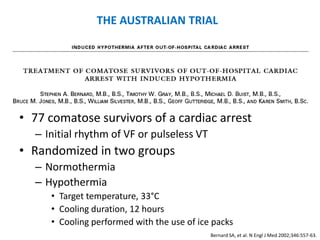
THE AUSTRALIAN TRIAL


• 77 comatose survivors of a cardiac arrest
  – Initial rhythm of VF or pulseless VT
• Randomized in two groups
  – Normothermia
  – Hypothermia
     • Target temperature, 33°C
     • Cooling duration, 12 hours
     • Cooling performed with the use of ice packs
                                            Bernard SA, et al. N Engl J Med 2002;346:557-63.
• Favorable neurologic recovery at hospital discharge
    –   Hypothermia group: 21/43 pts (49%)
    –   Normothermia group: 9/34 pts (26%)
    –   (P = 0.05)
    –   The odds ratio 5.25 (95% confidence interval [CI], 1.47 to 18.76; P = 0.01),
        after adjustment for age and duration of the arrest

                                                             Bernard SA, et al. N Engl J Med 2002;346:557-63.
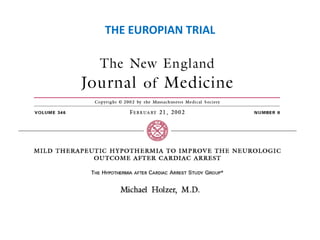
THE EUROPIAN TRIAL
• Multicenter trial
• 275 comatose survivors of a cardiac arrest of
  cardiac cause
  – VF
  – Pulseless VT
• Randomized in 2 groups
  – Normothermia
  – Hypothermia
     • Target temperature, 32 - 34°C
     • Cooling duration, 24 hours
     • Cooling with the use of cold air


                          Holtzer M. N Engl J Med 2002;346: 549-56. [Erratum, N Engl J Med 2002;346: 1756.]
Holtzer M. N Engl J Med 2002;346: 549-56. [Erratum, N Engl J Med 2002;346: 1756.]
• Favorable neurologic recovery after 6 months
  (good recovery or moderate disability)
   – Hypothermia: 75/136 pts (55%)
   – Normothermia: 54/137 pts (39%)
• Significant reduction in the rate of death at 6
  months

                      Holtzer M. N Engl J Med 2002;346: 549-56. [Erratum, N Engl J Med 2002;346: 1756.]
P value
                                             0.02


Holtzer M. N Engl J Med 2002;346: 549-56. [Erratum, N Engl J Med 2002;346: 1756.]
CLINICAL USE OF THERAPEUTIC HYPOTHERMIA

• According to the two major trials
  – Out-of-hospital comatose patients after cardiac
    arrest
  – Successfully resuscitated (return of spontaneous
    circulation)
  – Cardiac arrest with an initial rhythm
     • VF
     • Pulseless VT
  – Hemodynamically stable
Q2
 WHO SHOULD UNDERGO TARGETED
  TEMPERATURE MANAGEMENT?
1. Comatose stable patient with out-of-hospital
   post cardiac arrest, with schockable initial
   cardiac rhythm (VF, pulseless VT) after ROSC
2. Comatose unstable patient with in-hospital
   post cardiac arrest, with non-shockable initial
   cardiac rhythm (Asyatole, PEA) after ROSC
3. Both groups may benefit from therapeutic
   hypothermia
AREAS OF UNCERTAINTY
  Who Should Undergo Targeted Temperature Management

• Both groups have the same pathophysiology
  of brain damage
  – Global ischemia
  – Reperfusion
• Both groups may benefit from therapeutic
  hypothermia
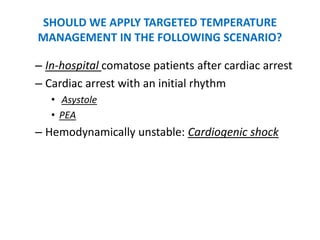
SHOULD WE APPLY TARGETED TEMPERATURE
MANAGEMENT IN THE FOLLOWING SCENARIO?

– In-hospital comatose patients after cardiac arrest
– Cardiac arrest with an initial rhythm
   • Asystole
   • PEA
– Hemodynamically unstable: Cardiogenic shock
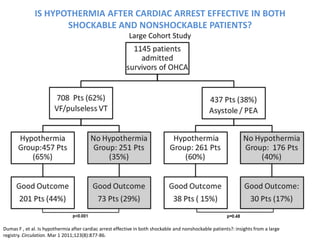
IS HYPOTHERMIA AFTER CARDIAC ARREST EFFECTIVE IN BOTH
                     SHOCKABLE AND NONSHOCKABLE PATIENTS?
                                                           Large Cohort Study


Dumas F , et al. Is hypothermia after cardiac arrest effective in both shockable and nonshockable patients?: insights from a large
registry. Circulation. Mar 1 2011;123(8):877-86.
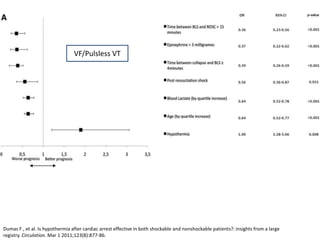
VF/Pulsless VT


Dumas F , et al. Is hypothermia after cardiac arrest effective in both shockable and nonshockable patients?: insights from a large
registry. Circulation. Mar 1 2011;123(8):877-86.
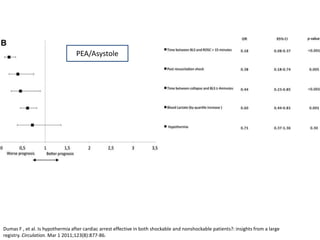
PEA/Asystole


Dumas F , et al. Is hypothermia after cardiac arrest effective in both shockable and nonshockable patients?: insights from a large
registry. Circulation. Mar 1 2011;123(8):877-86.
IS HYPOTHERMIA AFTER CARDIAC ARREST EFFECTIVE IN BOTH
                SHOCKABLE AND NONSHOCKABLE PATIENTS?

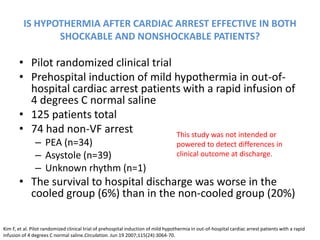
       • Pilot randomized clinical trial
       • Prehospital induction of mild hypothermia in out-of-
         hospital cardiac arrest patients with a rapid infusion of
         4 degrees C normal saline
       • 125 patients total
       • 74 had non-VF arrest            This study was not intended or
               – PEA (n=34)                                                        powered to detect differences in
               – Asystole (n=39)                                                   clinical outcome at discharge.
               – Unknown rhythm (n=1)
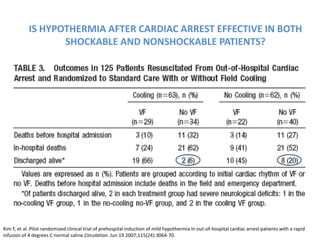
       • The survival to hospital discharge was worse in the
         cooled group (6%) than in the non-cooled group (20%)

Kim F, et al. Pilot randomized clinical trial of prehospital induction of mild hypothermia in out-of-hospital cardiac arrest patients with a rapid
infusion of 4 degrees C normal saline.Circulation. Jun 19 2007;115(24):3064-70.
IS HYPOTHERMIA AFTER CARDIAC ARREST EFFECTIVE IN BOTH
                   SHOCKABLE AND NONSHOCKABLE PATIENTS?


Kim F, et al. Pilot randomized clinical trial of prehospital induction of mild hypothermia in out-of-hospital cardiac arrest patients with a rapid
infusion of 4 degrees C normal saline.Circulation. Jun 19 2007;115(24):3064-70.
IS HYPOTHERMIA AFTER CARDIAC ARREST EFFECTIVE IN BOTH
       SHOCKABLE AND NONSHOCKABLE PATIENTS?

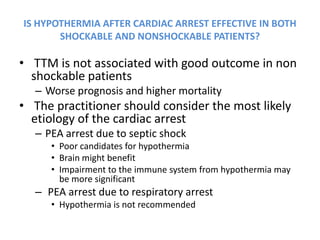
• TTM is not associated with good outcome in non
  shockable patients
  – Worse prognosis and higher mortality
• The practitioner should consider the most likely
  etiology of the cardiac arrest
  – PEA arrest due to septic shock
     • Poor candidates for hypothermia
     • Brain might benefit
     • Impairment to the immune system from hypothermia may
       be more significant
  – PEA arrest due to respiratory arrest
     • Hypothermia is not recommended
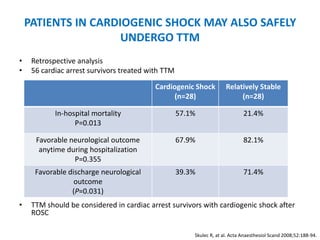
PATIENTS IN CARDIOGENIC SHOCK MAY ALSO SAFELY
                     UNDERGO TTM
•    Retrospective analysis
•    56 cardiac arrest survivors treated with TTM

                                           Cardiogenic Shock          Relatively Stable
                                                 (n=28)                    (n=28)

            In-hospital mortality                   57.1%                     21.4%
                  P=0.013

      Favorable neurological outcome                67.9%                     82.1%
       anytime during hospitalization
                 P=0.355
      Favorable discharge neurological              39.3%                     71.4%
                  outcome
                 (P=0.031)
•    TTM should be considered in cardiac arrest survivors with cardiogenic shock after
     ROSC

                                                        Skulec R, at al. Acta Anaesthesiol Scand 2008;52:188-94.
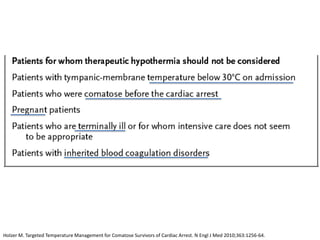
Q3
     TARGETED TEMPERATURE
   MANAGEMENT SHOULD NOT BE
         CONSIDERED?
1. Pt with body core temperature below 30 C on
   admission
2. Pt who was comatose before the cardiac arrest
3. Pregnant patient
4. Pt who is terminally ill
5. Pt with profound blood coagulopathy
6. All of the above
Holzer M. Targeted Temperature Management for Comatose Survivors of Cardiac Arrest. N Engl J Med 2010;363:1256-64.
THE TIME DEPENDENCE OF TREATMENT

• No data are available from large-scale clinical
  trials in humans
• Animal models
• Should be initiated as early as possible and
  not later than 10 hours after the cardiac arrest
• Delay in the initiation of TTM may diminish
  the beneficial effects


                                 Kuboyama K, et al. Crit Care Med 1993;21:1348-58.
                                    Colbourne F, et al. J Neurosci 1995;15:7250-60.
The Hypothermia after Cardiac Arrest Study Group. Mild therapeutic hypothermia to improve the neurologic outcome after cardiac arrest. N Engl
J Med 2002;346: 549-56. [Erratum, N Engl J Med 2002;346: 1756.]
ANESTHESIA AND ANALGESIA PROTOCOL DURING
                     TTM
• Shivering may occur when you reach a body temperature of 35 C
• Sedation, analgesia, and paralysis to prevent shivering
   – should be initiated when you reach a body temperature of 35 C
• Shivering can lead to
   –   Stress like response
   –   Increased oxygen consumption
   –   Increase in the heart rate
   –   Excessively laborious breathing
   –   Impede the cooling process
• 68 ICUs from various countries
   – Midazolam: the most used sedative (5 mg/h and 0.3 mg/kg/h)
   – Fentanyl : The most used analgesic (0.5 and 10 μg/kg/h)
   – Pancuronium: the most used paralytic followed by cisatracurium


                                                Chamorro C, et al. Anesth Analg 2010;110:1328-35.
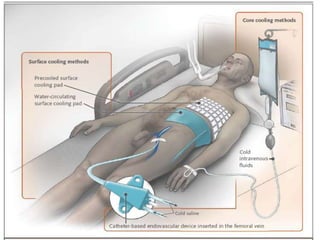
COOLING METHODS

• Surface cooling
   – Ice packs around the head, neck, torso, and limbs (in the
     Australian trial)
   – Cold-air mattress covering the entire body (in the European
     trial)
• Core cooling
   – Intravascular cooling catheters (made of metal or containing
     balloons filled with cold saline)
   – Intravenous infusion of cold fluids
       • 30 ml/kg (2 L for a patient who weighs 70 kg)of cold (4°C) lactated
         Ringer’s solution administered intravenously over the course of 30
         minutes
• Combination of core-cooling and surface-cooling methods
MEASUREMENT OF THE CORE BODY TEMPERATURE

• The temperature in the bladder and rectum
  may be slow to reflect a change in core body
  temperature
• Core body temperature should be measured
  at:
  – Central monitoring sites: the esophagus (with the
    use of a multipurpose temperature probe)
  – Central venous system (with the use of a Swan–
    Ganz catheter)

                                     Stone JG, et al. Anesthesiology 1995;82:344-51.
Q4
 WHAT WOULD YOU EXPECT DURING
    TARGETED TEMPERATURE
        MANAGEMENT?
1. Left shift in the oxyhemoglobin dissociation
   curve
2. Tissue hypoxia
3. Respiratory alkalosis
4. All of the above
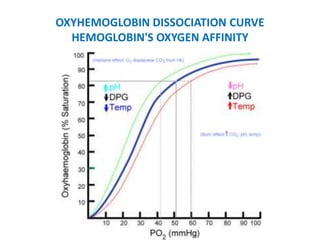
OXYHEMOGLOBIN DISSOCIATION CURVE
  HEMOGLOBIN'S OXYGEN AFFINITY
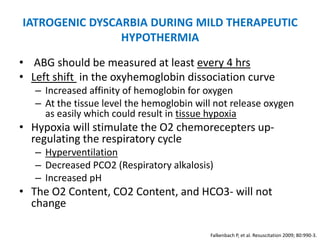
IATROGENIC DYSCARBIA DURING MILD THERAPEUTIC
                HYPOTHERMIA

• ABG should be measured at least every 4 hrs
• Left shift in the oxyhemoglobin dissociation curve
   – Increased affinity of hemoglobin for oxygen
   – At the tissue level the hemoglobin will not release oxygen
     as easily which could result in tissue hypoxia
• Hypoxia will stimulate the O2 chemorecepters up-
  regulating the respiratory cycle
   – Hyperventilation
   – Decreased PCO2 (Respiratory alkalosis)
   – Increased pH
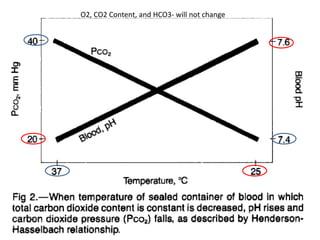
• The O2 Content, CO2 Content, and HCO3- will not
  change

                                           Falkenbach P, et al. Resuscitation 2009; 80:990-3.
O2, CO2 Content, and HCO3- will not change
ABG TEMPERATURE CORRECTION: TO CORRECT OR
     NOT TO CORRECT; THAT IS THE QUESTION

• “corrected" : corrected to the pt’s body temperature.
  The ABG analyzer readings at the patient's body
  temperature
• "non-corrected" : The ABG analyzer readings at 37
• Final recommendation is to assess the acid-base and
  oxygenation status by looking at the non-corrected
  ABG (at 37 degree) regardless of the patient's actual
  temperature
• We need to adjust mechanical ventilation to meet the
  patient’s needs
   – The goal of achieving normal [PaCO2] and sufficient
     oxygenation
METABOLIC DISTURBANCES IN HYPOTHERMIA

• Regular measurement of electrolyte and
  glucose levels is necessary
• Hypothermia can induce
  – Hypokalemia
  – Hypomagnesemia
  – Hypophosphatemia
  – Hyperglycemia


                              Polderman KH, et al. J Neurosurg 2001; 94:697-705.
Q5
A 62-year-old man collapses on the street, and emergency medical personnel who are
    called to the scene find that he is not breathing and that he has no pulse. The first
    recorded cardiac rhythm is ventricular fibrillation.
ACLS measures, including intubation, a total dose of 2 mg of epinephrine, and six
    defibrillation attempts, ROSC 22 minutes after the onset of the event.
On admission to the emergency department, his condition is hemodynamically stable
    and he has adequate oxygenation and ventilation, but he is still comatose. A
    neurologic examination reveals reactive pupils and a positive cough reflex. The
    core body temperature is 35.5°C. A diagnosis of the post–cardiac arrest syndrome
    with coma is made.
Targeted temperature management was initiated. 6 hours later the core body
    temperature is 30 C and the patient starts bleeding from the CVC insertion site
    with profound hematuria. What would you do next:

1.   Transfuse platelets due to mild hypothermia induced thrombocyotpenia
2.   Transfuse FFP
3.   Transfuse Cryo
4.   Raise the temperature level until these side effects resolve
COAGULATION DISORDER IN HYPOTHERMIA

• Higher risk of bleeding
• Inhibits human platelet activation
• Leukopenia and thrombocytopenia
  – Typically do not require intervention
  – Rarely severe thrombocytopenia may develop
• It is reasonable to raise the temperature level
  until these side effects resolve


                               Michelson AD, et al. Thromb Haemost 1994;71:633-40.
NONCONVULSIVE SEIZURES IN HYPOTHERMIA

• Nonconvulsive seizures can occur during
  hypothermia
• It is reasonable to perform continuous EEG
  monitoring to detect these seizures and to
  treat them if they occur
• Unknown if it improves the long-term
  outcome


                             Rundgren M, et al. Intensive Care Med 2006;32: 836-42.
HEMODYNAMIC INSTABILITY DURING HYPOTHERMIA

• Rewarming may not be helpful
  – Vasodilatation can occur during rewarming
• Fluid replacement
• Inotropics
• Pressors


                    Holtzer M. N Engl J Med 2002;346: 549-56. [Erratum, N Engl J Med 2002;346: 1756.]
REWARMING

• After maintenance of hypothermia for 24 hours
• Slowly (0.3 to 0.5°C per hour) to normal core temperature(36.5 to
  37.5°C)
• Temperature should be kept within the normal range for up to 48
  hrs
• Above normal body temperatures should be avoided
   – Hyperthermia could worsen the outcome
   – Unfavorable neurologic ischemia
   – Excitotoxicity
• Rewarming methods
   – Passive rewarming is preferred
   – Blowing warm air over the patient
   – Covering the patient with blankets
• Paralytic agents are discontinued at 35°C


                                                 Zeiner A, et al. Cell Calcium 2010;47:122-9.
The Hypothermia after Cardiac Arrest Study Group. Mild therapeutic hypothermia to improve the neurologic outcome after cardiac arrest. N Engl
J Med 2002;346: 549-56. [Erratum, N Engl J Med 2002;346: 1756.]
ADVERSE EFFECTS

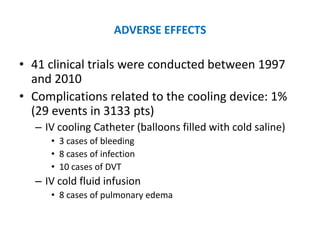
• 41 clinical trials were conducted between 1997
  and 2010
• Complications related to the cooling device: 1%
  (29 events in 3133 pts)
  – IV cooling Catheter (balloons filled with cold saline)
     • 3 cases of bleeding
     • 8 cases of infection
     • 10 cases of DVT
  – IV cold fluid infusion
     • 8 cases of pulmonary edema
ADVERSE EFFECTS

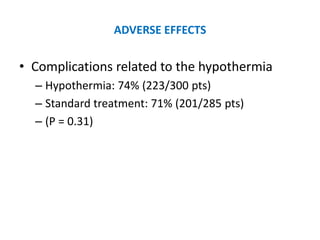
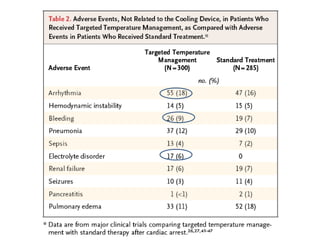
• Complications related to the hypothermia
  – Hypothermia: 74% (223/300 pts)
  – Standard treatment: 71% (201/285 pts)
  – (P = 0.31)
ADVERSE EFFECTS

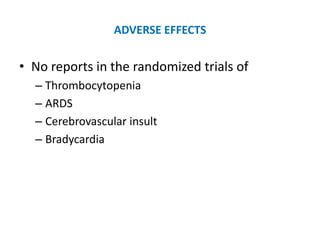
• No reports in the randomized trials of
  – Thrombocytopenia
  – ARDS
  – Cerebrovascular insult
  – Bradycardia
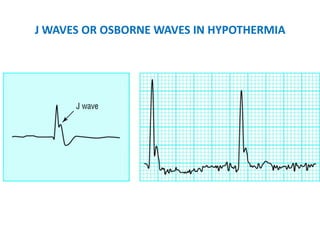
J WAVES OR OSBORNE WAVES IN HYPOTHERMIA
ADVERSE EFFECTS

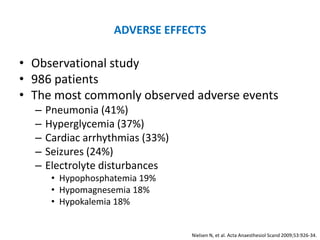
• Observational study
• 986 patients
• The most commonly observed adverse events
  –   Pneumonia (41%)
  –   Hyperglycemia (37%)
  –   Cardiac arrhythmias (33%)
  –   Seizures (24%)
  –   Electrolyte disturbances
       • Hypophosphatemia 19%
       • Hypomagnesemia 18%
       • Hypokalemia 18%


                                  Nielsen N, et al. Acta Anaesthesiol Scand 2009;53:926-34.
AREAS OF UNCERTAINTY
   What is The Optimal Regimen of Sedation, Analgesia, and
                         Relaxation
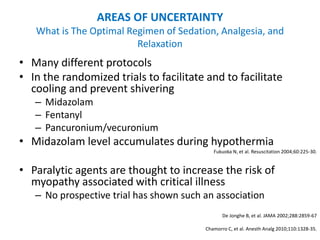
• Many different protocols
• In the randomized trials to facilitate and to facilitate
  cooling and prevent shivering
   – Midazolam
   – Fentanyl
   – Pancuronium/vecuronium
• Midazolam level accumulates during hypothermia
                                            Fukuoka N, et al. Resuscitation 2004;60:225-30.


• Paralytic agents are thought to increase the risk of
  myopathy associated with critical illness
   – No prospective trial has shown such an association
                                                De Jonghe B, et al. JAMA 2002;288:2859-67

                                         Chamorro C, et al. Anesth Analg 2010;110:1328-35.
AREAS OF UNCERTAINTY

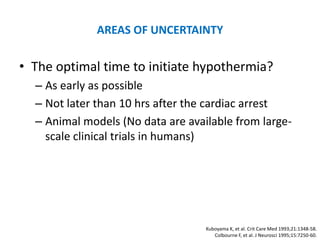
• The optimal time to initiate hypothermia?
  – As early as possible
  – Not later than 10 hrs after the cardiac arrest
  – Animal models (No data are available from large-
    scale clinical trials in humans)


                                   Kuboyama K, et al. Crit Care Med 1993;21:1348-58.
                                      Colbourne F, et al. J Neurosci 1995;15:7250-60.
AREAS OF UNCERTAINTY

• The optimal length of time that should be
  taken to reach the target temperature?
  – It should be fast
  – 4-8 hrs (in the European trial)
The Hypothermia after Cardiac Arrest Study Group. Mild therapeutic hypothermia to improve the neurologic outcome after cardiac arrest. N Engl
J Med 2002;346: 549-56. [Erratum, N Engl J Med 2002;346: 1756.]
AREAS OF UNCERTAINTY

       • The optimal duration of hypothermia?
       • The major randomized trials (the European)
              – Cooling duration, 24 hours
       • Longer exposure to hypothermia (>24hrs)
         might be required in the setting of more
         severe injury
              – Studies in rodents


Colbourne F, Corbett D. Delayed and prolonged post-ischemic hypothermia is neuroprotective in the gerbil. Brain Res 1994;654:265-72.
AREAS OF UNCERTAINTY

• The optimal level of hypothermia?
• The major randomized trials (the Australian
  and the European)
  – Target temperature, 32 - 34°C
• Milder levels of hypothermia (35°C) might
  have similar protective effects
  – Studies in rats


                                    Logue ES, et al. Acad Emerg Med 2007;14:293-300.
AREAS OF UNCERTAINTY

• The effect of the rewarming rate on the
  neurologic outcome after cardiac arrest?
• The major randomized trials (the Australian
  and the European)
  – 0.3 to 0.5°C / hr to normal core temperature(37°C)
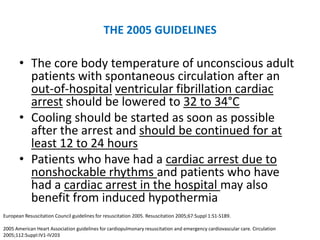
THE 2005 GUIDELINES

       • The core body temperature of unconscious adult
         patients with spontaneous circulation after an
         out-of-hospital ventricular fibrillation cardiac
         arrest should be lowered to 32 to 34°C
       • Cooling should be started as soon as possible
         after the arrest and should be continued for at
         least 12 to 24 hours
       • Patients who have had a cardiac arrest due to
         nonshockable rhythms and patients who have
         had a cardiac arrest in the hospital may also
         benefit from induced hypothermia
European Resuscitation Council guidelines for resuscitation 2005. Resuscitation 2005;67:Suppl 1:S1-S189.

2005 American Heart Association guidelines for cardiopulmonary resuscitation and emergency cardiovascular care. Circulation
2005;112:Suppl:IV1-IV203
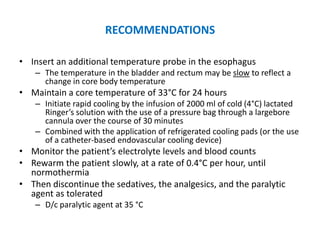
RECOMMENDATIONS

• Insert an additional temperature probe in the esophagus
    – The temperature in the bladder and rectum may be slow to reflect a
      change in core body temperature
• Maintain a core temperature of 33°C for 24 hours
    – Initiate rapid cooling by the infusion of 2000 ml of cold (4°C) lactated
      Ringer’s solution with the use of a pressure bag through a largebore
      cannula over the course of 30 minutes
    – Combined with the application of refrigerated cooling pads (or the use
      of a catheter-based endovascular cooling device)
• Monitor the patient’s electrolyte levels and blood counts
• Rewarm the patient slowly, at a rate of 0.4°C per hour, until
  normothermia
• Then discontinue the sedatives, the analgesics, and the paralytic
  agent as tolerated
    – D/c paralytic agent at 35 °C

Targeted Temperature Management (Therapeutic Hypothermia) in Critical Care: Mechanism of Benefit, Clinical Use and Recommendations, and Relevant Formal Guidelines

  • 1.
    Targeted Temperature Managementin Critical Care: Mechanism of Benefit, Clinical Use and Recommendations, and Relevant Formal Guidelines Bassel Ericsoussi, MD Fellow, Pulmonary and Critical Care Medicine University of Illinois Medical Center at Chicago
  • 2.
    Q1 A 35-year-old pregnantwoman collapses on the street, and emergency medical personnel who are called to the scene find that she is not breathing and that she has no pulse. The first recorded cardiac rhythm is ventricular fibrillation. ACLS measures, including intubation, a total dose of 2 mg of epinephrine, and six defibrillation attempts, restore spontaneous circulation (ROSC) 22 minutes after the onset of the event. On admission to the emergency department, her condition is hemodynamically stable and she has adequate oxygenation and ventilation, but she is still comatose. A neurologic examination reveals reactive pupils and a positive cough reflex. The core body temperature is 30°C. And she was found profoundly coagulopathic. A diagnosis of the post–cardiac arrest syndrome with coma is made. An intensive care specialist evaluates the patient and recommends the immediate initiation of targeted temperature management (TTM). Do you agree with this plan?
  • 3.
    THE CLINICAL PROBLEM •350,000 - 450,000/yr out-of-hospital cardiac arrests in the USA • 100,000 attempted rescusetation of these arrests • 40,000 patients survive to hospital admission • 1/3 of these admitted pts survive to hospital discharge Schulman SP, et al. Neurol Clin 2006;24:41-59.
  • 4.
    The Cost ofCare During The First 6 Months After a Cardiac Arrest • $200,000 for a pt with good recovery or moderate disability • $300,000 for a comatose pt, or pt in a persistent vegetative state, or pt suffering from varying degrees of cognitive dysfunction and other neurologic deficits • less than $10,000 for a pt with brain death • The incremental cost for an average pt – Targeted temperature management: $30,000 – Conventional care: $100,000 Merchant RM, et al. Circ Cardiovasc Qual Outcomes 2009;2:421-8.
  • 5.
    “POST–CARDIAC ARREST SYNDROME” •Brain injury – 80% of pts remain comatose > 1 hr after resuscitation • Myocardial dysfunction • Systemic ischemia • Reperfusion responses • Consequences of the disorder that caused the cardiac arrest. Nolan JP, et al. Resuscitation 2008;79:350-79.
  • 6.
    PATHOPHYSIOLOGY OF CARDICACARREST AND BRAIN INJURY • In animal models of cardiac arrest – Stores of oxygen in the brain are lost in seconds – Stores of glucose and ATP are lost within 5 minutes Greer DM, et al. Semin Neurol 2006;26: 373-9.
  • 7.
    PATHOPHYSIOLOGY OF CARDICACARREST AND BRAIN INJURY • Tissue hypoxia: – Loss of transmembrane electrochemical gradients – Failure of synaptic transmission, axonal conduction, and action-potential firing Hoesch RE, et al. Crit Care Clin 2008;24:25-44.
  • 8.
    PATHOPHYSIOLOGY OF CARDICACARREST AND BRAIN INJURY • Neuronal necrosis and apoptosis due to – The release of glutamate – The accumulation of intracellular calcium Redmond JM, et al. J Thorac Cardiovasc Surg 1994;107:776-86. Szydlowska K, et al. Cell Calcium 2010;47:122-9.
  • 9.
    REPERFUSION INJURY • Restorationof circulation can cause further neuronal damage over a period of hours to days – Vasomotor paralysis, followed by hypoperfusion Sterz F, et al. Resuscitation 1992;24:27-47. – Reoxygenation produces lipid peroxidation and oxidative stress Ernster L, et al. Crit Care Med 1988;16:947-53. – Endothelial activation, leukocyte infiltration, and further tissue injury Wong CHY, et al. Curr Med Chem 2008;15:1-14.
  • 10.
    THE EFFECT OFTHERAPEUTIC HYPOTHERMIA • Limit neurologic injury after a patient’s resuscitation from cardiac arrest – Reduction in brain metabolism – Reduction in oxygen utilization – Reduction in ATP consumption McCullough JN, et al. Ann Thorac Surg 1999;67:1895-9. Laptook AR, et al. Pediatr Res 1995;38:919-25. • Inhibit the release of glutamate and dopamine Hachimi-Idrissi S, et al. Brain Res 2004;1019:217-25.
  • 11.
    THE EFFECT OFTHERAPEUTIC HYPOTHERMIA (cont.) • Inhibit apoptosis (reduction in calcium overload and glutamate release) Eberspächer E, et al. Acta Anaesthesiol Scand 2005;49:477-87. • Suppress the inflammation that occurs after global cerebral ischemia Webster CM, et al. Neurobiol Dis 2009;33:301-12. • Reduce reperfusion injury Karibe H, et al. J Cereb Blood Flow Metab 1994;14:620-7. • Decreases reoxygenation (lipid peroxidation and oxidative stress) Maier CM, et al. Neurobiol Dis 2002; 11:28-42.
  • 12.
    CLINICAL EVIDENCE • Thefirst major clinical trials were published in 2002. • One conducted in Australia and the other in Europe • The basis for clinical guidelines regarding the use of therapeutic hypothermia in patients who have had a cardiac arrest
  • 13.
    THE AUSTRALIAN TRIAL •77 comatose survivors of a cardiac arrest – Initial rhythm of VF or pulseless VT • Randomized in two groups – Normothermia – Hypothermia • Target temperature, 33°C • Cooling duration, 12 hours • Cooling performed with the use of ice packs Bernard SA, et al. N Engl J Med 2002;346:557-63.
  • 14.
    • Favorable neurologicrecovery at hospital discharge – Hypothermia group: 21/43 pts (49%) – Normothermia group: 9/34 pts (26%) – (P = 0.05) – The odds ratio 5.25 (95% confidence interval [CI], 1.47 to 18.76; P = 0.01), after adjustment for age and duration of the arrest Bernard SA, et al. N Engl J Med 2002;346:557-63.
  • 15.
  • 16.
    • Multicenter trial •275 comatose survivors of a cardiac arrest of cardiac cause – VF – Pulseless VT • Randomized in 2 groups – Normothermia – Hypothermia • Target temperature, 32 - 34°C • Cooling duration, 24 hours • Cooling with the use of cold air Holtzer M. N Engl J Med 2002;346: 549-56. [Erratum, N Engl J Med 2002;346: 1756.]
  • 17.
    Holtzer M. NEngl J Med 2002;346: 549-56. [Erratum, N Engl J Med 2002;346: 1756.]
  • 18.
    • Favorable neurologicrecovery after 6 months (good recovery or moderate disability) – Hypothermia: 75/136 pts (55%) – Normothermia: 54/137 pts (39%) • Significant reduction in the rate of death at 6 months Holtzer M. N Engl J Med 2002;346: 549-56. [Erratum, N Engl J Med 2002;346: 1756.]
  • 19.
    P value 0.02 Holtzer M. N Engl J Med 2002;346: 549-56. [Erratum, N Engl J Med 2002;346: 1756.]
  • 20.
    CLINICAL USE OFTHERAPEUTIC HYPOTHERMIA • According to the two major trials – Out-of-hospital comatose patients after cardiac arrest – Successfully resuscitated (return of spontaneous circulation) – Cardiac arrest with an initial rhythm • VF • Pulseless VT – Hemodynamically stable
  • 21.
    Q2 WHO SHOULDUNDERGO TARGETED TEMPERATURE MANAGEMENT? 1. Comatose stable patient with out-of-hospital post cardiac arrest, with schockable initial cardiac rhythm (VF, pulseless VT) after ROSC 2. Comatose unstable patient with in-hospital post cardiac arrest, with non-shockable initial cardiac rhythm (Asyatole, PEA) after ROSC 3. Both groups may benefit from therapeutic hypothermia
  • 22.
    AREAS OF UNCERTAINTY Who Should Undergo Targeted Temperature Management • Both groups have the same pathophysiology of brain damage – Global ischemia – Reperfusion • Both groups may benefit from therapeutic hypothermia
  • 23.
    SHOULD WE APPLYTARGETED TEMPERATURE MANAGEMENT IN THE FOLLOWING SCENARIO? – In-hospital comatose patients after cardiac arrest – Cardiac arrest with an initial rhythm • Asystole • PEA – Hemodynamically unstable: Cardiogenic shock
  • 24.
    IS HYPOTHERMIA AFTERCARDIAC ARREST EFFECTIVE IN BOTH SHOCKABLE AND NONSHOCKABLE PATIENTS? Large Cohort Study Dumas F , et al. Is hypothermia after cardiac arrest effective in both shockable and nonshockable patients?: insights from a large registry. Circulation. Mar 1 2011;123(8):877-86.
  • 25.
    VF/Pulsless VT Dumas F, et al. Is hypothermia after cardiac arrest effective in both shockable and nonshockable patients?: insights from a large registry. Circulation. Mar 1 2011;123(8):877-86.
  • 26.
    PEA/Asystole Dumas F ,et al. Is hypothermia after cardiac arrest effective in both shockable and nonshockable patients?: insights from a large registry. Circulation. Mar 1 2011;123(8):877-86.
  • 27.
    IS HYPOTHERMIA AFTERCARDIAC ARREST EFFECTIVE IN BOTH SHOCKABLE AND NONSHOCKABLE PATIENTS? • Pilot randomized clinical trial • Prehospital induction of mild hypothermia in out-of- hospital cardiac arrest patients with a rapid infusion of 4 degrees C normal saline • 125 patients total • 74 had non-VF arrest This study was not intended or – PEA (n=34) powered to detect differences in – Asystole (n=39) clinical outcome at discharge. – Unknown rhythm (n=1) • The survival to hospital discharge was worse in the cooled group (6%) than in the non-cooled group (20%) Kim F, et al. Pilot randomized clinical trial of prehospital induction of mild hypothermia in out-of-hospital cardiac arrest patients with a rapid infusion of 4 degrees C normal saline.Circulation. Jun 19 2007;115(24):3064-70.
  • 28.
    IS HYPOTHERMIA AFTERCARDIAC ARREST EFFECTIVE IN BOTH SHOCKABLE AND NONSHOCKABLE PATIENTS? Kim F, et al. Pilot randomized clinical trial of prehospital induction of mild hypothermia in out-of-hospital cardiac arrest patients with a rapid infusion of 4 degrees C normal saline.Circulation. Jun 19 2007;115(24):3064-70.
  • 29.
    IS HYPOTHERMIA AFTERCARDIAC ARREST EFFECTIVE IN BOTH SHOCKABLE AND NONSHOCKABLE PATIENTS? • TTM is not associated with good outcome in non shockable patients – Worse prognosis and higher mortality • The practitioner should consider the most likely etiology of the cardiac arrest – PEA arrest due to septic shock • Poor candidates for hypothermia • Brain might benefit • Impairment to the immune system from hypothermia may be more significant – PEA arrest due to respiratory arrest • Hypothermia is not recommended
  • 30.
    PATIENTS IN CARDIOGENICSHOCK MAY ALSO SAFELY UNDERGO TTM • Retrospective analysis • 56 cardiac arrest survivors treated with TTM Cardiogenic Shock Relatively Stable (n=28) (n=28) In-hospital mortality 57.1% 21.4% P=0.013 Favorable neurological outcome 67.9% 82.1% anytime during hospitalization P=0.355 Favorable discharge neurological 39.3% 71.4% outcome (P=0.031) • TTM should be considered in cardiac arrest survivors with cardiogenic shock after ROSC Skulec R, at al. Acta Anaesthesiol Scand 2008;52:188-94.
  • 31.
    Q3 TARGETED TEMPERATURE MANAGEMENT SHOULD NOT BE CONSIDERED? 1. Pt with body core temperature below 30 C on admission 2. Pt who was comatose before the cardiac arrest 3. Pregnant patient 4. Pt who is terminally ill 5. Pt with profound blood coagulopathy 6. All of the above
  • 32.
    Holzer M. TargetedTemperature Management for Comatose Survivors of Cardiac Arrest. N Engl J Med 2010;363:1256-64.
  • 33.
    THE TIME DEPENDENCEOF TREATMENT • No data are available from large-scale clinical trials in humans • Animal models • Should be initiated as early as possible and not later than 10 hours after the cardiac arrest • Delay in the initiation of TTM may diminish the beneficial effects Kuboyama K, et al. Crit Care Med 1993;21:1348-58. Colbourne F, et al. J Neurosci 1995;15:7250-60.
  • 34.
    The Hypothermia afterCardiac Arrest Study Group. Mild therapeutic hypothermia to improve the neurologic outcome after cardiac arrest. N Engl J Med 2002;346: 549-56. [Erratum, N Engl J Med 2002;346: 1756.]
  • 35.
    ANESTHESIA AND ANALGESIAPROTOCOL DURING TTM • Shivering may occur when you reach a body temperature of 35 C • Sedation, analgesia, and paralysis to prevent shivering – should be initiated when you reach a body temperature of 35 C • Shivering can lead to – Stress like response – Increased oxygen consumption – Increase in the heart rate – Excessively laborious breathing – Impede the cooling process • 68 ICUs from various countries – Midazolam: the most used sedative (5 mg/h and 0.3 mg/kg/h) – Fentanyl : The most used analgesic (0.5 and 10 μg/kg/h) – Pancuronium: the most used paralytic followed by cisatracurium Chamorro C, et al. Anesth Analg 2010;110:1328-35.
  • 36.
    COOLING METHODS • Surfacecooling – Ice packs around the head, neck, torso, and limbs (in the Australian trial) – Cold-air mattress covering the entire body (in the European trial) • Core cooling – Intravascular cooling catheters (made of metal or containing balloons filled with cold saline) – Intravenous infusion of cold fluids • 30 ml/kg (2 L for a patient who weighs 70 kg)of cold (4°C) lactated Ringer’s solution administered intravenously over the course of 30 minutes • Combination of core-cooling and surface-cooling methods
  • 38.
    MEASUREMENT OF THECORE BODY TEMPERATURE • The temperature in the bladder and rectum may be slow to reflect a change in core body temperature • Core body temperature should be measured at: – Central monitoring sites: the esophagus (with the use of a multipurpose temperature probe) – Central venous system (with the use of a Swan– Ganz catheter) Stone JG, et al. Anesthesiology 1995;82:344-51.
  • 39.
    Q4 WHAT WOULDYOU EXPECT DURING TARGETED TEMPERATURE MANAGEMENT? 1. Left shift in the oxyhemoglobin dissociation curve 2. Tissue hypoxia 3. Respiratory alkalosis 4. All of the above
  • 40.
    OXYHEMOGLOBIN DISSOCIATION CURVE HEMOGLOBIN'S OXYGEN AFFINITY
  • 41.
    IATROGENIC DYSCARBIA DURINGMILD THERAPEUTIC HYPOTHERMIA • ABG should be measured at least every 4 hrs • Left shift in the oxyhemoglobin dissociation curve – Increased affinity of hemoglobin for oxygen – At the tissue level the hemoglobin will not release oxygen as easily which could result in tissue hypoxia • Hypoxia will stimulate the O2 chemorecepters up- regulating the respiratory cycle – Hyperventilation – Decreased PCO2 (Respiratory alkalosis) – Increased pH • The O2 Content, CO2 Content, and HCO3- will not change Falkenbach P, et al. Resuscitation 2009; 80:990-3.
  • 42.
    O2, CO2 Content,and HCO3- will not change
  • 43.
    ABG TEMPERATURE CORRECTION:TO CORRECT OR NOT TO CORRECT; THAT IS THE QUESTION • “corrected" : corrected to the pt’s body temperature. The ABG analyzer readings at the patient's body temperature • "non-corrected" : The ABG analyzer readings at 37 • Final recommendation is to assess the acid-base and oxygenation status by looking at the non-corrected ABG (at 37 degree) regardless of the patient's actual temperature • We need to adjust mechanical ventilation to meet the patient’s needs – The goal of achieving normal [PaCO2] and sufficient oxygenation
  • 44.
    METABOLIC DISTURBANCES INHYPOTHERMIA • Regular measurement of electrolyte and glucose levels is necessary • Hypothermia can induce – Hypokalemia – Hypomagnesemia – Hypophosphatemia – Hyperglycemia Polderman KH, et al. J Neurosurg 2001; 94:697-705.
  • 45.
    Q5 A 62-year-old mancollapses on the street, and emergency medical personnel who are called to the scene find that he is not breathing and that he has no pulse. The first recorded cardiac rhythm is ventricular fibrillation. ACLS measures, including intubation, a total dose of 2 mg of epinephrine, and six defibrillation attempts, ROSC 22 minutes after the onset of the event. On admission to the emergency department, his condition is hemodynamically stable and he has adequate oxygenation and ventilation, but he is still comatose. A neurologic examination reveals reactive pupils and a positive cough reflex. The core body temperature is 35.5°C. A diagnosis of the post–cardiac arrest syndrome with coma is made. Targeted temperature management was initiated. 6 hours later the core body temperature is 30 C and the patient starts bleeding from the CVC insertion site with profound hematuria. What would you do next: 1. Transfuse platelets due to mild hypothermia induced thrombocyotpenia 2. Transfuse FFP 3. Transfuse Cryo 4. Raise the temperature level until these side effects resolve
  • 46.
    COAGULATION DISORDER INHYPOTHERMIA • Higher risk of bleeding • Inhibits human platelet activation • Leukopenia and thrombocytopenia – Typically do not require intervention – Rarely severe thrombocytopenia may develop • It is reasonable to raise the temperature level until these side effects resolve Michelson AD, et al. Thromb Haemost 1994;71:633-40.
  • 47.
    NONCONVULSIVE SEIZURES INHYPOTHERMIA • Nonconvulsive seizures can occur during hypothermia • It is reasonable to perform continuous EEG monitoring to detect these seizures and to treat them if they occur • Unknown if it improves the long-term outcome Rundgren M, et al. Intensive Care Med 2006;32: 836-42.
  • 48.
    HEMODYNAMIC INSTABILITY DURINGHYPOTHERMIA • Rewarming may not be helpful – Vasodilatation can occur during rewarming • Fluid replacement • Inotropics • Pressors Holtzer M. N Engl J Med 2002;346: 549-56. [Erratum, N Engl J Med 2002;346: 1756.]
  • 49.
    REWARMING • After maintenanceof hypothermia for 24 hours • Slowly (0.3 to 0.5°C per hour) to normal core temperature(36.5 to 37.5°C) • Temperature should be kept within the normal range for up to 48 hrs • Above normal body temperatures should be avoided – Hyperthermia could worsen the outcome – Unfavorable neurologic ischemia – Excitotoxicity • Rewarming methods – Passive rewarming is preferred – Blowing warm air over the patient – Covering the patient with blankets • Paralytic agents are discontinued at 35°C Zeiner A, et al. Cell Calcium 2010;47:122-9.
  • 50.
    The Hypothermia afterCardiac Arrest Study Group. Mild therapeutic hypothermia to improve the neurologic outcome after cardiac arrest. N Engl J Med 2002;346: 549-56. [Erratum, N Engl J Med 2002;346: 1756.]
  • 51.
    ADVERSE EFFECTS • 41clinical trials were conducted between 1997 and 2010 • Complications related to the cooling device: 1% (29 events in 3133 pts) – IV cooling Catheter (balloons filled with cold saline) • 3 cases of bleeding • 8 cases of infection • 10 cases of DVT – IV cold fluid infusion • 8 cases of pulmonary edema
  • 52.
    ADVERSE EFFECTS • Complicationsrelated to the hypothermia – Hypothermia: 74% (223/300 pts) – Standard treatment: 71% (201/285 pts) – (P = 0.31)
  • 54.
    ADVERSE EFFECTS • Noreports in the randomized trials of – Thrombocytopenia – ARDS – Cerebrovascular insult – Bradycardia
  • 55.
    J WAVES OROSBORNE WAVES IN HYPOTHERMIA
  • 56.
    ADVERSE EFFECTS • Observationalstudy • 986 patients • The most commonly observed adverse events – Pneumonia (41%) – Hyperglycemia (37%) – Cardiac arrhythmias (33%) – Seizures (24%) – Electrolyte disturbances • Hypophosphatemia 19% • Hypomagnesemia 18% • Hypokalemia 18% Nielsen N, et al. Acta Anaesthesiol Scand 2009;53:926-34.
  • 57.
    AREAS OF UNCERTAINTY What is The Optimal Regimen of Sedation, Analgesia, and Relaxation • Many different protocols • In the randomized trials to facilitate and to facilitate cooling and prevent shivering – Midazolam – Fentanyl – Pancuronium/vecuronium • Midazolam level accumulates during hypothermia Fukuoka N, et al. Resuscitation 2004;60:225-30. • Paralytic agents are thought to increase the risk of myopathy associated with critical illness – No prospective trial has shown such an association De Jonghe B, et al. JAMA 2002;288:2859-67 Chamorro C, et al. Anesth Analg 2010;110:1328-35.
  • 58.
    AREAS OF UNCERTAINTY •The optimal time to initiate hypothermia? – As early as possible – Not later than 10 hrs after the cardiac arrest – Animal models (No data are available from large- scale clinical trials in humans) Kuboyama K, et al. Crit Care Med 1993;21:1348-58. Colbourne F, et al. J Neurosci 1995;15:7250-60.
  • 59.
    AREAS OF UNCERTAINTY •The optimal length of time that should be taken to reach the target temperature? – It should be fast – 4-8 hrs (in the European trial)
  • 60.
    The Hypothermia afterCardiac Arrest Study Group. Mild therapeutic hypothermia to improve the neurologic outcome after cardiac arrest. N Engl J Med 2002;346: 549-56. [Erratum, N Engl J Med 2002;346: 1756.]
  • 61.
    AREAS OF UNCERTAINTY • The optimal duration of hypothermia? • The major randomized trials (the European) – Cooling duration, 24 hours • Longer exposure to hypothermia (>24hrs) might be required in the setting of more severe injury – Studies in rodents Colbourne F, Corbett D. Delayed and prolonged post-ischemic hypothermia is neuroprotective in the gerbil. Brain Res 1994;654:265-72.
  • 62.
    AREAS OF UNCERTAINTY •The optimal level of hypothermia? • The major randomized trials (the Australian and the European) – Target temperature, 32 - 34°C • Milder levels of hypothermia (35°C) might have similar protective effects – Studies in rats Logue ES, et al. Acad Emerg Med 2007;14:293-300.
  • 63.
    AREAS OF UNCERTAINTY •The effect of the rewarming rate on the neurologic outcome after cardiac arrest? • The major randomized trials (the Australian and the European) – 0.3 to 0.5°C / hr to normal core temperature(37°C)
  • 64.
    THE 2005 GUIDELINES • The core body temperature of unconscious adult patients with spontaneous circulation after an out-of-hospital ventricular fibrillation cardiac arrest should be lowered to 32 to 34°C • Cooling should be started as soon as possible after the arrest and should be continued for at least 12 to 24 hours • Patients who have had a cardiac arrest due to nonshockable rhythms and patients who have had a cardiac arrest in the hospital may also benefit from induced hypothermia European Resuscitation Council guidelines for resuscitation 2005. Resuscitation 2005;67:Suppl 1:S1-S189. 2005 American Heart Association guidelines for cardiopulmonary resuscitation and emergency cardiovascular care. Circulation 2005;112:Suppl:IV1-IV203
  • 65.
    RECOMMENDATIONS • Insert anadditional temperature probe in the esophagus – The temperature in the bladder and rectum may be slow to reflect a change in core body temperature • Maintain a core temperature of 33°C for 24 hours – Initiate rapid cooling by the infusion of 2000 ml of cold (4°C) lactated Ringer’s solution with the use of a pressure bag through a largebore cannula over the course of 30 minutes – Combined with the application of refrigerated cooling pads (or the use of a catheter-based endovascular cooling device) • Monitor the patient’s electrolyte levels and blood counts • Rewarm the patient slowly, at a rate of 0.4°C per hour, until normothermia • Then discontinue the sedatives, the analgesics, and the paralytic agent as tolerated – D/c paralytic agent at 35 °C