Post Resuscitation Care

  “Restart the Heart and Keep it Restarted”


                 Dr. Rashidi Ahmad
    Malaysian Association of Emergency Medicine
                      (MAEM)
Aim

To create an awareness that post
resuscitation intervention is as important
as resuscitation itself
To highlight the proper resuscitation care
To save human lives
Outline

Understanding post resuscitation phase &
care
Causes of failure post resuscitation
Principles post resuscitation care Mx
Discuss by an examples
Introduction
Phases of Resuscitation: resuscitation & post
resuscitation
Outcome: death or ROSC
Upon ROSC patient may:
  Awake with stable hemodynamic
  Remain comatose with unstable circulation
  Half of death occurs first 24 hrs
  Over 1 to 3 days: sepsis syndrome and MOF
  Days later; rapid deterioration → Death
  Post resuscitation syndrome
Post resuscitation syndrome

  Reperfusion failure
  Reperfusion injury
  Cerebral intoxication from ischemic
  metabolites
  Coagulopathy
CPR related injuries

In a study of CPR related autopsy findings:
40% of patients had injuries related to
closed chest CPR, i.e. fractured ribs,
sternum, bone marrow emboli to lung,
mediastinal bleeding, etc.
What is post resuscitation
             care?
Post resuscitation care is referred to a period
between restoration of a spontaneous circulation
and transfer of patient care to another healthcare
provider who assumes responsibility.
In general, this period will be less than 30
minutes (CRUCIAL TIME)
The immediate goal is to provide cardio-
respiratory support to optimize tissue perfusion,
especially to the brain.
Principles of Post resus Mx
Avoid CPA recurrence
Restore perfusion & oxygenation of regional
organ & cell tissues
Continuous ABCDs of Primary and Secondary
surveys
Evaluate and monitor neurologic functions
(restoration of cerebral circulation)
Support other dysfunction organs
Resolve the situation that promoted CPA
Scenario 1

46 years old man, had severe ischemic chest
pain since an hour ago.
Suddenly he had pulseless ventricular
tachycardia.
Immediate asynchronized cardioversion
reverted the rhythm.
What is your next step?
Scenario 2

6 years old boy, near drowning
Cardiopulmonary resuscitation was
commenced
ROSC after 45 minutes
What is your next step?
Scenario 3
37 years old man had MVA (high velocity
injury)
He sustained head injury & intraabdominal
injury
Hemodynamic unstable
While on fluid resuscitation he developed VT
What is your next step?
Airway & respiratory system

1. Is the patient intubated?
  YES: rapidly assess patency, position, security,
  and oxygenation
  NO: rapidly assess the need for intubation, i.e.
  oxygenation, mental status, other considerations.

  INTUBATE if any indication for it exists.
Airway & respiratory system
2. All patients will receive supplemental oxygen.
  Assessment of adequate ventilation and
  oxygenation:
  Pulse oximetry
  ABG's (if already available)
  Physical exam (i.e. breath sounds, symmetrical
  chest expansion
  Respiratory character, skin color, midline trachea)
Airway & respiratory system
3. Consider mechanical impediments to adequate
  respiration, and pursue treatment of these when
  feasible:
  Tension pneumothorax, pneumothorax, and
  hemothorax
  Flail chest
  Mucous plugging
  Interstitial edema
  Improperly places endotracheal tube
Mechanical Ventilation
Volume ventilator-assist-control or
intermittent mandatory ventilation (IMV)
Tidal volume = ideal weight in kg x 10
I:E ratio 1:2 or 1:1.5
Respiratory rate: 10-12 times/min
Oxygen FiO2 - 1.0 (100%)
Sensitivity: 2 cmH2O for assist-control
Humidifier: 36° C
PEEP: 5 cmH2O, increased as required
Circulatory system
1. Assess the status of the circulatory system:
  Clinical indicators: skin temperature, capillary
  refill, quality of pulses, level of consciousness
  Monitor parameters: heart rate and rhythm, BP,
  urine output (use of Foley catheter when
  available)
  PMH and current medications
Circulatory system
2. Support inadequate circulatory system:
  Hypotension - if there is evidence of bleeding,
  treat with IV crystalloids and blood products
  For evidence of cardiogenic shock, septic shock
  or spinal shock – treat appropriately
  Prophylactic drugs for reverted VF/VT
  Well function cardiac pace maker
  Maintain the drug infusion preferably via central
  line
General survey
After stabilization of the respiratory and
circulatory systems, a general survey of the
entire patient should be performed.
Look for a cause and precipitating causes of
CA
Serial exams of areas of particular concern
should be performed.
Serial review of vital signs
Review ECG and Chest x ray
Review ABG, and pH, serum electrolytes,
magnesium and calcium
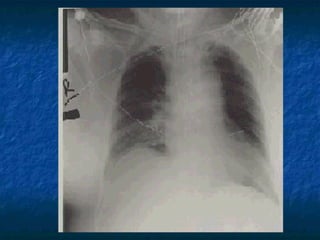
Chest X-Ray

Position of endotracheal tube
Position of central venous catheter
Pneumothorax, hemothorax, hydrothorax
Pulmonary edema, CHF
Cardiac silhoutte
Diaphragms
Rib fracture
Other considerations

Optimally, there should be two well-secured,
functioning intravenous lines.
A nasogastric tube (or orogastric) is useful to
keep the stomach decompressed, especially in
patients receiving positive-pressure ventilation.
Preserve body temperature.
Stop the seizure
Communication & documentation
 It is important to maintain a collaborative
 approach to patient care utilizing the referring
 physicians/nurses' report and suggestions prior
 to liftoff.
 Resus notes should include the history,
 assessment
 findings, and any treatments done by the
 referring EMS or hospital personnel.
 It is acceptable to state "see transfer notes,"
 for particular details, and write out only the
 most prominent interventions.
Transfer
Transfer to special care unit as soon as possible
by senior most experience personal
Support ventilation and provide oxygenation
Monitor ECG, oxygen saturation and BP
Prior to transport, make sure IV is secured
Transport with portable monitor, defibrillator
Oxygen with connections to bag-valve-system
Resus drugs must accompany the patient
Take Home Message

Resuscitated the heart, restore the brain
Treat the patient, not the arrhythmia
The value of unbroken Chain of Survival:
Time is critical
Seek and treat the cause, not just the
condition
Post resuscitation care

Post resuscitation care

  • 1.
    Post Resuscitation Care “Restart the Heart and Keep it Restarted” Dr. Rashidi Ahmad Malaysian Association of Emergency Medicine (MAEM)
  • 2.
    Aim To create anawareness that post resuscitation intervention is as important as resuscitation itself To highlight the proper resuscitation care To save human lives
  • 3.
    Outline Understanding post resuscitationphase & care Causes of failure post resuscitation Principles post resuscitation care Mx Discuss by an examples
  • 4.
    Introduction Phases of Resuscitation:resuscitation & post resuscitation Outcome: death or ROSC Upon ROSC patient may: Awake with stable hemodynamic Remain comatose with unstable circulation Half of death occurs first 24 hrs Over 1 to 3 days: sepsis syndrome and MOF Days later; rapid deterioration → Death Post resuscitation syndrome
  • 5.
    Post resuscitation syndrome Reperfusion failure Reperfusion injury Cerebral intoxication from ischemic metabolites Coagulopathy
  • 6.
    CPR related injuries Ina study of CPR related autopsy findings: 40% of patients had injuries related to closed chest CPR, i.e. fractured ribs, sternum, bone marrow emboli to lung, mediastinal bleeding, etc.
  • 7.
    What is postresuscitation care? Post resuscitation care is referred to a period between restoration of a spontaneous circulation and transfer of patient care to another healthcare provider who assumes responsibility. In general, this period will be less than 30 minutes (CRUCIAL TIME) The immediate goal is to provide cardio- respiratory support to optimize tissue perfusion, especially to the brain.
  • 8.
    Principles of Postresus Mx Avoid CPA recurrence Restore perfusion & oxygenation of regional organ & cell tissues Continuous ABCDs of Primary and Secondary surveys Evaluate and monitor neurologic functions (restoration of cerebral circulation) Support other dysfunction organs Resolve the situation that promoted CPA
  • 9.
    Scenario 1 46 yearsold man, had severe ischemic chest pain since an hour ago. Suddenly he had pulseless ventricular tachycardia. Immediate asynchronized cardioversion reverted the rhythm. What is your next step?
  • 10.
    Scenario 2 6 yearsold boy, near drowning Cardiopulmonary resuscitation was commenced ROSC after 45 minutes What is your next step?
  • 11.
    Scenario 3 37 yearsold man had MVA (high velocity injury) He sustained head injury & intraabdominal injury Hemodynamic unstable While on fluid resuscitation he developed VT What is your next step?
  • 12.
    Airway & respiratorysystem 1. Is the patient intubated? YES: rapidly assess patency, position, security, and oxygenation NO: rapidly assess the need for intubation, i.e. oxygenation, mental status, other considerations. INTUBATE if any indication for it exists.
  • 13.
    Airway & respiratorysystem 2. All patients will receive supplemental oxygen. Assessment of adequate ventilation and oxygenation: Pulse oximetry ABG's (if already available) Physical exam (i.e. breath sounds, symmetrical chest expansion Respiratory character, skin color, midline trachea)
  • 14.
    Airway & respiratorysystem 3. Consider mechanical impediments to adequate respiration, and pursue treatment of these when feasible: Tension pneumothorax, pneumothorax, and hemothorax Flail chest Mucous plugging Interstitial edema Improperly places endotracheal tube
  • 15.
    Mechanical Ventilation Volume ventilator-assist-controlor intermittent mandatory ventilation (IMV) Tidal volume = ideal weight in kg x 10 I:E ratio 1:2 or 1:1.5 Respiratory rate: 10-12 times/min Oxygen FiO2 - 1.0 (100%) Sensitivity: 2 cmH2O for assist-control Humidifier: 36° C PEEP: 5 cmH2O, increased as required
  • 16.
    Circulatory system 1. Assessthe status of the circulatory system: Clinical indicators: skin temperature, capillary refill, quality of pulses, level of consciousness Monitor parameters: heart rate and rhythm, BP, urine output (use of Foley catheter when available) PMH and current medications
  • 17.
    Circulatory system 2. Supportinadequate circulatory system: Hypotension - if there is evidence of bleeding, treat with IV crystalloids and blood products For evidence of cardiogenic shock, septic shock or spinal shock – treat appropriately Prophylactic drugs for reverted VF/VT Well function cardiac pace maker Maintain the drug infusion preferably via central line
  • 18.
    General survey After stabilizationof the respiratory and circulatory systems, a general survey of the entire patient should be performed. Look for a cause and precipitating causes of CA Serial exams of areas of particular concern should be performed. Serial review of vital signs Review ECG and Chest x ray Review ABG, and pH, serum electrolytes, magnesium and calcium
  • 19.
    Chest X-Ray Position ofendotracheal tube Position of central venous catheter Pneumothorax, hemothorax, hydrothorax Pulmonary edema, CHF Cardiac silhoutte Diaphragms Rib fracture
  • 21.
    Other considerations Optimally, thereshould be two well-secured, functioning intravenous lines. A nasogastric tube (or orogastric) is useful to keep the stomach decompressed, especially in patients receiving positive-pressure ventilation. Preserve body temperature. Stop the seizure
  • 22.
    Communication & documentation It is important to maintain a collaborative approach to patient care utilizing the referring physicians/nurses' report and suggestions prior to liftoff. Resus notes should include the history, assessment findings, and any treatments done by the referring EMS or hospital personnel. It is acceptable to state "see transfer notes," for particular details, and write out only the most prominent interventions.
  • 23.
    Transfer Transfer to specialcare unit as soon as possible by senior most experience personal Support ventilation and provide oxygenation Monitor ECG, oxygen saturation and BP Prior to transport, make sure IV is secured Transport with portable monitor, defibrillator Oxygen with connections to bag-valve-system Resus drugs must accompany the patient
  • 24.
    Take Home Message Resuscitatedthe heart, restore the brain Treat the patient, not the arrhythmia The value of unbroken Chain of Survival: Time is critical Seek and treat the cause, not just the condition