Post Resuscitation Care

          Dr.Joseph Rajesh
                HOD
       Dept of Anesthesiology
 Indira Gandhi Medical College & RI
             Puducherry
Got back


ROSC ?
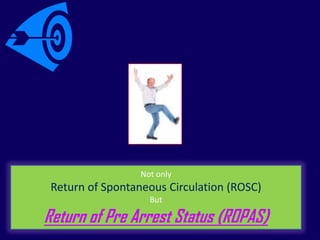
Not only
 Return of Spontaneous Circulation (ROSC)
                    But

Return of Pre Arrest Status (ROPAS)
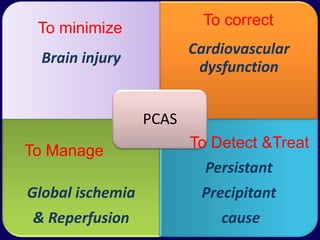
To correct
 To minimize
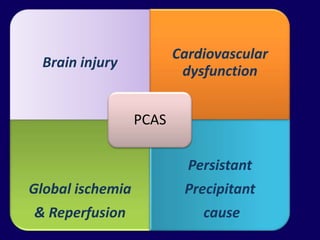
                         Cardiovascular
  Brain injury
                          dysfunction


                  PCAS
To Manage                To Detect &Treat
                           Persistant
Global ischemia           Precipitant
& Reperfusion                cause
Cardiovascular
  Brain injury
                          dysfunction


                  PCAS

                           Persistant
Global ischemia           Precipitant
& Reperfusion                cause
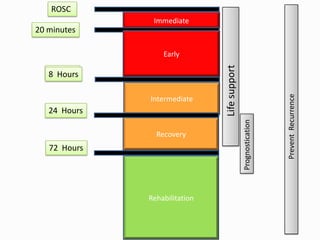
ROSC
               Immediate
20 minutes

                  Early


                               Life support
   6 Hours
   8 Hours


                                                                Prevent Recurrence
              Intermediate
   24 Hours


                                              Prognostication
                Recovery
   72 Hours


              Rehabilitation
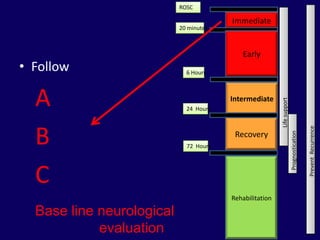
ROSC

                                        Immediate
                           20 minutes


                                           Early
• Follow                     6 Hours


  A                                     Intermediate


                                                         Life support
                             24 Hours


  B


                                                                                          Prevent Recurrence
                                         Recovery


                                                                        Prognostication
                             72 Hours


  C
                                        Rehabilitation

  Base line neurological
            evaluation
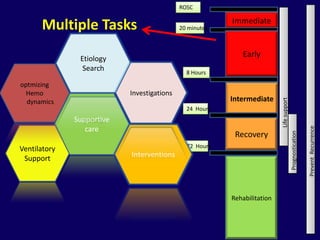
ROSC

                                                         Immediate
      Multiple Tasks                        20 minutes


               Etiology
                                                            Early
                Search                        8 Hours
optmizing
  Hemo                     Investigations
                                                         Intermediate


                                                                          Life support
  dynamics
                                              24 Hours
              Supportive
                 care


                                                                                                           Prevent Recurrence
                                                          Recovery


                                                                                         Prognostication
                                              72 Hours
Ventilatory
 Support                   Interventions


                                                         Rehabilitation
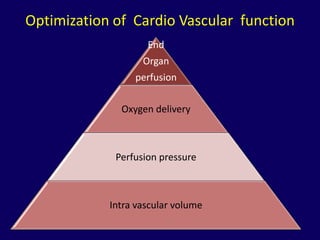
Optimization of Cardio Vascular function
                    End
                   Organ
                 perfusion

              Oxygen delivery


             Perfusion pressure


            Intra vascular volume
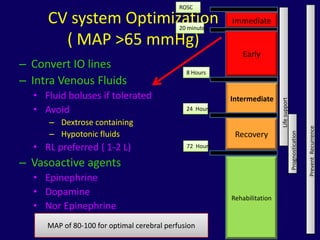
ROSC

     CV system Optimization                 20 minutes
                                                         Immediate

       ( MAP >65 mmHg)
                                                            Early
– Convert IO lines
                                              8 Hours
– Intra Venous Fluids
  • Fluid boluses if tolerated                           Intermediate


                                                                          Life support
  • Avoid                                     24 Hours

     – Dextrose containing


                                                                                                           Prevent Recurrence
     – Hypotonic fluids                                   Recovery


                                                                                         Prognostication
  • RL preferred ( 1-2 L)                     72 Hours

– Vasoactive agents
  • Epinephrine
  • Dopamine
                                                         Rehabilitation
  • Nor Epinephrine
     MAP of 80-100 for optimal cerebral perfusion
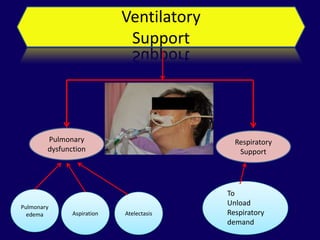
Ventilatory
                             Support


        Pulmonary                           Respiratory
        dysfunction                          Support


                                          To
Pulmonary
                                          Unload
  edema        Aspiration   Atelectasis   Respiratory
                                          demand
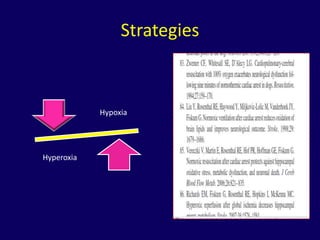
Strategies


            Hypoxia


Hyperoxia
Ventilatory
                   Support
• Goals:
  – SpO2 ~ 94-99 %
  – PaCO2 - 40 -45 mmHg.
• How?
  – Titrate FiO2
  – Set Tidal volume of 6-7 ml/kg
  – 10 -12 breath/mt
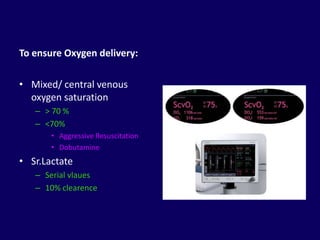
To ensure Oxygen delivery:

• Mixed/ central venous
  oxygen saturation
   – > 70 %
   – <70%
       • Aggressive Resuscitation
       • Dobutamine
• Sr.Lactate
   – Serial vlaues
   – 10% clearence
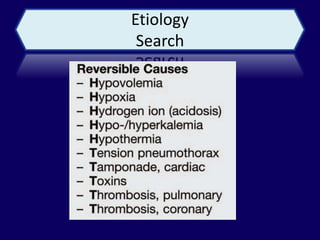
Etiology
 Search
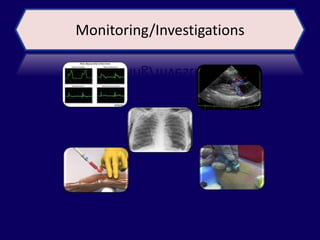
Monitoring/Investigations
Interventions

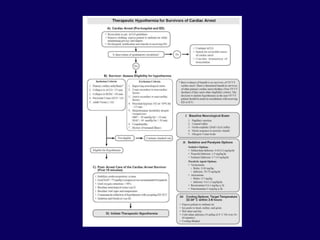
Targeted Temperature
         management
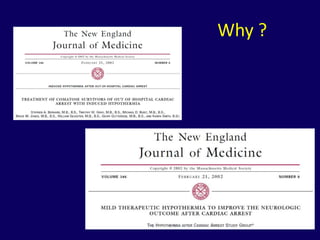
Why ?
Hypothermia
• Who ?
  – comatose (usually defined as a lack of meaningful
    response to verbal commands) after ROSC.
• How long ?
  – 12- 24 hours
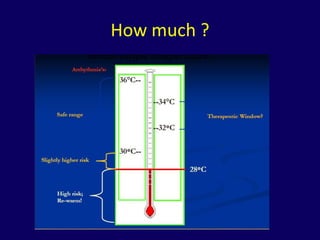
How much ?
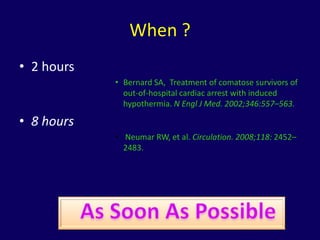
When ?
• 2 hours
            • Bernard SA, Treatment of comatose survivors of
              out-of-hospital cardiac arrest with induced
              hypothermia. N Engl J Med. 2002;346:557–563.

• 8 hours
            • Neumar RW, et al. Circulation. 2008;118: 2452–
              2483.
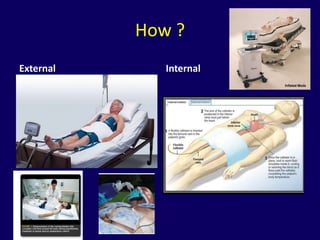
How ?
External      Internal
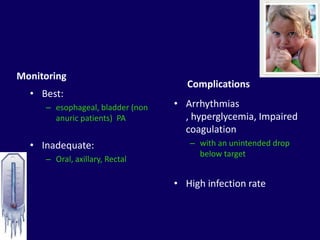
Monitoring
                                     Complications
  • Best:
     – esophageal, bladder (non   • Arrhythmias
       anuric patients) PA          , hyperglycemia, Impaired
                                    coagulation
  • Inadequate:                      – with an unintended drop
                                       below target
     – Oral, axillary, Rectal

                                  • High infection rate
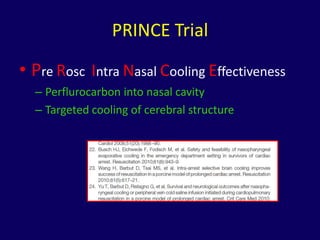
PRINCE Trial

• Pre Rosc Intra Nasal Cooling Effectiveness
  – Perflurocarbon into nasal cavity
  – Targeted cooling of cerebral structure
Interventions
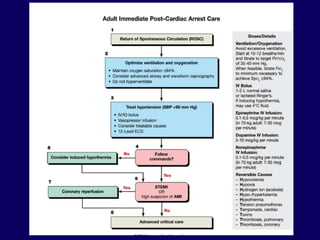
• Coronary revascularization:
  – All patients with STEMI/New LBBB
• Coronary catheterization:
  – Ongoing hemodynamic instability
     • Increasing biomarkers
     • Regional wall motion abnormalities
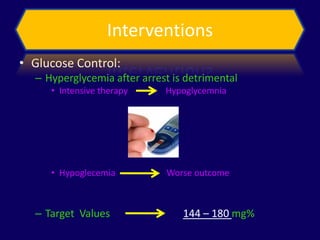
Interventions
• Glucose Control:
  – Hyperglycemia after arrest is detrimental
     • Intensive therapy     Hypoglycemnia


     • Hypoglecemia          Worse outcome


  – Target Values                144 – 180 mg%
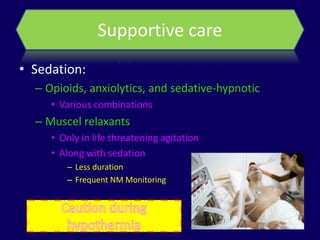
Supportive care
• Sedation:
  – Opioids, anxiolytics, and sedative-hypnotic
     • Various combinations
  – Muscel relaxants
     • Only in life threatening agitation
     • Along with sedation
        – Less duration
        – Frequent NM Monitoring
Supportive care
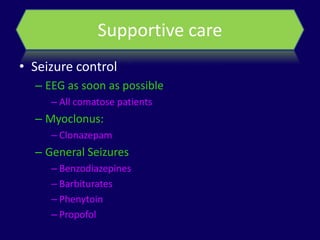
• Seizure control
  – EEG as soon as possible
     – All comatose patients
  – Myoclonus:
     – Clonazepam
  – General Seizures
     – Benzodiazepines
     – Barbiturates
     – Phenytoin
     – Propofol
Supportive care
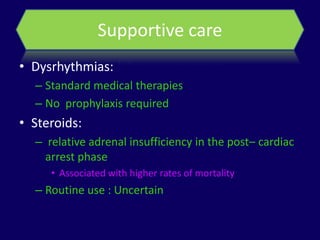
• Dysrhythmias:
  – Standard medical therapies
  – No prophylaxis required
• Steroids:
  – relative adrenal insufficiency in the post– cardiac
    arrest phase
     • Associated with higher rates of mortality
  – Routine use : Uncertain
Supportive care
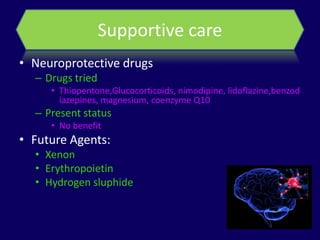
• Neuroprotective drugs
  – Drugs tried
     • Thiopentone,Glucocorticoids, nimodipine, lidoflazine,benzod
       iazepines, magnesium, coenzyme Q10
  – Present status
     • No benefit
• Future Agents:
  • Xenon
  • Erythropoietin
  • Hydrogen sluphide
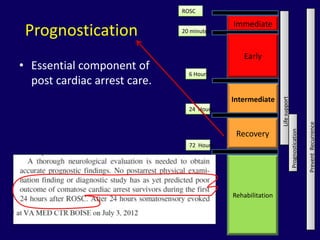
ROSC

                                           Immediate
 Prognostication              20 minutes


                                              Early
• Essential component of
                                6 Hours
  post cardiac arrest care.
                                           Intermediate


                                                            Life support
                                24 Hours


                                                                                             Prevent Recurrence
                                                                           Prognostication
                                            Recovery
                                72 Hours


                                           Rehabilitation
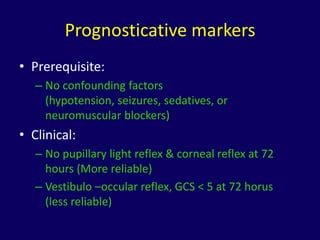
Prognosticative markers
• Prerequisite:
   – No confounding factors
     (hypotension, seizures, sedatives, or
     neuromuscular blockers)
• Clinical:
   – No pupillary light reflex & corneal reflex at 72
     hours (More reliable)
   – Vestibulo –occular reflex, GCS < 5 at 72 horus
     (less reliable)
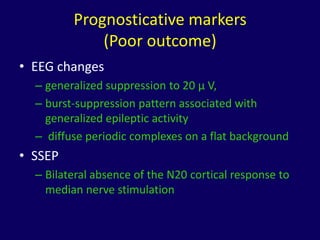
Prognosticative markers
             (Poor outcome)
• EEG changes
  – generalized suppression to 20 µ V,
  – burst-suppression pattern associated with
    generalized epileptic activity
  – diffuse periodic complexes on a flat background
• SSEP
  – Bilateral absence of the N20 cortical response to
    median nerve stimulation
Prognosticative markers
               (Poor outcome)
• Neuroimaging:
  – MRI:
     • Extensive cortical and subcortical lesions
  – CT parameters
     • quantitative measure of gray matter:white matter
       Hounsfield unit ratio
• Biomarkers:
  – Neuron-specific enolase [NSE], S100B, GFAP, CK-
    BB)
Summary
References
• 1. Part 9: Post–Cardiac Arrest Care: 2010
  American Heart Association Guidelines for
  Cardiopulmonary Resuscitation and
  Emergency Cardiovascular Care
  – Circulation. 2010;122:S768-S786,
• 2.UptoDate 2012
Post resuscitation  care

Post resuscitation care

  • 1.
    Post Resuscitation Care Dr.Joseph Rajesh HOD Dept of Anesthesiology Indira Gandhi Medical College & RI Puducherry
  • 2.
  • 3.
    Not only Returnof Spontaneous Circulation (ROSC) But Return of Pre Arrest Status (ROPAS)
  • 4.
    To correct Tominimize Cardiovascular Brain injury dysfunction PCAS To Manage To Detect &Treat Persistant Global ischemia Precipitant & Reperfusion cause
  • 6.
    Cardiovascular Braininjury dysfunction PCAS Persistant Global ischemia Precipitant & Reperfusion cause
  • 7.
    ROSC Immediate 20 minutes Early Life support 6 Hours 8 Hours Prevent Recurrence Intermediate 24 Hours Prognostication Recovery 72 Hours Rehabilitation
  • 8.
    ROSC Immediate 20 minutes Early • Follow 6 Hours A Intermediate Life support 24 Hours B Prevent Recurrence Recovery Prognostication 72 Hours C Rehabilitation Base line neurological evaluation
  • 9.
    ROSC Immediate Multiple Tasks 20 minutes Etiology Early Search 8 Hours optmizing Hemo Investigations Intermediate Life support dynamics 24 Hours Supportive care Prevent Recurrence Recovery Prognostication 72 Hours Ventilatory Support Interventions Rehabilitation
  • 10.
    Optimization of CardioVascular function End Organ perfusion Oxygen delivery Perfusion pressure Intra vascular volume
  • 11.
    ROSC CV system Optimization 20 minutes Immediate ( MAP >65 mmHg) Early – Convert IO lines 8 Hours – Intra Venous Fluids • Fluid boluses if tolerated Intermediate Life support • Avoid 24 Hours – Dextrose containing Prevent Recurrence – Hypotonic fluids Recovery Prognostication • RL preferred ( 1-2 L) 72 Hours – Vasoactive agents • Epinephrine • Dopamine Rehabilitation • Nor Epinephrine MAP of 80-100 for optimal cerebral perfusion
  • 12.
    Ventilatory Support Pulmonary Respiratory dysfunction Support To Pulmonary Unload edema Aspiration Atelectasis Respiratory demand
  • 13.
    Strategies Hypoxia Hyperoxia
  • 14.
    Ventilatory Support • Goals: – SpO2 ~ 94-99 % – PaCO2 - 40 -45 mmHg. • How? – Titrate FiO2 – Set Tidal volume of 6-7 ml/kg – 10 -12 breath/mt
  • 15.
    To ensure Oxygendelivery: • Mixed/ central venous oxygen saturation – > 70 % – <70% • Aggressive Resuscitation • Dobutamine • Sr.Lactate – Serial vlaues – 10% clearence
  • 16.
  • 17.
  • 18.
  • 19.
  • 20.
    Hypothermia • Who ? – comatose (usually defined as a lack of meaningful response to verbal commands) after ROSC. • How long ? – 12- 24 hours
  • 21.
  • 22.
    When ? • 2hours • Bernard SA, Treatment of comatose survivors of out-of-hospital cardiac arrest with induced hypothermia. N Engl J Med. 2002;346:557–563. • 8 hours • Neumar RW, et al. Circulation. 2008;118: 2452– 2483.
  • 23.
  • 24.
    Monitoring Complications • Best: – esophageal, bladder (non • Arrhythmias anuric patients) PA , hyperglycemia, Impaired coagulation • Inadequate: – with an unintended drop below target – Oral, axillary, Rectal • High infection rate
  • 26.
    PRINCE Trial • PreRosc Intra Nasal Cooling Effectiveness – Perflurocarbon into nasal cavity – Targeted cooling of cerebral structure
  • 27.
    Interventions • Coronary revascularization: – All patients with STEMI/New LBBB • Coronary catheterization: – Ongoing hemodynamic instability • Increasing biomarkers • Regional wall motion abnormalities
  • 28.
    Interventions • Glucose Control: – Hyperglycemia after arrest is detrimental • Intensive therapy Hypoglycemnia • Hypoglecemia Worse outcome – Target Values 144 – 180 mg%
  • 29.
    Supportive care • Sedation: – Opioids, anxiolytics, and sedative-hypnotic • Various combinations – Muscel relaxants • Only in life threatening agitation • Along with sedation – Less duration – Frequent NM Monitoring
  • 30.
    Supportive care • Seizurecontrol – EEG as soon as possible – All comatose patients – Myoclonus: – Clonazepam – General Seizures – Benzodiazepines – Barbiturates – Phenytoin – Propofol
  • 31.
    Supportive care • Dysrhythmias: – Standard medical therapies – No prophylaxis required • Steroids: – relative adrenal insufficiency in the post– cardiac arrest phase • Associated with higher rates of mortality – Routine use : Uncertain
  • 32.
    Supportive care • Neuroprotectivedrugs – Drugs tried • Thiopentone,Glucocorticoids, nimodipine, lidoflazine,benzod iazepines, magnesium, coenzyme Q10 – Present status • No benefit • Future Agents: • Xenon • Erythropoietin • Hydrogen sluphide
  • 33.
    ROSC Immediate Prognostication 20 minutes Early • Essential component of 6 Hours post cardiac arrest care. Intermediate Life support 24 Hours Prevent Recurrence Prognostication Recovery 72 Hours Rehabilitation
  • 34.
    Prognosticative markers • Prerequisite: – No confounding factors (hypotension, seizures, sedatives, or neuromuscular blockers) • Clinical: – No pupillary light reflex & corneal reflex at 72 hours (More reliable) – Vestibulo –occular reflex, GCS < 5 at 72 horus (less reliable)
  • 35.
    Prognosticative markers (Poor outcome) • EEG changes – generalized suppression to 20 µ V, – burst-suppression pattern associated with generalized epileptic activity – diffuse periodic complexes on a flat background • SSEP – Bilateral absence of the N20 cortical response to median nerve stimulation
  • 36.
    Prognosticative markers (Poor outcome) • Neuroimaging: – MRI: • Extensive cortical and subcortical lesions – CT parameters • quantitative measure of gray matter:white matter Hounsfield unit ratio • Biomarkers: – Neuron-specific enolase [NSE], S100B, GFAP, CK- BB)
  • 37.
  • 38.
    References • 1. Part9: Post–Cardiac Arrest Care: 2010 American Heart Association Guidelines for Cardiopulmonary Resuscitation and Emergency Cardiovascular Care – Circulation. 2010;122:S768-S786, • 2.UptoDate 2012