PROBLEMS ASSOCIATED WITH PBC
NECK
 Grossly restricted neck movements
 Patients are likely to be malnourished ,anemic and
hypoproteinemic
 Possibility of restricted mouth opening and narrowed nasal
passages.
 Difficult laryngoscopy and endotracheal intubation
 Compromised airway
 Psychiatric tendencies in patients and possible drug
interactions in anaesthesia
 Poor oral hygeine in patients
RELEVANT ASPECTS IN
HISTORY
 Duration of contractures
 History of convulsions
 Difficulty in breathing and swallowing
 H/O motion sickness
 H/O snoring
 H/O epistaxis and bleeding from oral cavity
 H/O psychiatric problems
 H/O acid peptic disease and reflux
RELEVANT EXAMINATION OF
PATIENT
 Nature of contracture
- soft
- firm(hard)
 Location of contracture
 Duration of contracture
 Extent of contracture ( sterno cleido mastoid involved?)
 Is mouth opening restricted ?
 Can the mandible be moved up and down
 Are the nasal passages patent?
 Is the patient dyspneic, can he lie down comfortably ?
 Can he blow air through mouth and nose
INVESTIGATIONS
 SURGICAL PROFILE:
 Complete blood picture
 Blood Grouping
 Random blood sugar
 Urea and Creatinine
 Serum electrolytes
• X-Ray chest –PAview
• ECG – 12 lead
• HbsAg ,HIV , HCV
• THYROID PROFILE
PREPARATION OF THE
PATIENT
 Improve oral hygeine
 Correct anemia and hypoproteinemia
 H2 receptor antagonists, prokinetics
 Anti emetics
 Aggressive treatment of upper and lower
respiratory tract infections
PRE- MEDICATION
GUIDELINES
 Avoid heavy sedation.
 Preserve respiration – drugs that depress respiration
viz. narcotics are better avoided till airway is
secured
 I.M. glycopyrolate / atropine is better than I.V.
premedication.
 Continue H2 receptor blockers and antiemetics
 Consider pre-op nasal decongestants – they help
you in putting a naso-pharyngeal airway
PRE MEDICATION
(Cont..)
 Use topical viscous anaesthesia for oral
cavity and pharynx before induction of
anaesthesia - it helps in improving
quality of anaesthesia
 Consider superior laryngeal nerve block
if hyoid and upper margin of thryiod
cartilage are visible.- it reduces
incidence of laryngospasm during
anaesthesia
 Fix E.T tubes always to the maxilla .Fixing them to
mandible can soak them and soil them with blood
and secretions from the operative field and can also
interfere with field of surgery .
 Use narcotics like fentanyl etc ., only after
securing access to trachea.
 N.S.AIDS are very useful for post op analgesia
.Hence use them.
 Avoid narcotics , tramadol and metronidazole in
patients with migraine and motion sickness.
TREATMENT FOR CONTRACTURE
• RELEASE OF CONTRACTURE SURGICALLY AND USE OF
SKIN GRAFT OR “Z”
PLASTY OR DIFFERENT FLAPS.
DIFFERENT FLAPS USED ARE—
• TRANSPOSITION FLAPS,
• VERTICAL OR TRANSVERSE;
• LATERALLY BASED FLAP;
• BILOBED FLAP;
• BIPEDICLED FLAP;
• ADVANCEMENT FLAP;
• REGIONAL FLAP;
• RANDOM CUTANEOUS FL AP (EPAULETTE
FL AP, CHARRETERAFLAP);
• FASCIOCUTANEOUS/ MYOCUTANEOUS
FLAP;
• TUBE FLAP;
• EXPANDED SKIN FLAP;
• COMBINED SKIN GRAFT AND FLAP;
• MICROVASCULAR FREE FLAP.
• PROPER PHYSIOTHERAPY AND
REHABILITATION IS ESSENTIAL.
• PRESSURE GARMENTS TO PREVENT
HYPERTROPHIC SCARS.
• MANAGEMENT OF ITCHING IN THE
SCAR USING ALOEVERA,
ANTIHISTAMINES AND MOISTURIZING
CREAMS.
PROBLEMS IN MANAGING BURN
CONTRACTURE
• GIVING PROPER ANAESTHESIA IS
CHALLENGING
• NEED FOR REPEATED SURGERIES AS STAGED
ONE.
• MAINTAINING THE POSITION WITH SKELETAL
TRACTION, FIXATION, B COLLAR,
POP CAST, ETC.
• PSYCHOLOGICAL PROBLEMS AND NEEDS
COUNSELLING.
• PROLONGED HOSPITAL STAY, COST FACTORS.
• JOINT EXERCISE IN FULL RANGE DURING
RECOVERY PERIOD OF BURNS
• PRESSURE GARMENTS FOR A LONG PERIOD
• TOPICAL SILICON SHEETING
• SALINE EXPANDERS FOR SCARS
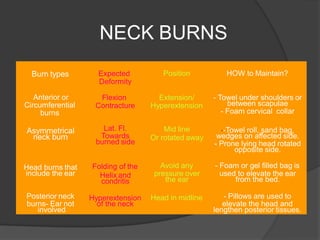
NECK BURNS
Burn types Expected
Deformity
Position HOW to Maintain?
Anterior or
Circumferential
burns
Flexion
Contracture
Extension/
Hyperextension
- Towel under shoulders or
between scapulae
- Foam cervical collar
Asymmetrical
neck burn
Lat. Fl.
Towards
burned side
Mid line
Or rotated away
--Towel roll, sand bag,
wedges on affected side.
- Prone lying head rotated
opposite side.
Head burns that
include the ear
Folding of the
Helix and
condritis
Avoid any
pressure over
the ear
- Foam or gel filled bag is
used to elevate the ear
from the bed.
Posterior neck
burns- Ear not
involved
Hyperextension
of the neck
Head in midline - Pillows are used to
elevate the head and
lengthen posterior tissues.
PRECAUTIONS IN THE POST-OP
PERIOD
 Extubate only when sure.
 Watch for airway obstruction .
 Observe resp. pattern.
 Use nasopharyngeal /oral airway if needed.
 Anti-emetics to be continued post-op
neck_contracture.pptx

neck_contracture.pptx

  • 2.
    PROBLEMS ASSOCIATED WITHPBC NECK  Grossly restricted neck movements  Patients are likely to be malnourished ,anemic and hypoproteinemic  Possibility of restricted mouth opening and narrowed nasal passages.  Difficult laryngoscopy and endotracheal intubation  Compromised airway  Psychiatric tendencies in patients and possible drug interactions in anaesthesia  Poor oral hygeine in patients
  • 3.
    RELEVANT ASPECTS IN HISTORY Duration of contractures  History of convulsions  Difficulty in breathing and swallowing  H/O motion sickness  H/O snoring  H/O epistaxis and bleeding from oral cavity  H/O psychiatric problems  H/O acid peptic disease and reflux
  • 4.
    RELEVANT EXAMINATION OF PATIENT Nature of contracture - soft - firm(hard)  Location of contracture  Duration of contracture  Extent of contracture ( sterno cleido mastoid involved?)  Is mouth opening restricted ?  Can the mandible be moved up and down  Are the nasal passages patent?  Is the patient dyspneic, can he lie down comfortably ?  Can he blow air through mouth and nose
  • 5.
    INVESTIGATIONS  SURGICAL PROFILE: Complete blood picture  Blood Grouping  Random blood sugar  Urea and Creatinine  Serum electrolytes • X-Ray chest –PAview • ECG – 12 lead • HbsAg ,HIV , HCV • THYROID PROFILE
  • 6.
    PREPARATION OF THE PATIENT Improve oral hygeine  Correct anemia and hypoproteinemia  H2 receptor antagonists, prokinetics  Anti emetics  Aggressive treatment of upper and lower respiratory tract infections
  • 7.
    PRE- MEDICATION GUIDELINES  Avoidheavy sedation.  Preserve respiration – drugs that depress respiration viz. narcotics are better avoided till airway is secured  I.M. glycopyrolate / atropine is better than I.V. premedication.  Continue H2 receptor blockers and antiemetics  Consider pre-op nasal decongestants – they help you in putting a naso-pharyngeal airway
  • 8.
    PRE MEDICATION (Cont..)  Usetopical viscous anaesthesia for oral cavity and pharynx before induction of anaesthesia - it helps in improving quality of anaesthesia  Consider superior laryngeal nerve block if hyoid and upper margin of thryiod cartilage are visible.- it reduces incidence of laryngospasm during anaesthesia
  • 9.
     Fix E.Ttubes always to the maxilla .Fixing them to mandible can soak them and soil them with blood and secretions from the operative field and can also interfere with field of surgery .  Use narcotics like fentanyl etc ., only after securing access to trachea.  N.S.AIDS are very useful for post op analgesia .Hence use them.  Avoid narcotics , tramadol and metronidazole in patients with migraine and motion sickness.
  • 10.
    TREATMENT FOR CONTRACTURE •RELEASE OF CONTRACTURE SURGICALLY AND USE OF SKIN GRAFT OR “Z” PLASTY OR DIFFERENT FLAPS. DIFFERENT FLAPS USED ARE— • TRANSPOSITION FLAPS, • VERTICAL OR TRANSVERSE; • LATERALLY BASED FLAP; • BILOBED FLAP; • BIPEDICLED FLAP; • ADVANCEMENT FLAP;
  • 11.
    • REGIONAL FLAP; •RANDOM CUTANEOUS FL AP (EPAULETTE FL AP, CHARRETERAFLAP); • FASCIOCUTANEOUS/ MYOCUTANEOUS FLAP; • TUBE FLAP; • EXPANDED SKIN FLAP; • COMBINED SKIN GRAFT AND FLAP; • MICROVASCULAR FREE FLAP.
  • 12.
    • PROPER PHYSIOTHERAPYAND REHABILITATION IS ESSENTIAL. • PRESSURE GARMENTS TO PREVENT HYPERTROPHIC SCARS. • MANAGEMENT OF ITCHING IN THE SCAR USING ALOEVERA, ANTIHISTAMINES AND MOISTURIZING CREAMS.
  • 13.
    PROBLEMS IN MANAGINGBURN CONTRACTURE • GIVING PROPER ANAESTHESIA IS CHALLENGING • NEED FOR REPEATED SURGERIES AS STAGED ONE. • MAINTAINING THE POSITION WITH SKELETAL TRACTION, FIXATION, B COLLAR, POP CAST, ETC. • PSYCHOLOGICAL PROBLEMS AND NEEDS COUNSELLING. • PROLONGED HOSPITAL STAY, COST FACTORS.
  • 14.
    • JOINT EXERCISEIN FULL RANGE DURING RECOVERY PERIOD OF BURNS • PRESSURE GARMENTS FOR A LONG PERIOD • TOPICAL SILICON SHEETING • SALINE EXPANDERS FOR SCARS
  • 15.
    NECK BURNS Burn typesExpected Deformity Position HOW to Maintain? Anterior or Circumferential burns Flexion Contracture Extension/ Hyperextension - Towel under shoulders or between scapulae - Foam cervical collar Asymmetrical neck burn Lat. Fl. Towards burned side Mid line Or rotated away --Towel roll, sand bag, wedges on affected side. - Prone lying head rotated opposite side. Head burns that include the ear Folding of the Helix and condritis Avoid any pressure over the ear - Foam or gel filled bag is used to elevate the ear from the bed. Posterior neck burns- Ear not involved Hyperextension of the neck Head in midline - Pillows are used to elevate the head and lengthen posterior tissues.
  • 16.
    PRECAUTIONS IN THEPOST-OP PERIOD  Extubate only when sure.  Watch for airway obstruction .  Observe resp. pattern.  Use nasopharyngeal /oral airway if needed.  Anti-emetics to be continued post-op