BURN AND POST BURN
CONTRACTURE
DR SHRIKANT GHUGE
MAJOR PERIOPERATIVE CONCERN FOR BURN PATIENT
 Age of the patient
 Extent of burn injury
 Mechanism of burn injury
 Elapsed time from burn injury
 Associated injuries
 Inhalational injury
 Adequacy of resuscitation
 Airway patency
 Difficult vascular access
 Gastric statis
 Altered drug responses
 Altered mental status
 Pain/Anxiety
 Presence of organ dysfunction
 Presence of infection
American Burn Life Support (ABLS) indications for early
intubation include:
 Signs of airway obstruction (hoarseness, stridor, accessory respiratory
muscle use, sternal retraction)
 Extent of the burn (total body surface area burn > 40%–50%)
 Extensive and deep facial burns
 Burns inside the mouth
 Significant edema or risk for edema
 Difficulty swallowing
 Signs of respiratory compromise: inability to clear secretions,
respiratory fatigue, poor oxygenation or ventilation
 Decreased level of consciousness where airway protective reflexes are
impaired
 Anticipated patient transfer of large burn with airway issue without
qualified personnel to intubate en route
Onah’s classification of postburn contracture of
the neck
1) Mild anterior contracture
limited extension, full flexion to normal anatomic position
skin, subcutaneous tissue involved
2) Moderate anterior contracture
extension causes significant pull at uninvolved lower lip
skin, subcutaneous tissue involved
3) Severe anterior contracture
restricted extension, skin, subcutaneous tissue and strap muscles involved
4) Posterior contracture
neck held in extension, skin subcutaneous tissue involved
Problems in patients with healed burn
1) Distorted and reduced nasal opening
2) Narrow nasal passage
3) Distorted and reduced mouth opening
4) Restricted neck movement
5) Stiff submandibular space
6) Scar and contracture in front of neck
7) Larynx may be shifted from midline
8) Decreased oropharyngeal space
9) Distortion in anatomic alignment of oro-pharynx
pharynx and trachea
10) Cervical spine distortion
11) Fixed flexion neck deformity
POINTS TO BE KEPT IN MIND DURING PAC
1) Type of surgery
2) Time of burn and its duration
3) Cause of burn
4) Extent of burn
5) Assessment of airway
6) Technique of choice of anaesthesia
7) Starting IV lines
AIRWAY ASSESSMENT
1) Psychological preparation
2) Difficult mask ventilation
3) Difficulty laryngoscopy
4) Difficult intubation
5) Difficult supraglottic devices placement
6) Difficult surgical airway
7) Difficult extubation
AIRWAY ASSESSMENT
PREOPERATIVE INVESTIGATIONS
 Serum electrolytes
 CBC
 RFT
 Chest X ray (AP/Lateral view)
 ECG
AIRWAY MANAGEMENT
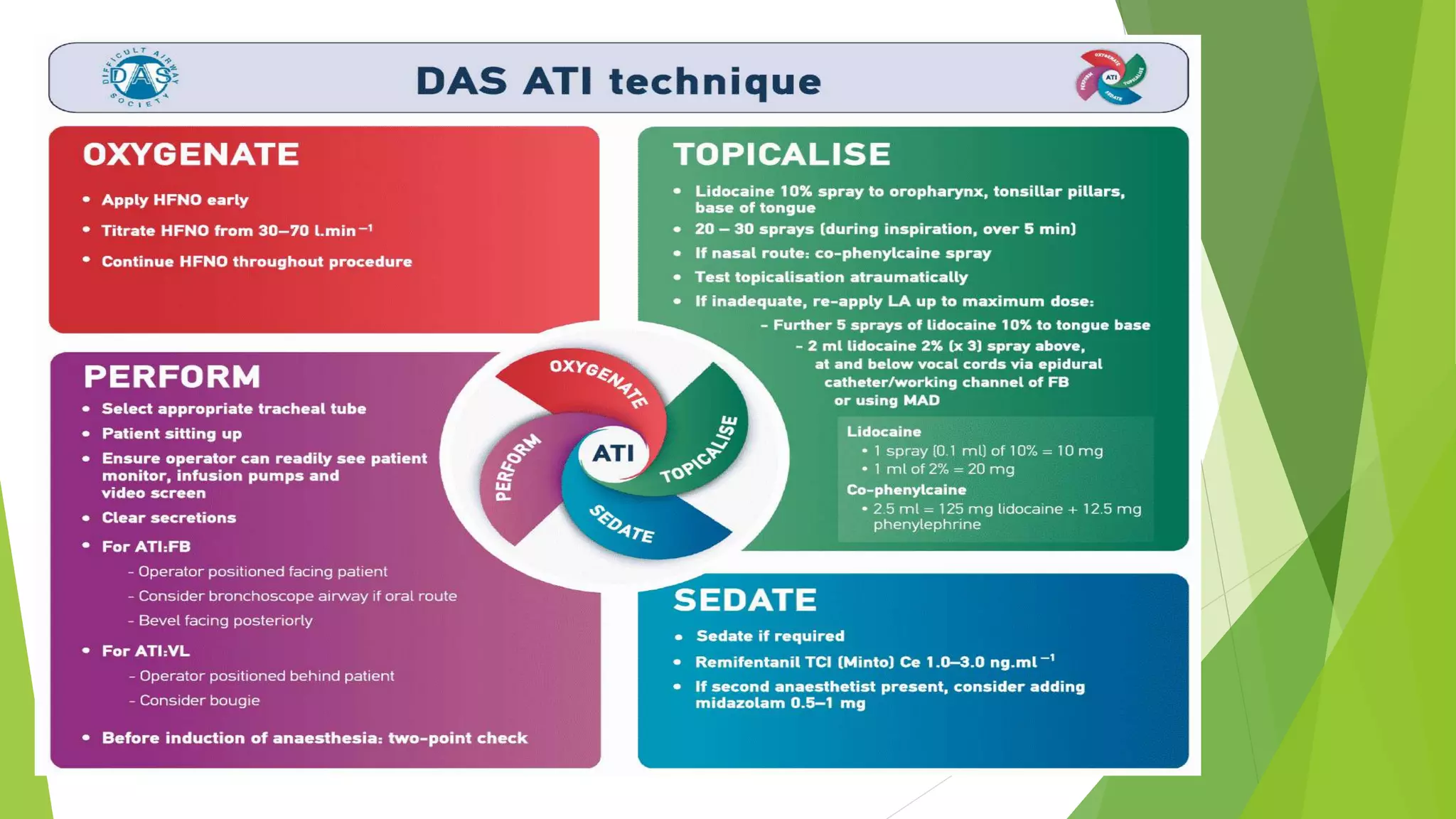
 Plan A- awake nasal FB/ Oral FB
 Plan B- Awake video laryngoscopy
 Plan C- SGAD under inhalational
 Plan D- Release of scar under Ketamine
 Plan E – Tumescent anaesthesia
AWAKE FIBREOPTIC NASAL INTUBATION
PREPARATION- ‘ADD TSP’
 Adequate explanation of need of procedure
 Decongestion of nasal passage using vasoconstrictors
 Drying up secretions by using glycopyrrolate
 Topicalisation of upper airway by nebulization, gargle and local spray
 Sedation and anxiolysis
 Preoxygenation-Perioxygenation
McKENZIE TECHNIQUE (MUCOSAL AUTOMIZATION DEVICE)
MUCOSAL AUTOMIZATION DEVICE (MAD)
ADMINISTRATION OF NEBULIZED LIGNOCAINE
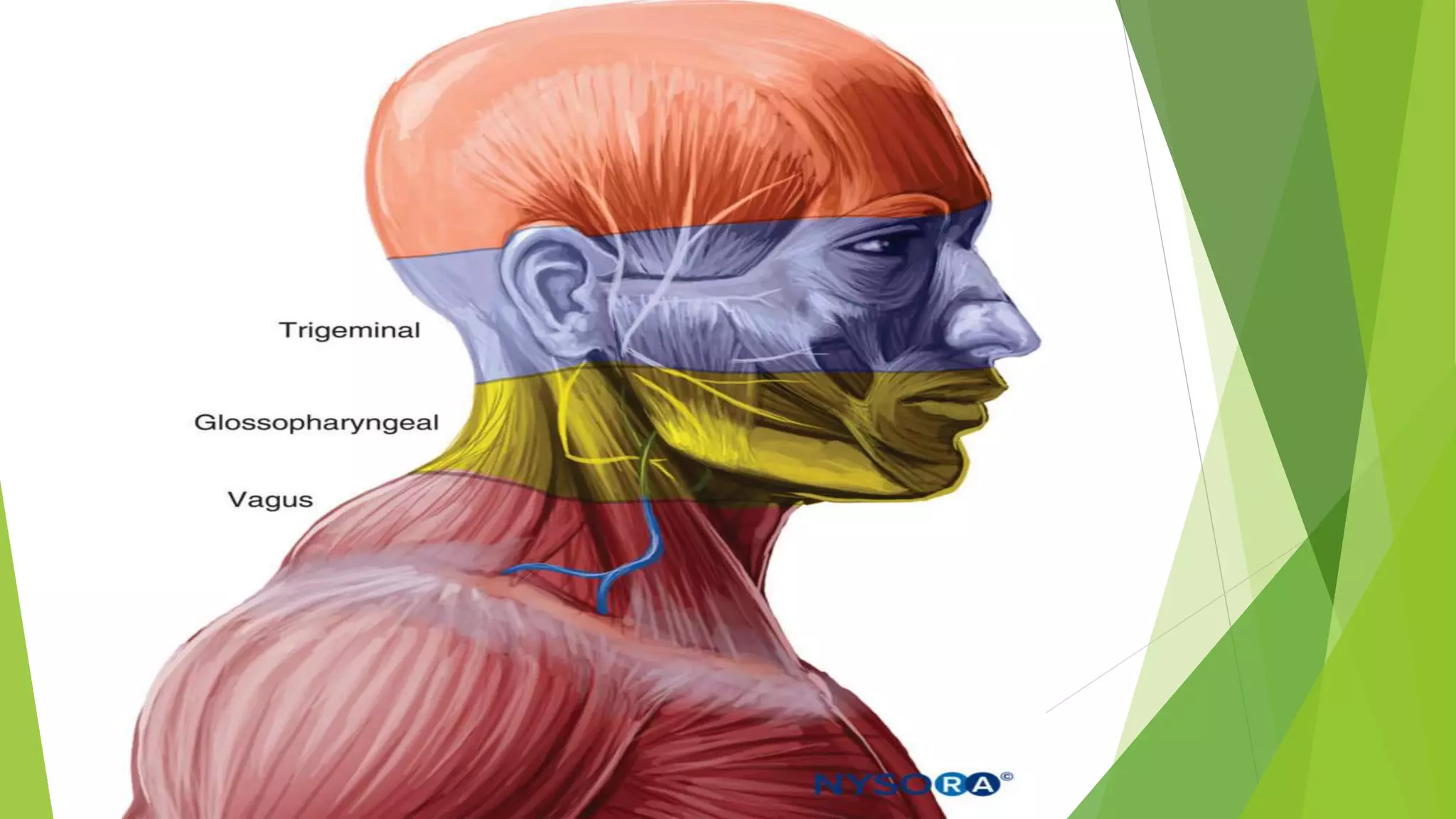
GLOSSOPHARYNGEAL NERVE BLOCK
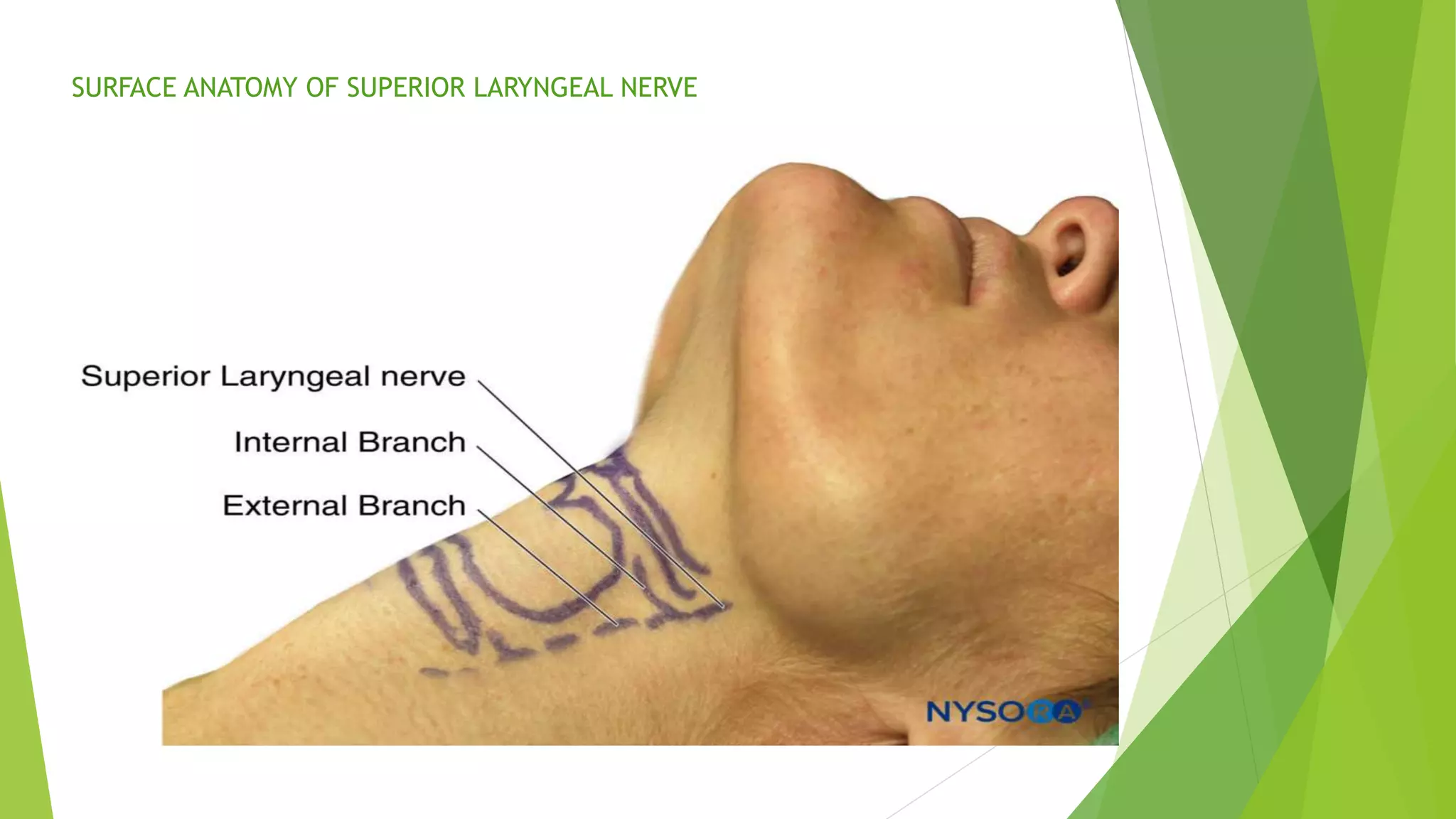
SURFACE ANATOMY OF SUPERIOR LARYNGEAL NERVE
TRANSLARYNGEAL BLOCK
DIFFICULT AIRWAY TROLLEY
TROUBLE SHOOTING DURING FIBREOPTIC
INTUBATION
Blurred view
Can not identify larynx
Bleeding
Can not remove fibreoptic
Can not pass tube
TUMESCENT LA
Solution for tumescent contains lignocaine, adrenaline, hyaluronidase,
and saline
FORMULA: 25ml of 2% lignocaine + hyaluronidase 1-2ml + 1 ml of 1 in
1,00,000 adrenaline + distilled water to a total volume of 100 ml.
Tumescent LA infiltrated along with incision line and into surrounding
areas.
The associated vasoconstriction was so complete that there was virtually
no blood loss during surgery.
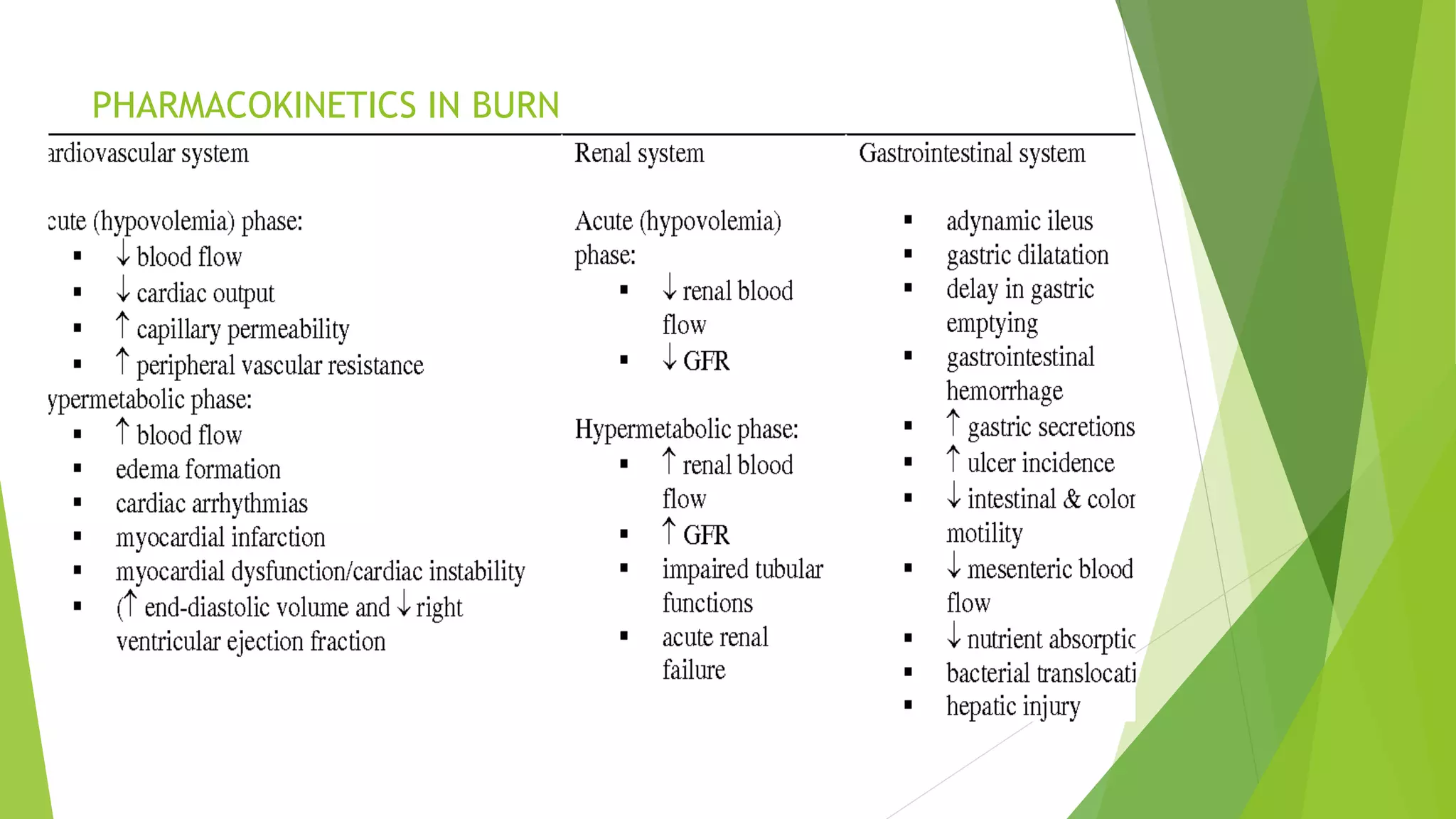
PHARMACOKINETICS IN BURN
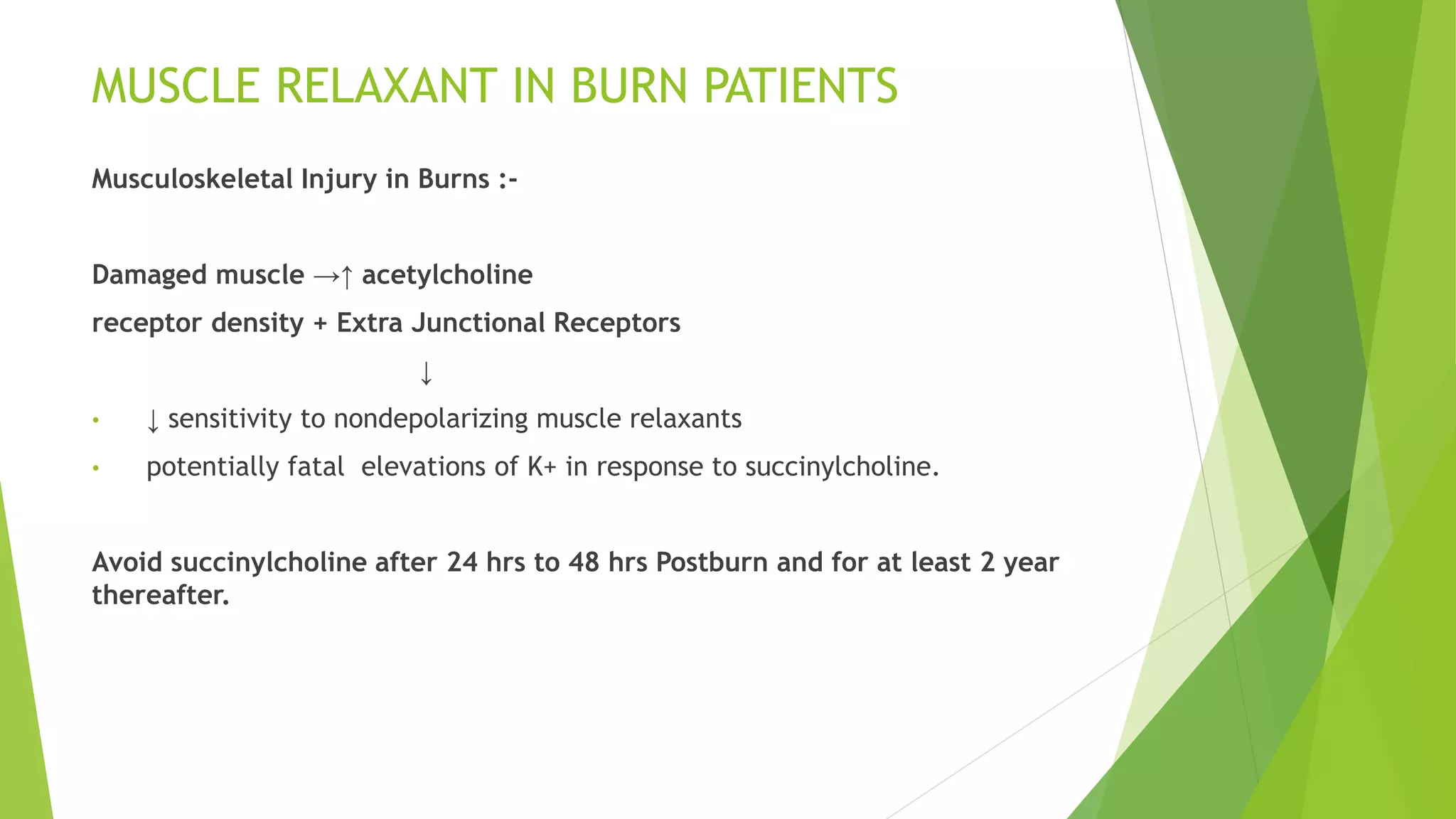
MUSCLE RELAXANT IN BURN PATIENTS
Musculoskeletal Injury in Burns :-
Damaged muscle →↑ acetylcholine
receptor density + Extra Junctional Receptors
↓
• ↓ sensitivity to nondepolarizing muscle relaxants
• potentially fatal elevations of K+ in response to succinylcholine.
Avoid succinylcholine after 24 hrs to 48 hrs Postburn and for at least 2 year
thereafter.
ROLE OF KETAMINE IN BURNS
1) Hemodynamic stability
2) Airway patency
3) Preserves hypoxic and hypercapnic responses
4) Decreases airway resistance
post burn contracture-2.pptx

post burn contracture-2.pptx

  • 1.
    BURN AND POSTBURN CONTRACTURE DR SHRIKANT GHUGE
  • 2.
    MAJOR PERIOPERATIVE CONCERNFOR BURN PATIENT  Age of the patient  Extent of burn injury  Mechanism of burn injury  Elapsed time from burn injury  Associated injuries  Inhalational injury  Adequacy of resuscitation  Airway patency  Difficult vascular access  Gastric statis  Altered drug responses  Altered mental status  Pain/Anxiety  Presence of organ dysfunction  Presence of infection
  • 9.
    American Burn LifeSupport (ABLS) indications for early intubation include:  Signs of airway obstruction (hoarseness, stridor, accessory respiratory muscle use, sternal retraction)  Extent of the burn (total body surface area burn > 40%–50%)  Extensive and deep facial burns  Burns inside the mouth  Significant edema or risk for edema  Difficulty swallowing  Signs of respiratory compromise: inability to clear secretions, respiratory fatigue, poor oxygenation or ventilation  Decreased level of consciousness where airway protective reflexes are impaired  Anticipated patient transfer of large burn with airway issue without qualified personnel to intubate en route
  • 10.
    Onah’s classification ofpostburn contracture of the neck 1) Mild anterior contracture limited extension, full flexion to normal anatomic position skin, subcutaneous tissue involved 2) Moderate anterior contracture extension causes significant pull at uninvolved lower lip skin, subcutaneous tissue involved 3) Severe anterior contracture restricted extension, skin, subcutaneous tissue and strap muscles involved 4) Posterior contracture neck held in extension, skin subcutaneous tissue involved
  • 11.
    Problems in patientswith healed burn 1) Distorted and reduced nasal opening 2) Narrow nasal passage 3) Distorted and reduced mouth opening 4) Restricted neck movement 5) Stiff submandibular space 6) Scar and contracture in front of neck 7) Larynx may be shifted from midline 8) Decreased oropharyngeal space 9) Distortion in anatomic alignment of oro-pharynx pharynx and trachea 10) Cervical spine distortion 11) Fixed flexion neck deformity
  • 12.
    POINTS TO BEKEPT IN MIND DURING PAC 1) Type of surgery 2) Time of burn and its duration 3) Cause of burn 4) Extent of burn 5) Assessment of airway 6) Technique of choice of anaesthesia 7) Starting IV lines
  • 13.
    AIRWAY ASSESSMENT 1) Psychologicalpreparation 2) Difficult mask ventilation 3) Difficulty laryngoscopy 4) Difficult intubation 5) Difficult supraglottic devices placement 6) Difficult surgical airway 7) Difficult extubation
  • 14.
  • 15.
    PREOPERATIVE INVESTIGATIONS  Serumelectrolytes  CBC  RFT  Chest X ray (AP/Lateral view)  ECG
  • 16.
    AIRWAY MANAGEMENT  PlanA- awake nasal FB/ Oral FB  Plan B- Awake video laryngoscopy  Plan C- SGAD under inhalational  Plan D- Release of scar under Ketamine  Plan E – Tumescent anaesthesia
  • 17.
    AWAKE FIBREOPTIC NASALINTUBATION PREPARATION- ‘ADD TSP’  Adequate explanation of need of procedure  Decongestion of nasal passage using vasoconstrictors  Drying up secretions by using glycopyrrolate  Topicalisation of upper airway by nebulization, gargle and local spray  Sedation and anxiolysis  Preoxygenation-Perioxygenation
  • 25.
    McKENZIE TECHNIQUE (MUCOSALAUTOMIZATION DEVICE)
  • 26.
  • 27.
  • 28.
  • 29.
    SURFACE ANATOMY OFSUPERIOR LARYNGEAL NERVE
  • 30.
  • 31.
  • 33.
    TROUBLE SHOOTING DURINGFIBREOPTIC INTUBATION Blurred view Can not identify larynx Bleeding Can not remove fibreoptic Can not pass tube
  • 37.
    TUMESCENT LA Solution fortumescent contains lignocaine, adrenaline, hyaluronidase, and saline FORMULA: 25ml of 2% lignocaine + hyaluronidase 1-2ml + 1 ml of 1 in 1,00,000 adrenaline + distilled water to a total volume of 100 ml. Tumescent LA infiltrated along with incision line and into surrounding areas. The associated vasoconstriction was so complete that there was virtually no blood loss during surgery.
  • 39.
  • 40.
    MUSCLE RELAXANT INBURN PATIENTS Musculoskeletal Injury in Burns :- Damaged muscle →↑ acetylcholine receptor density + Extra Junctional Receptors ↓ • ↓ sensitivity to nondepolarizing muscle relaxants • potentially fatal elevations of K+ in response to succinylcholine. Avoid succinylcholine after 24 hrs to 48 hrs Postburn and for at least 2 year thereafter.
  • 41.
    ROLE OF KETAMINEIN BURNS 1) Hemodynamic stability 2) Airway patency 3) Preserves hypoxic and hypercapnic responses 4) Decreases airway resistance