Richard Bryant MD
 None
 Anatomy of the cervical plexus
 Cervical plexus blocks
 Literature review
 Utility of cervical plexus blocks
 72 yo African male with symptomatic
hypercalcemia secondary to
hyperparathyroidism
 ROS: CAD with 2 vessel fixed stenosis, CHF EF
30-35%, Multiple CVAs (most recent 3 months
ago)
 Vitals: normal
 Surgery: Right parathyroidectomy
 http://intranet.tdmu.edu.ua/data/kafedra/internal/anatomy/classes_stud/en/nurse/1/13%20Spinal%20nerves.%20Nerve%20plexuses.htm
 Halsted at Bellvue Hospital in New York 1884
 First published by Kappis in Germany 1912
describing a posterior approach
 1914 Heidenhein described the lateral approach
 1922 NEJM - local/regional analgesia to be the
safest method for thyroidectomy
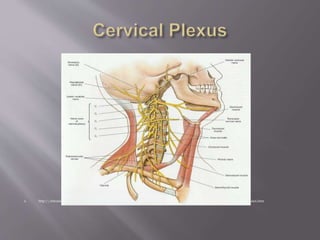
Cervical
Plexus
The cervical plexus represents nerves from
the anterior rami of C1 – C4
Superficial (4 primary braches)
• Lesser occipital n.
• Greater auricular n.
• Supraclavicular n.
• Transverse cervical n.
Deep (primarily muscular innervation)
• C1 innervates thyrohyoid, geniohyoid
• Ansa cervicalis (C1 – C3 loop)
innervates sternohyoid, omohyoid,
sternothyroid
• Segmental branches innervate scalene
muscles
• Phrenic (C3 – C5) innervates the
diaphragm and pericardium
 http://www.studyblue.com/notes/note/n/neck/deck/4588539
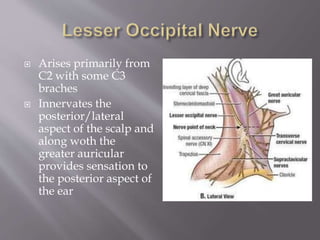
 Arises primarily from
C2 with some C3
braches
 Innervates the
posterior/lateral
aspect of the scalp and
along woth the
greater auricular
provides sensation to
the posterior aspect of
the ear
 http://quizlet.com/2618249/unit-11-posterior-triangle-of-neck-flash-
cards/
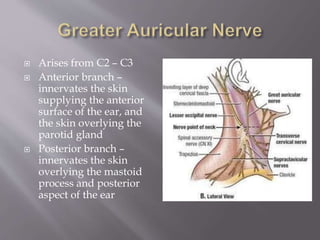
 Arises from C2 – C3
 Anterior branch –
innervates the skin
supplying the anterior
surface of the ear, and
the skin overlying the
parotid gland
 Posterior branch –
innervates the skin
overlying the mastoid
process and posterior
aspect of the ear
 http://quizlet.com/2618249/unit-11-posterior-triangle-of-neck-flash-cards/
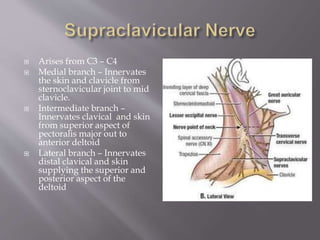
 Arises from C3 – C4
 Medial branch – Innervates
the skin and clavicle from
sternoclavicular joint to mid
clavicle.
 Intermediate branch –
Innervates clavical and skin
from superior aspect of
pectoralis major out to
anterior deltoid
 Lateral branch – Innervates
distal clavical and skin
supplying the superior and
posterior aspect of the
deltoid
 http://quizlet.com/2618249/unit-11-posterior-triangle-of-neck-flash-cards/
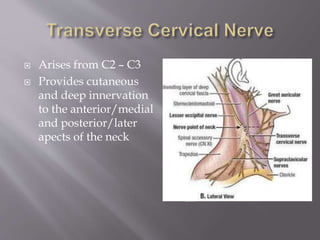
 Arises from C2 – C3
 Provides cutaneous
and deep innervation
to the anterior/medial
and posterior/later
apects of the neck
 http://quizlet.com/2618249/unit-11-posterior-triangle-of-neck-flash-
cards/
 www.nysora.com  Brown: Atlas of Regional Anesthesia, 3rd ed., Copyright © 2006
Saunders
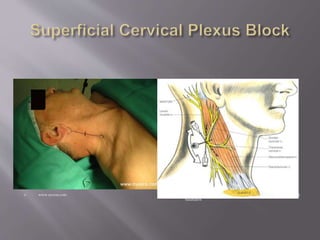
 Position: supine/sitting
 Landmarks: sternocleidomastoid muscle
 Local: 10 ml
 Block is generally performed starting at the
midpoint on the posterior/lateral border of the
sternocleidomastoid muscle.
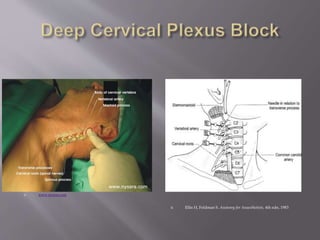
 www.nysora.com
 Ellis H, Feldman S. Anatomy for Anaesthetists, 4th edn, 1983
 Position: Supine/sitting
 Landmarks: Mastoid process, Chassaignac
tubercle
 Local: 3-4 ml injected each at C2, C3, C4
 Classically the block is performed using a
paresthesia eliciting technique to obtain a
paravertebral block of C2 – C4.
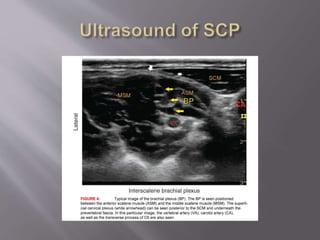
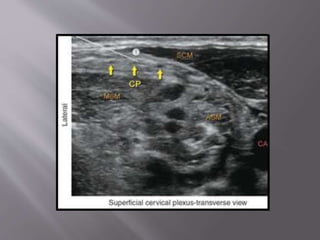
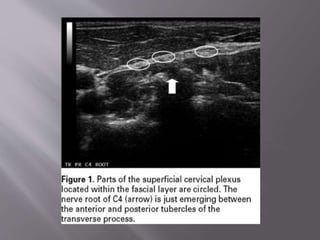
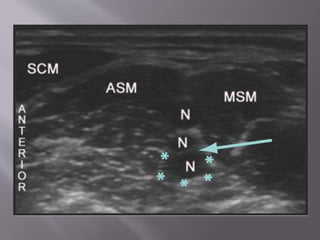
 Basically ultrasound guided superficial cervical
plexus block
 Ensures deeper components of the SCP are
anesthetized
 Position: Supine/Sitting
 Landmarks: Posterior border of the
sternocleidomastoid muscle at the level of the
external jugular vein
 Local: 5-15 mL
THYROIDECTOMY UNDER LOCAL OR REGIONAL ANESTHESIA
IGOR BRICHKOV, MD, PAUL LOGERFO, MD
The technique used for local/regional anesthesia for thyroid surgery is described. The experience
with a large number of patients undergoing local/regional anesthesia is incorporated in
describing this technique.
Local or regional anesthesia for thyroid surgery has been
used since the 19th century. Thomas Peel Dunhill originally
popularized this technique; his experience with it
can be found elsewhere. 1-3 Local anesthesia has been offered
to patients undergoing thyroid surgery at this institution
for the past 15 years. The resurgence of this approach
began with patients' desire to avoid general
anesthesia when undergoing thyroid surgery. The use of
local anesthesia was originally thought to limit the extent
of procedures being performed because the ability to extend
dissections beyond that of uncomplicated thyroidectomy
was not considered feasible. However, with additional
experience, we found that a wide range of thyroid
and parathyroid surgery could be performed under local
anesthesia. We have performed 800 thyroidectomies under
local anesthesia (approximately 95% of patients), with
conversion to general anesthesia in only 1% of patients.
This technique has proven safe and effective when compared
to general anesthesia. 4
Surgery Journal
Year: 2011 | Volume: 6 | Issue: 1 | Page No.: 7-12
DOI: 10.3923/sjour.2011.7.12
Day Case Thyroidectomy under Local/Regional Block in a Tropical Sub-Urban Teaching
Hospital in a Developing Country-Preliminary Report
Musa Adewale , Philip A.O. Adeniyi , Lasisi Akeem , Agboola Oladeji and Oyegunle Ayodele
Abstract: Throidectomy is routinely performed under general anaesthesia and patient is often
admitted for a few days. This has been found unnecessary because complications following
thyriodectomy are very rare. Day case surgery is an ideal way of utilizing heath resources to
maximum, cheap and conserves hospital beds. A prospective study performing thyroidectomy
under regional anaesthesia as day cases. Department of Surgery, Endocrine Unit, Olabisi
Onabanjo University Teaching Hospital, Sagamu, Nigeria. In a 36 month period, April 2007 to
March 2010, about 150 patients with simple nodular/multinodualr goiter were strictly selected
for the study. Patients selected for the surgery were 135 females and 15 males with age range
of 27-55 years and a mean age of 40.5 years±9.3 SD. Three had nodular goiter, seven with
isthmus enlargement and 140 had simple multinodular goiter (two as recurrent). Three had
lobectomy, seven had isthmusectomy with bilateral partial lobectomies; the remaining had
near total thyroidectomy including the patients with recurrent goiter. There were no
complications, all were discharged between 6-8 h post operative except one of the patients
with recurrent goiter who had two pints of blood and was discharged at 20 h, post surgery.
She also had transient hypocalcaemia. Thirty five patients had headache which responded to
simple analgesic. About 95% of the patients were satisfied with procedure and would
recommend it to others, 3% were satisfied but would not recommend it while 2% were
indifferent. Day case thyroidectomy is safe and feasible even in rural and sub-urban centres.
Surgery. 1998 Dec;124(6):975-8; discussion 978-9.
Local/regional anesthesia for thyroidectomy: evaluation as an outpatient procedure.
Lo Gerfo P.
Source
Columbia University College of Physicians and Surgeons, New York, NY, USA.
Abstract
BACKGROUND:
The purpose of this paper was to review my evolving experience with local/regional anesthesia in an outpatient
setting.
METHODS:
Two hundred three consecutive patients during a 9-year period who chose to undergo thyroid operation under
regional/local anesthesia were reviewed. Early discharge was offered to patients who were observed for 6 hours
without neck swelling and who had no surgical reasons for delaying discharge.
RESULTS:
In group A there were 2 patients who were given inhalation anesthesia during operation compared with none in
groups B and C. The average length of stay in group A was 0.49 days, 0.55 days in group B, and 0.24 days in
group C. Eighty-five percent of the patients whose operation began before 1300 hours were discharged within 6
hours versus only 50% of those operated on later in the day. Forty-seven percent of patients in group A, 65% of
group B, and 77% of patients in group C were discharged within 6 hours of operation. On the basis of previous
experience with general anesthesia, discharge time is not significantly influenced by the type of anesthesia
chosen. There were no readmissions to the hospital, but 2 episodes of postoperative bleeding required
reoperation. Survey showed that 95% of patients rated the level of pain equivalent or less severe than dental
procedures under local anesthesia, and all patients would choose local again.
CONCLUSIONS:
These data suggest that thyroidectomy can be performed with the patient under local/regional anesthesia, with
low morbidity and high patient satisfaction. Most patients can be discharged within 6 to 8 hours, and these
discharges were not associated with readmissions.
Head and Neck
Regional Anesthesia and
Thyroidectomy: Local Anesthesia for
Thyroidectomies?
Guest Reviewers: R. Russell Martin, COL, MC, USA, and
Alan Sbar, MAJ, MC, USA, General Surgery Service, Brooke Army
Medical Center, Fort Sam Houston, Texas
CHARACTERISTICS OF PATIENTS HAVING THYROID SURGERY UNDER
REGIONAL ANESTHESIA. Specht MC, Romero M, Barden CB, Esposito C, Fahey
TJ III. J Am Coll Surg 2001;193:367-372.
Objective: To examine and compare patient characteristics and outcomes for patients undergoing thyroid surgery with either regional or general
anesthesia.
Design: A retrospective review of 175 consecutive thyroid surgeries performed at a single institution with a single primary surgeon over 3 years.
Setting: The New York Presbyterian Hospital-Weill Medical College of Cornell University, New York, New York.
Participants: A total of 175 consecutive patients undergoing thyroid surgery from February 1977 to May 2000.
Results: Regional anesthesia was discussed preoperatively with all patients prior to surgery, and the patient’s decision was used to assign the subjects
into a regional
anesthesia and general anesthesia group. The only absolute contraindications to regional anesthesia in this series were substernal goiter and inability of
a patient to
communicate. The patient characteristics of the 2 groups were compared with regard to age, gender, Body Mass Index (BMI), anesthesia class,
pathology, size of tumor, and type of operation (hemi vs. total thyroidectomy). Operative time and length of stay was compared, and perioperative
complications were assessed in both groups. The only demographic difference between the 2 groups was BMI, in which 2% of the regional group and
23% of the general group were considered obese. All other characteristics measured showed no statistical difference or trends. Operative time was
significantly longer in the general anesthesia group, although this difference disappeared when the obese patients as a subgroup were factored out.
Length of stay was significantly shorter in the regional anesthesia group (0.95 vs. 1.30 days), and many patients chose to go home the same day.
Perioperative complications, which included transient or permanent hypocalcemia and vocal cord paralysis, hematoma, infection, and conversion to
general anesthesia, were few and did not show a statistically significant difference.
Conclusions: In patients who undergo thyroid surgery, regional anesthesia can be
considered a safe alternative to general anesthesia. The only contraindications to regional anesthesia as set forth
by the authors were substernal goiter (possibly requiring sternal split) and inability to communicate verbally with the anesthesiologist.
Operative times were similar, and there was no increased incidence of complications,
whereas length of stay was significantly shorter in the regional group.
LOCAL/REGIONAL ANESTHESIA FOR THYROIDECTOMY: EVALUATION
AS AN OUTPATIENT PROCEDURE. Lo Gerfo P. Surgery 1998;124:975-979.
Objective: To review the experience of a single surgeon in the use of local/regional anesthesia for thyroid surgery.
Design: A retrospective review of patients undergoing thyroid surgery by the author under local/regional anesthesia from 1988 to 1993, with patients
added prospectively to the database thereafter, with the intention of discharge on the day of surgery.
Setting: Columbia University College of Physicians and Surgeons, New York, New York.
Participants: Consecutive patients undergoing thyroid surgery from 1988 to 1997 under local/regional anesthesia.
Results: The patients were divided into 3 groups based on surgery date: Group A from 1988 to 1993, Group B from 1993 to 1996, Group C from 1996 to
1998.
Groups A, B, and C had 40, 70, and 93 patients, respectively, for a total n of 203. The records were assessed for type of surgery, operative time, duration
of hospital stay, and complications to include anesthetic complications, hypocalcemia, nerve injury, wound infection, mortality, and reoperation for
bleeding. Although the groups were divided into smaller periods of time throughout the review, the numbers of patients in each group increased,
showing a general increase in the number of patients receiving local/regional anesthesia per year. There is a slight trend away from thyroid lobectomy
toward total thyroidectomy in the last group of the
study. A trend of higher anesthesia class could be seen from Group A to Group C. Operative times were compared with patients undergoing general
anesthetic from
1996 to 1997. Overall times were increased by 25% when compared with patients undergoing general anesthesia. The duration of hospital stay ranged
from 0.24 to 0.55 days, with the percentage of patients treated as outpatients (stay of less than 6 hours) rising steadily from 47% to 77% over the time of
the study.
Mortality was 0, and all complications together were 7%. The greatest percentage of complications (5%) was that of transient hypocalcemia. There was a
12% incidence of transient hypocalcemia in the patients undergoing total thyroidectmy. Complications of local anesthesia requiring conversion to general
anesthesia were seen in 1%, and entirely in the earlier time period of the study. In addition, 1 patient suffered a permanent nerve injury and 2 required
reoperation for bleeding. There were no wound infections.
Conclusions: The author has shown that patients undergoing thyroid surgery can be safely operated on with local/regional anesthesia. Low
complication rates are shown in this series, and they are comparable to that of general
anesthesia. In his experience, 70% of patients chose local anesthesia when offered, and patient satisfaction
with local anesthesia was reported as near universal. The increase in operative time is attributed to patient intolerance to pressure, which limited the
speed of dissection; however, this increase was offset by the elimination of induction and wakeup from general anesthesia. In the hands of these thyroid
surgeons, outpatient thyroid surgery (6-hour hospital stay) was safe.
Ultrasound Med Biol. 2013 Jun;39(6):981-6. doi: 10.1016/j.ultrasmedbio.2013.01.002. Epub 2013 Mar 15.
Combination of high-resolution ultrasound-guided perivascular regional anesthesia of the internal carotid
artery and intermediate cervical plexus block for carotid surgery.
Rössel T, Kersting S, Heller AR, Koch T.
Source
Department of Anesthesiology and Intensive Care Medicine, University Hospital Carl Gustav Carus, Dresden
University of Technology, Dresden, Germany. thomas.roessel@uniklinikum-dresden.de
Abstract
All previously documented regional anesthesia procedures for carotid artery surgery routinely require
additional local infiltration or systemic supplementation with opioids to achieve satisfactory analgesia because
of the complex innervation of the surgical site. Here, we report a reliable ultrasound-guided anesthesia method
for carotid artery surgery. High-resolution ultrasound-guided regional anesthesia using a 12.5-MHz linear
ultrasound transducer was performed in 34 patients undergoing carotid endarterectomy. Anesthesia consisted of
perivascular regional anesthesia of the internal carotid artery and intermediate cervical plexus block. The
internal carotid artery and the nerves of the superficial cervical plexus were identified, and a needle was placed
dorsal to the internal carotid artery and directed cranially to the carotid bifurcation under ultrasound
visualization. After careful aspiration, local anesthetic was spread around the internal carotid artery and the
carotid bifurcation. In the second step, local anesthetic was injected below the sternocleidomastoid muscle along
the previously identified nerves of the intermediate cervical plexus. The necessity for intra-operative
supplementation and the conversion rate to general anesthesia were recorded. Ultrasonic visualization of the
region of interest was possible in all cases. Needle direction was successful in all cases. Three to five milliliters of
0.5% ropivacaine produced satisfactory spread around the carotid bifurcation. For intermediate cervical plexus
block, 10 to 20 mL of 0.5% ropivacaine produced sufficient intra-operative analgesia. Conversion to general
anesthesia because of an incomplete block was not necessary. Five cases required additional local infiltration
with 1% prilocaine (2-6 mL) by the surgeon. Visualization with high-resolution ultrasound yields safe and
accurate performance of the block. Because of the low rate of intra-operative supplementation, we conclude that
the described ultrasound-guided perivascular anesthesia technique is effective for carotid artery surgery.
Copyright © 2013 World Federation for Ultrasound in Medicine & Biology. Published by Elsevier Inc. All rights
reserved.
Tex Heart Inst J. 2010;37(3):297-300.
Carotid endarterectomy with intermediate cervical plexus block.
Barone M, Diemunsch P, Baldassarre E, Oben WE, Ciarlo M, Wolter J, Albani A.
Source
Department of Anesthesia & Perioperative Medicine, Umberto Parini Hospital, Aosta 11100, Italy.
marco.barone@yahoo.it
Abstract
During carotid endarterectomy, the use of locoregional anesthesia to achieve a combined superficial and deep
cervical plexus block can cause cardiovascular, respiratory, and neurologic complications. Seeking to reduce risk
and find an easier procedure, we applied locoregional anesthesia and an intermediate cervical plexus block in a
series of patients who underwent carotid endarterectomy. From 2006 through 2007, 183 patients underwent
primary carotid endarterectomy at our hospital. Mean age was 75.9 +/- 9.9 yr; mean body mass index, 27.3 +/-
6.7 kg/m(2); and median American Society of Anesthesiologists physical status classification, P3 (range, P2-P4).
All procedures combined an intermediate cervical plexus block with subcutaneous infiltration of the incision line.
We inserted a 15-mm, 25G needle to its full length, perpendicular to the skin along the posterior border of the
sternocleidomastoid muscle, midway between the mastoid process and the clavicle. We injected 10 mL of 0.75%
ropivacaine solution for 3 to 5 minutes. This block was systematically combined with subcutaneous infiltration of
the incision line with the ropivacaine (0.75%, 10 mL), and sometimes also with 2% topical lidocaine
intraoperatively. If necessary, intraoperative sedation, analgesia, or both were given to patients to improve their
compliance. Intraoperative topical lidocaine was required in 59 patients (32.2%), and intravenous midazolam,
fentanyl, or both were required in 29 patients (15.8%). Two procedures were converted to general anesthesia
(1.1%). No perioperative deaths or complications occurred. Postoperatively, 2 patients experienced strokes and 1
sustained a myocardial infarction (total rate, 1.6%). We found the intermediate cervical plexus block to be
feasible, effective, and safe, with low perioperative and postoperative complication rates. Herein, we report our
findings.
KEYWORDS:
Anesthesia/methods/utilization, cervical plexus, endarterectomy, carotid/adverse effects/methods, injections,
intramuscular, nerve block/adverse effects/methods, safety, treatment outcome
Br J Anaesth. 2007 Aug;99(2):159-69. Epub 2007 Jun 18.
Superficial or deep cervical plexus block for carotid endarterectomy: a systematic review of
complications.
Pandit JJ, Satya-Krishna R, Gration P.
Source
Nuffield Department of Anaesthetics, John Radcliffe Hospital, Oxford OX3 9DU, UK.
jaideep.pandit@physiol.ox.ac.uk
Abstract
Carotid endarterectomy is commonly conducted under regional (deep, superficial, intermediate, or
combined) cervical plexus block, but it is not known if complication rates differ. We conducted a
systematic review of published papers to assess the complication rate associated with superficial
(or intermediate) and deep (or combined deep plus superficial/intermediate). The null hypothesis
was that complication rates were equal. Complications of interest were: (1) serious complications
related to the placement of block, (2) incidence of conversion to general anaesthesia, and (3) serious
systemic complications of the surgical-anaesthetic process. We retrieved 69 papers describing a
total of 7558 deep/combined blocks and 2533 superficial/intermediate blocks. Deep/combined
block was associated with a higher serious complication rate related to the injecting needle when
compared with the superficial/intermediate block (odds ratio 2.13, P = 0.006). The conversion rate
to general anaesthesia was also higher with deep/combined block (odds ratio 5.15, P < 0.0001), but
there was an equivalent incidence of other systemic serious complications (odds ratio 1.13, P =
0.273; NS). We conclude that superficial/intermediate block is safer than any method that
employs a deep injection. The higher rate of conversion to general anaesthesia with the
deep/combined block may have been influenced by the higher incidence of direct
complications, but may also suggest that the superficial/combined block provides better
analgesia during surgery.
Eur J Vasc Endovasc Surg. 2007 Jan;33(1):50-4. Epub 2006 Sep 8.
The superficial cervical plexus block for postoperative pain therapy in carotid artery surgery. A prospective randomised
controlled trial.
Messner M, Albrecht S, Lang W, Sittl R, Dinkel M.
Source
Department of Anesthesiology, Friedrich-Alexander Universität, Erlangen, Germany. messner@gmx.li
Abstract
OBJECTIVES:
Rapid and reliable neurological evaluation soon after carotid artery surgery is feasible with modern methods of general anesthesia,
but postoperative pain therapy remains a challenge. Use of opioids can mask neurological deficits. We investigated whether
superficial cervical plexus block reduced postoperative opioid consumption after carotid endarterectomy.
DESIGN:
Prospective, randomised, double-blinded, placebo controlled trial.
METHODS:
46 patients undergoing unilateral carotid endarterectomy under general anesthesia were randomized to either superficial cervical
block with ropivacaine (n=23) or placebo (n=23). A patient controlled analgesia device (PCA) delivering morphine was provided for
all patients. Subjective pain levels (visual analog scale, VAS) were recorded. The primary outcome was total morphine consumption
on discharge from the recovery room. Secondary outcomes included arterial pCO2 (as an indicator of central nervous effects of
morphine) and patient satisfaction.
RESULTS:
No adverse effects of the superficial cervical plexus block were reported. Four patients in the placebo group were excluded because
of other drug use post-operatively. Per protocol analysis compared 23 patients in ropivacaine group and 19 patients in the placebo
group. The ropivacaine group had a significant reduction in morphine consumption (3.8+/-2.0 versus 12.9+/-4.0, p<0.001), lower
maximal pain scores (2.6+/-2.0 versus 5.8+/-1.6, p<0.001), and paCO2 levels (39.0+/-2.6 versus 41.9+/-3.4, p=0.008) at discharge
from the recovery room. Patient satisfaction (1=very good to 6=insufficient) was substantially higher in the ropivacaine group
(1.7+/-0.7 versus 3.1+/-1.2, p<00.01).
CONCLUSION:
The significant and clinically relevant lower morphine consumption and pain score, as well as the substantially higher patient
satisfaction demonstrate that superficial cervical plexus block provides effective pain relief for patients undergoing carotid
endarterectomy.
World J Surg. 2010 Oct;34(10):2338-43. doi: 10.1007/s00268-010-0698-7.
Bilateral superficial cervical plexus block combined with general anesthesia administered in thyroid
operations.
Shih ML, Duh QY, Hsieh CB, Liu YC, Lu CH, Wong CS, Yu JC, Yeh CC.
Source
Division of General Surgery, Department of Surgery, Tri-service General Hospital, National Defense Medical
Center, Taipei, Taiwan, ROC. judeshih@gmail.com
Abstract
BACKGROUND:
We investigated the analgesic efficacy of bilateral superficial cervical plexus block in patients undergoing
thyroidectomy and to determine whether it reduces the adverse effects of general anesthesia.
METHODS:
We prospectively recruited 162 patients who underwent elective thyroid operations from March 2006 to
October 2007. They were randomly assigned to receive a bilateral superficial cervical block (12 ml per side)
with isotonic saline (group A; n = 56), bupivacaine 0.5% (group B; n = 52), or levobupivacaine 0.5% (group C; n
= 54) after induction of general anesthesia. The analgesic efficacy of the block was assessed with:
intraoperative anesthetics (desflurane), numbers of patients needing postoperative analgesics, the time to the
first analgesics required, and pain intensity by visual analog scale (VAS). Postoperative nausea and vomiting
(PONV) for 24 h were also assessed by the "PONV grade." We also compared hospital stay, operative time, and
discomfort in swallowing.
RESULTS:
There were no significant differences in patient characteristics. Each average end-tidal desflurane
concentration was 5.8, 3.9, and 3.8% in groups A, B, and C, respectively (p < 0.001). Fewer patients in groups B
and C required analgesics (A: B: C = 33:8:7; p < 0.001), and it took longer before the first analgesic dose was
needed postoperatively (group A: B: C = 82.1:360.8:410.1 min; p < 0.001). Postoperative pain VAS were lower
in groups B and C for the first 24 h postoperatively (p < 0.001). Incidences of overall and severe PONV were
lower, however, there were not sufficient numbers of patients to detect differences in PONV among the three
groups. Hospital stay was shorter in group B and group C (p = 0.011). There was no significant difference in
operative time and postoperative swallowing pain among the three groups.
CONCLUSIONS:
Bilateral superficial cervical plexus block reduces general anesthetics required during thyroidectomy. It also
significantly lowers the severity of postoperative pain during the first 24 h and shortens the hospital stay.
Semin Cardiothorac Vasc Anesth. 2010 Mar;14(1):49-50. doi: 10.1177/1089253210363010.
Postoperative recovery advantages in patients undergoing thyroid and parathyroid
surgery under regional anesthesia.
Suri KB, Hunter CW, Davidov T, Anderson MB, Dombrovskiy V, Trooskin SZ.
Source
UMDNJ-Robert Wood Johnson Medical School, New Brunswick, NJ 08901, USA.
Abstract
Thyroid or parathyroid surgery may be performed using general anesthesia or regional
anesthesia. Ninety-five (95) patients underwent thyroid or parathyroid surgery using
general anesthesia (n=64) or bilateral superficial cervical plexus block with sedation
(n=31) and completed a postoperative questionnaire regarding the perioperative
experience. Patients undergoing parathyroid surgery under regional anesthesia (n=24)
were more likely to experience better energy levels (p=0.012) and earlier return to work
(p=0.045) postoperatively. Overall, 96% of patients undergoing either type of surgery
with either type of anesthetic reported satisfaction with the anesthetic.
Kathmandu Univ Med J (KUMJ). 2009 Jul-Sep;7(27):242-5.
Cervical epidural anaesthesia for thyroid surgery.
Khanna R, Singh DK.
Source
Department of Surgery, Institute of Medical Sciences, Banaras Hindu University, Varanasi, India.
dr_rahul_khanna@rediffmail.com
Abstract
BACKGROUND:
Cervical epidural anaesthesia is a regional anaesthesia technique which has been used for upper limb surgery,
upper thoracic wall surgery, carotid artery surgery and neck dissections. Anaesthesia for thyroid surgery can be
complicated due to the altered functional status of the thyroid or its large size.
OBJECTIVE:
This prospective study was designed to assess the effectiveness and safety of cervical epidural anaesthesia for
thyroid surgery.
MATERIALS AND METHODS:
Cervical epidural anaesthesia was attempted in 9 patients and the results compared with 44 patients who
underwent thyroid surgery under conventional general anaesthesia with endotracheal intubation. The epidural
catheter was placed in the C(7) - T(1) vertebral interspace and 10 - 15 ml of 1% Lignocaine with adrenaline was
injected.
RESULTS:
The technique of cervical epidural anaesthesia was successfully used in 8 out of 9 patients in whom it was
attempted All patients were maintained in a state of conscious - sedation and effective analgesia was obtained in
all 8 patients. There were no significant complications especially those related to diaphragmatic function and
cardiovascular stability. In contrast patients undergoing surgery under conventional general anaesthesia had
complications related to endotracheal intubation, cardiac arrhythmias and hypotension
CONCLUSION:
The technique of cervical epidural anaesthesia should be considered in thyroid patients where difficult
endotracheal intubation is anticipated and in those in whom alterations in thyroid functional state make them
vulnerable to cardiovascular complications under conventional general anaesthesia.
Thyroid. 2012 Jan;22(1):44-52. doi: 10.1089/thy.2011.0260. Epub 2011 Dec 5.
Bilateral superficial cervical plexus block in combination with general anesthesia has a low efficacy in thyroid
surgery: a meta-analysis of randomized controlled trials.
Warschkow R, Tarantino I, Jensen K, Beutner U, Clerici T, Schmied BM, Steffen T.
Source
Department of Surgery, Kantonsspital St. Gallen, St. Gallen, Switzerland.
Abstract
BACKGROUND:
A combination of bilateral superficial cervical plexus block (BSCPB) and general anesthesia is recommended for
thyroid surgery. Proof of the efficacy of this combination remains weak. Furthermore, data on the safety of this
regimen are lacking. Therefore, a meta-analysis of randomized controlled trials (RCT) to evaluate the efficacy and
safety of BSCPB as an adjunct to general anesthesia in patients receiving thyroid surgery was performed.
METHODS:
A meta-analysis of RCT was performed that included interventional groups evaluating the efficacy of BSCPB 6
and 24 hours after thyroid surgery.
RESULTS:
Eight RCT, including a total of 799 patients (463 who underwent BSCPB and 336 controls), were analyzed. A
meta-analysis demonstrated a reduction in pain scores 6 hours (Hedges' g: -0.46 [95% CI: -0.74 to -0.19]; p=0.001)
and 24 hours postoperatively (Hedges' g: -0.49 [95% CI: -0.71 to -0.27]; p<0.001) in patients who had undergone
BSCPB. The relative risk for postoperative nausea and vomiting (PONV) was 0.80 (95% CI: 0.58 to 1.09, p=0.159)
in patients receiving BSCPB. Procedure-related adverse events were reported in three of the 476 patients who had
undergone BSCPB (0.6%; 95% CI: 0.1% to 2.0%). These three patients had transient paresis of the brachial plexus,
combined with a diaphragmatic paresis in one case, and all spontaneously resolved.
CONCLUSION:
The combination of BSCPB and general anesthesia has a significant benefit in reducing pain 6 and 24 hours after
thyroid surgery. However, the effect on pain reduction is too small to be of clinical relevance. Although it is a safe
procedure, the existing evidence allows for no recommendation concerning the application of BSCPB in thyroid
surgery. Further trials should evaluate a dose-response relationship and the incidence of PONV with this
regimen.
 Anterior shoulder
 Acromioclavicular joint
 Clavicle
 Anterior neck (thyroid, carotid, etc.)
 Mastoid
 Auricular
 72 yo African male with symptomatic
hypercalcemia secondary to
hyperparathyroidism
 ROS: CAD with 2 vessel fixed stenosis, CHF EF
30-35%, Multiple CVAs (most recent 3 months
ago)
 Vitals: normal
 Surgery: Right parathyroidectomy
 Pre-procedure – versed 1mg
 Procedure – Right intermediate cervical plexus
10 ml Ropivicaine 0.75%, Right SCP 10 mL
Ropivicaine 0.75%
 Sugery: Propofol 25 mcg/kg/min
 Surgeon had to supplement twice (once when
he crossed the midline and the second at the
posterior/inferior aspect of the thyroid)
 Post-procedure – Pain 0/10
25820 - Cervical Plexus Block (1).pptx

25820 - Cervical Plexus Block (1).pptx

  • 1.
  • 2.
  • 3.
     Anatomy ofthe cervical plexus  Cervical plexus blocks  Literature review  Utility of cervical plexus blocks
  • 4.
     72 yoAfrican male with symptomatic hypercalcemia secondary to hyperparathyroidism  ROS: CAD with 2 vessel fixed stenosis, CHF EF 30-35%, Multiple CVAs (most recent 3 months ago)  Vitals: normal  Surgery: Right parathyroidectomy
  • 5.
  • 6.
     Halsted atBellvue Hospital in New York 1884  First published by Kappis in Germany 1912 describing a posterior approach  1914 Heidenhein described the lateral approach  1922 NEJM - local/regional analgesia to be the safest method for thyroidectomy
  • 7.
    Cervical Plexus The cervical plexusrepresents nerves from the anterior rami of C1 – C4 Superficial (4 primary braches) • Lesser occipital n. • Greater auricular n. • Supraclavicular n. • Transverse cervical n. Deep (primarily muscular innervation) • C1 innervates thyrohyoid, geniohyoid • Ansa cervicalis (C1 – C3 loop) innervates sternohyoid, omohyoid, sternothyroid • Segmental branches innervate scalene muscles • Phrenic (C3 – C5) innervates the diaphragm and pericardium  http://www.studyblue.com/notes/note/n/neck/deck/4588539
  • 8.
     Arises primarilyfrom C2 with some C3 braches  Innervates the posterior/lateral aspect of the scalp and along woth the greater auricular provides sensation to the posterior aspect of the ear  http://quizlet.com/2618249/unit-11-posterior-triangle-of-neck-flash- cards/
  • 9.
     Arises fromC2 – C3  Anterior branch – innervates the skin supplying the anterior surface of the ear, and the skin overlying the parotid gland  Posterior branch – innervates the skin overlying the mastoid process and posterior aspect of the ear  http://quizlet.com/2618249/unit-11-posterior-triangle-of-neck-flash-cards/
  • 10.
     Arises fromC3 – C4  Medial branch – Innervates the skin and clavicle from sternoclavicular joint to mid clavicle.  Intermediate branch – Innervates clavical and skin from superior aspect of pectoralis major out to anterior deltoid  Lateral branch – Innervates distal clavical and skin supplying the superior and posterior aspect of the deltoid  http://quizlet.com/2618249/unit-11-posterior-triangle-of-neck-flash-cards/
  • 11.
     Arises fromC2 – C3  Provides cutaneous and deep innervation to the anterior/medial and posterior/later apects of the neck  http://quizlet.com/2618249/unit-11-posterior-triangle-of-neck-flash- cards/
  • 12.
     www.nysora.com Brown: Atlas of Regional Anesthesia, 3rd ed., Copyright © 2006 Saunders
  • 13.
     Position: supine/sitting Landmarks: sternocleidomastoid muscle  Local: 10 ml  Block is generally performed starting at the midpoint on the posterior/lateral border of the sternocleidomastoid muscle.
  • 14.
     www.nysora.com  EllisH, Feldman S. Anatomy for Anaesthetists, 4th edn, 1983
  • 15.
     Position: Supine/sitting Landmarks: Mastoid process, Chassaignac tubercle  Local: 3-4 ml injected each at C2, C3, C4  Classically the block is performed using a paresthesia eliciting technique to obtain a paravertebral block of C2 – C4.
  • 16.
     Basically ultrasoundguided superficial cervical plexus block  Ensures deeper components of the SCP are anesthetized
  • 21.
     Position: Supine/Sitting Landmarks: Posterior border of the sternocleidomastoid muscle at the level of the external jugular vein  Local: 5-15 mL
  • 22.
    THYROIDECTOMY UNDER LOCALOR REGIONAL ANESTHESIA IGOR BRICHKOV, MD, PAUL LOGERFO, MD The technique used for local/regional anesthesia for thyroid surgery is described. The experience with a large number of patients undergoing local/regional anesthesia is incorporated in describing this technique. Local or regional anesthesia for thyroid surgery has been used since the 19th century. Thomas Peel Dunhill originally popularized this technique; his experience with it can be found elsewhere. 1-3 Local anesthesia has been offered to patients undergoing thyroid surgery at this institution for the past 15 years. The resurgence of this approach began with patients' desire to avoid general anesthesia when undergoing thyroid surgery. The use of local anesthesia was originally thought to limit the extent of procedures being performed because the ability to extend dissections beyond that of uncomplicated thyroidectomy was not considered feasible. However, with additional experience, we found that a wide range of thyroid and parathyroid surgery could be performed under local anesthesia. We have performed 800 thyroidectomies under local anesthesia (approximately 95% of patients), with conversion to general anesthesia in only 1% of patients. This technique has proven safe and effective when compared to general anesthesia. 4
  • 23.
    Surgery Journal Year: 2011| Volume: 6 | Issue: 1 | Page No.: 7-12 DOI: 10.3923/sjour.2011.7.12 Day Case Thyroidectomy under Local/Regional Block in a Tropical Sub-Urban Teaching Hospital in a Developing Country-Preliminary Report Musa Adewale , Philip A.O. Adeniyi , Lasisi Akeem , Agboola Oladeji and Oyegunle Ayodele Abstract: Throidectomy is routinely performed under general anaesthesia and patient is often admitted for a few days. This has been found unnecessary because complications following thyriodectomy are very rare. Day case surgery is an ideal way of utilizing heath resources to maximum, cheap and conserves hospital beds. A prospective study performing thyroidectomy under regional anaesthesia as day cases. Department of Surgery, Endocrine Unit, Olabisi Onabanjo University Teaching Hospital, Sagamu, Nigeria. In a 36 month period, April 2007 to March 2010, about 150 patients with simple nodular/multinodualr goiter were strictly selected for the study. Patients selected for the surgery were 135 females and 15 males with age range of 27-55 years and a mean age of 40.5 years±9.3 SD. Three had nodular goiter, seven with isthmus enlargement and 140 had simple multinodular goiter (two as recurrent). Three had lobectomy, seven had isthmusectomy with bilateral partial lobectomies; the remaining had near total thyroidectomy including the patients with recurrent goiter. There were no complications, all were discharged between 6-8 h post operative except one of the patients with recurrent goiter who had two pints of blood and was discharged at 20 h, post surgery. She also had transient hypocalcaemia. Thirty five patients had headache which responded to simple analgesic. About 95% of the patients were satisfied with procedure and would recommend it to others, 3% were satisfied but would not recommend it while 2% were indifferent. Day case thyroidectomy is safe and feasible even in rural and sub-urban centres.
  • 24.
    Surgery. 1998 Dec;124(6):975-8;discussion 978-9. Local/regional anesthesia for thyroidectomy: evaluation as an outpatient procedure. Lo Gerfo P. Source Columbia University College of Physicians and Surgeons, New York, NY, USA. Abstract BACKGROUND: The purpose of this paper was to review my evolving experience with local/regional anesthesia in an outpatient setting. METHODS: Two hundred three consecutive patients during a 9-year period who chose to undergo thyroid operation under regional/local anesthesia were reviewed. Early discharge was offered to patients who were observed for 6 hours without neck swelling and who had no surgical reasons for delaying discharge. RESULTS: In group A there were 2 patients who were given inhalation anesthesia during operation compared with none in groups B and C. The average length of stay in group A was 0.49 days, 0.55 days in group B, and 0.24 days in group C. Eighty-five percent of the patients whose operation began before 1300 hours were discharged within 6 hours versus only 50% of those operated on later in the day. Forty-seven percent of patients in group A, 65% of group B, and 77% of patients in group C were discharged within 6 hours of operation. On the basis of previous experience with general anesthesia, discharge time is not significantly influenced by the type of anesthesia chosen. There were no readmissions to the hospital, but 2 episodes of postoperative bleeding required reoperation. Survey showed that 95% of patients rated the level of pain equivalent or less severe than dental procedures under local anesthesia, and all patients would choose local again. CONCLUSIONS: These data suggest that thyroidectomy can be performed with the patient under local/regional anesthesia, with low morbidity and high patient satisfaction. Most patients can be discharged within 6 to 8 hours, and these discharges were not associated with readmissions.
  • 25.
    Head and Neck RegionalAnesthesia and Thyroidectomy: Local Anesthesia for Thyroidectomies? Guest Reviewers: R. Russell Martin, COL, MC, USA, and Alan Sbar, MAJ, MC, USA, General Surgery Service, Brooke Army Medical Center, Fort Sam Houston, Texas CHARACTERISTICS OF PATIENTS HAVING THYROID SURGERY UNDER REGIONAL ANESTHESIA. Specht MC, Romero M, Barden CB, Esposito C, Fahey TJ III. J Am Coll Surg 2001;193:367-372. Objective: To examine and compare patient characteristics and outcomes for patients undergoing thyroid surgery with either regional or general anesthesia. Design: A retrospective review of 175 consecutive thyroid surgeries performed at a single institution with a single primary surgeon over 3 years. Setting: The New York Presbyterian Hospital-Weill Medical College of Cornell University, New York, New York. Participants: A total of 175 consecutive patients undergoing thyroid surgery from February 1977 to May 2000. Results: Regional anesthesia was discussed preoperatively with all patients prior to surgery, and the patient’s decision was used to assign the subjects into a regional anesthesia and general anesthesia group. The only absolute contraindications to regional anesthesia in this series were substernal goiter and inability of a patient to communicate. The patient characteristics of the 2 groups were compared with regard to age, gender, Body Mass Index (BMI), anesthesia class, pathology, size of tumor, and type of operation (hemi vs. total thyroidectomy). Operative time and length of stay was compared, and perioperative complications were assessed in both groups. The only demographic difference between the 2 groups was BMI, in which 2% of the regional group and 23% of the general group were considered obese. All other characteristics measured showed no statistical difference or trends. Operative time was significantly longer in the general anesthesia group, although this difference disappeared when the obese patients as a subgroup were factored out. Length of stay was significantly shorter in the regional anesthesia group (0.95 vs. 1.30 days), and many patients chose to go home the same day. Perioperative complications, which included transient or permanent hypocalcemia and vocal cord paralysis, hematoma, infection, and conversion to general anesthesia, were few and did not show a statistically significant difference. Conclusions: In patients who undergo thyroid surgery, regional anesthesia can be considered a safe alternative to general anesthesia. The only contraindications to regional anesthesia as set forth by the authors were substernal goiter (possibly requiring sternal split) and inability to communicate verbally with the anesthesiologist. Operative times were similar, and there was no increased incidence of complications, whereas length of stay was significantly shorter in the regional group.
  • 26.
    LOCAL/REGIONAL ANESTHESIA FORTHYROIDECTOMY: EVALUATION AS AN OUTPATIENT PROCEDURE. Lo Gerfo P. Surgery 1998;124:975-979. Objective: To review the experience of a single surgeon in the use of local/regional anesthesia for thyroid surgery. Design: A retrospective review of patients undergoing thyroid surgery by the author under local/regional anesthesia from 1988 to 1993, with patients added prospectively to the database thereafter, with the intention of discharge on the day of surgery. Setting: Columbia University College of Physicians and Surgeons, New York, New York. Participants: Consecutive patients undergoing thyroid surgery from 1988 to 1997 under local/regional anesthesia. Results: The patients were divided into 3 groups based on surgery date: Group A from 1988 to 1993, Group B from 1993 to 1996, Group C from 1996 to 1998. Groups A, B, and C had 40, 70, and 93 patients, respectively, for a total n of 203. The records were assessed for type of surgery, operative time, duration of hospital stay, and complications to include anesthetic complications, hypocalcemia, nerve injury, wound infection, mortality, and reoperation for bleeding. Although the groups were divided into smaller periods of time throughout the review, the numbers of patients in each group increased, showing a general increase in the number of patients receiving local/regional anesthesia per year. There is a slight trend away from thyroid lobectomy toward total thyroidectomy in the last group of the study. A trend of higher anesthesia class could be seen from Group A to Group C. Operative times were compared with patients undergoing general anesthetic from 1996 to 1997. Overall times were increased by 25% when compared with patients undergoing general anesthesia. The duration of hospital stay ranged from 0.24 to 0.55 days, with the percentage of patients treated as outpatients (stay of less than 6 hours) rising steadily from 47% to 77% over the time of the study. Mortality was 0, and all complications together were 7%. The greatest percentage of complications (5%) was that of transient hypocalcemia. There was a 12% incidence of transient hypocalcemia in the patients undergoing total thyroidectmy. Complications of local anesthesia requiring conversion to general anesthesia were seen in 1%, and entirely in the earlier time period of the study. In addition, 1 patient suffered a permanent nerve injury and 2 required reoperation for bleeding. There were no wound infections. Conclusions: The author has shown that patients undergoing thyroid surgery can be safely operated on with local/regional anesthesia. Low complication rates are shown in this series, and they are comparable to that of general anesthesia. In his experience, 70% of patients chose local anesthesia when offered, and patient satisfaction with local anesthesia was reported as near universal. The increase in operative time is attributed to patient intolerance to pressure, which limited the speed of dissection; however, this increase was offset by the elimination of induction and wakeup from general anesthesia. In the hands of these thyroid surgeons, outpatient thyroid surgery (6-hour hospital stay) was safe.
  • 27.
    Ultrasound Med Biol.2013 Jun;39(6):981-6. doi: 10.1016/j.ultrasmedbio.2013.01.002. Epub 2013 Mar 15. Combination of high-resolution ultrasound-guided perivascular regional anesthesia of the internal carotid artery and intermediate cervical plexus block for carotid surgery. Rössel T, Kersting S, Heller AR, Koch T. Source Department of Anesthesiology and Intensive Care Medicine, University Hospital Carl Gustav Carus, Dresden University of Technology, Dresden, Germany. thomas.roessel@uniklinikum-dresden.de Abstract All previously documented regional anesthesia procedures for carotid artery surgery routinely require additional local infiltration or systemic supplementation with opioids to achieve satisfactory analgesia because of the complex innervation of the surgical site. Here, we report a reliable ultrasound-guided anesthesia method for carotid artery surgery. High-resolution ultrasound-guided regional anesthesia using a 12.5-MHz linear ultrasound transducer was performed in 34 patients undergoing carotid endarterectomy. Anesthesia consisted of perivascular regional anesthesia of the internal carotid artery and intermediate cervical plexus block. The internal carotid artery and the nerves of the superficial cervical plexus were identified, and a needle was placed dorsal to the internal carotid artery and directed cranially to the carotid bifurcation under ultrasound visualization. After careful aspiration, local anesthetic was spread around the internal carotid artery and the carotid bifurcation. In the second step, local anesthetic was injected below the sternocleidomastoid muscle along the previously identified nerves of the intermediate cervical plexus. The necessity for intra-operative supplementation and the conversion rate to general anesthesia were recorded. Ultrasonic visualization of the region of interest was possible in all cases. Needle direction was successful in all cases. Three to five milliliters of 0.5% ropivacaine produced satisfactory spread around the carotid bifurcation. For intermediate cervical plexus block, 10 to 20 mL of 0.5% ropivacaine produced sufficient intra-operative analgesia. Conversion to general anesthesia because of an incomplete block was not necessary. Five cases required additional local infiltration with 1% prilocaine (2-6 mL) by the surgeon. Visualization with high-resolution ultrasound yields safe and accurate performance of the block. Because of the low rate of intra-operative supplementation, we conclude that the described ultrasound-guided perivascular anesthesia technique is effective for carotid artery surgery. Copyright © 2013 World Federation for Ultrasound in Medicine & Biology. Published by Elsevier Inc. All rights reserved.
  • 28.
    Tex Heart InstJ. 2010;37(3):297-300. Carotid endarterectomy with intermediate cervical plexus block. Barone M, Diemunsch P, Baldassarre E, Oben WE, Ciarlo M, Wolter J, Albani A. Source Department of Anesthesia & Perioperative Medicine, Umberto Parini Hospital, Aosta 11100, Italy. marco.barone@yahoo.it Abstract During carotid endarterectomy, the use of locoregional anesthesia to achieve a combined superficial and deep cervical plexus block can cause cardiovascular, respiratory, and neurologic complications. Seeking to reduce risk and find an easier procedure, we applied locoregional anesthesia and an intermediate cervical plexus block in a series of patients who underwent carotid endarterectomy. From 2006 through 2007, 183 patients underwent primary carotid endarterectomy at our hospital. Mean age was 75.9 +/- 9.9 yr; mean body mass index, 27.3 +/- 6.7 kg/m(2); and median American Society of Anesthesiologists physical status classification, P3 (range, P2-P4). All procedures combined an intermediate cervical plexus block with subcutaneous infiltration of the incision line. We inserted a 15-mm, 25G needle to its full length, perpendicular to the skin along the posterior border of the sternocleidomastoid muscle, midway between the mastoid process and the clavicle. We injected 10 mL of 0.75% ropivacaine solution for 3 to 5 minutes. This block was systematically combined with subcutaneous infiltration of the incision line with the ropivacaine (0.75%, 10 mL), and sometimes also with 2% topical lidocaine intraoperatively. If necessary, intraoperative sedation, analgesia, or both were given to patients to improve their compliance. Intraoperative topical lidocaine was required in 59 patients (32.2%), and intravenous midazolam, fentanyl, or both were required in 29 patients (15.8%). Two procedures were converted to general anesthesia (1.1%). No perioperative deaths or complications occurred. Postoperatively, 2 patients experienced strokes and 1 sustained a myocardial infarction (total rate, 1.6%). We found the intermediate cervical plexus block to be feasible, effective, and safe, with low perioperative and postoperative complication rates. Herein, we report our findings. KEYWORDS: Anesthesia/methods/utilization, cervical plexus, endarterectomy, carotid/adverse effects/methods, injections, intramuscular, nerve block/adverse effects/methods, safety, treatment outcome
  • 29.
    Br J Anaesth.2007 Aug;99(2):159-69. Epub 2007 Jun 18. Superficial or deep cervical plexus block for carotid endarterectomy: a systematic review of complications. Pandit JJ, Satya-Krishna R, Gration P. Source Nuffield Department of Anaesthetics, John Radcliffe Hospital, Oxford OX3 9DU, UK. jaideep.pandit@physiol.ox.ac.uk Abstract Carotid endarterectomy is commonly conducted under regional (deep, superficial, intermediate, or combined) cervical plexus block, but it is not known if complication rates differ. We conducted a systematic review of published papers to assess the complication rate associated with superficial (or intermediate) and deep (or combined deep plus superficial/intermediate). The null hypothesis was that complication rates were equal. Complications of interest were: (1) serious complications related to the placement of block, (2) incidence of conversion to general anaesthesia, and (3) serious systemic complications of the surgical-anaesthetic process. We retrieved 69 papers describing a total of 7558 deep/combined blocks and 2533 superficial/intermediate blocks. Deep/combined block was associated with a higher serious complication rate related to the injecting needle when compared with the superficial/intermediate block (odds ratio 2.13, P = 0.006). The conversion rate to general anaesthesia was also higher with deep/combined block (odds ratio 5.15, P < 0.0001), but there was an equivalent incidence of other systemic serious complications (odds ratio 1.13, P = 0.273; NS). We conclude that superficial/intermediate block is safer than any method that employs a deep injection. The higher rate of conversion to general anaesthesia with the deep/combined block may have been influenced by the higher incidence of direct complications, but may also suggest that the superficial/combined block provides better analgesia during surgery.
  • 30.
    Eur J VascEndovasc Surg. 2007 Jan;33(1):50-4. Epub 2006 Sep 8. The superficial cervical plexus block for postoperative pain therapy in carotid artery surgery. A prospective randomised controlled trial. Messner M, Albrecht S, Lang W, Sittl R, Dinkel M. Source Department of Anesthesiology, Friedrich-Alexander Universität, Erlangen, Germany. messner@gmx.li Abstract OBJECTIVES: Rapid and reliable neurological evaluation soon after carotid artery surgery is feasible with modern methods of general anesthesia, but postoperative pain therapy remains a challenge. Use of opioids can mask neurological deficits. We investigated whether superficial cervical plexus block reduced postoperative opioid consumption after carotid endarterectomy. DESIGN: Prospective, randomised, double-blinded, placebo controlled trial. METHODS: 46 patients undergoing unilateral carotid endarterectomy under general anesthesia were randomized to either superficial cervical block with ropivacaine (n=23) or placebo (n=23). A patient controlled analgesia device (PCA) delivering morphine was provided for all patients. Subjective pain levels (visual analog scale, VAS) were recorded. The primary outcome was total morphine consumption on discharge from the recovery room. Secondary outcomes included arterial pCO2 (as an indicator of central nervous effects of morphine) and patient satisfaction. RESULTS: No adverse effects of the superficial cervical plexus block were reported. Four patients in the placebo group were excluded because of other drug use post-operatively. Per protocol analysis compared 23 patients in ropivacaine group and 19 patients in the placebo group. The ropivacaine group had a significant reduction in morphine consumption (3.8+/-2.0 versus 12.9+/-4.0, p<0.001), lower maximal pain scores (2.6+/-2.0 versus 5.8+/-1.6, p<0.001), and paCO2 levels (39.0+/-2.6 versus 41.9+/-3.4, p=0.008) at discharge from the recovery room. Patient satisfaction (1=very good to 6=insufficient) was substantially higher in the ropivacaine group (1.7+/-0.7 versus 3.1+/-1.2, p<00.01). CONCLUSION: The significant and clinically relevant lower morphine consumption and pain score, as well as the substantially higher patient satisfaction demonstrate that superficial cervical plexus block provides effective pain relief for patients undergoing carotid endarterectomy.
  • 31.
    World J Surg.2010 Oct;34(10):2338-43. doi: 10.1007/s00268-010-0698-7. Bilateral superficial cervical plexus block combined with general anesthesia administered in thyroid operations. Shih ML, Duh QY, Hsieh CB, Liu YC, Lu CH, Wong CS, Yu JC, Yeh CC. Source Division of General Surgery, Department of Surgery, Tri-service General Hospital, National Defense Medical Center, Taipei, Taiwan, ROC. judeshih@gmail.com Abstract BACKGROUND: We investigated the analgesic efficacy of bilateral superficial cervical plexus block in patients undergoing thyroidectomy and to determine whether it reduces the adverse effects of general anesthesia. METHODS: We prospectively recruited 162 patients who underwent elective thyroid operations from March 2006 to October 2007. They were randomly assigned to receive a bilateral superficial cervical block (12 ml per side) with isotonic saline (group A; n = 56), bupivacaine 0.5% (group B; n = 52), or levobupivacaine 0.5% (group C; n = 54) after induction of general anesthesia. The analgesic efficacy of the block was assessed with: intraoperative anesthetics (desflurane), numbers of patients needing postoperative analgesics, the time to the first analgesics required, and pain intensity by visual analog scale (VAS). Postoperative nausea and vomiting (PONV) for 24 h were also assessed by the "PONV grade." We also compared hospital stay, operative time, and discomfort in swallowing. RESULTS: There were no significant differences in patient characteristics. Each average end-tidal desflurane concentration was 5.8, 3.9, and 3.8% in groups A, B, and C, respectively (p < 0.001). Fewer patients in groups B and C required analgesics (A: B: C = 33:8:7; p < 0.001), and it took longer before the first analgesic dose was needed postoperatively (group A: B: C = 82.1:360.8:410.1 min; p < 0.001). Postoperative pain VAS were lower in groups B and C for the first 24 h postoperatively (p < 0.001). Incidences of overall and severe PONV were lower, however, there were not sufficient numbers of patients to detect differences in PONV among the three groups. Hospital stay was shorter in group B and group C (p = 0.011). There was no significant difference in operative time and postoperative swallowing pain among the three groups. CONCLUSIONS: Bilateral superficial cervical plexus block reduces general anesthetics required during thyroidectomy. It also significantly lowers the severity of postoperative pain during the first 24 h and shortens the hospital stay.
  • 32.
    Semin Cardiothorac VascAnesth. 2010 Mar;14(1):49-50. doi: 10.1177/1089253210363010. Postoperative recovery advantages in patients undergoing thyroid and parathyroid surgery under regional anesthesia. Suri KB, Hunter CW, Davidov T, Anderson MB, Dombrovskiy V, Trooskin SZ. Source UMDNJ-Robert Wood Johnson Medical School, New Brunswick, NJ 08901, USA. Abstract Thyroid or parathyroid surgery may be performed using general anesthesia or regional anesthesia. Ninety-five (95) patients underwent thyroid or parathyroid surgery using general anesthesia (n=64) or bilateral superficial cervical plexus block with sedation (n=31) and completed a postoperative questionnaire regarding the perioperative experience. Patients undergoing parathyroid surgery under regional anesthesia (n=24) were more likely to experience better energy levels (p=0.012) and earlier return to work (p=0.045) postoperatively. Overall, 96% of patients undergoing either type of surgery with either type of anesthetic reported satisfaction with the anesthetic.
  • 33.
    Kathmandu Univ MedJ (KUMJ). 2009 Jul-Sep;7(27):242-5. Cervical epidural anaesthesia for thyroid surgery. Khanna R, Singh DK. Source Department of Surgery, Institute of Medical Sciences, Banaras Hindu University, Varanasi, India. dr_rahul_khanna@rediffmail.com Abstract BACKGROUND: Cervical epidural anaesthesia is a regional anaesthesia technique which has been used for upper limb surgery, upper thoracic wall surgery, carotid artery surgery and neck dissections. Anaesthesia for thyroid surgery can be complicated due to the altered functional status of the thyroid or its large size. OBJECTIVE: This prospective study was designed to assess the effectiveness and safety of cervical epidural anaesthesia for thyroid surgery. MATERIALS AND METHODS: Cervical epidural anaesthesia was attempted in 9 patients and the results compared with 44 patients who underwent thyroid surgery under conventional general anaesthesia with endotracheal intubation. The epidural catheter was placed in the C(7) - T(1) vertebral interspace and 10 - 15 ml of 1% Lignocaine with adrenaline was injected. RESULTS: The technique of cervical epidural anaesthesia was successfully used in 8 out of 9 patients in whom it was attempted All patients were maintained in a state of conscious - sedation and effective analgesia was obtained in all 8 patients. There were no significant complications especially those related to diaphragmatic function and cardiovascular stability. In contrast patients undergoing surgery under conventional general anaesthesia had complications related to endotracheal intubation, cardiac arrhythmias and hypotension CONCLUSION: The technique of cervical epidural anaesthesia should be considered in thyroid patients where difficult endotracheal intubation is anticipated and in those in whom alterations in thyroid functional state make them vulnerable to cardiovascular complications under conventional general anaesthesia.
  • 34.
    Thyroid. 2012 Jan;22(1):44-52.doi: 10.1089/thy.2011.0260. Epub 2011 Dec 5. Bilateral superficial cervical plexus block in combination with general anesthesia has a low efficacy in thyroid surgery: a meta-analysis of randomized controlled trials. Warschkow R, Tarantino I, Jensen K, Beutner U, Clerici T, Schmied BM, Steffen T. Source Department of Surgery, Kantonsspital St. Gallen, St. Gallen, Switzerland. Abstract BACKGROUND: A combination of bilateral superficial cervical plexus block (BSCPB) and general anesthesia is recommended for thyroid surgery. Proof of the efficacy of this combination remains weak. Furthermore, data on the safety of this regimen are lacking. Therefore, a meta-analysis of randomized controlled trials (RCT) to evaluate the efficacy and safety of BSCPB as an adjunct to general anesthesia in patients receiving thyroid surgery was performed. METHODS: A meta-analysis of RCT was performed that included interventional groups evaluating the efficacy of BSCPB 6 and 24 hours after thyroid surgery. RESULTS: Eight RCT, including a total of 799 patients (463 who underwent BSCPB and 336 controls), were analyzed. A meta-analysis demonstrated a reduction in pain scores 6 hours (Hedges' g: -0.46 [95% CI: -0.74 to -0.19]; p=0.001) and 24 hours postoperatively (Hedges' g: -0.49 [95% CI: -0.71 to -0.27]; p<0.001) in patients who had undergone BSCPB. The relative risk for postoperative nausea and vomiting (PONV) was 0.80 (95% CI: 0.58 to 1.09, p=0.159) in patients receiving BSCPB. Procedure-related adverse events were reported in three of the 476 patients who had undergone BSCPB (0.6%; 95% CI: 0.1% to 2.0%). These three patients had transient paresis of the brachial plexus, combined with a diaphragmatic paresis in one case, and all spontaneously resolved. CONCLUSION: The combination of BSCPB and general anesthesia has a significant benefit in reducing pain 6 and 24 hours after thyroid surgery. However, the effect on pain reduction is too small to be of clinical relevance. Although it is a safe procedure, the existing evidence allows for no recommendation concerning the application of BSCPB in thyroid surgery. Further trials should evaluate a dose-response relationship and the incidence of PONV with this regimen.
  • 35.
     Anterior shoulder Acromioclavicular joint  Clavicle  Anterior neck (thyroid, carotid, etc.)  Mastoid  Auricular
  • 36.
     72 yoAfrican male with symptomatic hypercalcemia secondary to hyperparathyroidism  ROS: CAD with 2 vessel fixed stenosis, CHF EF 30-35%, Multiple CVAs (most recent 3 months ago)  Vitals: normal  Surgery: Right parathyroidectomy
  • 37.
     Pre-procedure –versed 1mg  Procedure – Right intermediate cervical plexus 10 ml Ropivicaine 0.75%, Right SCP 10 mL Ropivicaine 0.75%  Sugery: Propofol 25 mcg/kg/min  Surgeon had to supplement twice (once when he crossed the midline and the second at the posterior/inferior aspect of the thyroid)  Post-procedure – Pain 0/10

Editor's Notes