
TRAP CASES
Presented by Fadiya Keloth
Volunteer at AFRS
TRAP CASES
A trap is nothing but the means of detecting a crime by catching the criminal
“flagrante delicto”.
Trap is a procedure by which a government employee/ public servant is caught
while accepting bribe from the complainant.
A successful trap is a vital piece of telltale evidence to prove the alleged demand of
illegal gratification by the accused public servant from the complainant' and its
subsequent acceptance by him in furtherance of the demand.
A PUBLIC SERVENT ASK
FOR BRIBE
THE COMPLAINANT
FILE A CASE
PROCEDURE FOR TRAP
IS BEGUN
TRAP CASE AND PC
ACT, 1988
Section 7 of the Prevention of Corruption Act, 1988
S
ection 13(1)(d)of PC ACT, 1988
Sections 13(2)of PC ACT,1988
WHO LAYS THE TRAP?
CBI/ACB lays traps to catch bribe takers red-handed.
They verify the recieved complaint and seek permission
from DG of ACB/Chief secretory/Chief Minister.
PROCEDURE FOR SETTING TRAP
WHEN TRAP IS LAID?
Trap is laid when,
A written complaint is received
The complaint is found genuine in secret verification
Permission recieved from the concerned higher authority
FIRis registered
FIR and the original complaint is sent to the Special
Judge for Anti-CORRUPTION
HOW TRAPS ARE LAID?
1.The money for the trap is arranged by the complainant
2.Coating the currency with phenolphthalein powder
3.The complainant is set to meet with the bribe taker to hand over
the money
4.Apre-arranged signal is given by the complainant indicating the
handover
5.The officer in charge of the trap party enters the scene,
reveals his/her identity
6.Phenolphthein test is conducted
7.If the test is positive,the accused will be arrested and questioned
PHENOLPHTHALEIN TEST
PROPERTIES OF PHENOLPHTHALEIN POWDER
Coal tar product, available in the form of light powder
It remains colorless in acid and neutral media,
but turns pink in alkali media weak acid and almost unionized
PRINCIPLE BEHIND PHENOLPHTHALEIN TEST
Locards principle of exchange
CHEMISTRY BEHIND PHENOLPHTHALEIN TEST
Unionized molecules in phenolphthalein are colorless which on
ionization give colorless H+ and pink colored phenolphthalein ions
When the currency notes smeared with phenolphthalein powder are touched or pocketed
by the bribetaker, his hand or clothes respectively will collect a few specks of the powder.
When the hand or clothes of the bribe-taker is dipped in lime water or sodium carbonate
(washing soda) solution, it will turn pink in colour
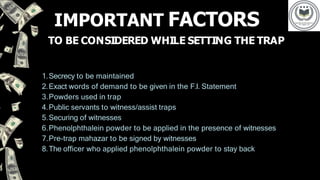
IMPORTANT FACTORS
TO BE CONSIDERED WHILE SETTING THE TRAP
1.Secrecy to be maintained
2.Exact words of demand to be given in the F.I. Statement
3.Powders used in trap
4.Public servants to witness/assist traps
5.Securing of witnesses
6.Phenolphthalein powder to be applied in the presence of witnesses
7.Pre-trap mahazar to be signed by witnesses
8.The officer who applied phenolphthalein powder to stay back
REFERENCES
https://www.slideshare.net/raghurx/examination-of- chemicals-in-trap-cases
https://mrunal.org/2013/11/ethics-traps-in-bribery- case- features-safeguards-
phenolphthalein-test-case- studies.html
https://www.dvac.tn.gov.in/FAQ.html
https://www.vigilance.kerala.gov.in/public/pdf/vigilance_manual/vigilance_manual.pdf
THANK YOU!

TRAP CASES

  • 1.
    TRAP CASES Presented byFadiya Keloth Volunteer at AFRS
  • 2.
    TRAP CASES A trapis nothing but the means of detecting a crime by catching the criminal “flagrante delicto”. Trap is a procedure by which a government employee/ public servant is caught while accepting bribe from the complainant. A successful trap is a vital piece of telltale evidence to prove the alleged demand of illegal gratification by the accused public servant from the complainant' and its subsequent acceptance by him in furtherance of the demand.
  • 3.
    A PUBLIC SERVENTASK FOR BRIBE THE COMPLAINANT FILE A CASE PROCEDURE FOR TRAP IS BEGUN TRAP CASE AND PC ACT, 1988 Section 7 of the Prevention of Corruption Act, 1988 S ection 13(1)(d)of PC ACT, 1988 Sections 13(2)of PC ACT,1988
  • 4.
    WHO LAYS THETRAP? CBI/ACB lays traps to catch bribe takers red-handed. They verify the recieved complaint and seek permission from DG of ACB/Chief secretory/Chief Minister. PROCEDURE FOR SETTING TRAP
  • 5.
    WHEN TRAP ISLAID? Trap is laid when, A written complaint is received The complaint is found genuine in secret verification Permission recieved from the concerned higher authority FIRis registered FIR and the original complaint is sent to the Special Judge for Anti-CORRUPTION
  • 6.
    HOW TRAPS ARELAID? 1.The money for the trap is arranged by the complainant 2.Coating the currency with phenolphthalein powder 3.The complainant is set to meet with the bribe taker to hand over the money 4.Apre-arranged signal is given by the complainant indicating the handover 5.The officer in charge of the trap party enters the scene, reveals his/her identity 6.Phenolphthein test is conducted 7.If the test is positive,the accused will be arrested and questioned
  • 7.
    PHENOLPHTHALEIN TEST PROPERTIES OFPHENOLPHTHALEIN POWDER Coal tar product, available in the form of light powder It remains colorless in acid and neutral media, but turns pink in alkali media weak acid and almost unionized PRINCIPLE BEHIND PHENOLPHTHALEIN TEST Locards principle of exchange
  • 8.
    CHEMISTRY BEHIND PHENOLPHTHALEINTEST Unionized molecules in phenolphthalein are colorless which on ionization give colorless H+ and pink colored phenolphthalein ions When the currency notes smeared with phenolphthalein powder are touched or pocketed by the bribetaker, his hand or clothes respectively will collect a few specks of the powder. When the hand or clothes of the bribe-taker is dipped in lime water or sodium carbonate (washing soda) solution, it will turn pink in colour
  • 9.
    IMPORTANT FACTORS TO BECONSIDERED WHILE SETTING THE TRAP 1.Secrecy to be maintained 2.Exact words of demand to be given in the F.I. Statement 3.Powders used in trap 4.Public servants to witness/assist traps 5.Securing of witnesses 6.Phenolphthalein powder to be applied in the presence of witnesses 7.Pre-trap mahazar to be signed by witnesses 8.The officer who applied phenolphthalein powder to stay back
  • 10.
    REFERENCES https://www.slideshare.net/raghurx/examination-of- chemicals-in-trap-cases https://mrunal.org/2013/11/ethics-traps-in-bribery- case-features-safeguards- phenolphthalein-test-case- studies.html https://www.dvac.tn.gov.in/FAQ.html https://www.vigilance.kerala.gov.in/public/pdf/vigilance_manual/vigilance_manual.pdf
  • 11.