IMPOTENCE AND STERILITY
Dr NIKITA , Senior Resident
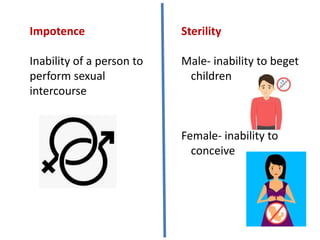
Impotence
Inability of a person to
perform sexual
intercourse
Sterility
Male- inability to beget
children
Female- inability to
conceive
• All sterile persons may not be impotent
• All impotent persons may not be sterile
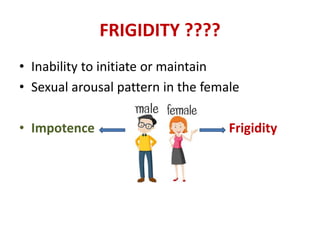
FRIGIDITY ????
• Inability to initiate or maintain
• Sexual arousal pattern in the female
• Impotence / Frigidity
Causes Male
(1) AGE- young and old
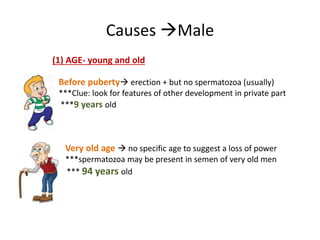
Before puberty erection + but no spermatozoa (usually)
***Clue: look for features of other development in private part
***9 years old
Very old age  no specific age to suggest a loss of power
***spermatozoa may be present in semen of very old men
*** 94 years old
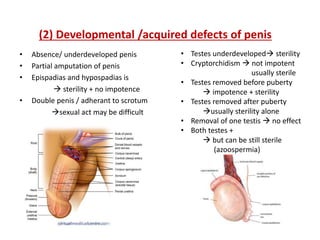
(2) Developmental /acquired defects of penis
• Absence/ underdeveloped penis
• Partial amputation of penis
• Epispadias and hypospadias is
 sterility + no impotence
• Double penis / adherant to scrotum
sexual act may be difficult
• Testes underdeveloped sterility
• Cryptorchidism  not impotent
usually sterile
• Testes removed before puberty
 impotence + sterility
• Testes removed after puberty
usually sterility alone
• Removal of one testis  no effect
• Both testes +
 but can be still sterile
(azoospermia)
(3) Local diseases
• Mechanical obstruction- phimosis/paraphimosis
• Local Diseases- gonorrhoea/ local infections/ sores on the penis
- TB/ syphilis
- sarcoma
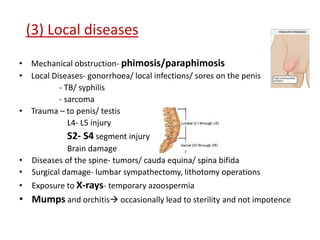
• Trauma – to penis/ testis
L4- L5 injury
S2- S4 segment injury
Brain damage
• Diseases of the spine- tumors/ cauda equina/ spina bifida
• Surgical damage- lumbar sympathectomy, lithotomy operations
• Exposure to X-rays- temporary azoospermia
• Mumps and orchitis occasionally lead to sterility and not impotence
(4) General Diseases
• Any acute illness- temporary impotence
• Diabetes
• Tuberculosis
• Chronic nephritis
• Syringomyelia
• Tabes dorsalis
• Paraplegia
• Disseminated sclerosis
• Locomotor ataxia
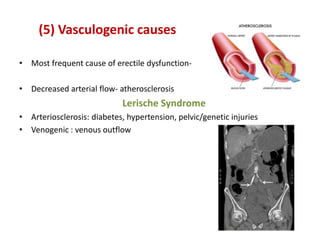
(5) Vasculogenic causes
• Most frequent cause of erectile dysfunction-
• Decreased arterial flow- atherosclerosis
Lerische Syndrome
• Arteriosclerosis: diabetes, hypertension, pelvic/genetic injuries
• Venogenic : venous outflow
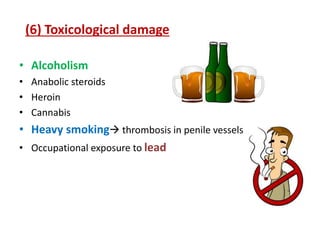
(6) Toxicological damage
• Alcoholism
• Anabolic steroids
• Heroin
• Cannabis
• Heavy smoking thrombosis in penile vessels
• Occupational exposure to lead
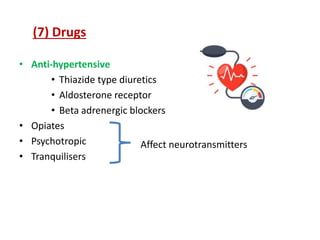
(7) Drugs
• Anti-hypertensive
• Thiazide type diuretics
• Aldosterone receptor
• Beta adrenergic blockers
• Opiates
• Psychotropic
• Tranquilisers
Affect neurotransmitters
(8) Psychic causes
• Emotional disturbances- temporary
• Anxiety, depression
• First night incompetence/ bridegroom incompetence-
temporary
• Sexual overindulgence, repeat masturbation
• Guilt sense
• Paranoia
• General impotence of the insane
• Impotence Quoad hoc (as far as this) impotent with one
particular women but not with others
Summary of the causes
• 40 % Vasculogenic impotence
• 15 to 20 % Diabetes mellitus
• 12 % Psychogenic
• 7 % Neurogenic
Causes of impotence in the female
(1) Age- Not much effect on potency (passive agent)
Sexual desire is lost in old age
Fertile- from puberty to menopause
(2) Developmental defects and acquired defects
(3) Local diseases
may not produce impotence but may cause sterility
eg: ovarian diseases, endometritis
(4) General diseases: do not cause impotence (passive agent)
(5)Psychic factors: it is of active nature called ‘vaginismus’
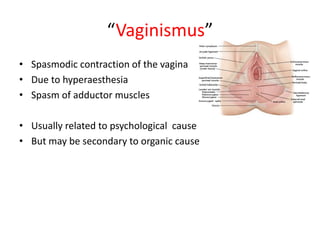
“Vaginismus”
• Spasmodic contraction of the vagina
• Due to hyperaesthesia
• Spasm of adductor muscles
• Usually related to psychological cause
• But may be secondary to organic cause
Frigidity
• Usually psychological
• In a female who has developed a dislike to sexual intercourse
– Dislike of the partner
– Neurological disorders
– Hypothyroidism
– Sedatives/depressants
– menopause
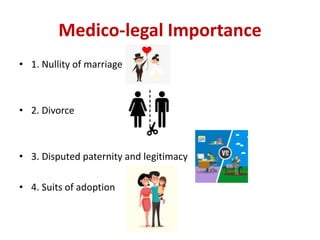
Medico-legal Importance
• 1. Nullity of marriage
• 2. Divorce
• 3. Disputed paternity and legitimacy
• 4. Suits of adoption
• 6. Claim for damage or loss of sexual function
• 7. Adultery
• 8. Rape
• 9. Unnatural sexual offences
Fecundation ab extra
• Conception is possible
• Without penetration of vagina by penis
– Due to passage of spermatozoa
– Deposited in the external genitalia
– To the uterus
• Rhythmic contraction of genital passage and
pelvic floor muscles help in it
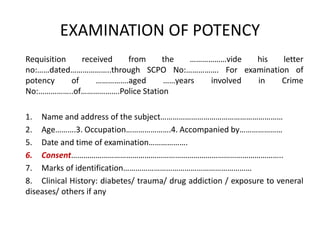
EXAMINATION OF POTENCY
Requisition received from the ………………vide his letter
no:……dated………………..through SCPO No:……………. For examination of
potency of …………….aged ……years involved in Crime
No:……………..of……………….Police Station
1. Name and address of the subject……………………………………………………
2. Age……….3. Occupation………………….4. Accompanied by…………………
5. Date and time of examination……………….
6. Consent…………………………………………………………………………………………..
7. Marks of identification………………………………………………………
8. Clinical History: diabetes/ trauma/ drug addiction / exposure to veneral
diseases/ others if any
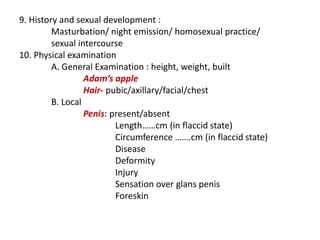
9. History and sexual development :
Masturbation/ night emission/ homosexual practice/
sexual intercourse
10. Physical examination
A. General Examination : height, weight, built
Adam’s apple
Hair- pubic/axillary/facial/chest
B. Local
Penis: present/absent
Length……cm (in flaccid state)
Circumference …….cm (in flaccid state)
Disease
Deformity
Injury
Sensation over glans penis
Foreskin
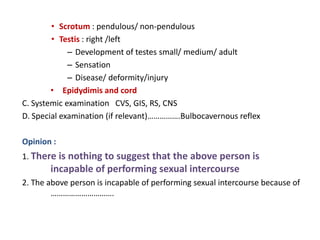
• Scrotum : pendulous/ non-pendulous
• Testis : right /left
– Development of testes small/ medium/ adult
– Sensation
– Disease/ deformity/injury
• Epidydimis and cord
C. Systemic examination CVS, GIS, RS, CNS
D. Special examination (if relevant)…………….Bulbocavernous reflex
Opinion :
1. There is nothing to suggest that the above person is
incapable of performing sexual intercourse
2. The above person is incapable of performing sexual intercourse because of
………………………….
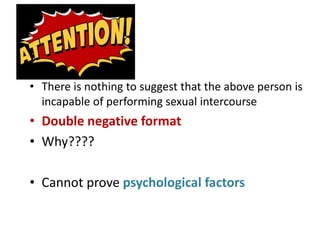
• There is nothing to suggest that the above person is
incapable of performing sexual intercourse
• Double negative format
• Why????
• Cannot prove psychological factors
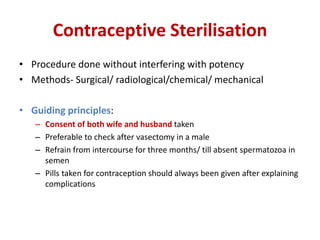
Contraceptive Sterilisation
• Procedure done without interfering with potency
• Methods- Surgical/ radiological/chemical/ mechanical
• Guiding principles:
– Consent of both wife and husband taken
– Preferable to check after vasectomy in a male
– Refrain from intercourse for three months/ till absent spermatozoa in
semen
– Pills taken for contraception should always been given after explaining
complications
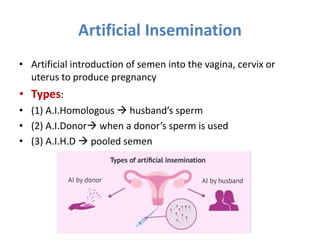
Artificial Insemination
• Artificial introduction of semen into the vagina, cervix or
uterus to produce pregnancy
• Types:
• (1) A.I.Homologous  husband’s sperm
• (2) A.I.Donor when a donor’s sperm is used
• (3) A.I.H.D  pooled semen
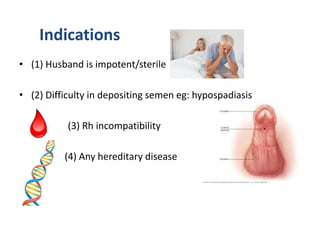
Indications
• (1) Husband is impotent/sterile
• (2) Difficulty in depositing semen eg: hypospadiasis
• ( (3) Rh incompatibility
• (4) Any hereditary disease
Principles when a donor is used
1. Consent of the donor and his wife-necessary
2. Identity of the donor- secret
3. Donor should not know the recipient too
4. Donor- healthy+ no hereditary disease
5. Donor must not be a relative of the recipient
6. Race should resemble
7. Donor- same blood group of the husband
8. No Rh incompatibility
9. Physician selects the donor
10. Couple- psychologically fit and emotionally stable
11. A witness must be present during insemination
12. Pooled semen preferred whenever possible
13. Physician doing insemination should not conduct the
delivery - to avoid falsifying of documents
14. A single donor not > 10 children
Legal Problems
1. Adultery- donor or recipient not guilty
2. Legitimacy- husband not actual father
Inheritance not possible
3. Never a ground for divorce if for sterility
But if impotent divorce ++
4. An unmarried women/ widow- can have a child by artificial
insemination the status of the child remains illegitimate
5. Incest there is a possibility between the donors children and
the A.I children.(India legally not punishable)
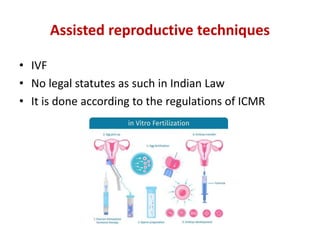
Assisted reproductive techniques
• IVF
• No legal statutes as such in Indian Law
• It is done according to the regulations of ICMR
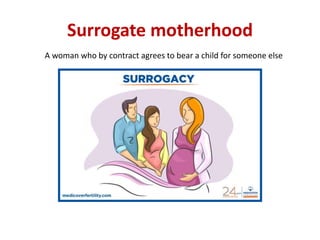
Surrogate motherhood
A woman who by contract agrees to bear a child for someone else
1. Complete surrogacy  ovum +uterus
2. Gestational surrogacy uterus alone
3. Ovarian surrogacy ovum alone
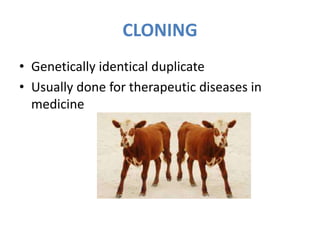
CLONING
• Genetically identical duplicate
• Usually done for therapeutic diseases in
medicine
Important questions
1. Causes of impotence
2. Impotence Quoad hanc
3. Drugs causing impotence
4. Medico-legal importance
5. Artificial insemination
THANK YOU

Impotence and sterility

  • 1.
    IMPOTENCE AND STERILITY DrNIKITA , Senior Resident
  • 2.
    Impotence Inability of aperson to perform sexual intercourse Sterility Male- inability to beget children Female- inability to conceive
  • 3.
    • All sterilepersons may not be impotent • All impotent persons may not be sterile
  • 4.
    FRIGIDITY ???? • Inabilityto initiate or maintain • Sexual arousal pattern in the female • Impotence / Frigidity
  • 5.
    Causes Male (1) AGE-young and old Before puberty erection + but no spermatozoa (usually) ***Clue: look for features of other development in private part ***9 years old Very old age  no specific age to suggest a loss of power ***spermatozoa may be present in semen of very old men *** 94 years old
  • 6.
    (2) Developmental /acquireddefects of penis • Absence/ underdeveloped penis • Partial amputation of penis • Epispadias and hypospadias is  sterility + no impotence • Double penis / adherant to scrotum sexual act may be difficult • Testes underdeveloped sterility • Cryptorchidism  not impotent usually sterile • Testes removed before puberty  impotence + sterility • Testes removed after puberty usually sterility alone • Removal of one testis  no effect • Both testes +  but can be still sterile (azoospermia)
  • 7.
    (3) Local diseases •Mechanical obstruction- phimosis/paraphimosis • Local Diseases- gonorrhoea/ local infections/ sores on the penis - TB/ syphilis - sarcoma • Trauma – to penis/ testis L4- L5 injury S2- S4 segment injury Brain damage • Diseases of the spine- tumors/ cauda equina/ spina bifida • Surgical damage- lumbar sympathectomy, lithotomy operations • Exposure to X-rays- temporary azoospermia • Mumps and orchitis occasionally lead to sterility and not impotence
  • 8.
    (4) General Diseases •Any acute illness- temporary impotence • Diabetes • Tuberculosis • Chronic nephritis • Syringomyelia • Tabes dorsalis • Paraplegia • Disseminated sclerosis • Locomotor ataxia
  • 9.
    (5) Vasculogenic causes •Most frequent cause of erectile dysfunction- • Decreased arterial flow- atherosclerosis Lerische Syndrome • Arteriosclerosis: diabetes, hypertension, pelvic/genetic injuries • Venogenic : venous outflow
  • 10.
    (6) Toxicological damage •Alcoholism • Anabolic steroids • Heroin • Cannabis • Heavy smoking thrombosis in penile vessels • Occupational exposure to lead
  • 11.
    (7) Drugs • Anti-hypertensive •Thiazide type diuretics • Aldosterone receptor • Beta adrenergic blockers • Opiates • Psychotropic • Tranquilisers Affect neurotransmitters
  • 12.
    (8) Psychic causes •Emotional disturbances- temporary • Anxiety, depression • First night incompetence/ bridegroom incompetence- temporary • Sexual overindulgence, repeat masturbation • Guilt sense • Paranoia • General impotence of the insane • Impotence Quoad hoc (as far as this) impotent with one particular women but not with others
  • 13.
    Summary of thecauses • 40 % Vasculogenic impotence • 15 to 20 % Diabetes mellitus • 12 % Psychogenic • 7 % Neurogenic
  • 14.
    Causes of impotencein the female (1) Age- Not much effect on potency (passive agent) Sexual desire is lost in old age Fertile- from puberty to menopause (2) Developmental defects and acquired defects (3) Local diseases may not produce impotence but may cause sterility eg: ovarian diseases, endometritis (4) General diseases: do not cause impotence (passive agent) (5)Psychic factors: it is of active nature called ‘vaginismus’
  • 15.
    “Vaginismus” • Spasmodic contractionof the vagina • Due to hyperaesthesia • Spasm of adductor muscles • Usually related to psychological cause • But may be secondary to organic cause
  • 16.
    Frigidity • Usually psychological •In a female who has developed a dislike to sexual intercourse – Dislike of the partner – Neurological disorders – Hypothyroidism – Sedatives/depressants – menopause
  • 17.
    Medico-legal Importance • 1.Nullity of marriage • 2. Divorce • 3. Disputed paternity and legitimacy • 4. Suits of adoption
  • 18.
    • 6. Claimfor damage or loss of sexual function • 7. Adultery • 8. Rape • 9. Unnatural sexual offences
  • 19.
    Fecundation ab extra •Conception is possible • Without penetration of vagina by penis – Due to passage of spermatozoa – Deposited in the external genitalia – To the uterus • Rhythmic contraction of genital passage and pelvic floor muscles help in it
  • 20.
    EXAMINATION OF POTENCY Requisitionreceived from the ………………vide his letter no:……dated………………..through SCPO No:……………. For examination of potency of …………….aged ……years involved in Crime No:……………..of……………….Police Station 1. Name and address of the subject…………………………………………………… 2. Age……….3. Occupation………………….4. Accompanied by………………… 5. Date and time of examination………………. 6. Consent………………………………………………………………………………………….. 7. Marks of identification……………………………………………………… 8. Clinical History: diabetes/ trauma/ drug addiction / exposure to veneral diseases/ others if any
  • 21.
    9. History andsexual development : Masturbation/ night emission/ homosexual practice/ sexual intercourse 10. Physical examination A. General Examination : height, weight, built Adam’s apple Hair- pubic/axillary/facial/chest B. Local Penis: present/absent Length……cm (in flaccid state) Circumference …….cm (in flaccid state) Disease Deformity Injury Sensation over glans penis Foreskin
  • 22.
    • Scrotum :pendulous/ non-pendulous • Testis : right /left – Development of testes small/ medium/ adult – Sensation – Disease/ deformity/injury • Epidydimis and cord C. Systemic examination CVS, GIS, RS, CNS D. Special examination (if relevant)…………….Bulbocavernous reflex Opinion : 1. There is nothing to suggest that the above person is incapable of performing sexual intercourse 2. The above person is incapable of performing sexual intercourse because of ………………………….
  • 23.
    • There isnothing to suggest that the above person is incapable of performing sexual intercourse • Double negative format • Why???? • Cannot prove psychological factors
  • 24.
    Contraceptive Sterilisation • Proceduredone without interfering with potency • Methods- Surgical/ radiological/chemical/ mechanical • Guiding principles: – Consent of both wife and husband taken – Preferable to check after vasectomy in a male – Refrain from intercourse for three months/ till absent spermatozoa in semen – Pills taken for contraception should always been given after explaining complications
  • 26.
    Artificial Insemination • Artificialintroduction of semen into the vagina, cervix or uterus to produce pregnancy • Types: • (1) A.I.Homologous  husband’s sperm • (2) A.I.Donor when a donor’s sperm is used • (3) A.I.H.D  pooled semen
  • 27.
    Indications • (1) Husbandis impotent/sterile • (2) Difficulty in depositing semen eg: hypospadiasis • ( (3) Rh incompatibility • (4) Any hereditary disease
  • 28.
    Principles when adonor is used 1. Consent of the donor and his wife-necessary 2. Identity of the donor- secret 3. Donor should not know the recipient too 4. Donor- healthy+ no hereditary disease 5. Donor must not be a relative of the recipient 6. Race should resemble 7. Donor- same blood group of the husband 8. No Rh incompatibility
  • 30.
    9. Physician selectsthe donor 10. Couple- psychologically fit and emotionally stable 11. A witness must be present during insemination 12. Pooled semen preferred whenever possible 13. Physician doing insemination should not conduct the delivery - to avoid falsifying of documents 14. A single donor not > 10 children
  • 31.
    Legal Problems 1. Adultery-donor or recipient not guilty 2. Legitimacy- husband not actual father Inheritance not possible 3. Never a ground for divorce if for sterility But if impotent divorce ++ 4. An unmarried women/ widow- can have a child by artificial insemination the status of the child remains illegitimate 5. Incest there is a possibility between the donors children and the A.I children.(India legally not punishable)
  • 32.
    Assisted reproductive techniques •IVF • No legal statutes as such in Indian Law • It is done according to the regulations of ICMR
  • 33.
    Surrogate motherhood A womanwho by contract agrees to bear a child for someone else
  • 34.
    1. Complete surrogacy ovum +uterus 2. Gestational surrogacy uterus alone 3. Ovarian surrogacy ovum alone
  • 35.
    CLONING • Genetically identicalduplicate • Usually done for therapeutic diseases in medicine
  • 36.
    Important questions 1. Causesof impotence 2. Impotence Quoad hanc 3. Drugs causing impotence 4. Medico-legal importance 5. Artificial insemination
  • 37.