

ELECTROSTATIC
DETECTION
APPARATUS (ESDA)
PRESENTED BY :
HARSHITA NIRANJAN
CRIMINOLOGY VOLUNTEER
APPLIED FORENSIC RESEARCH SCIENCES
CONTENTS
 INTRODUCTION
 PRINCIPLE
 HISTORY
 STORY BEHIND
 COMPONENTS
 ADVANTAGES
 DISADVANTAGES
 APPLICATIONS
 REFERENCES
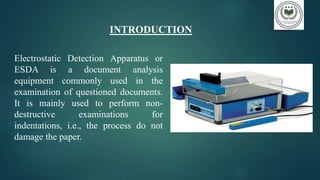
Electrostatic Detection Apparatus or
ESDA is a document analysis
equipment commonly used in the
examination of questioned documents.
It is mainly used to perform non-
destructive examinations for
indentations, i.e., the process do not
damage the paper.
INTRODUCTION
 ESDA uses applied charges and toner to visualize areas of
indented writing.
 It uses the principle that indented areas of the document carry less
negative charge than surrounding areas.
 This causes the toner used in the ESDA to be attracted to these
areas, revealing indentations that are present.
PRINCIPLE
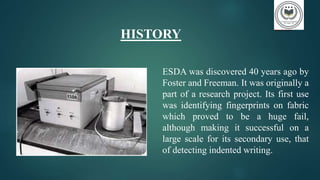
ESDA was discovered 40 years ago by
Foster and Freeman. It was originally a
part of a research project. Its first use
was identifying fingerprints on fabric
which proved to be a huge fail,
although making it successful on a
large scale for its secondary use, that
of detecting indented writing.
HISTORY
The popularity of ESDA reached peaks overnight following a
raid on a London bank. Originally a part of a research project,
ESDA was suddenly used by police to examine a note handed
by the robber to the bank teller demanding cash.
ESDA revealed the indentations which came out to be of a
telex message drafted to someone in Canada. The message was
a pleading to send money to an address in Surrey. This led to
the arrest of the man further popularizing the ESDA technique.
STORY BEHIND
 Main Unit
 Reel Holder (Imaging Film)
 Corona Wand
 Mains Power Adapter
COMPONENTS
1. Latent indented writing can be detected and preserved, which
otherwise is not visible by oblique light.
2. Indented writing is revealed which usually is unnoticeable to the
naked eye.
3. It is a non-destructive technique and hence does no damage to
the paper during the examination process.
4. It is a sensitive technique as indentations from up to 7 layers of
paper beneath the original writings are recovered.
ADVANTAGES
1. It is not suitable for examination of loose paper such as
newspaper.
2. This technique cannot be performed on glossy paper such as
that of a magazine.
3. If a document gets wet by any liquid, it will completely
destroy the ESDA impressions.
DISADVANTAGES
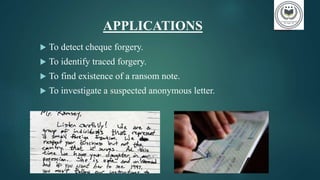
 To detect cheque forgery.
 To identify traced forgery.
 To find existence of a ransom note.
 To investigate a suspected anonymous letter.
APPLICATIONS
 https://www.questioneddocuments.com/esda/
 https://www.fosterfreeman.com/product/qde-products/678-esda-
history.html
 https://www.cbsnews.com/news/48-hours-preview-the-fascinating-
history-of-the-ransom-note/
 https://english.jagran.com/india/delhi-man-steals-cheques-from-bank-
drop-box-new-fraud-raises-concern-over-its-safety-10022295
REFERENCES
THANK YOU

ESDA

  • 2.
    ELECTROSTATIC DETECTION APPARATUS (ESDA) PRESENTED BY: HARSHITA NIRANJAN CRIMINOLOGY VOLUNTEER APPLIED FORENSIC RESEARCH SCIENCES
  • 3.
    CONTENTS  INTRODUCTION  PRINCIPLE HISTORY  STORY BEHIND  COMPONENTS  ADVANTAGES  DISADVANTAGES  APPLICATIONS  REFERENCES
  • 4.
    Electrostatic Detection Apparatusor ESDA is a document analysis equipment commonly used in the examination of questioned documents. It is mainly used to perform non- destructive examinations for indentations, i.e., the process do not damage the paper. INTRODUCTION
  • 5.
     ESDA usesapplied charges and toner to visualize areas of indented writing.  It uses the principle that indented areas of the document carry less negative charge than surrounding areas.  This causes the toner used in the ESDA to be attracted to these areas, revealing indentations that are present. PRINCIPLE
  • 6.
    ESDA was discovered40 years ago by Foster and Freeman. It was originally a part of a research project. Its first use was identifying fingerprints on fabric which proved to be a huge fail, although making it successful on a large scale for its secondary use, that of detecting indented writing. HISTORY
  • 7.
    The popularity ofESDA reached peaks overnight following a raid on a London bank. Originally a part of a research project, ESDA was suddenly used by police to examine a note handed by the robber to the bank teller demanding cash. ESDA revealed the indentations which came out to be of a telex message drafted to someone in Canada. The message was a pleading to send money to an address in Surrey. This led to the arrest of the man further popularizing the ESDA technique. STORY BEHIND
  • 8.
     Main Unit Reel Holder (Imaging Film)  Corona Wand  Mains Power Adapter COMPONENTS
  • 9.
    1. Latent indentedwriting can be detected and preserved, which otherwise is not visible by oblique light. 2. Indented writing is revealed which usually is unnoticeable to the naked eye. 3. It is a non-destructive technique and hence does no damage to the paper during the examination process. 4. It is a sensitive technique as indentations from up to 7 layers of paper beneath the original writings are recovered. ADVANTAGES
  • 10.
    1. It isnot suitable for examination of loose paper such as newspaper. 2. This technique cannot be performed on glossy paper such as that of a magazine. 3. If a document gets wet by any liquid, it will completely destroy the ESDA impressions. DISADVANTAGES
  • 11.
     To detectcheque forgery.  To identify traced forgery.  To find existence of a ransom note.  To investigate a suspected anonymous letter. APPLICATIONS
  • 12.
     https://www.questioneddocuments.com/esda/  https://www.fosterfreeman.com/product/qde-products/678-esda- history.html https://www.cbsnews.com/news/48-hours-preview-the-fascinating- history-of-the-ransom-note/  https://english.jagran.com/india/delhi-man-steals-cheques-from-bank- drop-box-new-fraud-raises-concern-over-its-safety-10022295 REFERENCES
  • 13.