






Using Cryptography
Properly in Applications
POSSCON 2015
Andy Watson
Ionic Security
About:
Name: Andy Watson
Occupation: Byte Mangler
Employer: Ionic Security
http://ionicsecurity.com/
Why:
I’ve seen too many people not using
cryptography or using it incorrectly.
This information may help you not be one of
them.
Agenda:
● Random
● Salt
● Hash
● Key Derivation
● Symmetric Encryption
● Famous Mistakes
Random
Random Number Generators
RNG: A computational or physical device designed to
generate a sequence of numbers that lack any pattern
High quality generators depend on an entropy source like
radioactive decay or radio frequency noise
For cryptographic functions, higher levels of entropy are
required to work properly
Pseudo
Computational RNG are known as Pseudo RNG
PRNG are “seeded” with a value to generate a
series of numbers
SALT
What is a Salt?
Random data added to your input to create
better output from one way functions
Useful for defending against dictionary and rainbow table
attacks.
Hash
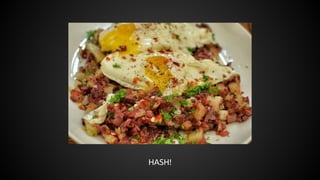
HASH!
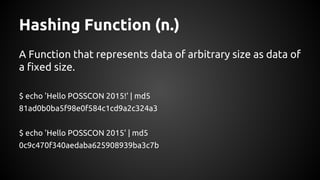
Hashing Function (n.)
A Function that represents data of arbitrary size as data of
a fixed size.
$ echo 'Hello POSSCON 2015!' | md5
81ad0b0ba5f98e0f584c1cd9a2c324a3
$ echo 'Hello POSSCON 2015' | md5
0c9c470f340aedaba625908939ba3c7b
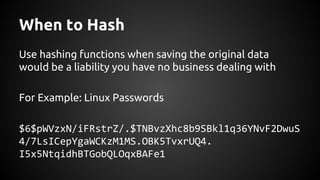
When to Hash
Use hashing functions when saving the original data
would be a liability you have no business dealing with
For Example: Linux Passwords
$6$pWVzxN/iFRstrZ/.$TNBvzXhc8b9SBkl1q36YNvF2DwuS
4/7LsICepYgaWCKzM1MS.OBK5TvxrUQ4.
I5x5NtqidhBTGobQLOqxBAFe1
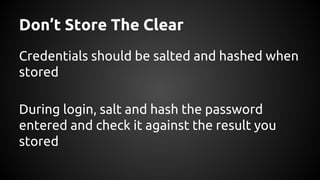
Don’t Store The Clear
Credentials should be salted and hashed when
stored
During login, salt and hash the password
entered and check it against the result you
stored
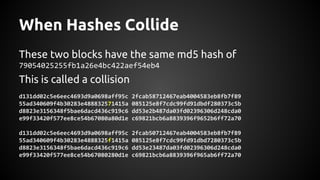
When Hashes Collide
These two blocks have the same md5 hash of
79054025255fb1a26e4bc422aef54eb4
This is called a collision
d131dd02c5e6eec4693d9a0698aff95c 2fcab58712467eab4004583eb8fb7f89
55ad340609f4b30283e488832571415a 085125e8f7cdc99fd91dbdf280373c5b
d8823e3156348f5bae6dacd436c919c6 dd53e2b487da03fd02396306d248cda0
e99f33420f577ee8ce54b67080a80d1e c69821bcb6a8839396f9652b6ff72a70
d131dd02c5e6eec4693d9a0698aff95c 2fcab50712467eab4004583eb8fb7f89
55ad340609f4b30283e4888325f1415a 085125e8f7cdc99fd91dbd7280373c5b
d8823e3156348f5bae6dacd436c919c6 dd53e23487da03fd02396306d248cda0
e99f33420f577ee8ce54b67080280d1e c69821bcb6a8839396f965ab6ff72a70
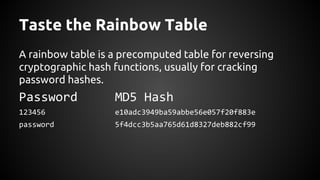
Taste the Rainbow Table
A rainbow table is a precomputed table for reversing
cryptographic hash functions, usually for cracking
password hashes.
Password MD5 Hash
123456 e10adc3949ba59abbe56e057f20f883e
password 5f4dcc3b5aa765d61d8327deb882cf99
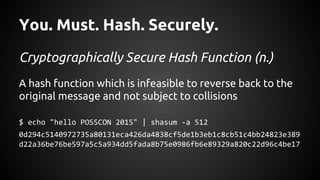
You. Must. Hash. Securely.
Cryptographically Secure Hash Function (n.)
A hash function which is infeasible to reverse back to the
original message and not subject to collisions
$ echo "hello POSSCON 2015" | shasum -a 512
0d294c5140972735a80131eca426da4838cf5de1b3eb1c8cb51c4bb24823e389
d22a36be76be597a5c5a934dd5fada8b75e0986fb6e89329a820c22d96c4be17
Key Derivation
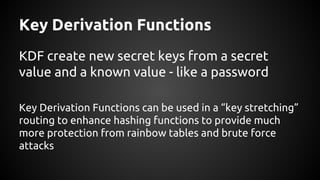
Key Derivation Functions
KDF create new secret keys from a secret
value and a known value - like a password
Key Derivation Functions can be used in a “key stretching”
routing to enhance hashing functions to provide much
more protection from rainbow tables and brute force
attacks
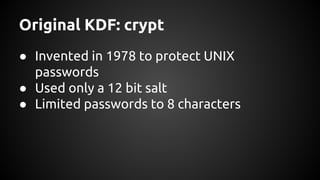
Original KDF: crypt
● Invented in 1978 to protect UNIX
passwords
● Used only a 12 bit salt
● Limited passwords to 8 characters
Modern KDFs
PDKDF2
● 64 bit random salt
● 5000 iterations of SHA1 (hashing function)
SCRYPT
● Consumes large amounts of memory on
purpose
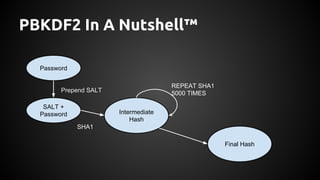
PBKDF2 In A Nutshell™
Password
SALT +
Password
Prepend SALT
Intermediate
Hash
SHA1
REPEAT SHA1
5000 TIMES
Final Hash
Save the Salt
Store the salt, the resulting hash and the
number of iterations in your datastore
You’ll have to calculate the derived key of the
credential again to verify it is correct
Symmetric Encryption
Used when your application needs to protect data at rest
(on disk etc) but will need to use those values later
The most common algorithm for symmetric encryption is
AES (Advanced Encryption Standard)
It can operate in multiple modes like ECB, CBC, CTR and
GCM - each suited to different uses
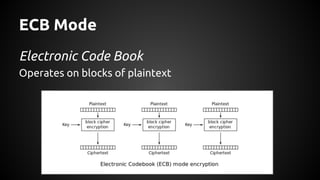
ECB Mode
Electronic Code Book
Operates on blocks of plaintext
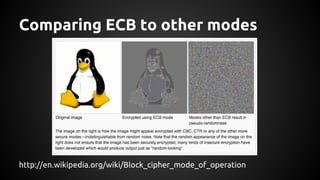
Comparing ECB to other modes
http://en.wikipedia.org/wiki/Block_cipher_mode_of_operation
Galois Counter Mode (GCM)
Authenticates and Encrypts Messages
Reduces the opportunity for interference with
messages to go undetected
It’s Complicated
Use a well known, well tested cryptographic
library / framework - do not write your own!
Do research before shipping your code - make
sure you’re using the right primitives / modes
for your application
Let’s point and laugh
Some Mistakes Were
Made
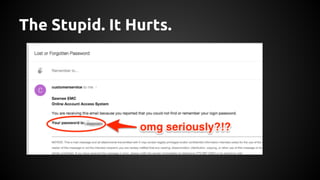
The Stupid. It Hurts.
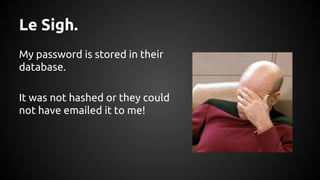
Le Sigh.
My password is stored in their
database.
It was not hashed or they could
not have emailed it to me!
Which is bad because...
A lot of people use the same password
everywhere and use their email address as
their login!
So...
An attacker that gets this password list can try
to log in to all kinds of things as you!
1. email
2. banks
3. credit reporting
4. even NetFlix!
Adobe Hack
Millions of “encrypted” passwords stolen
Hashed with MD5
Large numbers of them found in rainbow tables
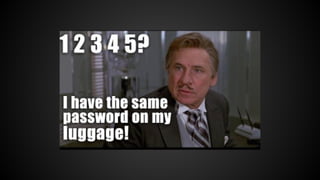
Most Common Password: 123456
http://stricture-group.com/files/adobe-top100.txt
Beware The Default Settings
Default settings for Android Bouncy Castle
starting in 2.1 were not good
Defaulted to ECB mode!
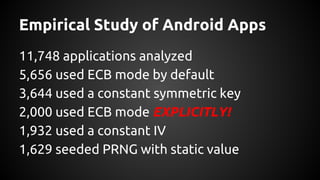
Empirical Study of Android Apps
11,748 applications analyzed
5,656 used ECB mode by default
3,644 used a constant symmetric key
2,000 used ECB mode EXPLICITLY!
1,932 used a constant IV
1,629 seeded PRNG with static value
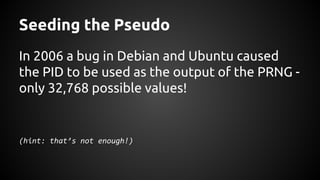
Seeding the Pseudo
In 2006 a bug in Debian and Ubuntu caused
the PID to be used as the output of the PRNG -
only 32,768 possible values!
(hint: that’s not enough!)
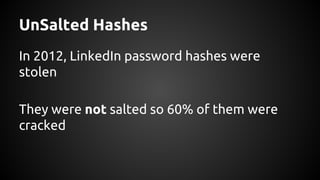
UnSalted Hashes
In 2012, LinkedIn password hashes were
stolen
They were not salted so 60% of them were
cracked
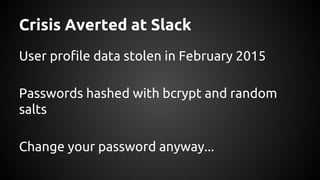
Crisis Averted at Slack
User profile data stolen in February 2015
Passwords hashed with bcrypt and random
salts
Change your password anyway...
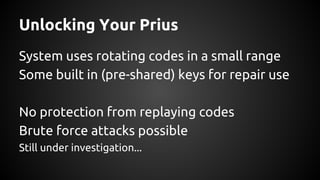
Unlocking Your Prius
System uses rotating codes in a small range
Some built in (pre-shared) keys for repair use
No protection from replaying codes
Brute force attacks possible
Still under investigation...
Yay!
More Resources For You
https://bitly.com/bundles/andrewwatson/2
@andrewwatson
http://andywatson.space/
http://www.ionicsecurity.com/
Thank You

How to Use Cryptography Properly: The Common Mistakes People Make When Using Cryptographic Functions

  • 1.
    Using Cryptography Properly inApplications POSSCON 2015 Andy Watson Ionic Security
  • 2.
    About: Name: Andy Watson Occupation:Byte Mangler Employer: Ionic Security http://ionicsecurity.com/
  • 3.
    Why: I’ve seen toomany people not using cryptography or using it incorrectly. This information may help you not be one of them.
  • 4.
    Agenda: ● Random ● Salt ●Hash ● Key Derivation ● Symmetric Encryption ● Famous Mistakes
  • 5.
  • 6.
    Random Number Generators RNG:A computational or physical device designed to generate a sequence of numbers that lack any pattern High quality generators depend on an entropy source like radioactive decay or radio frequency noise For cryptographic functions, higher levels of entropy are required to work properly
  • 7.
    Pseudo Computational RNG areknown as Pseudo RNG PRNG are “seeded” with a value to generate a series of numbers
  • 8.
  • 9.
    What is aSalt? Random data added to your input to create better output from one way functions Useful for defending against dictionary and rainbow table attacks.
  • 10.
  • 11.
  • 12.
    Hashing Function (n.) AFunction that represents data of arbitrary size as data of a fixed size. $ echo 'Hello POSSCON 2015!' | md5 81ad0b0ba5f98e0f584c1cd9a2c324a3 $ echo 'Hello POSSCON 2015' | md5 0c9c470f340aedaba625908939ba3c7b
  • 13.
    When to Hash Usehashing functions when saving the original data would be a liability you have no business dealing with For Example: Linux Passwords $6$pWVzxN/iFRstrZ/.$TNBvzXhc8b9SBkl1q36YNvF2DwuS 4/7LsICepYgaWCKzM1MS.OBK5TvxrUQ4. I5x5NtqidhBTGobQLOqxBAFe1
  • 14.
    Don’t Store TheClear Credentials should be salted and hashed when stored During login, salt and hash the password entered and check it against the result you stored
  • 15.
    When Hashes Collide Thesetwo blocks have the same md5 hash of 79054025255fb1a26e4bc422aef54eb4 This is called a collision d131dd02c5e6eec4693d9a0698aff95c 2fcab58712467eab4004583eb8fb7f89 55ad340609f4b30283e488832571415a 085125e8f7cdc99fd91dbdf280373c5b d8823e3156348f5bae6dacd436c919c6 dd53e2b487da03fd02396306d248cda0 e99f33420f577ee8ce54b67080a80d1e c69821bcb6a8839396f9652b6ff72a70 d131dd02c5e6eec4693d9a0698aff95c 2fcab50712467eab4004583eb8fb7f89 55ad340609f4b30283e4888325f1415a 085125e8f7cdc99fd91dbd7280373c5b d8823e3156348f5bae6dacd436c919c6 dd53e23487da03fd02396306d248cda0 e99f33420f577ee8ce54b67080280d1e c69821bcb6a8839396f965ab6ff72a70
  • 16.
    Taste the RainbowTable A rainbow table is a precomputed table for reversing cryptographic hash functions, usually for cracking password hashes. Password MD5 Hash 123456 e10adc3949ba59abbe56e057f20f883e password 5f4dcc3b5aa765d61d8327deb882cf99
  • 17.
    You. Must. Hash.Securely. Cryptographically Secure Hash Function (n.) A hash function which is infeasible to reverse back to the original message and not subject to collisions $ echo "hello POSSCON 2015" | shasum -a 512 0d294c5140972735a80131eca426da4838cf5de1b3eb1c8cb51c4bb24823e389 d22a36be76be597a5c5a934dd5fada8b75e0986fb6e89329a820c22d96c4be17
  • 18.
  • 19.
    Key Derivation Functions KDFcreate new secret keys from a secret value and a known value - like a password Key Derivation Functions can be used in a “key stretching” routing to enhance hashing functions to provide much more protection from rainbow tables and brute force attacks
  • 20.
    Original KDF: crypt ●Invented in 1978 to protect UNIX passwords ● Used only a 12 bit salt ● Limited passwords to 8 characters
  • 21.
    Modern KDFs PDKDF2 ● 64bit random salt ● 5000 iterations of SHA1 (hashing function) SCRYPT ● Consumes large amounts of memory on purpose
  • 22.
    PBKDF2 In ANutshell™ Password SALT + Password Prepend SALT Intermediate Hash SHA1 REPEAT SHA1 5000 TIMES Final Hash
  • 23.
    Save the Salt Storethe salt, the resulting hash and the number of iterations in your datastore You’ll have to calculate the derived key of the credential again to verify it is correct
  • 24.
  • 25.
    Symmetric Encryption Used whenyour application needs to protect data at rest (on disk etc) but will need to use those values later The most common algorithm for symmetric encryption is AES (Advanced Encryption Standard) It can operate in multiple modes like ECB, CBC, CTR and GCM - each suited to different uses
  • 26.
    ECB Mode Electronic CodeBook Operates on blocks of plaintext
  • 27.
    Comparing ECB toother modes http://en.wikipedia.org/wiki/Block_cipher_mode_of_operation
  • 28.
    Galois Counter Mode(GCM) Authenticates and Encrypts Messages Reduces the opportunity for interference with messages to go undetected
  • 29.
    It’s Complicated Use awell known, well tested cryptographic library / framework - do not write your own! Do research before shipping your code - make sure you’re using the right primitives / modes for your application
  • 30.
    Let’s point andlaugh Some Mistakes Were Made
  • 31.
  • 32.
    Le Sigh. My passwordis stored in their database. It was not hashed or they could not have emailed it to me!
  • 33.
    Which is badbecause... A lot of people use the same password everywhere and use their email address as their login!
  • 34.
    So... An attacker thatgets this password list can try to log in to all kinds of things as you! 1. email 2. banks 3. credit reporting 4. even NetFlix!
  • 35.
    Adobe Hack Millions of“encrypted” passwords stolen Hashed with MD5 Large numbers of them found in rainbow tables Most Common Password: 123456 http://stricture-group.com/files/adobe-top100.txt
  • 37.
    Beware The DefaultSettings Default settings for Android Bouncy Castle starting in 2.1 were not good Defaulted to ECB mode!
  • 38.
    Empirical Study ofAndroid Apps 11,748 applications analyzed 5,656 used ECB mode by default 3,644 used a constant symmetric key 2,000 used ECB mode EXPLICITLY! 1,932 used a constant IV 1,629 seeded PRNG with static value
  • 39.
    Seeding the Pseudo In2006 a bug in Debian and Ubuntu caused the PID to be used as the output of the PRNG - only 32,768 possible values! (hint: that’s not enough!)
  • 40.
    UnSalted Hashes In 2012,LinkedIn password hashes were stolen They were not salted so 60% of them were cracked
  • 41.
    Crisis Averted atSlack User profile data stolen in February 2015 Passwords hashed with bcrypt and random salts Change your password anyway...
  • 42.
    Unlocking Your Prius Systemuses rotating codes in a small range Some built in (pre-shared) keys for repair use No protection from replaying codes Brute force attacks possible Still under investigation...
  • 43.
  • 44.
    More Resources ForYou https://bitly.com/bundles/andrewwatson/2
  • 45.