Tools for Open Source Systems
Administration
POSSCON 2015
Elizabeth K. Joseph
lyz@princessleia.com
@pleia2
Elizabeth K. Joseph
●
OpenStack Infrastructure Team sysadmin
●
Long time contributor to various open source
projects
●
Co-author of The Official Ubuntu Book, 8th ed
Elizabeth K. Joseph | @pleia2
How most open source projects do
infrastructure
●
Team (or company) manages it ...or they just use code
hosting
●
Requests are submitted via mailing list, bug report or
ticketing system
●
Request priority is determined by the core team
This may be similar to your organization.
Is there a better way?
Elizabeth K. Joseph | @pleia2
OpenStack Infrastructure Team
●
Our job is to make sure the OpenStack
developers can do their job
●
All of our system configurations are open
source and tracked in git:
https://git.openstack.org/cgit/openstack-infra
●
Anyone in the world can propose patches for
direct inclusion in our infrastructure,
instructions at:
http://docs.openstack.org/infra/manual/developers.html
Elizabeth K. Joseph | @pleia2
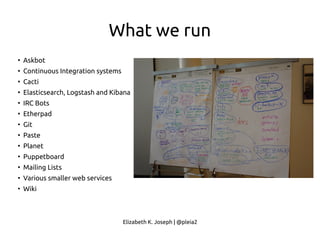
What we run
●
Askbot
●
Continuous Integration systems
●
Cacti
●
Elasticsearch, Logstash and Kibana
●
IRC Bots
●
Etherpad
●
Git
●
Paste
●
Planet
●
Puppetboard
●
Mailing Lists
●
Various smaller web services
●
Wiki
Elizabeth K. Joseph | @pleia2
OpenStack Continuous Integration
(CI) System
●
Lots of individual projects
●
All projects must work together
●
Changes can't break master branch
●
Code should be syntactically clean
●
Testing must be completed automated
Elizabeth K. Joseph | @pleia2
Tools we're using for CI
●
Launchpad (someday: openstackid)
●
Git
●
Gerrit
●
Zuul*
●
Gearman
●
Jenkins (with jenkins-job-builder*, devstack-gate*)
●
Nodepool*
* Started by the OpenStack Infrastructure team
Elizabeth K. Joseph | @pleia2
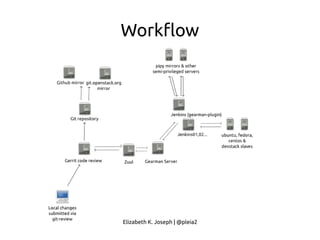
Workflow
Elizabeth K. Joseph | @pleia2
Automated tests for infrastructure
●
flake8 (pep 8 and pyflakes)
●
puppet parser validate
●
puppet lint
●
Puppet application tests
●
XML checkers
●
Alphabetized files
●
IRC channel permissions
Elizabeth K. Joseph | @pleia2
Peer review means...
●
Multiple eyes on changes prior to merging
●
Good infrastructure for developing new
solutions
●
No special process to go through for commit
access
●
Trains us to be collaborative by default
●
Since anyone can contribute, anyone can
devote resources to it
Elizabeth K. Joseph | @pleia2
Automated deployment
●
Change gets approved, tested and merged
●
...Either puppet master gets updated and
applies change
●
...Or vcsrepo module in puppet pulls in latest
version of project
Elizabeth K. Joseph | @pleia2
Can you really manage an
infrastructure via git commits?
●
Cacti (http://cacti.openstack.org/) to keep an eye on
server usage
●
PuppetBoard (http://puppetboard.openstack.org/) so
you can watch your changes get applied, or not
●
Thorough, specific documentation at
http://ci.openstack.org
Elizabeth K. Joseph | @pleia2
Well, not everything
●
Automation is imperfect and doesn't cover
everything, sometimes you just need to log into
a server
●
Complicated migrations and upgrades need
manual components
●
Initial persistent server deployment still has
manual components
●
Passwords need to be privately managed (but we
use git!)
Elizabeth K. Joseph | @pleia2
Human collaboration
●
IRC channel
●
Weekly IRC-based meetings
●
Etherpad
●
Pastebin
●
In person collaboration at the OpenStack summit
every 6 months
No voice calls.
Elizabeth K. Joseph | @pleia2
Questions
OpenStack CI Resources: http://ci.openstack.org

Tools for Open Source Systems Administration

  • 1.
    Tools for OpenSource Systems Administration POSSCON 2015 Elizabeth K. Joseph lyz@princessleia.com @pleia2
  • 2.
    Elizabeth K. Joseph ● OpenStackInfrastructure Team sysadmin ● Long time contributor to various open source projects ● Co-author of The Official Ubuntu Book, 8th ed
  • 3.
    Elizabeth K. Joseph| @pleia2 How most open source projects do infrastructure ● Team (or company) manages it ...or they just use code hosting ● Requests are submitted via mailing list, bug report or ticketing system ● Request priority is determined by the core team This may be similar to your organization. Is there a better way?
  • 4.
    Elizabeth K. Joseph| @pleia2 OpenStack Infrastructure Team ● Our job is to make sure the OpenStack developers can do their job ● All of our system configurations are open source and tracked in git: https://git.openstack.org/cgit/openstack-infra ● Anyone in the world can propose patches for direct inclusion in our infrastructure, instructions at: http://docs.openstack.org/infra/manual/developers.html
  • 5.
    Elizabeth K. Joseph| @pleia2 What we run ● Askbot ● Continuous Integration systems ● Cacti ● Elasticsearch, Logstash and Kibana ● IRC Bots ● Etherpad ● Git ● Paste ● Planet ● Puppetboard ● Mailing Lists ● Various smaller web services ● Wiki
  • 6.
    Elizabeth K. Joseph| @pleia2 OpenStack Continuous Integration (CI) System ● Lots of individual projects ● All projects must work together ● Changes can't break master branch ● Code should be syntactically clean ● Testing must be completed automated
  • 7.
    Elizabeth K. Joseph| @pleia2 Tools we're using for CI ● Launchpad (someday: openstackid) ● Git ● Gerrit ● Zuul* ● Gearman ● Jenkins (with jenkins-job-builder*, devstack-gate*) ● Nodepool* * Started by the OpenStack Infrastructure team
  • 8.
    Elizabeth K. Joseph| @pleia2 Workflow
  • 9.
    Elizabeth K. Joseph| @pleia2 Automated tests for infrastructure ● flake8 (pep 8 and pyflakes) ● puppet parser validate ● puppet lint ● Puppet application tests ● XML checkers ● Alphabetized files ● IRC channel permissions
  • 10.
    Elizabeth K. Joseph| @pleia2 Peer review means... ● Multiple eyes on changes prior to merging ● Good infrastructure for developing new solutions ● No special process to go through for commit access ● Trains us to be collaborative by default ● Since anyone can contribute, anyone can devote resources to it
  • 11.
    Elizabeth K. Joseph| @pleia2 Automated deployment ● Change gets approved, tested and merged ● ...Either puppet master gets updated and applies change ● ...Or vcsrepo module in puppet pulls in latest version of project
  • 12.
    Elizabeth K. Joseph| @pleia2 Can you really manage an infrastructure via git commits? ● Cacti (http://cacti.openstack.org/) to keep an eye on server usage ● PuppetBoard (http://puppetboard.openstack.org/) so you can watch your changes get applied, or not ● Thorough, specific documentation at http://ci.openstack.org
  • 13.
    Elizabeth K. Joseph| @pleia2 Well, not everything ● Automation is imperfect and doesn't cover everything, sometimes you just need to log into a server ● Complicated migrations and upgrades need manual components ● Initial persistent server deployment still has manual components ● Passwords need to be privately managed (but we use git!)
  • 14.
    Elizabeth K. Joseph| @pleia2 Human collaboration ● IRC channel ● Weekly IRC-based meetings ● Etherpad ● Pastebin ● In person collaboration at the OpenStack summit every 6 months No voice calls.
  • 15.
    Elizabeth K. Joseph| @pleia2 Questions OpenStack CI Resources: http://ci.openstack.org