google-melange.com
Google Summer of Code
Google Summer of Code is an online,
international program designed to
encourage university student participation
in open source software development.
Google Summer of Code
It started with the idea that university
students should spend their time outside of
school working in a field that would help
them with their studies and with their
career after university.
Google Summer of Code
The program provides the framework for
students to work for an open source
software organization by paying them a
stipend in exchange for their development
on the project.
What are the goals of the program?
Students get exposure to real-world
software development scenarios like
mailing list etiquette, working with fellow
developers across time zones, and using
source control.
What are the goals of the program?
Students get references and contacts in the
industry which helps them later when they
apply for jobs and want to network in their
field.
What are the goals of the program?
Many of the students who participate are
new to open source, which means the
organizations continue to identify and bring
in new developers each year.
What are the goals of the program?
The program gets more open source code
created and released for the benefit of all.
All of the projects the students produce are
publicly available at the end of the term for
anyone to access.
How does it work?
Early in the year (February) open source
software projects apply to be mentoring
organizations for the program.
How does it work?
Google chooses the organizations it would
like to participate in this year’s program and
announces them on the program website
(March).
How does it work?
Students submit project proposals (March)
to the mentoring organizations they’d like
to work with.
How does it work?
Mentoring organizations choose which
students they’d like to accept and then pairs
them with mentors to help them through
their project. The students are notified of
their acceptance in late April.
How does it work?
This student-mentor relationship is one of
the key aspects of Google Summer of Code.
It gives the student a great chance for
success and often produces lasting
connections in the community.
How does it work?
The students execute to milestones laid out
in their accepted project proposal over the
course of about 4 months (April - August).
They work closely with their mentor and
their mentoring organization.
How does it work?
The students and mentors both go through
two evaluations: a midterm and a final.
Students who pass their evaluations are
paid a stipend for their work.
How does it work?
At the end of the term students submit their
project to the program website for
everyone to see and use.
Some interesting student statistics
Over the past 10 years 8,616 students have
been accepted into Google Summer of
Code.
Some interesting student statistics
Countries with the most students over the
last 10 years:
United States (1,957), India (1,473), and
Germany (601).
Some interesting student statistics
We’ve seen a trend of more students
participating from underrepresented and
developing nations in the last few years and
we hope to continue that in the future. We
can always use your help spreading the
word about the program in these places!
Some interesting student statistics
An estimated 50 million lines of code have
been produced by Google Summer of Code
student developers.
Some interesting student stories
We get a wide range of students in different
majors including history, dance, music,
cartography, linguistics, medicine,
philosophy, theology, languages, business,
international relations, film, and many
others.
Timeline
Accepted students are announced on
27 April.
Timeline
The “community bonding period” for the
program is from 27 April - 25 May. This
period is another way we give our
participating students the best chance of
success in the program.
Timeline
Students begin coding on 25 May.
Timeline
Mid-term evaluations begin on 26 June and
end on 3 July.
Timeline
Final evaluations begin on 21 August and
end on 28 August. Students are expected to
submit their code by 25 September.
Useful links
Melange: http://www.google-melange.com
Google Summer of Code discussion list:
http://bit.ly/gsocdiscuss
Google Summer of Code student manual:
http://en.flossmanuals.net/GSoCStudentGuide
Google Summer of Code mentor manual:
http://en.flossmanuals.net/GSoCMentoring
www.google-melange.com
Welcome to Google Code-in
• Online contest for 13-17 year old pre-university
students
• Introduction to open source software development
• Open source organizations create tasks for
students to work on
• Students choose the tasks that interest them
• Students earn certificates, t-shirts, hooded
sweatshirts and can work towards the Grand Prize
trip to Google’s campus
What is Google Code-in?
www.google-melange.com
• Apply classroom skills to real life OS projects
• Excite students about the many types of open
source projects they can choose from
• Become part of the community
• Easy entry, mentors available to guide students
• OS software isn’t just about coding - variety of
types of tasks to choose from
Why participate in GCI?
www.google-melange.com
Each task is designed to take approximately the same
amount of time to complete (about 3-5 hours)
Categories of Tasks
● Coding
● Documentation/Training
● Outreach/Research
● Quality Assurance
● User Interface
Types of Tasks
www.google-melange.com
• Great way to get started in the contest
• Become familiar with how the org works
• Build confidence
• Students can complete up to 2 beginner tasks
Beginner Tasks
www.google-melange.com
Prizes
1 task = Certificate of completion
3 tasks = Google t-shirt and a certificate of completion
5 Finalists from each org = hooded sweatshirt, t-shirt,
certificate of completion
20+ Grand Prize Winners (2 from each org) will receive
a trip to Google Headquarters for themselves and a
parent or legal guardian.
www.google-melange.com
Grand Prize
● Each open source organization will choose 2 Grand
Prize Winners.
● Winners are chosen from the 10 students who
complete the most tasks from each organization
● Organizations will evaluate a student’s work based
on creativity, thoroughness and quality of work
● Grand Prize winners receive a 4 day trip for
themselves and a parent to Google’s headquarters.
www.google-melange.com
Fun Stats for 2014
● 17.93% female participants
● 3236 tasks completed by 658 students
● Students from 87 different countries have
completed tasks
● Over 2200 total participants in the program from
2010 - 2014
www.google-melange.com
Fun Stats for 2014
● 203 mentors from 12 organizations
● 10 mentors were previous GCI students
www.google-melange.com
Timeline
• November Open source organizations
announced
• December Contest starts, students can
register at google-melange.com
• January Contest ends
• February Grand Prize winners named
www.google-melange.com
Important Links
Discussion list:
http://groups.google.com/group/gci-discuss
GCI general website:
developers.google.com/open-source/gci
Manual for using the GCI site:
http://flossmanuals.net/gci-melange/
www.google-melange.com
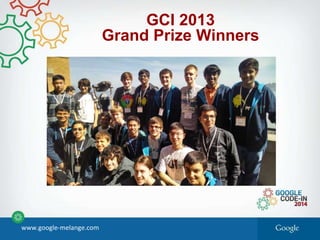
GCI 2013
Grand Prize Winners
www.google-melange.com
google-melange.com
Thank You!

Google Summer of Code

  • 1.
  • 2.
    Google Summer ofCode Google Summer of Code is an online, international program designed to encourage university student participation in open source software development.
  • 3.
    Google Summer ofCode It started with the idea that university students should spend their time outside of school working in a field that would help them with their studies and with their career after university.
  • 4.
    Google Summer ofCode The program provides the framework for students to work for an open source software organization by paying them a stipend in exchange for their development on the project.
  • 5.
    What are thegoals of the program? Students get exposure to real-world software development scenarios like mailing list etiquette, working with fellow developers across time zones, and using source control.
  • 6.
    What are thegoals of the program? Students get references and contacts in the industry which helps them later when they apply for jobs and want to network in their field.
  • 7.
    What are thegoals of the program? Many of the students who participate are new to open source, which means the organizations continue to identify and bring in new developers each year.
  • 8.
    What are thegoals of the program? The program gets more open source code created and released for the benefit of all. All of the projects the students produce are publicly available at the end of the term for anyone to access.
  • 9.
    How does itwork? Early in the year (February) open source software projects apply to be mentoring organizations for the program.
  • 10.
    How does itwork? Google chooses the organizations it would like to participate in this year’s program and announces them on the program website (March).
  • 11.
    How does itwork? Students submit project proposals (March) to the mentoring organizations they’d like to work with.
  • 12.
    How does itwork? Mentoring organizations choose which students they’d like to accept and then pairs them with mentors to help them through their project. The students are notified of their acceptance in late April.
  • 13.
    How does itwork? This student-mentor relationship is one of the key aspects of Google Summer of Code. It gives the student a great chance for success and often produces lasting connections in the community.
  • 14.
    How does itwork? The students execute to milestones laid out in their accepted project proposal over the course of about 4 months (April - August). They work closely with their mentor and their mentoring organization.
  • 15.
    How does itwork? The students and mentors both go through two evaluations: a midterm and a final. Students who pass their evaluations are paid a stipend for their work.
  • 16.
    How does itwork? At the end of the term students submit their project to the program website for everyone to see and use.
  • 17.
    Some interesting studentstatistics Over the past 10 years 8,616 students have been accepted into Google Summer of Code.
  • 18.
    Some interesting studentstatistics Countries with the most students over the last 10 years: United States (1,957), India (1,473), and Germany (601).
  • 19.
    Some interesting studentstatistics We’ve seen a trend of more students participating from underrepresented and developing nations in the last few years and we hope to continue that in the future. We can always use your help spreading the word about the program in these places!
  • 20.
    Some interesting studentstatistics An estimated 50 million lines of code have been produced by Google Summer of Code student developers.
  • 21.
    Some interesting studentstories We get a wide range of students in different majors including history, dance, music, cartography, linguistics, medicine, philosophy, theology, languages, business, international relations, film, and many others.
  • 22.
    Timeline Accepted students areannounced on 27 April.
  • 23.
    Timeline The “community bondingperiod” for the program is from 27 April - 25 May. This period is another way we give our participating students the best chance of success in the program.
  • 24.
  • 25.
    Timeline Mid-term evaluations beginon 26 June and end on 3 July.
  • 26.
    Timeline Final evaluations beginon 21 August and end on 28 August. Students are expected to submit their code by 25 September.
  • 27.
    Useful links Melange: http://www.google-melange.com GoogleSummer of Code discussion list: http://bit.ly/gsocdiscuss Google Summer of Code student manual: http://en.flossmanuals.net/GSoCStudentGuide Google Summer of Code mentor manual: http://en.flossmanuals.net/GSoCMentoring
  • 28.
  • 29.
    • Online contestfor 13-17 year old pre-university students • Introduction to open source software development • Open source organizations create tasks for students to work on • Students choose the tasks that interest them • Students earn certificates, t-shirts, hooded sweatshirts and can work towards the Grand Prize trip to Google’s campus What is Google Code-in? www.google-melange.com
  • 30.
    • Apply classroomskills to real life OS projects • Excite students about the many types of open source projects they can choose from • Become part of the community • Easy entry, mentors available to guide students • OS software isn’t just about coding - variety of types of tasks to choose from Why participate in GCI? www.google-melange.com
  • 31.
    Each task isdesigned to take approximately the same amount of time to complete (about 3-5 hours) Categories of Tasks ● Coding ● Documentation/Training ● Outreach/Research ● Quality Assurance ● User Interface Types of Tasks www.google-melange.com
  • 32.
    • Great wayto get started in the contest • Become familiar with how the org works • Build confidence • Students can complete up to 2 beginner tasks Beginner Tasks www.google-melange.com
  • 33.
    Prizes 1 task =Certificate of completion 3 tasks = Google t-shirt and a certificate of completion 5 Finalists from each org = hooded sweatshirt, t-shirt, certificate of completion 20+ Grand Prize Winners (2 from each org) will receive a trip to Google Headquarters for themselves and a parent or legal guardian. www.google-melange.com
  • 34.
    Grand Prize ● Eachopen source organization will choose 2 Grand Prize Winners. ● Winners are chosen from the 10 students who complete the most tasks from each organization ● Organizations will evaluate a student’s work based on creativity, thoroughness and quality of work ● Grand Prize winners receive a 4 day trip for themselves and a parent to Google’s headquarters. www.google-melange.com
  • 35.
    Fun Stats for2014 ● 17.93% female participants ● 3236 tasks completed by 658 students ● Students from 87 different countries have completed tasks ● Over 2200 total participants in the program from 2010 - 2014 www.google-melange.com
  • 36.
    Fun Stats for2014 ● 203 mentors from 12 organizations ● 10 mentors were previous GCI students www.google-melange.com
  • 37.
    Timeline • November Opensource organizations announced • December Contest starts, students can register at google-melange.com • January Contest ends • February Grand Prize winners named www.google-melange.com
  • 38.
    Important Links Discussion list: http://groups.google.com/group/gci-discuss GCIgeneral website: developers.google.com/open-source/gci Manual for using the GCI site: http://flossmanuals.net/gci-melange/ www.google-melange.com
  • 39.
    GCI 2013 Grand PrizeWinners www.google-melange.com
  • 40.