An Introduction to
Web Security
Ansh Bhawnani
Colors
Web Development
Principles
Performance
Images
Simplicity
Purpose
Security
But why Security?
• There is a hack attack every 39 seconds
• The average cost of a data breach in 2020 will exceed $150 million
• $2 trillion total in 2019
• $6 trillion is expected to be spent globally on cybersecurity by 2021
• Cybersecurity jobs worldwide will reach 3.5 million by 2021
“Cybercrime is the greatest threat to every company in the world.”
How to define security?
“Human stupidity is the biggest vulnerability.”
01
02
03
04
Confidentiality
Website
Security
Principles
Integrity
Availability
Authentication
What should
you know, as
a Developer?
Top 8 web security threats
1. Injection
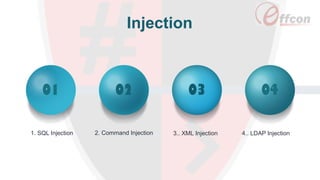
01 02 03 04
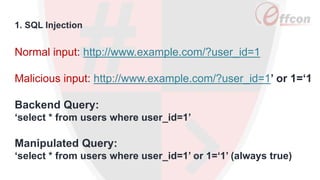
1. SQL Injection
Injection
2. Command Injection 3.. XML Injection 4.. LDAP Injection
Normal input: http://www.example.com/?user_id=1
Malicious input: http://www.example.com/?user_id=1’ or 1=‘1
Backend Query:
‘select * from users where user_id=1’
Manipulated Query:
‘select * from users where user_id=1’ or 1=‘1’ (always true)
1. SQL Injection
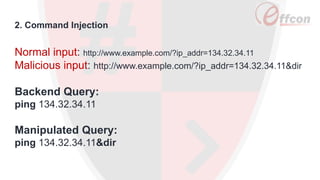
Normal input: http://www.example.com/?ip_addr=134.32.34.11
Malicious input: http://www.example.com/?ip_addr=134.32.34.11&dir
Backend Query:
ping 134.32.34.11
Manipulated Query:
ping 134.32.34.11&dir
2. Command Injection
“A user input is always malicious”
2. Broken Authentication
Broken Authentication
1. URL Exposure:http://www.example.com/user/101/?session=234739jf7932th0f
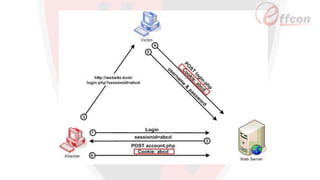
2. Weak Session IDs
3. Set-Cookie: eyt3nfo (fixation)
4. Session Hijacking
http://website.kom/<script>document.cookie=”sessionid=abcd”;</script>
Broken Authentication
5. Weak Remember Password
Cookie: session=234nf83h34t; password=something
6. Successive login attempts
7. Email verification
8. Weak Username/Password policies (charset, length)
“Your Identity is everything.”
3. Sensitive Data Exposure
Sensitive Data Exposure
1. HTTPS
2. HTTP Strict Transport Policy (hack-yourself-first.com)
http://google.com
https://google.com
Sensitive Data Exposure
1. In transit:
1. Plain text
2. Stored data exposure
1. Storing passwords in plain text
2. No hashing
3. No salting
3. Cookies Secure flag
“Don’t tell everything you know.”
4. Cross Site Scripting (XSS)
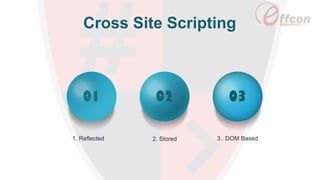
Cross Site Scripting
01 02 03
1. Reflected 2. Stored 3.. DOM Based
Cross Site Scripting
1. Injecting arbitrary JavaScript codes in input strings
Normal URL: http://somesite.com/?user=John
HTML:
<body>
<h1>Welcome John!</h1>
</body>
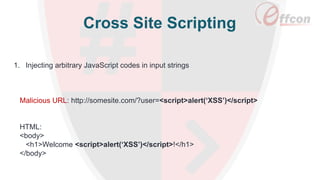
Cross Site Scripting
1. Injecting arbitrary JavaScript codes in input strings
Malicious URL: http://somesite.com/?user=<script>alert(‘XSS’)</script>
HTML:
<body>
<h1>Welcome <script>alert(‘XSS’)</script>!</h1>
</body>
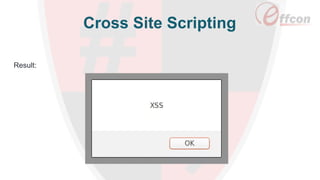
Cross Site Scripting
Result:
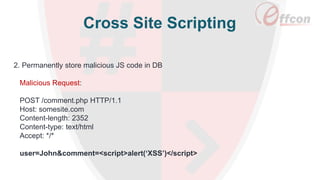
Cross Site Scripting
2. Permanently store malicious JS code in DB
Malicious Request:
POST /comment.php HTTP/1.1
Host: somesite.com
Content-length: 2352
Content-type: text/html
Accept: */*
user=John&comment=<script>alert(‘XSS’)</script>
“Never play with JavaScript.”
5. Security Misconfigurations
Security Misconfigurations
1. Not changing default passwords
1. admin/admin
2. admin/password
3. root/password
4. login/password
2. Directory access enabled
3. Debug mode enabled
4. Errors/stack traces
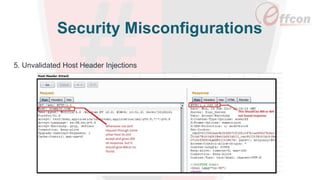
5. Unvalidated Host Header Injections
Security Misconfigurations
“Did you check the closet.”
6. Cross Site Request Forgery (CSRF)
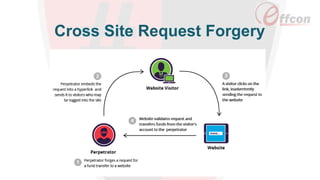
Cross Site Request Forgery
1. GET Scenario
GET http://bank.com/transfer.do?acct=BOB&amount=100 HTTP/1.1
<img src="http://bank.com/transfer.do?acct=MARIA&amount=100000"
width="0" height="0" border="0">
2. POST Scenario
POST http://bank.com/transfer.do HTTP/1.1
acct=BOB&amount=100
Cross Site Request Forgery
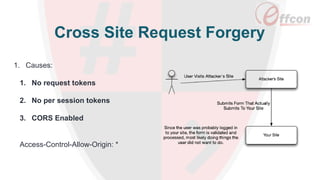
1. Causes:
1. No request tokens
2. No per session tokens
3. CORS Enabled
Access-Control-Allow-Origin: *
“Attend the party without invitation.”
7. Unvalidated Redirects and Forwards
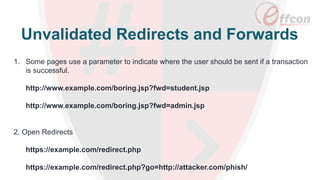
1. Some pages use a parameter to indicate where the user should be sent if a transaction
is successful.
http://www.example.com/boring.jsp?fwd=student.jsp
http://www.example.com/boring.jsp?fwd=admin.jsp
2. Open Redirects
https://example.com/redirect.php
https://example.com/redirect.php?go=http://attacker.com/phish/
Unvalidated Redirects and Forwards
“Don’t flow with the Internet.”
8. Insecure Direct Object Reference
(IDOR)
Insecure Direct Object Reference
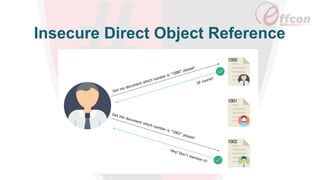
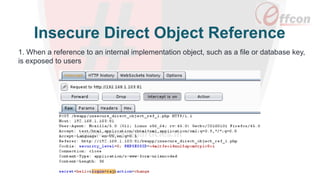
1. When a reference to an internal implementation object, such as a file or database key,
is exposed to users
“Don’t let users spoil your abstraction.”
Nothing is 100%
Foolproof
Understand Assess
Plan Implement
GET Queries?
Thank You!

Web Security.pdf