Secure	Boot
They’re	doing	it	wrong.
Scott	G.	Kelly
March	15,	2017
CanSecWest 2017
Who	am	I?
• Platform	security	architect,	Netflix
– Consult	with	System	on	Chip	(SoC)	and	embedded	device	
designers/manufacturers	on	security	design	and	
implementation
– Design	reviews	of	hardware/firmware
– Code	reviews	for	security-critical	elements
– Make	recommendations
• Mitigation	strategies	for	current	issues
• Design	changes	for	future	products
• Development	process	changes
March	15,	2017 CSW	2017 2
Why	am	I	here	today?
• Connected	systems	are	proliferating
– Smart	{phone,TV,STB,alarm,<fill-in>}
• Everything connected	to	the	Internet	will	be	
probed	by	predators
– And	in	some	cases,	pwned.
• It’s	early,	but	the	cracks	in	IoT/embedded	are	
already	serious.
March	15,	2017 CSW	2017 3
March	15,	2017 CSW	2017 4
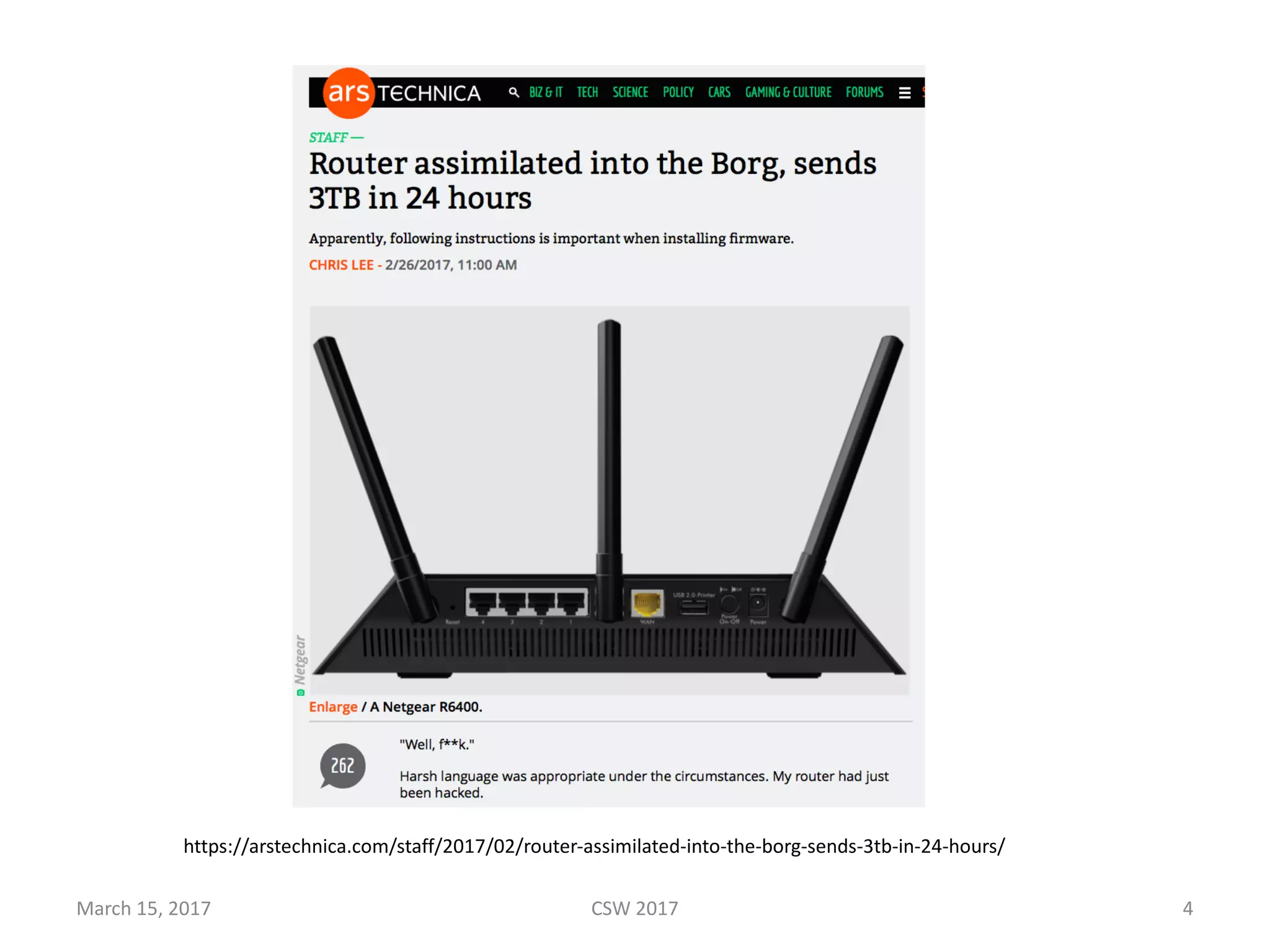
https://arstechnica.com/staff/2017/02/router-assimilated-into-the-borg-sends-3tb-in-24-hours/
March	15,	2017 CSW	2017 5
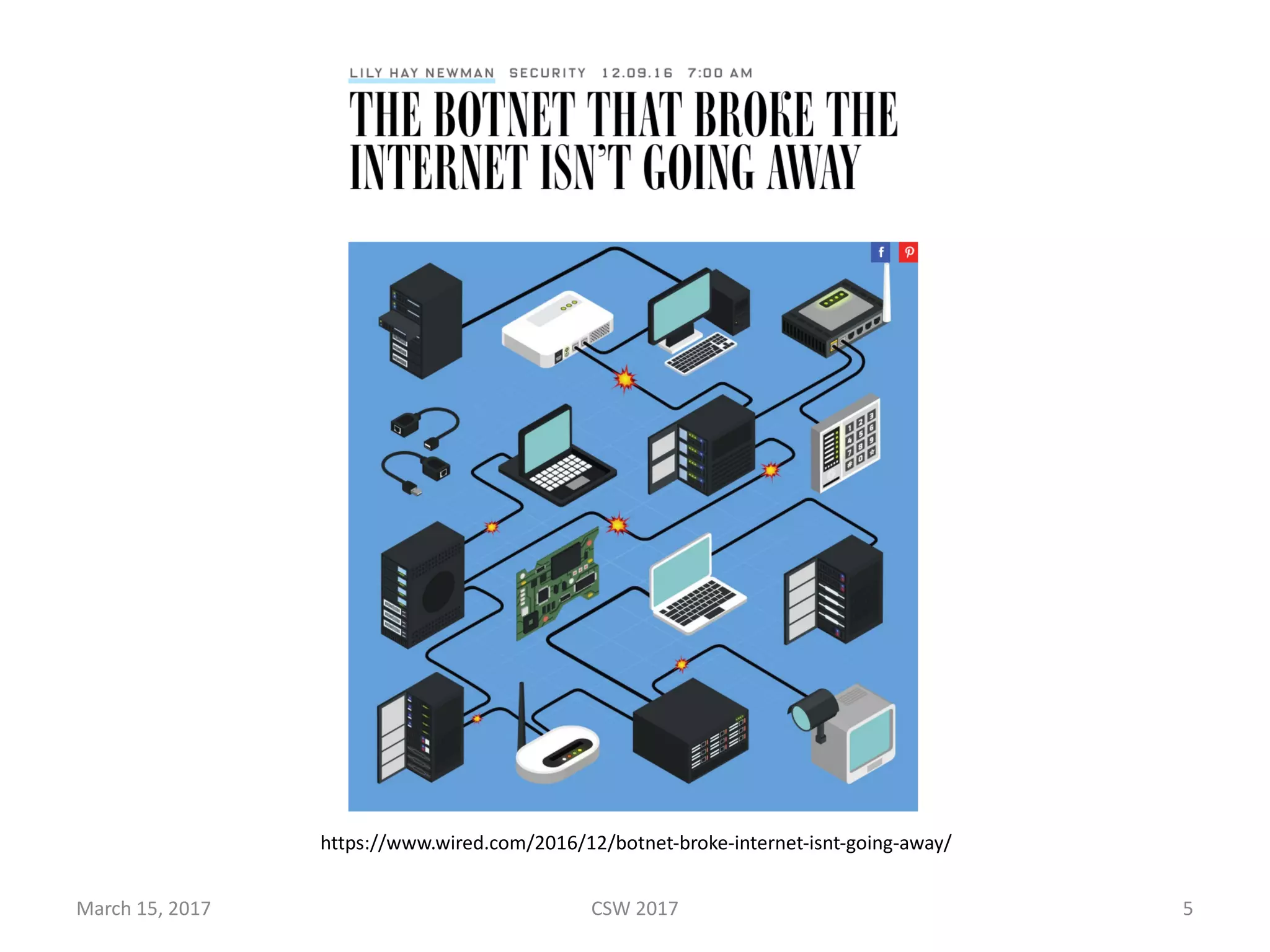
https://www.wired.com/2016/12/botnet-broke-internet-isnt-going-away/
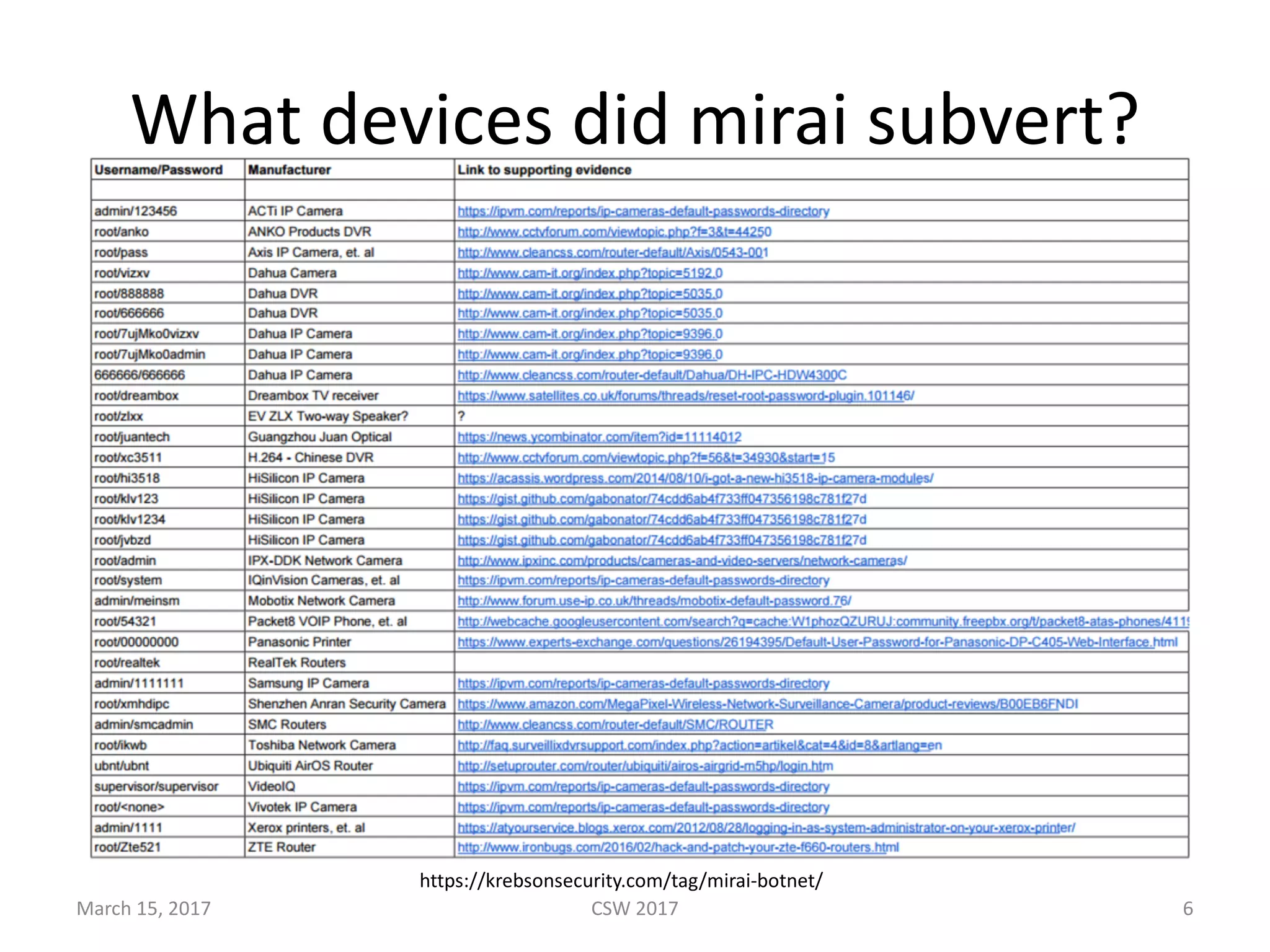
What	devices	did	mirai subvert?
March	15,	2017 CSW	2017 6
https://krebsonsecurity.com/tag/mirai-botnet/
March	15,	2017 CSW	2017 7
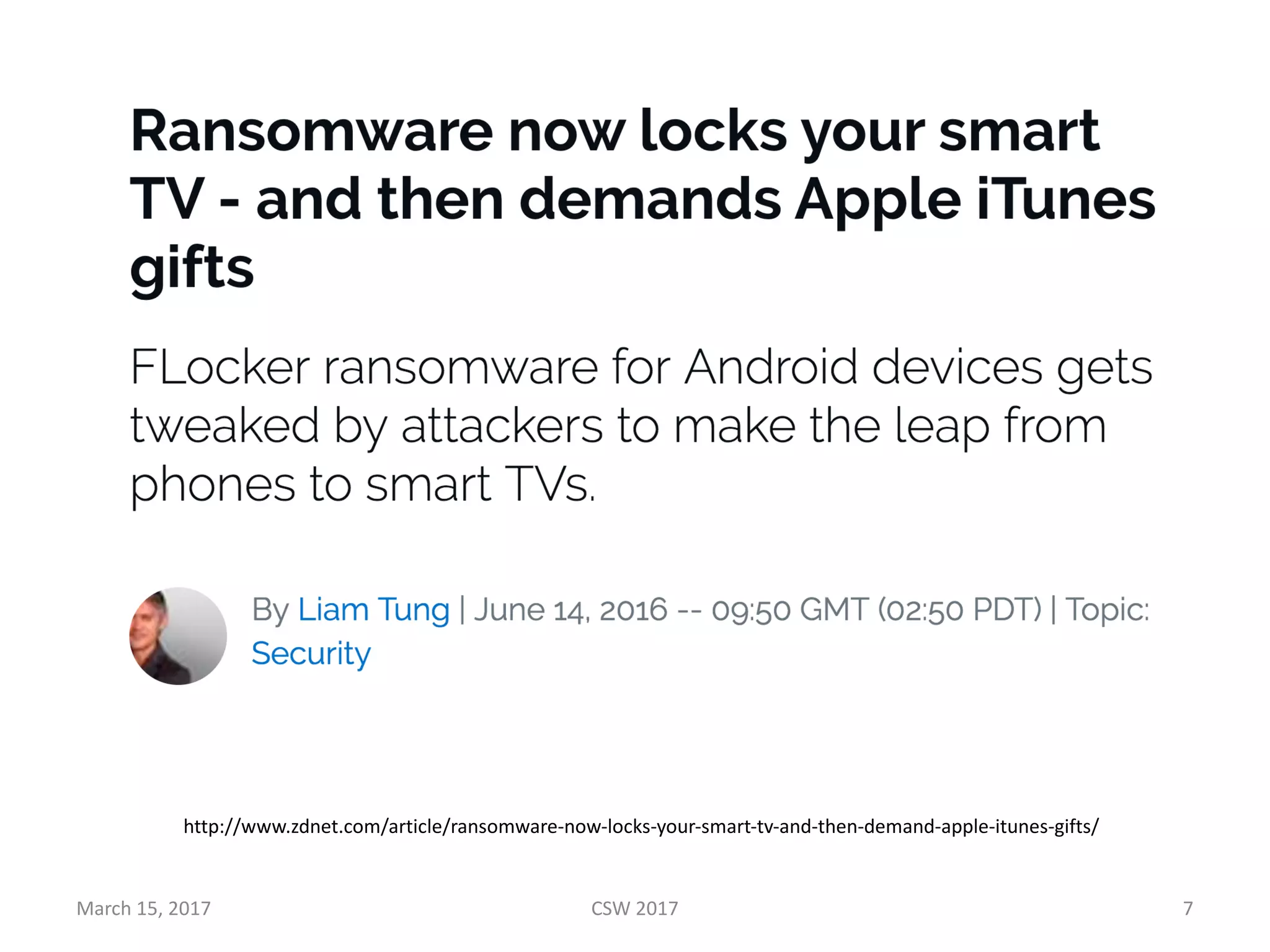
http://www.zdnet.com/article/ransomware-now-locks-your-smart-tv-and-then-demand-apple-itunes-gifts/
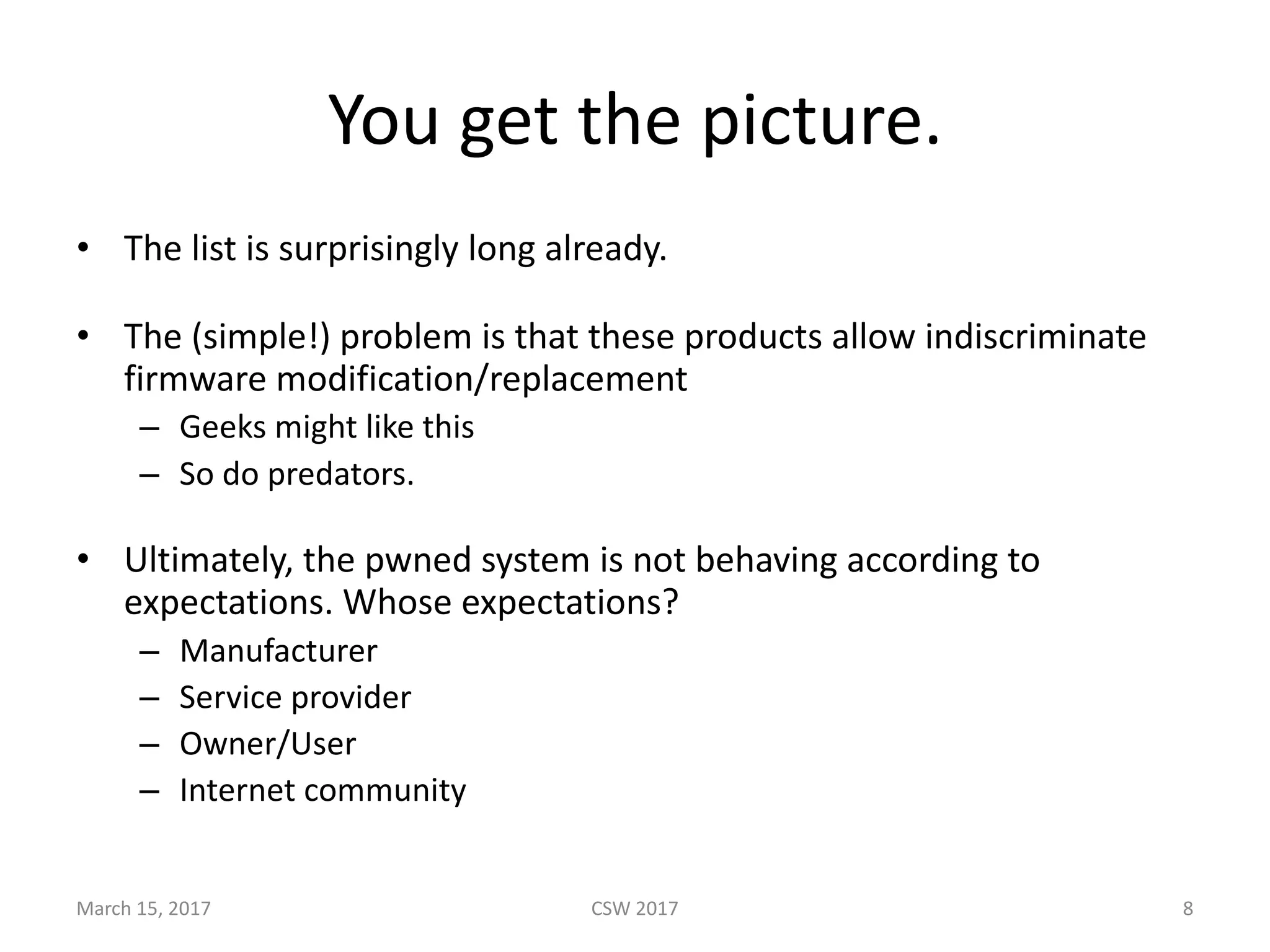
You	get	the	picture.
• The	list	is	surprisingly	long	already.
• The	(simple!)	problem	is	that	these	products	allow	indiscriminate	
firmware	modification/replacement
– Geeks	might	like	this
– So	do	predators.
• Ultimately,	the	pwned system	is	not	behaving	according	to	
expectations.	Whose	expectations?
– Manufacturer
– Service	provider
– Owner/User
– Internet	community
March	15,	2017 CSW	2017 8
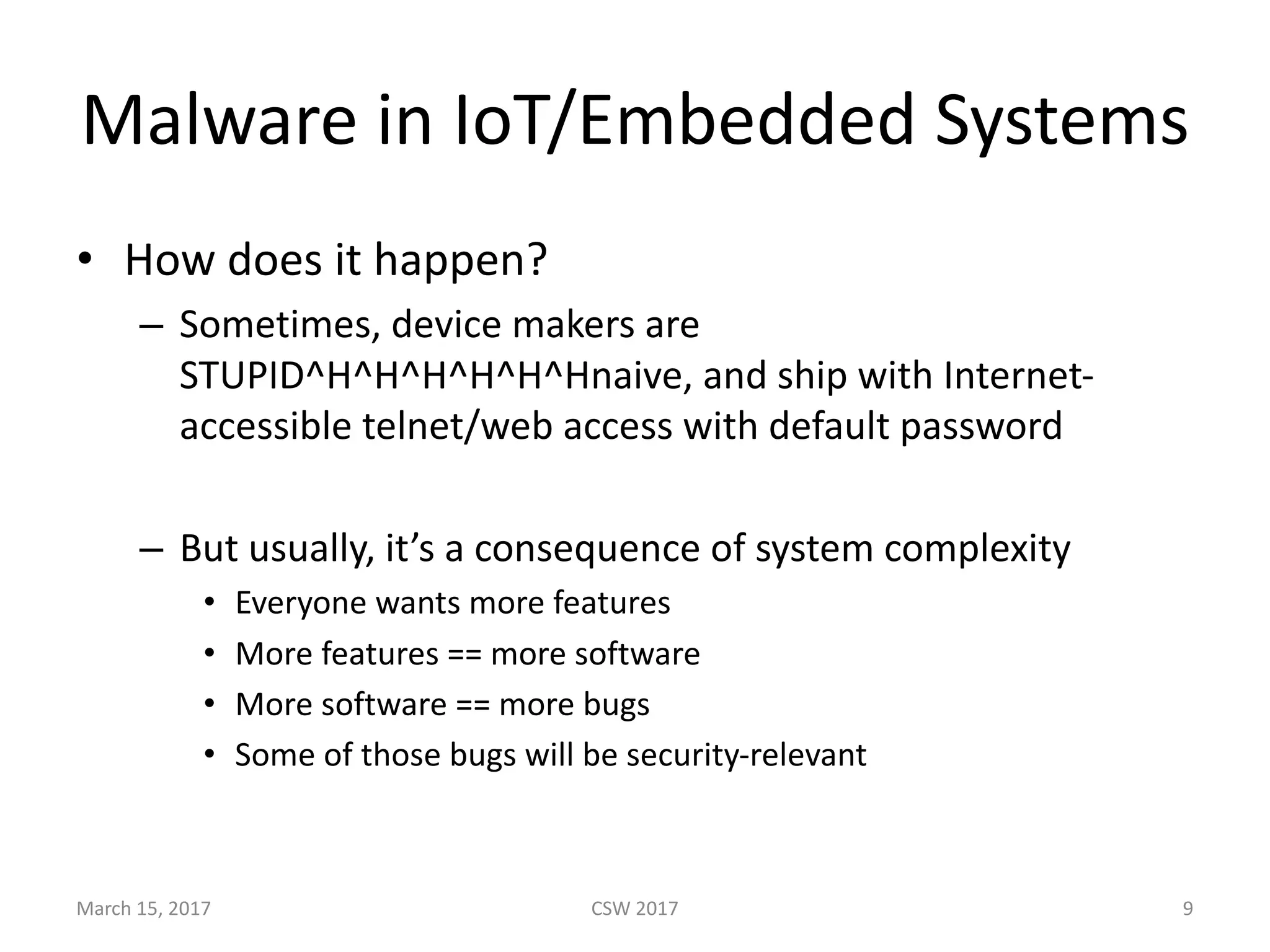
Malware	in	IoT/Embedded	Systems
• How	does	it	happen?
– Sometimes,	device	makers	are	
STUPID^H^H^H^H^H^Hnaive,	and	ship	with	Internet-
accessible	telnet/web	access	with	default	password
– But	usually,	it’s	a	consequence	of	system	complexity
• Everyone	wants	more	features
• More	features	==	more	software
• More	software	==	more	bugs
• Some	of	those	bugs	will	be	security-relevant	
March	15,	2017 CSW	2017 9
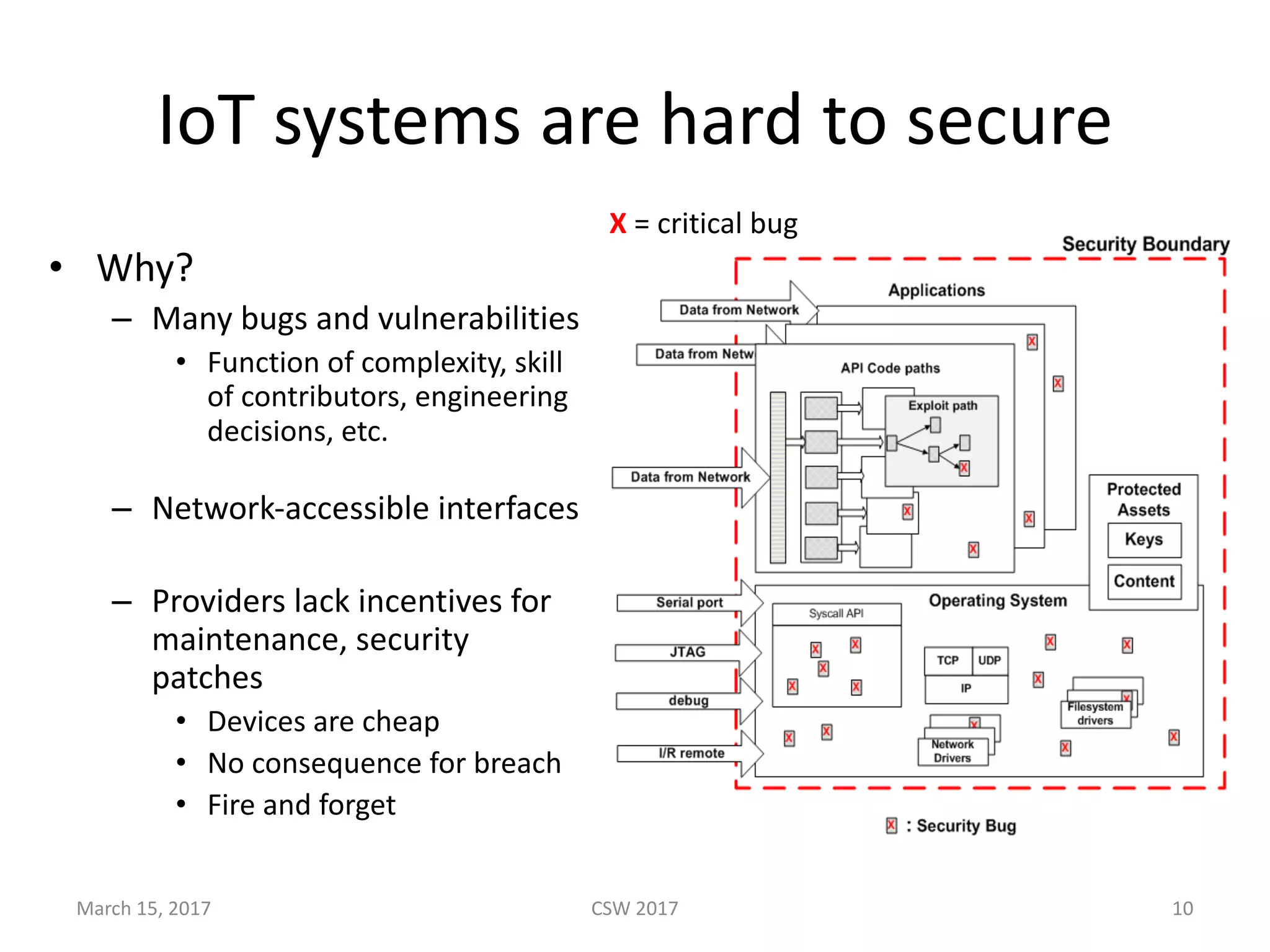
IoT systems	are	hard	to	secure
• Why?
– Many	bugs	and	vulnerabilities
• Function	of	complexity,	skill	
of	contributors,	engineering	
decisions,	etc.	
– Network-accessible	interfaces
– Providers	lack	incentives	for	
maintenance,	security	
patches
• Devices	are	cheap
• No	consequence	for	breach
• Fire	and	forget
March	15,	2017 CSW	2017 10
X =	critical	bug
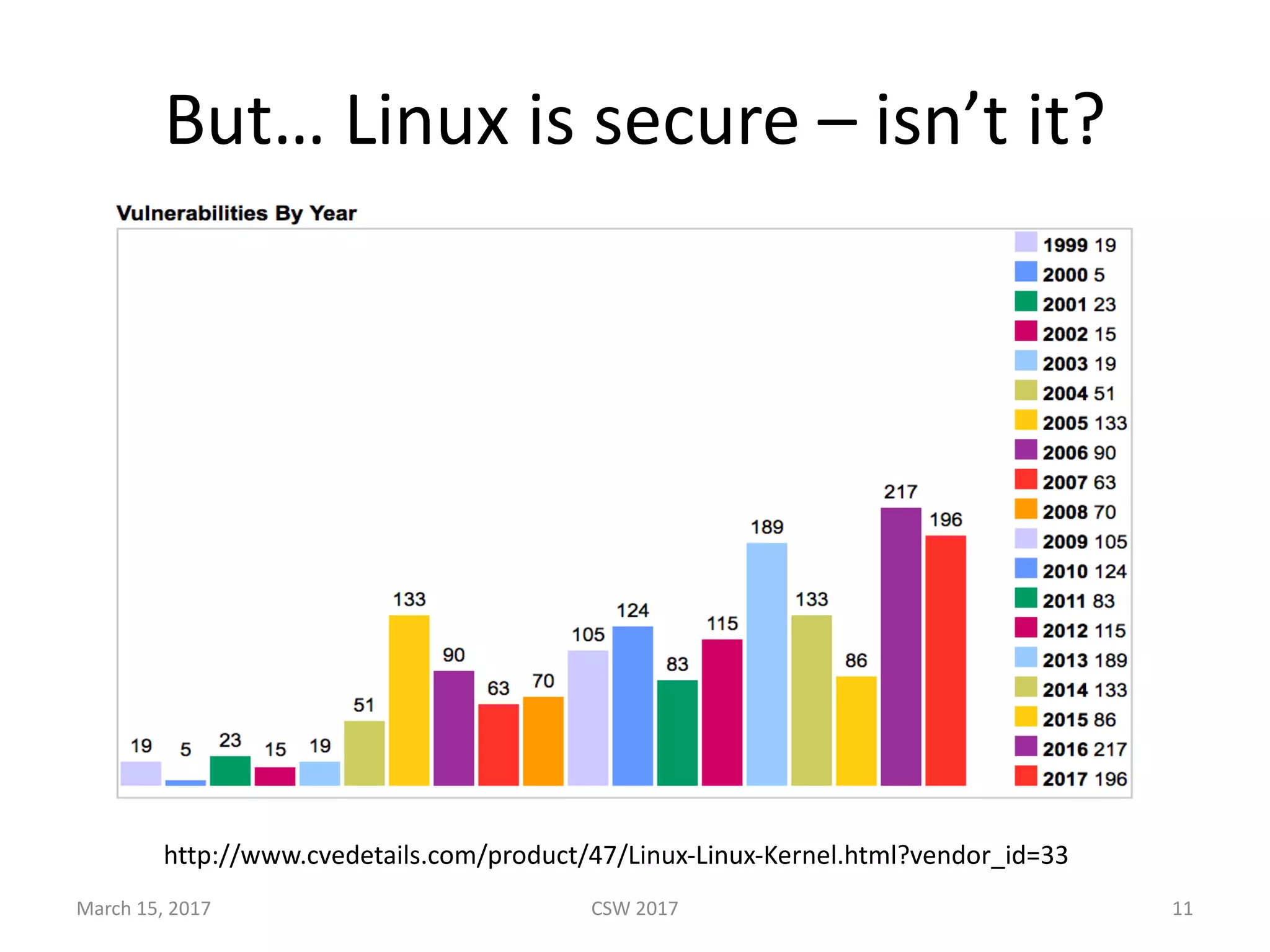
But… Linux	is	secure	– isn’t	it?
March	15,	2017 CSW	2017 11
http://www.cvedetails.com/product/47/Linux-Linux-Kernel.html?vendor_id=33
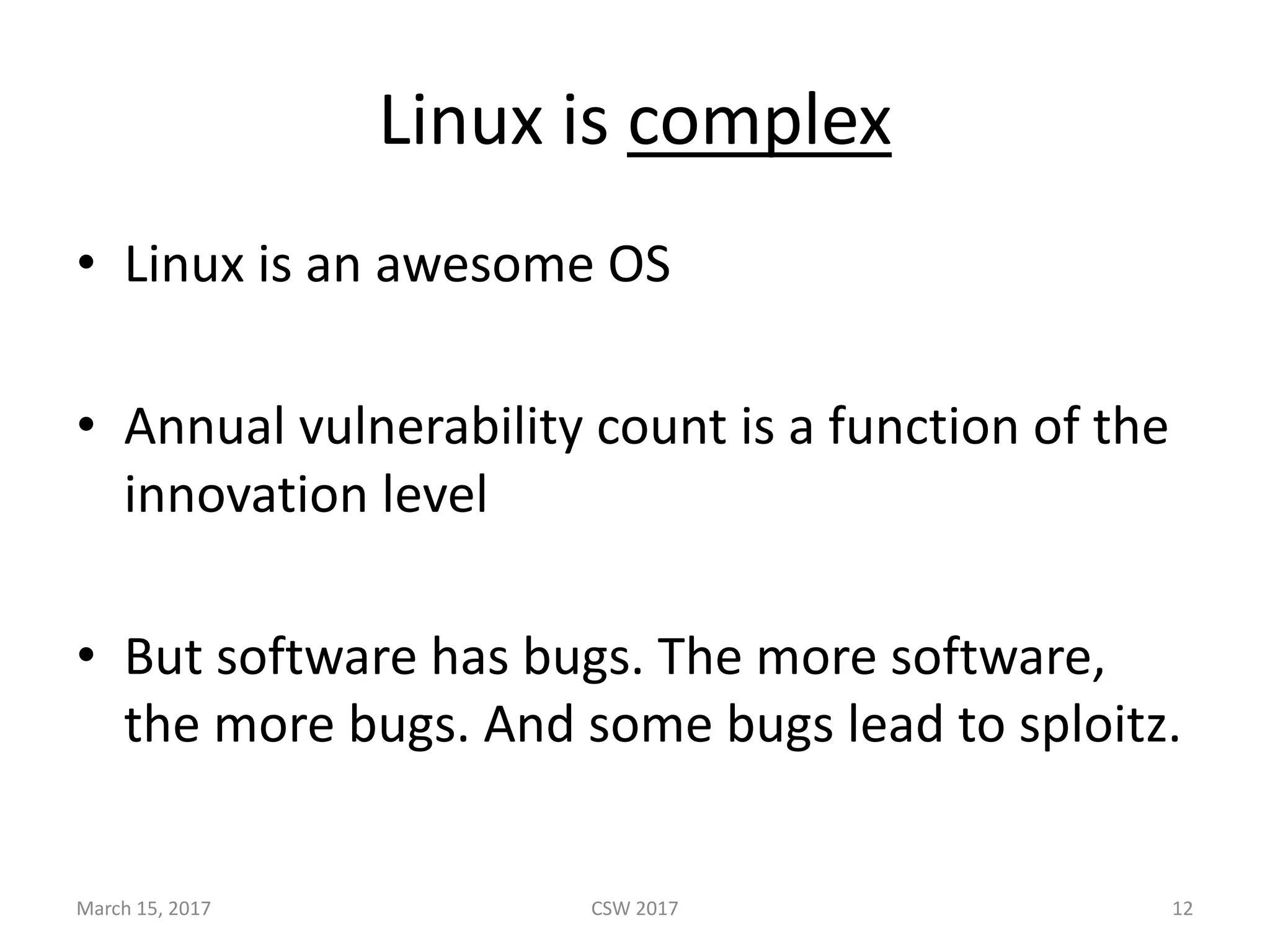
Linux	is	complex
• Linux	is	an	awesome	OS
• Annual	vulnerability	count	is	a	function	of	the	
innovation	level
• But	software	has	bugs.	The	more	software,	
the	more	bugs.	And	some	bugs	lead	to	sploitz.
March	15,	2017 CSW	2017 12
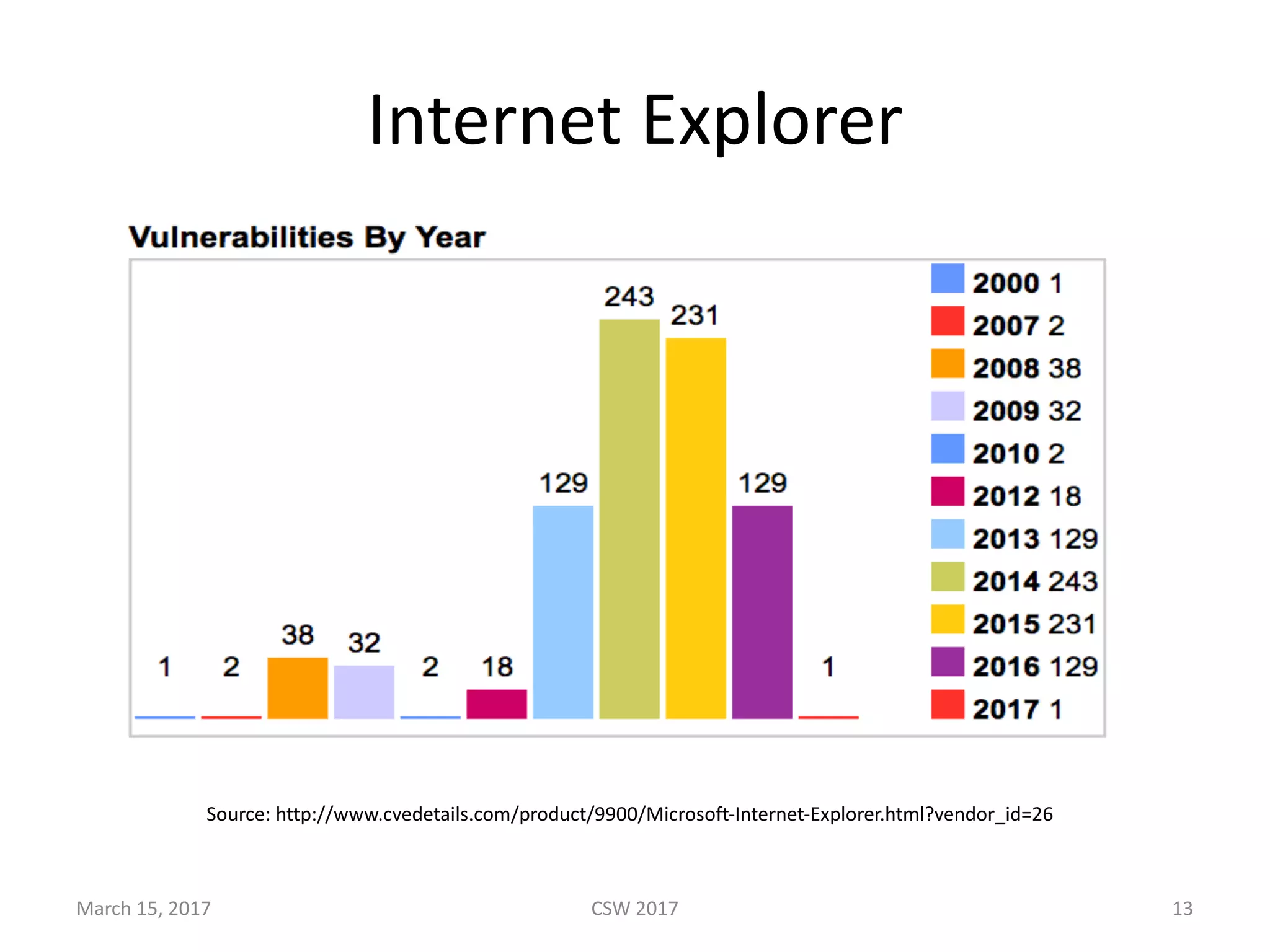
Internet	Explorer
March	15,	2017
Source:	http://www.cvedetails.com/product/9900/Microsoft-Internet-Explorer.html?vendor_id=26
CSW	2017 13
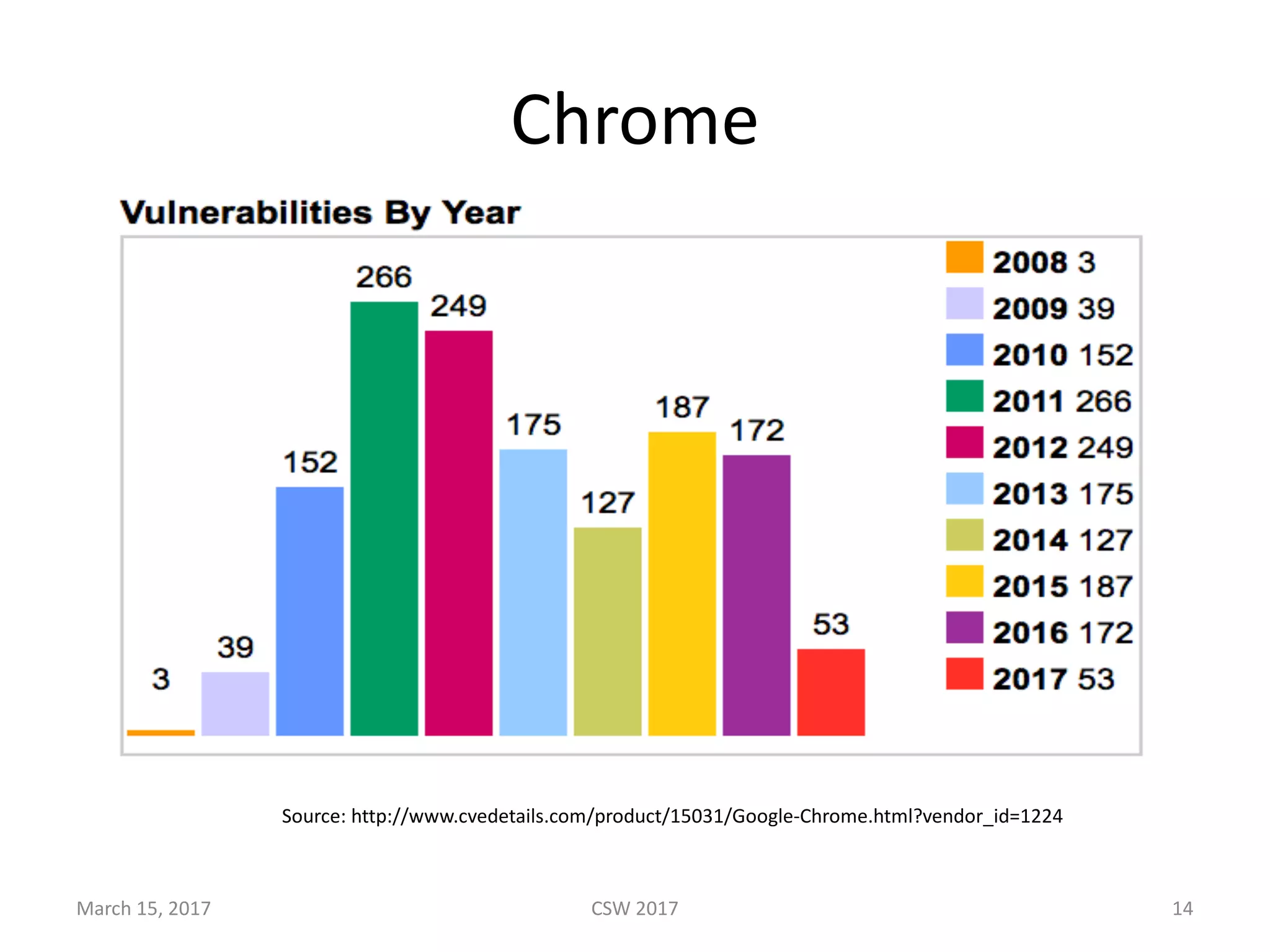
Chrome
March	15,	2017
Source:	http://www.cvedetails.com/product/15031/Google-Chrome.html?vendor_id=1224
CSW	2017 14
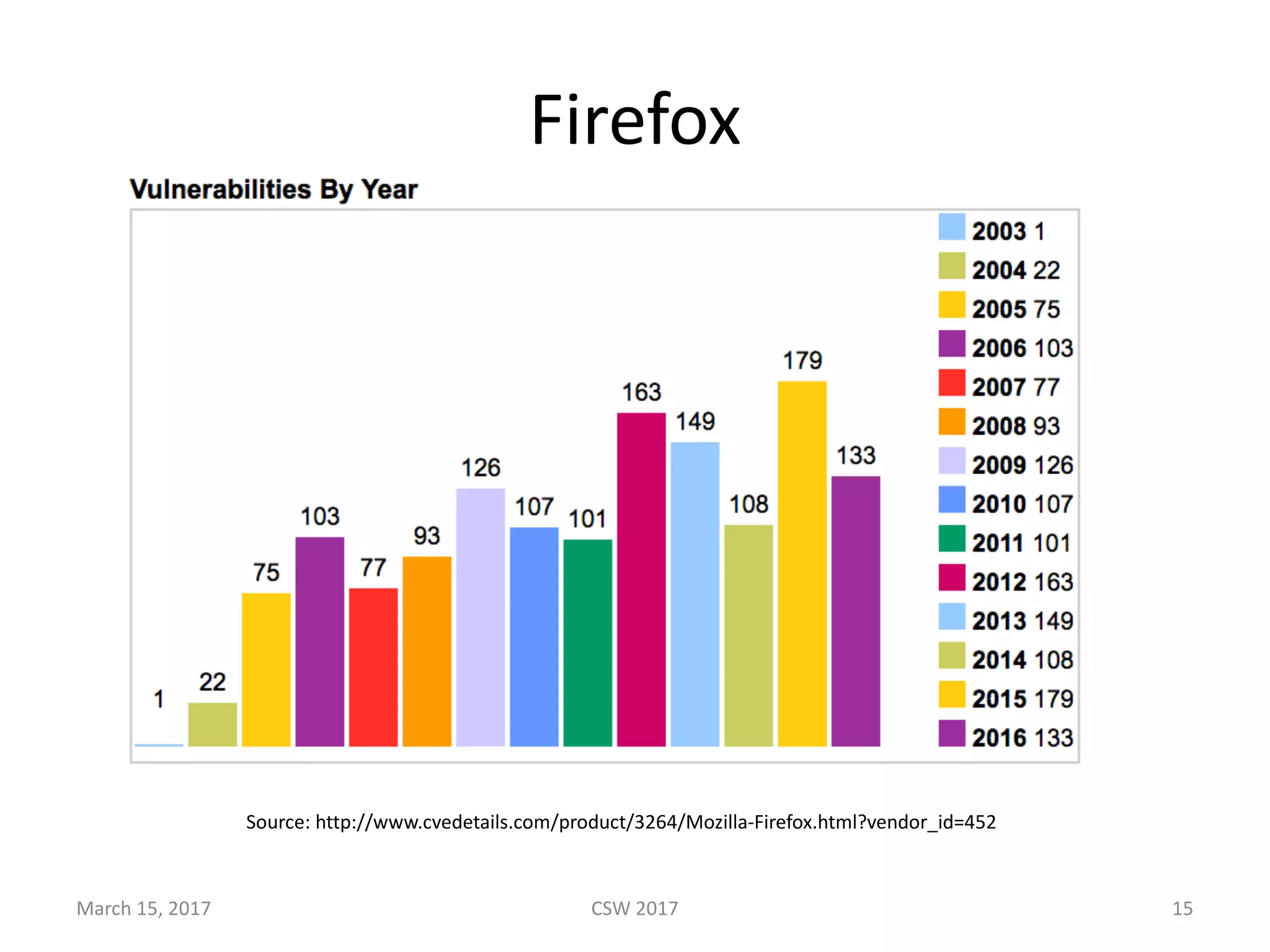
Firefox
March	15,	2017
Source:	http://www.cvedetails.com/product/3264/Mozilla-Firefox.html?vendor_id=452
CSW	2017 15
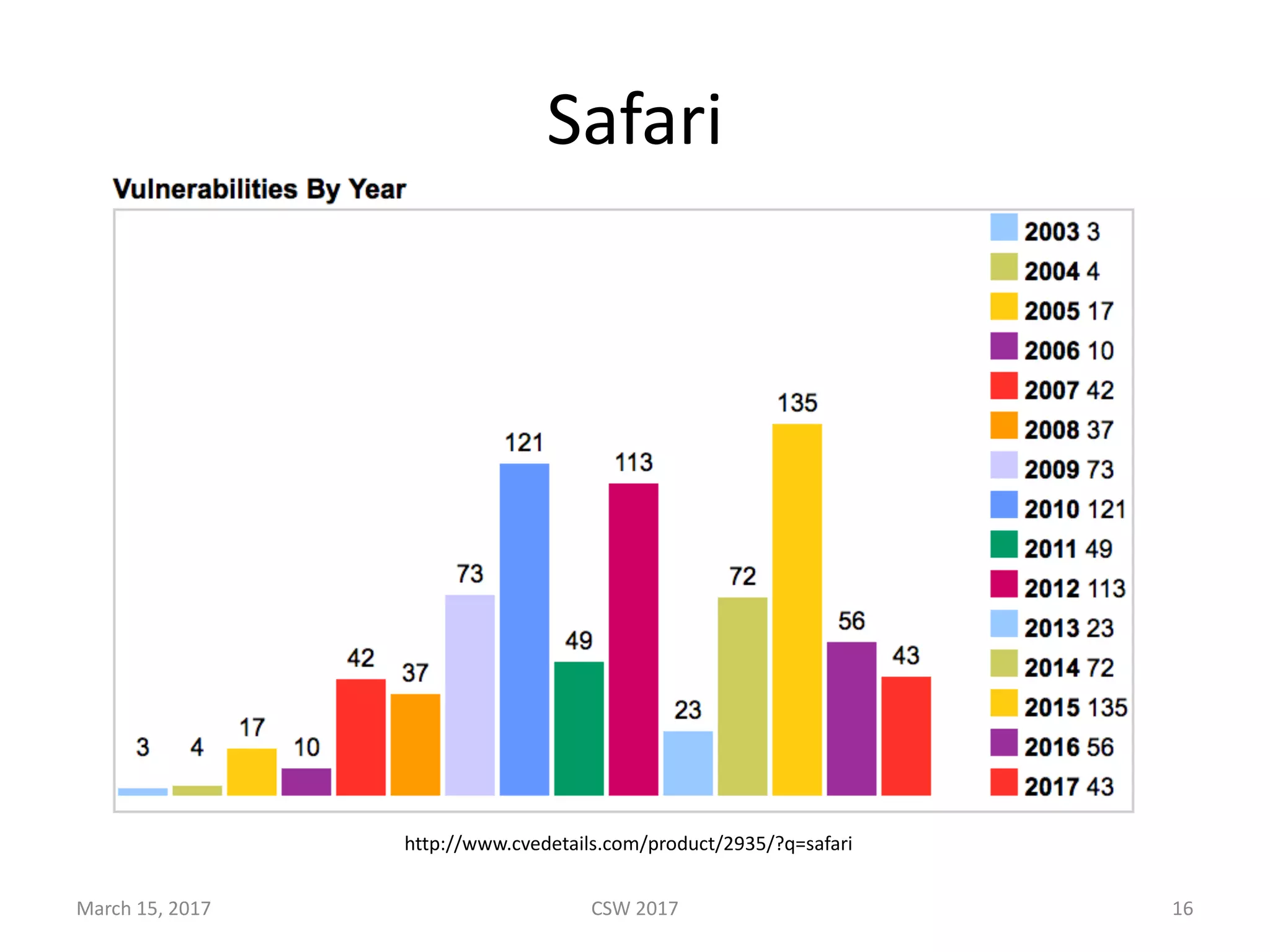
Safari
March	15,	2017 CSW	2017 16
http://www.cvedetails.com/product/2935/?q=safari
Complex	software	is	difficult	to	secure
• It	will	always be	difficult	to	secure	rich	
applications
– Major	browser	vendors	are	all	very	competent
– Yet,	they	regularly	push	security	patches
– We	have	to	accept	that	sometimes,	sploitz will	happen.*
• But,	we	don’t have	to	allow	malware	to	replace	
trusted	code	(e.g.	bootloaders,	OS,	system	
software,	etc.)
– Not	if	we	correctly	implement	secure	boot.
March	15,	2017 CSW	2017 17
So,	what	is Secure	Boot?
• Put	simply,	means	that	only	authorized	system code	runs
– If	image	is	corrupted,	or	you	try	to	install	your	own	(unauthorized)	
code,	system	will	not	run.
• Cool!	Why	don’t	they	have	that	for	Windows?
– Actually,	they	do,	sort	of	(it’s	called	UEFI).	
– See	Vincent	Zimmer’s	excellent	CSW-15	presentation	
(https://cansecwest.com/csw15archive.html)
• Today,	we’ll	focus	on	embedded/IoT
• So,	how	is	secure	boot	implemented?	We	need	some	
background	first.
March	15,	2017 CSW	2017 18
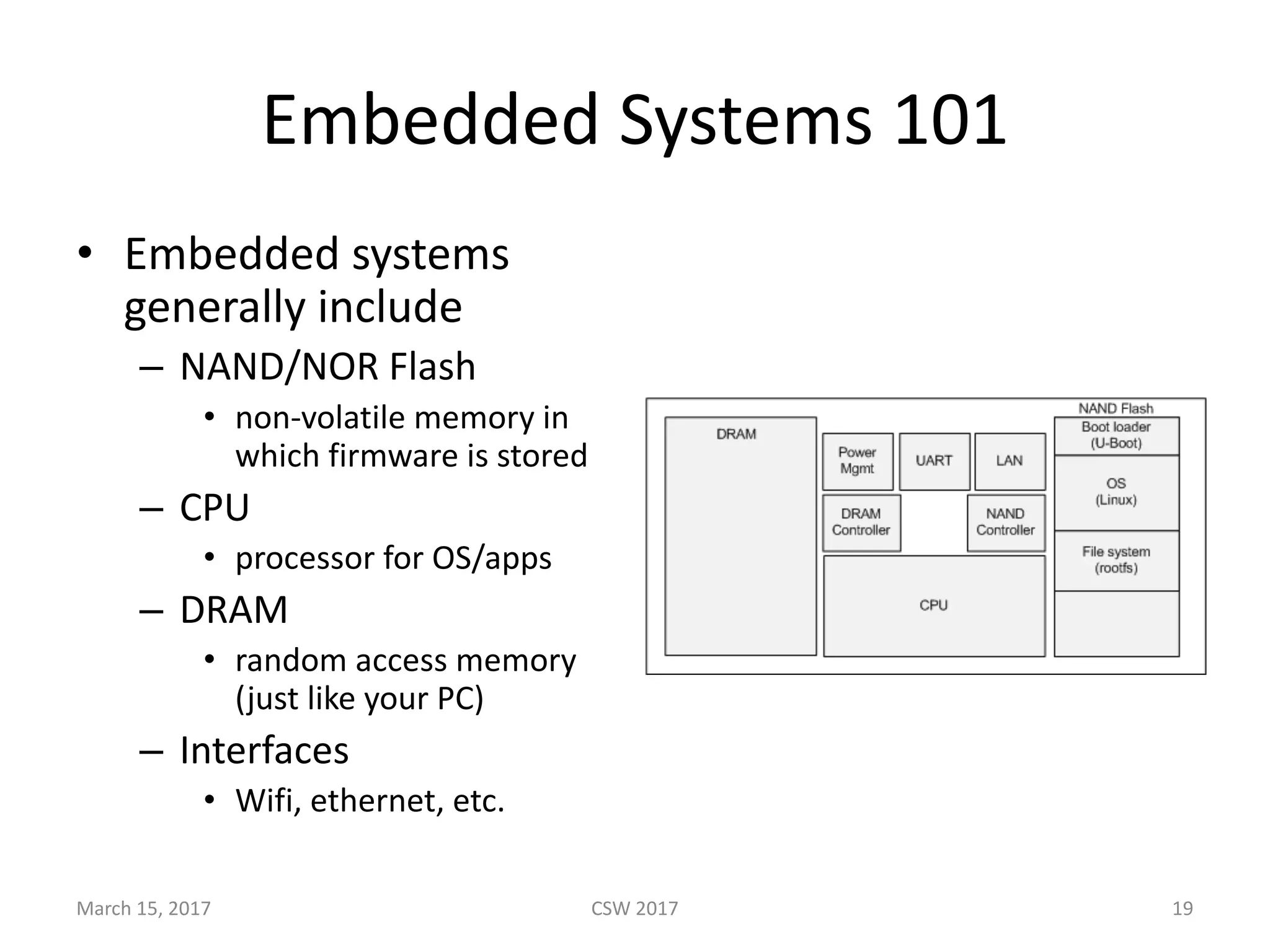
Embedded	Systems	101
• Embedded	systems	
generally	include
– NAND/NOR	Flash
• non-volatile	memory	in	
which	firmware	is	stored
– CPU
• processor	for	OS/apps
– DRAM
• random	access	memory	
(just	like	your	PC)
– Interfaces	
• Wifi,	ethernet,	etc.
March	15,	2017 CSW	2017 19
Embedded	Systems	101	(2)
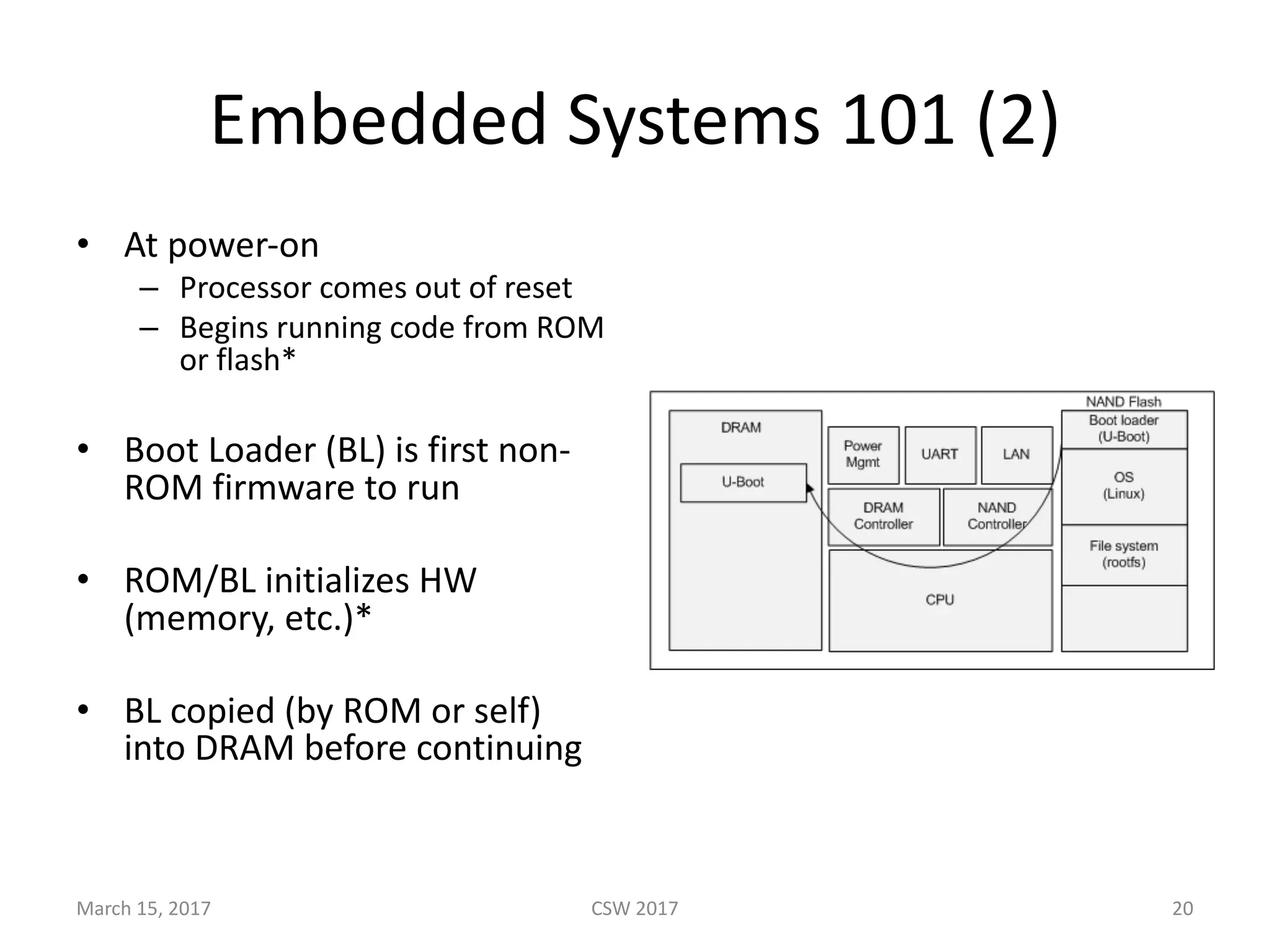
• At	power-on
– Processor	comes	out	of	reset
– Begins	running	code	from	ROM	
or	flash*
• Boot	Loader	(BL)	is	first	non-
ROM	firmware	to	run
• ROM/BL	initializes	HW	
(memory,	etc.)*
• BL	copied	(by	ROM	or	self)	
into	DRAM	before	continuing
March	15,	2017 CSW	2017 20
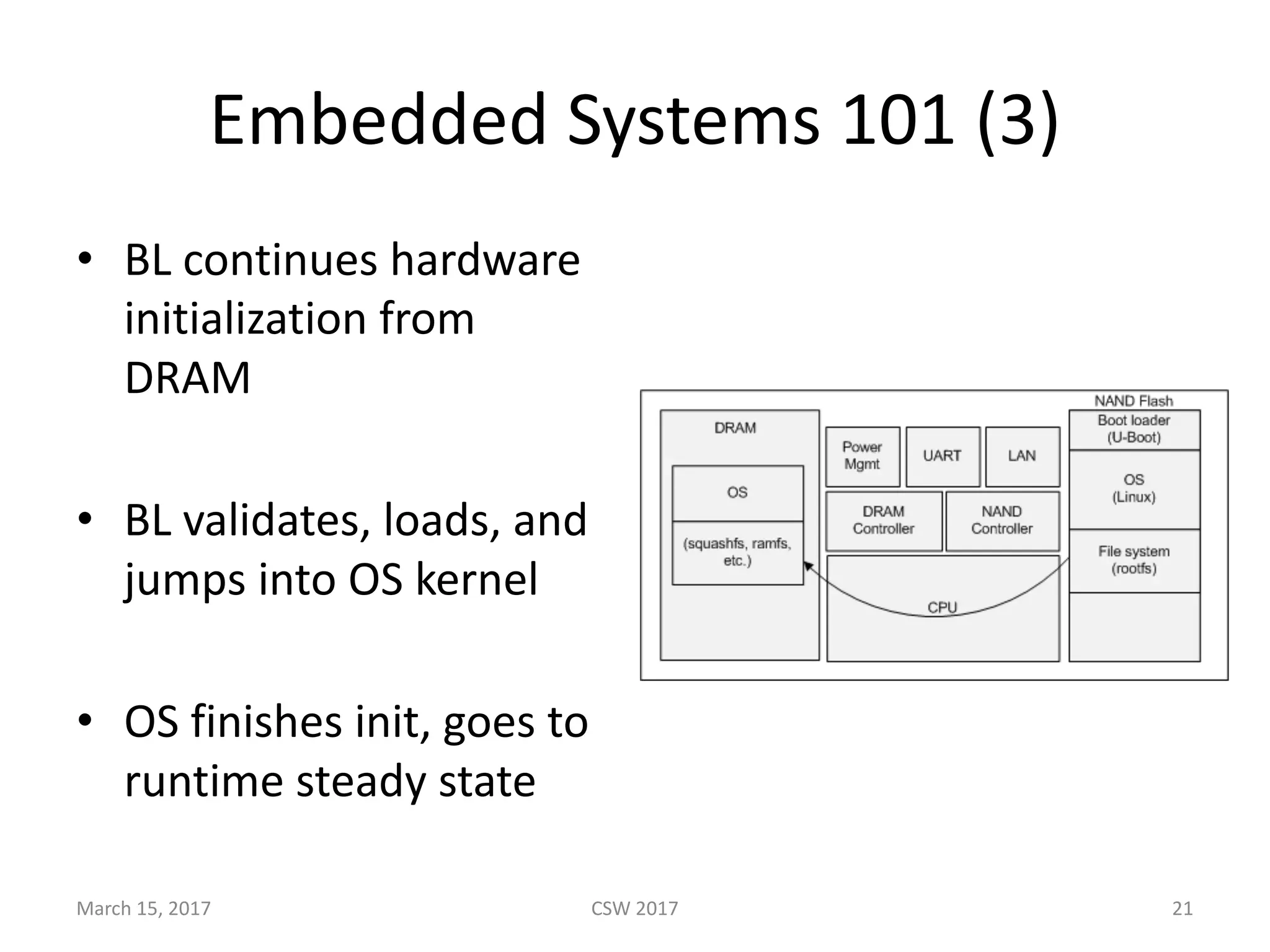
Embedded	Systems	101	(3)
• BL	continues	hardware	
initialization	from	
DRAM
• BL	validates,	loads,	and	
jumps	into	OS	kernel
• OS	finishes	init,	goes	to	
runtime	steady	state
March	15,	2017 CSW	2017 21
Important	Observations
• IoT devices	often	have	multiple	processors/cores
– Application	processor	(may	be	SMP)	is	but	one
– Audio/video,	networking,	GPU,	all	use	processors
– Various	others	(depending	on	device	type,	applications)
• These	cores	run	distinct	instruction	streams	(software)
– They	are	often	not	controlled	by	application	CPU	OS
– What	resources	they	share	(e.g.	memory,	buses,	etc.)	are	design	
choices
• Frequently,	they	are	DMA	masters
– Meaning	they	have	full	run	of	DRAM
– Read	and	write.
March	15,	2017 CSW	2017 22
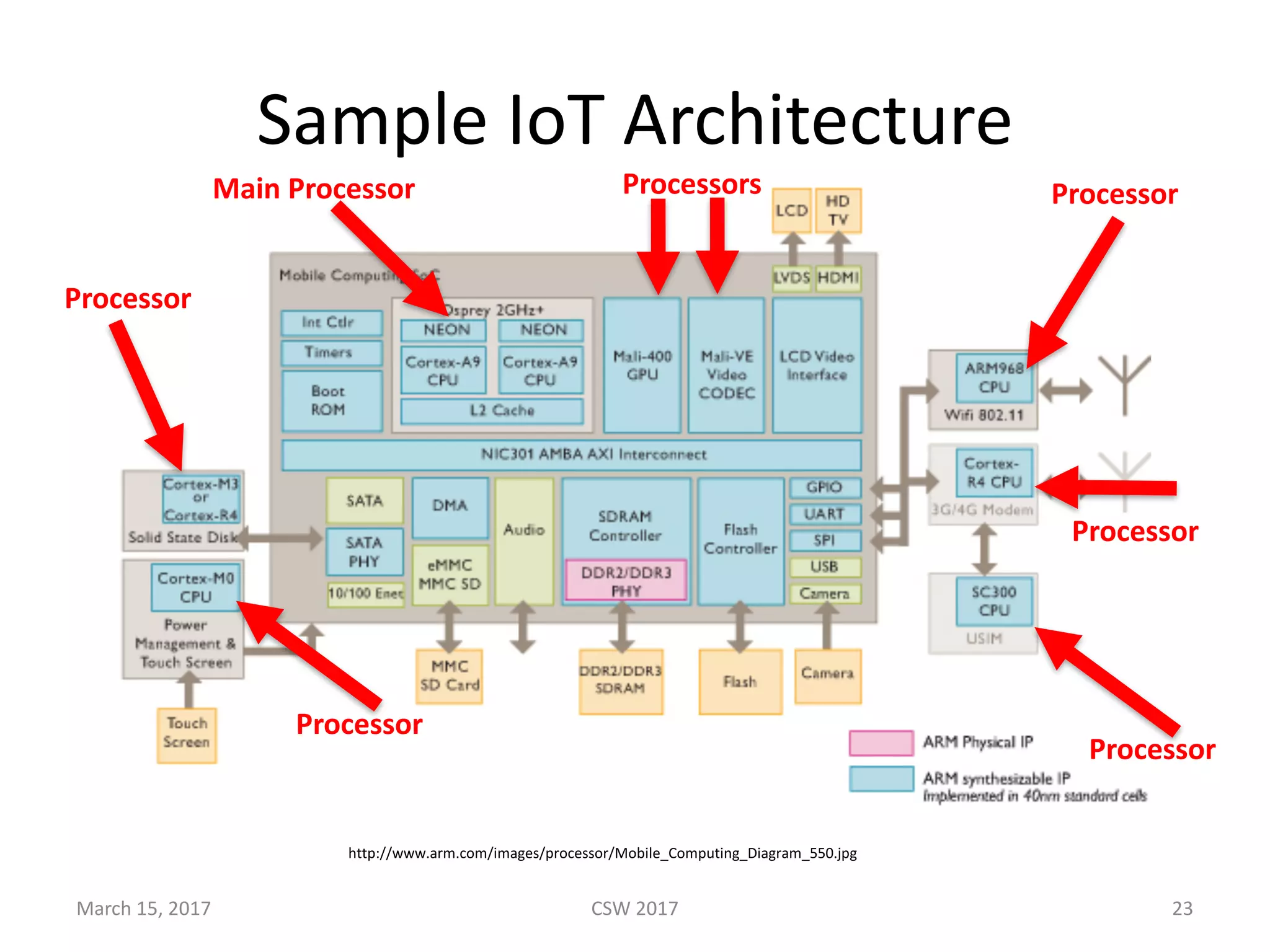
Sample	IoT Architecture
March	15,	2017 CSW	2017 23
http://www.arm.com/images/processor/Mobile_Computing_Diagram_550.jpg
Processor
Processor
Processor
Processor
ProcessorMain	Processor Processors
Back	to	the	future
• Attackers	are	exploiting	IoT systems	by	
modifying/replacing	malleable	firmware	elements
• Need	a	way	to	prevent	this,	while	still	allowing	
authorized	updates/app	loading
• Enter	secure	boot?
– We	need	system	to	be	extensible,	flexible
– This	means	we	can’t	necessarily	protect	everything.
– How	to	solve	this?
March	15,	2017 CSW	2017 24
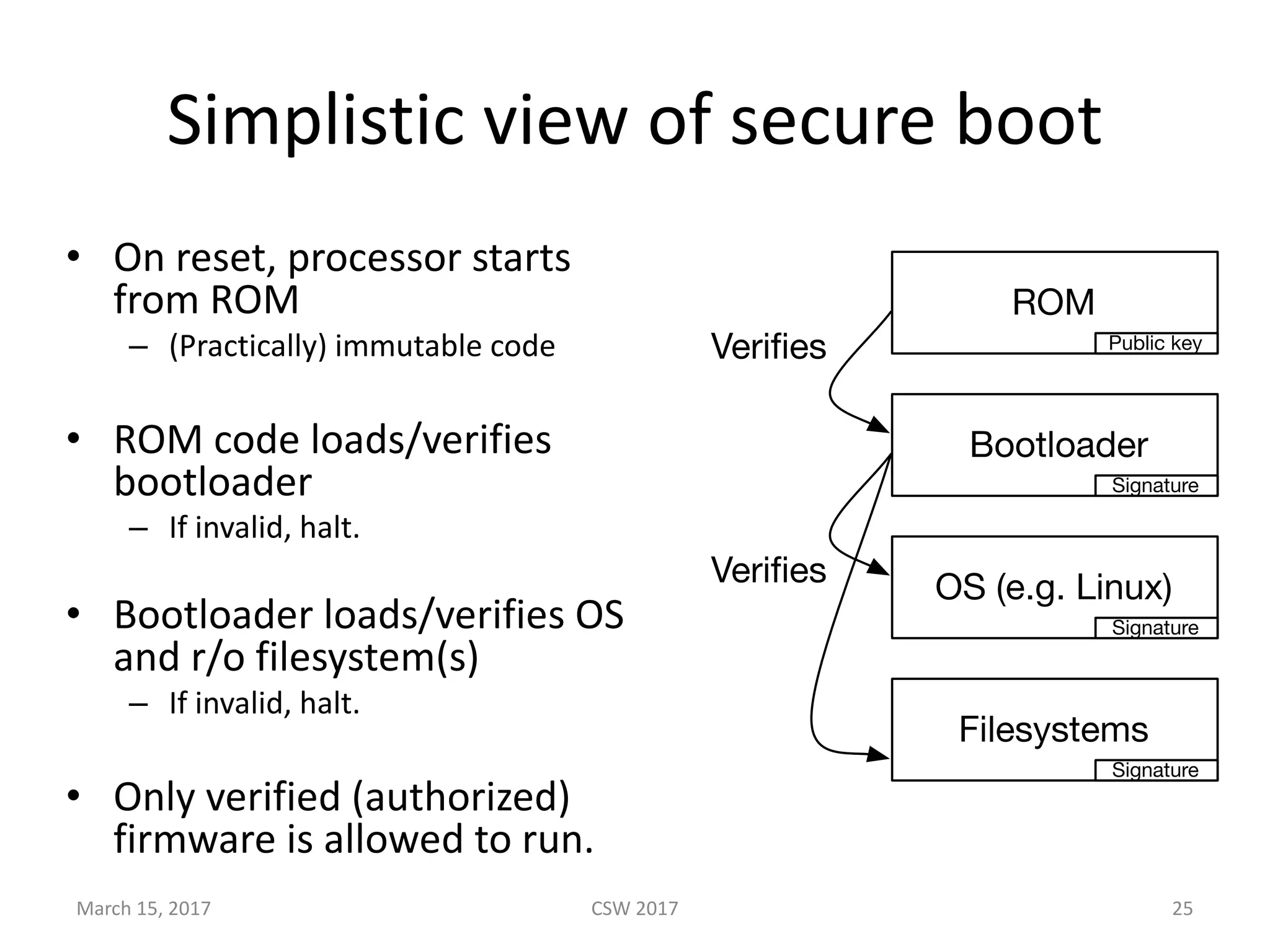
Simplistic	view	of	secure	boot
• On	reset,	processor	starts	
from	ROM
– (Practically)	immutable	code
• ROM	code	loads/verifies	
bootloader
– If	invalid,	halt.
• Bootloader	loads/verifies	OS	
and	r/o	filesystem(s)
– If	invalid,	halt.
• Only	verified	(authorized)	
firmware	is	allowed	to	run.
ROM
Bootloader
OS (e.g. Linux)
Filesystems
Public key
Signature
Signature
Signature
Verifies
Verifies
March	15,	2017 CSW	2017 25
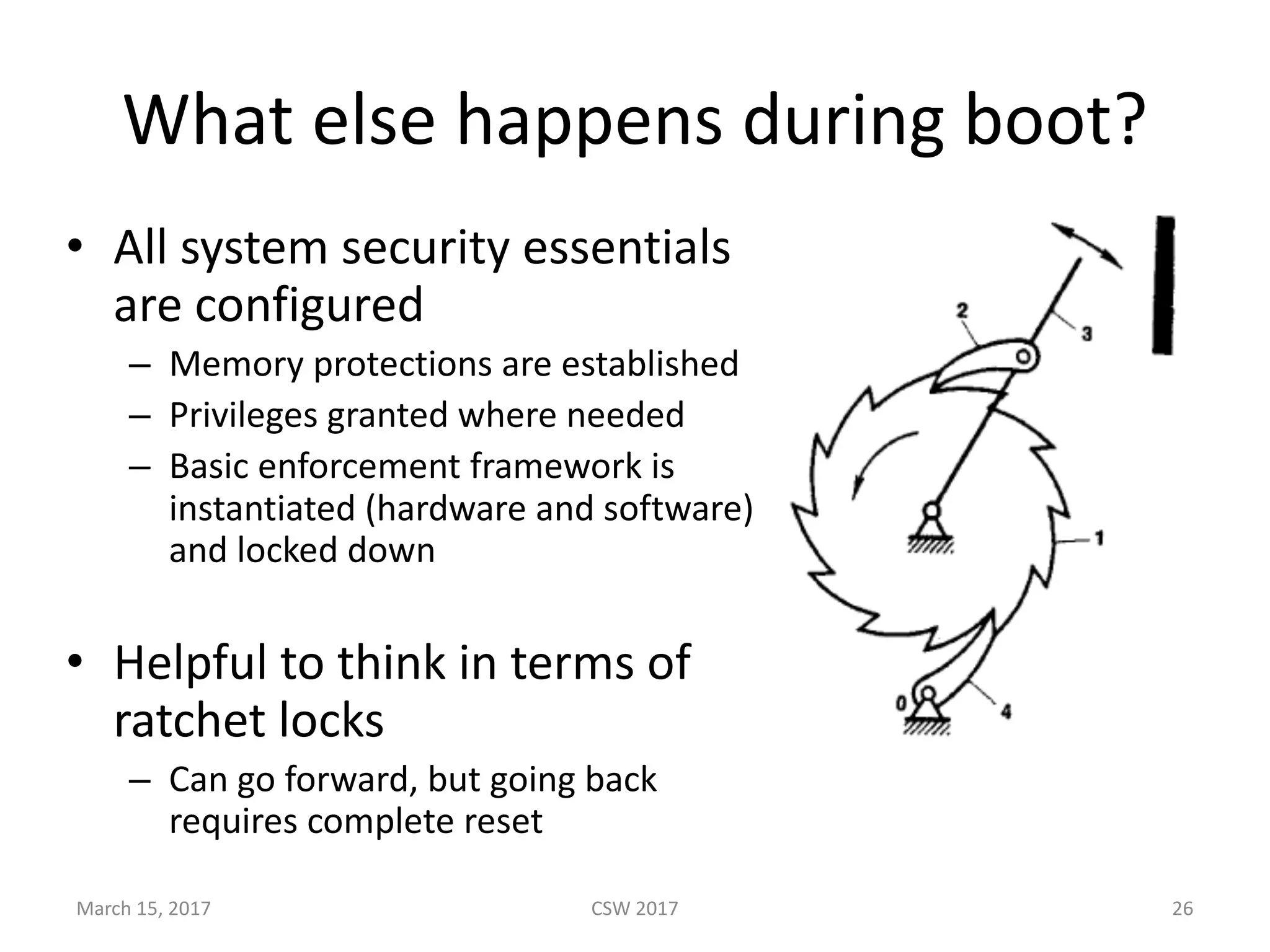
What	else	happens	during	boot?
• All	system	security	essentials	
are	configured
– Memory	protections	are	established
– Privileges	granted	where	needed
– Basic	enforcement	framework	is	
instantiated	(hardware	and	software)	
and	locked	down
• Helpful	to	think	in	terms	of	
ratchet	locks
– Can	go	forward,	but	going	back	
requires	complete	reset
March	15,	2017 CSW	2017 26
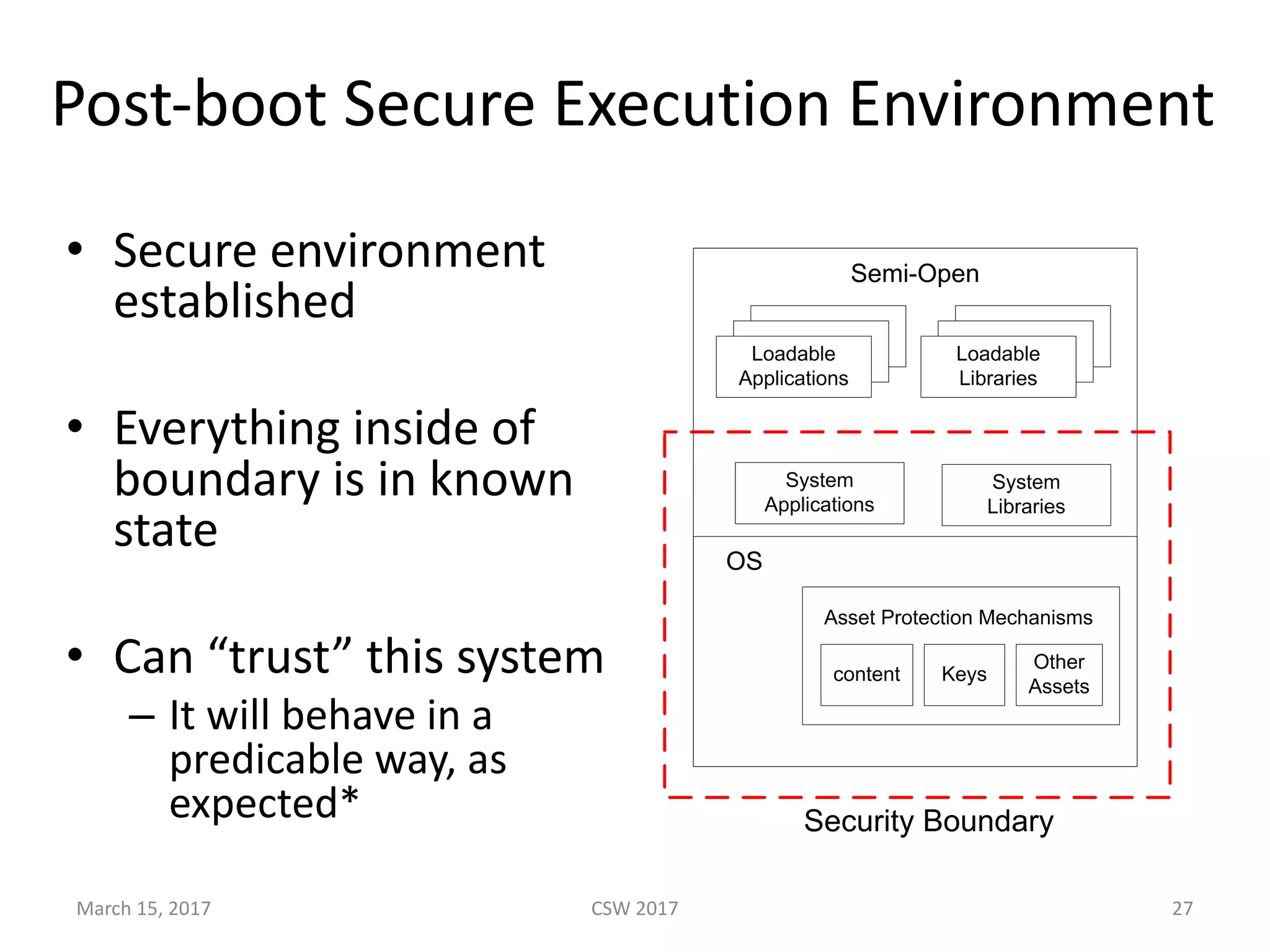
Post-boot	Secure	Execution	Environment
• Secure	environment	
established
• Everything	inside	of	
boundary	is	in	known	
state
• Can	“trust”	this	system
– It	will	behave	in	a	
predicable	way,	as	
expected*
CSW	2017March	15,	2017 27
Subverting	the	boot	process
• Malware	often	circumvents	boot	process
– Attack	replaces	some	part	of	early	boot	code
– Takes	control	of	the	system	early	on
– Robust	secure	boot	can	prevent	this.
• Of	course,	application	may	exploit	system	bug	(later)
– But	robustly	configured	system	can	still	protect	some	
assets,	operations
– This	is	the	purpose	of	hardware-based	“ratchets”
• Compromise	at	later	phase	can’t	undo	previous	“locks”
– System	can	potentially	be	recovered	by	reboot
CSW	2017March	15,	2017 28
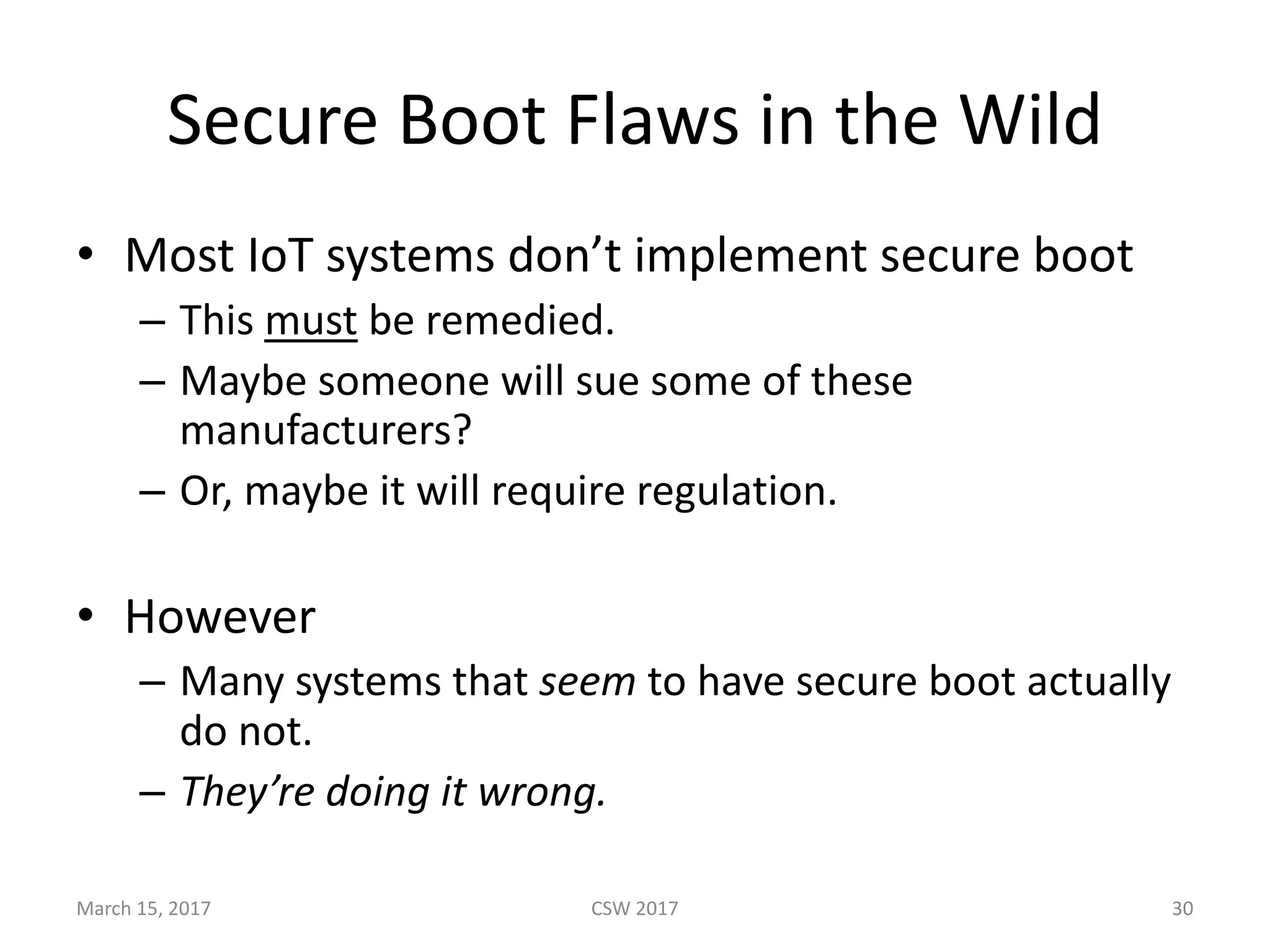
How	to	Attack	Secure	Boot?
• Glitching
– Cause	system	to	erroneously	accept	(or	ignore!)	invalid	signature
• Compromise	signing	key
– Then,	you	can	sign	your	own	firmware	images!
• Break	crypto	(e.g.	factor	RSA	modulus)
– Yeah,	good	luck	with	that.*
• Find	bug/flaw	in	validation	code
– Buffer	overflow,	integer	{under,over}flow,	etc.
– Incorrect	crypto	implementation
• Take	advantage	of	flawed	design.	
CSW	2017March	15,	2017 29
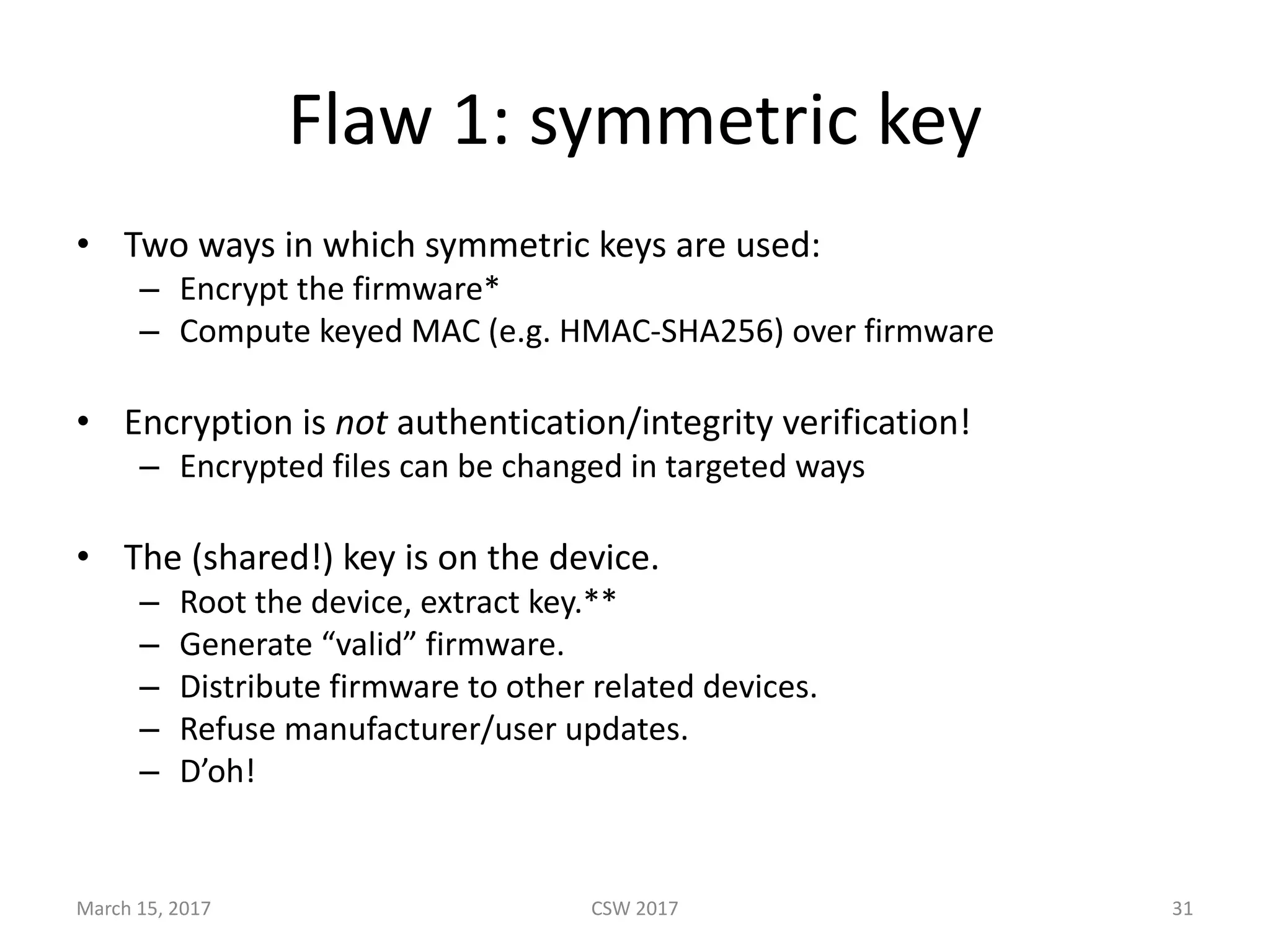
Secure	Boot	Flaws	in	the	Wild
• Most	IoT systems	don’t	implement	secure	boot
– This	must be	remedied.
– Maybe	someone	will	sue	some	of	these	
manufacturers?
– Or,	maybe	it	will	require	regulation.
• However
– Many	systems	that	seem to	have	secure	boot	actually	
do	not.
– They’re	doing	it	wrong.
March	15,	2017 CSW	2017 30
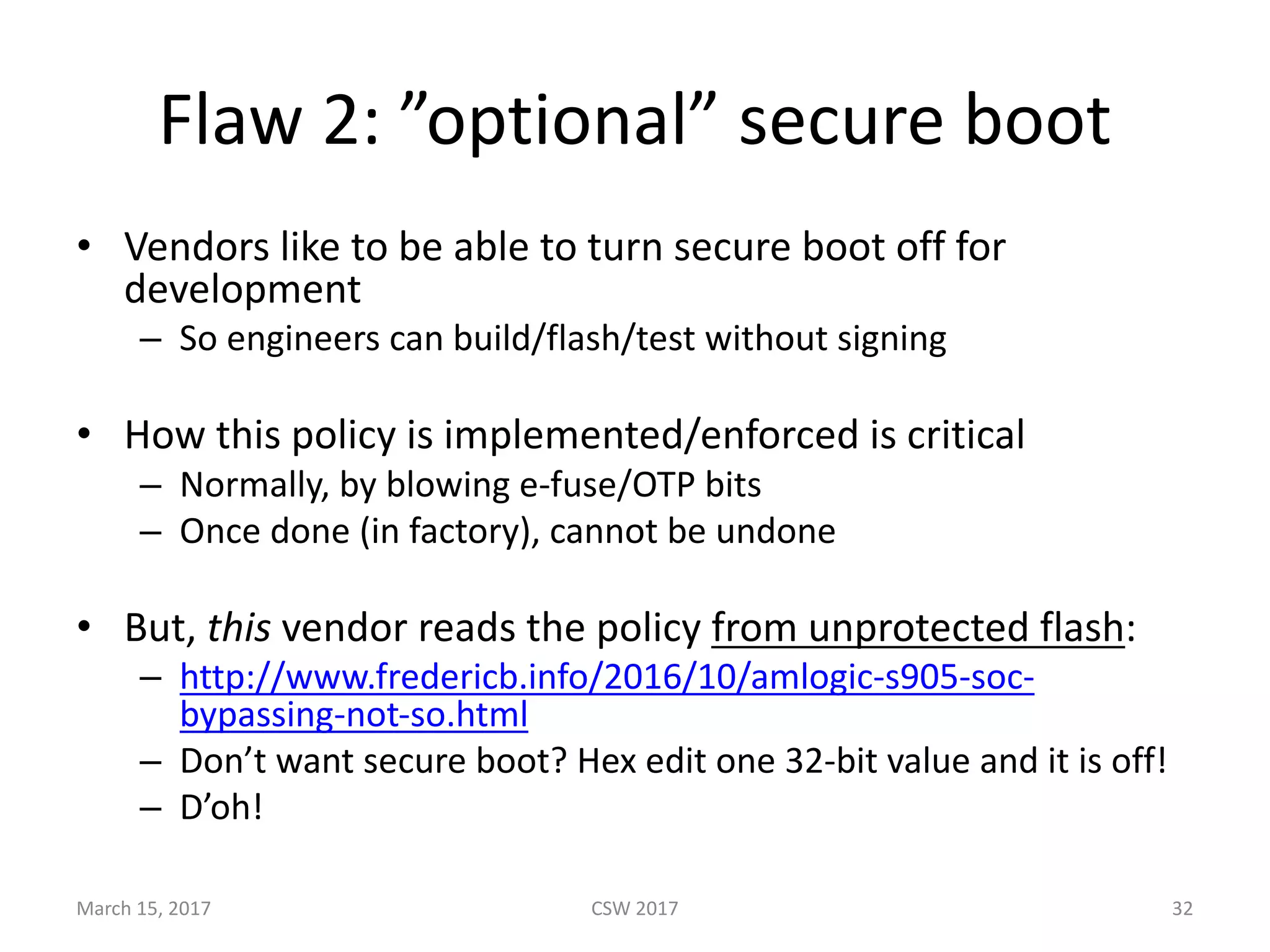
Flaw	1:	symmetric	key
• Two	ways	in	which	symmetric	keys	are	used:
– Encrypt	the	firmware*
– Compute	keyed	MAC	(e.g.	HMAC-SHA256)	over	firmware
• Encryption	is	not authentication/integrity	verification!
– Encrypted	files	can	be	changed	in	targeted	ways
• The	(shared!)	key	is	on	the	device.	
– Root	the	device,	extract	key.**
– Generate	“valid”	firmware.	
– Distribute	firmware	to	other	related	devices.	
– Refuse	manufacturer/user	updates.
– D’oh!
March	15,	2017 CSW	2017 31
Flaw	2:	”optional”	secure	boot
• Vendors	like	to	be	able	to	turn	secure	boot	off	for	
development
– So	engineers	can	build/flash/test	without	signing
• How	this	policy	is	implemented/enforced	is	critical
– Normally,	by	blowing	e-fuse/OTP	bits
– Once	done	(in	factory),	cannot	be	undone
• But,	this vendor	reads	the	policy	from	unprotected	flash:
– http://www.fredericb.info/2016/10/amlogic-s905-soc-
bypassing-not-so.html
– Don’t	want	secure	boot?	Hex	edit	one	32-bit	value	and	it	is	off!
– D’oh!
March	15,	2017 CSW	2017 32
Flaw	3:	Weak	root	of	trust
• Secure	boot	depends	on	root	of	trust
– Normally,	starts	from	ROM
– If	first	code	that	runs	can	be	changed,	you	are	potentially	in	the	
matrix
• PCs	still	have	this	issue	(start	from	BIOS/EFI	flash).	Due	to	
scalability/liability	issues?
– Trammell	Hudson	illustrated	the	issue	with	thunderstrike:
• https://trmm.net/Thunderstrike_31c3
• Macbook,	some	PCs	implement	UEFI	
– But	so	long	as	EFI	flash	can	be	rewritten,	this	is	fundamentally	
flawed
March	15,	2017 CSW	2017 33
Flaw	3:	weak	root	of	trust	(2)
• This	same	problem	exists	in	many	IoT devices
– To	save	on	cost,	sometimes	no	ROM
• Processor	loads	first	stage	bootloader	from	unprotected	flash
• What	if	attacker	re-flashes?
– There	are hardware-based	methods	for	protecting	the	flash	at	
runtime
• Update	window	is	opened	early	in	boot	process
• If	valid,	signed	image	is	found,	update	occurs
• One-shot	lock	requires	reboot	to	“open	the	window”	again
• But	these	cost	money,	so	not	often	implemented.
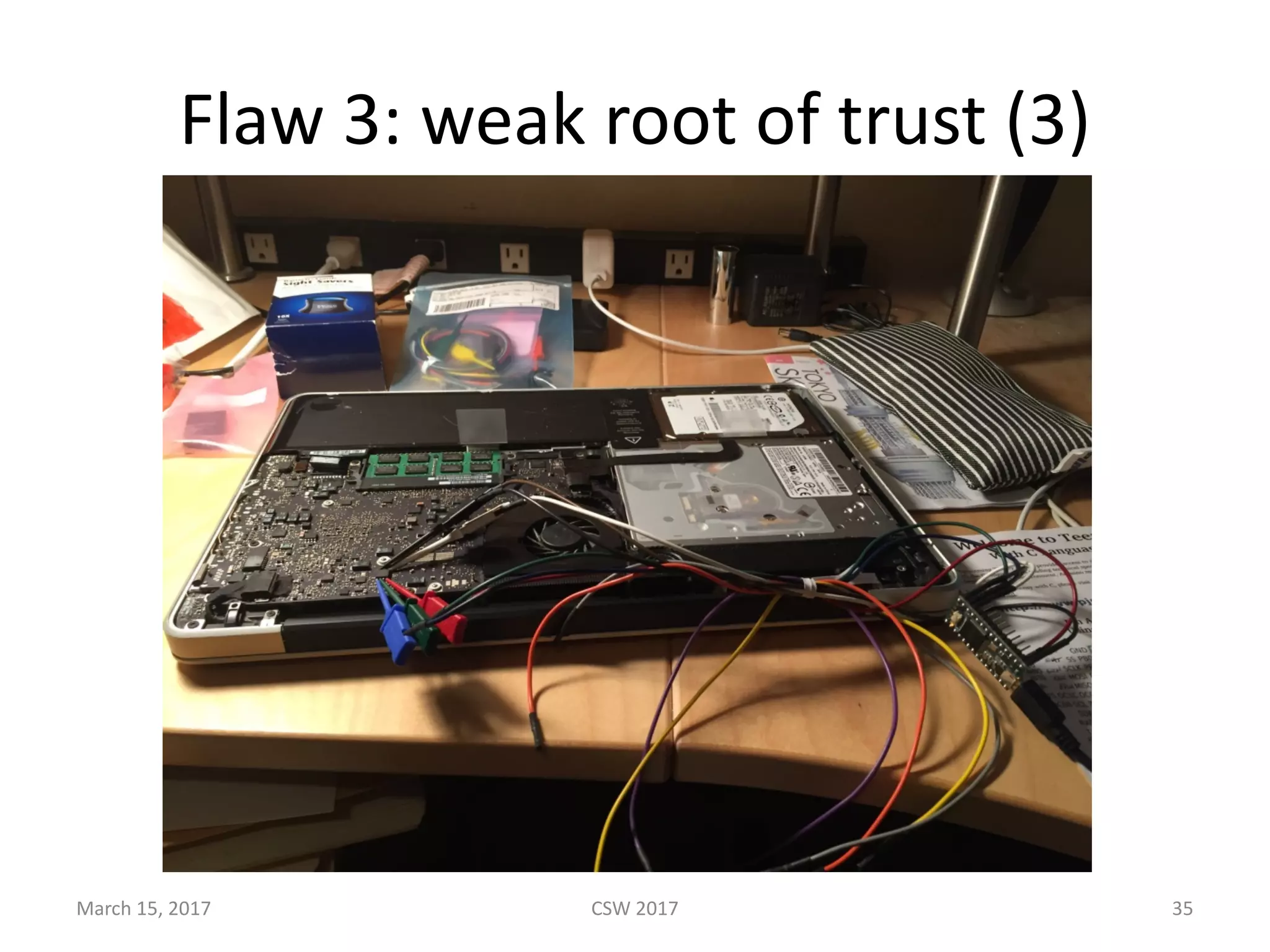
– Regardless,	still	cannot	prevent	physical	attack	
• e.g.	using	teensy:	https://trmm.net/SPI	
March	15,	2017 CSW	2017 34
Flaw	3:	weak	root	of	trust	(3)
March	15,	2017 CSW	2017 35
Flaw	4:	RSA	with	no	padding
• This	is	a	surprisingly	common	problem
• Some	engineers	eliminate	RSA	padding	to	save	
space
– Has	no	impact	on	signature	size
– Slightly	reduces	code	size/complexity	(in	ROM)
• Creates	subtle	issues
March	15,	2017 CSW	2017 36
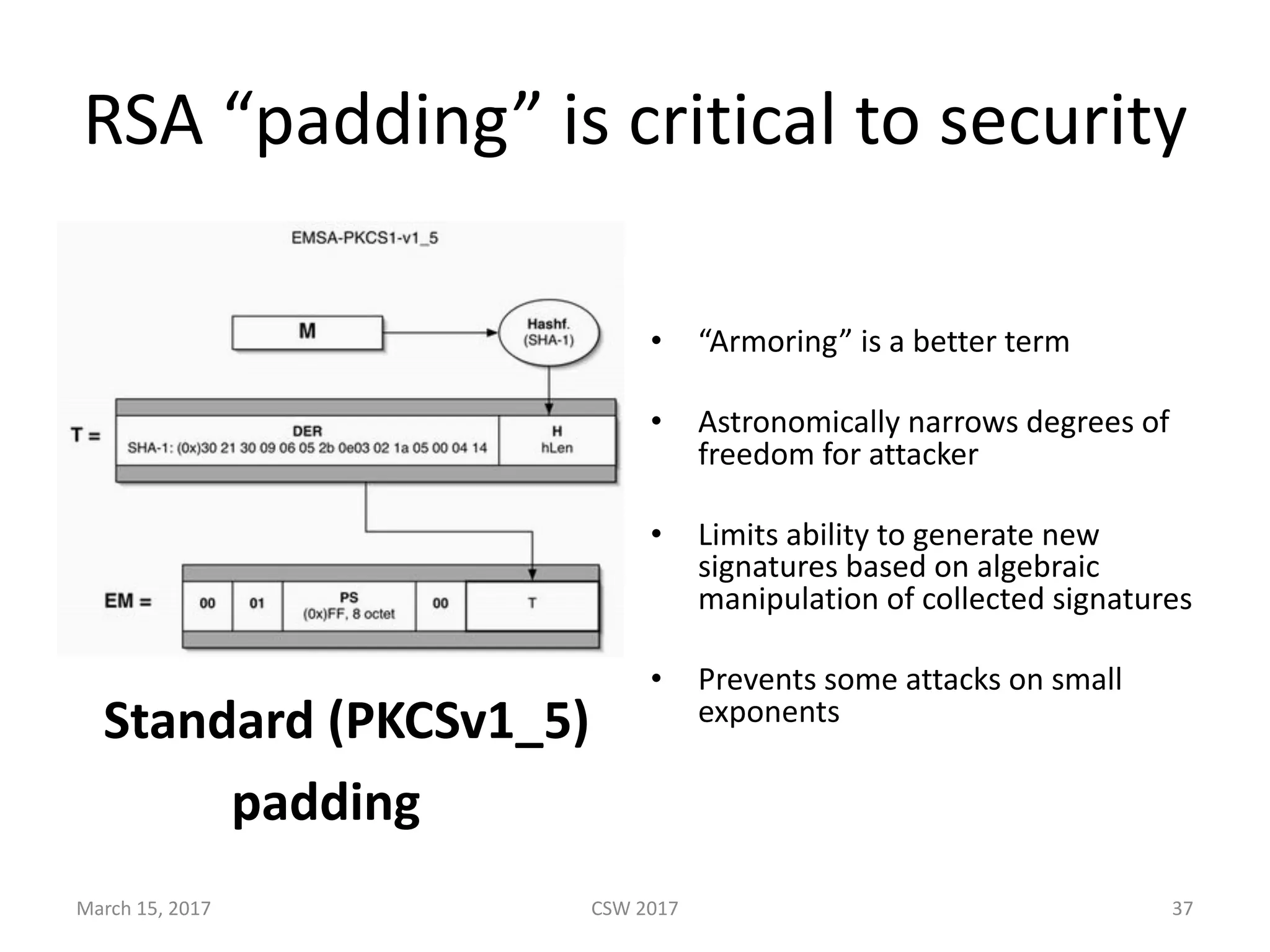
RSA	“padding”	is	critical	to	security
Standard	(PKCSv1_5)	
padding
• “Armoring”	is	a	better	term
• Astronomically	narrows	degrees	of	
freedom	for	attacker
• Limits	ability	to	generate	new	
signatures	based	on	algebraic	
manipulation	of	collected	signatures
• Prevents	some	attacks	on	small	
exponents
March	15,	2017 CSW	2017 37
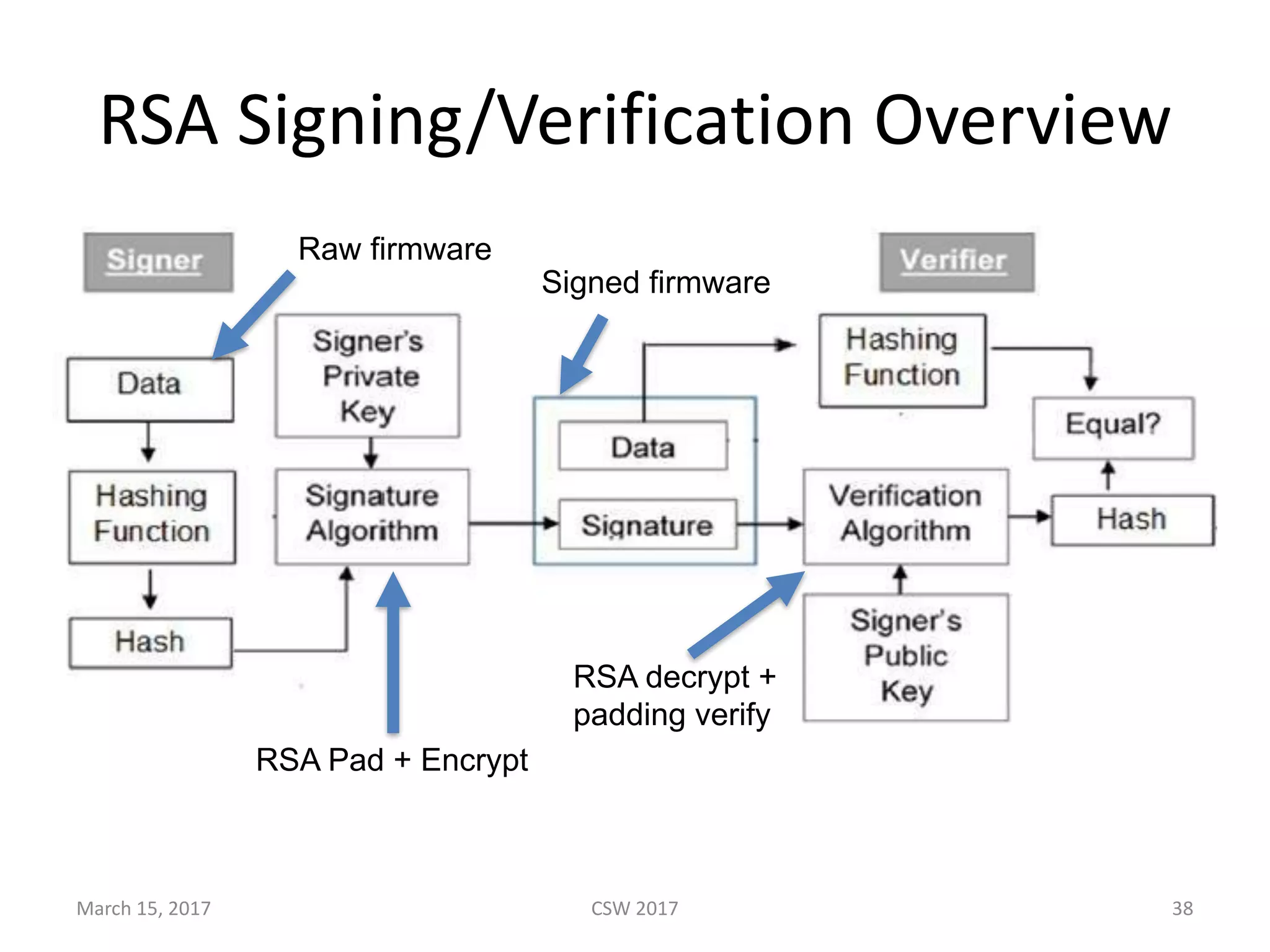
RSA	Signing/Verification	Overview
RSA decrypt +
padding verify
RSA Pad + Encrypt
Raw firmware
Signed firmware
March	15,	2017 CSW	2017 38
Flaw	5:	“clever”	crypto
• Security	is	hard.	Cryptography	is	harder.
– Almost	always	the	case	that	engineers	implementing	
the	crypto	do	not	understand	it.
– There be	dragons.	
• I’ve	seen	many	cases	of	crypto	modifications,	
shortcuts,	“optimizations":
– To	save	space
– To	speed	boot	process
– Because	it’s	just	math*
March	15,	2017 CSW	2017 39
Hacking	Secure	Boot
A	worked	example
• “It’s	just	math”
• Above,	we	saw	that	a	robust	secure	boot	process	uses	
asymmetric	cryptography	to	implement	a	digital	
signature	algorithm
– RSA,	ECDSA,	etc.
• Following	is	an	example	of	how	wannabe	clever	
engineers	gave	me	the	keys	to	their	kingdom.
– Some	details	have	been	changed	to	protect	vendor	
confidentiality
– But	the	essence	of	the	flaw	remains.	
March	15,	2017 CSW	2017 40
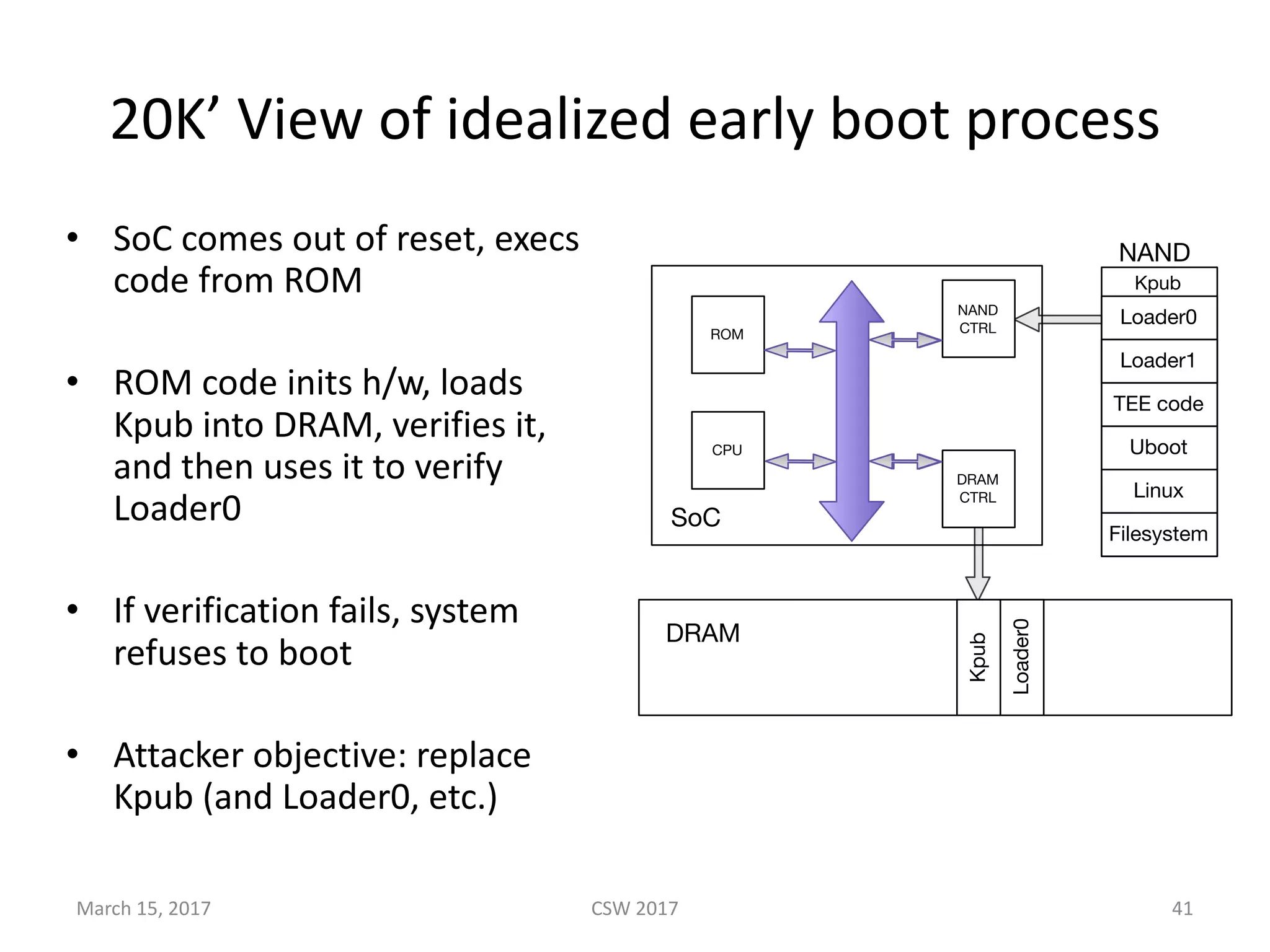
20K’	View	of	idealized	early	boot	process
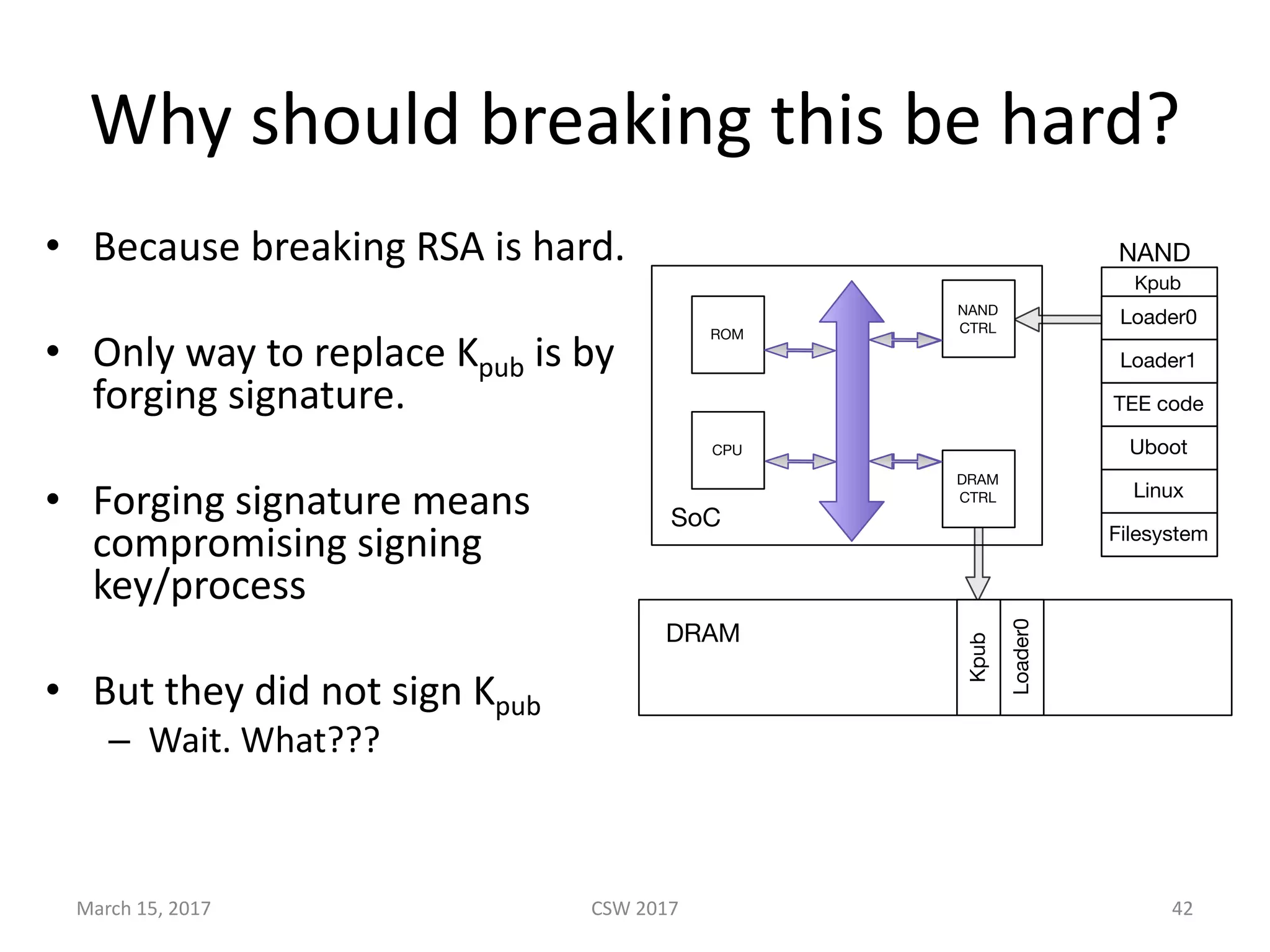
• SoC comes	out	of	reset,	execs	
code	from	ROM
• ROM	code	inits h/w,	loads	
Kpub into	DRAM,	verifies	it,	
and	then	uses	it	to	verify	
Loader0
• If	verification	fails,	system	
refuses	to	boot
• Attacker	objective:	replace	
Kpub (and	Loader0,	etc.)
CSW	2017
Loader0
Loader1
TEE code
Uboot
Linux
Filesystem
NAND
CTRL
DRAM
CTRL
ROM
CPU
SoC
DRAM
NAND
Kpub
Kpub
Loader0
March	15,	2017 41
Why	should	breaking	this	be	hard?
• Because	breaking	RSA	is	hard.
• Only	way	to	replace	Kpub is	by	
forging	signature.
• Forging	signature	means	
compromising	signing	
key/process
• But	they	did	not	sign	Kpub
– Wait.	What???
CSW	2017March	15,	2017 42
Loader0
Loader1
TEE code
Uboot
Linux
Filesystem
NAND
CTRL
DRAM
CTRL
ROM
CPU
SoC
DRAM
NAND
Kpub
Kpub
Loader0
RSA	in	brief	(1)
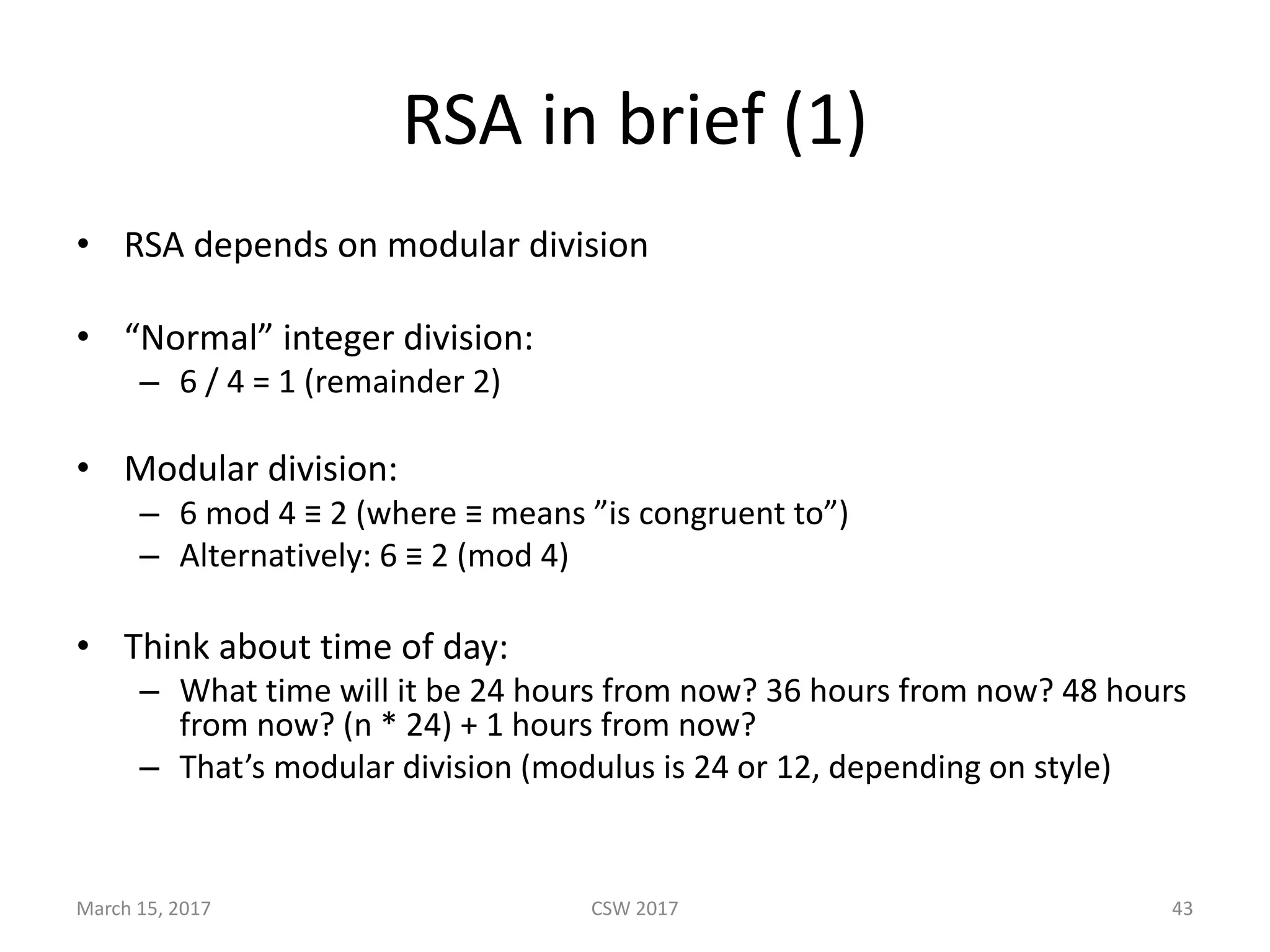
• RSA	depends	on	modular	division
• “Normal”	integer	division:
– 6	/	4	=	1	(remainder	2)
• Modular	division:
– 6	mod	4	≡ 2	(where	≡ means	”is	congruent	to”)
– Alternatively:	6	≡ 2	(mod	4)
• Think	about	time	of	day:
– What	time	will	it	be	24	hours	from	now?	36	hours	from	now?	48	hours	
from	now?	(n	*	24)	+	1	hours	from	now?
– That’s	modular	division	(modulus	is	24	or	12,	depending	on	style)
March	15,	2017 CSW	2017 43
RSA	in	brief	(2)
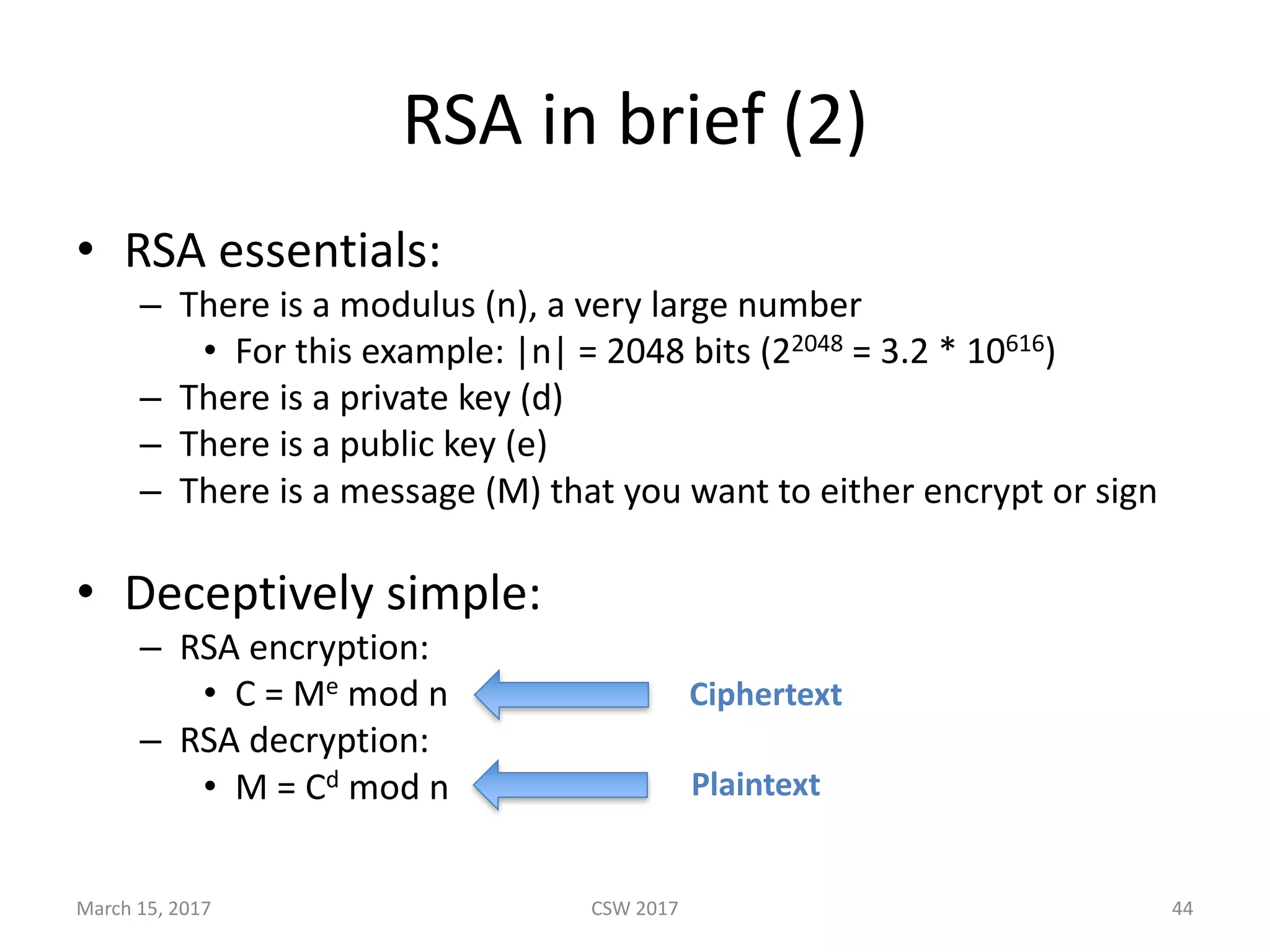
• RSA	essentials:
– There	is	a	modulus	(n),	a	very	large	number
• For	this	example:	|n|	=	2048	bits	(22048 =	3.2	*	10616)
– There	is	a	private	key	(d)	
– There	is	a	public	key	(e)
– There	is	a	message	(M)	that	you	want	to	either	encrypt	or	sign
• Deceptively	simple:
– RSA	encryption:
• C	=	Me mod	n
– RSA	decryption:
• M	=	Cd mod	n
Ciphertext
Plaintext
March	15,	2017 CSW	2017 44
RSA	in	brief	(3)
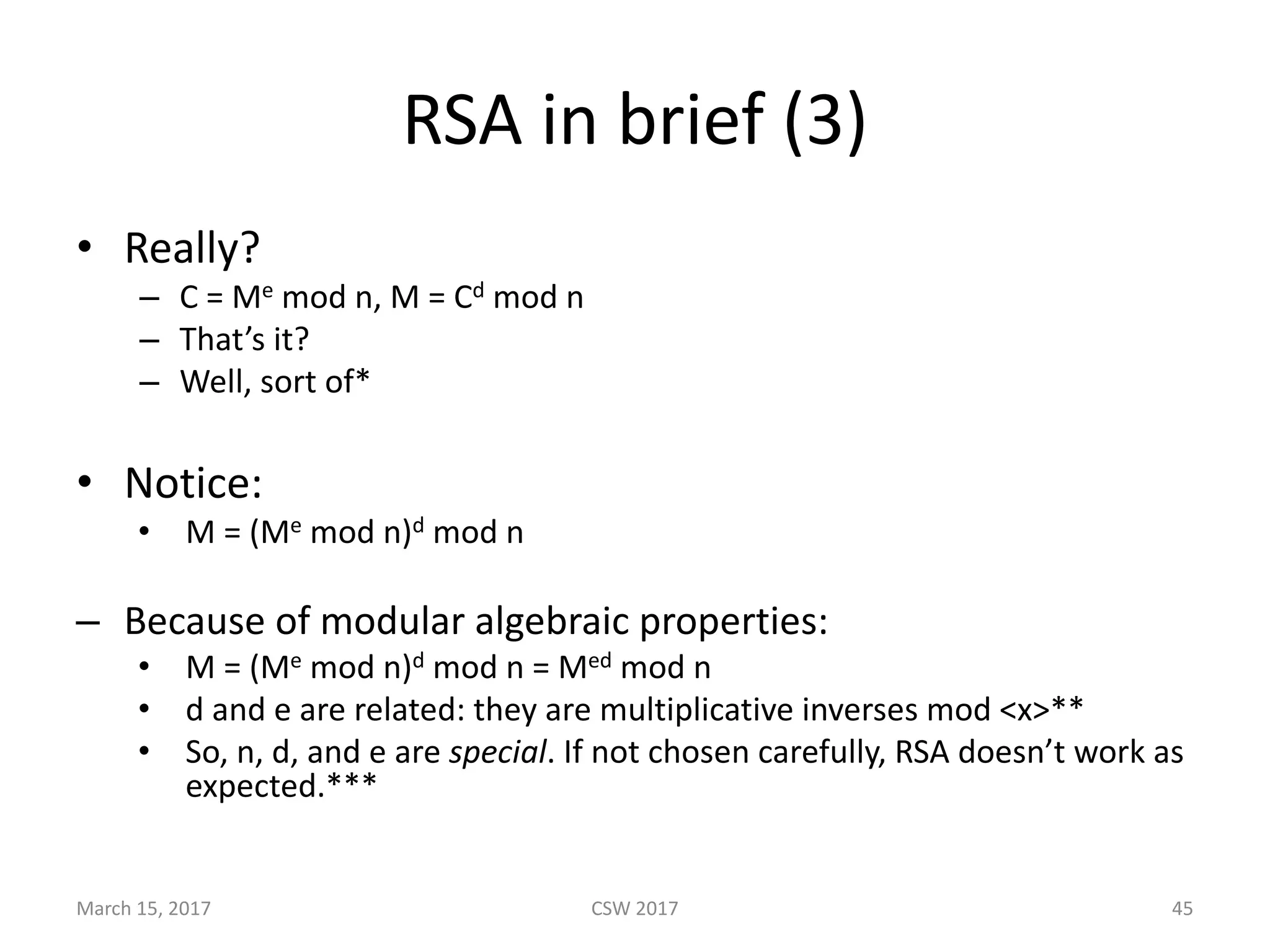
• Really?
– C	=	Me mod	n,	M	=	Cd mod	n
– That’s	it?
– Well,	sort	of*
• Notice:
• M	=	(Me mod	n)d mod	n
– Because	of	modular	algebraic	properties:
• M	=	(Me mod	n)d mod	n	=	Med mod	n
• d	and	e	are	related:	they	are	multiplicative	inverses	mod	<x>**
• So,	n,	d,	and	e	are	special.	If	not	chosen	carefully,	RSA	doesn’t	work	as	
expected.***
March	15,	2017 CSW	2017 45
One	critical	bit	of	RSA	advice
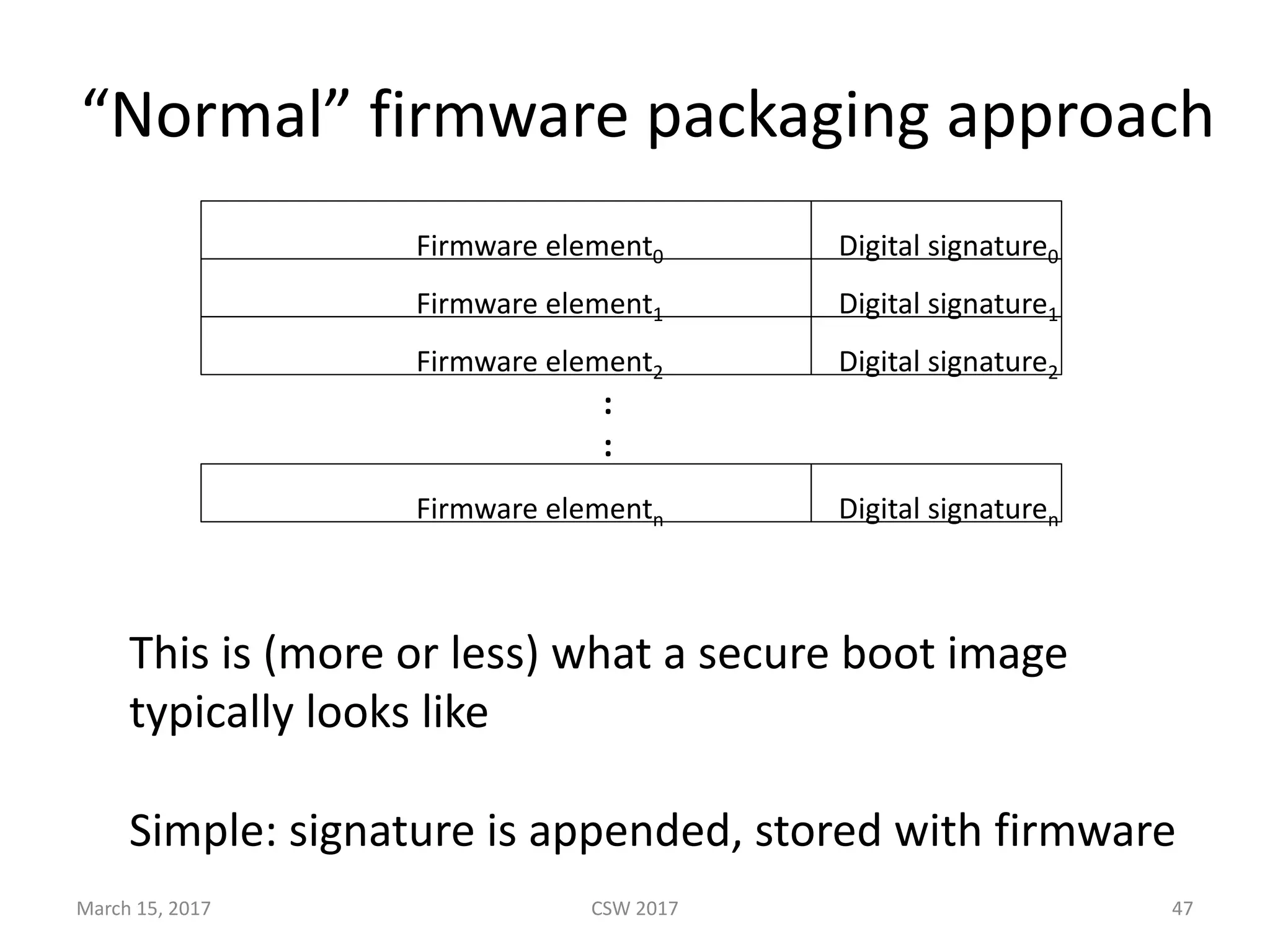
• Never	EVER encrypt	raw	messages	(M)	with	RSA
– i.e.	C	=	Me mod	n	?	Don’t	do	it.
– Depending	on	what	you	encrypt,	and	details	of	your	specific	
keys/modulus,	various	attacks	are	possible
– This	is	*really*	important!
• I’ll	show	you	exactly	why	shortly.
• See	Dan	Boneh’s paper	for	more	info:
– https://crypto.stanford.edu/~dabo/papers/RSA-survey.pdf
March	15,	2017 CSW	2017 46
“Normal”	firmware	packaging	approach
CSW	2017
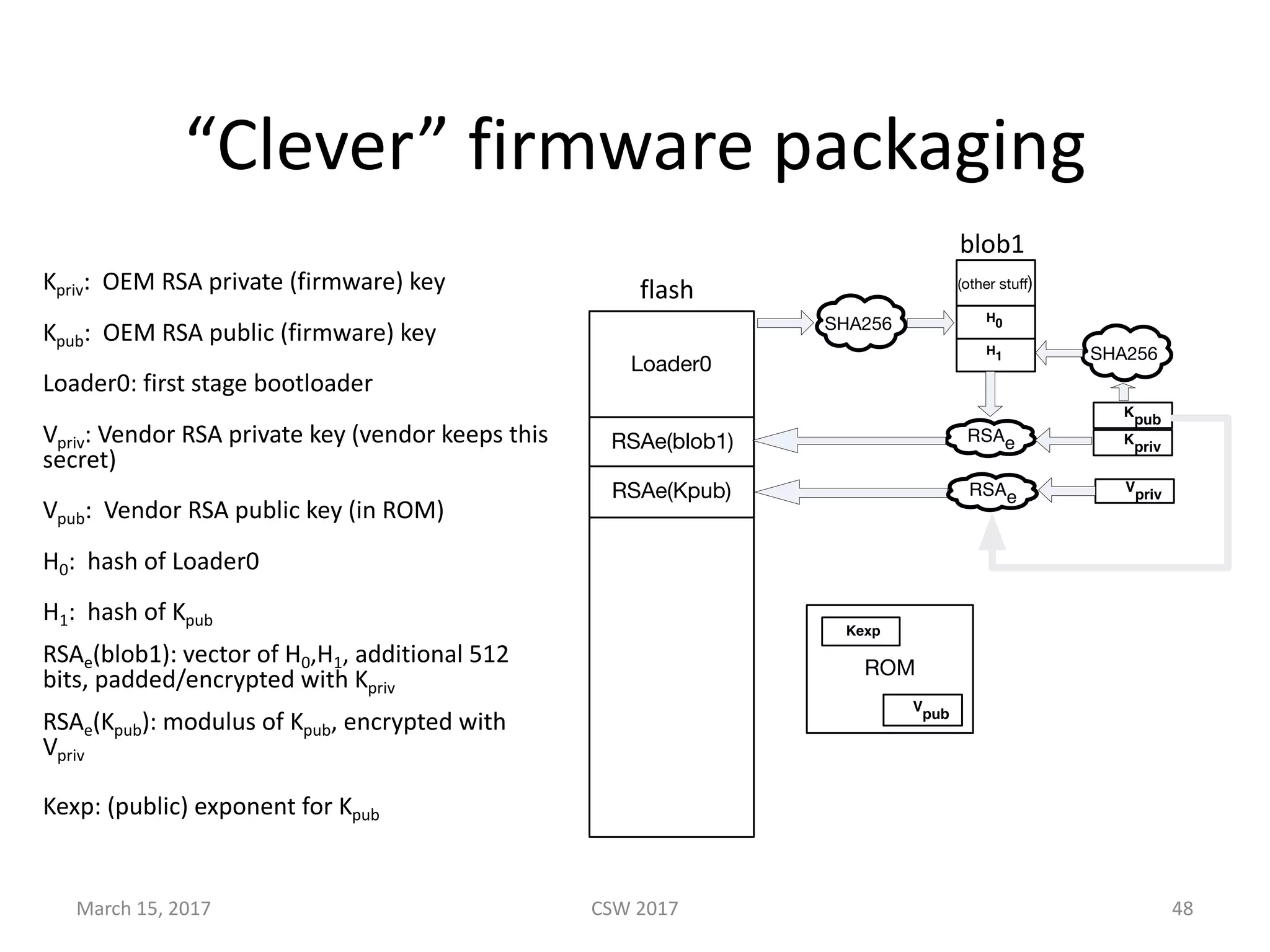
This	is	(more	or	less)	what	a	secure	boot	image	
typically	looks	like
Simple:	signature	is	appended,	stored	with	firmware
Firmware	element0 Digital	signature0
Firmware	element1 Digital	signature1
Firmware	element2 Digital	signature2
Firmware	elementn Digital	signaturen
:
:
March	15,	2017 47
“Clever”	firmware	packaging
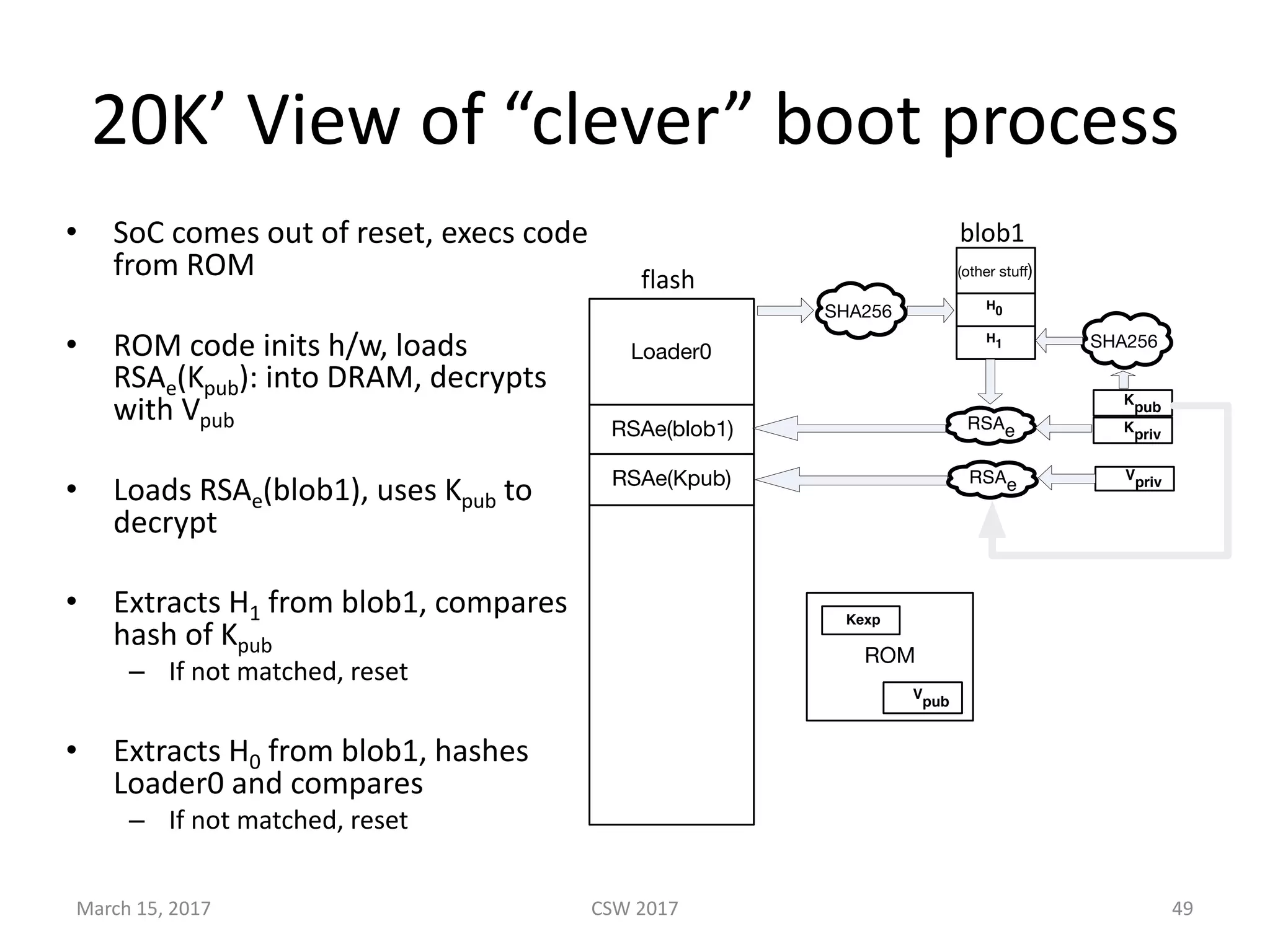
Kpriv:		OEM	RSA	private	(firmware)	key
Kpub:		OEM	RSA	public	(firmware)	key
Loader0:	first	stage	bootloader
Vpriv:	Vendor	RSA	private	key	(vendor	keeps	this	
secret)
Vpub:		Vendor	RSA	public	key	(in	ROM)
H0:		hash	of	Loader0
H1:		hash	of	Kpub
RSAe(blob1):	vector	of	H0,H1,	additional	512	
bits,	padded/encrypted	with	Kpriv
RSAe(Kpub):	modulus	of	Kpub,	encrypted	with	
Vpriv
Kexp:	(public)	exponent	for	Kpub
March	15,	2017 CSW	2017 48
Loader0
RSAe(blob1)
RSAe(Kpub)
SHA256
Kpub
H1
(other stuff)
H0
Kpriv
Vpriv
SHA256
RSAe
RSAe
ROM
Vpub
Kexp
blob1
flash
20K’	View	of	“clever”	boot	process
• SoC comes	out	of	reset,	execs	code	
from	ROM
• ROM	code	inits h/w,	loads	
RSAe(Kpub):	into	DRAM,	decrypts	
with	Vpub
• Loads	RSAe(blob1),	uses	Kpub to	
decrypt
• Extracts	H1 from	blob1,	compares	
hash	of	Kpub
– If	not	matched,	reset
• Extracts	H0 from	blob1,	hashes	
Loader0	and	compares
– If	not	matched,	reset
CSW	2017March	15,	2017 49
Loader0
RSAe(blob1)
RSAe(Kpub)
SHA256
Kpub
H1
(other stuff)
H0
Kpriv
Vpriv
SHA256
RSAe
RSAe
ROM
Vpub
blob1
flash
Kexp
It	just	feels wrong
• Why	aren’t	they	using	signatures?
– “encrypting”	instead,	and	with	private key
• No	padding	on	RSAe(Kpub)
– Numerous	papers	describe	related	attacks
• Decrypted	Kpub is	used	before it	is	verified
March	15,	2017 CSW	2017 50
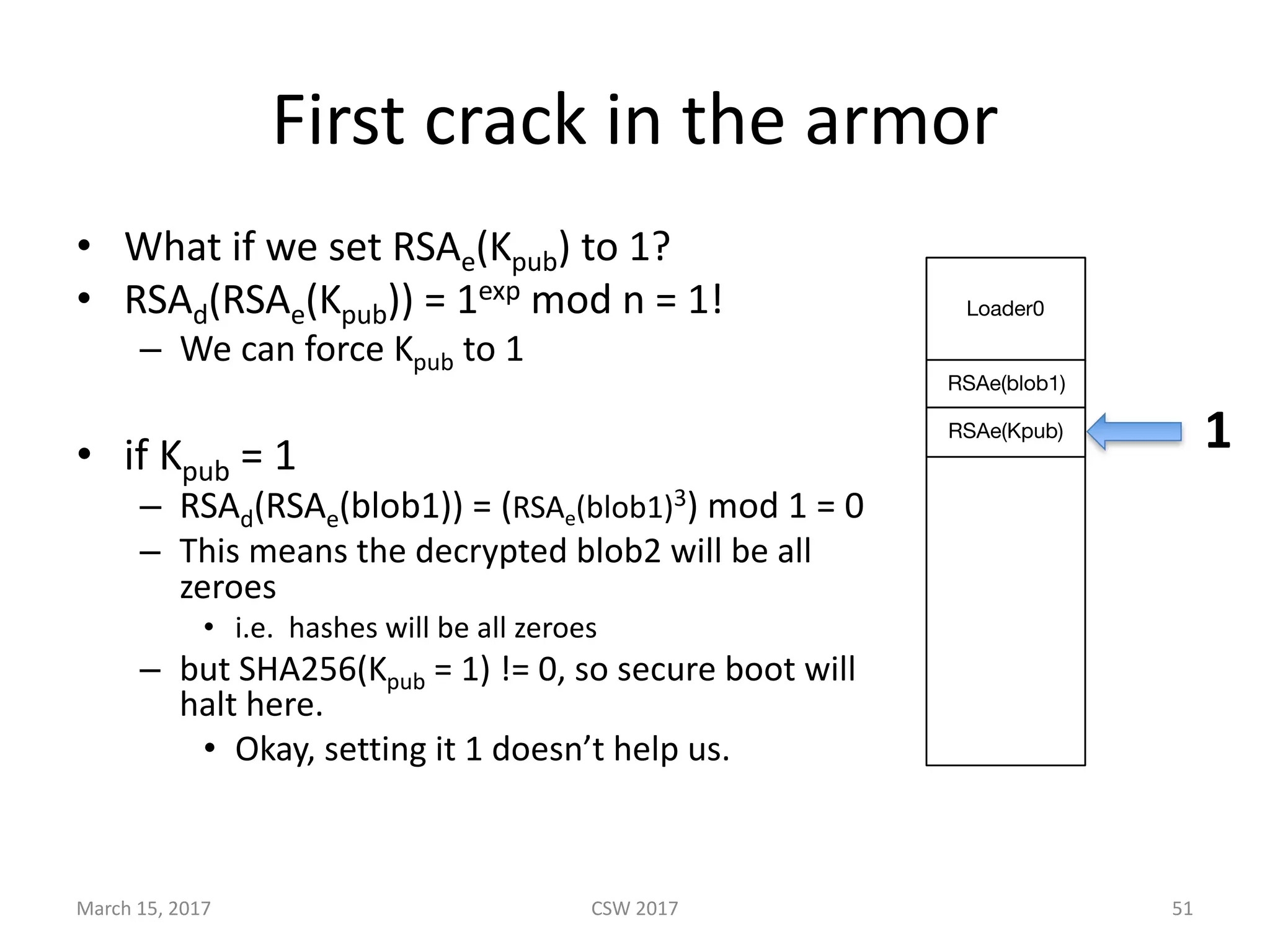
First	crack	in	the	armor
• What	if	we	set	RSAe(Kpub)	to	1?	
• RSAd(RSAe(Kpub))	=	1exp mod	n	=	1!
– We	can	force	Kpub to	1
• if	Kpub =	1	
– RSAd(RSAe(blob1))	=	(RSAe(blob1)3)	mod	1	=	0
– This	means	the	decrypted	blob2	will	be	all	
zeroes
• i.e.		hashes	will	be	all	zeroes
– but	SHA256(Kpub =	1)	!=	0,	so	secure	boot	will	
halt	here.
• Okay,	setting	it	1	doesn’t	help	us.
March	15,	2017 CSW	2017 51
Loader0
RSAe(blob1)
RSAe(Kpub) 1
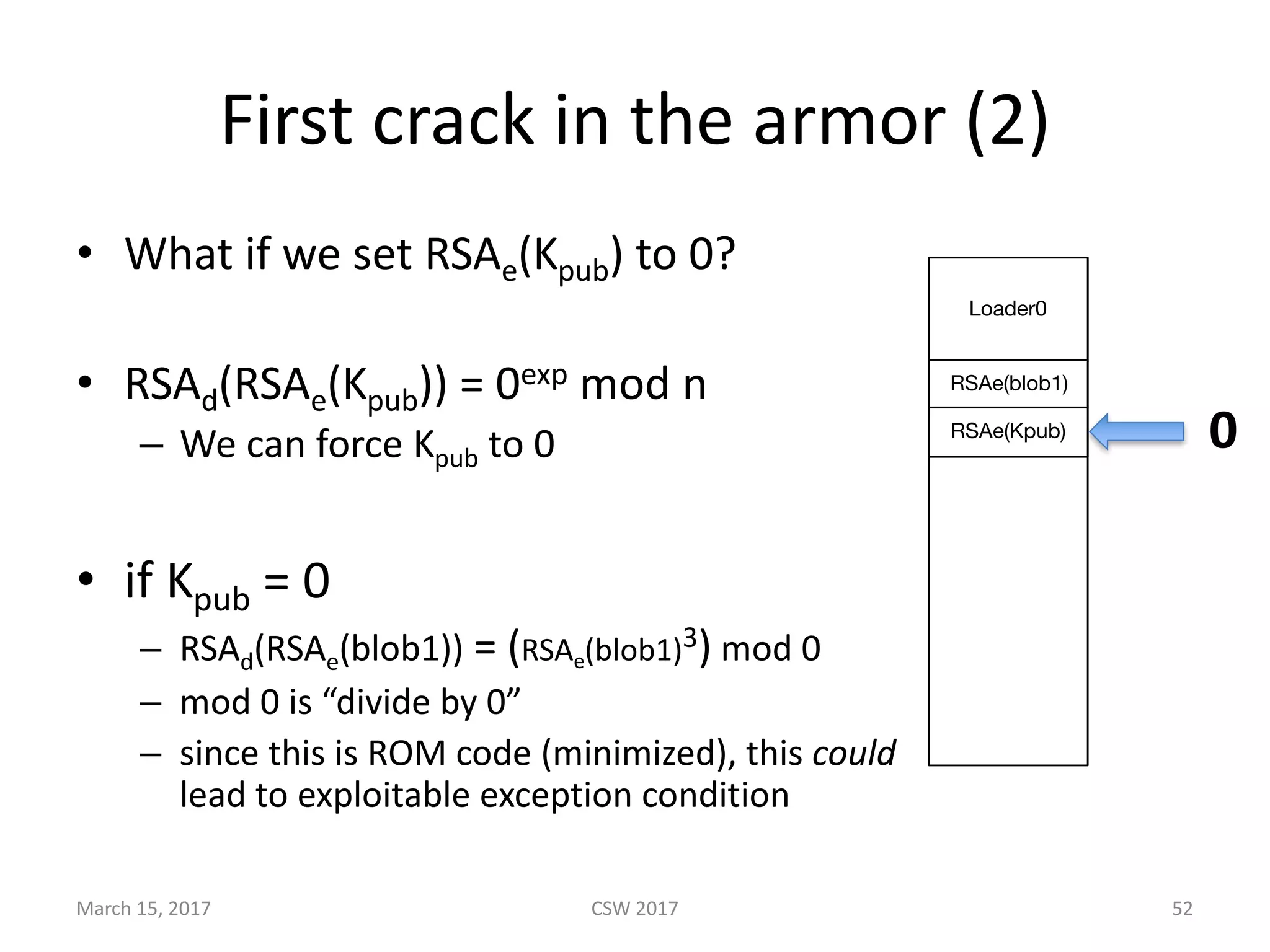
First	crack	in	the	armor	(2)
• What	if	we	set	RSAe(Kpub)	to	0?	
• RSAd(RSAe(Kpub))	=	0exp mod	n
– We	can	force	Kpub to	0
• if	Kpub =	0
– RSAd(RSAe(blob1)) =	(RSAe(blob1)3) mod	0	
– mod	0	is	“divide	by	0”
– since	this	is	ROM	code	(minimized),	this	could
lead	to	exploitable	exception	condition
March	15,	2017 CSW	2017 52
Loader0
RSAe(blob1)
RSAe(Kpub) 0
Any	other	options?
• 0/1	replacement	attack	seems	impractical
– Is	that	all	we’ve	got?
• No:
– ROM	code	will	decrypt	any RSAe(Kpub)	and	use	it
– This	is	a	decryption	oracle
• But	what	to	do	with	this?	
– We	need	to	understand	more	about	how/why	RSA	
works…
CSW	2017March	15,	2017 53
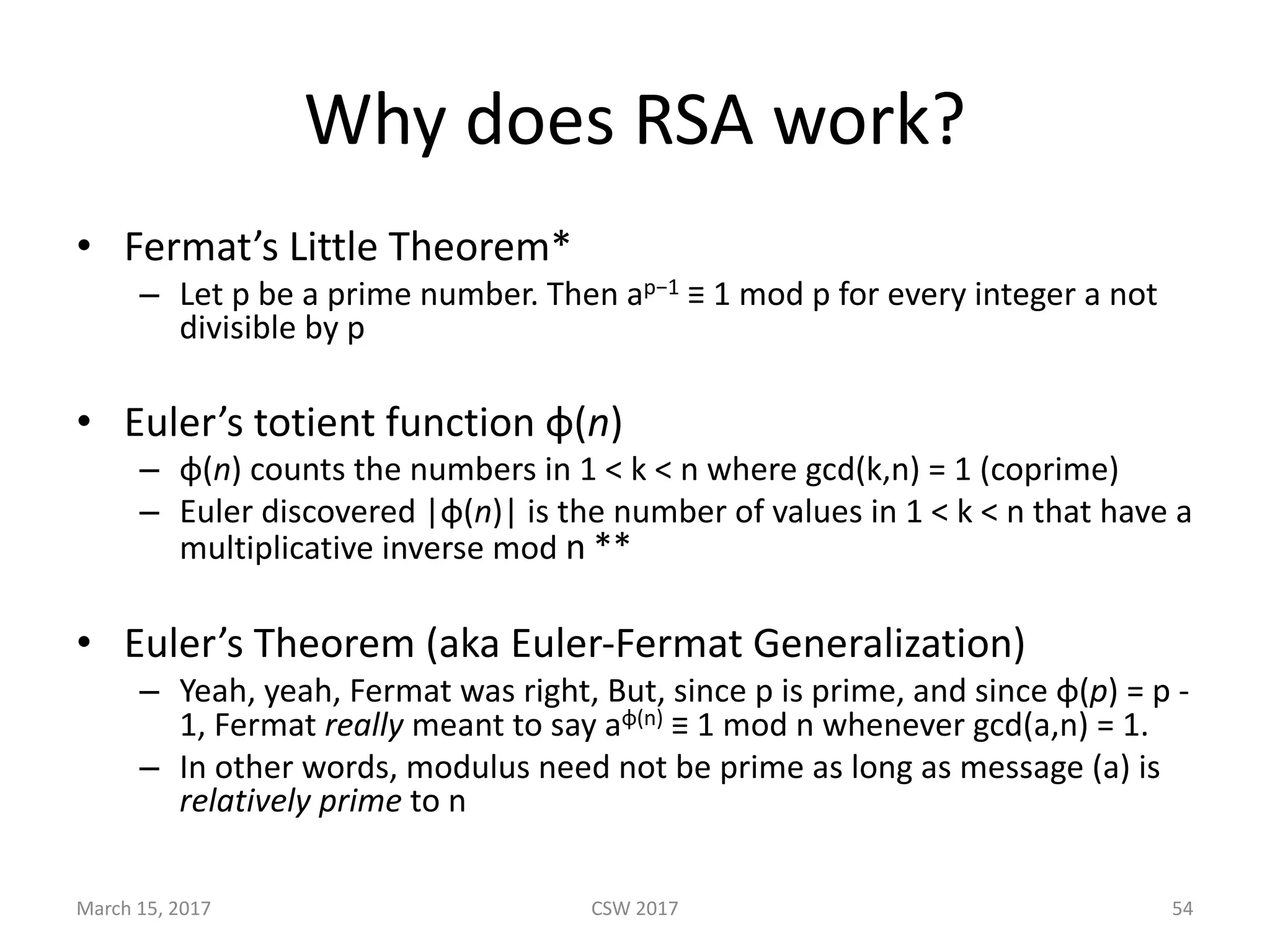
Why	does	RSA	work?
• Fermat’s	Little	Theorem*
– Let	p	be	a	prime	number.	Then	ap−1 ≡	1	mod	p	for	every	integer	a	not	
divisible	by	p	
• Euler’s	totient	function φ(n)
– φ(n)	counts	the	numbers	in	1	<	k	<	n	where	gcd(k,n)	=	1	(coprime)
– Euler	discovered	|φ(n)|	is	the	number	of	values	in	1	<	k	<	n	that	have	a	
multiplicative	inverse	mod	n **
• Euler’s	Theorem	(aka	Euler-Fermat	Generalization)
– Yeah,	yeah,	Fermat	was	right,	But,	since	p	is	prime,	and	since	φ(p)	=	p	-
1,	Fermat	really meant	to	say	aφ(n) ≡	1	mod	n	whenever	gcd(a,n)	=	1.
– In	other	words,	modulus	need	not	be	prime	as	long	as	message	(a)	is	
relatively	prime to	n
March	15,	2017 CSW	2017 54
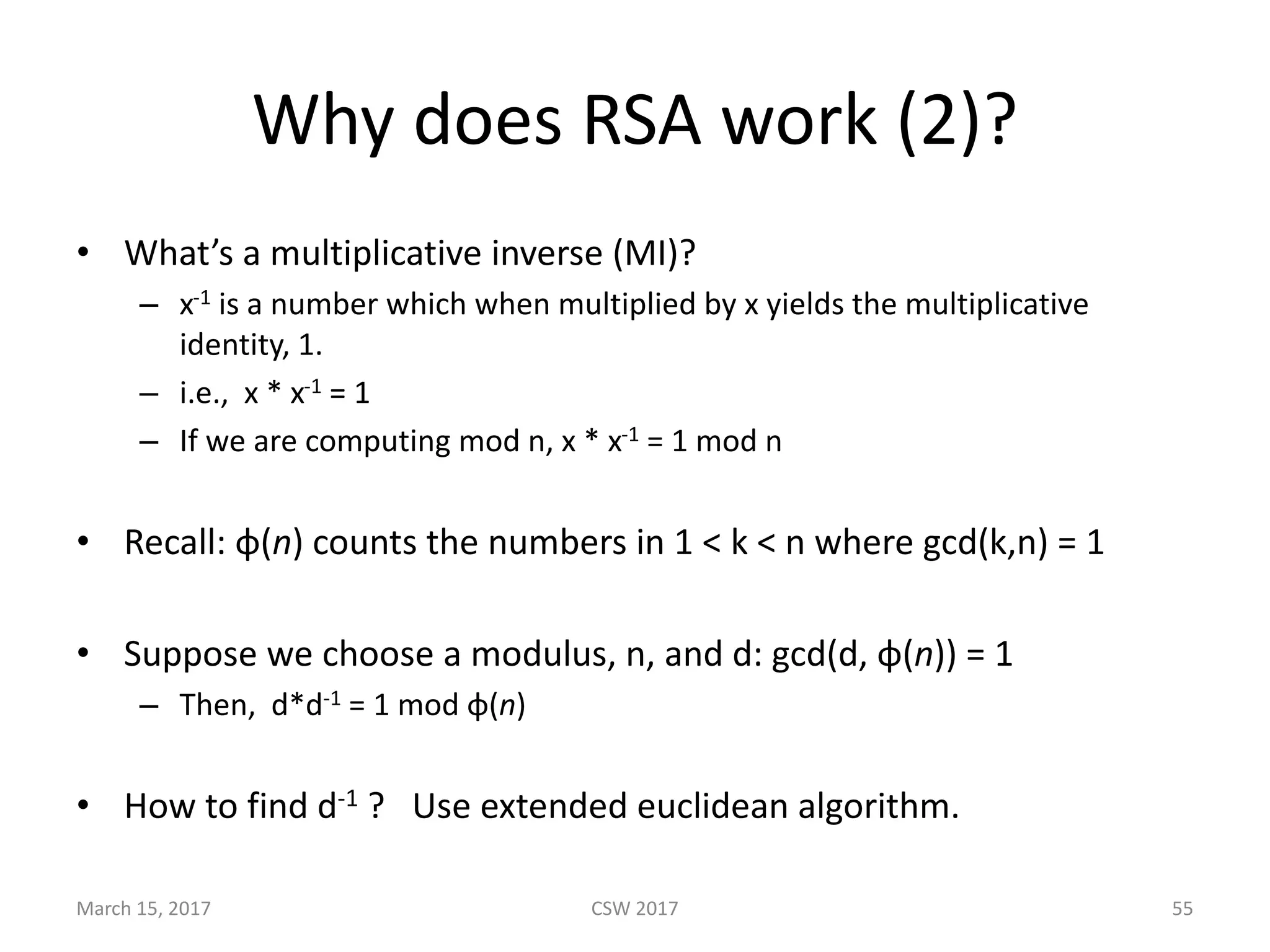
Why	does	RSA	work	(2)?
• What’s	a	multiplicative	inverse	(MI)?
– x-1 is	a	number	which	when	multiplied	by	x	yields	the	multiplicative	
identity,	1.
– i.e.,		x	*	x-1 =	1
– If	we	are	computing	mod	n,	x	*	x-1 =	1	mod	n	
• Recall:	φ(n)	counts	the	numbers	in	1	<	k	<	n	where	gcd(k,n)	=	1
• Suppose	we	choose	a	modulus,	n,	and	d:	gcd(d, φ(n))	=	1
– Then,		d*d-1 =	1	mod	φ(n)
• How	to	find	d-1 ?			Use	extended	euclidean	algorithm.
CSW	2017March	15,	2017 55
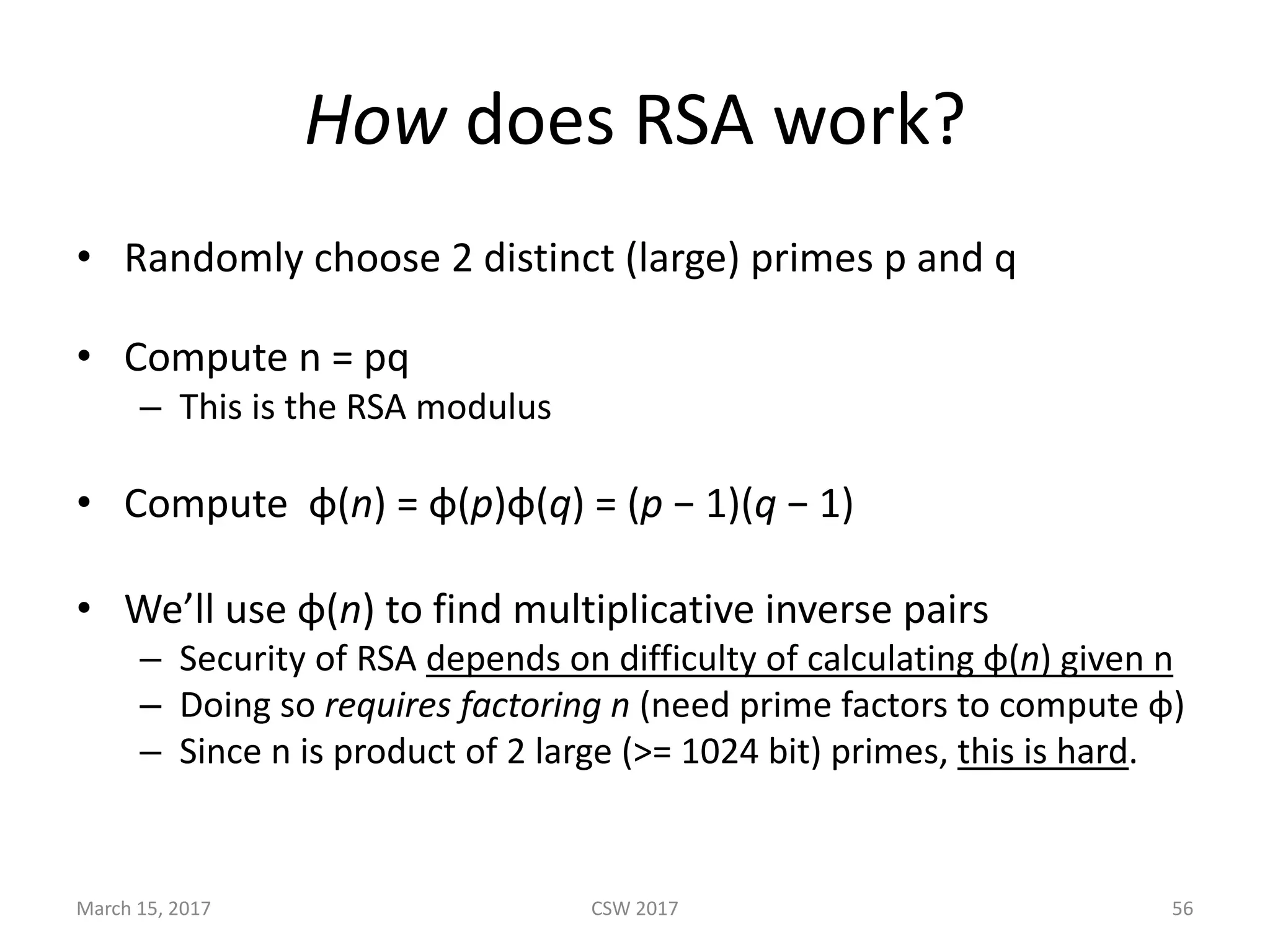
How does	RSA	work?
• Randomly	choose	2	distinct	(large)	primes	p	and	q
• Compute	n	=	pq
– This	is	the	RSA	modulus
• Compute	 φ(n)	=	φ(p)φ(q)	=	(p −	1)(q −	1)
• We’ll	use	φ(n)	to	find	multiplicative	inverse	pairs
– Security	of	RSA	depends	on	difficulty	of	calculating	φ(n)	given	n
– Doing	so	requires	factoring	n	(need	prime	factors	to	compute	φ)
– Since	n	is	product	of	2	large	(>=	1024	bit)	primes,	this	is	hard.
March	15,	2017 CSW	2017 56
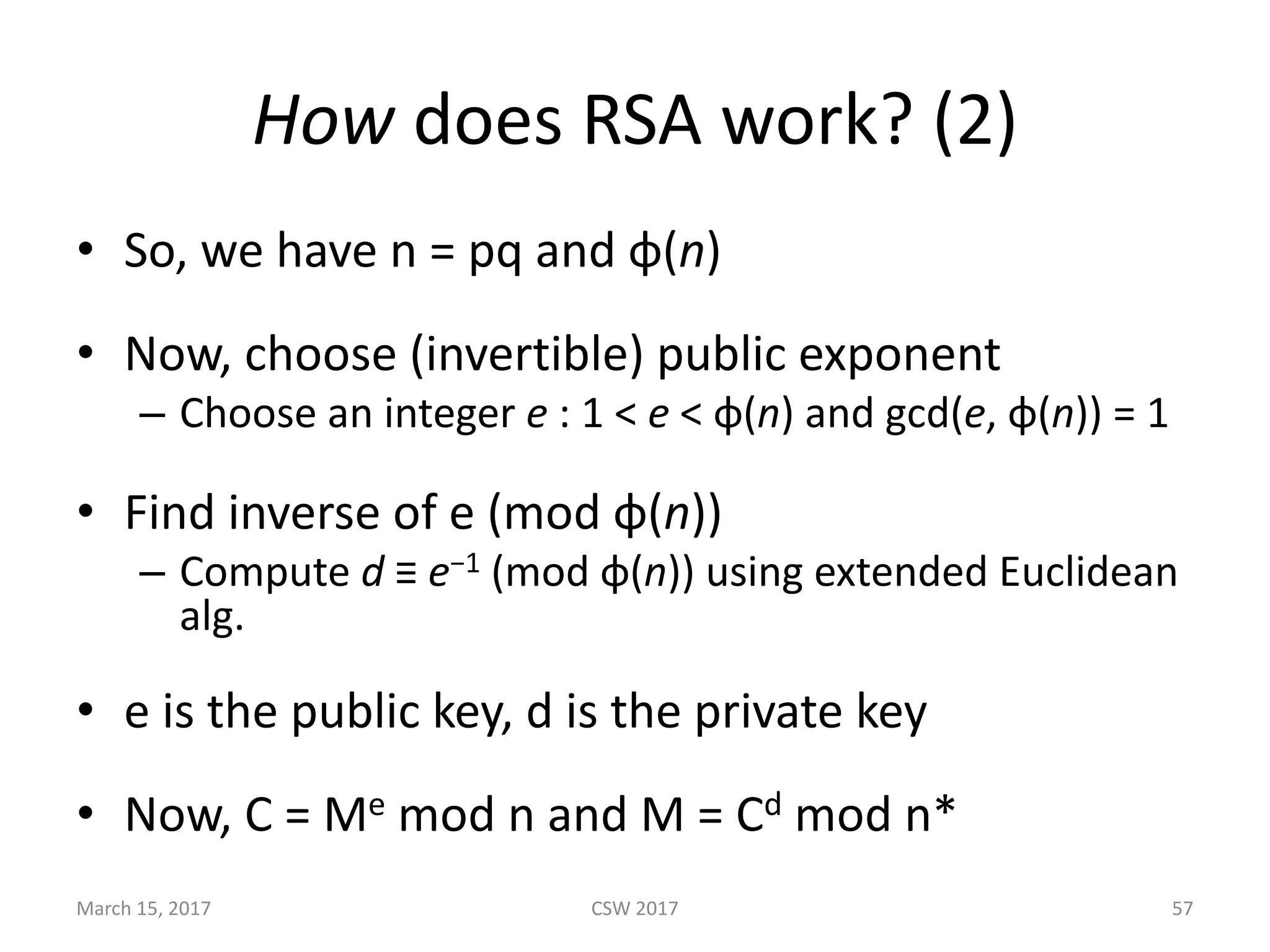
How does	RSA	work?	(2)
• So,	we	have	n	=	pq	and	φ(n)
• Now,	choose	(invertible)	public	exponent
– Choose	an	integer e : 1	< e <	φ(n) and gcd(e,	φ(n))	=	1
• Find	inverse	of	e	(mod	φ(n))
– Compute	d ≡ e−1 (mod	φ(n))	using	extended	Euclidean	
alg.
• e	is	the	public	key,	d	is	the	private	key
• Now,	C	=	Me mod	n	and	M	=	Cd mod	n*
March	15,	2017 CSW	2017 57
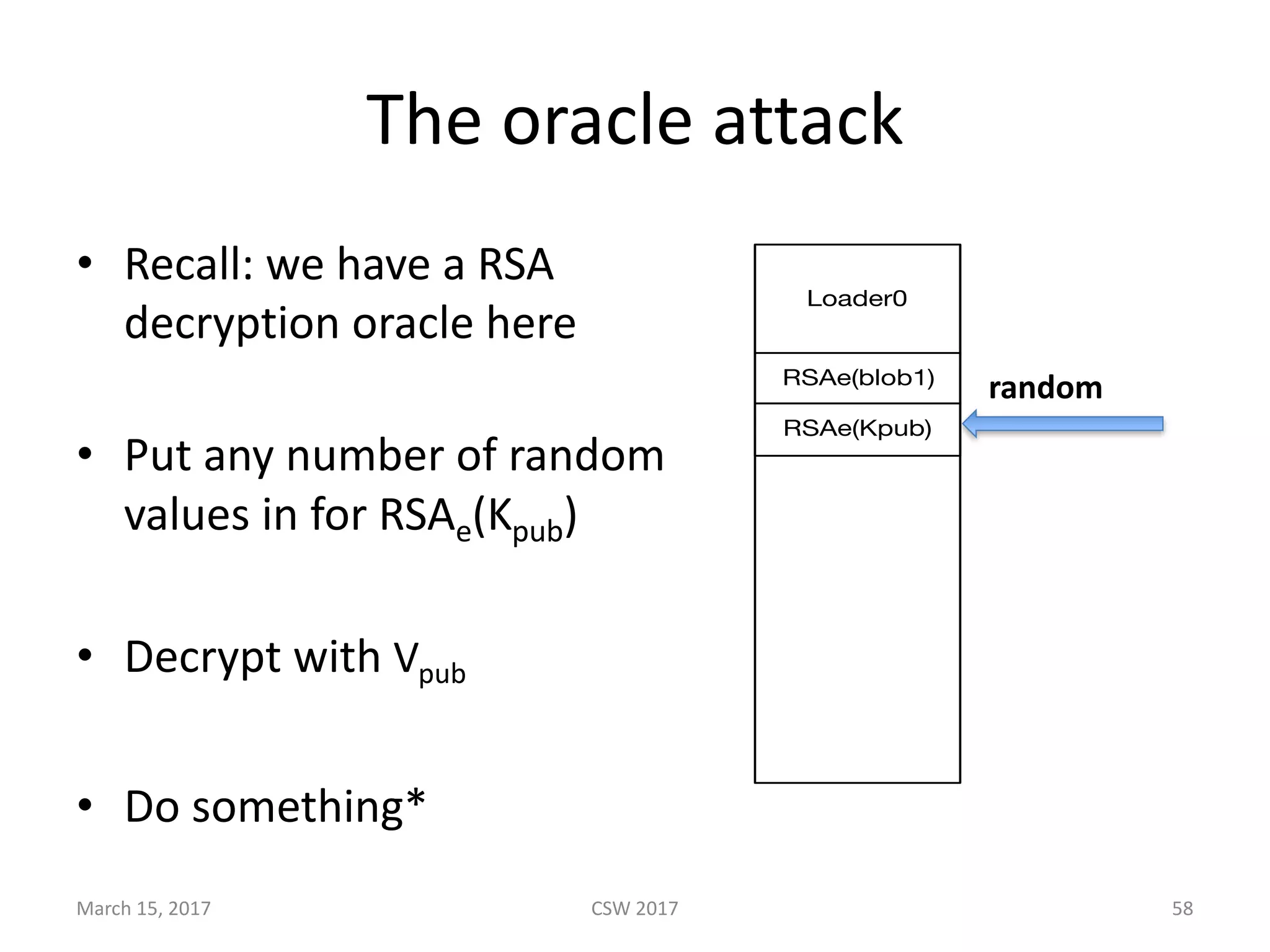
The	oracle	attack
• Recall:	we	have	a	RSA	
decryption	oracle	here
• Put	any	number	of	random	
values	in	for	RSAe(Kpub)
• Decrypt	with	Vpub
• Do	something*
March	15,	2017 CSW	2017 58
Loader0
RSAe(blob1)
RSAe(Kpub)
random
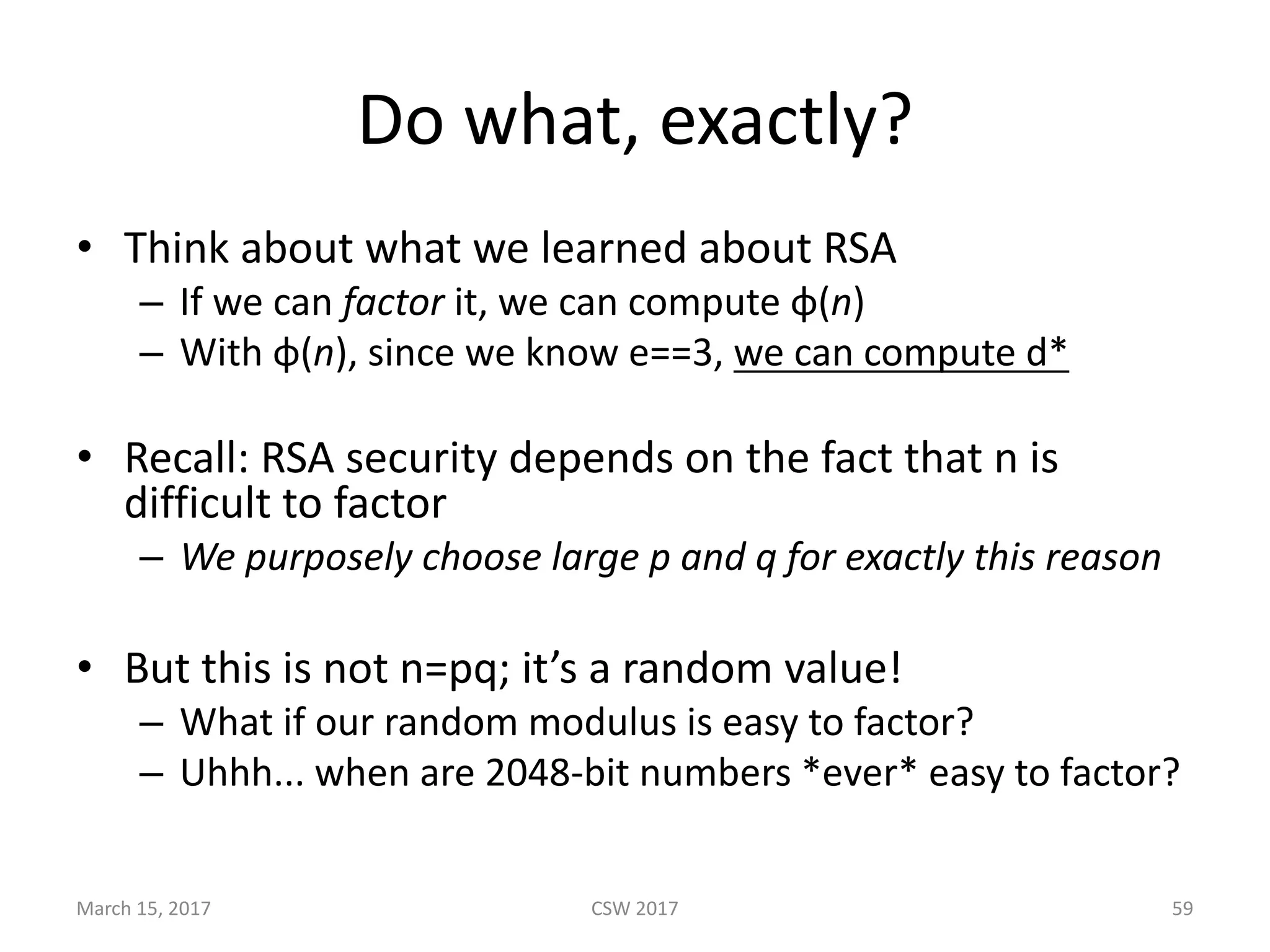
Do	what,	exactly?
• Think	about	what	we	learned	about	RSA
– If	we	can	factor it,	we	can	compute	φ(n)
– With	φ(n),	since	we	know	e==3,	we	can	compute	d*
• Recall:	RSA	security	depends	on	the	fact	that	n	is	
difficult	to	factor
– We	purposely	choose	large	p	and	q	for	exactly	this	reason
• But	this	is	not	n=pq;	it’s	a	random	value!
– What	if	our	random	modulus	is	easy	to	factor?
– Uhhh...	when	are	2048-bit	numbers	*ever*	easy	to	factor?
March	15,	2017 CSW	2017 59
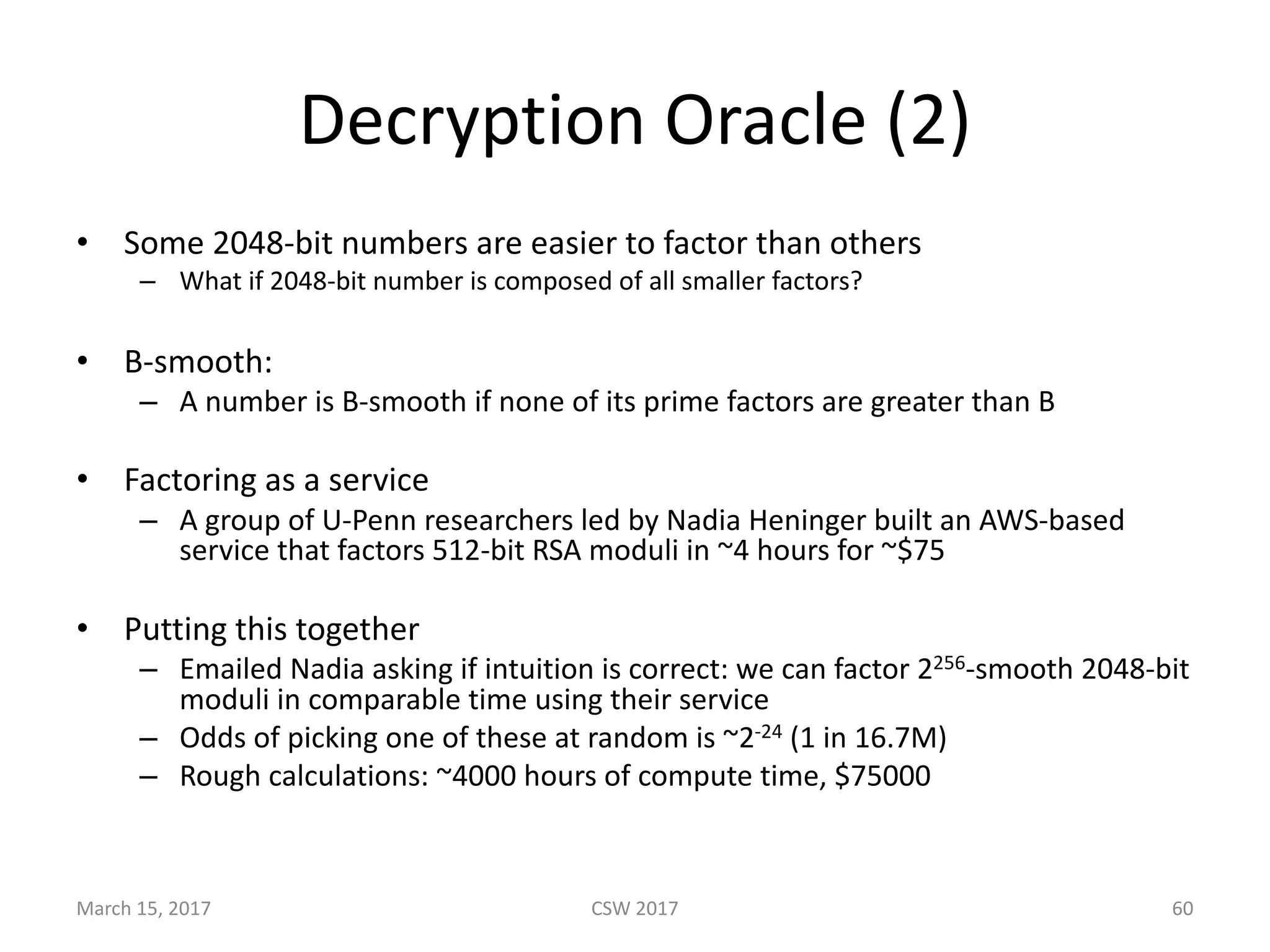
Decryption	Oracle	(2)
• Some	2048-bit	numbers	are	easier	to	factor	than	others
– What	if	2048-bit	number	is	composed	of	all	smaller	factors?
• B-smooth:
– A	number	is	B-smooth	if	none	of	its	prime	factors	are	greater	than	B	
• Factoring	as	a	service
– A	group	of	U-Penn	researchers	led	by	Nadia	Heninger built	an	AWS-based	
service	that	factors	512-bit	RSA	moduli	in	~4	hours	for	~$75
• Putting	this	together
– Emailed	Nadia	asking	if	intuition	is	correct:	we	can	factor	2256-smooth	2048-bit	
moduli	in	comparable	time	using	their	service
– Odds	of	picking	one	of	these	at	random	is	~2-24 (1	in	16.7M)
– Rough	calculations:	~4000	hours	of	compute	time,	$75000
March	15,	2017 CSW	2017 60
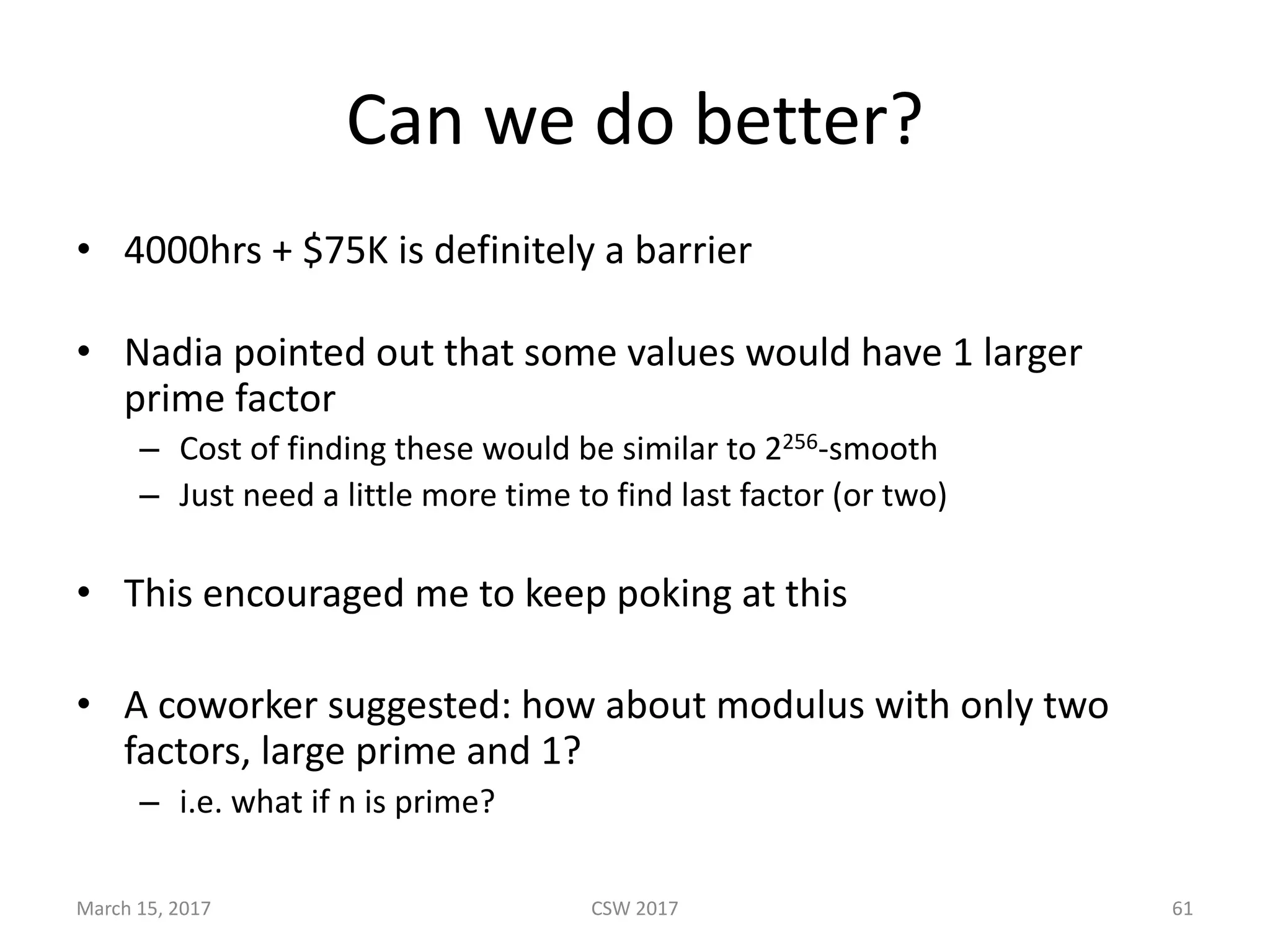
Can	we	do	better?
• 4000hrs	+	$75K	is	definitely	a	barrier
• Nadia	pointed	out	that	some	values	would	have	1	larger	
prime	factor
– Cost	of	finding	these	would	be	similar	to	2256-smooth	
– Just	need	a	little	more	time	to	find	last	factor	(or	two)	
• This	encouraged	me	to	keep	poking	at	this
• A	coworker	suggested:	how	about	modulus	with	only	two	
factors,	large	prime	and	1?
– i.e.	what	if	n	is	prime?
CSW	2017March	15,	2017 61
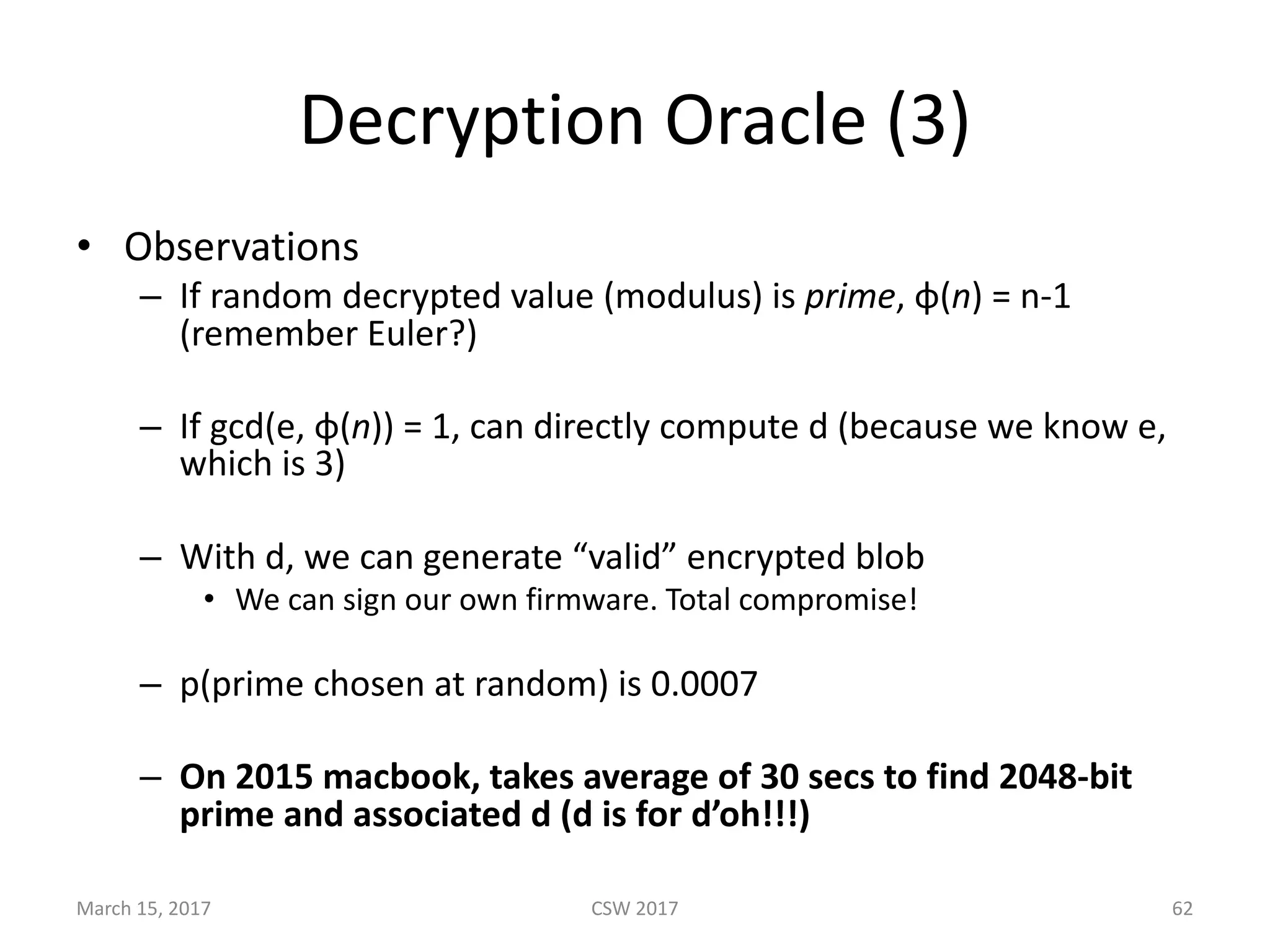
Decryption	Oracle	(3)
• Observations
– If	random	decrypted	value	(modulus) is	prime, φ(n)	=	n-1	
(remember	Euler?)	
– If	gcd(e,	φ(n))	=	1,	can	directly	compute	d	(because	we	know	e,	
which	is	3)
– With	d,	we	can	generate	“valid”	encrypted	blob
• We	can	sign	our	own	firmware.	Total	compromise!
– p(prime	chosen	at	random)	is	0.0007
– On	2015	macbook,	takes	average	of	30	secs	to	find	2048-bit	
prime	and	associated	d	(d	is	for	d’oh!!!)
March	15,	2017 CSW	2017 62
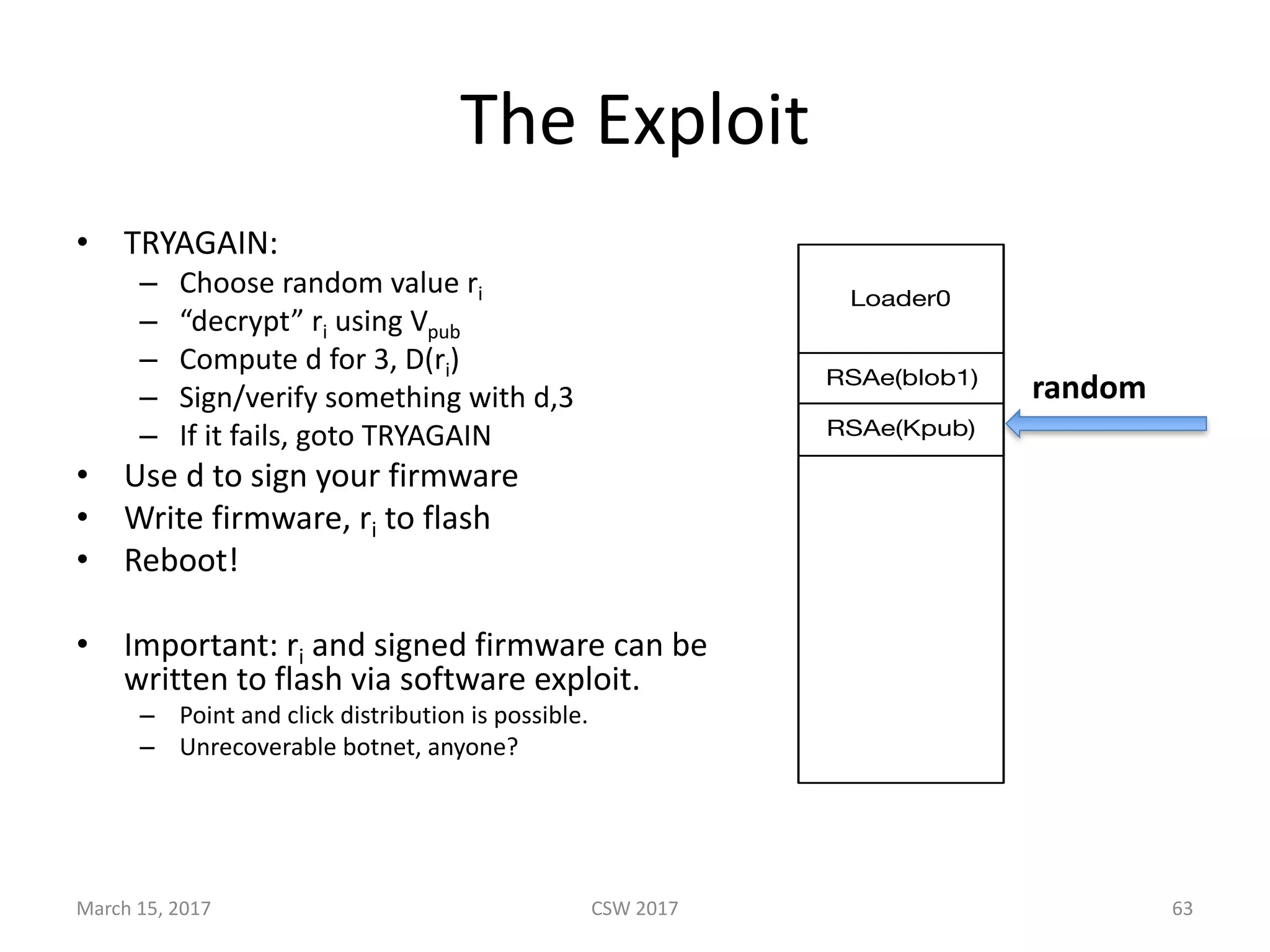
The	Exploit
• TRYAGAIN:
– Choose	random	value	ri
– “decrypt”	ri using	Vpub
– Compute	d	for	3,	D(ri)
– Sign/verify	something	with	d,3
– If	it	fails,	goto TRYAGAIN
• Use	d	to	sign	your	firmware		
• Write	firmware,	ri to	flash
• Reboot!
• Important:	ri and	signed	firmware	can	be	
written	to	flash	via	software	exploit.
– Point	and	click	distribution	is	possible.
– Unrecoverable	botnet,	anyone?
March	15,	2017 CSW	2017 63
Loader0
RSAe(blob1)
RSAe(Kpub)
random
Wrap	up
• IoT devices	are	cannon	fodder	due	to	lack	of	
secure	boot
• Security	is	hard.	Cryptography	is	harder.
– Do	it	by	the	book!	Don’t	try	to	be	clever!
• We	really need	a	solution	for	the	IoT
insecurity	problem.	Think	about	it.
March	15,	2017 CSW	2017 64
Acknowledgements
• Nadia	Heninger
– Her	research	pointed	me	in	the	right	direction,	
and	her	suggestions	nudged	me	toward	the	
solution
• Filip	Paun
– His	RSA	knowledge	and	insight	were	instrumental	
in	taking	the	exploit	from	4hrs/$75K	to	<	30	secs
March	15,	2017 CSW	2017 65
backup
March	15,	2017 CSW	2017 66
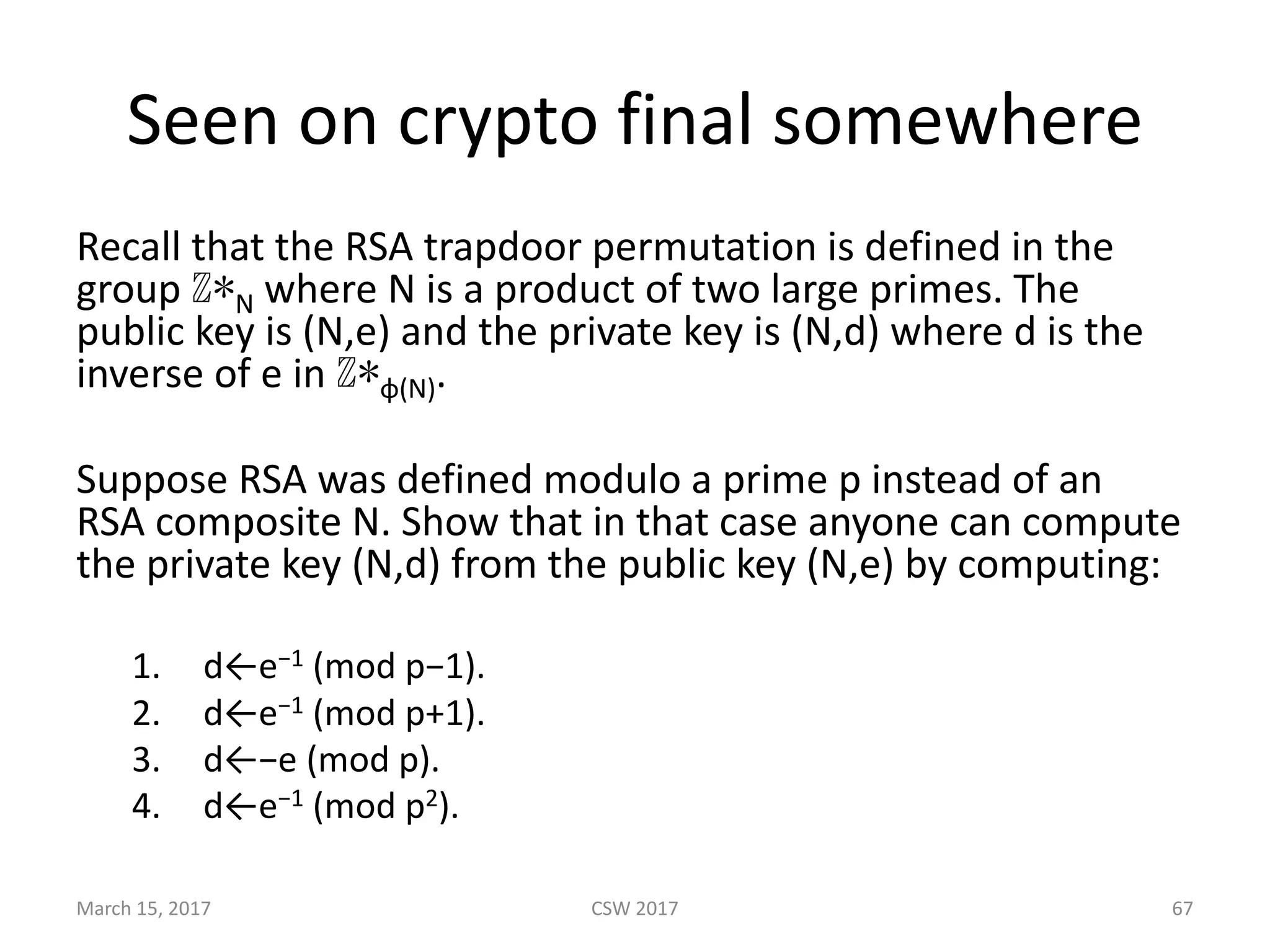
Seen	on	crypto	final	somewhere
Recall	that	the	RSA	trapdoor	permutation	is	defined	in	the	
group ℤ∗N where N is	a	product	of	two	large	primes.	The	
public	key	is (N,e) and	the	private	key	is (N,d)	where d is	the	
inverse	of e in ℤ∗φ(N).
Suppose	RSA	was	defined	modulo	a	prime p instead	of	an	
RSA composite N.	Show	that	in	that	case	anyone	can	compute	
the	private key (N,d) from	the	public	key (N,e) by	computing:
1. d←e−1 (mod	p−1).
2. d←e−1 (mod	p+1).
3. d←−e (mod	p).
4. d←e−1 (mod	p2).
March	15,	2017 CSW	2017 67
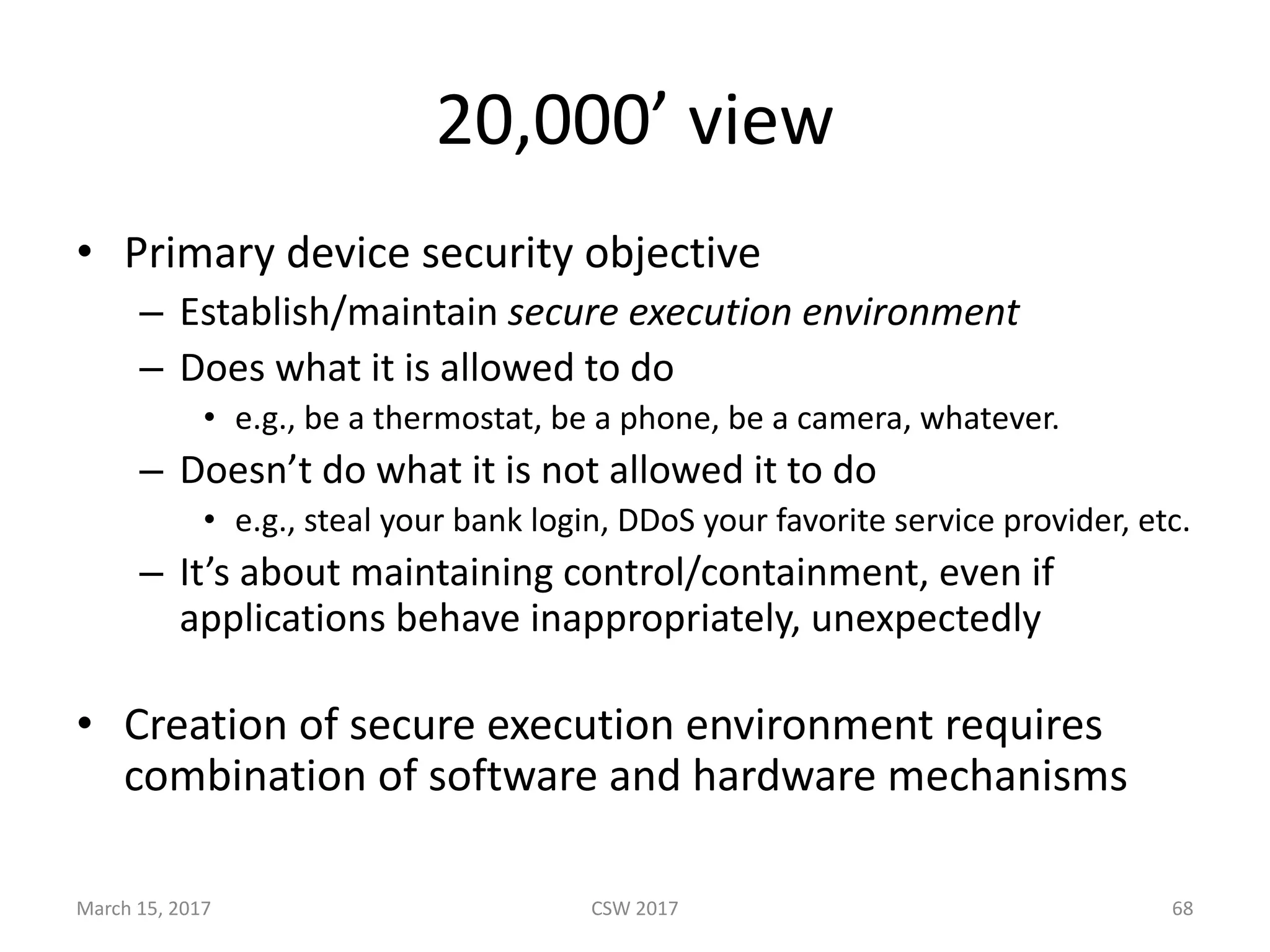
20,000’	view
• Primary	device	security	objective
– Establish/maintain	secure	execution	environment
– Does	what	it	is	allowed	to	do
• e.g.,	be	a	thermostat,	be	a	phone,	be	a	camera,	whatever.
– Doesn’t	do	what	it	is	not	allowed	it	to	do
• e.g.,	steal	your	bank	login,	DDoS	your	favorite	service	provider,	etc.
– It’s	about	maintaining	control/containment,	even	if	
applications	behave	inappropriately,	unexpectedly
• Creation	of	secure	execution	environment	requires	
combination	of	software	and	hardware	mechanisms
CSW	2017March	15,	2017 68
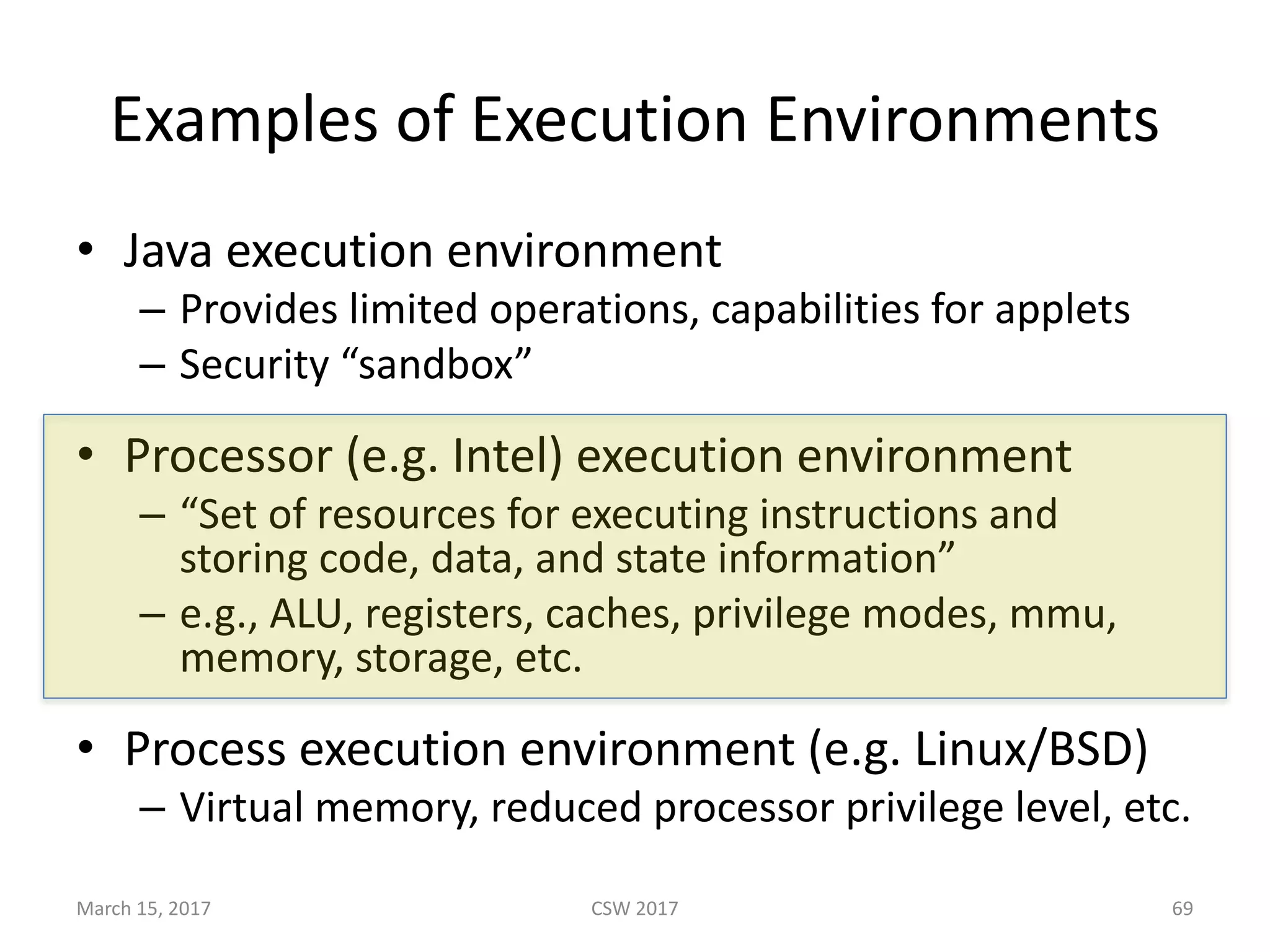
Examples	of	Execution	Environments
• Java	execution	environment
– Provides	limited	operations,	capabilities	for	applets
– Security	“sandbox”
• Processor	(e.g.	Intel)	execution	environment
– “Set	of	resources	for	executing	instructions	and	
storing	code,	data,	and	state	information”	
– e.g.,	ALU,	registers,	caches,	privilege	modes,	mmu,	
memory,	storage,	etc.
• Process	execution	environment	(e.g.	Linux/BSD)
– Virtual	memory,	reduced	processor	privilege	level,	etc.
CSW	2017March	15,	2017 69
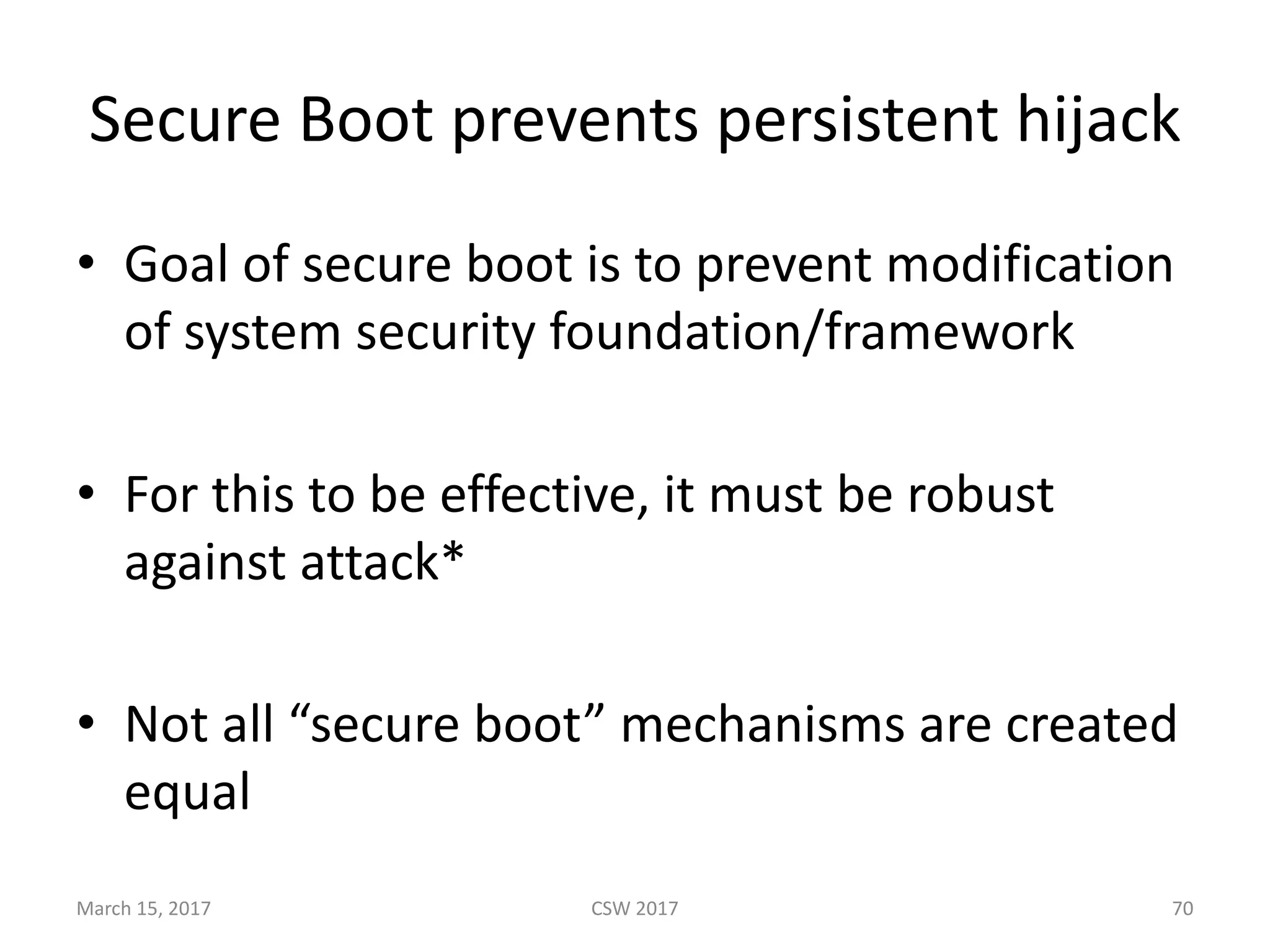
Secure	Boot	prevents	persistent	hijack
• Goal	of	secure	boot	is	to	prevent	modification	
of	system	security	foundation/framework
• For	this	to	be	effective,	it	must	be	robust	
against	attack*
• Not	all	“secure	boot”	mechanisms	are	created	
equal
March	15,	2017 CSW	2017 70
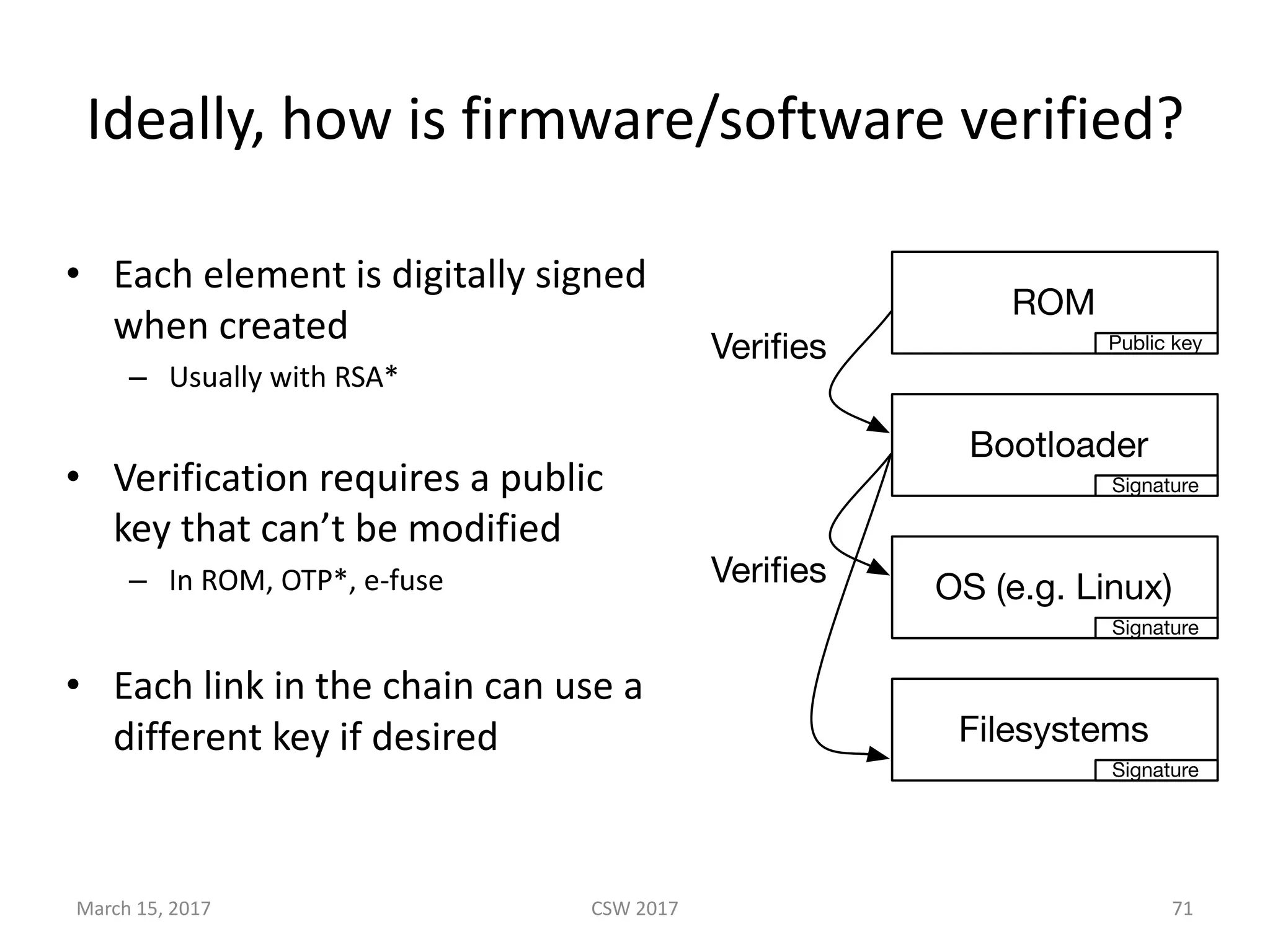
Ideally,	how	is	firmware/software	verified?
• Each	element	is	digitally	signed	
when	created
– Usually	with	RSA*
• Verification	requires	a	public	
key	that	can’t	be	modified
– In	ROM,	OTP*,	e-fuse
• Each	link	in	the	chain	can	use	a	
different	key	if	desired
ROM
Bootloader
OS (e.g. Linux)
Filesystems
Public key
Signature
Signature
Signature
Verifies
Verifies
March	15,	2017 CSW	2017 71
Signature
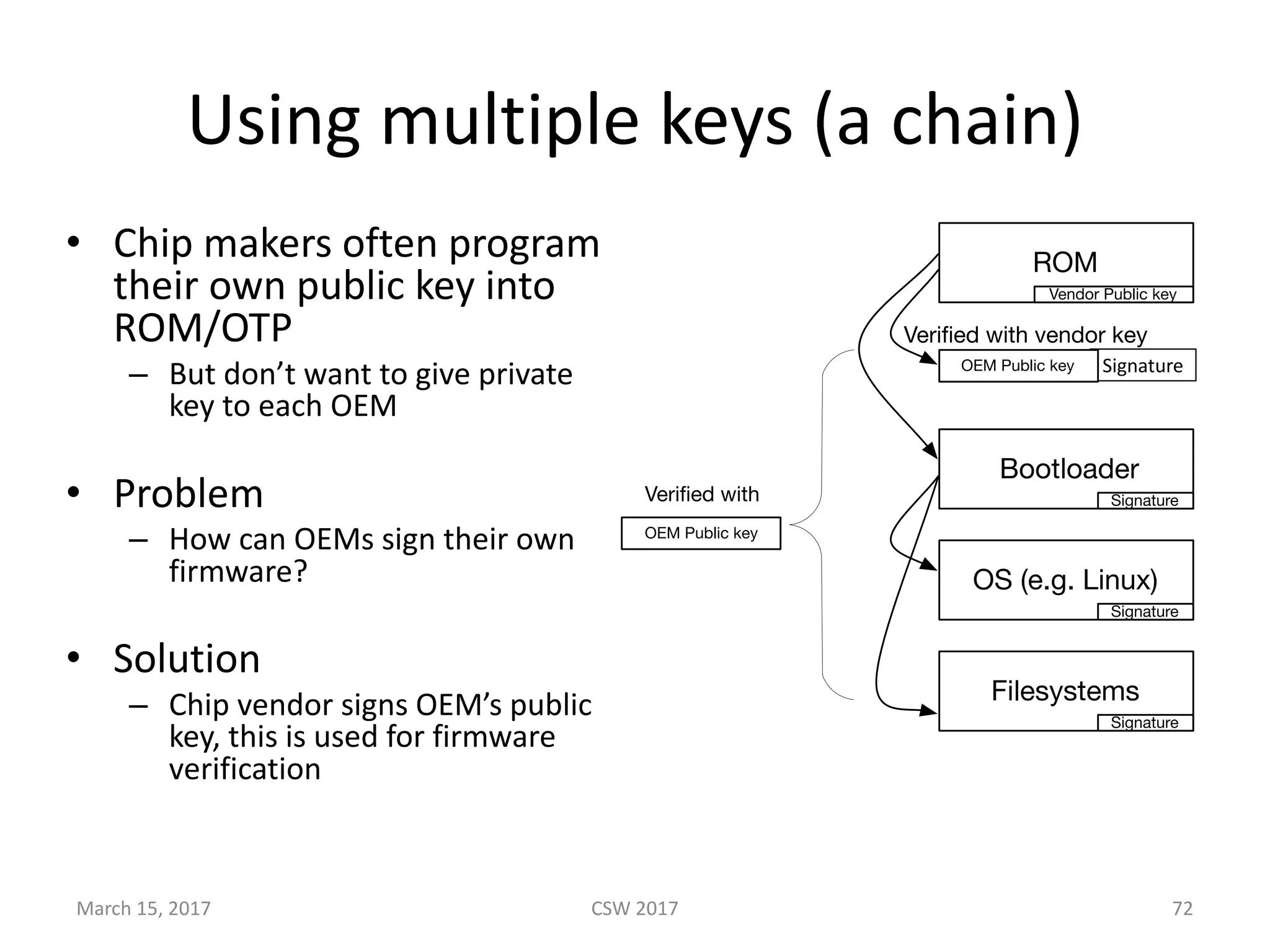
Using	multiple	keys	(a	chain)
• Chip	makers	often	program	
their	own	public	key	into	
ROM/OTP
– But	don’t	want	to	give	private	
key	to	each	OEM
• Problem
– How	can	OEMs	sign	their	own	
firmware?
• Solution
– Chip	vendor	signs	OEM’s	public	
key,	this	is	used	for	firmware	
verification
ROM
Bootloader
OS (e.g. Linux)
Filesystems
Vendor Public key
Signature
Signature
Signature
Verified with vendor key
OEM Public key
Verified with
OEM Public key
March	15,	2017 CSW	2017 72
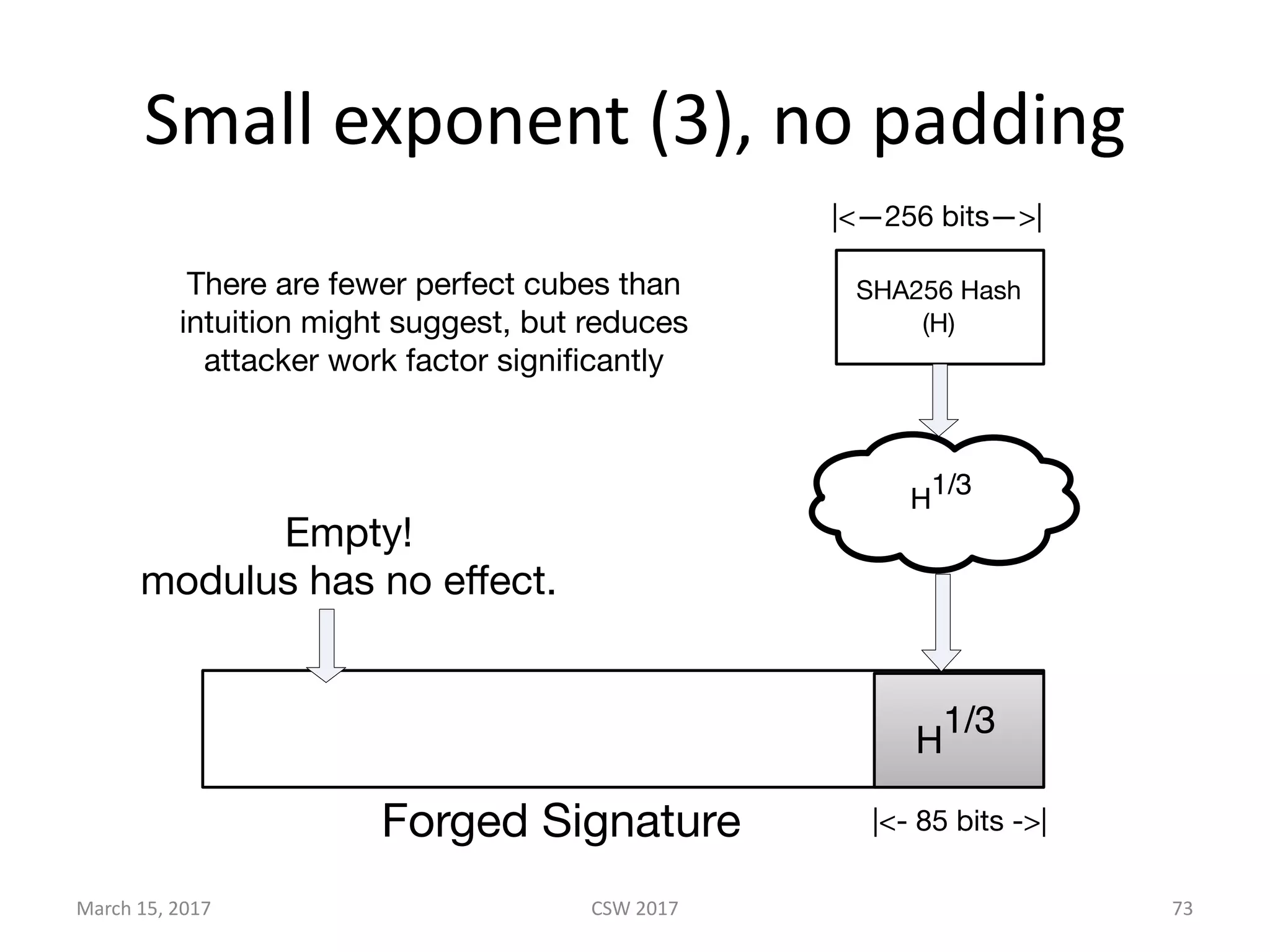
Small	exponent	(3),	no	padding
March	15,	2017 CSW	2017 73
There are fewer perfect cubes than
intuition might suggest, but reduces
attacker work factor significantly
Forged Signature
SHA256 Hash
(H)
H1/3
|<—256 bits—>|
Empty!
modulus has no effect.
H
1/3
|<- 85 bits ->|
Secure	Initialization	is	Essential
• Assuming	all	essential	security	hardware	building	blocks	are	
present,	everything else	depends	on	secure	system	
initialization
– System	must	boot	into	secure	state
– Implies	boot	process	is	secured	from	power-on
• Secure	boot	design/implementation	is	one	of	the	things	I	
consult	on
– Sometimes	I	find	issues.	
– Usually,	they	can	be	fixed.	Sometimes,	they	cannot.
• That’s	what	this	talk	is	about.
CSW	2017March	15,	2017 74
Actual	symmetric	key	hacks
• Asus	SBK
– Asus	EEE	Transformer	Tablet	used	symmetric	AES	key	to	validate	bootloader,	
image	(SBK)
– Key	is	well	protected	within	system,	but	it	was	leaked	by	insider	(they	since	
changed	SBK)
– http://www.overclock.net/t/1037242/twitter-asus-transformer-secure-boot-
key
– But	they	continued	to	use	symmetric	key.
• Samsung	CMAC	key
– Various	Samsung	DTV/BDP	devices	use	symmetric	key	to	validate	bootloader,	
Linux	image,	root	filesystem
– Key	is	not well	protected	within	system
– Attackers	root	device,	directly	read	key.
– https://forum.samygo.tv/search.php?keywords=cmac&sid=089fdff1a665f34db
5fcf143f213c3c7
March	15,	2017 CSW	2017 75

CSW2017 Scott kelly secureboot-csw2017-v1