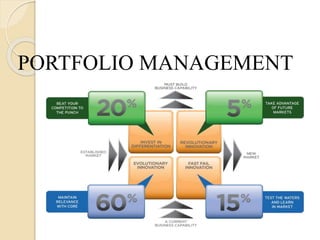
PORTFOLIO MANAGEMENT
VEDAPRADHA.R
PORTFOLIO MANAGEMENT
MEANING OF INVESTMENT
Portfolio management
refers to process of
planning, organising,
directing, co-ordinating &
controlling of various
portfolios.
STEPS
1. Determining investment objectives and
policy
2. Correlation coefficient and risk of
portfolio
3. Beta as measure of risk
4. Security analysis
5. Construction of portfolio
6. Portfolio rebalancing
7. Portfolio evaluation
MARKOWITZ MODEL
 Assumptions:
 Market is efficient and all investors have knowledge about the stock
market.
 All investors have common goal and they are risk averse.
 Investors like to earn maximum rate or return on their investment.
 Rate of return and SD are important parameters for the investment
decision.
 By combining assets, risk can be minimised and return can be
maximised.
 Higher the risk, higher the returns
 Investor should be able to get higher returns for each level of risk
by determining the optimal sets of portfolios.
Limitations of Markowitz model
To identify optimal set of portfolio,
the approach demands lot of input
data and computation.
The analysts are accustomed to
think about expected rate of
return and are usually not used to
estimate co-variance of return
among assets.
SHARPE’S SINGLE INDEX MODEL
 Assumptions:
 Stock prices move the market index
 When the Sensex increases, stock prices also tend to
increase and vice versa.
 Some underlying factors affect the market index as well as
the stock prices.
 Stock prices are related to the market index and this
relationship could be used to estimate the return on stock.
 There is only one macro-economic facto that cause the
systematic risk affecting all stock returns and this factor is
represented by the rate of return on a market index.
JENSEN MODEL
 Michael Jensen has developed method, which is
based on differential returns and is known as
Jensen’s Ratio. The differential return is the return
that has been earned over and above this return. It
gives an indication that how well the portfolio has
performed. The differential return is Alpha.
 Ratio measures the difference between the actual
return of a portfolio and expected return of a
portfolio in view of the risk of the portfolio.
 It is based on the CAPM.
 Positive alpha – out performed, negative alpha-
underperformed, 0 =expected.
TREYNOR’S MODEL
Jack Treynor developed a ratio in 1965
known as Volatility ratio. The total risk
consists of two components systematic
and unsystematic risk. A well diversified
portfolio like mutual; fund, the relevant
risk is systematic risk. This ratio measures
excess risk over the risk free return per
unit of systematic risk. Systematic risk is
measured by beta of the portfolio.
PORTFOLIO MANAGEMENT

PORTFOLIO MANAGEMENT

  • 1.
  • 3.
  • 4.
    MEANING OF INVESTMENT Portfoliomanagement refers to process of planning, organising, directing, co-ordinating & controlling of various portfolios.
  • 5.
    STEPS 1. Determining investmentobjectives and policy 2. Correlation coefficient and risk of portfolio 3. Beta as measure of risk 4. Security analysis 5. Construction of portfolio 6. Portfolio rebalancing 7. Portfolio evaluation
  • 6.
    MARKOWITZ MODEL  Assumptions: Market is efficient and all investors have knowledge about the stock market.  All investors have common goal and they are risk averse.  Investors like to earn maximum rate or return on their investment.  Rate of return and SD are important parameters for the investment decision.  By combining assets, risk can be minimised and return can be maximised.  Higher the risk, higher the returns  Investor should be able to get higher returns for each level of risk by determining the optimal sets of portfolios.
  • 7.
    Limitations of Markowitzmodel To identify optimal set of portfolio, the approach demands lot of input data and computation. The analysts are accustomed to think about expected rate of return and are usually not used to estimate co-variance of return among assets.
  • 8.
    SHARPE’S SINGLE INDEXMODEL  Assumptions:  Stock prices move the market index  When the Sensex increases, stock prices also tend to increase and vice versa.  Some underlying factors affect the market index as well as the stock prices.  Stock prices are related to the market index and this relationship could be used to estimate the return on stock.  There is only one macro-economic facto that cause the systematic risk affecting all stock returns and this factor is represented by the rate of return on a market index.
  • 9.
    JENSEN MODEL  MichaelJensen has developed method, which is based on differential returns and is known as Jensen’s Ratio. The differential return is the return that has been earned over and above this return. It gives an indication that how well the portfolio has performed. The differential return is Alpha.  Ratio measures the difference between the actual return of a portfolio and expected return of a portfolio in view of the risk of the portfolio.  It is based on the CAPM.  Positive alpha – out performed, negative alpha- underperformed, 0 =expected.
  • 10.
    TREYNOR’S MODEL Jack Treynordeveloped a ratio in 1965 known as Volatility ratio. The total risk consists of two components systematic and unsystematic risk. A well diversified portfolio like mutual; fund, the relevant risk is systematic risk. This ratio measures excess risk over the risk free return per unit of systematic risk. Systematic risk is measured by beta of the portfolio.

Editor's Notes

  • #8 Finance function refers to all the activities of a company with respect to financial management.