Ch2
The purpose of
Five-Forces Analysis
• The five forces are environmental
forces that impact on a company’s
ability to compete in a given market.
• The purpose of five-forces analysis is to
diagnose the principal competitive
pressures in a market and assess how
strong and important each one is.
Ch2
Threat of
New
Entrants
Threat of
New
Entrants
Porter’s Five Forces
Model of Competition
Ch2
Threat of New Entrants
Barriers to
Entry
Expected RetaliationExpected Retaliation
Government PolicyGovernment Policy
Economies of ScaleEconomies of Scale
Product DifferentiationProduct Differentiation
Capital RequirementsCapital Requirements
Switching CostsSwitching Costs
Access to Distribution ChannelsAccess to Distribution Channels
Cost Disadvantages IndependentCost Disadvantages Independent
of Scaleof Scale
Ch2
Bargaining
Power of
Suppliers
Threat of
New
Entrants
Threat of
New
Entrants
Porter’s Five Forces
Model of Competition
Ch2
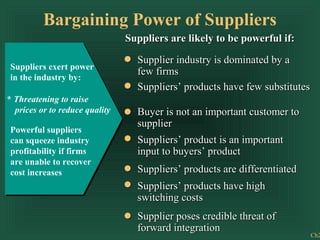
Bargaining Power of Suppliers
Suppliers exert power
in the industry by:
* Threatening to raise
prices or to reduce quality
Powerful suppliers
can squeeze industry
profitability if firms
are unable to recover
cost increases
Suppliers are likely to be powerful if:Suppliers are likely to be powerful if:
Supplier industry is dominated by aSupplier industry is dominated by a
few firmsfew firms
Suppliers’ products have few substitutesSuppliers’ products have few substitutes
Buyer is not an important customer toBuyer is not an important customer to
suppliersupplier
Suppliers’ product is an importantSuppliers’ product is an important
input to buyers’ productinput to buyers’ product
Suppliers’ products are differentiatedSuppliers’ products are differentiated
Suppliers’ products have highSuppliers’ products have high
switching costsswitching costs
Supplier poses credible threat ofSupplier poses credible threat of
forward integrationforward integration
Ch2
Bargaining
Power of
Buyers
Threat of
New
Entrants
Threat of
New
Entrants
Bargaining
Power of
Suppliers
Porter’s Five Forces
Model of Competition
Ch2
Bargaining Power of Buyers
Buyers compete
with the supplying
industry by:
* Bargaining down prices
* Forcing higher quality
* Playing firms off of
each other
Buyer groups are likely to be powerful if:Buyer groups are likely to be powerful if:
Buyers are concentrated or purchasesBuyers are concentrated or purchases
are large relative to seller’s salesare large relative to seller’s sales
Purchase accounts for a significantPurchase accounts for a significant
fraction of supplier’s salesfraction of supplier’s sales
Products are undifferentiatedProducts are undifferentiated
Buyers face few switching costsBuyers face few switching costs
Buyers’ industry earns low profitsBuyers’ industry earns low profits
Buyer presents a credible threat ofBuyer presents a credible threat of
backward integrationbackward integration
Product unimportant to qualityProduct unimportant to quality
Buyer has full informationBuyer has full information
Ch2
Threat of
Substitute
Products
Threat of
New
Entrants
Threat of
New
Entrants
Bargaining
Power of
Buyers
Bargaining
Power of
Suppliers
Porter’s Five Forces
Model of Competition
Ch2
Threat of Substitute Products
Products
with similar
function
limit the
prices firms
can charge
Keys to evaluate substitute products:Keys to evaluate substitute products:
Products with improvingProducts with improving
price/performance tradeoffsprice/performance tradeoffs
relative to present industryrelative to present industry
productsproducts
Example:Example:
Electronic security systems inElectronic security systems in
place of security guardsplace of security guards
Fax machines in place ofFax machines in place of
overnight mail deliveryovernight mail delivery
Ch2-
Threat of
Substitute
Products
Threat of
New
Entrants
Threat of
New
Entrants
Rivalry Among
Competing Firms
in Industry
Bargaining
Power of
Buyers
Bargaining
Power of
Suppliers
Porter’s Five Forces
Model of Competition
Ch2-
Rivalry Among Existing Competitors
Intense rivalry often plays out in the following ways:Intense rivalry often plays out in the following ways:
Jockeying for strategic positionJockeying for strategic position
Using price competitionUsing price competition
Staging advertising battlesStaging advertising battles
Making new product introductionsMaking new product introductions
Increasing consumer warranties or serviceIncreasing consumer warranties or service
Occurs when a firm is pressured or sees an opportunityOccurs when a firm is pressured or sees an opportunity
Price competition often leaves the entire industry worse offPrice competition often leaves the entire industry worse off
Advertising battles may increase total industry demand, butAdvertising battles may increase total industry demand, but
may be costly to smaller competitorsmay be costly to smaller competitors
Ch2-
CutthroatCutthroat competitioncompetition is more likely to occur when:is more likely to occur when:
Rivalry Among Existing Competitors
Numerous or equally balanced competitorsNumerous or equally balanced competitors
Slow growth industrySlow growth industry
High fixed costsHigh fixed costs
Lack of differentiation or switching costsLack of differentiation or switching costs
High storage costsHigh storage costs
Capacity added in large incrementsCapacity added in large increments
High strategic stakesHigh strategic stakes
High exit barriersHigh exit barriers
Diverse competitorsDiverse competitors
Ch2-
CoCa-Cola
• Suppliers:
 Price and availability of ingredients on world
market
 Quality speed safety, traceability, flexibility of
supply chain
• Buyers/consumers:
 High as a result of intense competition both
among branded and unbranded products.
 Combined purchase power of shops, bars,
Ch2-
Competitive advantage
• The Competitive Advantage model of Porter learns that
competitive strategy is about taking offensive or defensive
action to create a defendable position in an industry, in order
to cope successfully with competitive forces.
• Companies can combat the pressure of the five forces and
create competitive advantages.
• There are 2 basics types of Competitive Advantage :
 Cost leadership (low cost)
 Differentiation
Ch2-
StrengthS of five forCeS
model:
 The model is strong tool for competitive
analysis at industry level.
 It provides useful input for performing a
SWOT analysis.
Ch2-
limitationS
• Inside-out strategy is ignored (core competence)
• It does not cope with synergies and interdependencies
within the portfolio of large corporations (parenting
advantage)
• The environments which are characterized by rapid,
systemic and radical change require more flexible, dynamic
or emergent approaches to strategy formulation (disruptive
innovation)
• Sometimes it may be possible to create completely new
markets instead of selecting from existing ones (blue ocean
strategy)

Porter 5 forces model

  • 1.
    Ch2 The purpose of Five-ForcesAnalysis • The five forces are environmental forces that impact on a company’s ability to compete in a given market. • The purpose of five-forces analysis is to diagnose the principal competitive pressures in a market and assess how strong and important each one is.
  • 2.
  • 3.
    Ch2 Threat of NewEntrants Barriers to Entry Expected RetaliationExpected Retaliation Government PolicyGovernment Policy Economies of ScaleEconomies of Scale Product DifferentiationProduct Differentiation Capital RequirementsCapital Requirements Switching CostsSwitching Costs Access to Distribution ChannelsAccess to Distribution Channels Cost Disadvantages IndependentCost Disadvantages Independent of Scaleof Scale
  • 4.
    Ch2 Bargaining Power of Suppliers Threat of New Entrants Threatof New Entrants Porter’s Five Forces Model of Competition
  • 5.
    Ch2 Bargaining Power ofSuppliers Suppliers exert power in the industry by: * Threatening to raise prices or to reduce quality Powerful suppliers can squeeze industry profitability if firms are unable to recover cost increases Suppliers are likely to be powerful if:Suppliers are likely to be powerful if: Supplier industry is dominated by aSupplier industry is dominated by a few firmsfew firms Suppliers’ products have few substitutesSuppliers’ products have few substitutes Buyer is not an important customer toBuyer is not an important customer to suppliersupplier Suppliers’ product is an importantSuppliers’ product is an important input to buyers’ productinput to buyers’ product Suppliers’ products are differentiatedSuppliers’ products are differentiated Suppliers’ products have highSuppliers’ products have high switching costsswitching costs Supplier poses credible threat ofSupplier poses credible threat of forward integrationforward integration
  • 6.
    Ch2 Bargaining Power of Buyers Threat of New Entrants Threatof New Entrants Bargaining Power of Suppliers Porter’s Five Forces Model of Competition
  • 7.
    Ch2 Bargaining Power ofBuyers Buyers compete with the supplying industry by: * Bargaining down prices * Forcing higher quality * Playing firms off of each other Buyer groups are likely to be powerful if:Buyer groups are likely to be powerful if: Buyers are concentrated or purchasesBuyers are concentrated or purchases are large relative to seller’s salesare large relative to seller’s sales Purchase accounts for a significantPurchase accounts for a significant fraction of supplier’s salesfraction of supplier’s sales Products are undifferentiatedProducts are undifferentiated Buyers face few switching costsBuyers face few switching costs Buyers’ industry earns low profitsBuyers’ industry earns low profits Buyer presents a credible threat ofBuyer presents a credible threat of backward integrationbackward integration Product unimportant to qualityProduct unimportant to quality Buyer has full informationBuyer has full information
  • 8.
    Ch2 Threat of Substitute Products Threat of New Entrants Threatof New Entrants Bargaining Power of Buyers Bargaining Power of Suppliers Porter’s Five Forces Model of Competition
  • 9.
    Ch2 Threat of SubstituteProducts Products with similar function limit the prices firms can charge Keys to evaluate substitute products:Keys to evaluate substitute products: Products with improvingProducts with improving price/performance tradeoffsprice/performance tradeoffs relative to present industryrelative to present industry productsproducts Example:Example: Electronic security systems inElectronic security systems in place of security guardsplace of security guards Fax machines in place ofFax machines in place of overnight mail deliveryovernight mail delivery
  • 10.
    Ch2- Threat of Substitute Products Threat of New Entrants Threatof New Entrants Rivalry Among Competing Firms in Industry Bargaining Power of Buyers Bargaining Power of Suppliers Porter’s Five Forces Model of Competition
  • 11.
    Ch2- Rivalry Among ExistingCompetitors Intense rivalry often plays out in the following ways:Intense rivalry often plays out in the following ways: Jockeying for strategic positionJockeying for strategic position Using price competitionUsing price competition Staging advertising battlesStaging advertising battles Making new product introductionsMaking new product introductions Increasing consumer warranties or serviceIncreasing consumer warranties or service Occurs when a firm is pressured or sees an opportunityOccurs when a firm is pressured or sees an opportunity Price competition often leaves the entire industry worse offPrice competition often leaves the entire industry worse off Advertising battles may increase total industry demand, butAdvertising battles may increase total industry demand, but may be costly to smaller competitorsmay be costly to smaller competitors
  • 12.
    Ch2- CutthroatCutthroat competitioncompetition ismore likely to occur when:is more likely to occur when: Rivalry Among Existing Competitors Numerous or equally balanced competitorsNumerous or equally balanced competitors Slow growth industrySlow growth industry High fixed costsHigh fixed costs Lack of differentiation or switching costsLack of differentiation or switching costs High storage costsHigh storage costs Capacity added in large incrementsCapacity added in large increments High strategic stakesHigh strategic stakes High exit barriersHigh exit barriers Diverse competitorsDiverse competitors
  • 13.
    Ch2- CoCa-Cola • Suppliers:  Priceand availability of ingredients on world market  Quality speed safety, traceability, flexibility of supply chain • Buyers/consumers:  High as a result of intense competition both among branded and unbranded products.  Combined purchase power of shops, bars,
  • 14.
    Ch2- Competitive advantage • TheCompetitive Advantage model of Porter learns that competitive strategy is about taking offensive or defensive action to create a defendable position in an industry, in order to cope successfully with competitive forces. • Companies can combat the pressure of the five forces and create competitive advantages. • There are 2 basics types of Competitive Advantage :  Cost leadership (low cost)  Differentiation
  • 15.
    Ch2- StrengthS of fiveforCeS model:  The model is strong tool for competitive analysis at industry level.  It provides useful input for performing a SWOT analysis.
  • 16.
    Ch2- limitationS • Inside-out strategyis ignored (core competence) • It does not cope with synergies and interdependencies within the portfolio of large corporations (parenting advantage) • The environments which are characterized by rapid, systemic and radical change require more flexible, dynamic or emergent approaches to strategy formulation (disruptive innovation) • Sometimes it may be possible to create completely new markets instead of selecting from existing ones (blue ocean strategy)