INDUSTRY ANALYSIS Narender Bansal MBA 3 rd  Semester Maharaja Agrasen Institute of Technology Delhi-110086
Industry Analysis After economic analysis, we ask the question “which industries will benefit most from the upcoming economic environment?” This will lead to several industries, and our analysis will lead us to choose the one that we find to be best positioned.
What is an Industry?
INDUSTRY GROUPS AGRICULTURE STEEL HEALTH CARE RETAIL AUTOMOBILES PHARMACEUTICAL FINANCIAL SERVICES HOTEL & TOURISM IT TELECOM UTILITIES PAPER & PRINTING BANKING FMCG INFRASTRUCTURE TEXTILE OIL AND GAS EXPLORATION
SIC   Code ECONOMIC SECTOR Manufacturing Distribution Services PRODUCT AND SERVICES List of what is offered by the industry GEOGRAPHIC SCOPE Local ,Regional, National, International
Computer industry Different Market Segments Personal  Computer Micro  Computer Mini  Computer Mainframe  Computer
Furniture industry Home Furniture Office Furniture Wooden Hosehold Metal Household
Industry Analysis tries to find out following answer Difference between return for alternate industries Future performance of currently performing companyin one period Consistent performance over time Risk difference between different industries Risk variability over period of time
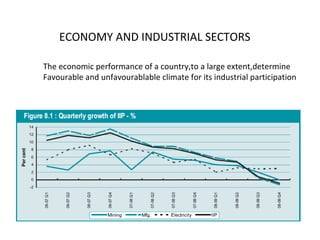
ECONOMY AND INDUSTRIAL SECTORS The economic performance of a country,to a large extent,determine  Favourable and unfavourablable climate for its industrial participation
Reasons of industrial analysis Provide an awareness of market performance Identify investment opportunities Important part of company’s business plan Financial institutions
Data Requirement Product Line Complementry Product Product Growth Product Pattern   (Seasonal,Cyclical) Econimies of Scales Suppliers Labour Market Buyer and their Behaviour Substitute Product Prices Marketing and Selling Cost Structure Logistic Department of Economic Analysis , Business Publication
Industrial Life Cycle It is Rise and Fall in Customer Interest
Industrial Life Cycle Rise and Fall of Customer Interest Depend on extent of technology and innovation Each phase passes from four stages Introduction Stage Growth Stage Maturity Stage Stability/Decline  Stage
 
Feature  of Industrial Life Cycle Marketing Manufacturing Competion Risk Margin Strategy High Advertising Skimming Pricing Under Capacity High Production Cost Low High High but low profit Increase Market Share High Advertising Under Capacity Shift to High Production Many Competitor Groth Vs Risk High and High Profit High Prices Change Quality &Price Image Market Segmentation Services Optimum Capacity Price Competition Low Low due to price war Marketing Effectiveness Low Advertising Overcapacity, Mass Production Exit,Fewer Very High Risk Low Profit Cost Control Introduction  Growth   Maturity  Decline
TOOLS FOR INDUSTRY ANALYSIS Qualitative Cross sectional industry performance Industry performnce overtime Difference in industry risk SWOT analysis Competition over industry life cycle Quantitative Analysing employment data Analysis of emolument data Input output analysis Earning data analysis
Cross sectional industry performance Aimed at finding out variability in Rate of return among various industries in given time period compare performance in term of  Sale profit  market capitalisation dividend
Example Stock market growth=10% Industrial growth rates = 5% to 8%  Stock market growth=50% Industrial growth rates = 80% to - 20%
Industry performance over time To identify stage of product life cycle Time duration  3 to 5 year  Difficult to forecast future performance due to  compositional change  in industry technological change   innovation
Differences in industry risk Besides focussing on return also consider risk Specifically investigate two question Does risk differ across industries in given time period Are industry risk stable over time Measured in term of variability in return/productive value Risk pattern also depend on economic situation
 
SWOT ANALYSIS Strenth & weakness Assess strenth and weakness Internal capability of industry Competitive advantage or defensive against weakness Opportunity & threat Evaluate opportunity and threat Environmental trend External situation Competitive forces Technology Government regulation
SWOT analysis STRENTH Capicity Competitive advantage Good custermor service High quality product Customer loyality Financial resources WEAKNESS Limitation default defect Competitor has exploitable  advantage Example: Small scale industry hs poor financial resources Industry that cater domestic market, would have weakness of catering to global market
SWOT analysis Opportunity Favourable condition in environment May be trend or need  Growing market of industry product Shrinking competition Identification of new market Threat Unfavourable situation May be barrior or constraint Slowing domestic economy  Competition New entrant New technology
SWOT analysis Threat Opprtunity Strenth Weakness Internal environment External  environment Confront Avoid Exploit Search
Analysing Employment data Life cycle can be predicted by Product life cycle Help in identify key industries Identify growth and decline Evaluate importance of industry to economy DetermineCompetitiveness among industries
Data Requrement Industry wise total employment in current as well earlier years Industry wise total emolument data in current as well earlier years Employes: Who receive wge and hold clerical superwisery post Duration of analysis Short  : Changing environment Long  :  Predictive purpose Base year
Employment share of sub industry =  Employment in sub industry  *100 Total employment in industry Employment in wools=2000 Total in textile  =11500 % Share  =2000/11500*100 ie 17.39% Change in employment Current yr no. Of employes  _1  *100  Base yr no. Of employes Current employes:1500 Base yr employes:1200 % change : [(1500/1200)-1]*100 ie 25 %
Location quotient: Measure concentration of industry’s concentratio in an area relative to rest of nation Industry location quotient Industry share of regional employment Industry share of national employment or Industry’s regional employment Total national employment Industry national employment Total national employment % change in location quotient [ (Current yer LQ/Base yr LQ)1 ] *100 LQ  = location quotient
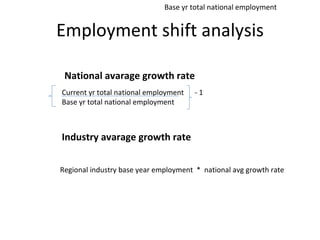
Employment shift analysis Current yr total national employment  - 1 Base yr total national employment Base yr total national employment National avarage growth rate Industry avarage growth rate Regional industry base year employment  *  national avg growth rate
Emolument Data Sum of wages and salaries,employer’s contribution to provident fund And other fund and workmen and staff welfare expenses Emolument per employ= Industry regional emolument Industry regional emolument
Change in emolument per employe by industry Current yr emolument per employe Base yr emolument per employe  -1 * 100
Input output analysis Total input   Include value of fuel,material  consumed,expenditure,repair  costtaxes,,postage,banking charges Total output  value of product  byproduct
 

Industry Analysis

  • 1.
    INDUSTRY ANALYSIS NarenderBansal MBA 3 rd Semester Maharaja Agrasen Institute of Technology Delhi-110086
  • 2.
    Industry Analysis Aftereconomic analysis, we ask the question “which industries will benefit most from the upcoming economic environment?” This will lead to several industries, and our analysis will lead us to choose the one that we find to be best positioned.
  • 3.
    What is anIndustry?
  • 4.
    INDUSTRY GROUPS AGRICULTURESTEEL HEALTH CARE RETAIL AUTOMOBILES PHARMACEUTICAL FINANCIAL SERVICES HOTEL & TOURISM IT TELECOM UTILITIES PAPER & PRINTING BANKING FMCG INFRASTRUCTURE TEXTILE OIL AND GAS EXPLORATION
  • 5.
    SIC Code ECONOMIC SECTOR Manufacturing Distribution Services PRODUCT AND SERVICES List of what is offered by the industry GEOGRAPHIC SCOPE Local ,Regional, National, International
  • 6.
    Computer industry DifferentMarket Segments Personal Computer Micro Computer Mini Computer Mainframe Computer
  • 7.
    Furniture industry HomeFurniture Office Furniture Wooden Hosehold Metal Household
  • 8.
    Industry Analysis triesto find out following answer Difference between return for alternate industries Future performance of currently performing companyin one period Consistent performance over time Risk difference between different industries Risk variability over period of time
  • 9.
    ECONOMY AND INDUSTRIALSECTORS The economic performance of a country,to a large extent,determine Favourable and unfavourablable climate for its industrial participation
  • 10.
    Reasons of industrialanalysis Provide an awareness of market performance Identify investment opportunities Important part of company’s business plan Financial institutions
  • 11.
    Data Requirement ProductLine Complementry Product Product Growth Product Pattern (Seasonal,Cyclical) Econimies of Scales Suppliers Labour Market Buyer and their Behaviour Substitute Product Prices Marketing and Selling Cost Structure Logistic Department of Economic Analysis , Business Publication
  • 12.
    Industrial Life CycleIt is Rise and Fall in Customer Interest
  • 13.
    Industrial Life CycleRise and Fall of Customer Interest Depend on extent of technology and innovation Each phase passes from four stages Introduction Stage Growth Stage Maturity Stage Stability/Decline Stage
  • 14.
  • 15.
    Feature ofIndustrial Life Cycle Marketing Manufacturing Competion Risk Margin Strategy High Advertising Skimming Pricing Under Capacity High Production Cost Low High High but low profit Increase Market Share High Advertising Under Capacity Shift to High Production Many Competitor Groth Vs Risk High and High Profit High Prices Change Quality &Price Image Market Segmentation Services Optimum Capacity Price Competition Low Low due to price war Marketing Effectiveness Low Advertising Overcapacity, Mass Production Exit,Fewer Very High Risk Low Profit Cost Control Introduction Growth Maturity Decline
  • 16.
    TOOLS FOR INDUSTRYANALYSIS Qualitative Cross sectional industry performance Industry performnce overtime Difference in industry risk SWOT analysis Competition over industry life cycle Quantitative Analysing employment data Analysis of emolument data Input output analysis Earning data analysis
  • 17.
    Cross sectional industryperformance Aimed at finding out variability in Rate of return among various industries in given time period compare performance in term of Sale profit market capitalisation dividend
  • 18.
    Example Stock marketgrowth=10% Industrial growth rates = 5% to 8% Stock market growth=50% Industrial growth rates = 80% to - 20%
  • 19.
    Industry performance overtime To identify stage of product life cycle Time duration 3 to 5 year Difficult to forecast future performance due to compositional change in industry technological change innovation
  • 20.
    Differences in industryrisk Besides focussing on return also consider risk Specifically investigate two question Does risk differ across industries in given time period Are industry risk stable over time Measured in term of variability in return/productive value Risk pattern also depend on economic situation
  • 21.
  • 22.
    SWOT ANALYSIS Strenth& weakness Assess strenth and weakness Internal capability of industry Competitive advantage or defensive against weakness Opportunity & threat Evaluate opportunity and threat Environmental trend External situation Competitive forces Technology Government regulation
  • 23.
    SWOT analysis STRENTHCapicity Competitive advantage Good custermor service High quality product Customer loyality Financial resources WEAKNESS Limitation default defect Competitor has exploitable advantage Example: Small scale industry hs poor financial resources Industry that cater domestic market, would have weakness of catering to global market
  • 24.
    SWOT analysis OpportunityFavourable condition in environment May be trend or need Growing market of industry product Shrinking competition Identification of new market Threat Unfavourable situation May be barrior or constraint Slowing domestic economy Competition New entrant New technology
  • 25.
    SWOT analysis ThreatOpprtunity Strenth Weakness Internal environment External environment Confront Avoid Exploit Search
  • 26.
    Analysing Employment dataLife cycle can be predicted by Product life cycle Help in identify key industries Identify growth and decline Evaluate importance of industry to economy DetermineCompetitiveness among industries
  • 27.
    Data Requrement Industrywise total employment in current as well earlier years Industry wise total emolument data in current as well earlier years Employes: Who receive wge and hold clerical superwisery post Duration of analysis Short : Changing environment Long : Predictive purpose Base year
  • 28.
    Employment share ofsub industry = Employment in sub industry *100 Total employment in industry Employment in wools=2000 Total in textile =11500 % Share =2000/11500*100 ie 17.39% Change in employment Current yr no. Of employes _1 *100 Base yr no. Of employes Current employes:1500 Base yr employes:1200 % change : [(1500/1200)-1]*100 ie 25 %
  • 29.
    Location quotient: Measureconcentration of industry’s concentratio in an area relative to rest of nation Industry location quotient Industry share of regional employment Industry share of national employment or Industry’s regional employment Total national employment Industry national employment Total national employment % change in location quotient [ (Current yer LQ/Base yr LQ)1 ] *100 LQ = location quotient
  • 30.
    Employment shift analysisCurrent yr total national employment - 1 Base yr total national employment Base yr total national employment National avarage growth rate Industry avarage growth rate Regional industry base year employment * national avg growth rate
  • 31.
    Emolument Data Sumof wages and salaries,employer’s contribution to provident fund And other fund and workmen and staff welfare expenses Emolument per employ= Industry regional emolument Industry regional emolument
  • 32.
    Change in emolumentper employe by industry Current yr emolument per employe Base yr emolument per employe -1 * 100
  • 33.
    Input output analysisTotal input Include value of fuel,material consumed,expenditure,repair costtaxes,,postage,banking charges Total output value of product byproduct
  • 34.