Porter’s Five Forces
MICHAEL PORTER
“An industry’s profit potential is largely
determined by the intensity of competitive
rivalry within that industry”
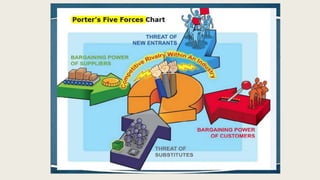
Introduction to Five Competitive Forces
• The model of the Five Competitive Forces was developed by Michael E. Porter
• An important tool for analyzing an organizations industry structure in strategic processes.
• These forces determine the intensity of competition and hence the profitability and

attractiveness of an industry.
• impact on a company’s ability to compete in a given market.
Bargaining power of Suppliers
The term 'suppliers' comprises all sources for inputs that are needed in order to
provide goods or services:
Supplier bargaining power is likely to be high when:-
 The market is dominated by a few large suppliers rather than a fragmented
source of supply.
 There are no substitutes for the particular input.
 Employee solidarity.
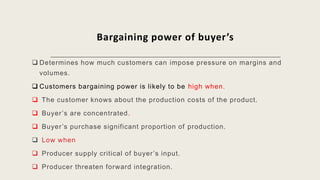
Bargaining power of buyer’s
 Determines how much customers can impose pressure on margins and
volumes.
 Customers bargaining power is likely to be high when.
 The customer knows about the production costs of the product.
 Buyer’s are concentrated.
 Buyer’s purchase significant proportion of production.
 Low when
 Producer supply critical of buyer’s input.
 Producer threaten forward integration.
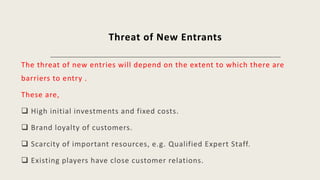
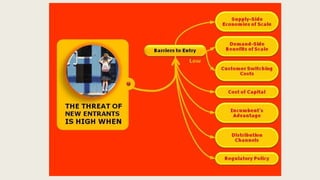
Threat of New Entrants
The threat of new entries will depend on the extent to which there are
barriers to entry .
These are,
 High initial investments and fixed costs.
 Brand loyalty of customers.
 Scarcity of important resources, e.g. Qualified Expert Staff.
 Existing players have close customer relations.
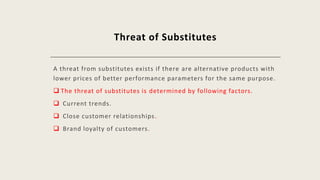
Threat of Substitutes
A threat from substitutes exists if there are alternative products with
lower prices of better performance parameters for the same purpose.
 The threat of substitutes is determined by following factors.
 Current trends.
 Close customer relationships.
 Brand loyalty of customers.
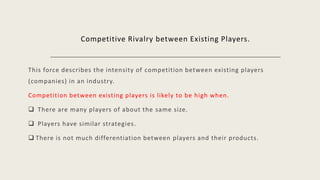
Competitive Rivalry between Existing Players.
This force describes the intensity of competition between existing players
(companies) in an industry.
Competition between existing players is likely to be high when.
 There are many players of about the same size.
 Players have similar strategies.
 There is not much differentiation between players and their products.
Conclusion
 Thus, Porters Model of Five Competitive Forces is a simple but
powerful tool for understanding where power lies in a business
situation.
 It helps to understand both the strength of your current
competitive position & the strength of a position you are looking to
move into.
Thank You

Porter's 5 forces model

  • 1.
  • 2.
    MICHAEL PORTER “An industry’sprofit potential is largely determined by the intensity of competitive rivalry within that industry”
  • 3.
    Introduction to FiveCompetitive Forces • The model of the Five Competitive Forces was developed by Michael E. Porter • An important tool for analyzing an organizations industry structure in strategic processes. • These forces determine the intensity of competition and hence the profitability and attractiveness of an industry. • impact on a company’s ability to compete in a given market.

  • 20.
    Bargaining power ofSuppliers The term 'suppliers' comprises all sources for inputs that are needed in order to provide goods or services: Supplier bargaining power is likely to be high when:-  The market is dominated by a few large suppliers rather than a fragmented source of supply.  There are no substitutes for the particular input.  Employee solidarity.
  • 21.
    Bargaining power ofbuyer’s  Determines how much customers can impose pressure on margins and volumes.  Customers bargaining power is likely to be high when.  The customer knows about the production costs of the product.  Buyer’s are concentrated.  Buyer’s purchase significant proportion of production.  Low when  Producer supply critical of buyer’s input.  Producer threaten forward integration.
  • 22.
    Threat of NewEntrants The threat of new entries will depend on the extent to which there are barriers to entry . These are,  High initial investments and fixed costs.  Brand loyalty of customers.  Scarcity of important resources, e.g. Qualified Expert Staff.  Existing players have close customer relations.
  • 23.
    Threat of Substitutes Athreat from substitutes exists if there are alternative products with lower prices of better performance parameters for the same purpose.  The threat of substitutes is determined by following factors.  Current trends.  Close customer relationships.  Brand loyalty of customers.
  • 24.
    Competitive Rivalry betweenExisting Players. This force describes the intensity of competition between existing players (companies) in an industry. Competition between existing players is likely to be high when.  There are many players of about the same size.  Players have similar strategies.  There is not much differentiation between players and their products.
  • 50.
    Conclusion  Thus, PortersModel of Five Competitive Forces is a simple but powerful tool for understanding where power lies in a business situation.  It helps to understand both the strength of your current competitive position & the strength of a position you are looking to move into.
  • 51.