Welcome


   M.Jakkaraiah
   Asst.professor
     PBR VITS
      KAVALI
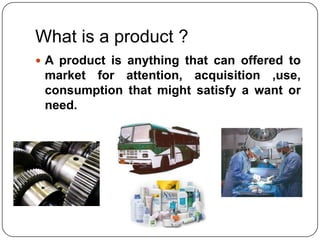
What is a product ?
 A product is anything that can offered to
 market for attention, acquisition ,use,
 consumption that might satisfy a want or
 need.
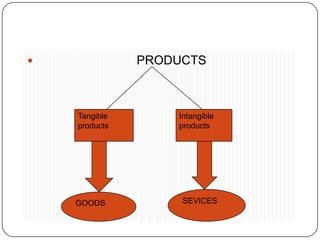
              PRODUCTS


    Tangible       Intangible
    products       products


    GOODS           SEVICES
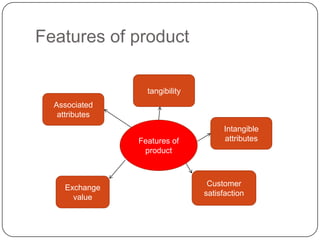
Features of product
                  tangibility
  Associated
   attributes
                                      Intangible
                Features of           attributes
                 product


                                 Customer
     Exchange
       value                    satisfaction
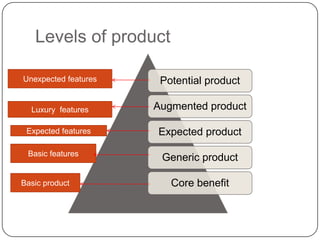
Levels of product

Unexpected features    Potential product

  Luxury features     Augmented product

 Expected features    Expected product
 Basic features
                       Generic product

Basic product            Core benefit
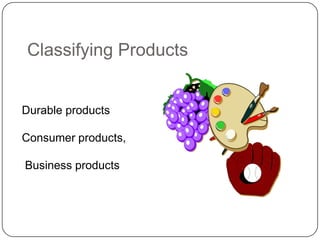
Classifying Products


Durable products

Consumer products,

Business products
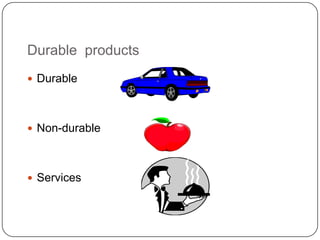
Durable products
 Durable


 Non-durable


 Services
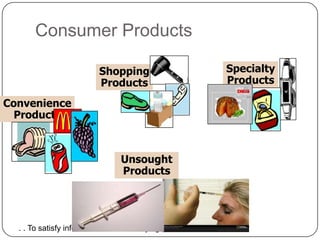
Consumer Products

                         Shopping                     Specialty
                         Products                     Products

Convenience
  Products


                               Unsought
                               Products


  . . To satisfy information needs & buying motives
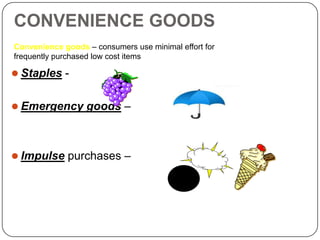
CONVENIENCE GOODS
Convenience goods – consumers use minimal effort for
frequently purchased low cost items

 Staples -


 Emergency goods –


 Impulse purchases –
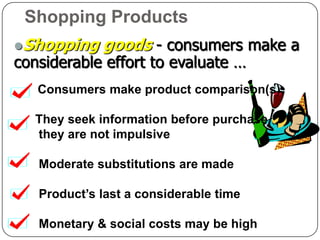
Shopping Products
Shopping    goods - consumers make a
considerable effort to evaluate …
   Consumers make product comparison(s),

   They seek information before purchase,
   they are not impulsive

   Moderate substitutions are made

   Product’s last a considerable time

   Monetary & social costs may be high
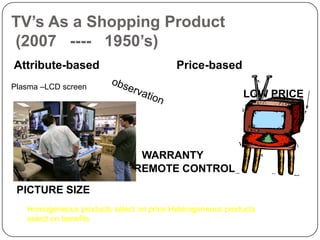
TV’s As a Shopping Product
(2007 ---- 1950’s)
Attribute-based                          Price-based
Plasma –LCD screen
                                                          LOW PRICE


                               WARRANTY
                              REMOTE CONTROL

 PICTURE SIZE
   Homogeneous products select on price Heterogeneous products
   select on benefits
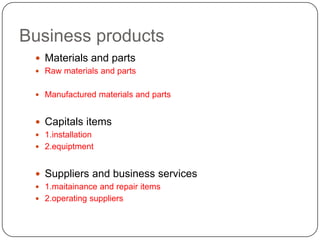
Business products
  Materials and parts
  Raw materials and parts


  Manufactured materials and parts


  Capitals items
  1.installation
  2.equiptment


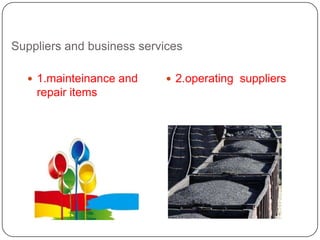
  Suppliers and business services
  1.maitainance and repair items
  2.operating suppliers
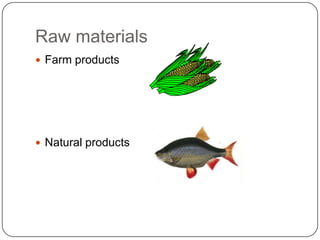
Raw materials
 Farm products


 Natural products
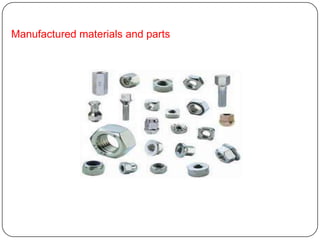
Manufactured materials and parts
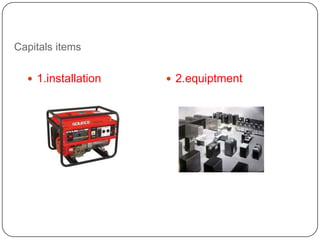
Capitals items

   1.installation    2.equiptment
Suppliers and business services

   1.mainteinance and      2.operating suppliers
    repair items
Product Mix & Product Line


      • Product Item
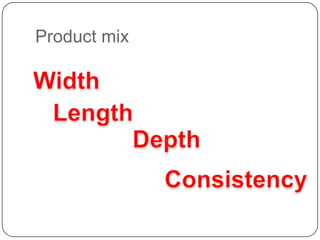
Product mix
Product Mix
 The assortment of products that a company
    offers to a market
   Width – how many different product lines?
   Length – the number of items in the product
    mix
   Depth – The no. of variants offered in a
    product line
   Consistency – how closely the product lines
    are related in usage
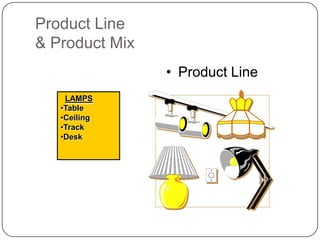
Product Line
& Product Mix
                • Product Line
    LAMPS
   •Table
   •Ceiling
   •Track
   •Desk
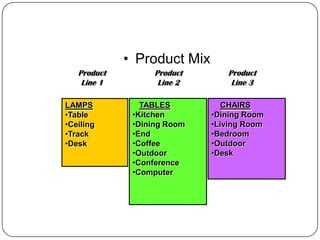
• Product Mix
   Product         Product      Product
    Line 1          Line 2       Line 3

LAMPS           TABLES          CHAIRS
•Table        •Kitchen       •Dining Room
•Ceiling      •Dining Room   •Living Room
•Track        •End           •Bedroom
•Desk         •Coffee        •Outdoor
              •Outdoor       •Desk
              •Conference
              •Computer
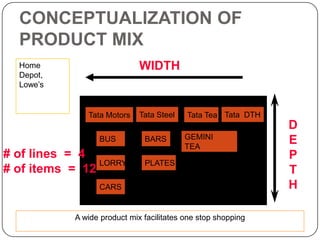
CONCEPTUALIZATION OF
  PRODUCT MIX
  Home                        WIDTH
  Depot,
  Lowe’s


               Tata Motors    Tata Steel   Tata Tea Tata DTH
                                                               D
                                           GEMINI
                  BUS          BARS
                                           TEA
                                                               E
# of lines = 4                                                 P
                LORRY          PLATES
# of items = 12                                                T
                  CARS                                         H

            A wide product mix facilitates one stop shopping
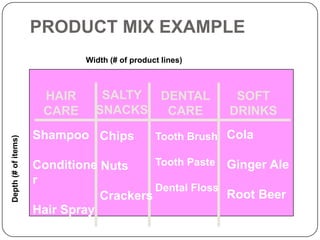
PRODUCT MIX EXAMPLE
        Width (# of product lines)


 HAIR      SALTY            DENTAL     SOFT
 CARE     SNACKS             CARE     DRINKS
Shampoo Chips             Tooth Brush Cola

Conditione Nuts     Tooth Paste Ginger Ale
r
                    Dental Floss
           Crackers              Root Beer
Hair Spray
Factors influencing change in product mix
      Changes in market demand
      Cost of production
      Quantity of production
      Changes in company desire
      Competitors actions and reactions
Product mix stratagies
 Expansion of product mix
 Contracting or dropping the product mix
 Alteration of existing product s
 Trading up/trading down stratagies
Product management
 Planning
 Forecasting
 Marketing
       of products of a company is product
 management
Objectives of product management
 To design product stratagies
 To spot market opportunities
 To develop strategies for each stage of product life
  cycle
 To generate new product ideas
New product planning
New product : New to the company even it is in the
  world
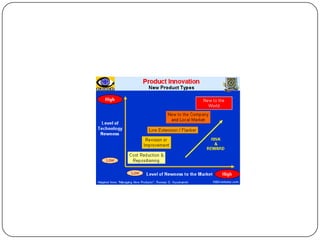
Types of new products
1.New to the world
2.New to the firm
3.Addition to existing product line
4.Improved and revised
5.Reduction in cost
Importance of new product
 To meet consumer needs and wants
 To meet competition
 To increase profits
 To avoid threats from substitutes
New Product Development Process

        Step 1. Idea Generation
  Systematic Search for New Product
                Ideas
Internal sources
Customers
Competitors
Distributors
Suppliers
Step 2. Idea Screening


 Process to spot good ideas and drop poor
  ones
 Technically feasibility
 Financially viable
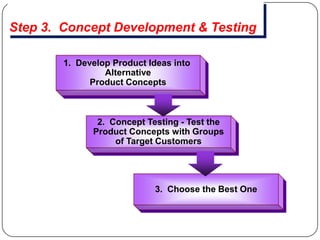
Step 3. Concept Development & Testing

        1. Develop Product Ideas into
                 Alternative
              Product Concepts


               2. Concept Testing - Test the
              Product Concepts with Groups
                   of Target Customers


                            3. Choose the Best One
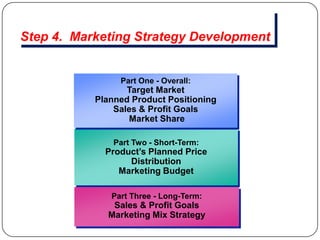
Step 4. Marketing Strategy Development


                Part One - Overall:
                  Target Market
           Planned Product Positioning
               Sales & Profit Goals
                  Market Share

               Part Two - Short-Term:
             Product’s Planned Price
                  Distribution
                Marketing Budget

              Part Three - Long-Term:
              Sales & Profit Goals
             Marketing Mix Strategy
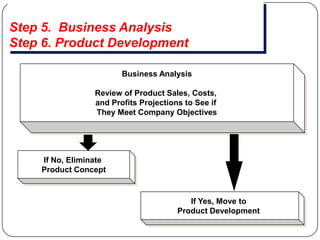
Step 5. Business Analysis
Step 6. Product Development

                        Business Analysis

                 Review of Product Sales, Costs,
                 and Profits Projections to See if
                 They Meet Company Objectives


    If No, Eliminate
    Product Concept


                                          If Yes, Move to
                                       Product Development
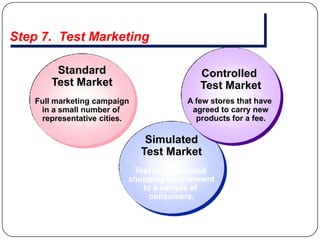
Step 7. Test Marketing

         Standard                         Controlled
        Test Market                       Test Market
    Full marketing campaign            A few stores that have
     in a small number of               agreed to carry new
     representative cities.              products for a fee.

                               Simulated
                              Test Market
                           Test in a simulated
                          shopping environment
                             to a sample of
                               consumers.
Step-8 commercialization


  Introducing the product into the market
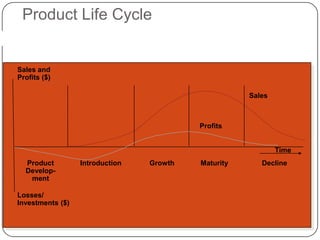
Product Life Cycle


Sales and
Profits ($)

                                                     Sales


                                          Profits


                                                             Time
  Product         Introduction   Growth   Maturity      Decline
  Develop-
   ment

Losses/
Investments ($)
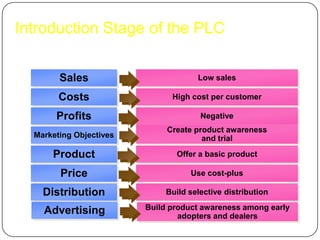
Introduction Stage of the PLC


        Sales                         Low sales

        Costs                  High cost per customer

       Profits                         Negative
                              Create product awareness
  Marketing Objectives                 and trial

      Product                   Offer a basic product

        Price                       Use cost-plus

    Distribution              Build selective distribution

    Advertising          Build product awareness among early
                                 adopters and dealers
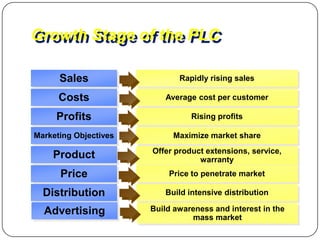
Growth Stage of the PLC

      Sales                   Rapidly rising sales

      Costs               Average cost per customer

     Profits                     Rising profits

Marketing Objectives        Maximize market share
                       Offer product extensions, service,
    Product                        warranty
      Price                Price to penetrate market

  Distribution            Build intensive distribution

  Advertising          Build awareness and interest in the
                                 mass market
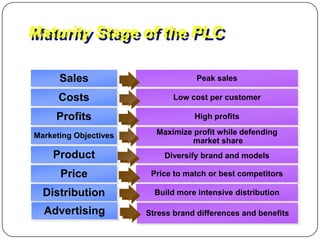
Maturity Stage of the PLC

      Sales                         Peak sales

      Costs                   Low cost per customer

     Profits                       High profits

Marketing Objectives     Maximize profit while defending
                                  market share
    Product                Diversify brand and models

      Price             Price to match or best competitors

  Distribution           Build more intensive distribution

  Advertising          Stress brand differences and benefits
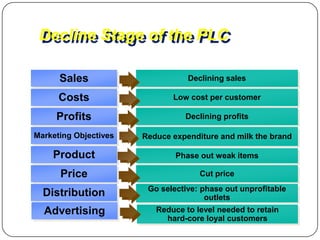
Decline Stage of the PLC

      Sales                       Declining sales

      Costs                   Low cost per customer

     Profits                     Declining profits

Marketing Objectives   Reduce expenditure and milk the brand

    Product                    Phase out weak items

      Price                          Cut price
                        Go selective: phase out unprofitable
  Distribution                         outlets
  Advertising             Reduce to level needed to retain
                            hard-core loyal customers
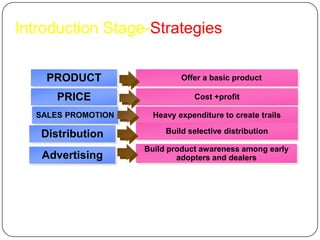
Introduction Stage-Strategies


    PRODUCT                  Offer a basic product

      PRICE                      Cost +profit

  SALES PROMOTION     Heavy expenditure to create trails

   Distribution          Build selective distribution

                    Build product awareness among early
   Advertising              adopters and dealers
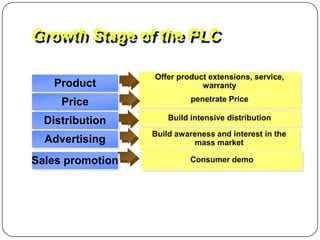
Growth Stage of the PLC

                  Offer product extensions, service,
   Product                    warranty

     Price                  penetrate Price

  Distribution        Build intensive distribution

                  Build awareness and interest in the
  Advertising               mass market

Sales promotion             Consumer demo
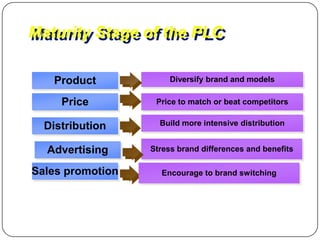
Maturity Stage of the PLC

   Product             Diversify brand and models

     Price         Price to match or beat competitors


  Distribution      Build more intensive distribution


  Advertising     Stress brand differences and benefits

Sales promotion     Encourage to brand switching
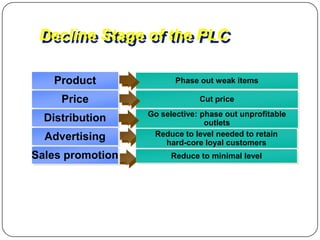
Decline Stage of the PLC

   Product               Phase out weak items

     Price                     Cut price
                  Go selective: phase out unprofitable
  Distribution                   outlets
  Advertising      Reduce to level needed to retain
                      hard-core loyal customers
Sales promotion         Reduce to minimal level
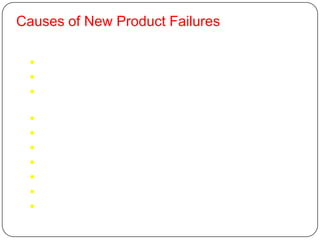
Causes of New Product Failures

  Overestimation of Market Size
  Product Design Problems
  Product Incorrectly Positioned, Priced or
     Advertised
    Costs of Product Development
    Competitive Actions
    Technical problems
    Poor planning
    Inadequate promotion
    Poor packing
    Fault pricing
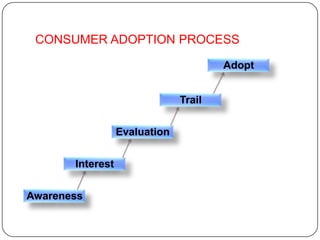
CONSUMER ADOPTION PROCESS

                                       Adopt


                               Trail


                  Evaluation

       Interest


Awareness
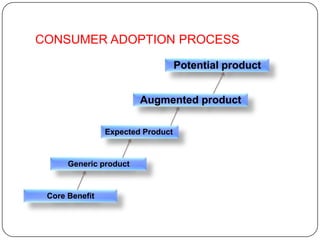
CONSUMER ADOPTION PROCESS

                                   Potential product


                        Augmented product

                Expected Product


      Generic product


 Core Benefit

Product management

  • 1.
    Welcome M.Jakkaraiah Asst.professor PBR VITS KAVALI
  • 2.
    What is aproduct ?  A product is anything that can offered to market for attention, acquisition ,use, consumption that might satisfy a want or need.
  • 3.
    PRODUCTS Tangible Intangible products products GOODS SEVICES
  • 4.
    Features of product tangibility Associated attributes Intangible Features of attributes product Customer Exchange value satisfaction
  • 5.
    Levels of product Unexpectedfeatures Potential product Luxury features Augmented product Expected features Expected product Basic features Generic product Basic product Core benefit
  • 6.
  • 7.
    Durable products  Durable Non-durable  Services
  • 8.
    Consumer Products Shopping Specialty Products Products Convenience Products Unsought Products . . To satisfy information needs & buying motives
  • 9.
    CONVENIENCE GOODS Convenience goods– consumers use minimal effort for frequently purchased low cost items  Staples -  Emergency goods –  Impulse purchases –
  • 10.
    Shopping Products Shopping goods - consumers make a considerable effort to evaluate … Consumers make product comparison(s), They seek information before purchase, they are not impulsive Moderate substitutions are made Product’s last a considerable time Monetary & social costs may be high
  • 11.
    TV’s As aShopping Product (2007 ---- 1950’s) Attribute-based Price-based Plasma –LCD screen LOW PRICE WARRANTY REMOTE CONTROL PICTURE SIZE Homogeneous products select on price Heterogeneous products select on benefits
  • 12.
    Business products Materials and parts  Raw materials and parts  Manufactured materials and parts  Capitals items  1.installation  2.equiptment  Suppliers and business services  1.maitainance and repair items  2.operating suppliers
  • 13.
    Raw materials  Farmproducts  Natural products
  • 14.
  • 15.
    Capitals items  1.installation  2.equiptment
  • 16.
    Suppliers and businessservices  1.mainteinance and  2.operating suppliers repair items
  • 17.
    Product Mix &Product Line • Product Item
  • 18.
  • 19.
    Product Mix  Theassortment of products that a company offers to a market  Width – how many different product lines?  Length – the number of items in the product mix  Depth – The no. of variants offered in a product line  Consistency – how closely the product lines are related in usage
  • 20.
    Product Line & ProductMix • Product Line LAMPS •Table •Ceiling •Track •Desk
  • 21.
    • Product Mix Product Product Product Line 1 Line 2 Line 3 LAMPS TABLES CHAIRS •Table •Kitchen •Dining Room •Ceiling •Dining Room •Living Room •Track •End •Bedroom •Desk •Coffee •Outdoor •Outdoor •Desk •Conference •Computer
  • 22.
    CONCEPTUALIZATION OF PRODUCT MIX Home WIDTH Depot, Lowe’s Tata Motors Tata Steel Tata Tea Tata DTH D GEMINI BUS BARS TEA E # of lines = 4 P LORRY PLATES # of items = 12 T CARS H A wide product mix facilitates one stop shopping
  • 23.
    PRODUCT MIX EXAMPLE Width (# of product lines) HAIR SALTY DENTAL SOFT CARE SNACKS CARE DRINKS Shampoo Chips Tooth Brush Cola Conditione Nuts Tooth Paste Ginger Ale r Dental Floss Crackers Root Beer Hair Spray
  • 24.
    Factors influencing changein product mix  Changes in market demand  Cost of production  Quantity of production  Changes in company desire  Competitors actions and reactions
  • 25.
    Product mix stratagies Expansion of product mix  Contracting or dropping the product mix  Alteration of existing product s  Trading up/trading down stratagies
  • 26.
    Product management  Planning Forecasting  Marketing of products of a company is product management
  • 27.
    Objectives of productmanagement  To design product stratagies  To spot market opportunities  To develop strategies for each stage of product life cycle  To generate new product ideas
  • 28.
    New product planning Newproduct : New to the company even it is in the world Types of new products 1.New to the world 2.New to the firm 3.Addition to existing product line 4.Improved and revised 5.Reduction in cost
  • 30.
    Importance of newproduct  To meet consumer needs and wants  To meet competition  To increase profits  To avoid threats from substitutes
  • 31.
    New Product DevelopmentProcess Step 1. Idea Generation Systematic Search for New Product Ideas Internal sources Customers Competitors Distributors Suppliers
  • 32.
    Step 2. IdeaScreening  Process to spot good ideas and drop poor ones  Technically feasibility  Financially viable
  • 33.
    Step 3. ConceptDevelopment & Testing 1. Develop Product Ideas into Alternative Product Concepts 2. Concept Testing - Test the Product Concepts with Groups of Target Customers 3. Choose the Best One
  • 34.
    Step 4. MarketingStrategy Development Part One - Overall: Target Market Planned Product Positioning Sales & Profit Goals Market Share Part Two - Short-Term: Product’s Planned Price Distribution Marketing Budget Part Three - Long-Term: Sales & Profit Goals Marketing Mix Strategy
  • 35.
    Step 5. BusinessAnalysis Step 6. Product Development Business Analysis Review of Product Sales, Costs, and Profits Projections to See if They Meet Company Objectives If No, Eliminate Product Concept If Yes, Move to Product Development
  • 36.
    Step 7. TestMarketing Standard Controlled Test Market Test Market Full marketing campaign A few stores that have in a small number of agreed to carry new representative cities. products for a fee. Simulated Test Market Test in a simulated shopping environment to a sample of consumers.
  • 37.
    Step-8 commercialization Introducing the product into the market
  • 38.
    Product Life Cycle Salesand Profits ($) Sales Profits Time Product Introduction Growth Maturity Decline Develop- ment Losses/ Investments ($)
  • 39.
    Introduction Stage ofthe PLC Sales Low sales Costs High cost per customer Profits Negative Create product awareness Marketing Objectives and trial Product Offer a basic product Price Use cost-plus Distribution Build selective distribution Advertising Build product awareness among early adopters and dealers
  • 40.
    Growth Stage ofthe PLC Sales Rapidly rising sales Costs Average cost per customer Profits Rising profits Marketing Objectives Maximize market share Offer product extensions, service, Product warranty Price Price to penetrate market Distribution Build intensive distribution Advertising Build awareness and interest in the mass market
  • 41.
    Maturity Stage ofthe PLC Sales Peak sales Costs Low cost per customer Profits High profits Marketing Objectives Maximize profit while defending market share Product Diversify brand and models Price Price to match or best competitors Distribution Build more intensive distribution Advertising Stress brand differences and benefits
  • 42.
    Decline Stage ofthe PLC Sales Declining sales Costs Low cost per customer Profits Declining profits Marketing Objectives Reduce expenditure and milk the brand Product Phase out weak items Price Cut price Go selective: phase out unprofitable Distribution outlets Advertising Reduce to level needed to retain hard-core loyal customers
  • 43.
    Introduction Stage-Strategies PRODUCT Offer a basic product PRICE Cost +profit SALES PROMOTION Heavy expenditure to create trails Distribution Build selective distribution Build product awareness among early Advertising adopters and dealers
  • 44.
    Growth Stage ofthe PLC Offer product extensions, service, Product warranty Price penetrate Price Distribution Build intensive distribution Build awareness and interest in the Advertising mass market Sales promotion Consumer demo
  • 45.
    Maturity Stage ofthe PLC Product Diversify brand and models Price Price to match or beat competitors Distribution Build more intensive distribution Advertising Stress brand differences and benefits Sales promotion Encourage to brand switching
  • 46.
    Decline Stage ofthe PLC Product Phase out weak items Price Cut price Go selective: phase out unprofitable Distribution outlets Advertising Reduce to level needed to retain hard-core loyal customers Sales promotion Reduce to minimal level
  • 47.
    Causes of NewProduct Failures  Overestimation of Market Size  Product Design Problems  Product Incorrectly Positioned, Priced or Advertised  Costs of Product Development  Competitive Actions  Technical problems  Poor planning  Inadequate promotion  Poor packing  Fault pricing
  • 48.
    CONSUMER ADOPTION PROCESS Adopt Trail Evaluation Interest Awareness
  • 49.
    CONSUMER ADOPTION PROCESS Potential product Augmented product Expected Product Generic product Core Benefit