The purpose of
      Five-Forces Analysis
• The five forces are environmental
  forces that impact on a company’s
  ability to compete in a given market.
• The purpose of five-forces analysis is to
  diagnose the principal competitive
  pressures in a market and assess how
  strong and important each one is.

                                              Ch2
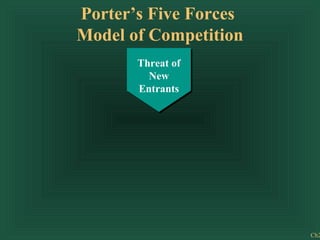
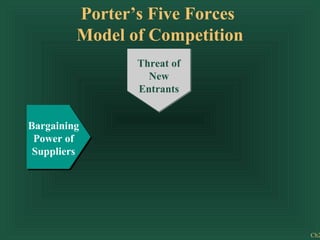
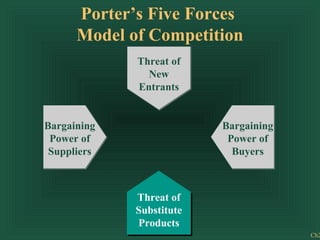
Porter’s Five Forces
Model of Competition
      Threat of
       Threat of
        New
         New
      Entrants
       Entrants


                       Ch2
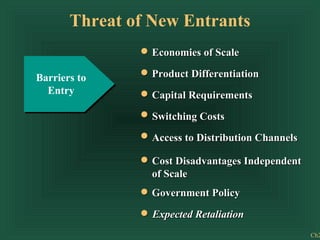
Threat of New Entrants
                 Economies of Scale

Barriers to      Product Differentiation
  Entry          Capital Requirements

                 Switching Costs
                 Access to Distribution Channels

                 Cost Disadvantages Independent
                 of Scale
                 Government Policy

                 Expected Retaliation
                                                   Ch2
Porter’s Five Forces
         Model of Competition
               Threat of
                Threat of
                 New
                  New
               Entrants
                Entrants


Bargaining
 Power of
 Suppliers


                                Ch2
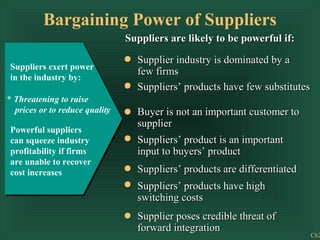
Bargaining Power of Suppliers
                                Suppliers are likely to be powerful if:

                                  Supplier industry is dominated by a
Suppliers exert power
                                  few firms
in the industry by:
                                  Suppliers’ products have few substitutes
* Threatening to raise
  prices or to reduce quality     Buyer is not an important customer to
                                  supplier
Powerful suppliers
can squeeze industry              Suppliers’ product is an important
profitability if firms            input to buyers’ product
are unable to recover
cost increases                    Suppliers’ products are differentiated
                                  Suppliers’ products have high
                                  switching costs
                                  Supplier poses credible threat of
                                  forward integration
                                                                             Ch2
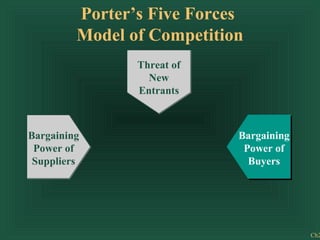
Porter’s Five Forces
         Model of Competition
               Threat of
                Threat of
                 New
                  New
               Entrants
                Entrants


Bargaining                  Bargaining
 Power of                    Power of
 Suppliers                    Buyers


                                         Ch2
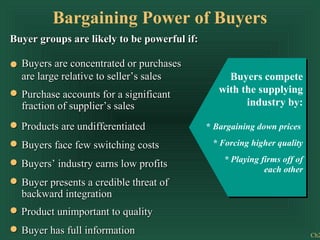
Bargaining Power of Buyers
Buyer groups are likely to be powerful if:

  Buyers are concentrated or purchases
  are large relative to seller’s sales            Buyers compete
  Purchase accounts for a significant           with the supplying
  fraction of supplier’s sales                        industry by:

  Products are undifferentiated              * Bargaining down prices

  Buyers face few switching costs             * Forcing higher quality
                                                 * Playing firms off of
  Buyers’ industry earns low profits                        each other
  Buyer presents a credible threat of
  backward integration
  Product unimportant to quality
  Buyer has full information                                              Ch2
Porter’s Five Forces
      Model of Competition
             Threat of
              Threat of
               New
                New
             Entrants
              Entrants


Bargaining                Bargaining
 Power of                  Power of
 Suppliers                  Buyers


             Threat of
             Substitute
             Products
                                       Ch2
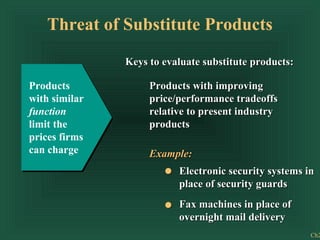
Threat of Substitute Products
               Keys to evaluate substitute products:

Products            Products with improving
with similar        price/performance tradeoffs
function            relative to present industry
limit the           products
prices firms
can charge          Example:
                          Electronic security systems in
                          place of security guards
                          Fax machines in place of
                          overnight mail delivery
                                                       Ch2
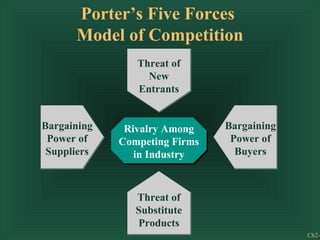
Porter’s Five Forces
      Model of Competition
               Threat of
                Threat of
                 New
                  New
               Entrants
                Entrants


Bargaining    Rivalry Among    Bargaining
 Power of    Competing Firms    Power of
 Suppliers      in Industry      Buyers


                Threat of
                Substitute
                Products
                                            Ch2-
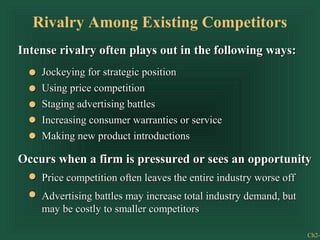
Rivalry Among Existing Competitors
Intense rivalry often plays out in the following ways:
    Jockeying for strategic position
    Using price competition
    Staging advertising battles
    Increasing consumer warranties or service
    Making new product introductions

Occurs when a firm is pressured or sees an opportunity
    Price competition often leaves the entire industry worse off
    Advertising battles may increase total industry demand, but
    may be costly to smaller competitors

                                                                   Ch2-
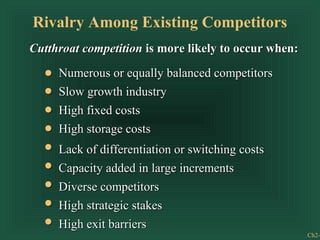
Rivalry Among Existing Competitors
Cutthroat competition is more likely to occur when:
     Numerous or equally balanced competitors
     Slow growth industry
     High fixed costs
     High storage costs
     Lack of differentiation or switching costs
     Capacity added in large increments
     Diverse competitors
     High strategic stakes
     High exit barriers
                                                      Ch2-
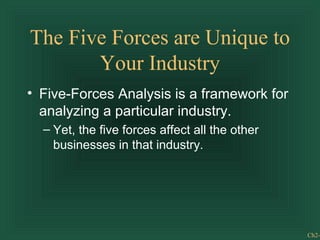
The Five Forces are Unique to
       Your Industry
• Five-Forces Analysis is a framework for
  analyzing a particular industry.
  – Yet, the five forces affect all the other
    businesses in that industry.


                                                Ch2-
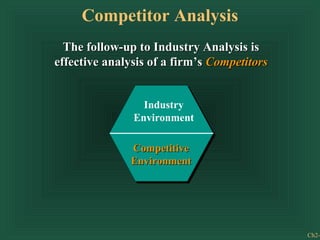
Competitor Analysis
  The follow-up to Industry Analysis is
effective analysis of a firm’s Competitors


                 Industry
               Environment

               Competitive
               Environment


                                             Ch2-
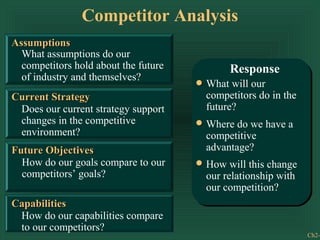
Competitor Analysis
Assumptions
  What assumptions do our
  competitors hold about the future        Response
  of industry and themselves?
                                      What will our
Current Strategy                      competitors do in the
 Does our current strategy support    future?
 changes in the competitive           Where do we have a
 environment?                         competitive
Future Objectives                     advantage?
  How do our goals compare to our     How will this change
  competitors’ goals?                 our relationship with
                                      our competition?
Capabilities
 How do our capabilities compare
 to our competitors?
                                                              Ch2-
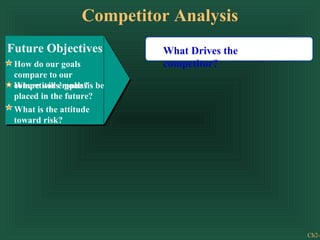
Competitor Analysis
Future Objectives         What Drives the
 How do our goals         competitor?
 compare to our
 Where will emphasis
 competitors’ goals? be
 placed in the future?
 What is the attitude
 toward risk?


                                            Ch2-
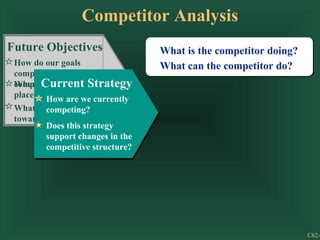
Competitor Analysis
Future Objectives                  What is the competitor doing?
 How do our goals                  What can the competitor do?
 compare to our
 Where Current be
 competitors’ goals?Strategy
        will emphasis
 placed in the future? currently
          How are we
 What is the attitude
          competing?
 toward risk?
          Does this strategy
          support changes in the
          competitive structure?


                                                                   Ch2-
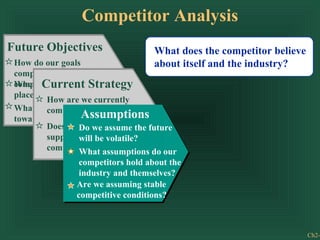
Competitor Analysis
Future Objectives                    What does the competitor believe
 How do our goals                    about itself and the industry?
 compare to our
 Where Current be
 competitors’ goals?Strategy
        will emphasis
 placed in the future?
          How are we currently
 What is the attitude
          competing?
 toward risk?       Assumptions
          Does this strategy
                   Do we assume the future
          support changes in the
                   will be volatile?
          competition structure?
                   What assumptions do our
                   competitors hold about the
                   industry and themselves?
                  Are we assuming stable
                  competitive conditions?


                                                                        Ch2-
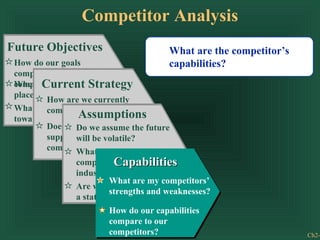
Competitor Analysis
Future Objectives                        What are the competitor’s
 How do our goals                        capabilities?
 compare to our
 Where Current be
 competitors’ goals?Strategy
        will emphasis
 placed in the future?
          How are we currently
 What is the attitude
          competing?
 toward risk?      Assumptions
          Does this strategy
                  Do we assume the future
          supportwill be volatile?
                   changes in the
          competition structure?
                  What assumptions do our
                            Capabilities
                  competitors hold about the
                  industry and themselves?
                           What are my competitors’
                  Are we operating under
                           strengths and weaknesses?
                  a status quo?
                         How do our capabilities
                         compare to our
                         competitors?                                Ch2-
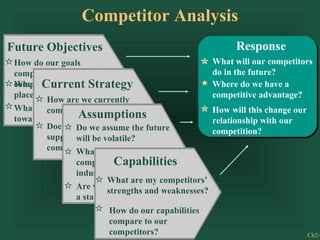
Competitor Analysis
Future Objectives                                            Response
 How do our goals                                      What will our competitors
 compare to our                                        do in the future?
 Where Current be
 competitors’ goals?Strategy
        will emphasis                                  Where do we have a
 placed in the future?                                 competitive advantage?
          How are we currently
 What is the attitude
          competing?                                   How will this change our
 toward risk?      Assumptions                         relationship with our
          Does this strategy
                  Do we assume the future              competition?
          supportwill be volatile?
                   changes in the
          competition structure?
                  What assumptions do our
                             Capabilities
                  competitors hold about the
                  industry and themselves?
                           What are my competitors’
                  Are we operating under
                           strengths and weaknesses?
                  a status quo?
                         How do our capabilities
                         compare to our
                         competitors?                                             Ch2-

Five forces model

  • 1.
    The purpose of Five-Forces Analysis • The five forces are environmental forces that impact on a company’s ability to compete in a given market. • The purpose of five-forces analysis is to diagnose the principal competitive pressures in a market and assess how strong and important each one is. Ch2
  • 2.
    Porter’s Five Forces Modelof Competition Threat of Threat of New New Entrants Entrants Ch2
  • 3.
    Threat of NewEntrants Economies of Scale Barriers to Product Differentiation Entry Capital Requirements Switching Costs Access to Distribution Channels Cost Disadvantages Independent of Scale Government Policy Expected Retaliation Ch2
  • 4.
    Porter’s Five Forces Model of Competition Threat of Threat of New New Entrants Entrants Bargaining Power of Suppliers Ch2
  • 5.
    Bargaining Power ofSuppliers Suppliers are likely to be powerful if: Supplier industry is dominated by a Suppliers exert power few firms in the industry by: Suppliers’ products have few substitutes * Threatening to raise prices or to reduce quality Buyer is not an important customer to supplier Powerful suppliers can squeeze industry Suppliers’ product is an important profitability if firms input to buyers’ product are unable to recover cost increases Suppliers’ products are differentiated Suppliers’ products have high switching costs Supplier poses credible threat of forward integration Ch2
  • 6.
    Porter’s Five Forces Model of Competition Threat of Threat of New New Entrants Entrants Bargaining Bargaining Power of Power of Suppliers Buyers Ch2
  • 7.
    Bargaining Power ofBuyers Buyer groups are likely to be powerful if: Buyers are concentrated or purchases are large relative to seller’s sales Buyers compete Purchase accounts for a significant with the supplying fraction of supplier’s sales industry by: Products are undifferentiated * Bargaining down prices Buyers face few switching costs * Forcing higher quality * Playing firms off of Buyers’ industry earns low profits each other Buyer presents a credible threat of backward integration Product unimportant to quality Buyer has full information Ch2
  • 8.
    Porter’s Five Forces Model of Competition Threat of Threat of New New Entrants Entrants Bargaining Bargaining Power of Power of Suppliers Buyers Threat of Substitute Products Ch2
  • 9.
    Threat of SubstituteProducts Keys to evaluate substitute products: Products Products with improving with similar price/performance tradeoffs function relative to present industry limit the products prices firms can charge Example: Electronic security systems in place of security guards Fax machines in place of overnight mail delivery Ch2
  • 10.
    Porter’s Five Forces Model of Competition Threat of Threat of New New Entrants Entrants Bargaining Rivalry Among Bargaining Power of Competing Firms Power of Suppliers in Industry Buyers Threat of Substitute Products Ch2-
  • 11.
    Rivalry Among ExistingCompetitors Intense rivalry often plays out in the following ways: Jockeying for strategic position Using price competition Staging advertising battles Increasing consumer warranties or service Making new product introductions Occurs when a firm is pressured or sees an opportunity Price competition often leaves the entire industry worse off Advertising battles may increase total industry demand, but may be costly to smaller competitors Ch2-
  • 12.
    Rivalry Among ExistingCompetitors Cutthroat competition is more likely to occur when: Numerous or equally balanced competitors Slow growth industry High fixed costs High storage costs Lack of differentiation or switching costs Capacity added in large increments Diverse competitors High strategic stakes High exit barriers Ch2-
  • 13.
    The Five Forcesare Unique to Your Industry • Five-Forces Analysis is a framework for analyzing a particular industry. – Yet, the five forces affect all the other businesses in that industry. Ch2-
  • 14.
    Competitor Analysis The follow-up to Industry Analysis is effective analysis of a firm’s Competitors Industry Environment Competitive Environment Ch2-
  • 15.
    Competitor Analysis Assumptions What assumptions do our competitors hold about the future Response of industry and themselves? What will our Current Strategy competitors do in the Does our current strategy support future? changes in the competitive Where do we have a environment? competitive Future Objectives advantage? How do our goals compare to our How will this change competitors’ goals? our relationship with our competition? Capabilities How do our capabilities compare to our competitors? Ch2-
  • 16.
    Competitor Analysis Future Objectives What Drives the How do our goals competitor? compare to our Where will emphasis competitors’ goals? be placed in the future? What is the attitude toward risk? Ch2-
  • 17.
    Competitor Analysis Future Objectives What is the competitor doing? How do our goals What can the competitor do? compare to our Where Current be competitors’ goals?Strategy will emphasis placed in the future? currently How are we What is the attitude competing? toward risk? Does this strategy support changes in the competitive structure? Ch2-
  • 18.
    Competitor Analysis Future Objectives What does the competitor believe How do our goals about itself and the industry? compare to our Where Current be competitors’ goals?Strategy will emphasis placed in the future? How are we currently What is the attitude competing? toward risk? Assumptions Does this strategy Do we assume the future support changes in the will be volatile? competition structure? What assumptions do our competitors hold about the industry and themselves? Are we assuming stable competitive conditions? Ch2-
  • 19.
    Competitor Analysis Future Objectives What are the competitor’s How do our goals capabilities? compare to our Where Current be competitors’ goals?Strategy will emphasis placed in the future? How are we currently What is the attitude competing? toward risk? Assumptions Does this strategy Do we assume the future supportwill be volatile? changes in the competition structure? What assumptions do our Capabilities competitors hold about the industry and themselves? What are my competitors’ Are we operating under strengths and weaknesses? a status quo? How do our capabilities compare to our competitors? Ch2-
  • 20.
    Competitor Analysis Future Objectives Response How do our goals What will our competitors compare to our do in the future? Where Current be competitors’ goals?Strategy will emphasis Where do we have a placed in the future? competitive advantage? How are we currently What is the attitude competing? How will this change our toward risk? Assumptions relationship with our Does this strategy Do we assume the future competition? supportwill be volatile? changes in the competition structure? What assumptions do our Capabilities competitors hold about the industry and themselves? What are my competitors’ Are we operating under strengths and weaknesses? a status quo? How do our capabilities compare to our competitors? Ch2-

Editor's Notes