

PORTER’S FIVE FORCES
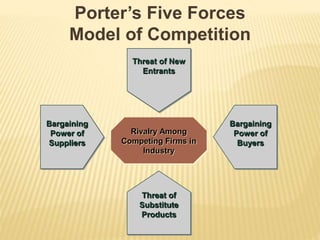
 Porter came up with a method for examining
the competitive environment of a market.
 His model analyses the five key factors that
will enable an organization to understand
how strong the competition is, and therefore
how to devise a suitable marketing strategy.
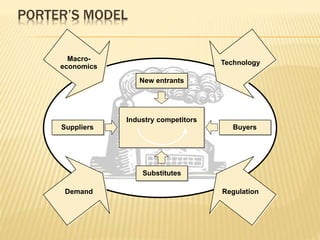
PORTER’S MODEL
Suppliers Buyers
New entrants
Substitutes
Industry competitors
RegulationDemand
Macro-
economics
Technology
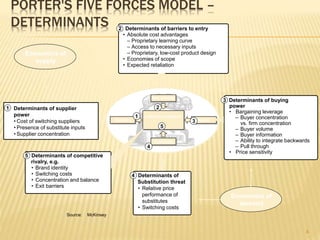
PORTER'S FIVE FORCES MODEL –
DETERMINANTS
4
Determinants of supplier
power
• Cost of switching suppliers
• Presence of substitute inputs
• Supplier concentration
1
Suppliers Buyers
New entrants
Substitutes
Industry competitors
Source: McKinsey
5 Determinants of competitive
rivalry, e.g.
• Brand identity
• Switching costs
• Concentration and balance
• Exit barriers
3 Determinants of buying
power
• Bargaining leverage
– Buyer concentration
vs. firm concentration
– Buyer volume
– Buyer information
– Ability to integrate backwards
– Pull through
• Price sensitivity
2 Determinants of barriers to entry
• Absolute cost advantages
– Proprietary learning curve
– Access to necessary inputs
– Proprietary, low-cost product design
• Economies of scope
• Expected retaliation
1
2
3
5
4
4 Determinants of
Substitution threat
• Relative price
performance of
substitutes
• Switching costs
Economics of
supply
Economics of
demand
Threat of
New
Entrants
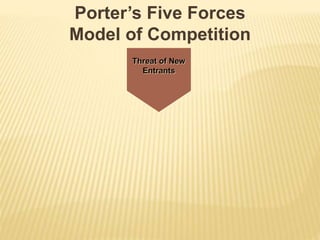
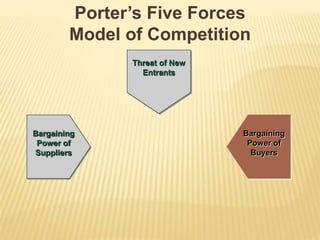
Threat of New
Entrants
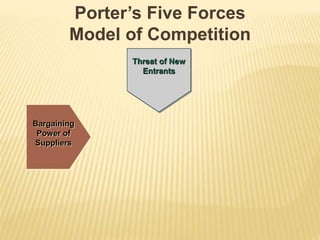
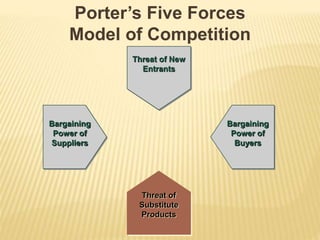
Porter’s Five Forces
Model of Competition
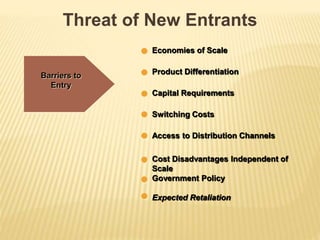
Threat of New Entrants
Barriers to
Entry
Expected Retaliation
Government Policy
Economies of Scale
Product Differentiation
Capital Requirements
Switching Costs
Access to Distribution Channels
Cost Disadvantages Independent of
Scale
PORTERS FIVE FORCES
THREAT OF NEW ENTRANTS
 New businesses coming into a market
increase competition, resulting in lower
prices and profits.
 Barriers that prevent entry into the market
can limit the competitive pressure and allow
existing businesses to make larger profits.
 Porter established a number of strategies for
businesses to help them increase the
barriers in their markets.
STRATEGIES TO PREVENT NEW ENTRANTS
FROM ENTERING THE MARKETS
Big Spending on Promotion
 Create strong brands by investing heavily
in promotion.
 Potential new entrants will face such high
costs of entry that they will be deterred
from entering the market.
Big Spending on Plant & Machinery
 New entrants will find it hard to compete
without the same levels of equipment, but
the expense of setting up will defer entry.
STRATEGIES TO PREVENT NEW ENTRANTS
FROM ENTERING THE MARKETS
Legal Protection: Patents & Copyrights
 Obtain legal protection for products and
processes through patents and copyrights to
prevent businesses simply copying your
successful operations.
Control of Distribution Channels
 Companies can control distribution channels
by entering into exclusivity agreements.
 This will make it hard for new rivals to get
their products to end users.
Bargaining
Power of
Suppliers
Threat of
New
Entrants
Threat of New
Entrants
Porter’s Five Forces
Model of Competition
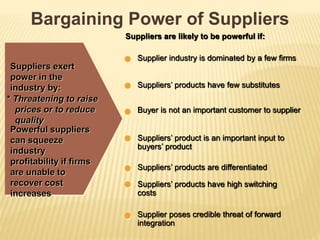
Bargaining Power of Suppliers
Suppliers exert
power in the
industry by:
* Threatening to raise
prices or to reduce
quality
Powerful suppliers
can squeeze
industry
profitability if firms
are unable to
recover cost
increases
Suppliers are likely to be powerful if:
Supplier industry is dominated by a few firms
Suppliers’ products have few substitutes
Buyer is not an important customer to supplier
Suppliers’ product is an important input to
buyers’ product
Suppliers’ products are differentiated
Suppliers’ products have high switching
costs
Supplier poses credible threat of forward
integration
PORTERS FIVE FORCES
BARGAINING POWER OF SUPPLIERS
 Just as buyers will use their bargaining
power, suppliers will try to get the best deal
they can.
 Suppliers with lots of power will be able to
push prices up, increasing an organization’s
costs and reducing its profitability.
STRATEGIES TO REDUCE THE BARGAINING
POWER OF SUPPLIERS
Vertical Backward Integration
 This involves buying suppliers to ensure
continuity of supply.
Reduce Dependence on any ONE Suppliers
 Businesses can reduce the power of suppliers
by not relying too heavily on one of them.
 By having a range of suppliers, a business can
switch to an alternative more easily if one
supplier tries to raise the price.
Bargaining
Power of
Buyers
Threat of
New
Entrants
Threat of New
Entrants
Bargaining
Power of
Suppliers
Porter’s Five Forces
Model of Competition
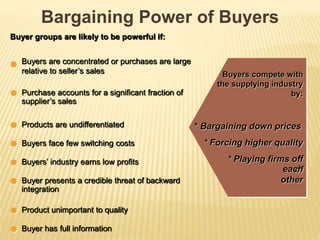
Bargaining Power of Buyers
Buyers compete with
the supplying industry
by:
* Bargaining down prices
* Forcing higher quality
* Playing firms off
ofeach
other
Buyer groups are likely to be powerful if:
Buyers are concentrated or purchases are large
relative to seller’s sales
Purchase accounts for a significant fraction of
supplier’s sales
Products are undifferentiated
Buyers face few switching costs
Buyers’ industry earns low profits
Buyer presents a credible threat of backward
integration
Product unimportant to quality
Buyer has full information
PORTERS FIVE FORCES
BARGAINING POWER OF BUYERS
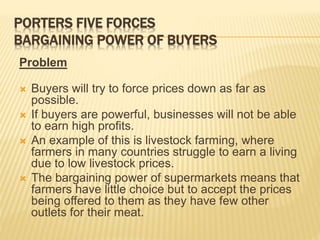
Problem
 Buyers will try to force prices down as far as
possible.
 If buyers are powerful, businesses will not be able
to earn high profits.
 An example of this is livestock farming, where
farmers in many countries struggle to earn a living
due to low livestock prices.
 The bargaining power of supermarkets means that
farmers have little choice but to accept the prices
being offered to them as they have few other
outlets for their meat.
STRATEGIES TO REDUCE THE BARGAINING
POWER OF BUYERS.
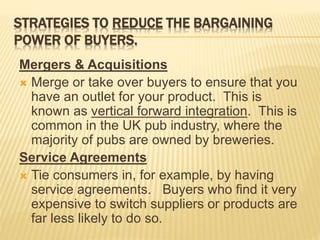
Mergers & Acquisitions
 Merge or take over buyers to ensure that you
have an outlet for your product. This is
known as vertical forward integration. This is
common in the UK pub industry, where the
majority of pubs are owned by breweries.
Service Agreements
 Tie consumers in, for example, by having
service agreements. Buyers who find it very
expensive to switch suppliers or products are
far less likely to do so.
Threat of
Substitute
Products
Threat of
New
Entrants
Threat of New
Entrants
Bargaining
Power of
Buyers
Bargaining
Power of
Suppliers
Porter’s Five Forces
Model of Competition
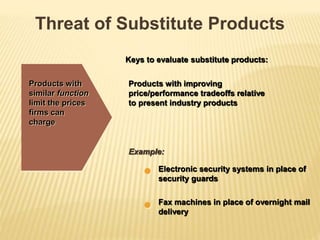
Threat of Substitute Products
Products with
similar function
limit the prices
firms can
charge
Keys to evaluate substitute products:
Products with improving
price/performance tradeoffs relative
to present industry products
Example:
Electronic security systems in place of
security guards
Fax machines in place of overnight mail
delivery
PORTERS FIVE FORCES
THREAT OF SUBSTITUTES
 If substitutes to an organization’s products
exist, consumers have a choice.
 The closer the substitute product, the more
difficult the business will find it to raise prices,
as consumers will simply switch to the
alternatives.
STRATEGIES TO REDUCE THE THREAT OF
SUBSTITUTES
 Firms need to create barriers to entry through
marketing so consumers feel the product is
better than another (not a close substitute).
Ways of doing this include:
 taking out patents and copyrights
 focusing on ensuring anti-competitive
behaviour.
Threat of
Substitute
Products
Threat of
New
Entrants
Threat of New
Entrants
Rivalry Among
Competing Firms in
Industry
Bargaining
Power of
Buyers
Bargaining
Power of
Suppliers
Porter’s Five Forces
Model of Competition
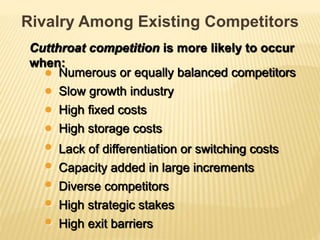
Cutthroat competition is more likely to occur
when:
Rivalry Among Existing Competitors
Numerous or equally balanced competitors
Slow growth industry
High fixed costs
Lack of differentiation or switching costs
High storage costs
Capacity added in large increments
High strategic stakes
High exit barriers
Diverse competitors
PORTERS FIVE FORCES
COMPETITIVE RIVALRY
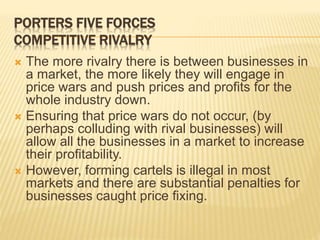
 The more rivalry there is between businesses in
a market, the more likely they will engage in
price wars and push prices and profits for the
whole industry down.
 Ensuring that price wars do not occur, (by
perhaps colluding with rival businesses) will
allow all the businesses in a market to increase
their profitability.
 However, forming cartels is illegal in most
markets and there are substantial penalties for
businesses caught price fixing.
STRATEGIES TO REDUCE THE IMPACT ON
COMPETITIVE RIVALRY
 In the same way that marketing activity can
help to reduce the threat of substitutes, it can
also reduce rivalry with other businesses by
ensuring that products are perceived as
better than their competitors.
THE FIVE FORCES ARE UNIQUE
TO YOUR INDUSTRY
 Five-Forces Analysis is a framework for
analyzing a particular industry.
 Yet, the five forces affect all the other
businesses in that industry.

Marketing Management - Porter's Five Forces

  • 1.
  • 2.
    PORTER’S FIVE FORCES Porter came up with a method for examining the competitive environment of a market.  His model analyses the five key factors that will enable an organization to understand how strong the competition is, and therefore how to devise a suitable marketing strategy.
  • 3.
    PORTER’S MODEL Suppliers Buyers Newentrants Substitutes Industry competitors RegulationDemand Macro- economics Technology
  • 4.
    PORTER'S FIVE FORCESMODEL – DETERMINANTS 4 Determinants of supplier power • Cost of switching suppliers • Presence of substitute inputs • Supplier concentration 1 Suppliers Buyers New entrants Substitutes Industry competitors Source: McKinsey 5 Determinants of competitive rivalry, e.g. • Brand identity • Switching costs • Concentration and balance • Exit barriers 3 Determinants of buying power • Bargaining leverage – Buyer concentration vs. firm concentration – Buyer volume – Buyer information – Ability to integrate backwards – Pull through • Price sensitivity 2 Determinants of barriers to entry • Absolute cost advantages – Proprietary learning curve – Access to necessary inputs – Proprietary, low-cost product design • Economies of scope • Expected retaliation 1 2 3 5 4 4 Determinants of Substitution threat • Relative price performance of substitutes • Switching costs Economics of supply Economics of demand
  • 5.
    Threat of New Entrants Threat ofNew Entrants Porter’s Five Forces Model of Competition
  • 6.
    Threat of NewEntrants Barriers to Entry Expected Retaliation Government Policy Economies of Scale Product Differentiation Capital Requirements Switching Costs Access to Distribution Channels Cost Disadvantages Independent of Scale
  • 7.
    PORTERS FIVE FORCES THREATOF NEW ENTRANTS  New businesses coming into a market increase competition, resulting in lower prices and profits.  Barriers that prevent entry into the market can limit the competitive pressure and allow existing businesses to make larger profits.  Porter established a number of strategies for businesses to help them increase the barriers in their markets.
  • 8.
    STRATEGIES TO PREVENTNEW ENTRANTS FROM ENTERING THE MARKETS Big Spending on Promotion  Create strong brands by investing heavily in promotion.  Potential new entrants will face such high costs of entry that they will be deterred from entering the market. Big Spending on Plant & Machinery  New entrants will find it hard to compete without the same levels of equipment, but the expense of setting up will defer entry.
  • 9.
    STRATEGIES TO PREVENTNEW ENTRANTS FROM ENTERING THE MARKETS Legal Protection: Patents & Copyrights  Obtain legal protection for products and processes through patents and copyrights to prevent businesses simply copying your successful operations. Control of Distribution Channels  Companies can control distribution channels by entering into exclusivity agreements.  This will make it hard for new rivals to get their products to end users.
  • 10.
    Bargaining Power of Suppliers Threat of New Entrants Threatof New Entrants Porter’s Five Forces Model of Competition
  • 11.
    Bargaining Power ofSuppliers Suppliers exert power in the industry by: * Threatening to raise prices or to reduce quality Powerful suppliers can squeeze industry profitability if firms are unable to recover cost increases Suppliers are likely to be powerful if: Supplier industry is dominated by a few firms Suppliers’ products have few substitutes Buyer is not an important customer to supplier Suppliers’ product is an important input to buyers’ product Suppliers’ products are differentiated Suppliers’ products have high switching costs Supplier poses credible threat of forward integration
  • 12.
    PORTERS FIVE FORCES BARGAININGPOWER OF SUPPLIERS  Just as buyers will use their bargaining power, suppliers will try to get the best deal they can.  Suppliers with lots of power will be able to push prices up, increasing an organization’s costs and reducing its profitability.
  • 13.
    STRATEGIES TO REDUCETHE BARGAINING POWER OF SUPPLIERS Vertical Backward Integration  This involves buying suppliers to ensure continuity of supply. Reduce Dependence on any ONE Suppliers  Businesses can reduce the power of suppliers by not relying too heavily on one of them.  By having a range of suppliers, a business can switch to an alternative more easily if one supplier tries to raise the price.
  • 14.
    Bargaining Power of Buyers Threat of New Entrants Threatof New Entrants Bargaining Power of Suppliers Porter’s Five Forces Model of Competition
  • 15.
    Bargaining Power ofBuyers Buyers compete with the supplying industry by: * Bargaining down prices * Forcing higher quality * Playing firms off ofeach other Buyer groups are likely to be powerful if: Buyers are concentrated or purchases are large relative to seller’s sales Purchase accounts for a significant fraction of supplier’s sales Products are undifferentiated Buyers face few switching costs Buyers’ industry earns low profits Buyer presents a credible threat of backward integration Product unimportant to quality Buyer has full information
  • 16.
    PORTERS FIVE FORCES BARGAININGPOWER OF BUYERS Problem  Buyers will try to force prices down as far as possible.  If buyers are powerful, businesses will not be able to earn high profits.  An example of this is livestock farming, where farmers in many countries struggle to earn a living due to low livestock prices.  The bargaining power of supermarkets means that farmers have little choice but to accept the prices being offered to them as they have few other outlets for their meat.
  • 17.
    STRATEGIES TO REDUCETHE BARGAINING POWER OF BUYERS. Mergers & Acquisitions  Merge or take over buyers to ensure that you have an outlet for your product. This is known as vertical forward integration. This is common in the UK pub industry, where the majority of pubs are owned by breweries. Service Agreements  Tie consumers in, for example, by having service agreements. Buyers who find it very expensive to switch suppliers or products are far less likely to do so.
  • 18.
    Threat of Substitute Products Threat of New Entrants Threatof New Entrants Bargaining Power of Buyers Bargaining Power of Suppliers Porter’s Five Forces Model of Competition
  • 19.
    Threat of SubstituteProducts Products with similar function limit the prices firms can charge Keys to evaluate substitute products: Products with improving price/performance tradeoffs relative to present industry products Example: Electronic security systems in place of security guards Fax machines in place of overnight mail delivery
  • 20.
    PORTERS FIVE FORCES THREATOF SUBSTITUTES  If substitutes to an organization’s products exist, consumers have a choice.  The closer the substitute product, the more difficult the business will find it to raise prices, as consumers will simply switch to the alternatives.
  • 21.
    STRATEGIES TO REDUCETHE THREAT OF SUBSTITUTES  Firms need to create barriers to entry through marketing so consumers feel the product is better than another (not a close substitute). Ways of doing this include:  taking out patents and copyrights  focusing on ensuring anti-competitive behaviour.
  • 22.
    Threat of Substitute Products Threat of New Entrants Threatof New Entrants Rivalry Among Competing Firms in Industry Bargaining Power of Buyers Bargaining Power of Suppliers Porter’s Five Forces Model of Competition
  • 23.
    Cutthroat competition ismore likely to occur when: Rivalry Among Existing Competitors Numerous or equally balanced competitors Slow growth industry High fixed costs Lack of differentiation or switching costs High storage costs Capacity added in large increments High strategic stakes High exit barriers Diverse competitors
  • 24.
    PORTERS FIVE FORCES COMPETITIVERIVALRY  The more rivalry there is between businesses in a market, the more likely they will engage in price wars and push prices and profits for the whole industry down.  Ensuring that price wars do not occur, (by perhaps colluding with rival businesses) will allow all the businesses in a market to increase their profitability.  However, forming cartels is illegal in most markets and there are substantial penalties for businesses caught price fixing.
  • 25.
    STRATEGIES TO REDUCETHE IMPACT ON COMPETITIVE RIVALRY  In the same way that marketing activity can help to reduce the threat of substitutes, it can also reduce rivalry with other businesses by ensuring that products are perceived as better than their competitors.
  • 26.
    THE FIVE FORCESARE UNIQUE TO YOUR INDUSTRY  Five-Forces Analysis is a framework for analyzing a particular industry.  Yet, the five forces affect all the other businesses in that industry.