INDUSTRIAL POLYMERS
PRESENTED TO – Dr. ASHIMA
SRIVASTAVA
GROUP PRESENTATION
2
VARIOUS INDUSTRIAL POLYMERS
NYLON-6
TEFLON
POLYSTYRENE
POLYETHENE
LiAlH4
LUCITE
Presentation title 3
I. NYLON-6
 HISTORY
 PREPARATION
 PROPERTIES AND APPLICATION
Presentation title 4
HISTORY OF NYLON-6
•In 1938 Paul Schlack of the IG Farben
company in Germany polymerized
Caprolactam and created a different form of
polymer identified as Nylon-6. It is a
homopolymer which is formed by ring opening
chain growth polymerisation
Presentation title 5
PREPARATION
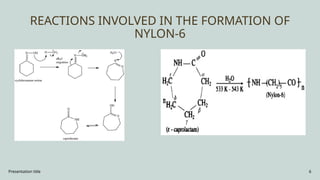
 Nylon-6 is prepared by prolonged heating of Caprolactam at 533K-
543K.
 It is formed by self condensation of a large number of molecules of
amino caproic acid.
 Since caprolactam is more easily available, it is used for
polymerisation, which is carried out in the presence of H2Oto
hydrolyse the lactum to amino acid.
 Caprolactam is obtained by Beckmann rearrangement of
cyclohexanone oxime.
Presentation title 6
REACTIONS INVOLVED IN THE FORMATION OF
NYLON-6
Presentation title 7
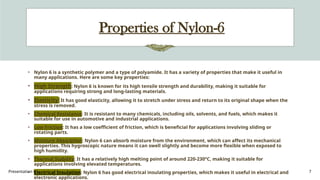
Properties of Nylon-6
• Nylon 6 is a synthetic polymer and a type of polyamide. It has a variety of properties that make it useful in
many applications. Here are some key properties:
• High Strength: Nylon 6 is known for its high tensile strength and durability, making it suitable for
applications requiring strong and long-lasting materials.
• Elasticity: It has good elasticity, allowing it to stretch under stress and return to its original shape when the
stress is removed.
• Chemical Resistance: It is resistant to many chemicals, including oils, solvents, and fuels, which makes it
suitable for use in automotive and industrial applications.
• Low Friction: It has a low coefficient of friction, which is beneficial for applications involving sliding or
rotating parts.
• Moisture Absorption: Nylon 6 can absorb moisture from the environment, which can affect its mechanical
properties. This hygroscopic nature means it can swell slightly and become more flexible when exposed to
high humidity.
• Thermal Stability: It has a relatively high melting point of around 220-230°C, making it suitable for
applications involving elevated temperatures.
• Electrical Insulation: Nylon 6 has good electrical insulating properties, which makes it useful in electrical and
electronic applications.
Applications of Nylon-6
Presentation title 8
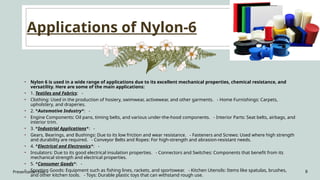
• Nylon 6 is used in a wide range of applications due to its excellent mechanical properties, chemical resistance, and
versatility. Here are some of the main applications:
• 1. Textiles and Fabrics: -
• Clothing: Used in the production of hosiery, swimwear, activewear, and other garments. - Home Furnishings: Carpets,
upholstery, and draperies.
• 2. *Automotive Industry*: -
• Engine Components: Oil pans, timing belts, and various under-the-hood components. - Interior Parts: Seat belts, airbags, and
interior trim.
• 3. *Industrial Applications*: -
• Gears, Bearings, and Bushings: Due to its low friction and wear resistance. - Fasteners and Screws: Used where high strength
and durability are required. - Conveyor Belts and Ropes: For high-strength and abrasion-resistant needs.
• 4. *Electrical and Electronics*: -
• Insulators: Due to its good electrical insulation properties. - Connectors and Switches: Components that benefit from its
mechanical strength and electrical properties.
• 5. *Consumer Goods*: -
• Sporting Goods: Equipment such as fishing lines, rackets, and sportswear. - Kitchen Utensils: Items like spatulas, brushes,
and other kitchen tools. - Toys: Durable plastic toys that can withstand rough use.
Presentation title 9
II. TEFLON
 WHAT IS TEFLON?
 PREPARATION
 PROPERTIES AND USES
Presentation title 10
What is Teflon?
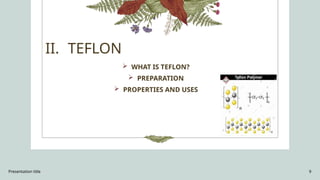
• Teflon is a synthetic fluoropolymer made up of
tetrafluoroethylene monomer. The chemical name of Teflon
is poly (1,1,2,2 tetrafluoroethylene). It is a thermoplastic
polymer. Teflon chemical formula is (C2F4)n. The Teflon
formula shows repetitive or n numbers of C2F4 units. It has
an ability to maintain high strength, toughness, and self-
lubrication at low temperatures (around 5 K), and good
flexibility at temperatures above 194 K.
Presentation title 11
Production of Teflon
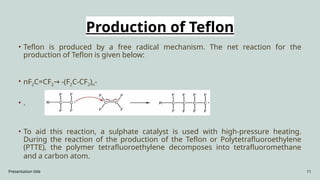
• Teflon is produced by a free radical mechanism. The net reaction for the
production of Teflon is given below:
• nF2C=CF2 -(F
→ 2C-CF2)n-
• .
• To aid this reaction, a sulphate catalyst is used with high-pressure heating.
During the reaction of the production of the Teflon or Polytetrafluoroethylene
(PTTE), the polymer tetrafluoroethylene decomposes into tetrafluoromethane
and a carbon atom.
Presentation title 12
Properties of Teflon
It is a white solid compound at room temperature.
Its density is about 2200 kg/m3
2.2 g/cm3
It shows good resistance towards heat and low temperature.
It is a chemical resistance compound, the only chemicals that can
affect these compounds are alkali metals.
Its melting point is 600 K.
It has a low water absorption capacity.
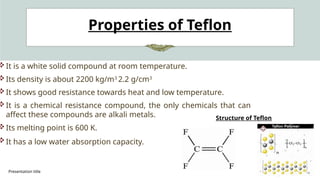
Structure of Teflon
Presentation title 13
Uses of Teflon
It is used in making waterproof fabric.
It is used in making non-stick cookware.
It is used in making an anti-friction device.
It is used for coating medical appliances (surgical devices).
Due to its high resistance to corrosion, it is used for coating
the lining of laboratory appliances.
Presentation title 14
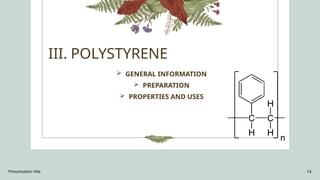
III. POLYSTYRENE
 GENERAL INFORMATION
 PREPARATION
 PROPERTIES AND USES
Presentation title 15
POLYSTYRENE
• GENERAL INFORMATION
POLYSTYRENE IS A
VERSATILE, LIGHTWEIGHT
PLASTIC COMMONLY USED
IN PACKAGING,
INSULATION, AND
DISPOSABLE FOOD
CONTAINERS.
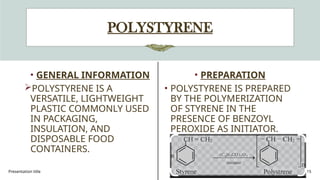
• PREPARATION
• POLYSTYRENE IS PREPARED
BY THE POLYMERIZATION
OF STYRENE IN THE
PRESENCE OF BENZOYL
PEROXIDE AS INITIATOR.
Presentation title 16
PROPERTIES
Electrical Insulation: Good dielectric properties, low dielectric constant.
Chemical Resistance: Resistant to acids and bases; dissolves in benzene
and acetone.
Non-Biodegradable: Persistent in the environment.
USES OF POLYSTYRENE
Used for preparing synthetic ion exchange resins in combination with p-
divinylbenzene.
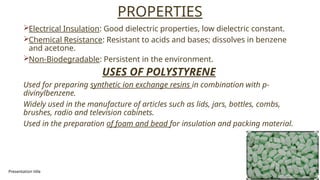
Widely used in the manufacture of articles such as lids, jars, bottles, combs,
brushes, radio and television cabinets.
Used in the preparation of foam and bead for insulation and packing material.
Presentation title 17
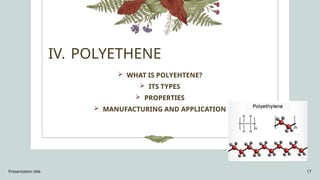
IV. POLYETHENE
 WHAT IS POLYEHTENE?
 ITS TYPES
 PROPERTIES
 MANUFACTURING AND APPLICATION
18
What is Polythene?
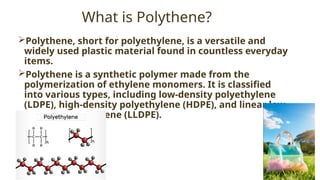
Polythene, short for polyethylene, is a versatile and
widely used plastic material found in countless everyday
items.
Polythene is a synthetic polymer made from the
polymerization of ethylene monomers. It is classified
into various types, including low-density polyethylene
(LDPE), high-density polyethylene (HDPE), and linear low-
density polyethylene (LLDPE).
Presentation title 19
TYPES OF POLYETHE
LDPE
• LDPE is flexible
and has
excellent tear
resistance,
making it ideal
for packaging
applications,
films, and bags.
HDPE
• HDPE is known
for its rigidity
and strength,
making it
suitable for
bottles, pipes,
and other
structural
components.
LLDPE
• LLDPE combines
the flexibility of
LDPE with the
strength of
HDPE, making it
suitable for both
packaging and
industrial
applications
Presentation title 20
Properties of Polyethene
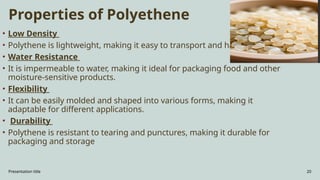
• Low Density
• Polythene is lightweight, making it easy to transport and handle.
• Water Resistance
• It is impermeable to water, making it ideal for packaging food and other
moisture-sensitive products.
• Flexibility
• It can be easily molded and shaped into various forms, making it
adaptable for different applications.
• Durability
• Polythene is resistant to tearing and punctures, making it durable for
packaging and storage
Presentation title 21
Manufacturing Process
The manufacturing process of polythene begins with the
polymerization of ethylene monomers. This process involves
several steps, including:
Ethylene Production -Ethylene gas is extracted from natural
gas or crude oil.
Polymerization - Ethylene monomers are polymerized under
high pressure and temperature to form polyethylene chains.
 Extrusion- The molten polyethylene is extruded through a die
to form the desired shape, such as sheets, films, or pipes.
 Cooling and Packaging -The extruded polythene is cooled
and packaged for distribution
Presentation title 22
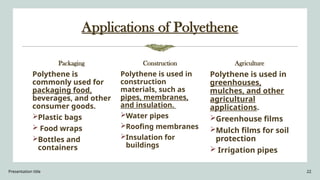
Applications of Polyethene
Packaging
Polythene is
commonly used for
packaging food,
beverages, and other
consumer goods.
Plastic bags
 Food wraps
Bottles and
containers
Construction
Polythene is used in
construction
materials, such as
pipes, membranes,
and insulation.
Water pipes
Roofing membranes
Insulation for
buildings
Agriculture
Polythene is used in
greenhouses,
mulches, and other
agricultural
applications.
Greenhouse films
Mulch films for soil
protection
 Irrigation pipes
Presentation title 23
V. LiAlH4
 INTRODUCTION
 PROPERTIES
 PREPARATION
 MECHANISM AND APPLICATIONS
Presentation title 24
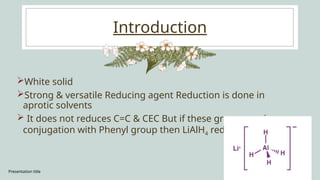
Introduction
White solid
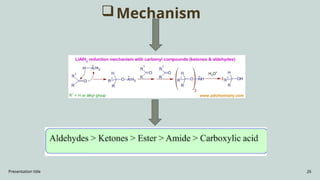
Strong & versatile Reducing agent Reduction is done in
aprotic solvents
 It does not reduces C=C & CEC But if these groups are in
conjugation with Phenyl group then LiAlH4 reduces these go.
Presentation title 25
Properties of LiAlH4
A Strong versatile reducing agent.
Highly soluble in diethyl ether.
 Decomposes at 125°c.
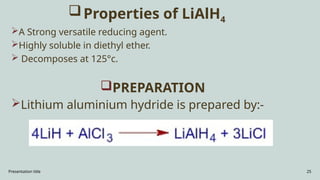
PREPARATION
Lithium aluminium hydride is prepared by:-
Presentation title 26
Mechanism
Presentation title 27
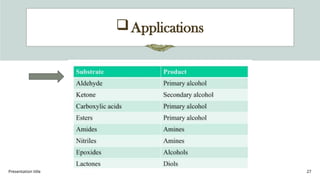
Applications
Presentation title 28
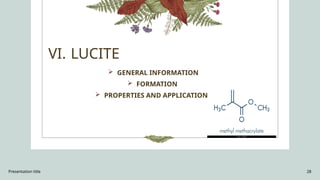
VI. LUCITE
 GENERAL INFORMATION
 FORMATION
 PROPERTIES AND APPLICATIONS
Presentation title 29
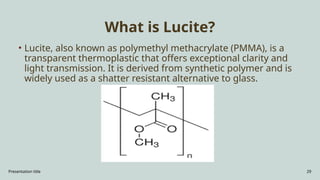
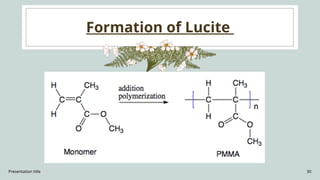
What is Lucite?
• Lucite, also known as polymethyl methacrylate (PMMA), is a
transparent thermoplastic that offers exceptional clarity and
light transmission. It is derived from synthetic polymer and is
widely used as a shatter resistant alternative to glass.
Presentation title 30
Formation of Lucite
Presentation title 31
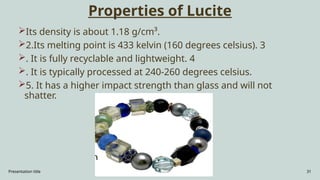
Properties of Lucite
Its density is about 1.18 g/cm³.
2.Its melting point is 433 kelvin (160 degrees celsius). 3
. It is fully recyclable and lightweight. 4
. It is typically processed at 240-260 degrees celsius.
5. It has a higher impact strength than glass and will not
shatter.
Presentation title 32
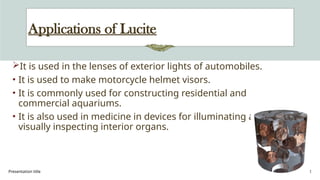
Applications of Lucite
It is used in the lenses of exterior lights of automobiles.
• It is used to make motorcycle helmet visors.
• It is commonly used for constructing residential and
commercial aquariums.
• It is also used in medicine in devices for illuminating and
visually inspecting interior organs.
Thank you
GROUP MEMBERS

INDUSTRIAL POLYMERS engineering chemistry.pptx

  • 1.
    INDUSTRIAL POLYMERS PRESENTED TO– Dr. ASHIMA SRIVASTAVA GROUP PRESENTATION
  • 2.
  • 3.
    Presentation title 3 I.NYLON-6  HISTORY  PREPARATION  PROPERTIES AND APPLICATION
  • 4.
    Presentation title 4 HISTORYOF NYLON-6 •In 1938 Paul Schlack of the IG Farben company in Germany polymerized Caprolactam and created a different form of polymer identified as Nylon-6. It is a homopolymer which is formed by ring opening chain growth polymerisation
  • 5.
    Presentation title 5 PREPARATION Nylon-6 is prepared by prolonged heating of Caprolactam at 533K- 543K.  It is formed by self condensation of a large number of molecules of amino caproic acid.  Since caprolactam is more easily available, it is used for polymerisation, which is carried out in the presence of H2Oto hydrolyse the lactum to amino acid.  Caprolactam is obtained by Beckmann rearrangement of cyclohexanone oxime.
  • 6.
    Presentation title 6 REACTIONSINVOLVED IN THE FORMATION OF NYLON-6
  • 7.
    Presentation title 7 Propertiesof Nylon-6 • Nylon 6 is a synthetic polymer and a type of polyamide. It has a variety of properties that make it useful in many applications. Here are some key properties: • High Strength: Nylon 6 is known for its high tensile strength and durability, making it suitable for applications requiring strong and long-lasting materials. • Elasticity: It has good elasticity, allowing it to stretch under stress and return to its original shape when the stress is removed. • Chemical Resistance: It is resistant to many chemicals, including oils, solvents, and fuels, which makes it suitable for use in automotive and industrial applications. • Low Friction: It has a low coefficient of friction, which is beneficial for applications involving sliding or rotating parts. • Moisture Absorption: Nylon 6 can absorb moisture from the environment, which can affect its mechanical properties. This hygroscopic nature means it can swell slightly and become more flexible when exposed to high humidity. • Thermal Stability: It has a relatively high melting point of around 220-230°C, making it suitable for applications involving elevated temperatures. • Electrical Insulation: Nylon 6 has good electrical insulating properties, which makes it useful in electrical and electronic applications.
  • 8.
    Applications of Nylon-6 Presentationtitle 8 • Nylon 6 is used in a wide range of applications due to its excellent mechanical properties, chemical resistance, and versatility. Here are some of the main applications: • 1. Textiles and Fabrics: - • Clothing: Used in the production of hosiery, swimwear, activewear, and other garments. - Home Furnishings: Carpets, upholstery, and draperies. • 2. *Automotive Industry*: - • Engine Components: Oil pans, timing belts, and various under-the-hood components. - Interior Parts: Seat belts, airbags, and interior trim. • 3. *Industrial Applications*: - • Gears, Bearings, and Bushings: Due to its low friction and wear resistance. - Fasteners and Screws: Used where high strength and durability are required. - Conveyor Belts and Ropes: For high-strength and abrasion-resistant needs. • 4. *Electrical and Electronics*: - • Insulators: Due to its good electrical insulation properties. - Connectors and Switches: Components that benefit from its mechanical strength and electrical properties. • 5. *Consumer Goods*: - • Sporting Goods: Equipment such as fishing lines, rackets, and sportswear. - Kitchen Utensils: Items like spatulas, brushes, and other kitchen tools. - Toys: Durable plastic toys that can withstand rough use.
  • 9.
    Presentation title 9 II.TEFLON  WHAT IS TEFLON?  PREPARATION  PROPERTIES AND USES
  • 10.
    Presentation title 10 Whatis Teflon? • Teflon is a synthetic fluoropolymer made up of tetrafluoroethylene monomer. The chemical name of Teflon is poly (1,1,2,2 tetrafluoroethylene). It is a thermoplastic polymer. Teflon chemical formula is (C2F4)n. The Teflon formula shows repetitive or n numbers of C2F4 units. It has an ability to maintain high strength, toughness, and self- lubrication at low temperatures (around 5 K), and good flexibility at temperatures above 194 K.
  • 11.
    Presentation title 11 Productionof Teflon • Teflon is produced by a free radical mechanism. The net reaction for the production of Teflon is given below: • nF2C=CF2 -(F → 2C-CF2)n- • . • To aid this reaction, a sulphate catalyst is used with high-pressure heating. During the reaction of the production of the Teflon or Polytetrafluoroethylene (PTTE), the polymer tetrafluoroethylene decomposes into tetrafluoromethane and a carbon atom.
  • 12.
    Presentation title 12 Propertiesof Teflon It is a white solid compound at room temperature. Its density is about 2200 kg/m3 2.2 g/cm3 It shows good resistance towards heat and low temperature. It is a chemical resistance compound, the only chemicals that can affect these compounds are alkali metals. Its melting point is 600 K. It has a low water absorption capacity. Structure of Teflon
  • 13.
    Presentation title 13 Usesof Teflon It is used in making waterproof fabric. It is used in making non-stick cookware. It is used in making an anti-friction device. It is used for coating medical appliances (surgical devices). Due to its high resistance to corrosion, it is used for coating the lining of laboratory appliances.
  • 14.
    Presentation title 14 III.POLYSTYRENE  GENERAL INFORMATION  PREPARATION  PROPERTIES AND USES
  • 15.
    Presentation title 15 POLYSTYRENE •GENERAL INFORMATION POLYSTYRENE IS A VERSATILE, LIGHTWEIGHT PLASTIC COMMONLY USED IN PACKAGING, INSULATION, AND DISPOSABLE FOOD CONTAINERS. • PREPARATION • POLYSTYRENE IS PREPARED BY THE POLYMERIZATION OF STYRENE IN THE PRESENCE OF BENZOYL PEROXIDE AS INITIATOR.
  • 16.
    Presentation title 16 PROPERTIES ElectricalInsulation: Good dielectric properties, low dielectric constant. Chemical Resistance: Resistant to acids and bases; dissolves in benzene and acetone. Non-Biodegradable: Persistent in the environment. USES OF POLYSTYRENE Used for preparing synthetic ion exchange resins in combination with p- divinylbenzene. Widely used in the manufacture of articles such as lids, jars, bottles, combs, brushes, radio and television cabinets. Used in the preparation of foam and bead for insulation and packing material.
  • 17.
    Presentation title 17 IV.POLYETHENE  WHAT IS POLYEHTENE?  ITS TYPES  PROPERTIES  MANUFACTURING AND APPLICATION
  • 18.
    18 What is Polythene? Polythene,short for polyethylene, is a versatile and widely used plastic material found in countless everyday items. Polythene is a synthetic polymer made from the polymerization of ethylene monomers. It is classified into various types, including low-density polyethylene (LDPE), high-density polyethylene (HDPE), and linear low- density polyethylene (LLDPE).
  • 19.
    Presentation title 19 TYPESOF POLYETHE LDPE • LDPE is flexible and has excellent tear resistance, making it ideal for packaging applications, films, and bags. HDPE • HDPE is known for its rigidity and strength, making it suitable for bottles, pipes, and other structural components. LLDPE • LLDPE combines the flexibility of LDPE with the strength of HDPE, making it suitable for both packaging and industrial applications
  • 20.
    Presentation title 20 Propertiesof Polyethene • Low Density • Polythene is lightweight, making it easy to transport and handle. • Water Resistance • It is impermeable to water, making it ideal for packaging food and other moisture-sensitive products. • Flexibility • It can be easily molded and shaped into various forms, making it adaptable for different applications. • Durability • Polythene is resistant to tearing and punctures, making it durable for packaging and storage
  • 21.
    Presentation title 21 ManufacturingProcess The manufacturing process of polythene begins with the polymerization of ethylene monomers. This process involves several steps, including: Ethylene Production -Ethylene gas is extracted from natural gas or crude oil. Polymerization - Ethylene monomers are polymerized under high pressure and temperature to form polyethylene chains.  Extrusion- The molten polyethylene is extruded through a die to form the desired shape, such as sheets, films, or pipes.  Cooling and Packaging -The extruded polythene is cooled and packaged for distribution
  • 22.
    Presentation title 22 Applicationsof Polyethene Packaging Polythene is commonly used for packaging food, beverages, and other consumer goods. Plastic bags  Food wraps Bottles and containers Construction Polythene is used in construction materials, such as pipes, membranes, and insulation. Water pipes Roofing membranes Insulation for buildings Agriculture Polythene is used in greenhouses, mulches, and other agricultural applications. Greenhouse films Mulch films for soil protection  Irrigation pipes
  • 23.
    Presentation title 23 V.LiAlH4  INTRODUCTION  PROPERTIES  PREPARATION  MECHANISM AND APPLICATIONS
  • 24.
    Presentation title 24 Introduction Whitesolid Strong & versatile Reducing agent Reduction is done in aprotic solvents  It does not reduces C=C & CEC But if these groups are in conjugation with Phenyl group then LiAlH4 reduces these go.
  • 25.
    Presentation title 25 Propertiesof LiAlH4 A Strong versatile reducing agent. Highly soluble in diethyl ether.  Decomposes at 125°c. PREPARATION Lithium aluminium hydride is prepared by:-
  • 26.
  • 27.
  • 28.
    Presentation title 28 VI.LUCITE  GENERAL INFORMATION  FORMATION  PROPERTIES AND APPLICATIONS
  • 29.
    Presentation title 29 Whatis Lucite? • Lucite, also known as polymethyl methacrylate (PMMA), is a transparent thermoplastic that offers exceptional clarity and light transmission. It is derived from synthetic polymer and is widely used as a shatter resistant alternative to glass.
  • 30.
  • 31.
    Presentation title 31 Propertiesof Lucite Its density is about 1.18 g/cm³. 2.Its melting point is 433 kelvin (160 degrees celsius). 3 . It is fully recyclable and lightweight. 4 . It is typically processed at 240-260 degrees celsius. 5. It has a higher impact strength than glass and will not shatter.
  • 32.
    Presentation title 32 Applicationsof Lucite It is used in the lenses of exterior lights of automobiles. • It is used to make motorcycle helmet visors. • It is commonly used for constructing residential and commercial aquariums. • It is also used in medicine in devices for illuminating and visually inspecting interior organs.
  • 33.