Chapter 7

Electrically Symmetric
Poly(Phenylene Acetylene)
Diodes
             Journal Molecular Crystals and Liquid Crystals (1994)
                              Vol. 256, pp. 555{561.

    S. A. Jeglinski, M. E. Hollier, J. F. Gold, and Z. V. Vardeny


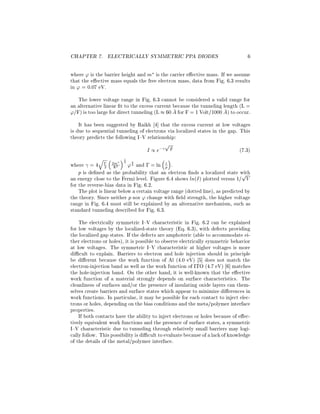
        University of Utah, Physics Department, Salt Lake City, UT 84112


                          Y. Ding and T. Barton


          Iowa State University, Chemistry Department, Ames, IA 50011


Abstract
A diode has been fabricated with poly(phenylene acetylene) [PPA] as the elec-
troluminescent polymer. The device exhibited an unusual symmetric (positive
and negative bias) I{V characteristic and electroluminescent output. These ex-
perimental results are discussed in terms of tunneling of electrons and holes via
localized states.

Introduction
Luminescent conjugated polymers have recently attracted considerable interest
because of their use as active materials in light-emitting devices (LEDs) [1].
Operation as such depends upon the ability to inject into the polymer electrons
and holes, which then recombine to emit light.

                                        1
CHAPTER 7.      ELECTRICALLY SYMMETRIC PPA DIODES                             2

Experimental Setup and Procedure
A PPA solution was made by mixing powder with CHCl3 (about 50 ml/mg).
The solution was thoroughly dissolved by immersion in an ultrasonic agitator.
The solution was then
ltered into clean glassware with a 0.2 m Nalge syringe
lter. Semitransparent ITO-coated silica plates ( 200 
/sq, 25 nm thick ITO
on 1.5 mm thick silica) were procured and cut with a diamond saw into ap-
proximately 12 2 12 mm squares. Approximately one-third of the ITO (a 4
mm strip on one end) was removed with a standard solution of aqua regia. The
substrates (2/3 ITO-silica, 1/3 silica-only) were then thoroughly cleaned by ul-
trasonic agitation in a CHCl3 bath several times, with a
nal wash in distilled
de-ionized water.
    Fabrication was accomplished by spin-casting the
ltered PPA solution onto
the prepared substrates, forming a polymer layer about 1000-1500  thick. The
                                                                 A
spin-casting and handling of the polymer/ITO substrate were performed in a
glove-box purged with nitrogen. Part of the polymer was then stripped o with
a solvent-dipped cotton swab. Aluminum electrodes were thermally evaporated
onto the PPA/ITO substrates in a vacuum chamber with an operating pressure
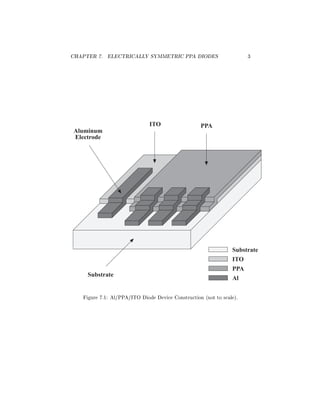
of about 8 2 1006 Torr. Figure 6.1 shows the
nal geometry of the prepared
device. The stripping procedures described above helped ensure that there was
no inadvertent shortening between the Al and the ITO.
    A Keithley 236 source-measure-unit (SMU) was interfaced to a PC and con-
nected to the aluminum electrodes with microclips. The SMU was then used to
bias the ITO layer positively and negatively with respect to the Al electrodes.
Swept measurements were made in the range from -20 to +20 Volts. All han-
dling and measurements were made either in the nitrogen-purged glove-box or
in an evacuated cryostat.

Result
A variety of results were obtained. Many devices never exhibited anything other
than resistive behavior. Some devices exhibited a nonlinear I{V characteristic
after the device was burned in by applying a constant voltage for a rela-
tively long period of time (several minutes), during which time the electrical
properties eventually settled into a repeatable pattern. Some devices exhib-
ited a well-de
ned nonlinear I{V characteristic immediately, but often would
fail rapidly unless operated while immersed in liquid nitrogen, probably due to
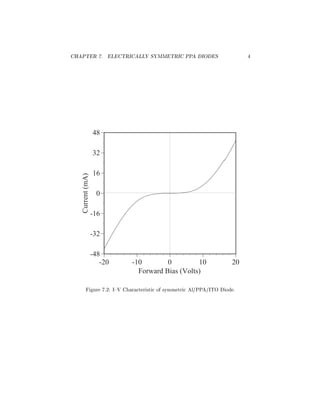
excess power dissipation in the device. Two of the devices constructed showed
a symmetric electrical characteristic, i.e., equal but opposite forward-bias and
reverse-bias behavior. This result is shown in Figure 6.2.

Electrically Symmetric Poly(Phenylene Acetylene) Diodes

  • 1.
    Chapter 7 Electrically Symmetric Poly(PhenyleneAcetylene) Diodes Journal Molecular Crystals and Liquid Crystals (1994) Vol. 256, pp. 555{561. S. A. Jeglinski, M. E. Hollier, J. F. Gold, and Z. V. Vardeny University of Utah, Physics Department, Salt Lake City, UT 84112 Y. Ding and T. Barton Iowa State University, Chemistry Department, Ames, IA 50011 Abstract A diode has been fabricated with poly(phenylene acetylene) [PPA] as the elec- troluminescent polymer. The device exhibited an unusual symmetric (positive and negative bias) I{V characteristic and electroluminescent output. These ex- perimental results are discussed in terms of tunneling of electrons and holes via localized states. Introduction Luminescent conjugated polymers have recently attracted considerable interest because of their use as active materials in light-emitting devices (LEDs) [1]. Operation as such depends upon the ability to inject into the polymer electrons and holes, which then recombine to emit light. 1
  • 2.
    CHAPTER 7. ELECTRICALLY SYMMETRIC PPA DIODES 2 Experimental Setup and Procedure A PPA solution was made by mixing powder with CHCl3 (about 50 ml/mg). The solution was thoroughly dissolved by immersion in an ultrasonic agitator. The solution was then
  • 3.
    ltered into cleanglassware with a 0.2 m Nalge syringe
  • 4.
    lter. Semitransparent ITO-coatedsilica plates ( 200 /sq, 25 nm thick ITO on 1.5 mm thick silica) were procured and cut with a diamond saw into ap- proximately 12 2 12 mm squares. Approximately one-third of the ITO (a 4 mm strip on one end) was removed with a standard solution of aqua regia. The substrates (2/3 ITO-silica, 1/3 silica-only) were then thoroughly cleaned by ul- trasonic agitation in a CHCl3 bath several times, with a
  • 5.
    nal wash indistilled de-ionized water. Fabrication was accomplished by spin-casting the
  • 6.
    ltered PPA solutiononto the prepared substrates, forming a polymer layer about 1000-1500 thick. The A spin-casting and handling of the polymer/ITO substrate were performed in a glove-box purged with nitrogen. Part of the polymer was then stripped o with a solvent-dipped cotton swab. Aluminum electrodes were thermally evaporated onto the PPA/ITO substrates in a vacuum chamber with an operating pressure of about 8 2 1006 Torr. Figure 6.1 shows the
  • 7.
    nal geometry ofthe prepared device. The stripping procedures described above helped ensure that there was no inadvertent shortening between the Al and the ITO. A Keithley 236 source-measure-unit (SMU) was interfaced to a PC and con- nected to the aluminum electrodes with microclips. The SMU was then used to bias the ITO layer positively and negatively with respect to the Al electrodes. Swept measurements were made in the range from -20 to +20 Volts. All han- dling and measurements were made either in the nitrogen-purged glove-box or in an evacuated cryostat. Result A variety of results were obtained. Many devices never exhibited anything other than resistive behavior. Some devices exhibited a nonlinear I{V characteristic after the device was burned in by applying a constant voltage for a rela- tively long period of time (several minutes), during which time the electrical properties eventually settled into a repeatable pattern. Some devices exhib- ited a well-de
  • 8.
    ned nonlinear I{Vcharacteristic immediately, but often would fail rapidly unless operated while immersed in liquid nitrogen, probably due to excess power dissipation in the device. Two of the devices constructed showed a symmetric electrical characteristic, i.e., equal but opposite forward-bias and reverse-bias behavior. This result is shown in Figure 6.2.