MPolybutylene Terephthalate (PBT)
Amina Maqbool
14MME-S1-316
5th Semester
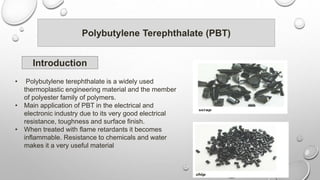
• Polybutylene terephthalate is a widely used
thermoplastic engineering material and the member
of polyester family of polymers.
• Main application of PBT in the electrical and
electronic industry due to its very good electrical
resistance, toughness and surface finish.
• When treated with flame retardants it becomes
inflammable. Resistance to chemicals and water
makes it a very useful material
POLYBUTYLENEHE TEREPHTHALATE
Introduction
Polybutylene Terephthalate (PBT)
MMMonomer
Butylene Terephthalate
Chemical Formula
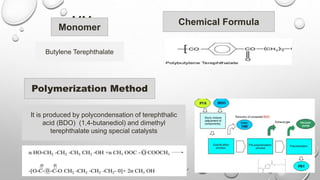
Polymerization Method
It is produced by polycondensation of terephthalic
acid (BDO) (1,4-butanediol) and dimethyl
terephthalate using special catalysts
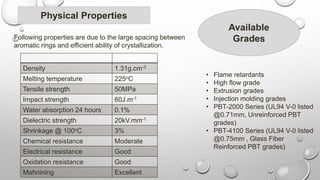
Following properties are due to the large spacing between
aromatic rings and efficient ability of crystallization.
Physical Properties
• Flame retardants
• High flow grade
• Extrusion grades
• Injection molding grades
• PBT-2000 Series (UL94 V-0 listed
@0.71mm, Unreinforced PBT
grades)
• PBT-4100 Series (UL94 V-0 listed
@0.75mm , Glass Fiber
Reinforced PBT grades)
Available
Grades
Density 1.31g.cm-3
Melting temperature 225oC
Tensile strength 50MPa
Impact strength 60J.m-1
Water absorption 24 hours 0.1%
Dielectric strength 20kV.mm-1
Shrinkage @ 100oC 3%
Chemical resistance Moderate
Electrical resistance Good
Oxidation resistance Good
Mahnining Excellent
• Injection molding (mostly used)
• Extrusion(wire, cable and fiber optics applications)
• Base resin
• PBT compound (PBT resin + fiber
glass and other additives)
Commercial Availabilty
Limitations
• Lower glass transition temperature
• Affected by boiling water
• Chemical resistance(not good for alkalis)
• Wrap when glass filler used
Processing Techniques for products
Applications
• Electrical industry
• Automotive industry
• Mirror system
• Switches
• Capacitors
• Door handles
• Computer keyboard
Production of super tough PBT based blends with
core shell structure Polyacrylic particles
• Core shell structured polyacrylic nanoparticles(CSPN) are impact modifiers
consisting of rubbery(n-butyl acrylate) core and rigid (poly methacrylate shell)
• CSPN are produced via seed emulsion polymerization
• They are melt blended with PBT to toughen it
• Impact strength and elongation at break of PBT increase dramatically
• Studying morphology of CSPN and fractured surface by scanning electron
microscope it was noted that CSPN is responsible for the impact strength
improvement of PBT. Which is 8.1 times greater than pure PBT.
Ref: Super-tough poly ( butylene
terephthalate)based blends by
modification with core-shell
structured polyacrylic
nanoparticles by Guonua Li,
Nongyue Wang, Maryam E.
Grami (15 Dec 2015)
Research Article
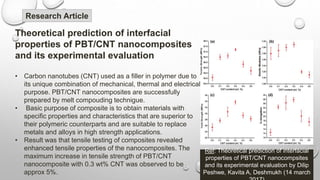
Theoretical prediction of interfacial
properties of PBT/CNT nanocomposites
and its experimental evaluation
• Carbon nanotubes (CNT) used as a filler in polymer due to
its unique combination of mechanical, thermal and electrical
purpose. PBT/CNT nanocomposites are successfully
prepared by melt compouding technigue.
• Basic purpose of composite is to obtain materials with
specific properties and characteristics that are superior to
their polymeric counterparts and are suitable to replace
metals and alloys in high strength applications.
• Result was that tensile testing of composites revealed
enhanced tensile properties of the nanocomposites. The
maximum increase in tensile strength of PBT/CNT
nanocomposite with 0.3 wt% CNT was observed to be
approx 5%.
Ref: Theoretical prediction of interfacial
properties of PBT/CNT nanocompsites
and its experimental evaluation by Dilip
Peshwe, Kavita A, Deshmukh (14 march
Research Article
Due to such vast properties of PBT it can adjust itself in many
applications (used in the automotive industry given its increasing need
for lighter, more resistant materials that require little maintenance and
are cost) which makes polybutylene terephthalate a complete
engineering material
Conclusion
Polybutylene terephthalate

Polybutylene terephthalate

  • 2.
    MPolybutylene Terephthalate (PBT) AminaMaqbool 14MME-S1-316 5th Semester
  • 3.
    • Polybutylene terephthalateis a widely used thermoplastic engineering material and the member of polyester family of polymers. • Main application of PBT in the electrical and electronic industry due to its very good electrical resistance, toughness and surface finish. • When treated with flame retardants it becomes inflammable. Resistance to chemicals and water makes it a very useful material POLYBUTYLENEHE TEREPHTHALATE Introduction Polybutylene Terephthalate (PBT)
  • 4.
    MMMonomer Butylene Terephthalate Chemical Formula PolymerizationMethod It is produced by polycondensation of terephthalic acid (BDO) (1,4-butanediol) and dimethyl terephthalate using special catalysts
  • 5.
    Following properties aredue to the large spacing between aromatic rings and efficient ability of crystallization. Physical Properties • Flame retardants • High flow grade • Extrusion grades • Injection molding grades • PBT-2000 Series (UL94 V-0 listed @0.71mm, Unreinforced PBT grades) • PBT-4100 Series (UL94 V-0 listed @0.75mm , Glass Fiber Reinforced PBT grades) Available Grades Density 1.31g.cm-3 Melting temperature 225oC Tensile strength 50MPa Impact strength 60J.m-1 Water absorption 24 hours 0.1% Dielectric strength 20kV.mm-1 Shrinkage @ 100oC 3% Chemical resistance Moderate Electrical resistance Good Oxidation resistance Good Mahnining Excellent
  • 6.
    • Injection molding(mostly used) • Extrusion(wire, cable and fiber optics applications) • Base resin • PBT compound (PBT resin + fiber glass and other additives) Commercial Availabilty Limitations • Lower glass transition temperature • Affected by boiling water • Chemical resistance(not good for alkalis) • Wrap when glass filler used Processing Techniques for products Applications • Electrical industry • Automotive industry • Mirror system • Switches • Capacitors • Door handles • Computer keyboard
  • 7.
    Production of supertough PBT based blends with core shell structure Polyacrylic particles • Core shell structured polyacrylic nanoparticles(CSPN) are impact modifiers consisting of rubbery(n-butyl acrylate) core and rigid (poly methacrylate shell) • CSPN are produced via seed emulsion polymerization • They are melt blended with PBT to toughen it • Impact strength and elongation at break of PBT increase dramatically • Studying morphology of CSPN and fractured surface by scanning electron microscope it was noted that CSPN is responsible for the impact strength improvement of PBT. Which is 8.1 times greater than pure PBT. Ref: Super-tough poly ( butylene terephthalate)based blends by modification with core-shell structured polyacrylic nanoparticles by Guonua Li, Nongyue Wang, Maryam E. Grami (15 Dec 2015) Research Article
  • 8.
    Theoretical prediction ofinterfacial properties of PBT/CNT nanocomposites and its experimental evaluation • Carbon nanotubes (CNT) used as a filler in polymer due to its unique combination of mechanical, thermal and electrical purpose. PBT/CNT nanocomposites are successfully prepared by melt compouding technigue. • Basic purpose of composite is to obtain materials with specific properties and characteristics that are superior to their polymeric counterparts and are suitable to replace metals and alloys in high strength applications. • Result was that tensile testing of composites revealed enhanced tensile properties of the nanocomposites. The maximum increase in tensile strength of PBT/CNT nanocomposite with 0.3 wt% CNT was observed to be approx 5%. Ref: Theoretical prediction of interfacial properties of PBT/CNT nanocompsites and its experimental evaluation by Dilip Peshwe, Kavita A, Deshmukh (14 march Research Article
  • 9.
    Due to suchvast properties of PBT it can adjust itself in many applications (used in the automotive industry given its increasing need for lighter, more resistant materials that require little maintenance and are cost) which makes polybutylene terephthalate a complete engineering material Conclusion