POLYBUTADIENE
Mohsin Hussain
M14-341
5th Semester (Morning)
College of Engineering & Emerging Technologies
University of the Punjab
 OBJECTIVES
• What is Polybutadiene?
• Monomer & polymerization method
• Processing techniques & types
• Properties
• Applications
• Research articles
• Conclusion
 INTRODUCTION
 In 1910 , it was firstly polymerized by a Russian chemist named Sergei Lebedev.
 Polybutadiene is an elastomeric synthetic rubber and a homopolymer of 1,3 Butadiene
monomer. Due to it’s high abrasion(wear) resistance, it is accounted for approximately a
quarter of total consumption of synthetic rubber in 2012. About 70 % of this polymer is used
in the manufacturing of tires and rest of it used to increase the mechanical strength of
plastics and other polymers.
 Monomer 
 Molecular Formula  C4H6
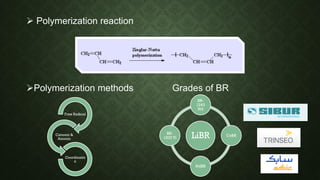
 Polymerization reaction
Polymerization methods Grades of BR
Free Radical
Cationic &
Anionic
Coordinatio
n
LiBR
BR-
1243
Nd
CoBR
NdBR
BR-
1203 Ti
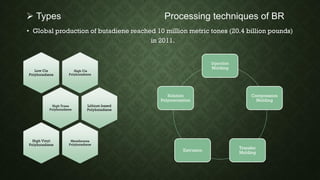
 Types Processing techniques of BR
• Global production of butadiene reached 10 million metric tones (20.4 billion pounds)
in 2011.
High Cis
Polybutadiene
Low Cis
Polybutadiene
High Trans
Polybutadiene
Lithium based
Polybutadiene
Metallocene
Polybutadiene
High Vinyl
Polybutadiene
Injection
Molding
Compression
Molding
Transfer
Molding
Extrusion
Solution
Polymerization
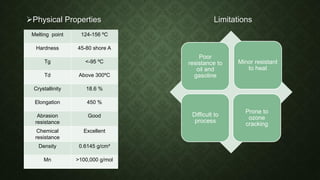
Physical Properties Limitations
Melting point 124-156 ºC
Hardness 45-80 shore A
Tg <-95 ºC
Td Above 300ºC
Crystallinity 18.6 %
Elongation 450 %
Abrasion
resistance
Good
Chemical
resistance
Excellent
Density 0.6145 g/cm³
Mn >100,000 g/mol
Poor
resistance to
oil and
gasoline
Minor resistant
to heat
Difficult to
process
Prone to
ozone
cracking
 COMMERCIAL AVAILABILITY OF BR
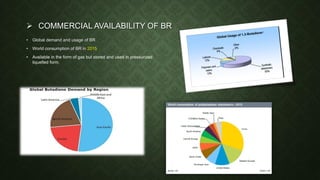
• Global demand and usage of BR
• World consumption of BR in 2015
• Available in the form of gas but stored and used in pressurized
liquefied form.
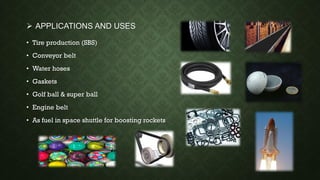
 APPLICATIONS AND USES
• Tire production (SBS)
• Conveyor belt
• Water hoses
• Gaskets
• Golf ball & super ball
• Engine belt
• As fuel in space shuttle for boosting rockets
 Sepiolite is a porous mineral exist in the form of fibers and
prepared by dry flow method. Average diameter of sepiolite is
less than 100 nm.
 Coupling agents like NDZ-201 (Isopropyl tri (dioctylphosphate)
titnate) and KH-560 (ᵞ-(2,3 epoxypropoxy)
propyltrimethoxysilane) are used with Cis-PBR as fillers .
Dumbbell shape samples were prepared and tested under at
UTTM.
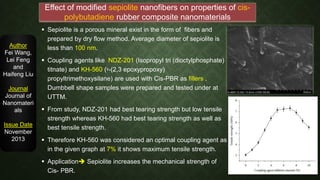
 From study, NDZ-201 had best tearing strength but low tensile
strength whereas KH-560 had best tearing strength as well as
best tensile strength.
 Therefore KH-560 was considered an optimal coupling agent as
in the given graph at 7% it shows maximum tensile strength.
 Application Sepiolite increases the mechanical strength of
Cis- PBR.
Author
Fei Wang,
Lei Feng
and
Haifeng Liu
Journal
Journal of
Nanomateri
als
Issue Date
November
2013
Effect of modified sepiolite nanofibers on properties of cis-
polybutadiene rubber composite nanomaterials
• In the presence of potassium persulfate,
disproportionate rosinate potassium emulsifiers and t-
dodecyl mercaptane as initiator for polymerization.
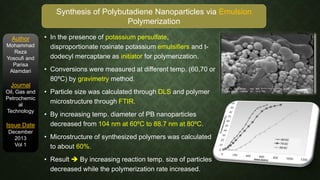
• Conversions were measured at different temp. (60,70 or
80ºC) by gravimetry method.
• Particle size was calculated through DLS and polymer
microstructure through FTIR.
• By increasing temp. diameter of PB nanoparticles
decreased from 104 nm at 60ºC to 88.7 nm at 80ºC.
• Microstructure of synthesized polymers was calculated
to about 60%.
• Result  By increasing reaction temp. size of particles
decreased while the polymerization rate increased.
Synthesis of Polybutadiene Nanoparticles via Emulsion
Polymerization
Author
Mohammad
Reza
Yosoufi and
Parisa
Alamdari
Journal
Oil, Gas and
Petrochemic
al
Technology
Issue Date
December
2013
Vol 1
 CONCLUSION
Polybutadiene is and will continue to be a high volume rubber for use in tires, toughened
plastics, and golf balls due to its low cost, availability and unique properties. As new
markets develop, there will be a need to develop new, higher performance grades of BR.
Thankyou for listening :D
Keep Calm and Don’t ask any Question 

Polybutadiene

  • 1.
    POLYBUTADIENE Mohsin Hussain M14-341 5th Semester(Morning) College of Engineering & Emerging Technologies University of the Punjab
  • 2.
     OBJECTIVES • Whatis Polybutadiene? • Monomer & polymerization method • Processing techniques & types • Properties • Applications • Research articles • Conclusion
  • 3.
     INTRODUCTION  In1910 , it was firstly polymerized by a Russian chemist named Sergei Lebedev.  Polybutadiene is an elastomeric synthetic rubber and a homopolymer of 1,3 Butadiene monomer. Due to it’s high abrasion(wear) resistance, it is accounted for approximately a quarter of total consumption of synthetic rubber in 2012. About 70 % of this polymer is used in the manufacturing of tires and rest of it used to increase the mechanical strength of plastics and other polymers.  Monomer   Molecular Formula  C4H6
  • 4.
     Polymerization reaction Polymerizationmethods Grades of BR Free Radical Cationic & Anionic Coordinatio n LiBR BR- 1243 Nd CoBR NdBR BR- 1203 Ti
  • 5.
     Types Processingtechniques of BR • Global production of butadiene reached 10 million metric tones (20.4 billion pounds) in 2011. High Cis Polybutadiene Low Cis Polybutadiene High Trans Polybutadiene Lithium based Polybutadiene Metallocene Polybutadiene High Vinyl Polybutadiene Injection Molding Compression Molding Transfer Molding Extrusion Solution Polymerization
  • 6.
    Physical Properties Limitations Meltingpoint 124-156 ºC Hardness 45-80 shore A Tg <-95 ºC Td Above 300ºC Crystallinity 18.6 % Elongation 450 % Abrasion resistance Good Chemical resistance Excellent Density 0.6145 g/cm³ Mn >100,000 g/mol Poor resistance to oil and gasoline Minor resistant to heat Difficult to process Prone to ozone cracking
  • 7.
     COMMERCIAL AVAILABILITYOF BR • Global demand and usage of BR • World consumption of BR in 2015 • Available in the form of gas but stored and used in pressurized liquefied form.
  • 8.
     APPLICATIONS ANDUSES • Tire production (SBS) • Conveyor belt • Water hoses • Gaskets • Golf ball & super ball • Engine belt • As fuel in space shuttle for boosting rockets
  • 9.
     Sepiolite isa porous mineral exist in the form of fibers and prepared by dry flow method. Average diameter of sepiolite is less than 100 nm.  Coupling agents like NDZ-201 (Isopropyl tri (dioctylphosphate) titnate) and KH-560 (ᵞ-(2,3 epoxypropoxy) propyltrimethoxysilane) are used with Cis-PBR as fillers . Dumbbell shape samples were prepared and tested under at UTTM.  From study, NDZ-201 had best tearing strength but low tensile strength whereas KH-560 had best tearing strength as well as best tensile strength.  Therefore KH-560 was considered an optimal coupling agent as in the given graph at 7% it shows maximum tensile strength.  Application Sepiolite increases the mechanical strength of Cis- PBR. Author Fei Wang, Lei Feng and Haifeng Liu Journal Journal of Nanomateri als Issue Date November 2013 Effect of modified sepiolite nanofibers on properties of cis- polybutadiene rubber composite nanomaterials
  • 10.
    • In thepresence of potassium persulfate, disproportionate rosinate potassium emulsifiers and t- dodecyl mercaptane as initiator for polymerization. • Conversions were measured at different temp. (60,70 or 80ºC) by gravimetry method. • Particle size was calculated through DLS and polymer microstructure through FTIR. • By increasing temp. diameter of PB nanoparticles decreased from 104 nm at 60ºC to 88.7 nm at 80ºC. • Microstructure of synthesized polymers was calculated to about 60%. • Result  By increasing reaction temp. size of particles decreased while the polymerization rate increased. Synthesis of Polybutadiene Nanoparticles via Emulsion Polymerization Author Mohammad Reza Yosoufi and Parisa Alamdari Journal Oil, Gas and Petrochemic al Technology Issue Date December 2013 Vol 1
  • 11.
     CONCLUSION Polybutadiene isand will continue to be a high volume rubber for use in tires, toughened plastics, and golf balls due to its low cost, availability and unique properties. As new markets develop, there will be a need to develop new, higher performance grades of BR. Thankyou for listening :D Keep Calm and Don’t ask any Question 