POLYMERIZATI 
ON 
TECHNIQUES
POLYMERIZATION TECHNIQUES 
1. Addition polymerization 
Bulk polymerization 
Solution polymerization 
Suspension polymerization 
Emulsion polymerization 
1. Condensation polymerization 
Melt polycondensation 
Solution polycondensation
BULK POLYMERIZATION 
• Mass or block polymerization: Polymerization of the 
undiluted monomer. 
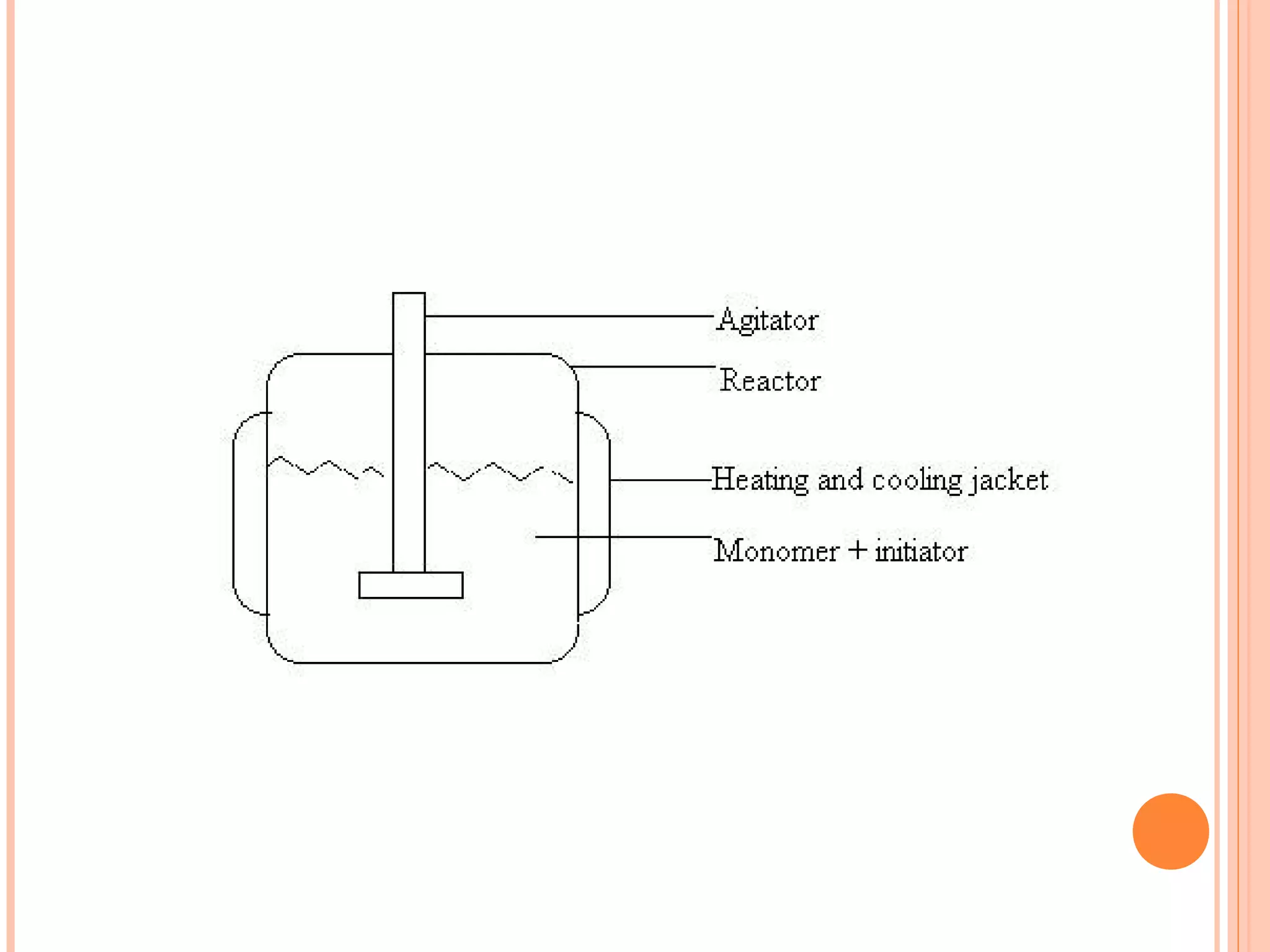
• carried out by adding a soluble initiator to 
pure monomer (in liquid state). 
• The mixture is constantly agitated & heated to 
polymerization temperature. 
• Once the reaction starts, heating is stopped as the 
reaction is exothermic. 
• The heat generated is dissipated by circulating water 
jacket. 
• Viscosity increases dramatically during conversion.
BULK POLYMERIZATION 
• The method is used for the polymerization of liquid 
state monomers. 
• It is usually adopted to produce polystyrene, 
polyvinyl chloride, polymethyl methacrylate and low 
density polyethylene.
Advantages Disadvantages 
• The system is simple and 
requires thermal insulation. 
• The polymer is obtained pure. 
• Large castings may be 
prepared directly. 
• Molecular weight 
distribution can be easily 
changed with the use of a 
chain transfer agent. 
• Heat transfer and mixing 
become difficult as the 
viscosity of reaction mass 
increases. 
• Highly exothermic. 
• The polymerization is 
obtained with a 
broad molecular weight 
distribution due to the 
high viscosity and lack of 
good heat transfer. 
• Very low molecular weights 
are obtained.
SOLUTION POLYMERIZATION 
 Some disadvantages of bulk polymerization are 
eliminated in solution polymerization. 
Monomer along with initiator dissolved in solvent, 
formed polymer stays dissolved. 
 The mixture is kept at polymerizaion temperature & 
constantly agitated. 
Depending on concentration of monomer the viscosity 
of solution does not increase.
SOLUTION POLYMERIZATION 
After the reaction is over, the polymer is used as such 
in the form of polymer solution or the polymer is 
isolated by evaporating the solvent. 
 Polymer so formed can be used for surface coating. 
 It is used for the production of Polyacrylonitrile, PVC, 
Polyacrylic acid, Polyacrylamide, Polyvinyl alcohol, 
PMMA, Polybutadiene, etc
Advantages 
• The solvent acts as a diluent & helps in facilitating 
continuous transfer of heat of polymerization. 
Therefore temperature control is easy. 
• The solvent allows easy stirring as it decreases the 
viscosity of reaction mixture. 
• Solvent also facilitates the ease of removal of polymer 
from the reactor. 
• Viscosity build up is negligible.
Disadvantages 
• To get pure polymer, evaporation of solvent is required 
additional technology, so it is essential to separate & 
recover the solvent. 
• The method is costly since it uses costly solvents. 
• Polymers of high molecular weight polymers cannot be 
formed as the solvent molecules may act as chain 
terminators. 
• The technique gives a smaller yield of polymer per 
reactor volume, as the solvent waste the reactor space. 
• The purity of product is also not as high as that of bulk 
polymerization. Removal of last traces of solvent is 
difficult.
SUSPENSION POLYMERIZATION 
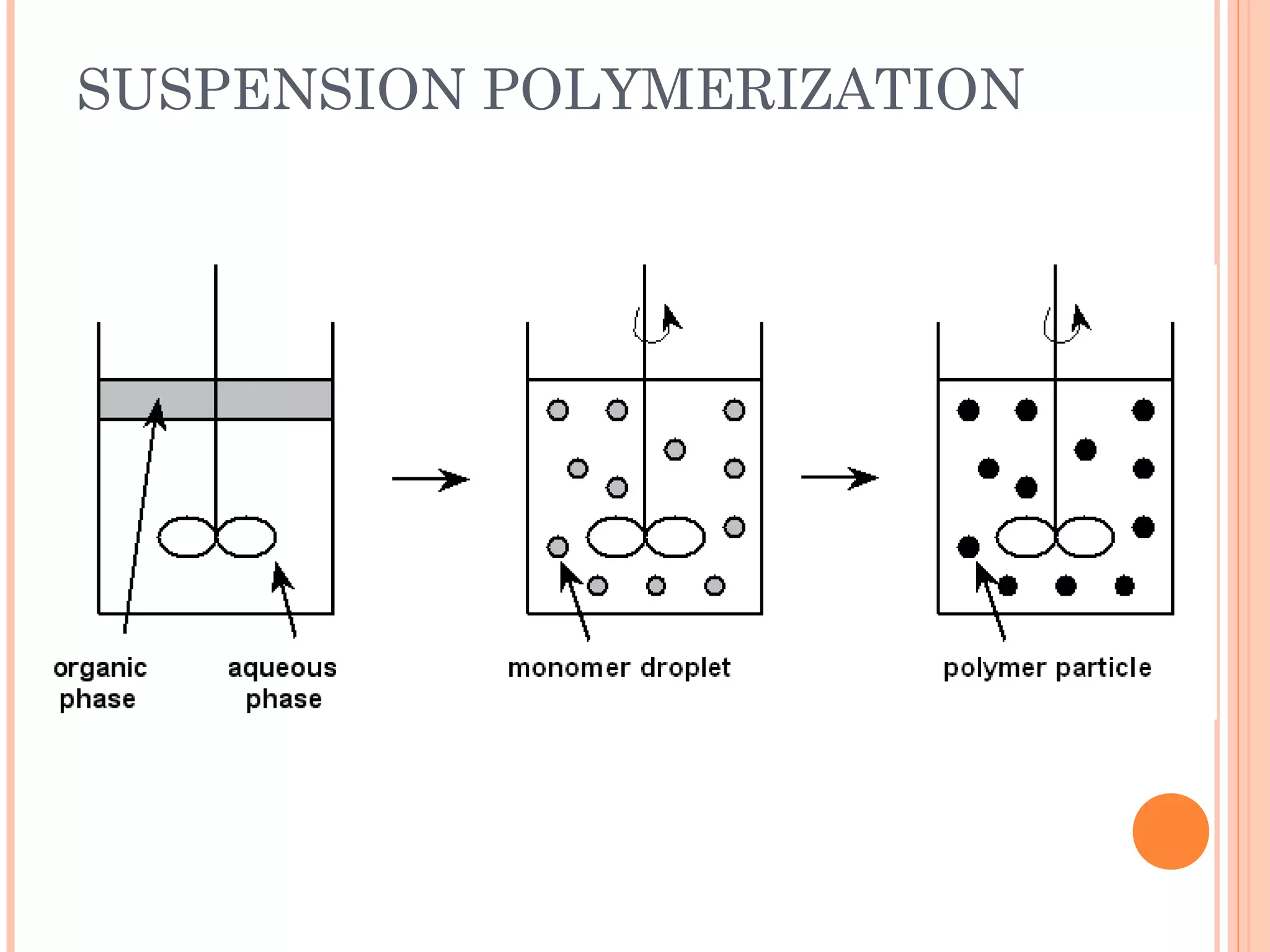
Liquid or dissolved monomer suspended in liquid 
phase like water. 
Initiators used are monomer soluble e.g. dibenzoyl 
peroxide. 
Thus, polymer is produced in heterogeneous medium. 
Initiator 
The size of monomer droplets is 50-200 μm in 
diameter. 
The dispersion is maintained by continuous agitation 
and the droplets are prevented to coalesce (unite or 
merge) by adding small quantity of stabilizers.
SUSPENSION POLYMERIZATION 
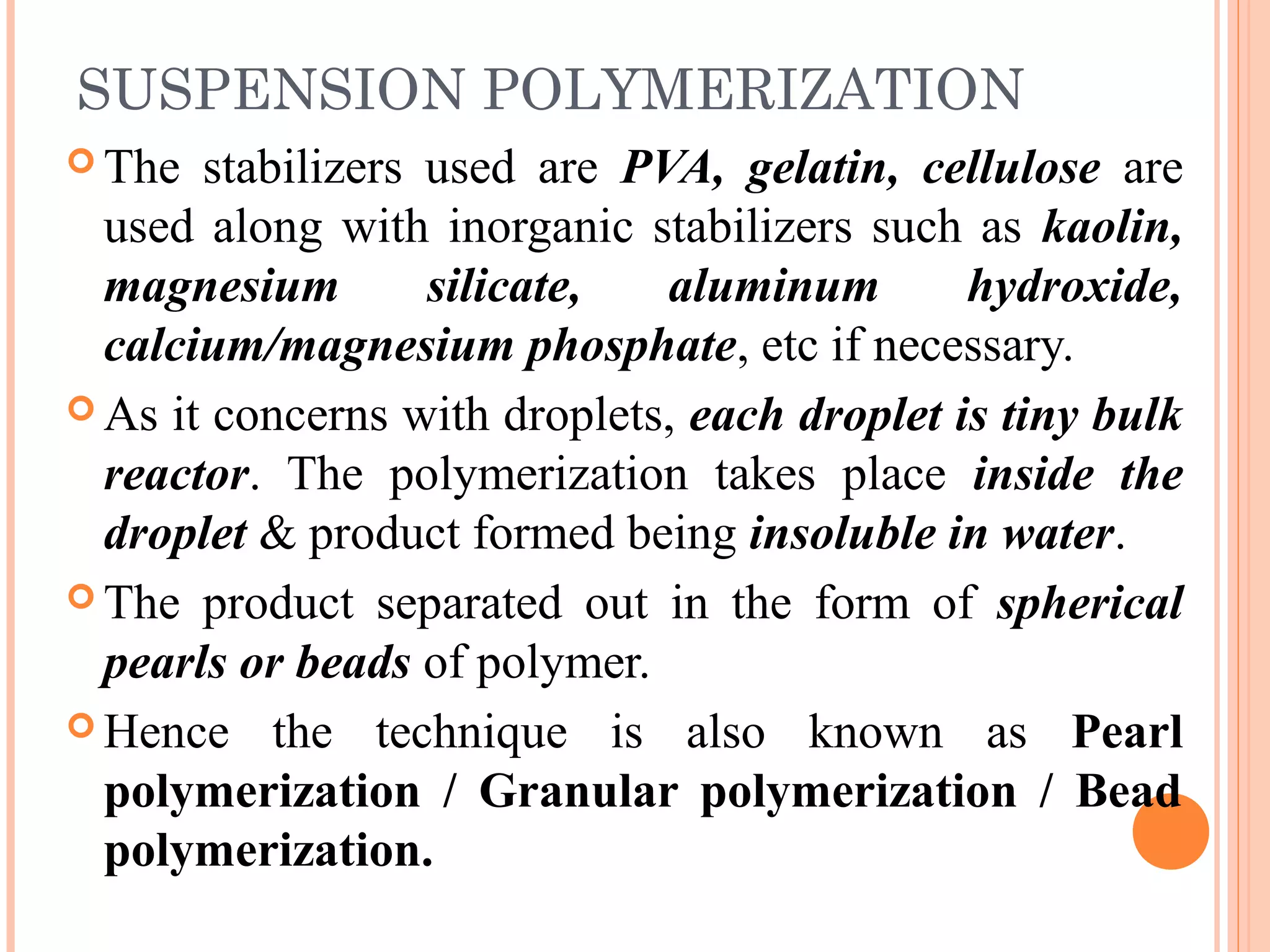
The stabilizers used are PVA, gelatin, cellulose are 
used along with inorganic stabilizers such as kaolin, 
magnesium silicate, aluminum hydroxide, 
calcium/magnesium phosphate, etc if necessary. 
As it concerns with droplets, each droplet is tiny bulk 
reactor. The polymerization takes place inside the 
droplet & product formed being insoluble in water. 
The product separated out in the form of spherical 
pearls or beads of polymer. 
Hence the technique is also known as Pearl 
polymerization / Granular polymerization / Bead 
polymerization.
SUSPENSION POLYMERIZATION 
The products are small uniform spheres. They can be 
used directly for some applications as precursors of 
ion exchange resins otherwise they can be extruded & 
chopped to form larger, easily moulded pallets. 
They can be dissolved in a suitable medium for use as 
adhesives & coatings. 
This technique is used to form PVC, Polyvinyl 
acetate, Polystyrene, Styrene-divinyl benzene 
copolymer beads (used for ion exchange) etc.
SUSPENSION POLYMERIZATION
Advantages 
• The process is comparatively cheap as it involves only 
water instead of solvents. 
• Viscosity increase is negligible. 
• Agitation & temperature control is easy. 
• Product isolation is easy since the product is insoluble 
in water.
Disadvantages 
• The method can be adopted only for water insoluble 
monomers. 
• It is difficult to control polymer size. 
• Polymer purity is low due to the presence of suspending 
& stabilizing additives that are difficult to remove 
completely. 
• Suspension polymerization reaction is highly agitation 
sensitive. 
• Larger volume of reactor is taken up by water. 
• The method cannot be used for tacky polymers such as 
elastomers because of the tendency for agglomeration of 
polymer particles.
EMULSION POLYMERIZATION 
The technique is used for the production of large 
number of commercial plastics & elastomers. 
The system consists of water insoluble monomer, 
dispersion medium & emulsifying agents or 
surfactants (soaps and detergents) and a water soluble 
initiator (potassium persulphate / H2O2, etc). 
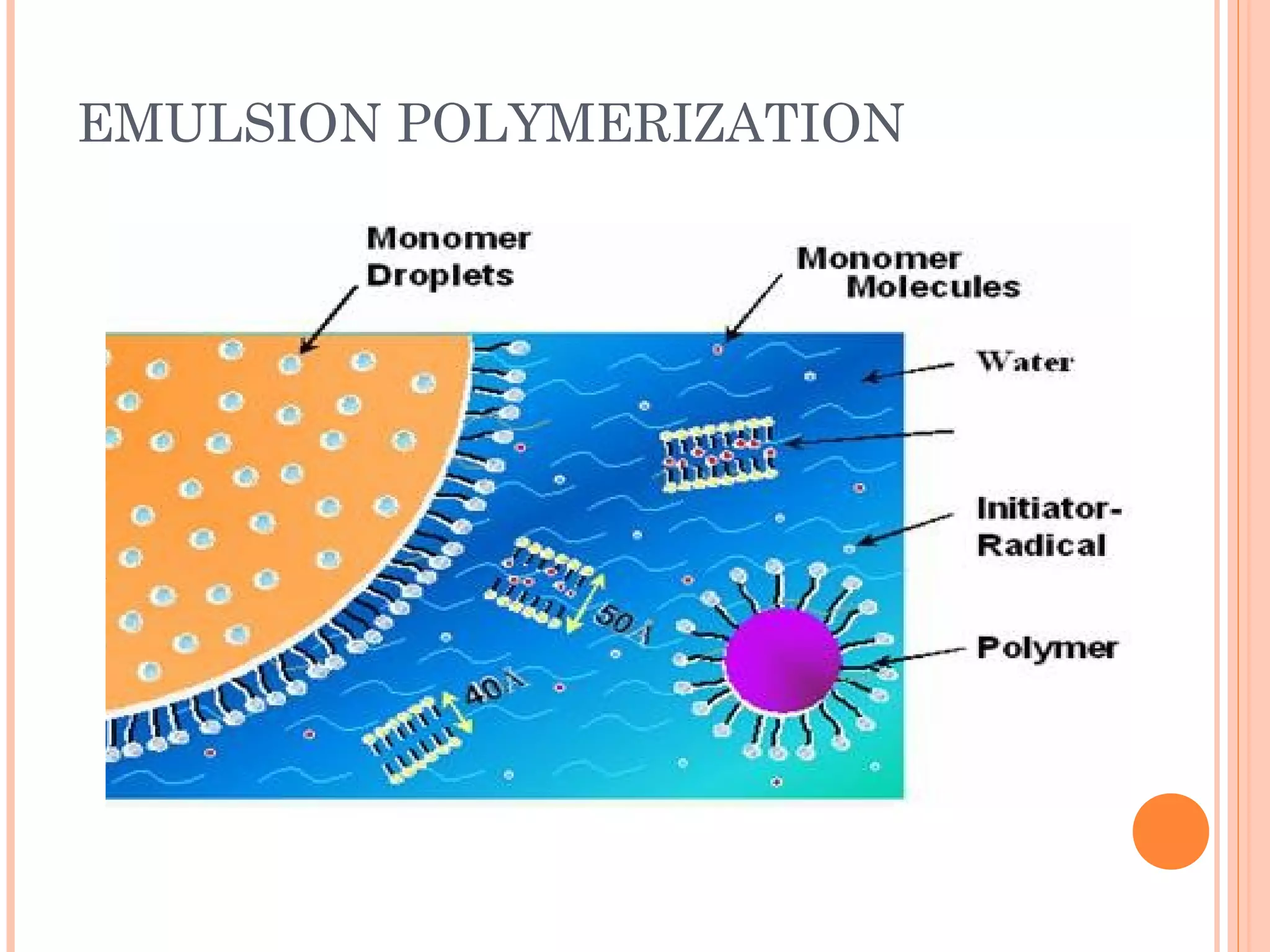
The monomer is dispersed in the aqueous phase, not 
as a discrete droplets, but as a uniform emulsion. 
The size of monomer droplet is around 0.5 to 10 μm 
in diameter depending upon the polymerization 
temperature & rate of agitation.
EMULSION POLYMERIZATION 
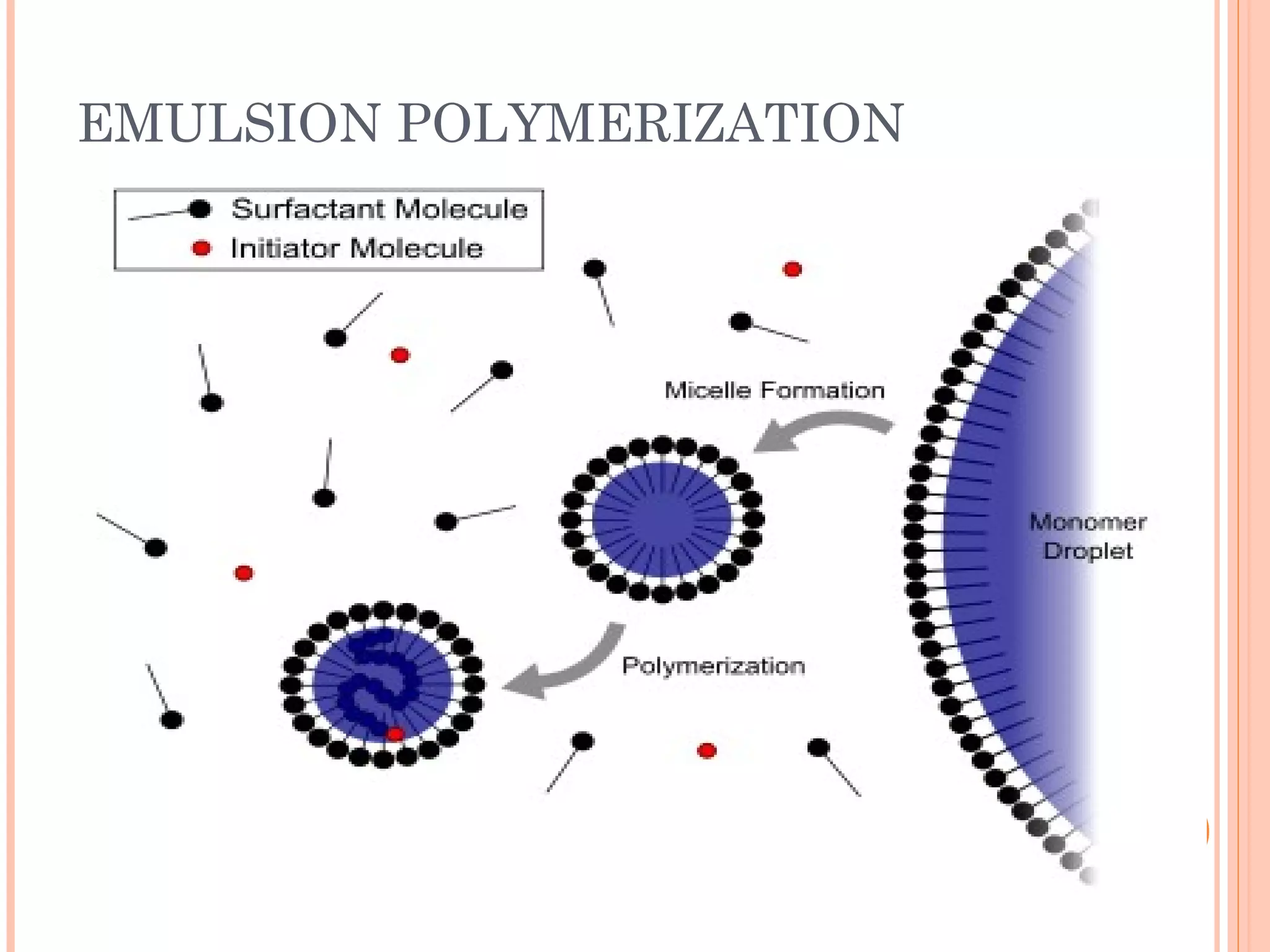
The emulsion of monomer in water is stabilized by a 
surfactant. 
A surfactant has a hydrophilic and hydrophobic end in 
its structure. 
When it is put into a water, the surfactant molecules 
gather together into aggregates called micelles. 
The hydrocarbon tails (hydrophobic) orient inwards & 
heads (hydrophilic) orient outwards into water. 
The monomer molecules diffuse from monomer 
droplets to water & from water to the hydrocarbon 
centre of micelles.
EMULSION POLYMERIZATION
EMULSION POLYMERIZATION 
• Water 
• Monomer 
• Surfactant 
Examples: 
• Synthetic rubber-styrene-butadiene (SBR), Polybutadiene, 
Polychloroprene. 
• Plastics-PVC, polystyrene, Acrylonitrile-butadiene-styrene 
terpolymer (ABS). 
• Dispersions-polyvinyl acetate, polyvinyl acetate copolymers, 
latexacrylic paint, Styrene-butadiene, VAE
Advantages Disadvantages 
 High molecular 
weight polymers 
 fast polymerization rates. 
 allows removal of heat from 
the system. 
 viscosity remains close to 
that of water and is not 
dependent on molecular 
weight. 
 The final product can be used 
as such ,does not need to be 
altered or processed 
 Surfactants and polymerization 
adjuvants -difficult to remove 
 For dry (isolated) polymers, 
water removal is an energy-intensive 
process 
 Designed to operate at high 
conversion of monomer to 
polymer. This can result in 
significant chain transfer to 
polymer. 
 Can not be used for 
condensation, ionic or Ziegler- 
Natta polymerization.

Polymerization techniques

  • 1.
  • 2.
    POLYMERIZATION TECHNIQUES 1.Addition polymerization Bulk polymerization Solution polymerization Suspension polymerization Emulsion polymerization 1. Condensation polymerization Melt polycondensation Solution polycondensation
  • 3.
    BULK POLYMERIZATION •Mass or block polymerization: Polymerization of the undiluted monomer. • carried out by adding a soluble initiator to pure monomer (in liquid state). • The mixture is constantly agitated & heated to polymerization temperature. • Once the reaction starts, heating is stopped as the reaction is exothermic. • The heat generated is dissipated by circulating water jacket. • Viscosity increases dramatically during conversion.
  • 4.
    BULK POLYMERIZATION •The method is used for the polymerization of liquid state monomers. • It is usually adopted to produce polystyrene, polyvinyl chloride, polymethyl methacrylate and low density polyethylene.
  • 6.
    Advantages Disadvantages •The system is simple and requires thermal insulation. • The polymer is obtained pure. • Large castings may be prepared directly. • Molecular weight distribution can be easily changed with the use of a chain transfer agent. • Heat transfer and mixing become difficult as the viscosity of reaction mass increases. • Highly exothermic. • The polymerization is obtained with a broad molecular weight distribution due to the high viscosity and lack of good heat transfer. • Very low molecular weights are obtained.
  • 7.
    SOLUTION POLYMERIZATION Some disadvantages of bulk polymerization are eliminated in solution polymerization. Monomer along with initiator dissolved in solvent, formed polymer stays dissolved.  The mixture is kept at polymerizaion temperature & constantly agitated. Depending on concentration of monomer the viscosity of solution does not increase.
  • 8.
    SOLUTION POLYMERIZATION Afterthe reaction is over, the polymer is used as such in the form of polymer solution or the polymer is isolated by evaporating the solvent.  Polymer so formed can be used for surface coating.  It is used for the production of Polyacrylonitrile, PVC, Polyacrylic acid, Polyacrylamide, Polyvinyl alcohol, PMMA, Polybutadiene, etc
  • 11.
    Advantages • Thesolvent acts as a diluent & helps in facilitating continuous transfer of heat of polymerization. Therefore temperature control is easy. • The solvent allows easy stirring as it decreases the viscosity of reaction mixture. • Solvent also facilitates the ease of removal of polymer from the reactor. • Viscosity build up is negligible.
  • 12.
    Disadvantages • Toget pure polymer, evaporation of solvent is required additional technology, so it is essential to separate & recover the solvent. • The method is costly since it uses costly solvents. • Polymers of high molecular weight polymers cannot be formed as the solvent molecules may act as chain terminators. • The technique gives a smaller yield of polymer per reactor volume, as the solvent waste the reactor space. • The purity of product is also not as high as that of bulk polymerization. Removal of last traces of solvent is difficult.
  • 13.
    SUSPENSION POLYMERIZATION Liquidor dissolved monomer suspended in liquid phase like water. Initiators used are monomer soluble e.g. dibenzoyl peroxide. Thus, polymer is produced in heterogeneous medium. Initiator The size of monomer droplets is 50-200 μm in diameter. The dispersion is maintained by continuous agitation and the droplets are prevented to coalesce (unite or merge) by adding small quantity of stabilizers.
  • 14.
    SUSPENSION POLYMERIZATION Thestabilizers used are PVA, gelatin, cellulose are used along with inorganic stabilizers such as kaolin, magnesium silicate, aluminum hydroxide, calcium/magnesium phosphate, etc if necessary. As it concerns with droplets, each droplet is tiny bulk reactor. The polymerization takes place inside the droplet & product formed being insoluble in water. The product separated out in the form of spherical pearls or beads of polymer. Hence the technique is also known as Pearl polymerization / Granular polymerization / Bead polymerization.
  • 15.
    SUSPENSION POLYMERIZATION Theproducts are small uniform spheres. They can be used directly for some applications as precursors of ion exchange resins otherwise they can be extruded & chopped to form larger, easily moulded pallets. They can be dissolved in a suitable medium for use as adhesives & coatings. This technique is used to form PVC, Polyvinyl acetate, Polystyrene, Styrene-divinyl benzene copolymer beads (used for ion exchange) etc.
  • 16.
  • 17.
    Advantages • Theprocess is comparatively cheap as it involves only water instead of solvents. • Viscosity increase is negligible. • Agitation & temperature control is easy. • Product isolation is easy since the product is insoluble in water.
  • 18.
    Disadvantages • Themethod can be adopted only for water insoluble monomers. • It is difficult to control polymer size. • Polymer purity is low due to the presence of suspending & stabilizing additives that are difficult to remove completely. • Suspension polymerization reaction is highly agitation sensitive. • Larger volume of reactor is taken up by water. • The method cannot be used for tacky polymers such as elastomers because of the tendency for agglomeration of polymer particles.
  • 19.
    EMULSION POLYMERIZATION Thetechnique is used for the production of large number of commercial plastics & elastomers. The system consists of water insoluble monomer, dispersion medium & emulsifying agents or surfactants (soaps and detergents) and a water soluble initiator (potassium persulphate / H2O2, etc). The monomer is dispersed in the aqueous phase, not as a discrete droplets, but as a uniform emulsion. The size of monomer droplet is around 0.5 to 10 μm in diameter depending upon the polymerization temperature & rate of agitation.
  • 20.
    EMULSION POLYMERIZATION Theemulsion of monomer in water is stabilized by a surfactant. A surfactant has a hydrophilic and hydrophobic end in its structure. When it is put into a water, the surfactant molecules gather together into aggregates called micelles. The hydrocarbon tails (hydrophobic) orient inwards & heads (hydrophilic) orient outwards into water. The monomer molecules diffuse from monomer droplets to water & from water to the hydrocarbon centre of micelles.
  • 21.
  • 22.
  • 23.
    EMULSION POLYMERIZATION •Water • Monomer • Surfactant Examples: • Synthetic rubber-styrene-butadiene (SBR), Polybutadiene, Polychloroprene. • Plastics-PVC, polystyrene, Acrylonitrile-butadiene-styrene terpolymer (ABS). • Dispersions-polyvinyl acetate, polyvinyl acetate copolymers, latexacrylic paint, Styrene-butadiene, VAE
  • 24.
    Advantages Disadvantages High molecular weight polymers  fast polymerization rates.  allows removal of heat from the system.  viscosity remains close to that of water and is not dependent on molecular weight.  The final product can be used as such ,does not need to be altered or processed  Surfactants and polymerization adjuvants -difficult to remove  For dry (isolated) polymers, water removal is an energy-intensive process  Designed to operate at high conversion of monomer to polymer. This can result in significant chain transfer to polymer.  Can not be used for condensation, ionic or Ziegler- Natta polymerization.