Lec 27- Polyploidy breeding- classification-
induction of polyploidy- achievements and
limitations
Introduction
• Somatic chromosome number - 2n
• Chromosome number of gametes – n
• An individual carrying the gametic chromosome
number, n, is known as haploid
• Monoploid – basic chromosome number- gametic
chromosome number of true diploid species- x
• Diploid species, n = x; one x constitutes a genome
or chromosome complement.
 Polyploids refers to any organism in which the
number of chromosome sets exceeds two
 Larger cells than diploids
 These larger cell sizes contribute to larger plant size
and higher yield
 Polyploids have generally larger, thicker and darker
green leaves, bigger flowers, fruits than the diploids
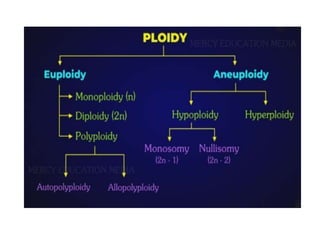
Polyploids
Euploids
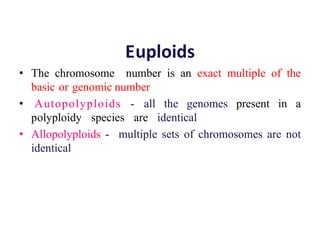
• The chromosome number is an exact multiple of the
basic or genomic number
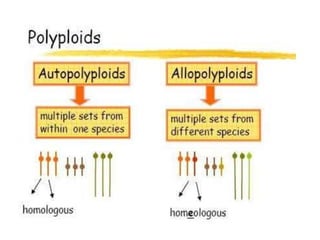
• Autopolyploids - all the genomes present in a
polyploidy species are identical
• Allopolyploids - multiple sets of chromosomes are not
identical
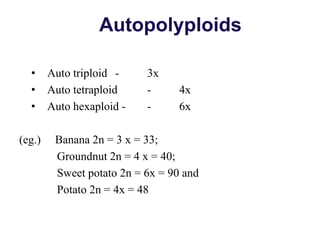
• Auto triploid - 3x
• Auto tetraploid - 4x
• Auto hexaploid - - 6x
(eg.) Banana 2n = 3 x = 33;
Groundnut 2n = 4 x = 40;
Sweet potato 2n = 6x = 90 and
Potato 2n = 4x = 48
Autopolyploids
Autotriploid
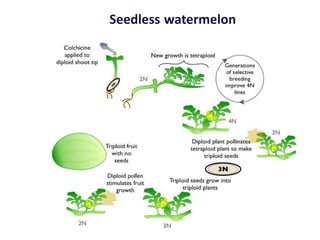
• The triploid organisms have three sets of chromosomes
• A triploid may originate by the union of a monoploid
gamete (n) with a diploid gamete (2n)
• Since an autotriploid remains sterile and cannot produce
seeds , it has great commercial value in producing
seedless varieties of economic plants
• eg. Seedless water melon
Autotetraploids
• The organisms with four genomes (4n) in the nuclei of
their somatic cells are called tetraploids
• They arise due to somatic doubling of chromosome
number
• Doubling is accomplished by either spontaneously or it
can be induced by chemicals such as colchicines
Induction of autopolyploids
• Spontaneous - chromosome doubling occurs occasionally
in somatic tissues and unreduced gametes are produced in
low frequencies.
• Production of adventitious buds
• Decapitation in some plants leads to callus development
at the cut ends of the stem.
• Such a callus has some polyploid cells and some of the shoot
buds regenerated from the callus may be polyploid.
• In Solanaceae, 6 - 36% of adventitious buds are tetraploids.
• The frequency of polyploid buds may be increased by the
application of 1% IAA at the cut ends as it promotes
callus development.
Treatment with physical agents
Heat or cold treatment, x-ray or gamma ray irradiation
may produce polyploids.
Exposing the plants or ears of maize to a temperature of
38- 45 °C at the time of the first division of zygote produce 2- 5
% tetraploid progeny.
Regeneration in vitro :
Polyploidy is a common feature of the cells cultured in-
vitro.
Colchicine treatment:
Colchicine treatment is the most effective and the most
widely used treatment for chromosome doubling.
Autopolyploidy
In autopolyploidy, triploidy, tetraploidy and higher levels of
ploidy are included.
Morphological and cytological features of auto polyploids
• Larger cell size than diploids.
• Guard cells of stomata are larger
• Number of stomata per unit area is less in polyploids than
diploids.
• Pollen grains of polyploids are generally larger than
those of the corresponding diploids.
• Polyploids are generally slower in growth and later in
flowering.
• Polyploids usually have larger and thicker leaves, and larger
flowers and fruits which are usually less in number than in
diploids.
• Polyploids generally show reduced fertility due to irregularities
during meiosis and due to genotypic imbalance leading to
physiological disturbances.
• In many cases autopolyploidy leads to increased vigour and
vegetative growth.
• Different species have different levels of optimum ploidy.
• For sugarbeet the optimum level is 3x, sweet potato 6x while for
timothy grass it is between 8 - 10x.
• Autopolyploids generally have a lower dry matter content than
diploids.
Application of Autopolyploidy in
Crop improvement
Triploids
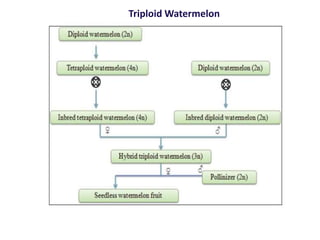
• Triploids are produced by hybridization between tetraploid
and diploid strains.
• They are generally highly sterile, except in a few cases.
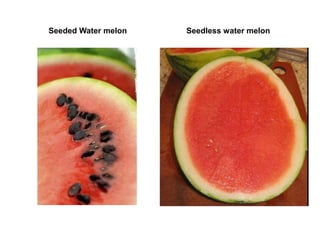
• This feature is useful in the production of seedless
watermelons.
• In certain species, they may be more vigorous than the
normal diploids,
• e.g., in sugarbeets
Triploid Watermelon
Seedless watermelon
Seeded Water melon Seedless water melon
Triploid sugar beets
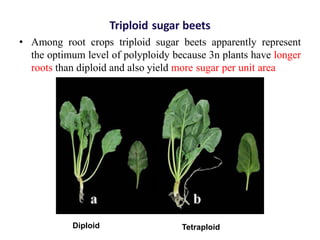
• Among root crops triploid sugar beets apparently represent
the optimum level of polyploidy because 3n plants have longer
roots than diploid and also yield more sugar per unit area
Diploid Tetraploid
Tetraploid rye
• The advantage of tetraploid over its diploid counterpart
are large kernel size, superior ability to emerge under adverse
condition and higher protein content
• Tetraploid rye varieties have been released for cultivation
• Eg. Double steel, Tetra petkus
Limitations of autoployploidy
1. The larger size of autopolyploids is generally
accompanied with a higher water content
2. Show high sterility and poor seed set.
3. Due to the complex segregation in autotetraploids progress
under selection is slow.
4. Triploids cannot be maintained except through clonal
propogation.
5. New polyploids can rarely be used directly in crop
production.
6. Effects of autopolyploidy cannot be predicted.
Allopolyploidy
• Allopolyploids have genomes from two or more
species production of allopolyploids has attracted
considerable attention; the aim almost always was
creation of new species
• Some success has been evident from the emergence
of triticale
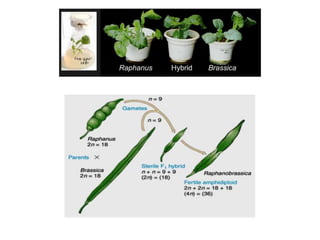
• Raphano brassica and allopolyploids of forage
grasses
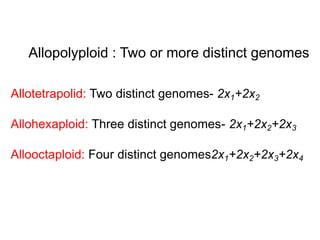
Allopolyploid : Two or more distinct genomes
Allotetrapolid: Two distinct genomes- 2x1+2x2
Allohexaploid: Three distinct genomes- 2x1+2x2+2x3
Allooctaploid: Four distinct genomes2x1+2x2+2x3+2x4
Morphological and cytological features of
allopolyploids
 Allopolyploids combine the morphological and
physiological characteristics of the parent species
but it is very difficult to predict the precise
combination of characters that would appear in the
new species.
 Many allopolyploids are apomictic
Ex : Tulips, Solanum
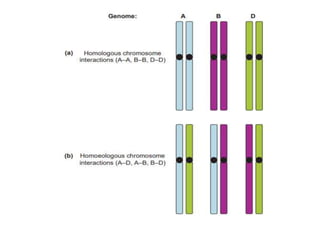
 The chromosome pairing in the new species depends upon the
similarities between the chromosomes of the parental species
 Chromosomes with such similarities are known as
homoeologous chromosomes.
 After chromosome doubling, the allopolyploid would have
two homeologous chromosomes for each chromosome
present in the F1 hybrid, comparable to the diploid species.
 Such allopolyploid is referred as amphidiploid or
Allotetraploid.
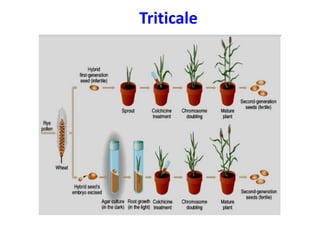
Triticale
Chinese cabbage, Bok Choi
Cauliflower, broccoli, kale
rape seed
Indian mustard
Canola-type oil seeds
Collard green,
good for cold
climates
biodiesel
AA
Brassica rapa
CC
Brassica olarecea
Black mustard
N=8
N=9 N=10
N=10+8
BB
Brassica nigra
AABB
Brassica juncea
BBCC
Brassica carinata
N=10+9
AACC
Brassica napus
N=9+8
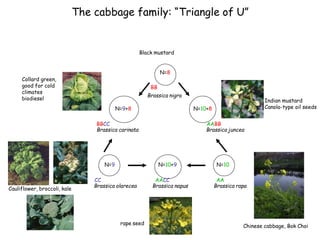
The cabbage family: “Triangle of U”
Applications of allopolyploidy in crop improvement
1. Utilization as bridging species: Amphidiploids serve as
bridging species in the transfer of characters from one species to
another species.
Why bridging species?
Most of the times interspecific hybrid is sterile.
Ex. The F1 obtained from cross Nicotiana tabacum x N.
sylvestris is sterile. Chromrosome doubling of this hybrid
resulted in a synthetic hexaploid called N.digluta which is
relatively fertile and is backcrossed to the N.tabacum to produce
a pentaploid. The pentaploid is fertile and is backcrossed to
N.tabacum and in the progeny N.tabacum -like plants resistant
to TMV are selected
2. Creation of new species.
Ex. 1. Triticale(wheat x rye) Commercially cultivated in
Poland, Germany, Canada and France
Desirable features of triticales: they yielding ability and quality
grains like wheat and abiotic stress tolerance like rye.
2.Raphanobrassica is a triploid from Brassica napus x B.
compestris
3.Widening the base of existing polyploids Ex. B. napus which
has less natural variability. Synthesize new amphidiploid B.
napus (AACC, n=19)from the parental diploids- B. compestris
(n=10, AA) x B. oleraceae (n=9, CC)
4. Polyploid is one of the sources for variation and thus
helps in evolution and polyploid played a key role in
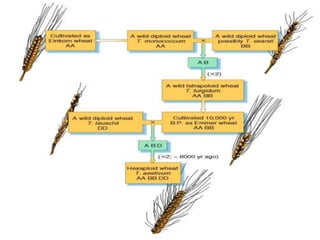
natural evolution of number of plants like wheat,
cotton, galeopsis and primula etc
5. Allopolyploid is one of the effective mechanism for
maintaining hybrid vigour in successive generation,
because as a result of allopolyploidy, different
genomes are brought together and are passed from one
generation to another.
Limitations
 Effect can’t be predicted
 Many defect associated with allopolyploid like
Low fertility, cytogenetic and genetic instability
 Aneuploidy – The change in chromosome number involving one or few
chromosomes of a genome.
 Aneuploid changes are determined in relation to the somatic chromosome
number – 2n
 Aneuploid – One or few chromosomes extra
or missing 2n ± few missing from 2n
 Nullisomic
 Monosomic
:One chromosome pair absent
:One chromosome absent
2n-2
2n-1
 Double monosomic :One chromosome from each of two different
chromosome pairs absent 2n-1-1
2n+1
 Trisomic
 Double trisomic
:One chromosome extra
:One chromosome from each of two different
chromosome pairs extra
 2n+1+1
2n+2
 Tetrasomic :One chromosome pair extra
Use of aneuploids in crop improvement
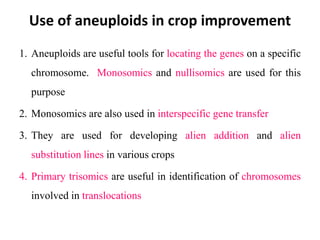
1. Aneuploids are useful tools for locating the genes on a specific
chromosome. Monosomics and nullisomics are used for this
purpose
2. Monosomics are also used in interspecific gene transfer
3. They are used for developing alien addition and alien
substitution lines in various crops
4. Primary trisomics are useful in identification of chromosomes
involved in translocations

polyploids.ppt

  • 1.
    Lec 27- Polyploidybreeding- classification- induction of polyploidy- achievements and limitations
  • 2.
    Introduction • Somatic chromosomenumber - 2n • Chromosome number of gametes – n • An individual carrying the gametic chromosome number, n, is known as haploid • Monoploid – basic chromosome number- gametic chromosome number of true diploid species- x • Diploid species, n = x; one x constitutes a genome or chromosome complement.
  • 3.
     Polyploids refersto any organism in which the number of chromosome sets exceeds two  Larger cells than diploids  These larger cell sizes contribute to larger plant size and higher yield  Polyploids have generally larger, thicker and darker green leaves, bigger flowers, fruits than the diploids Polyploids
  • 5.
    Euploids • The chromosomenumber is an exact multiple of the basic or genomic number • Autopolyploids - all the genomes present in a polyploidy species are identical • Allopolyploids - multiple sets of chromosomes are not identical
  • 7.
    • Auto triploid- 3x • Auto tetraploid - 4x • Auto hexaploid - - 6x (eg.) Banana 2n = 3 x = 33; Groundnut 2n = 4 x = 40; Sweet potato 2n = 6x = 90 and Potato 2n = 4x = 48 Autopolyploids
  • 8.
    Autotriploid • The triploidorganisms have three sets of chromosomes • A triploid may originate by the union of a monoploid gamete (n) with a diploid gamete (2n) • Since an autotriploid remains sterile and cannot produce seeds , it has great commercial value in producing seedless varieties of economic plants • eg. Seedless water melon
  • 9.
    Autotetraploids • The organismswith four genomes (4n) in the nuclei of their somatic cells are called tetraploids • They arise due to somatic doubling of chromosome number • Doubling is accomplished by either spontaneously or it can be induced by chemicals such as colchicines
  • 10.
    Induction of autopolyploids •Spontaneous - chromosome doubling occurs occasionally in somatic tissues and unreduced gametes are produced in low frequencies. • Production of adventitious buds • Decapitation in some plants leads to callus development at the cut ends of the stem. • Such a callus has some polyploid cells and some of the shoot buds regenerated from the callus may be polyploid. • In Solanaceae, 6 - 36% of adventitious buds are tetraploids. • The frequency of polyploid buds may be increased by the application of 1% IAA at the cut ends as it promotes callus development.
  • 11.
    Treatment with physicalagents Heat or cold treatment, x-ray or gamma ray irradiation may produce polyploids. Exposing the plants or ears of maize to a temperature of 38- 45 °C at the time of the first division of zygote produce 2- 5 % tetraploid progeny. Regeneration in vitro : Polyploidy is a common feature of the cells cultured in- vitro. Colchicine treatment: Colchicine treatment is the most effective and the most widely used treatment for chromosome doubling.
  • 12.
    Autopolyploidy In autopolyploidy, triploidy,tetraploidy and higher levels of ploidy are included. Morphological and cytological features of auto polyploids • Larger cell size than diploids. • Guard cells of stomata are larger • Number of stomata per unit area is less in polyploids than diploids. • Pollen grains of polyploids are generally larger than those of the corresponding diploids. • Polyploids are generally slower in growth and later in flowering.
  • 13.
    • Polyploids usuallyhave larger and thicker leaves, and larger flowers and fruits which are usually less in number than in diploids. • Polyploids generally show reduced fertility due to irregularities during meiosis and due to genotypic imbalance leading to physiological disturbances. • In many cases autopolyploidy leads to increased vigour and vegetative growth. • Different species have different levels of optimum ploidy. • For sugarbeet the optimum level is 3x, sweet potato 6x while for timothy grass it is between 8 - 10x. • Autopolyploids generally have a lower dry matter content than diploids.
  • 14.
    Application of Autopolyploidyin Crop improvement Triploids • Triploids are produced by hybridization between tetraploid and diploid strains. • They are generally highly sterile, except in a few cases. • This feature is useful in the production of seedless watermelons. • In certain species, they may be more vigorous than the normal diploids, • e.g., in sugarbeets
  • 15.
  • 16.
  • 17.
    Seeded Water melonSeedless water melon
  • 18.
    Triploid sugar beets •Among root crops triploid sugar beets apparently represent the optimum level of polyploidy because 3n plants have longer roots than diploid and also yield more sugar per unit area Diploid Tetraploid
  • 19.
    Tetraploid rye • Theadvantage of tetraploid over its diploid counterpart are large kernel size, superior ability to emerge under adverse condition and higher protein content • Tetraploid rye varieties have been released for cultivation • Eg. Double steel, Tetra petkus
  • 20.
    Limitations of autoployploidy 1.The larger size of autopolyploids is generally accompanied with a higher water content 2. Show high sterility and poor seed set. 3. Due to the complex segregation in autotetraploids progress under selection is slow. 4. Triploids cannot be maintained except through clonal propogation. 5. New polyploids can rarely be used directly in crop production. 6. Effects of autopolyploidy cannot be predicted.
  • 21.
    Allopolyploidy • Allopolyploids havegenomes from two or more species production of allopolyploids has attracted considerable attention; the aim almost always was creation of new species • Some success has been evident from the emergence of triticale • Raphano brassica and allopolyploids of forage grasses
  • 23.
    Allopolyploid : Twoor more distinct genomes Allotetrapolid: Two distinct genomes- 2x1+2x2 Allohexaploid: Three distinct genomes- 2x1+2x2+2x3 Allooctaploid: Four distinct genomes2x1+2x2+2x3+2x4
  • 24.
    Morphological and cytologicalfeatures of allopolyploids  Allopolyploids combine the morphological and physiological characteristics of the parent species but it is very difficult to predict the precise combination of characters that would appear in the new species.  Many allopolyploids are apomictic Ex : Tulips, Solanum
  • 25.
     The chromosomepairing in the new species depends upon the similarities between the chromosomes of the parental species  Chromosomes with such similarities are known as homoeologous chromosomes.  After chromosome doubling, the allopolyploid would have two homeologous chromosomes for each chromosome present in the F1 hybrid, comparable to the diploid species.  Such allopolyploid is referred as amphidiploid or Allotetraploid.
  • 27.
  • 29.
    Chinese cabbage, BokChoi Cauliflower, broccoli, kale rape seed Indian mustard Canola-type oil seeds Collard green, good for cold climates biodiesel AA Brassica rapa CC Brassica olarecea Black mustard N=8 N=9 N=10 N=10+8 BB Brassica nigra AABB Brassica juncea BBCC Brassica carinata N=10+9 AACC Brassica napus N=9+8 The cabbage family: “Triangle of U”
  • 30.
    Applications of allopolyploidyin crop improvement 1. Utilization as bridging species: Amphidiploids serve as bridging species in the transfer of characters from one species to another species. Why bridging species? Most of the times interspecific hybrid is sterile. Ex. The F1 obtained from cross Nicotiana tabacum x N. sylvestris is sterile. Chromrosome doubling of this hybrid resulted in a synthetic hexaploid called N.digluta which is relatively fertile and is backcrossed to the N.tabacum to produce a pentaploid. The pentaploid is fertile and is backcrossed to N.tabacum and in the progeny N.tabacum -like plants resistant to TMV are selected
  • 31.
    2. Creation ofnew species. Ex. 1. Triticale(wheat x rye) Commercially cultivated in Poland, Germany, Canada and France Desirable features of triticales: they yielding ability and quality grains like wheat and abiotic stress tolerance like rye. 2.Raphanobrassica is a triploid from Brassica napus x B. compestris 3.Widening the base of existing polyploids Ex. B. napus which has less natural variability. Synthesize new amphidiploid B. napus (AACC, n=19)from the parental diploids- B. compestris (n=10, AA) x B. oleraceae (n=9, CC)
  • 32.
    4. Polyploid isone of the sources for variation and thus helps in evolution and polyploid played a key role in natural evolution of number of plants like wheat, cotton, galeopsis and primula etc 5. Allopolyploid is one of the effective mechanism for maintaining hybrid vigour in successive generation, because as a result of allopolyploidy, different genomes are brought together and are passed from one generation to another.
  • 33.
    Limitations  Effect can’tbe predicted  Many defect associated with allopolyploid like Low fertility, cytogenetic and genetic instability
  • 34.
     Aneuploidy –The change in chromosome number involving one or few chromosomes of a genome.  Aneuploid changes are determined in relation to the somatic chromosome number – 2n  Aneuploid – One or few chromosomes extra or missing 2n ± few missing from 2n  Nullisomic  Monosomic :One chromosome pair absent :One chromosome absent 2n-2 2n-1  Double monosomic :One chromosome from each of two different chromosome pairs absent 2n-1-1 2n+1  Trisomic  Double trisomic :One chromosome extra :One chromosome from each of two different chromosome pairs extra  2n+1+1 2n+2  Tetrasomic :One chromosome pair extra
  • 35.
    Use of aneuploidsin crop improvement 1. Aneuploids are useful tools for locating the genes on a specific chromosome. Monosomics and nullisomics are used for this purpose 2. Monosomics are also used in interspecific gene transfer 3. They are used for developing alien addition and alien substitution lines in various crops 4. Primary trisomics are useful in identification of chromosomes involved in translocations