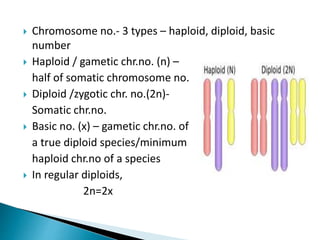
 Chromosome no.- 3 types – haploid, diploid, basic
number
 Haploid / gametic chr.no. (n) –
half of somatic chromosome no.
 Diploid /zygotic chr. no.(2n)-
Somatic chr.no.
 Basic no. (x) – gametic chr.no. of
a true diploid species/minimum
haploid chr.no of a species
 In regular diploids,
2n=2x
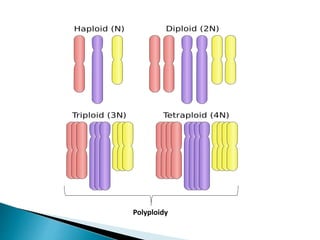
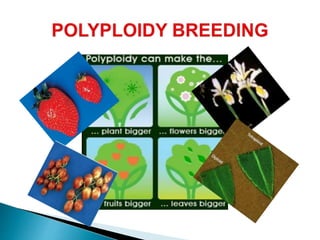
Polyploidy
Suitability of a crop for pp breeding depends on
following factors:
 Crops which are not seed propagated(ie, vegetatively
propagated crops where the economic part is not
seeds)
eg: forage crops, tubers, sugarcane, ornamentals
 Crops with low 2n no.
 Allogamy / cross pollination
eg: Poaceae against Leguminosae
 STEP 1
Artificial induction and/or collection of naturally
occuring pps and their maintanence.
 STEP 2
Detection of different kinds of pps.
 STEP 3
Isolation and handling of pps.
PP breeding includes:
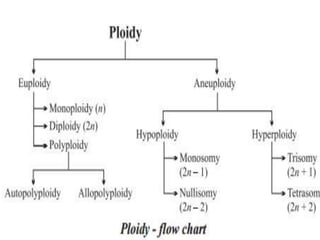
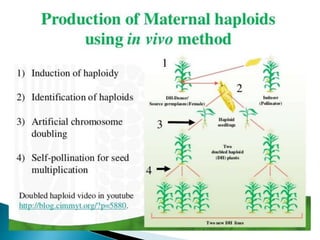
1. Monoploid/Haploid breeding
2. Autoploid breeding
3. Allopolyploid/Amphi(di)ploid breeding
4. Aneuploid breeding
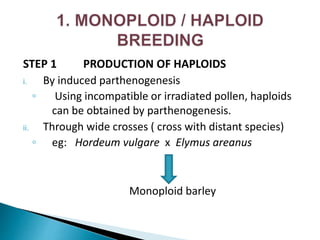
STEP 1 PRODUCTION OF HAPLOIDS
i. By induced parthenogenesis
◦ Using incompatible or irradiated pollen, haploids
can be obtained by parthenogenesis.
ii. Through wide crosses ( cross with distant species)
◦ eg: Hordeum vulgare х Elymus areanus
Monoploid barley
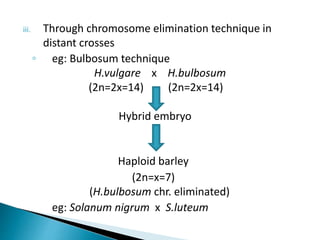
iii. Through chromosome elimination technique in
distant crosses
◦ eg: Bulbosum technique
H.vulgare х H.bulbosum
(2n=2x=14) (2n=2x=14)
Hybrid embryo
Haploid barley
(2n=x=7)
(H.bulbosum chr. eliminated)
eg: Solanum nigrum x S.luteum
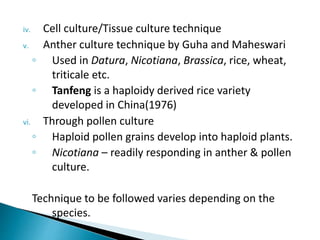
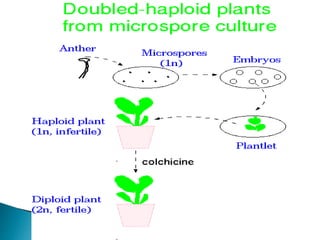
iv. Cell culture/Tissue culture technique
v. Anther culture technique by Guha and Maheswari
◦ Used in Datura, Nicotiana, Brassica, rice, wheat,
triticale etc.
◦ Tanfeng is a haploidy derived rice variety
developed in China(1976)
vi. Through pollen culture
◦ Haploid pollen grains develop into haploid plants.
◦ Nicotiana – readily responding in anther & pollen
culture.
Technique to be followed varies depending on the
species.
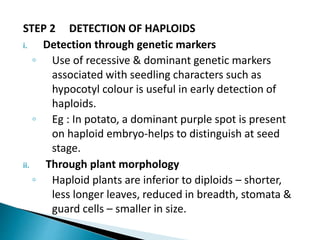
STEP 2 DETECTION OF HAPLOIDS
i. Detection through genetic markers
◦ Use of recessive & dominant genetic markers
associated with seedling characters such as
hypocotyl colour is useful in early detection of
haploids.
◦ Eg : In potato, a dominant purple spot is present
on haploid embryo-helps to distinguish at seed
stage.
ii. Through plant morphology
◦ Haploid plants are inferior to diploids – shorter,
less longer leaves, reduced in breadth, stomata &
guard cells – smaller in size.
STEP 3 DIPLOIDISATION
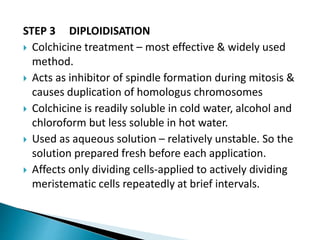
 Colchicine treatment – most effective & widely used
method.
 Acts as inhibitor of spindle formation during mitosis &
causes duplication of homologus chromosomes
 Colchicine is readily soluble in cold water, alcohol and
chloroform but less soluble in hot water.
 Used as aqueous solution – relatively unstable. So the
solution prepared fresh before each application.
 Affects only dividing cells-applied to actively dividing
meristematic cells repeatedly at brief intervals.
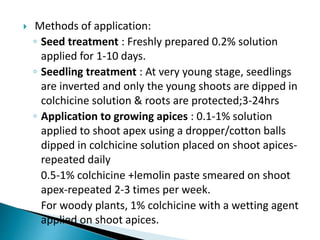
 Methods of application:
◦ Seed treatment : Freshly prepared 0.2% solution
applied for 1-10 days.
◦ Seedling treatment : At very young stage, seedlings
are inverted and only the young shoots are dipped in
colchicine solution & roots are protected;3-24hrs
◦ Application to growing apices : 0.1-1% solution
applied to shoot apex using a dropper/cotton balls
dipped in colchicine solution placed on shoot apices-
repeated daily
0.5-1% colchicine +lemolin paste smeared on shoot
apex-repeated 2-3 times per week.
For woody plants, 1% colchicine with a wetting agent
applied on shoot apices.
 Includes triploid and tetraploid breeding
I. TRIPLOID BREEDING
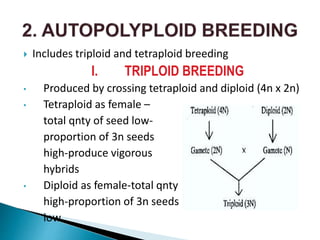
• Produced by crossing tetraploid and diploid (4n x 2n)
• Tetraploid as female –
total qnty of seed low-
proportion of 3n seeds
high-produce vigorous
hybrids
• Diploid as female-total qnty
high-proportion of 3n seeds
low
• Triploids-pollen sterile-seedless-advantageous in
watermelon
• In common planting, diploid planted to provide
pollen for satisfactory seed set in triploid in 5:1 ratio
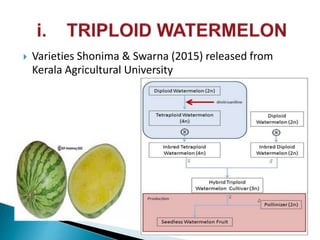
 Varieties Shonima & Swarna (2015) released from
Kerala Agricultural University
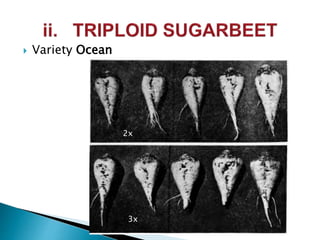
 Variety Ocean
2x
3x
 TV29
 produces larger shoots & biomass; yields more cured
leaf per unit area and tolerant to drought than
available diploid varieties
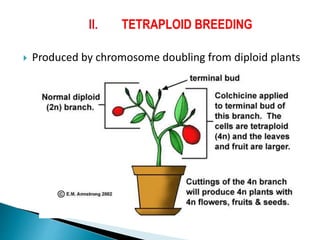
II. TETRAPLOID BREEDING
 Produced by chromosome doubling from diploid plants
 Possible in tobacco, Petunia etc.
 Autotetraploid maize has 43% more carotenoid
content & vitamin A.
 Successful in forage crops, ornamentals etc.
Pusa giant berseem -1st autotetraploid variety
(Egyptian clover) released for large scale cultivation –
higher green fodder yield
Vetiver variety – Sugandha – 11% more oil yield
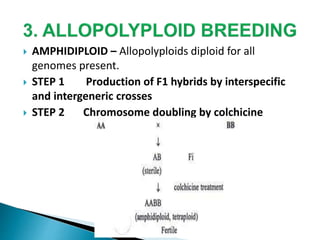
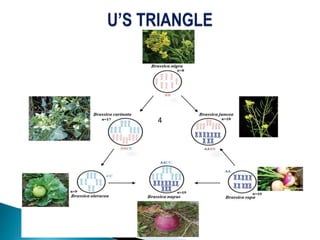
 AMPHIDIPLOID – Allopolyploids diploid for all
genomes present.
 STEP 1 Production of F1 hybrids by interspecific
and intergeneric crosses
 STEP 2 Chromosome doubling by colchicine
DD)
4
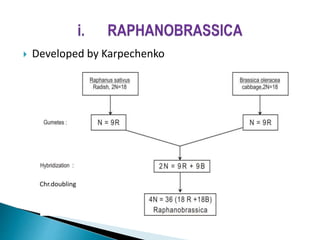
 Developed by Karpechenko
Chr.doubling
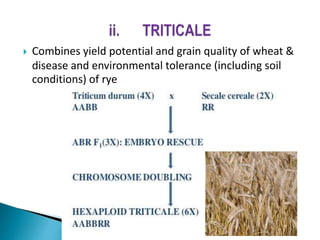
 Combines yield potential and grain quality of wheat &
disease and environmental tolerance (including soil
conditions) of rye
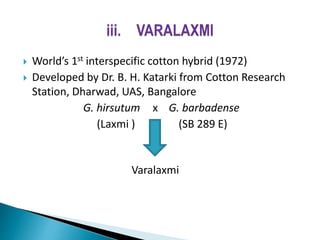
 World’s 1st interspecific cotton hybrid (1972)
 Developed by Dr. B. H. Katarki from Cotton Research
Station, Dharwad, UAS, Bangalore
G. hirsutum х G. barbadense
(Laxmi ) (SB 289 E)
Varalaxmi
 2n=38
 Hybrid between Brassica campestris(syn. B.rapa) and
Raphanus sativus (fodder raddish)
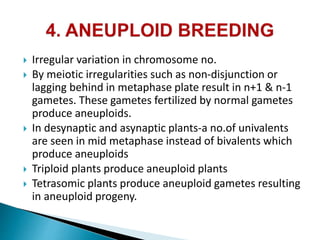
 Irregular variation in chromosome no.
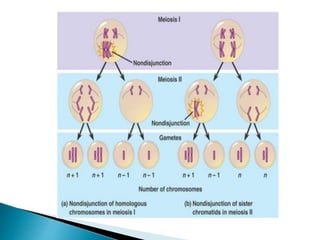
 By meiotic irregularities such as non-disjunction or
lagging behind in metaphase plate result in n+1 & n-1
gametes. These gametes fertilized by normal gametes
produce aneuploids.
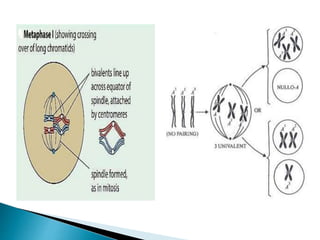
 In desynaptic and asynaptic plants-a no.of univalents
are seen in mid metaphase instead of bivalents which
produce aneuploids
 Triploid plants produce aneuploid plants
 Tetrasomic plants produce aneuploid gametes resulting
in aneuploid progeny.
Polyploidy breeding
Polyploidy breeding
Polyploidy breeding

Polyploidy breeding

  • 2.
     Chromosome no.-3 types – haploid, diploid, basic number  Haploid / gametic chr.no. (n) – half of somatic chromosome no.  Diploid /zygotic chr. no.(2n)- Somatic chr.no.  Basic no. (x) – gametic chr.no. of a true diploid species/minimum haploid chr.no of a species  In regular diploids, 2n=2x
  • 4.
  • 6.
    Suitability of acrop for pp breeding depends on following factors:  Crops which are not seed propagated(ie, vegetatively propagated crops where the economic part is not seeds) eg: forage crops, tubers, sugarcane, ornamentals  Crops with low 2n no.  Allogamy / cross pollination eg: Poaceae against Leguminosae
  • 7.
     STEP 1 Artificialinduction and/or collection of naturally occuring pps and their maintanence.  STEP 2 Detection of different kinds of pps.  STEP 3 Isolation and handling of pps.
  • 8.
    PP breeding includes: 1.Monoploid/Haploid breeding 2. Autoploid breeding 3. Allopolyploid/Amphi(di)ploid breeding 4. Aneuploid breeding
  • 9.
    STEP 1 PRODUCTIONOF HAPLOIDS i. By induced parthenogenesis ◦ Using incompatible or irradiated pollen, haploids can be obtained by parthenogenesis. ii. Through wide crosses ( cross with distant species) ◦ eg: Hordeum vulgare х Elymus areanus Monoploid barley
  • 10.
    iii. Through chromosomeelimination technique in distant crosses ◦ eg: Bulbosum technique H.vulgare х H.bulbosum (2n=2x=14) (2n=2x=14) Hybrid embryo Haploid barley (2n=x=7) (H.bulbosum chr. eliminated) eg: Solanum nigrum x S.luteum
  • 11.
    iv. Cell culture/Tissueculture technique v. Anther culture technique by Guha and Maheswari ◦ Used in Datura, Nicotiana, Brassica, rice, wheat, triticale etc. ◦ Tanfeng is a haploidy derived rice variety developed in China(1976) vi. Through pollen culture ◦ Haploid pollen grains develop into haploid plants. ◦ Nicotiana – readily responding in anther & pollen culture. Technique to be followed varies depending on the species.
  • 12.
    STEP 2 DETECTIONOF HAPLOIDS i. Detection through genetic markers ◦ Use of recessive & dominant genetic markers associated with seedling characters such as hypocotyl colour is useful in early detection of haploids. ◦ Eg : In potato, a dominant purple spot is present on haploid embryo-helps to distinguish at seed stage. ii. Through plant morphology ◦ Haploid plants are inferior to diploids – shorter, less longer leaves, reduced in breadth, stomata & guard cells – smaller in size.
  • 13.
    STEP 3 DIPLOIDISATION Colchicine treatment – most effective & widely used method.  Acts as inhibitor of spindle formation during mitosis & causes duplication of homologus chromosomes  Colchicine is readily soluble in cold water, alcohol and chloroform but less soluble in hot water.  Used as aqueous solution – relatively unstable. So the solution prepared fresh before each application.  Affects only dividing cells-applied to actively dividing meristematic cells repeatedly at brief intervals.
  • 14.
     Methods ofapplication: ◦ Seed treatment : Freshly prepared 0.2% solution applied for 1-10 days. ◦ Seedling treatment : At very young stage, seedlings are inverted and only the young shoots are dipped in colchicine solution & roots are protected;3-24hrs ◦ Application to growing apices : 0.1-1% solution applied to shoot apex using a dropper/cotton balls dipped in colchicine solution placed on shoot apices- repeated daily 0.5-1% colchicine +lemolin paste smeared on shoot apex-repeated 2-3 times per week. For woody plants, 1% colchicine with a wetting agent applied on shoot apices.
  • 17.
     Includes triploidand tetraploid breeding I. TRIPLOID BREEDING • Produced by crossing tetraploid and diploid (4n x 2n) • Tetraploid as female – total qnty of seed low- proportion of 3n seeds high-produce vigorous hybrids • Diploid as female-total qnty high-proportion of 3n seeds low
  • 18.
    • Triploids-pollen sterile-seedless-advantageousin watermelon • In common planting, diploid planted to provide pollen for satisfactory seed set in triploid in 5:1 ratio
  • 20.
     Varieties Shonima& Swarna (2015) released from Kerala Agricultural University
  • 21.
  • 22.
     TV29  produceslarger shoots & biomass; yields more cured leaf per unit area and tolerant to drought than available diploid varieties
  • 23.
    II. TETRAPLOID BREEDING Produced by chromosome doubling from diploid plants
  • 24.
     Possible intobacco, Petunia etc.  Autotetraploid maize has 43% more carotenoid content & vitamin A.  Successful in forage crops, ornamentals etc. Pusa giant berseem -1st autotetraploid variety (Egyptian clover) released for large scale cultivation – higher green fodder yield Vetiver variety – Sugandha – 11% more oil yield
  • 25.
     AMPHIDIPLOID –Allopolyploids diploid for all genomes present.  STEP 1 Production of F1 hybrids by interspecific and intergeneric crosses  STEP 2 Chromosome doubling by colchicine
  • 26.
  • 29.
  • 30.
     Developed byKarpechenko Chr.doubling
  • 31.
     Combines yieldpotential and grain quality of wheat & disease and environmental tolerance (including soil conditions) of rye
  • 32.
     World’s 1stinterspecific cotton hybrid (1972)  Developed by Dr. B. H. Katarki from Cotton Research Station, Dharwad, UAS, Bangalore G. hirsutum х G. barbadense (Laxmi ) (SB 289 E) Varalaxmi
  • 33.
     2n=38  Hybridbetween Brassica campestris(syn. B.rapa) and Raphanus sativus (fodder raddish)
  • 34.
     Irregular variationin chromosome no.  By meiotic irregularities such as non-disjunction or lagging behind in metaphase plate result in n+1 & n-1 gametes. These gametes fertilized by normal gametes produce aneuploids.  In desynaptic and asynaptic plants-a no.of univalents are seen in mid metaphase instead of bivalents which produce aneuploids  Triploid plants produce aneuploid plants  Tetrasomic plants produce aneuploid gametes resulting in aneuploid progeny.