POLYPLOIDY IN PLANT BREEDING
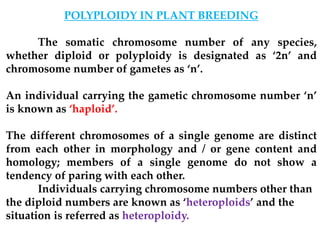
The somatic chromosome number of any species,
whether diploid or polyploidy is designated as ‘2n’ and
chromosome number of gametes as ‘n’.
An individual carrying the gametic chromosome number ‘n’
is known as ‘haploid’.
The different chromosomes of a single genome are distinct
from each other in morphology and / or gene content and
homology; members of a single genome do not show a
tendency of paring with each other.
Individuals carrying chromosome numbers other than
the diploid numbers are known as ‘heteroploids’ and the
situation is referred as heteroploidy.
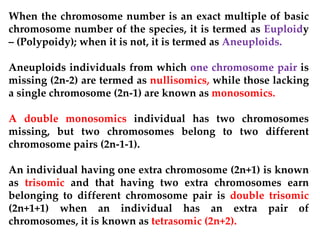
When the chromosome number is an exact multiple of basic
chromosome number of the species, it is termed as Euploidy
– (Polypoidy); when it is not, it is termed as Aneuploids.
Aneuploids individuals from which one chromosome pair is
missing (2n-2) are termed as nullisomics, while those lacking
a single chromosome (2n-1) are known as monosomics.
A double monosomics individual has two chromosomes
missing, but two chromosomes belong to two different
chromosome pairs (2n-1-1).
An individual having one extra chromosome (2n+1) is known
as trisomic and that having two extra chromosomes earn
belonging to different chromosome pair is double trisomic
(2n+1+1) when an individual has an extra pair of
chromosomes, it is known as tetrasomic (2n+2).
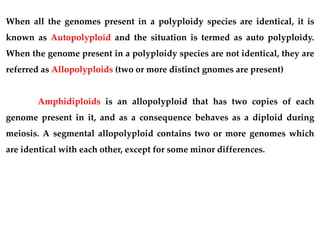
When all the genomes present in a polyploidy species are identical, it is
known as Autopolyploid and the situation is termed as auto polyploidy.
When the genome present in a polyploidy species are not identical, they are
referred as Allopolyploids (two or more distinct gnomes are present)
Amphidiploids is an allopolyploid that has two copies of each
genome present in it, and as a consequence behaves as a diploid during
meiosis. A segmental allopolyploid contains two or more genomes which
are identical with each other, except for some minor differences.
Blakeslee (1910) discovered a mutant in
Datura which later proved by Belling (1920) as a
trisomic. Winker (1916) induced first auto
tetroploid in Solanum nigrum.
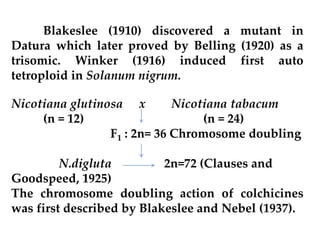
Nicotiana glutinosa x Nicotiana tabacum
(n = 12) (n = 24)
F1 : 2n= 36 Chromosome doubling
N.digluta 2n=72 (Clauses and
Goodspeed, 1925)
The chromosome doubling action of colchicines
was first described by Blakeslee and Nebel (1937).
ANEUPLOIDS
ORIGIN AND PRODUCTION
SPONTANEOUS:
Aneuploids originate spontaneously at a low frequency.
Meiotic irregularities lead to the formulation of n+1 and n-1
gametes eg., datura.
Triploid:
The best sources of Aneuploids are triploid plants. Due
to irregular meiosis at meiosis I phase, uneven distribution of
chromosomes occur which lead to production of aneuploid.
Asynaptic and Desynaptic plants :
Univalents occur in these plants. Progeny of these plants
produce aneuploids.
Tetrasomic plants :
Tetrasomic (2n+2) plants produce n +1 gametes in
considerable frequencies. When they crossed with normal
diploid or disomic (2n) plants, they produce a high frequency of
trisomics.
MORPHOLOGICAL AND CYTOLOGICAL FEATURES OF
ANEUPLOIDS
Aneuploids are weaker generally than diploids. All the
21 nullisomics are available in wheat. Full series of trisomics
are available in maize, barley, tomato, bajra.
Trisomics may be comparable to diploid. Aneuploids
exhibit distinct morphology. The monosomics in wheat are
comparable to normal plants. Hence, the plants respected to
be Aneuploids must be analyzed cytologically for
confirmation.
Nullisomics generally show regular bivalents and
gametes carry n-1 chromosomes.
Tetrasomics show irregular pairing and usually form
one IV.
In monosomics, one chromosome does not have a pair and
remain as a univalent in metaphase I. At Anaphase I, the
univalent move to one of the poles, may leg or lost or may
divide (as in mitosis) into 2 chromatids which move to
opposite poles. Due to this irregular behavior monosomics
produce n-1 gametes.
Aneuploids seeds are generally smaller and show
reduced germination and seedlings show lower viability.
APPLICATIONS IN CROP IMPROVEMENT
1. Aneuploids are useful in studies on the effects of loss or
gain of chromosome on the phenotype of the individual.
2. Aneuploids are useful in locating a linkage groups or a
gene to a particular chromosome.
3. Aneuploids are useful in the production of substitution
lines. They are useful for transfer of the genes from a
variety to another.
4. They are useful in studying the homology between
different genomes.
5. They are useful in identifying the chromosomes involved
in translocation.
Aneuploid analysis for locating genes on particular
chromosomes:
Genes may be located on particular chromosomes by
nullisomics, monosomics or trisomic analysis.
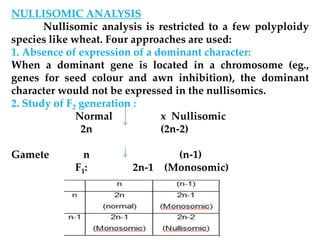
NULLISOMIC ANALYSIS
Nullisomic analysis is restricted to a few polyploidy
species like wheat. Four approaches are used:
1. Absence of expression of a dominant character:
When a dominant gene is located in a chromosome (eg.,
genes for seed colour and awn inhibition), the dominant
character would not be expressed in the nullisomics.
2. Study of F2 generation :
Normal x Nullisomic
2n (2n-2)
Gamete n (n-1)
F1: 2n-1 (Monosomic)
Selfed
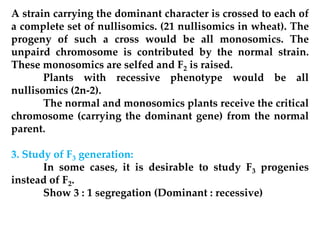
A strain carrying the dominant character is crossed to each of
a complete set of nullisomics. (21 nullisomics in wheat). The
progeny of such a cross would be all monosomics. The
unpaird chromosome is contributed by the normal strain.
These monosomics are selfed and F2 is raised.
Plants with recessive phenotype would be all
nullisomics (2n-2).
The normal and monosomics plants receive the critical
chromosome (carrying the dominant gene) from the normal
parent.
3. Study of F3 generation:
In some cases, it is desirable to study F3 progenies
instead of F2.
Show 3 : 1 segregation (Dominant : recessive)
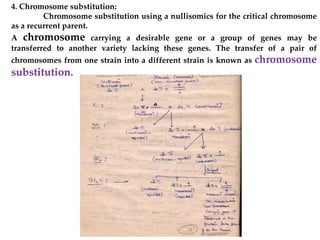
4. Chromosome substitution:
Chromosome substitution using a nullisomics for the critical chromosome
as a recurrent parent.
A chromosome carrying a desirable gene or a group of genes may be
transferred to another variety lacking these genes. The transfer of a pair of
chromosomes from one strain into a different strain is known as chromosome
substitution.
MONOSOMIC ANALYSIS
Monosomic analyses is useful in locating genes in
particular chromosomes and for chromosome substitution.
Monosomic analysis was first used in N. tabacum.
Limitations of aneuploid analyses:
1. It is necessary to produce and maintain a complete set
of aneuploids. Production, identification and
maintenance of aneuploids requires elaborate
cytogenetic analyses.
2. During aneuploid analyses and chromosome
substitution cytological analysis must be carried out
for accuracy. Hence, it is time consuming and tedious
task.
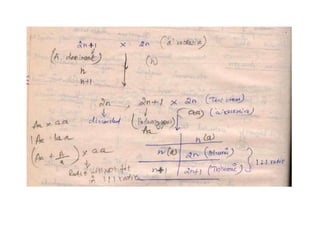
TRISOMIC ANALYSIS :
If monosomics or nullisomics analyses are not
possible, trisomic analysis is applicable.
The strain carrying the gene to be located on a particular
chromosome is crossed (as male) to each of the complete set
of trisomics (used as female ).
F1 will be trisomics and disomic plants. Disomics are
rejected. Trisomic F1 are either selfed or test crossed to a
recessive disomic strain. F2 will show 3: 1 (or) 1: 1 ratio
respectively for the character if it is not governed by a gene
present on the chromosome which is in trisomic state.
But, the ratio would be significantly different from 3 : 1 (or) 1
: 1 if it is present on the trisomic chromosome
Trisomic analysis has been done in maize, barley, tomato.
AUTOPOLYPLOIDY
Monoploidy, triploidy, tetraploidy etc., are included
in Autopolyploidy. Monoploid and haploid do not
constitute polyploidy.
Origin and production of doubled chromosome numbers:
1. Spontaneous: chromosome doubling occurs occasionally
in somatic tissues and unreduced gametes are also produced
in low frequencies. Production of unreduced gametes is
promoted by certain genes.
i.e., genes causing asynapsis or desynapsis.
2. Production of adventitious Buds: Shoot buds regenerated
from callus tissues may be polyploidy. Eg., solaneous family
where 6-36% of adventitious buds are reported to be
tetraploid.
The frequency of that polyploidy may be increased by the
application of 1% NAA at the cut end as it favours callus
development.
3. Physical agents: Heat or cold treatments, X-ray / r-ray
irradiation may produce polyploids in low frequencies.
Tetraploid plants are produced in datura due to cold
treatment. Exposure of maize ears to a temperature of 35 -
45°C at the time of first division of Zygote produces 2 – 5%
tetraploid progenies. Heat treatment may also induce
polyploids in barley, wheat and rye.
4. Regeneration in vitro: Polyploidy is a common feature of
cells in in vitro culture eg., Nicotiana, Datura, Rice
5. Colchicine treatment: Colchicine treatment is the most
effective and mostly used treatment for colchicine
doubling. It is widely used in monocots and dicots.
Colchicine is a poisonous chemical isolated from seeds and
bulbs of autumn crocus (Colchicum autumnale) It is readily
soluble in alcohol, chloroform or cold water.
Pure colchicine is C22H25O6N
It blocks spindle fibre formation and these inhibits the
movement of sister chromatids to opposite poles. As a
result, the chromosome number is doubled.
Since, colchicines affects only dividing cells, it should be
applied when the tissues are actively dividing. Colchicine
is usually applied as an aqueous solution various
treatments:
1. Seed treatment
2. Seedling treatment
3. Growing shoot apices are commonly treated
4. In woody plants, ccc is applied on shoot buds
OTHER CHEMICAL AGENTS
Nitrous oxide, acenapthene, 8, hydoxy-quinoline .
But they are less effective than colchicine and are not
commonly used.
MORPHOLOGICAL AND CYTOLOGICAL FEATURES
OF AUTOPOLYPLOIDS
1. Polyploids have larger cell size than diploids
2. Polyploids have larger pollen grain size and diploids
3. Polyploids are generally show greater in growth and
flowering
4. Polyploids have larger leaves, flowers but less in
number
5. Polyploids show reduced fertility due to irregularities
6. Polyploids leave low dry matter content
7. Different species have different levels of optimum
ploidy eg., sugarbeet – optimum level is 3x
Cytological features vary with the level of ploidy. In
monoploids, the chromosomes do not pair and their
distribution is random at Metaphase I leading to sterility.
In triploids, trivalent, bivalent and univalents are
produced. As a result, they produce various types of
aneuploid progeny. eg., trisomic, double trisomic etc.,
Auto triploids are generally sterile eg.,
watermelon, banana
Auto tetraploids show quadrivelent, trivalent,
bivalent and univalents.They show variable fertility but
fertility is lower than that of diploids. The fertility can be
improved upon selection, eg., Maize, Bajra, Rice.
Segregation in Auto tetraploids:
It is complex than in diploids. In Auto tetraploid, 4
chromosomes are homologous to each other and hence
each gene has four copies.
A simplex individual has 1D + 3R alleles (Aaaa). A
duplex has 2D + 2R (AAaa). A triplex has 3D + 1R (AAAa).
A quadraplex has all dominant alleles (AAAA) while
nulliplex has none (aaaa)
Role of auto polyploidy in Evolution
Some of our present day crop species are auto
ployploids eg., Potato (4 x), Groundnut (4 x), Alfalfa (4 x),
Banana (3 x), Sweet Potato (6 x).
Application of Auto polyploidy in Crop Improvement
Monoploids and Haploids :
1. Used for developing homozygous diploid lines by
chromosome doubling. This reduces time, labour for
the production of inbreds and pure lines.
2. They may be useful in isolation of mutants because
even recessive allele expresses in M1 itself due to
chromosome doubling.
3. Since, desirable gametes are more frequent (p) than
desirable zygotes (p2), selection based on haploids is
more advantageous than diploid.
4. In auto tetraploid plants like potato, breeding is
relatively easy at the haploid (2X) level than at
tetraploid level.
TRIPLOIDS
Produced by crossing tetraploid x diploid strains.
Generally, they are sterile except in a few cases.
Seedless watermelons are grown commercially in
Japan.
Triploid sugar beets produce larger roots and more
sugar than diploids.
TETRAPLOIDS
Used in breeding methods, to improve quality, to
overcome self – incompatibility, to make distant crosses
and occasionally directly used as varieties.
LIMITATIONS OF AUTOPLOYPLOIDY
1. Large size of autopolyploid is generally accompanied with
higher water content.
2. Auto polyploids show high sterility accompanied with poor
seed – set.
3. Fertility in auto tetraploids can be increased by
hybridization and selection. But due to complex segregation,
progress under selection is slow.
4. Monoploids and triploids can’t be maintained except
through clonal propagation.
5. New polyploids are generally characterized by a few or more
undesirable features. Eg., poor stem strength in grapes,
irregular fruit size in water melon.
ALLOPOLY PLOIDY
Allo polyploids have genomes from two or more
species.
Aim : To create new species. Some success obtained.
Eg., Triticale, Raphano brassica
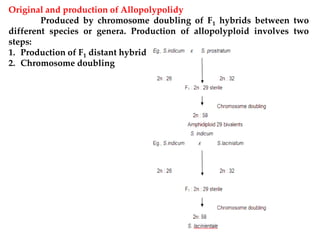
Original and production of Allopolypolidy
Produced by chromosome doubling of F1 hybrids between two
different species or genera. Production of allopolyploid involves two
steps:
1. Production of F1 distant hybrid
2. Chromosome doubling
Morphological and cytological features of Allopolyploids
1. The aim of achieving the desirable traits is reversed eg.,
Raphano brassica.
2. Many of them are Apomictic eg., grasses.
3. Characteristics of allopolyploids would result from an
interaction between genetic systems of the two parental
species.
4. Sterility is a common feature of polyploids.
5. Fertility of allopolyploids can be improved through
hybridization and selection.
Role of Allo polyploidy in Evolution
Allopolyploids have been more successful in crop
improvement than autopolyploid. Many of the crop species
are allopolyploid.
Eg., Brassica, Gosypium, Nicotiana, Saccharum
officinarum, Triticum etc.,
Winge postulated that allo- polyploidy was in crop
evolution. A vast majority of angiosperms were
allopolyploids.
Application of Allopolyploid in Crop Improvement
1. Utilization as a bridging species :
Amphidiploids serve as a bridge in the transfer of characters
from one species to a related species, more generally from
wild to a cultivated species.
2. Creation of new crop species :
Eg., Triticale, Sugarcane
Varalaxmi Cotton : G.hirsutum x G. barbadense
Widening the genetic of existing allopolyploid
Useful to introduce variability eg., Brassica
Limitations of Allo polyploid
1. Allopolyploid have undesirable features eg., Raphano
brassica
2. Newly synthesized allopolyploid have many defects eg.,
low fertility, genetic instability etc.,
3. Synthetic allopolyploids have to be improved through
extensive breeding at the polyploidy level. This involves
time, labour and cost.
4. Only a small proportion of allopolyploid are promising.

Lecture 27 - Polyploidy breeding.ppt

  • 1.
    POLYPLOIDY IN PLANTBREEDING The somatic chromosome number of any species, whether diploid or polyploidy is designated as ‘2n’ and chromosome number of gametes as ‘n’. An individual carrying the gametic chromosome number ‘n’ is known as ‘haploid’. The different chromosomes of a single genome are distinct from each other in morphology and / or gene content and homology; members of a single genome do not show a tendency of paring with each other. Individuals carrying chromosome numbers other than the diploid numbers are known as ‘heteroploids’ and the situation is referred as heteroploidy.
  • 2.
    When the chromosomenumber is an exact multiple of basic chromosome number of the species, it is termed as Euploidy – (Polypoidy); when it is not, it is termed as Aneuploids. Aneuploids individuals from which one chromosome pair is missing (2n-2) are termed as nullisomics, while those lacking a single chromosome (2n-1) are known as monosomics. A double monosomics individual has two chromosomes missing, but two chromosomes belong to two different chromosome pairs (2n-1-1). An individual having one extra chromosome (2n+1) is known as trisomic and that having two extra chromosomes earn belonging to different chromosome pair is double trisomic (2n+1+1) when an individual has an extra pair of chromosomes, it is known as tetrasomic (2n+2).
  • 3.
    When all thegenomes present in a polyploidy species are identical, it is known as Autopolyploid and the situation is termed as auto polyploidy. When the genome present in a polyploidy species are not identical, they are referred as Allopolyploids (two or more distinct gnomes are present) Amphidiploids is an allopolyploid that has two copies of each genome present in it, and as a consequence behaves as a diploid during meiosis. A segmental allopolyploid contains two or more genomes which are identical with each other, except for some minor differences.
  • 4.
    Blakeslee (1910) discovereda mutant in Datura which later proved by Belling (1920) as a trisomic. Winker (1916) induced first auto tetroploid in Solanum nigrum. Nicotiana glutinosa x Nicotiana tabacum (n = 12) (n = 24) F1 : 2n= 36 Chromosome doubling N.digluta 2n=72 (Clauses and Goodspeed, 1925) The chromosome doubling action of colchicines was first described by Blakeslee and Nebel (1937).
  • 5.
    ANEUPLOIDS ORIGIN AND PRODUCTION SPONTANEOUS: Aneuploidsoriginate spontaneously at a low frequency. Meiotic irregularities lead to the formulation of n+1 and n-1 gametes eg., datura. Triploid: The best sources of Aneuploids are triploid plants. Due to irregular meiosis at meiosis I phase, uneven distribution of chromosomes occur which lead to production of aneuploid. Asynaptic and Desynaptic plants : Univalents occur in these plants. Progeny of these plants produce aneuploids. Tetrasomic plants : Tetrasomic (2n+2) plants produce n +1 gametes in considerable frequencies. When they crossed with normal diploid or disomic (2n) plants, they produce a high frequency of trisomics.
  • 6.
    MORPHOLOGICAL AND CYTOLOGICALFEATURES OF ANEUPLOIDS Aneuploids are weaker generally than diploids. All the 21 nullisomics are available in wheat. Full series of trisomics are available in maize, barley, tomato, bajra. Trisomics may be comparable to diploid. Aneuploids exhibit distinct morphology. The monosomics in wheat are comparable to normal plants. Hence, the plants respected to be Aneuploids must be analyzed cytologically for confirmation. Nullisomics generally show regular bivalents and gametes carry n-1 chromosomes. Tetrasomics show irregular pairing and usually form one IV.
  • 7.
    In monosomics, onechromosome does not have a pair and remain as a univalent in metaphase I. At Anaphase I, the univalent move to one of the poles, may leg or lost or may divide (as in mitosis) into 2 chromatids which move to opposite poles. Due to this irregular behavior monosomics produce n-1 gametes. Aneuploids seeds are generally smaller and show reduced germination and seedlings show lower viability.
  • 8.
    APPLICATIONS IN CROPIMPROVEMENT 1. Aneuploids are useful in studies on the effects of loss or gain of chromosome on the phenotype of the individual. 2. Aneuploids are useful in locating a linkage groups or a gene to a particular chromosome. 3. Aneuploids are useful in the production of substitution lines. They are useful for transfer of the genes from a variety to another. 4. They are useful in studying the homology between different genomes. 5. They are useful in identifying the chromosomes involved in translocation. Aneuploid analysis for locating genes on particular chromosomes: Genes may be located on particular chromosomes by nullisomics, monosomics or trisomic analysis.
  • 9.
    NULLISOMIC ANALYSIS Nullisomic analysisis restricted to a few polyploidy species like wheat. Four approaches are used: 1. Absence of expression of a dominant character: When a dominant gene is located in a chromosome (eg., genes for seed colour and awn inhibition), the dominant character would not be expressed in the nullisomics. 2. Study of F2 generation : Normal x Nullisomic 2n (2n-2) Gamete n (n-1) F1: 2n-1 (Monosomic) Selfed
  • 10.
    A strain carryingthe dominant character is crossed to each of a complete set of nullisomics. (21 nullisomics in wheat). The progeny of such a cross would be all monosomics. The unpaird chromosome is contributed by the normal strain. These monosomics are selfed and F2 is raised. Plants with recessive phenotype would be all nullisomics (2n-2). The normal and monosomics plants receive the critical chromosome (carrying the dominant gene) from the normal parent. 3. Study of F3 generation: In some cases, it is desirable to study F3 progenies instead of F2. Show 3 : 1 segregation (Dominant : recessive)
  • 11.
    4. Chromosome substitution: Chromosomesubstitution using a nullisomics for the critical chromosome as a recurrent parent. A chromosome carrying a desirable gene or a group of genes may be transferred to another variety lacking these genes. The transfer of a pair of chromosomes from one strain into a different strain is known as chromosome substitution.
  • 12.
    MONOSOMIC ANALYSIS Monosomic analysesis useful in locating genes in particular chromosomes and for chromosome substitution. Monosomic analysis was first used in N. tabacum. Limitations of aneuploid analyses: 1. It is necessary to produce and maintain a complete set of aneuploids. Production, identification and maintenance of aneuploids requires elaborate cytogenetic analyses. 2. During aneuploid analyses and chromosome substitution cytological analysis must be carried out for accuracy. Hence, it is time consuming and tedious task.
  • 13.
    TRISOMIC ANALYSIS : Ifmonosomics or nullisomics analyses are not possible, trisomic analysis is applicable. The strain carrying the gene to be located on a particular chromosome is crossed (as male) to each of the complete set of trisomics (used as female ). F1 will be trisomics and disomic plants. Disomics are rejected. Trisomic F1 are either selfed or test crossed to a recessive disomic strain. F2 will show 3: 1 (or) 1: 1 ratio respectively for the character if it is not governed by a gene present on the chromosome which is in trisomic state. But, the ratio would be significantly different from 3 : 1 (or) 1 : 1 if it is present on the trisomic chromosome Trisomic analysis has been done in maize, barley, tomato.
  • 15.
    AUTOPOLYPLOIDY Monoploidy, triploidy, tetraploidyetc., are included in Autopolyploidy. Monoploid and haploid do not constitute polyploidy. Origin and production of doubled chromosome numbers: 1. Spontaneous: chromosome doubling occurs occasionally in somatic tissues and unreduced gametes are also produced in low frequencies. Production of unreduced gametes is promoted by certain genes. i.e., genes causing asynapsis or desynapsis. 2. Production of adventitious Buds: Shoot buds regenerated from callus tissues may be polyploidy. Eg., solaneous family where 6-36% of adventitious buds are reported to be tetraploid.
  • 16.
    The frequency ofthat polyploidy may be increased by the application of 1% NAA at the cut end as it favours callus development. 3. Physical agents: Heat or cold treatments, X-ray / r-ray irradiation may produce polyploids in low frequencies. Tetraploid plants are produced in datura due to cold treatment. Exposure of maize ears to a temperature of 35 - 45°C at the time of first division of Zygote produces 2 – 5% tetraploid progenies. Heat treatment may also induce polyploids in barley, wheat and rye.
  • 17.
    4. Regeneration invitro: Polyploidy is a common feature of cells in in vitro culture eg., Nicotiana, Datura, Rice 5. Colchicine treatment: Colchicine treatment is the most effective and mostly used treatment for colchicine doubling. It is widely used in monocots and dicots. Colchicine is a poisonous chemical isolated from seeds and bulbs of autumn crocus (Colchicum autumnale) It is readily soluble in alcohol, chloroform or cold water. Pure colchicine is C22H25O6N It blocks spindle fibre formation and these inhibits the movement of sister chromatids to opposite poles. As a result, the chromosome number is doubled.
  • 18.
    Since, colchicines affectsonly dividing cells, it should be applied when the tissues are actively dividing. Colchicine is usually applied as an aqueous solution various treatments: 1. Seed treatment 2. Seedling treatment 3. Growing shoot apices are commonly treated 4. In woody plants, ccc is applied on shoot buds OTHER CHEMICAL AGENTS Nitrous oxide, acenapthene, 8, hydoxy-quinoline . But they are less effective than colchicine and are not commonly used.
  • 19.
    MORPHOLOGICAL AND CYTOLOGICALFEATURES OF AUTOPOLYPLOIDS 1. Polyploids have larger cell size than diploids 2. Polyploids have larger pollen grain size and diploids 3. Polyploids are generally show greater in growth and flowering 4. Polyploids have larger leaves, flowers but less in number 5. Polyploids show reduced fertility due to irregularities 6. Polyploids leave low dry matter content 7. Different species have different levels of optimum ploidy eg., sugarbeet – optimum level is 3x
  • 20.
    Cytological features varywith the level of ploidy. In monoploids, the chromosomes do not pair and their distribution is random at Metaphase I leading to sterility. In triploids, trivalent, bivalent and univalents are produced. As a result, they produce various types of aneuploid progeny. eg., trisomic, double trisomic etc., Auto triploids are generally sterile eg., watermelon, banana Auto tetraploids show quadrivelent, trivalent, bivalent and univalents.They show variable fertility but fertility is lower than that of diploids. The fertility can be improved upon selection, eg., Maize, Bajra, Rice.
  • 21.
    Segregation in Autotetraploids: It is complex than in diploids. In Auto tetraploid, 4 chromosomes are homologous to each other and hence each gene has four copies. A simplex individual has 1D + 3R alleles (Aaaa). A duplex has 2D + 2R (AAaa). A triplex has 3D + 1R (AAAa). A quadraplex has all dominant alleles (AAAA) while nulliplex has none (aaaa) Role of auto polyploidy in Evolution Some of our present day crop species are auto ployploids eg., Potato (4 x), Groundnut (4 x), Alfalfa (4 x), Banana (3 x), Sweet Potato (6 x).
  • 22.
    Application of Autopolyploidy in Crop Improvement Monoploids and Haploids : 1. Used for developing homozygous diploid lines by chromosome doubling. This reduces time, labour for the production of inbreds and pure lines. 2. They may be useful in isolation of mutants because even recessive allele expresses in M1 itself due to chromosome doubling. 3. Since, desirable gametes are more frequent (p) than desirable zygotes (p2), selection based on haploids is more advantageous than diploid. 4. In auto tetraploid plants like potato, breeding is relatively easy at the haploid (2X) level than at tetraploid level.
  • 23.
    TRIPLOIDS Produced by crossingtetraploid x diploid strains. Generally, they are sterile except in a few cases. Seedless watermelons are grown commercially in Japan. Triploid sugar beets produce larger roots and more sugar than diploids. TETRAPLOIDS Used in breeding methods, to improve quality, to overcome self – incompatibility, to make distant crosses and occasionally directly used as varieties.
  • 24.
    LIMITATIONS OF AUTOPLOYPLOIDY 1.Large size of autopolyploid is generally accompanied with higher water content. 2. Auto polyploids show high sterility accompanied with poor seed – set. 3. Fertility in auto tetraploids can be increased by hybridization and selection. But due to complex segregation, progress under selection is slow. 4. Monoploids and triploids can’t be maintained except through clonal propagation. 5. New polyploids are generally characterized by a few or more undesirable features. Eg., poor stem strength in grapes, irregular fruit size in water melon. ALLOPOLY PLOIDY Allo polyploids have genomes from two or more species. Aim : To create new species. Some success obtained. Eg., Triticale, Raphano brassica
  • 25.
    Original and productionof Allopolypolidy Produced by chromosome doubling of F1 hybrids between two different species or genera. Production of allopolyploid involves two steps: 1. Production of F1 distant hybrid 2. Chromosome doubling
  • 26.
    Morphological and cytologicalfeatures of Allopolyploids 1. The aim of achieving the desirable traits is reversed eg., Raphano brassica. 2. Many of them are Apomictic eg., grasses. 3. Characteristics of allopolyploids would result from an interaction between genetic systems of the two parental species. 4. Sterility is a common feature of polyploids. 5. Fertility of allopolyploids can be improved through hybridization and selection.
  • 27.
    Role of Allopolyploidy in Evolution Allopolyploids have been more successful in crop improvement than autopolyploid. Many of the crop species are allopolyploid. Eg., Brassica, Gosypium, Nicotiana, Saccharum officinarum, Triticum etc., Winge postulated that allo- polyploidy was in crop evolution. A vast majority of angiosperms were allopolyploids.
  • 28.
    Application of Allopolyploidin Crop Improvement 1. Utilization as a bridging species : Amphidiploids serve as a bridge in the transfer of characters from one species to a related species, more generally from wild to a cultivated species. 2. Creation of new crop species : Eg., Triticale, Sugarcane Varalaxmi Cotton : G.hirsutum x G. barbadense Widening the genetic of existing allopolyploid Useful to introduce variability eg., Brassica
  • 29.
    Limitations of Allopolyploid 1. Allopolyploid have undesirable features eg., Raphano brassica 2. Newly synthesized allopolyploid have many defects eg., low fertility, genetic instability etc., 3. Synthetic allopolyploids have to be improved through extensive breeding at the polyploidy level. This involves time, labour and cost. 4. Only a small proportion of allopolyploid are promising.