Introduction to Polyploidy
Muhammad Qasim Hisbani
M-phil Scholar
Roll No# 2K23-MBOT-15
Polyploidy
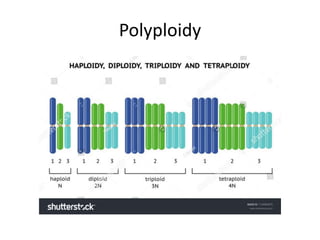
Polyploidy is a genetic condition characterized by having more
than two complete sets of chromosomes in an organism.
This condition can occur naturally or can be induced artificially
by researchers.
Nearly all plants and animals probably have some polyploid
tissues.
Examples:
1. Plant Endosperm is triploid
2. Wheat is hexaploid (6N) and the strewberry is octaploid (8N).
Polyploidy
Polyploidy
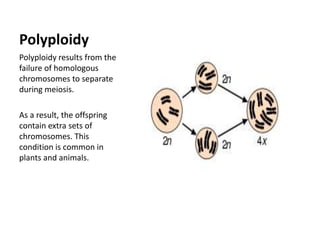
Polyploidy results from the
failure of homologous
chromosomes to separate
during meiosis.
As a result, the offspring
contain extra sets of
chromosomes. This
condition is common in
plants and animals.
Origin of Polyploids
• Somatic Doubling during mitosis.
• Non-reduction in meiosis leading to the
production of unreduced gametes.
• Polyspermaty (fertilization of the egg by two
male nuclei).
• Endoreplication ( replication of the DNA but no
cytokinesis.
Types of Polyploidy
• There are generally two types of polyploidy:
1. Autopolyploids 2. Allopolyploids
Autopolyploids: It happens when an organism’s chromosomes
double during cell division.
Allopolylpoids: It happens when two different species mate and
produce offspring with a higher chromosomes count than either
parent.
Types of Polyploids
Autopolyploidy
• Autopolyploidy occurs when an
individual has multiple sets of
chromosomes derived from the same
species.
• It commonly arises due to errors in
cell division, such as nondisjunction,
resulting in the formation of gametes
with double or multiple sets of
chromosomes.
• When these gametes fuse during
fertilization, they give rise to
offspring with higher ploidy levels.
• Examples: Potato, Banana , Peanut
etc.
Allopolyploidy
• arises when an organism possesses
multiple sets of chromosomes
derived from different species.
• It occurs through hybridization
between two closely related species
that have different chromosome
numbers.
• Allopolyploidy can lead to the
emergence of new species as the
hybrid offspring may acquire unique
traits and reproductive isolation from
their parental species.
• Examples: Wheat, Cotton and canola
etc.
Mechanism of Polyploidy
• Induction of Polyploidy:
• Polyploidy occurs naturally, but in breeding programs, it is often
induced artificially. Chemical agents such as colchicine or
oryzalin are commonly used to disrupt the normal separation of
chromosomes during cell division. This leads to the duplication
of chromosomes within cells, resulting in polyploids.
• Selection of Parental Plant:
• Suitable parental plant are chosen based on disease resistance,
yield, quality and environmental condition. The selected plants
should have high probability of producing viable offspring after
polyploidization.
Mechanism of Polyploidy
• Polyploid Verification
• After the recovery phase, the polyploid nature of the
regenerated plants is verified through chromosome counts.
This is done using techniques like microscopy, flow cytometry,
or molecular marker analysis.
• Breeding Strategies
• Once polylpoids are identified and confirmed, breeding
stretegies are employed to utilize their characteristics such as,
larger in size, altered morphology and increased vigor.
Mechanism of Polyploidy
• Crossbreeding and Selection
• Polyploids can be crossed with other existing varieties to
introduce new traits or combine desirable characteristics.
• Evaluation and Commercialization
• The selected polyploid offspring evaluated through field trails,
laboratory analyses, and other testing methods. Once
deemed suitable, these improved varieties can be further
developed, multiplied and eventually commercialized for
farmers to grow and benefit from.
Conclusion
• It’s worth noting that the success of polyploidy
breeding depends on various factors, including
the crop species involved the genetics of the
parent plants, and the breeding objectives.
• Additionally, polyploidy can also occur naturally
and contribute to the diversity of plant species,
but harnessing it through controlled breeding
techniques allows for more targeted crop
improvement.
Introduction to Polyploidy.pptx

Introduction to Polyploidy.pptx

  • 1.
    Introduction to Polyploidy MuhammadQasim Hisbani M-phil Scholar Roll No# 2K23-MBOT-15
  • 2.
    Polyploidy Polyploidy is agenetic condition characterized by having more than two complete sets of chromosomes in an organism. This condition can occur naturally or can be induced artificially by researchers. Nearly all plants and animals probably have some polyploid tissues. Examples: 1. Plant Endosperm is triploid 2. Wheat is hexaploid (6N) and the strewberry is octaploid (8N).
  • 3.
  • 4.
    Polyploidy Polyploidy results fromthe failure of homologous chromosomes to separate during meiosis. As a result, the offspring contain extra sets of chromosomes. This condition is common in plants and animals.
  • 5.
    Origin of Polyploids •Somatic Doubling during mitosis. • Non-reduction in meiosis leading to the production of unreduced gametes. • Polyspermaty (fertilization of the egg by two male nuclei). • Endoreplication ( replication of the DNA but no cytokinesis.
  • 6.
    Types of Polyploidy •There are generally two types of polyploidy: 1. Autopolyploids 2. Allopolyploids Autopolyploids: It happens when an organism’s chromosomes double during cell division. Allopolylpoids: It happens when two different species mate and produce offspring with a higher chromosomes count than either parent.
  • 7.
    Types of Polyploids Autopolyploidy •Autopolyploidy occurs when an individual has multiple sets of chromosomes derived from the same species. • It commonly arises due to errors in cell division, such as nondisjunction, resulting in the formation of gametes with double or multiple sets of chromosomes. • When these gametes fuse during fertilization, they give rise to offspring with higher ploidy levels. • Examples: Potato, Banana , Peanut etc. Allopolyploidy • arises when an organism possesses multiple sets of chromosomes derived from different species. • It occurs through hybridization between two closely related species that have different chromosome numbers. • Allopolyploidy can lead to the emergence of new species as the hybrid offspring may acquire unique traits and reproductive isolation from their parental species. • Examples: Wheat, Cotton and canola etc.
  • 8.
    Mechanism of Polyploidy •Induction of Polyploidy: • Polyploidy occurs naturally, but in breeding programs, it is often induced artificially. Chemical agents such as colchicine or oryzalin are commonly used to disrupt the normal separation of chromosomes during cell division. This leads to the duplication of chromosomes within cells, resulting in polyploids. • Selection of Parental Plant: • Suitable parental plant are chosen based on disease resistance, yield, quality and environmental condition. The selected plants should have high probability of producing viable offspring after polyploidization.
  • 9.
    Mechanism of Polyploidy •Polyploid Verification • After the recovery phase, the polyploid nature of the regenerated plants is verified through chromosome counts. This is done using techniques like microscopy, flow cytometry, or molecular marker analysis. • Breeding Strategies • Once polylpoids are identified and confirmed, breeding stretegies are employed to utilize their characteristics such as, larger in size, altered morphology and increased vigor.
  • 10.
    Mechanism of Polyploidy •Crossbreeding and Selection • Polyploids can be crossed with other existing varieties to introduce new traits or combine desirable characteristics. • Evaluation and Commercialization • The selected polyploid offspring evaluated through field trails, laboratory analyses, and other testing methods. Once deemed suitable, these improved varieties can be further developed, multiplied and eventually commercialized for farmers to grow and benefit from.
  • 11.
    Conclusion • It’s worthnoting that the success of polyploidy breeding depends on various factors, including the crop species involved the genetics of the parent plants, and the breeding objectives. • Additionally, polyploidy can also occur naturally and contribute to the diversity of plant species, but harnessing it through controlled breeding techniques allows for more targeted crop improvement.