PBG 201- FUNDAMENTALS
OF GENETICS
LECTURE 1. DEFINITION OF
GENETICS, HEREDITY,
INHERITANCE, CYTOLOGY,
CYTOGENETICS; BRIEF HISTORY
OF DEVELOPMENTS IN
GENETICS AND CYTOGENETICS.
Genetics
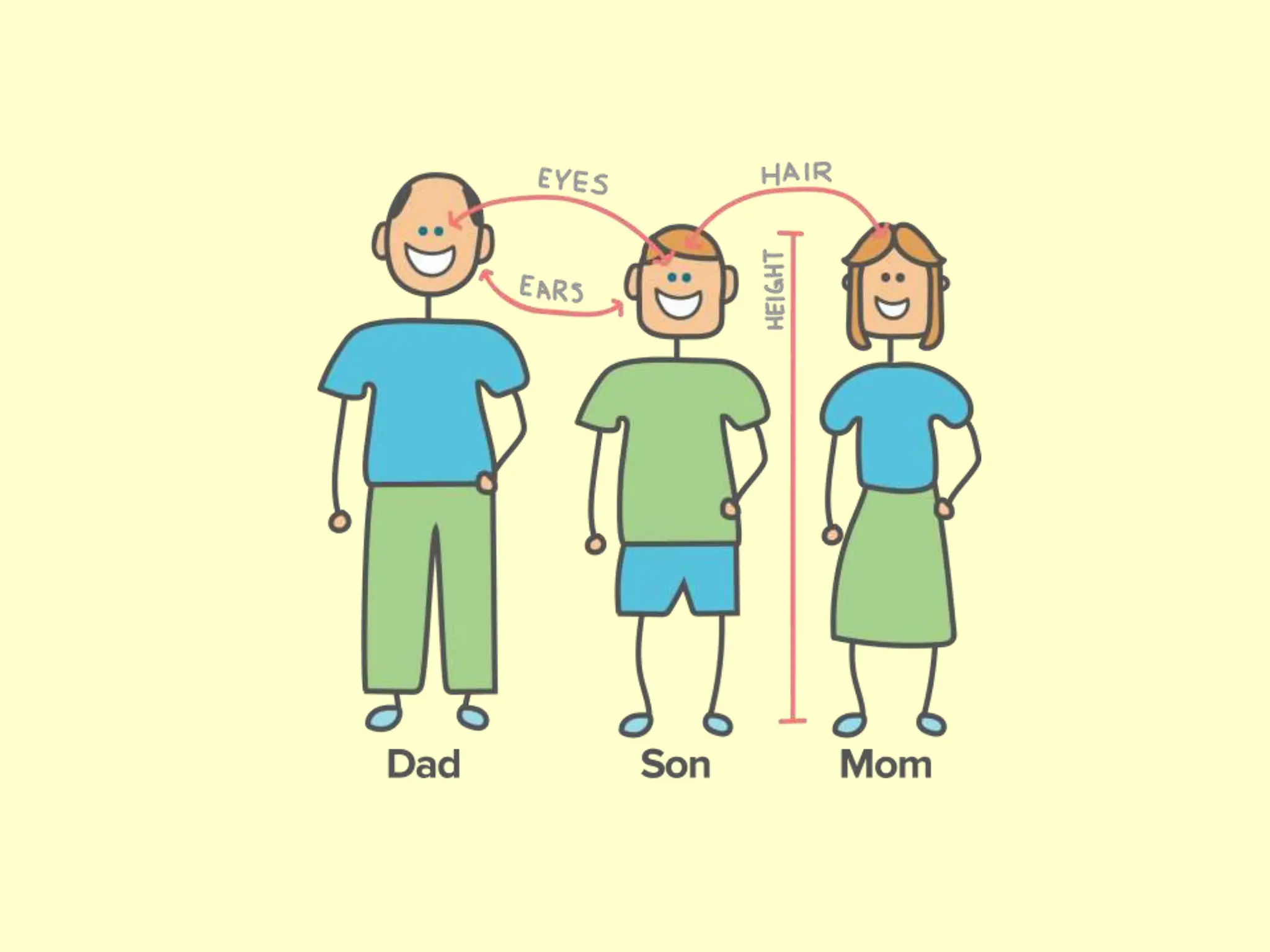
Genetics is a biological science, which deals with principles of heredity
and variation.
Heredity - process which brings about the biological similarity
between parents and progeny.
Deals with inheritance of characters from parents to offsprings.
Inheritance is the transmission of – genetic information from parents
and ancestors to offspring.
Variation: The differences among individuals of a single species for a
particular character.
• Genes: are the functional units that govern the
development of characters of an individual.
• Gene - unit of inheritance
• All characters are governed by genes
• Genetics is the study of
» structure
» composition and
» function of genes
• The term genetics was first coined by Bateson (1905)
Cell science – cell structure and function of cell organelles
with special emphasis on nucleus
how the chromosomes, the carrier of genes
behave in the somatic and reproductive cells of an organism
Expression of genetic behaviour at cellular level
» study of chromosomes
» Its behaviour in replication,
» reproduction
» organ development
» evolution of species
Cytogenetics is study of chromosomes in relation to
genetics.
Cytology
Cytogenetics
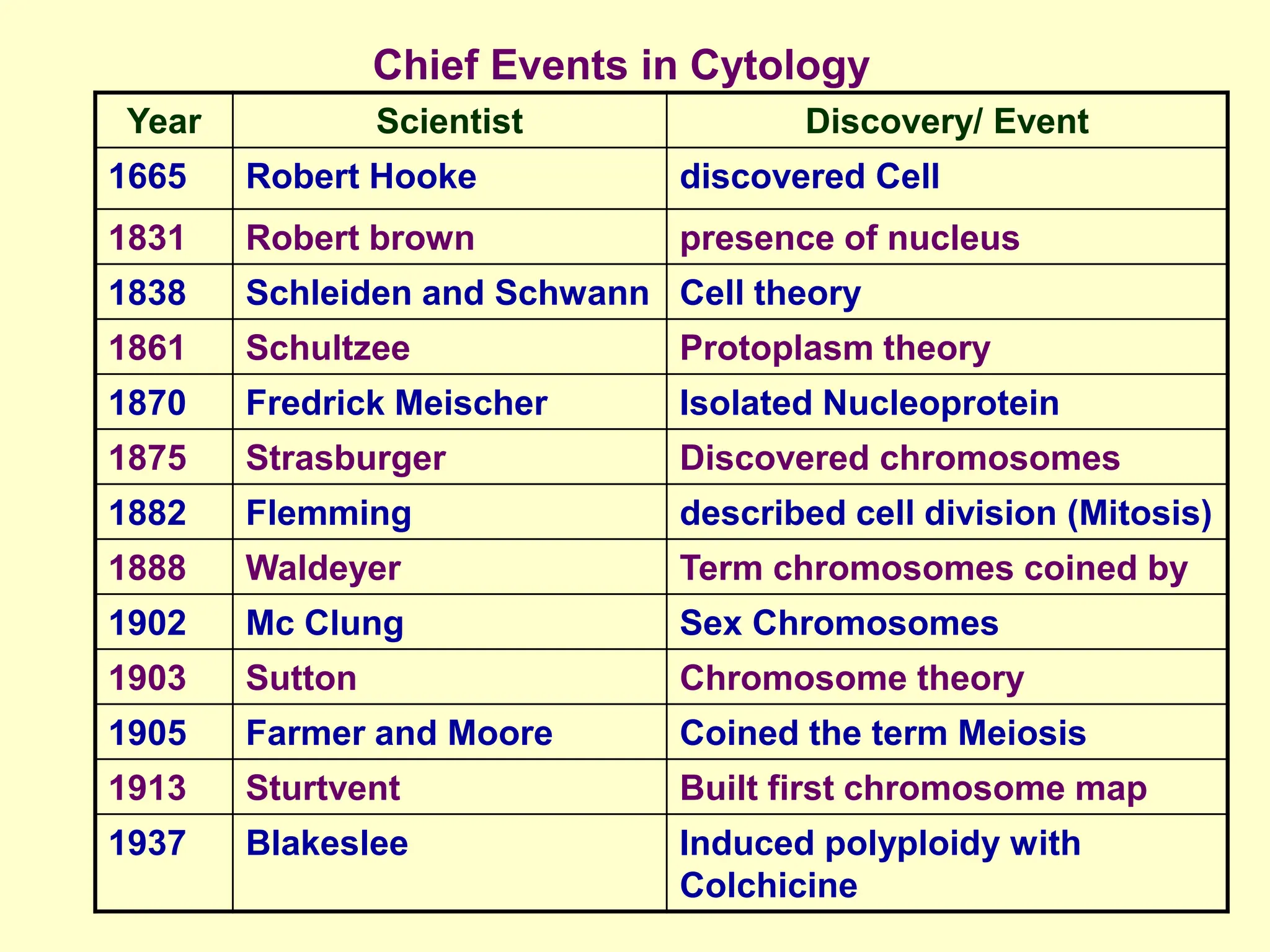
Year Scientist Discovery/ Event
1665 Robert Hooke discovered Cell
1831 Robert brown presence of nucleus
1838 Schleiden and Schwann Cell theory
1861 Schultzee Protoplasm theory
1870 Fredrick Meischer Isolated Nucleoprotein
1875 Strasburger Discovered chromosomes
1882 Flemming described cell division (Mitosis)
1888 Waldeyer Term chromosomes coined by
1902 Mc Clung Sex Chromosomes
1903 Sutton Chromosome theory
1905 Farmer and Moore Coined the term Meiosis
1913 Sturtvent Built first chromosome map
1937 Blakeslee Induced polyploidy with
Colchicine
Chief Events in Cytology
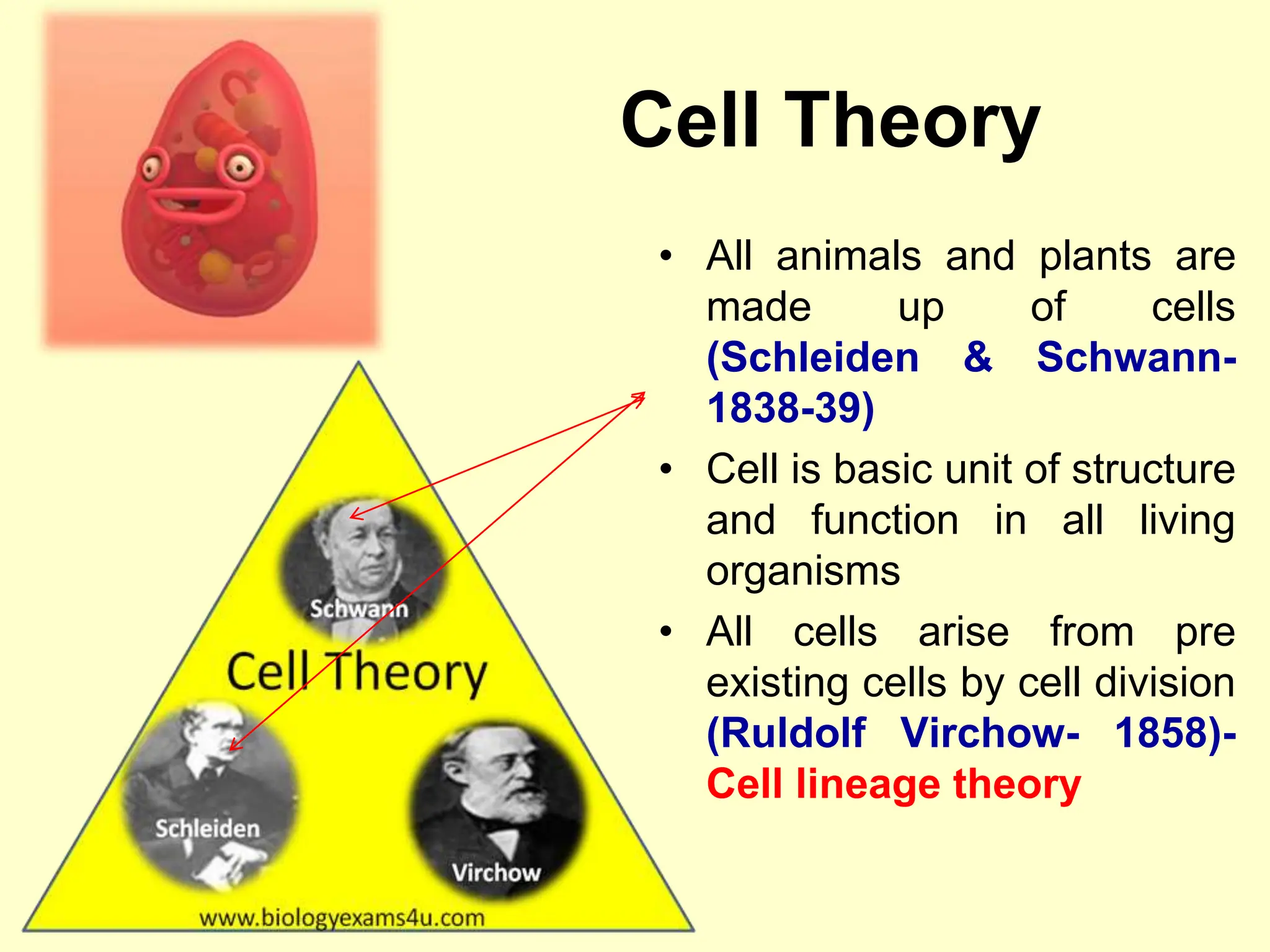
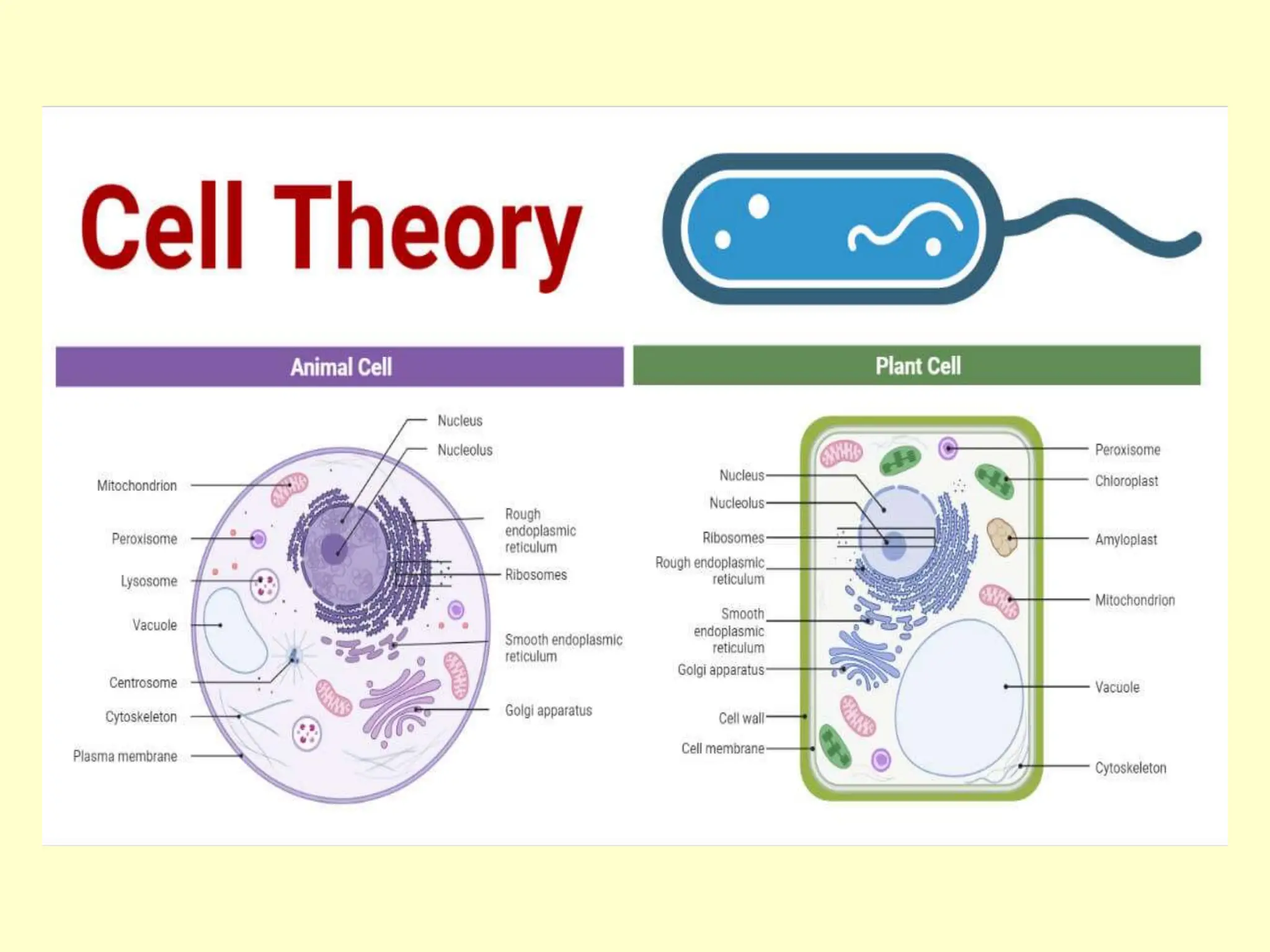
Cell Theory
• All animals and plants are
made up of cells
(Schleiden & Schwann-
1838-39)
• Cell is basic unit of structure
and function in all living
organisms
• All cells arise from pre
existing cells by cell division
(Ruldolf Virchow- 1858)-
Cell lineage theory
History of Genetics
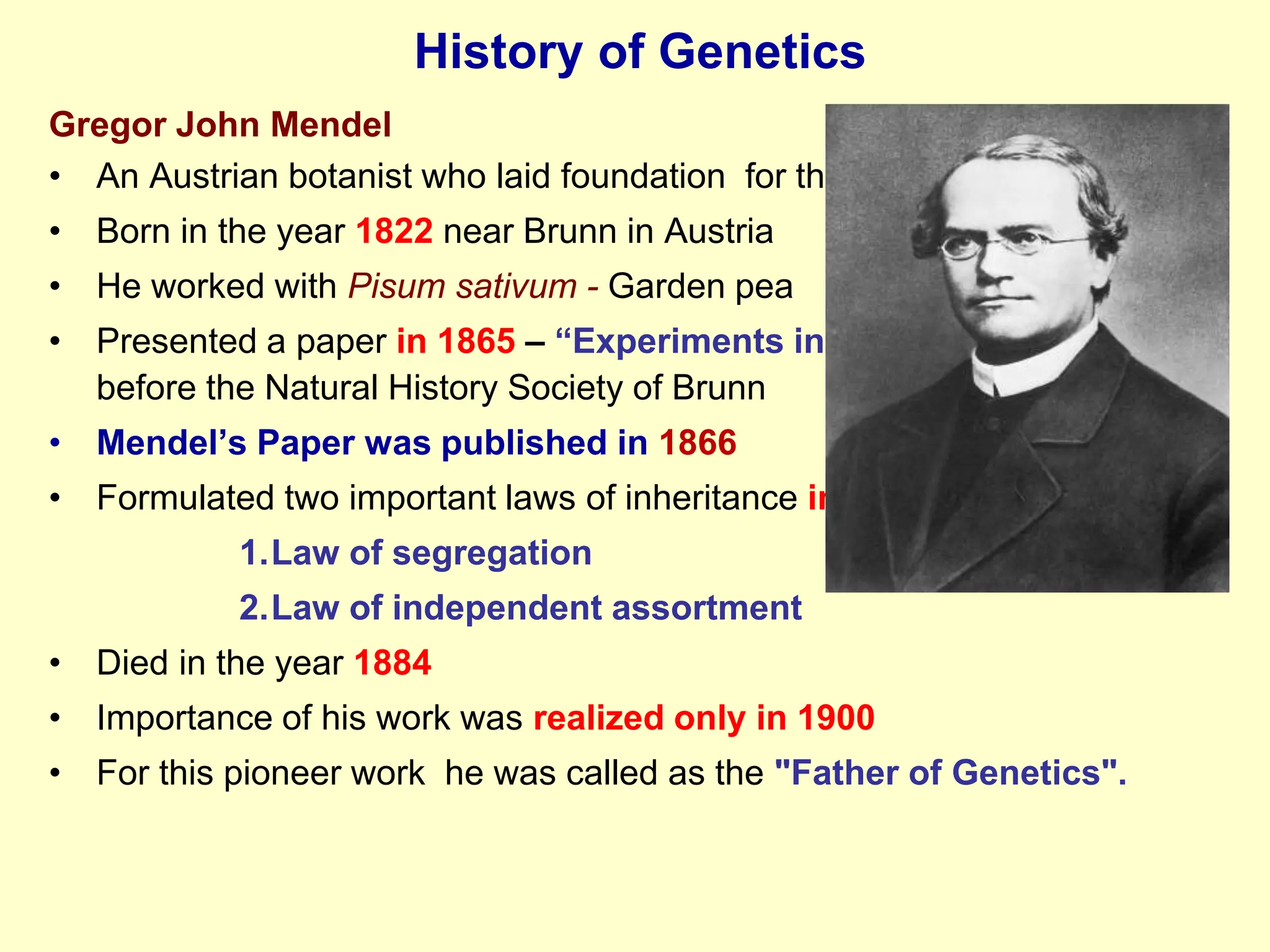
Gregor John Mendel
• An Austrian botanist who laid foundation for the science of genetics.
• Born in the year 1822 near Brunn in Austria
• He worked with Pisum sativum - Garden pea
• Presented a paper in 1865 – “Experiments in Plant Hybridization”
before the Natural History Society of Brunn
• Mendel’s Paper was published in 1866
• Formulated two important laws of inheritance in 1866
1.Law of segregation
2.Law of independent assortment
• Died in the year 1884
• Importance of his work was realized only in 1900
• For this pioneer work he was called as the "Father of Genetics".
Rediscovery of Mendels work in 1900 by Correns, Hugo devries,
Tschermak
Carl Erich Correns
• A german botanist who rediscovered Mendel's work in 1900
• He conducted research with garden pea and came to the same
conclusion as drawn by Mendel in 1865.
• He worked with Mirabilis jalapa (4'O' clock plant) and established the
first conclusive example for Extrachromosomal inheritance
Hugo devries
• Rediscovered the mendel's law of inheritance independentantly but
simultaneously with Correns and Tschermak in 1900,
• He coined the term Mutation - sudden heritable changes in the
characters
Tschermak
• One of the co discoverers of Mendel's classic papers on garden pea
• He applied mendel's law of heredity in barley, wheat rye hybrids and
oat hybrids for the development of new plants
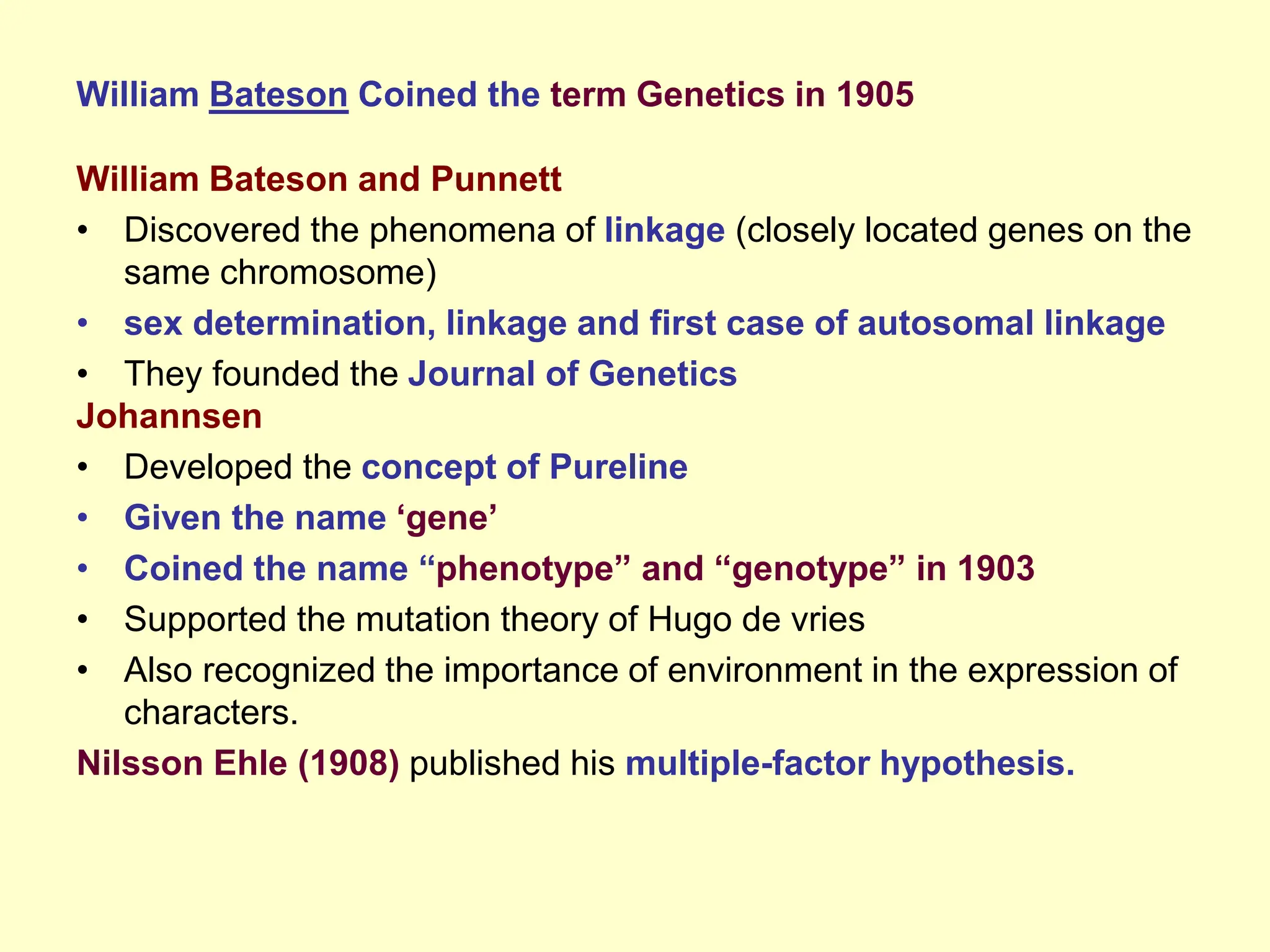
William Bateson Coined the term Genetics in 1905
William Bateson and Punnett
• Discovered the phenomena of linkage (closely located genes on the
same chromosome)
• sex determination, linkage and first case of autosomal linkage
• They founded the Journal of Genetics
Johannsen
• Developed the concept of Pureline
• Given the name ‘gene’
• Coined the name “phenotype” and “genotype” in 1903
• Supported the mutation theory of Hugo de vries
• Also recognized the importance of environment in the expression of
characters.
Nilsson Ehle (1908) published his multiple-factor hypothesis.
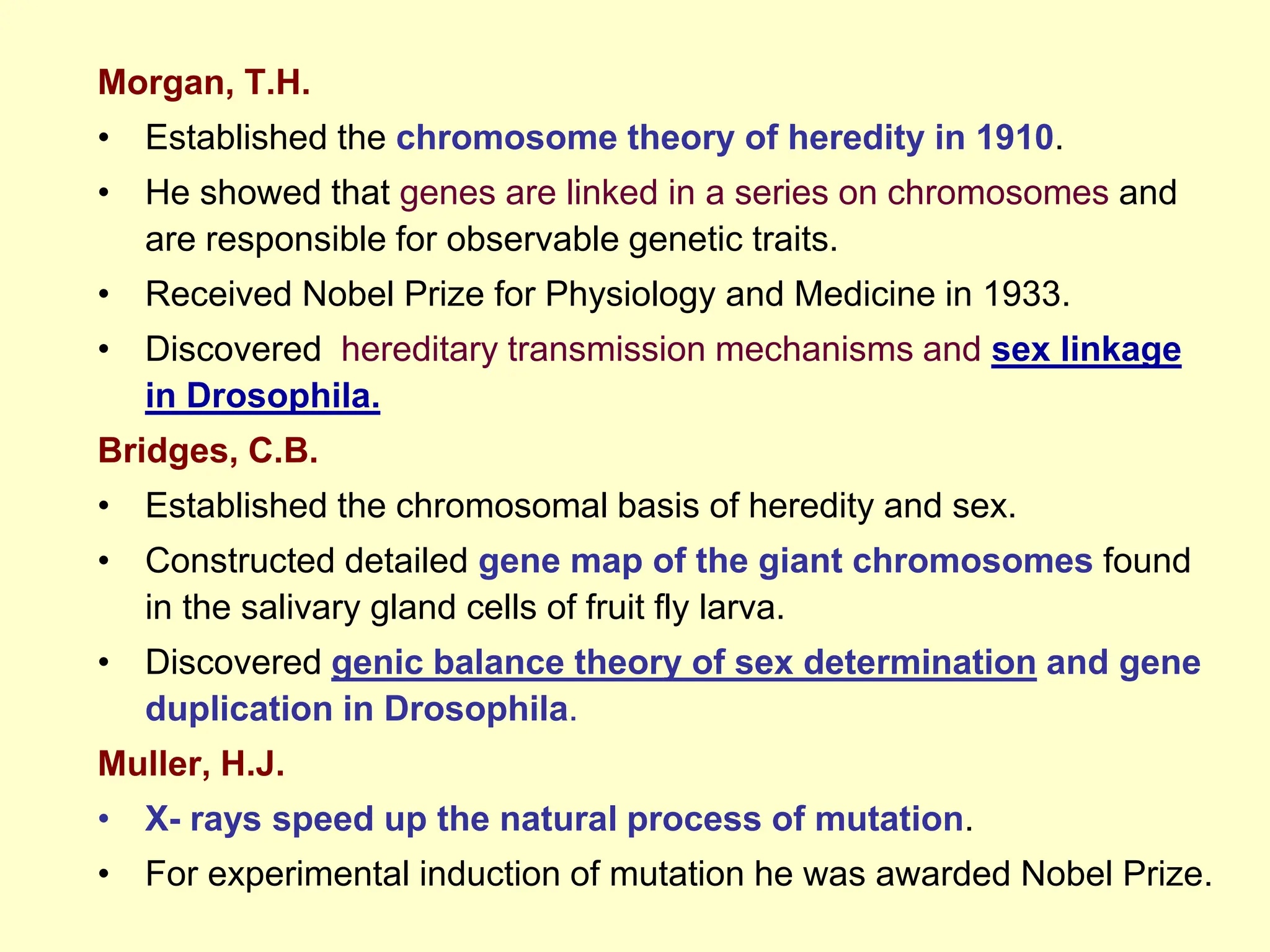
Morgan, T.H.
• Established the chromosome theory of heredity in 1910.
• He showed that genes are linked in a series on chromosomes and
are responsible for observable genetic traits.
• Received Nobel Prize for Physiology and Medicine in 1933.
• Discovered hereditary transmission mechanisms and sex linkage
in Drosophila.
Bridges, C.B.
• Established the chromosomal basis of heredity and sex.
• Constructed detailed gene map of the giant chromosomes found
in the salivary gland cells of fruit fly larva.
• Discovered genic balance theory of sex determination and gene
duplication in Drosophila.
Muller, H.J.
• X- rays speed up the natural process of mutation.
• For experimental induction of mutation he was awarded Nobel Prize.
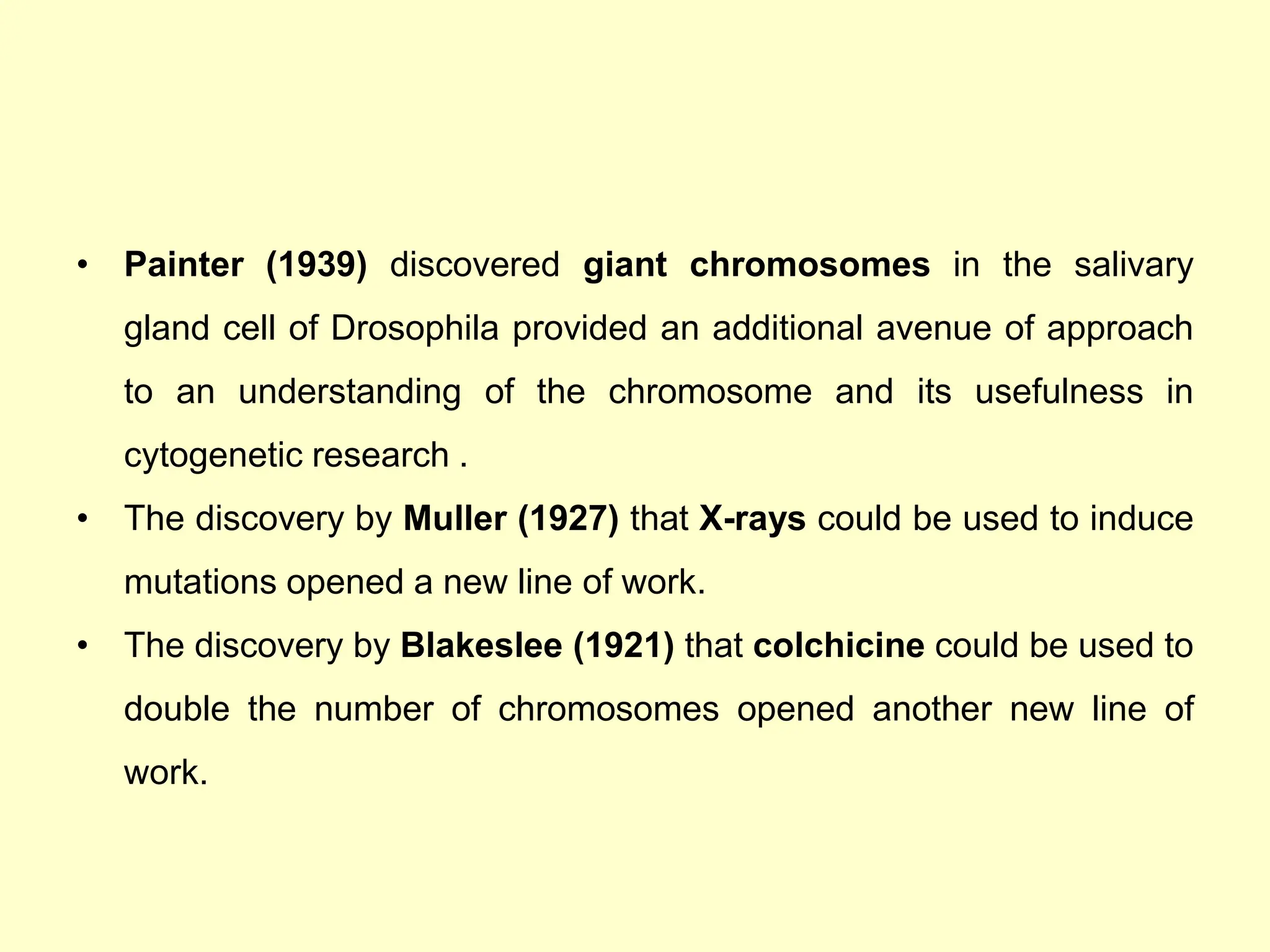
• Painter (1939) discovered giant chromosomes in the salivary
gland cell of Drosophila provided an additional avenue of approach
to an understanding of the chromosome and its usefulness in
cytogenetic research .
• The discovery by Muller (1927) that X-rays could be used to induce
mutations opened a new line of work.
• The discovery by Blakeslee (1921) that colchicine could be used to
double the number of chromosomes opened another new line of
work.
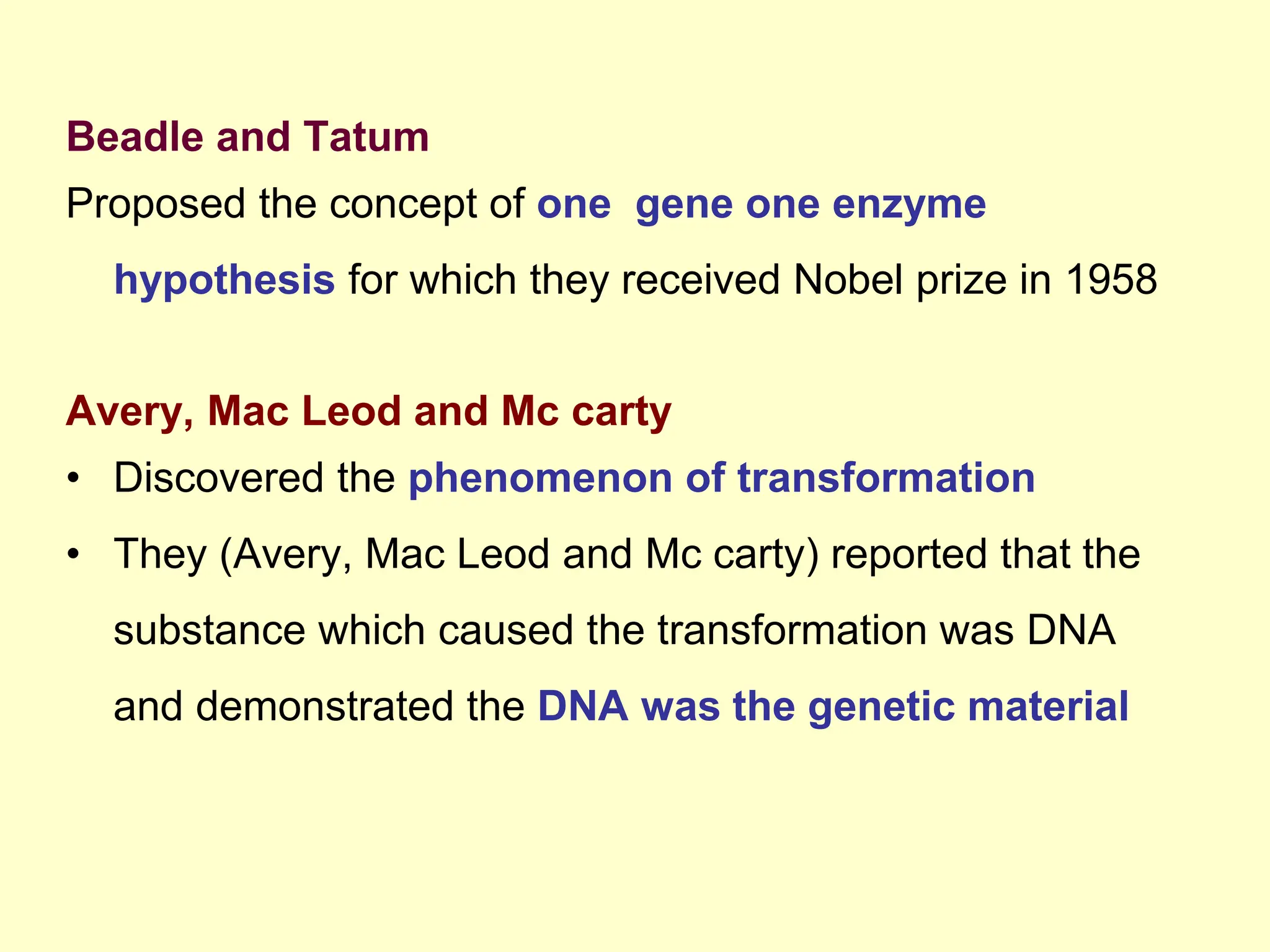
Beadle and Tatum
Proposed the concept of one gene one enzyme
hypothesis for which they received Nobel prize in 1958
Avery, Mac Leod and Mc carty
• Discovered the phenomenon of transformation
• They (Avery, Mac Leod and Mc carty) reported that the
substance which caused the transformation was DNA
and demonstrated the DNA was the genetic material
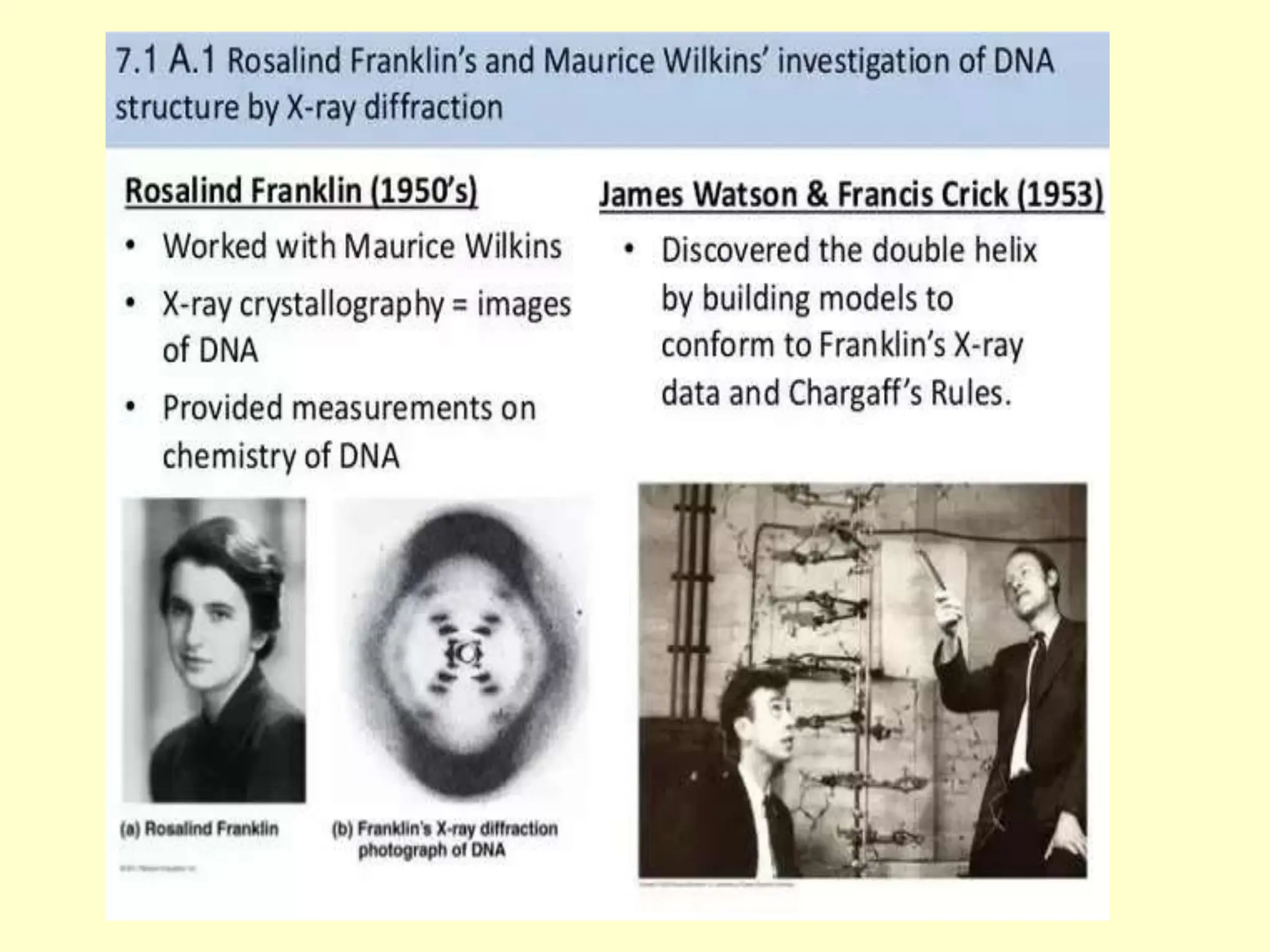
Watson and Crick (1953) and Wilkinson
• The X ray diffraction studies of DNA by Wilkinson
resulted in the Discovery of the molecular structure of
DNA, in 1953 by Watson and Crick
Watson and Crick - proposed the double helix model of
DNA
• The three scientists received Nobel prize in 1962
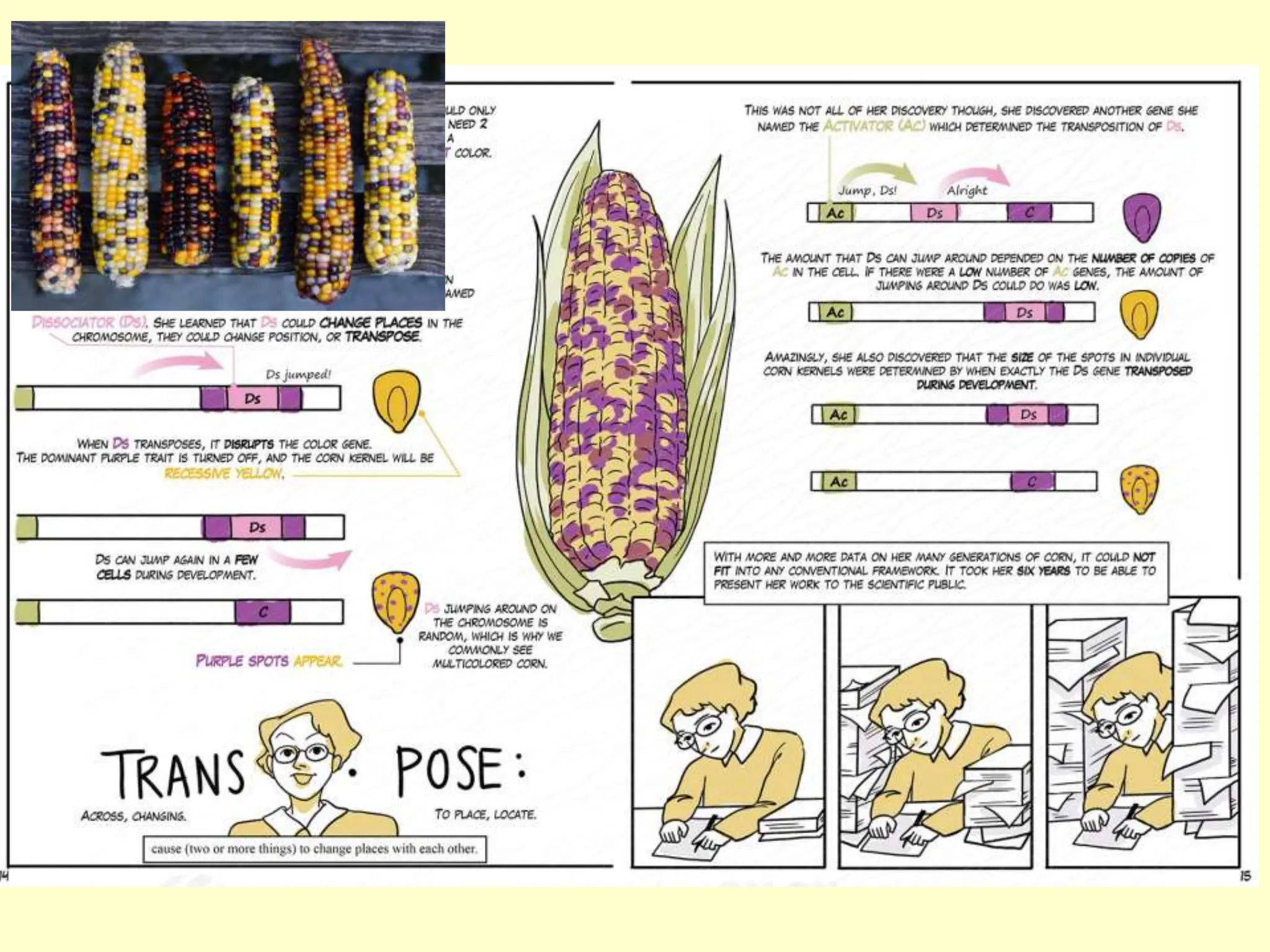
Barbara Mc Clintock
• Discovered transposons/ jumping genes in Maize in
1950
Genes that are capable of changing their position on
a chromosome and from one chromosome to
another
• Awarded Nobel Prize in 1983
Benzer
• Detail structure of viral genes and coined the term cistron to denote
functional sub unit of genes
• Gave sub divisions of genes viz., Cistron, Recon and Muton. These are
the units of function, recombination and mutation within a gene.
Meselson and Stahl
• Experimentally confirmed the semiconservative replication of DNA
F.H.C. Crick
• Proposed the Central Dogma of Molecular Biology in 1958
• Gave evidence for the triplet nature of genetic code in 1961
Nirenberg - Responsible for deciphering the genetic code- 1961
Jacob and Monad
• Explained gene regulation in cell metabolism by directing the
biosynthesis of enzymes - Operon concept in 1962
• Awarded Nobel prize in 1965
Khorana
• Discovered how the genetic components of the cell nucleus
control the synthesis of protein
• Awarded Nobel prize in 1968 with Nirenberg and Holley
• He prepared the first artificial copy of a yeast gene in 1970
Stanley Cohen and Herberd Boyer
• Genetic Engineering in 1973
A.M. Maxam and W.Frederick Gilbert; F. Sanger and Coulson
• Sequencing of DNA in 1977
Craig Venter (2001) – human Genome Project – Complete
sequencing of human genome
Goff et al and Yu et al (2002) – Rice Genome Sequencing

Definition of Genetics, Heredity and variation

  • 1.
  • 2.
    LECTURE 1. DEFINITIONOF GENETICS, HEREDITY, INHERITANCE, CYTOLOGY, CYTOGENETICS; BRIEF HISTORY OF DEVELOPMENTS IN GENETICS AND CYTOGENETICS.
  • 3.
    Genetics Genetics is abiological science, which deals with principles of heredity and variation. Heredity - process which brings about the biological similarity between parents and progeny. Deals with inheritance of characters from parents to offsprings. Inheritance is the transmission of – genetic information from parents and ancestors to offspring. Variation: The differences among individuals of a single species for a particular character.
  • 5.
    • Genes: arethe functional units that govern the development of characters of an individual. • Gene - unit of inheritance • All characters are governed by genes • Genetics is the study of » structure » composition and » function of genes • The term genetics was first coined by Bateson (1905)
  • 6.
    Cell science –cell structure and function of cell organelles with special emphasis on nucleus how the chromosomes, the carrier of genes behave in the somatic and reproductive cells of an organism Expression of genetic behaviour at cellular level » study of chromosomes » Its behaviour in replication, » reproduction » organ development » evolution of species Cytogenetics is study of chromosomes in relation to genetics. Cytology Cytogenetics
  • 7.
    Year Scientist Discovery/Event 1665 Robert Hooke discovered Cell 1831 Robert brown presence of nucleus 1838 Schleiden and Schwann Cell theory 1861 Schultzee Protoplasm theory 1870 Fredrick Meischer Isolated Nucleoprotein 1875 Strasburger Discovered chromosomes 1882 Flemming described cell division (Mitosis) 1888 Waldeyer Term chromosomes coined by 1902 Mc Clung Sex Chromosomes 1903 Sutton Chromosome theory 1905 Farmer and Moore Coined the term Meiosis 1913 Sturtvent Built first chromosome map 1937 Blakeslee Induced polyploidy with Colchicine Chief Events in Cytology
  • 8.
    Cell Theory • Allanimals and plants are made up of cells (Schleiden & Schwann- 1838-39) • Cell is basic unit of structure and function in all living organisms • All cells arise from pre existing cells by cell division (Ruldolf Virchow- 1858)- Cell lineage theory
  • 10.
    History of Genetics GregorJohn Mendel • An Austrian botanist who laid foundation for the science of genetics. • Born in the year 1822 near Brunn in Austria • He worked with Pisum sativum - Garden pea • Presented a paper in 1865 – “Experiments in Plant Hybridization” before the Natural History Society of Brunn • Mendel’s Paper was published in 1866 • Formulated two important laws of inheritance in 1866 1.Law of segregation 2.Law of independent assortment • Died in the year 1884 • Importance of his work was realized only in 1900 • For this pioneer work he was called as the "Father of Genetics".
  • 12.
    Rediscovery of Mendelswork in 1900 by Correns, Hugo devries, Tschermak Carl Erich Correns • A german botanist who rediscovered Mendel's work in 1900 • He conducted research with garden pea and came to the same conclusion as drawn by Mendel in 1865. • He worked with Mirabilis jalapa (4'O' clock plant) and established the first conclusive example for Extrachromosomal inheritance Hugo devries • Rediscovered the mendel's law of inheritance independentantly but simultaneously with Correns and Tschermak in 1900, • He coined the term Mutation - sudden heritable changes in the characters Tschermak • One of the co discoverers of Mendel's classic papers on garden pea • He applied mendel's law of heredity in barley, wheat rye hybrids and oat hybrids for the development of new plants
  • 13.
    William Bateson Coinedthe term Genetics in 1905 William Bateson and Punnett • Discovered the phenomena of linkage (closely located genes on the same chromosome) • sex determination, linkage and first case of autosomal linkage • They founded the Journal of Genetics Johannsen • Developed the concept of Pureline • Given the name ‘gene’ • Coined the name “phenotype” and “genotype” in 1903 • Supported the mutation theory of Hugo de vries • Also recognized the importance of environment in the expression of characters. Nilsson Ehle (1908) published his multiple-factor hypothesis.
  • 14.
    Morgan, T.H. • Establishedthe chromosome theory of heredity in 1910. • He showed that genes are linked in a series on chromosomes and are responsible for observable genetic traits. • Received Nobel Prize for Physiology and Medicine in 1933. • Discovered hereditary transmission mechanisms and sex linkage in Drosophila. Bridges, C.B. • Established the chromosomal basis of heredity and sex. • Constructed detailed gene map of the giant chromosomes found in the salivary gland cells of fruit fly larva. • Discovered genic balance theory of sex determination and gene duplication in Drosophila. Muller, H.J. • X- rays speed up the natural process of mutation. • For experimental induction of mutation he was awarded Nobel Prize.
  • 15.
    • Painter (1939)discovered giant chromosomes in the salivary gland cell of Drosophila provided an additional avenue of approach to an understanding of the chromosome and its usefulness in cytogenetic research . • The discovery by Muller (1927) that X-rays could be used to induce mutations opened a new line of work. • The discovery by Blakeslee (1921) that colchicine could be used to double the number of chromosomes opened another new line of work.
  • 16.
    Beadle and Tatum Proposedthe concept of one gene one enzyme hypothesis for which they received Nobel prize in 1958 Avery, Mac Leod and Mc carty • Discovered the phenomenon of transformation • They (Avery, Mac Leod and Mc carty) reported that the substance which caused the transformation was DNA and demonstrated the DNA was the genetic material
  • 17.
    Watson and Crick(1953) and Wilkinson • The X ray diffraction studies of DNA by Wilkinson resulted in the Discovery of the molecular structure of DNA, in 1953 by Watson and Crick Watson and Crick - proposed the double helix model of DNA • The three scientists received Nobel prize in 1962 Barbara Mc Clintock • Discovered transposons/ jumping genes in Maize in 1950 Genes that are capable of changing their position on a chromosome and from one chromosome to another • Awarded Nobel Prize in 1983
  • 20.
    Benzer • Detail structureof viral genes and coined the term cistron to denote functional sub unit of genes • Gave sub divisions of genes viz., Cistron, Recon and Muton. These are the units of function, recombination and mutation within a gene. Meselson and Stahl • Experimentally confirmed the semiconservative replication of DNA F.H.C. Crick • Proposed the Central Dogma of Molecular Biology in 1958 • Gave evidence for the triplet nature of genetic code in 1961 Nirenberg - Responsible for deciphering the genetic code- 1961 Jacob and Monad • Explained gene regulation in cell metabolism by directing the biosynthesis of enzymes - Operon concept in 1962 • Awarded Nobel prize in 1965
  • 21.
    Khorana • Discovered howthe genetic components of the cell nucleus control the synthesis of protein • Awarded Nobel prize in 1968 with Nirenberg and Holley • He prepared the first artificial copy of a yeast gene in 1970 Stanley Cohen and Herberd Boyer • Genetic Engineering in 1973 A.M. Maxam and W.Frederick Gilbert; F. Sanger and Coulson • Sequencing of DNA in 1977 Craig Venter (2001) – human Genome Project – Complete sequencing of human genome Goff et al and Yu et al (2002) – Rice Genome Sequencing