DR. KHALIFA BINKHAMIS& DR. FAWZIA ALOTAIBI
DEPARTMENT OF PATHOLOGY, COLLEGE OF MEDICINE
KING SAUD UNIVERSITY
Antibiotics & Selective Chemotherapy
2.
Lecture Objectives..
Lecture Objectives..
•By the end of this lecture the student should
be able to:
• Define antibiotics, chemotherapy and selective
toxicity
• Describe the difference between bactericidal and
bacteriostatic antibiotics
• Recognize the narrow and broad spectrum
antibiotics
• Define the therapeutic index
3.
Lecture Objectives..
Lecture Objectives..
•Recall the mechanism of action of
antimicrobial agents.
• Recognize the various classes of antimicrobial
agents(action, spectrum and side effects)
• Explain the criteria for an ideal antimicrobial
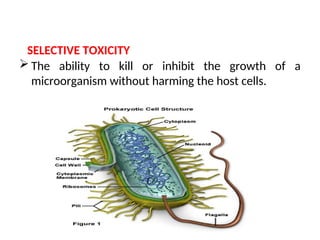
SELECTIVE TOXICITY
Theability to kill or inhibit the growth of a
microorganism without harming the host cells.
6.
BACTERICIDAL : Antimicrobialagent that kills the bacteria
BACTERIOSTATIC : : Antimicrobial agent that prevents
multiplication of the bacteria.
Spectrum of activity
Broad spectrum : Antimicrobial agent that affects Gram positive &
Gram negative bacteria
Narrow spectrum : Antimicrobial agent that affects only selected
organisms or group of bacteria ( G+VE,or G-VE).
7.
THERAPEUTIC INDEX
The Ratioof Toxic dose to human / Therapeutic dose against
bacteria.
Examples:
Penicillin: has a High therapeutic index and so is safe to
human.
Aminoglycosides : has a low therapeutic index.
Polymyxin B : has the lowest therapeutic index and very
toxic to human when given systemically.
8.
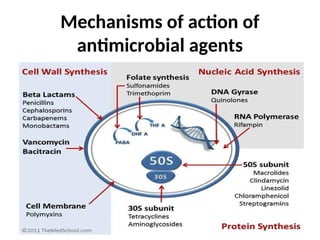
MECHANISMS OF ACTIONOF
ANTIMICROBIAL AGENTS
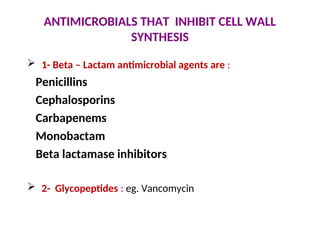
1) Inhibition of cell wall synthesis.
2) Alteration of cell membrane.
3) Inhibition of protein synthesis.
4) Inhibition of nucleic acid synthesis.
5) Anti-metabolite OR competitive antagonism.
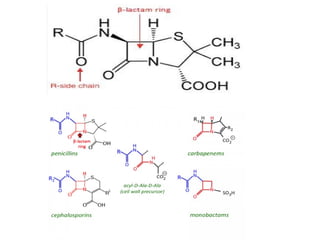
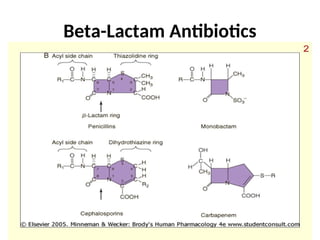
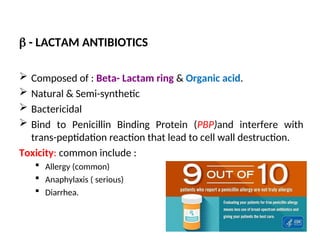
- LACTAMANTIBIOTICS
Composed of : Beta- Lactam ring & Organic acid.
Natural & Semi-synthetic
Bactericidal
Bind to Penicillin Binding Protein (PBP)and interfere with
trans-peptidation reaction that lead to cell wall destruction.
Toxicity: common include :
Allergy (common)
Anaphylaxis ( serious)
Diarrhea.
14.
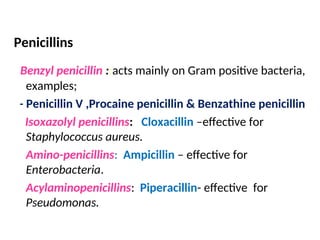
Penicillins
Benzyl penicillin ::actsmainly on Gram positive bacteria,
examples;
- Penicillin V ,Procaine penicillin & Benzathine penicillin
Isoxazolyl penicillins: Cloxacillin –effective for
Staphylococcus aureus.
Amino-penicillins: Ampicillin – effective for
Enterobacteria.
Acylaminopenicillins: Piperacillin- effective for
Pseudomonas.
15.
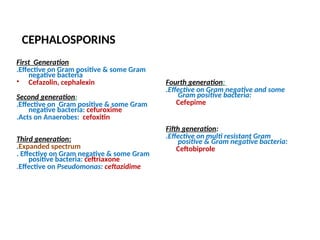
CEPHALOSPORINS
First Generation:
.Effective onGram positive & some Gram
negative bacteria
• Cefazolin, cephalexin
Second generation:
.Effective on Gram positive & some Gram
negative bacteria: cefuroxime
.Acts on Anaerobes: cefoxitin
Third generation:
.Expanded spectrum
. Effective on Gram negative & some Gram
positive bacteria: ceftriaxone
.Effective on Pseudomonas: ceftazidime
Fourth generation:
.Effective on Gram negative and some
Gram positive bacteria:
Cefepime
Fifth generation:
.Effective on multi resistant Gram
positive & Gram negative bacteria:
Ceftobiprole
16.
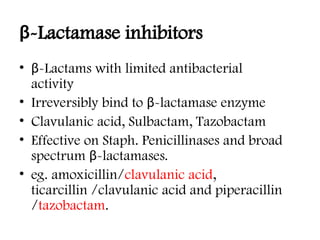
β-Lactamase inhibitors
• β-Lactamswith limited antibacterial
activity
• Irreversibly bind to β-lactamase enzyme
• Clavulanic acid, Sulbactam, Tazobactam
• Effective on Staph. Penicillinases and broad
spectrum β-lactamases.
• eg. amoxicillin/clavulanic acid,
ticarcillin /clavulanic acid and piperacillin
/tazobactam.
17.
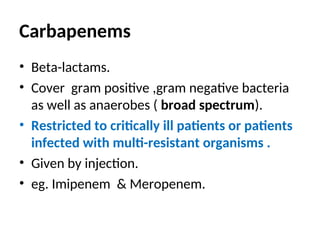
Carbapenems
• Beta-lactams.
• Covergram positive ,gram negative bacteria
as well as anaerobes ( broad spectrum).
• Restricted to critically ill patients or patients
infected with multi-resistant organisms .
• Given by injection.
• eg. Imipenem & Meropenem.
18.
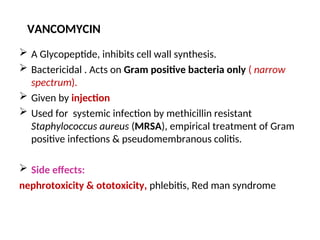
VANCOMYCIN
A Glycopeptide,inhibits cell wall synthesis.
Bactericidal . Acts on Gram positive bacteria only ( narrow
spectrum).
Given by injection
Used for systemic infection by methicillin resistant
Staphylococcus aureus (MRSA), empirical treatment of Gram
positive infections & pseudomembranous colitis.
Side effects:
nephrotoxicity & ototoxicity, phlebitis, Red man syndrome
19.
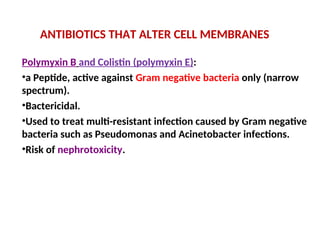
ANTIBIOTICS THAT ALTERCELL MEMBRANES
Polymyxin B and Colistin (polymyxin E):
•a Peptide, active against Gram negative bacteria only (narrow
spectrum).
•Bactericidal.
•Used to treat multi-resistant infection caused by Gram negative
bacteria such as Pseudomonas and Acinetobacter infections.
•Risk of nephrotoxicity.
AMINOGLYCOSIDES
1. Bactericidal
2. Actsonly on Gram negative bacteria ( narrow
spectrum)
3. Streptococci & anaerobes are naturally
resistant.
4. Examples: Gentamicin, Amikacin , Neomycin .
5. Given mainly by injection
6. Side effects : dose related Nephrotoxicity &
Ototoxicity.
22.
TETRACYCLINS
Broad spectrum, bacteriostatic. Given by oral route.
Effective for Intracellular organisms eg. Mycoplasma,
Chlamydia ,Brucella also effective for Nocardia and
Vibrio cholerae.
Classes
Short acting: Tetracyclin
Long acting: Minocycline , Doxycycline ( good CSF penetration).
New tetracycline : Tigycyclin ( covers multiresistant Gram positive and some
Gram negative bacteria and anaerobes).
Side effects : Permanent teeth discoloration , GIT disturbance
Should NOT be used for children < 8 year old and pregnant women.
23.
CHLORAMPHENICOL
Broad spectrum &bactericidal
Serious side effects : it affects bone marrow
cells and cause a plastic anemia.
Limited use nowadays : only for severe
infections not responding to treatment by
other antimicrobials .
can be applied topically (locally) for eye and
ear infections.
24.
MACROLIDES / LINCOSAMIDES
•Erythromycin ( Macrolide )
• Clindamycin ( Lincosamide)
Both are Bacteriostatic
Macrolides active on: Legionella, Camylobacter, Gram negative and
positive infections for patients allergic to Penicillins and
Cephalosporins including oral infections.
Clindamycin acts on Staphylococci, Streptococci and anaerobes
Side effects : GIT disturbance, Pseudomembraneous colitis (mainly
clindamycin).
New Macrolides :
Azithromycin & Clarithromycin .
Less side effects , better tissue penetration and longer half life.
RIFAMPICIN
Semi-synthetic, bactericidal, acts on Gram positive
bacteria and selected Gram negative bacteria.
Reserved for Tuberculosis
Resistance develops quickly. Must be used in
combination with other antimicrobial agent.
Side effects: Causes discoloration of body fluids &
hepatotoxicity.
28.
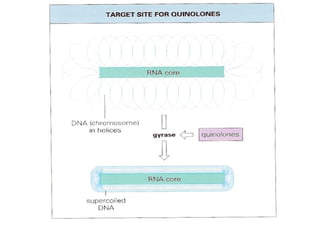
QUINOLONES
Synthetic, bactericidal,inhibit DNA Gyrase and /or
Topoisomerase.
Generations:
first generation: Nalidexic acid –locally acting
Second generation: Fluoroquinolones eg.
Ciprofloxacin, Norfloxacin, Ofloxacin,Levofloxacin
Third generation: Sparfloxacin, Gatifloxacin
Fourth generation: Moxifloxacin, Trovafloxacin
• Side effects: affects the cartilages (mainly in animals) & the heart
Should be used with caution for patients under 18 year and pregnancy.
30.
Metronidazole
• A Nitroimidazoleactive on anaerobic
bacteria and parasites .
• Causes DNA breakage.
• Used for the treatment of infections due to :
Bacteroides fragilis ( bacteria) , Trichomonas
vaginalis , amoebiasis and giardiasis (parasites).
31.
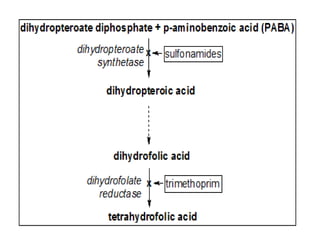
ANTIMETABOLITES ( folateinhibitors)
Trimethoprim-Sulfamethoxazole ( TMP-SMX)
Commonly used in Combination of TMP-SMX .
Block sequential steps in folic acid synthesis
Effective of infections caused by different organisms ,eg. Nocardia,
Chlamydia, Protozoa & Pneumocystis caranii infections
Used for the treatment of upper & lower respiratory tract infections ,
otitis media, sinusitis & infectious diarrhea.
Side effects: GIT, hepatitis , bone marrow depression & hypersensitivity
33.
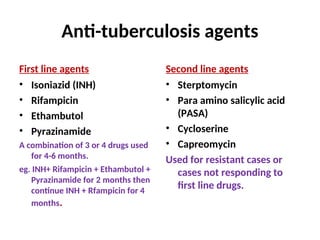
Anti-tuberculosis agents
First lineagents
• Isoniazid (INH)
• Rifampicin
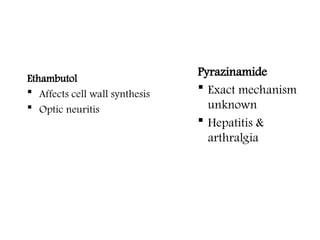
• Ethambutol
• Pyrazinamide
A combination of 3 or 4 drugs used
for 4-6 months.
eg. INH+ Rifampicin + Ethambutol +
Pyrazinamide for 2 months then
continue INH + Rfampicin for 4
months.
Second line agents
• Sterptomycin
• Para amino salicylic acid
(PASA)
• Cycloserine
• Capreomycin
Used for resistant cases or
cases not responding to
first line drugs.
34.
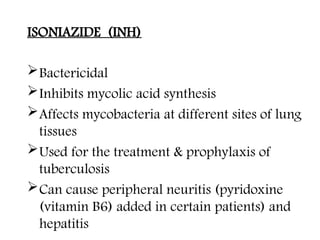
ISONIAZIDE (INH)
Bactericidal
Inhibits mycolicacid synthesis
Affects mycobacteria at different sites of lung
tissues
Used for the treatment & prophylaxis of
tuberculosis
Can cause peripheral neuritis (pyridoxine
(vitamin B6) added in certain patients) and
hepatitis
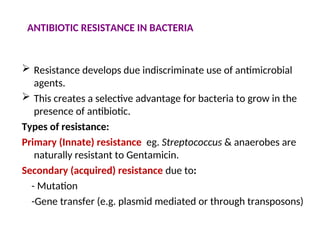
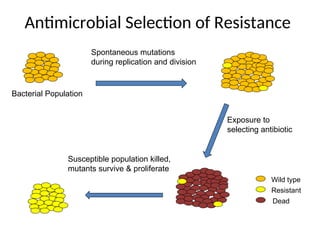
ANTIBIOTIC RESISTANCE INBACTERIA
Resistance develops due indiscriminate use of antimicrobial
agents.
This creates a selective advantage for bacteria to grow in the
presence of antibiotic.
Types of resistance:
Primary (Innate) resistance eg. Streptococcus & anaerobes are
naturally resistant to Gentamicin.
Secondary (acquired) resistance due to:
- Mutation
-Gene transfer (e.g. plasmid mediated or through transposons)
37.
Antimicrobial Selection ofResistance
Bacterial Population
Spontaneous mutations
during replication and division
Exposure to
selecting antibiotic
Susceptible population killed,
mutants survive & proliferate
Wild type
Resistant
Dead
38.
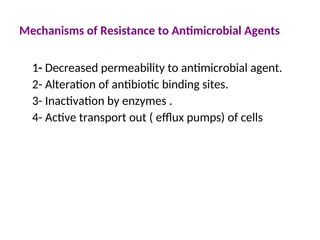
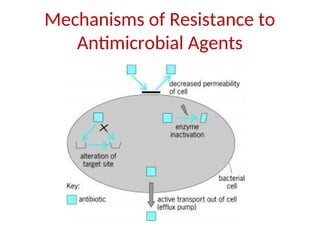
Mechanisms of Resistanceto Antimicrobial Agents
1- Decreased permeability to antimicrobial agent.
2- Alteration of antibiotic binding sites.
3- Inactivation by enzymes .
4- Active transport out ( efflux pumps) of cells
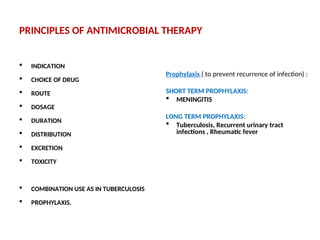
PRINCIPLES OF ANTIMICROBIALTHERAPY
INDICATION
CHOICE OF DRUG
ROUTE
DOSAGE
DURATION
DISTRIBUTION
EXCRETION
TOXICITY
COMBINATION USE AS IN TUBERCULOSIS
PROPHYLAXIS.
Prophylaxis ( to prevent recurrence of infection) :
SHORT TERM PROPHYLAXIS:
MENINGITIS
LONG TERM PROPHYLAXIS:
Tuberculosis, Recurrent urinary tract
infections , Rheumatic fever
41.
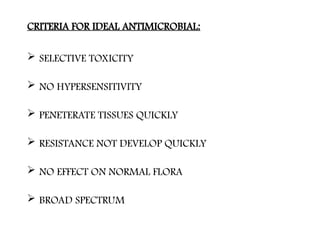
CRITERIA FOR IDEALANTIMICROBIAL:
SELECTIVE TOXICITY
NO HYPERSENSITIVITY
PENETERATE TISSUES QUICKLY
RESISTANCE NOT DEVELOP QUICKLY
NO EFFECT ON NORMAL FLORA
BROAD SPECTRUM
42.
Reference book andthe
Reference book and the
relevant page numbers..
relevant page numbers..
• Sherries Medical Microbiology, an introduction
to Infectious Diseases. Latest edition, Kenneth
Ryan and George Ray. Publisher: Mc Graw Hill.
43.
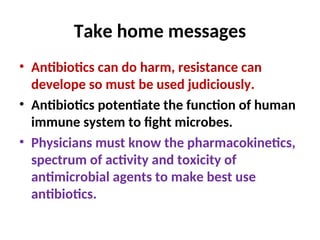
Take home messages
•Antibiotics can do harm, resistance can
develope so must be used judiciously.
• Antibiotics potentiate the function of human
immune system to fight microbes.
• Physicians must know the pharmacokinetics,
spectrum of activity and toxicity of
antimicrobial agents to make best use
antibiotics.
Editor's Notes
#34 Also disrupts DNA, lipid, carbohydrate, and nicotinamide adenine dinucleotide (NAD) synthesis and/or metabolism