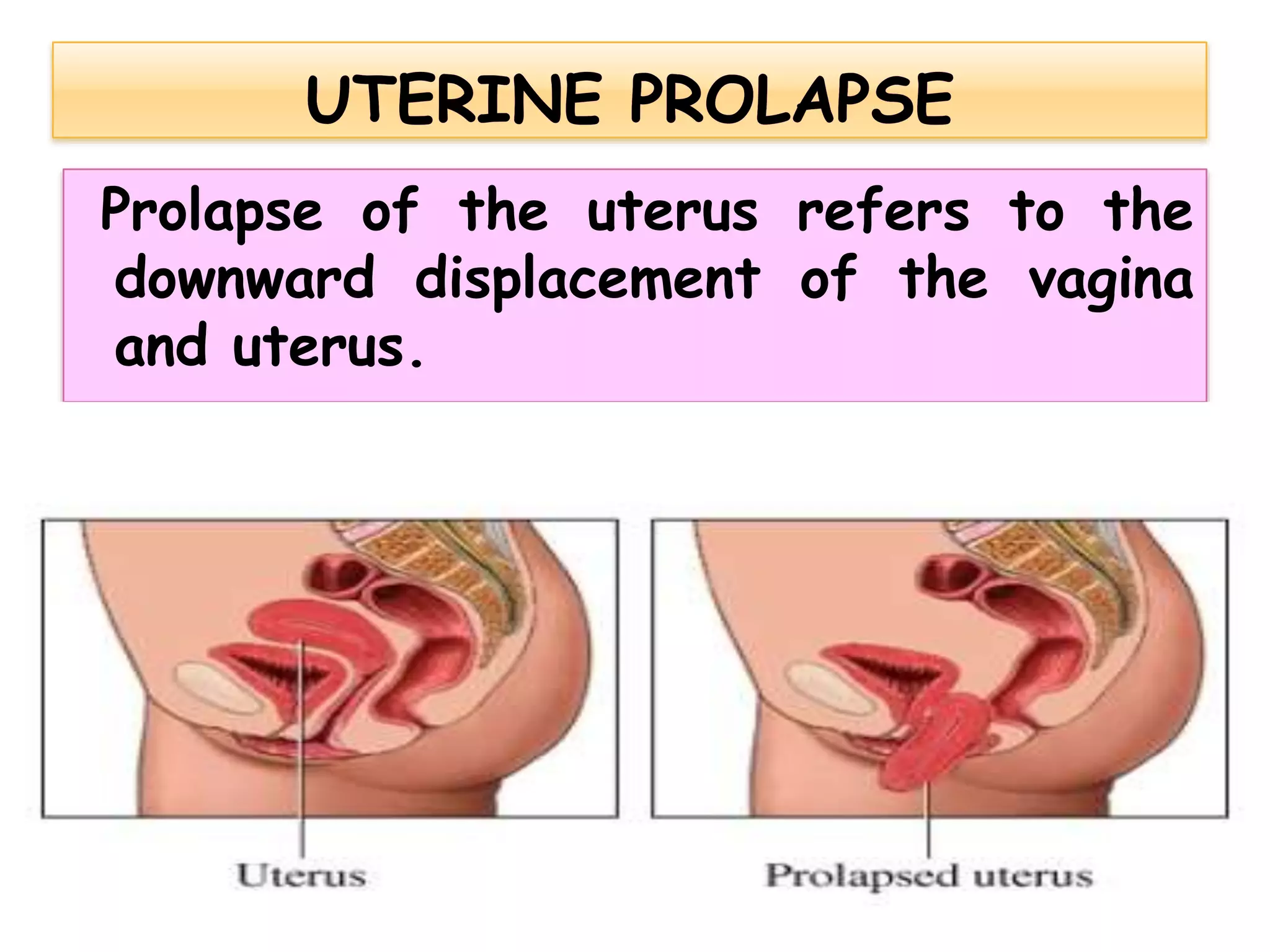
Prolapse of the uterus refers to the
downward displacement of the vagina
and uterus.
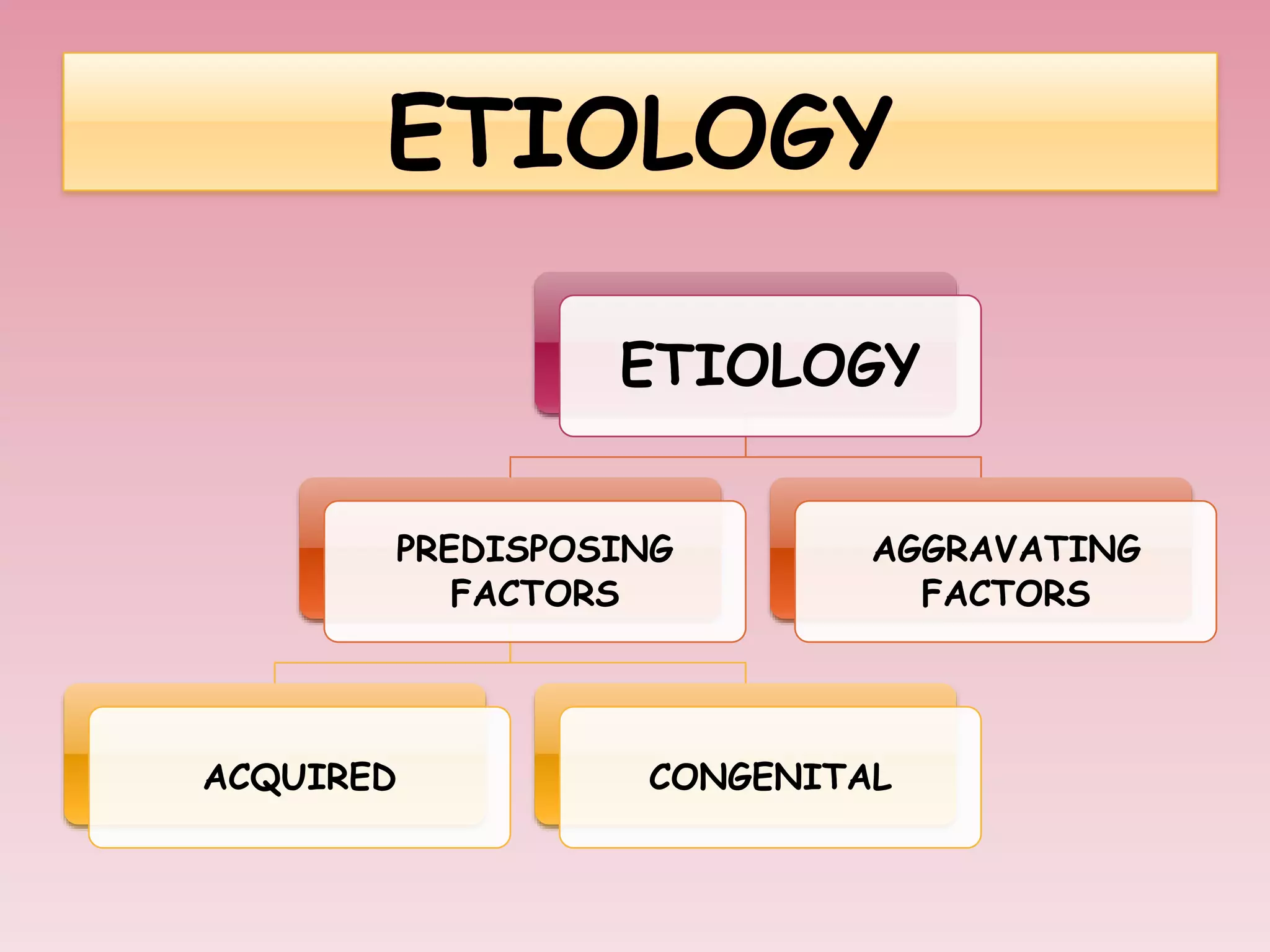
ETIOLOGY
PREDISPOSING
FACTORS
ACQUIRED CONGENITAL
AGGRAVATING
FACTORS
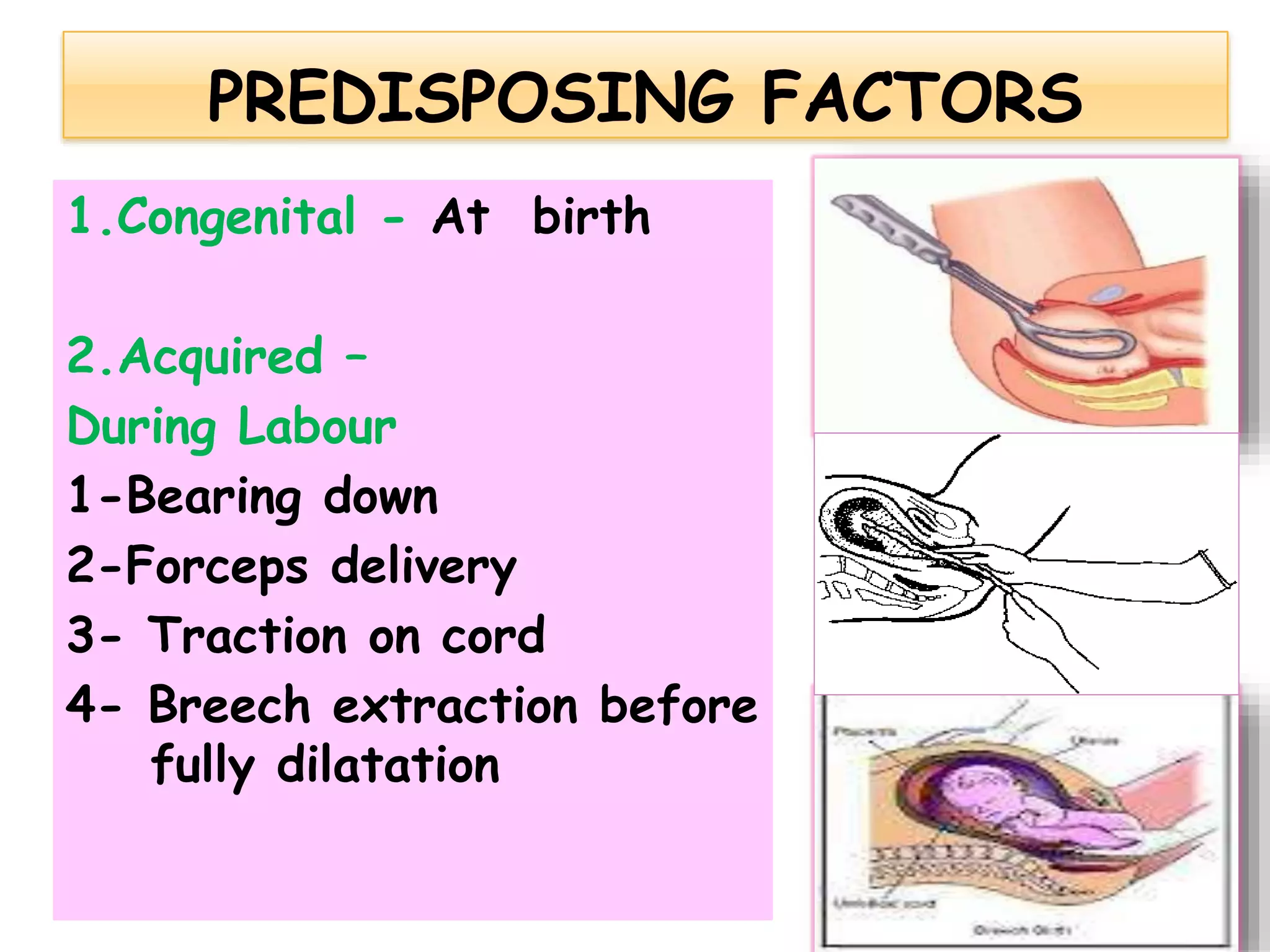
1.Congenital - At birth
2.Acquired –
During Labour
1-Bearing down
2-Forceps delivery
3- Traction on cord
4- Breech extraction before
fully dilatation
 During puerperium
Lack of exercise and
bodily weakness
Repeated deliveries or child
birth
1. Increase in intra -
abdominal pressure
Abdominal mass
Ascitis
Chronic cough,
constipation
2. Obesity
3. Uterine fibroid
1.In first-degree prolapse- the
prolapsed wall extends upto
cervix
2.In second-degree prolapse-
the prolapsed wall protrudes
through the cervix but
remains within the vagina.
3.In third-degree prolapse- the
prolapsed fundus extends
outside the vagina.
4. In fourth degree or total
prolapse or procidentia- both
the vagina and uterus are
prolapsed
1
2
3
4
 Feeling of something
coming down per vaginum
specially while she is
moving
 Backache or Dragging pain
in the pelvis
 Dysparenunia
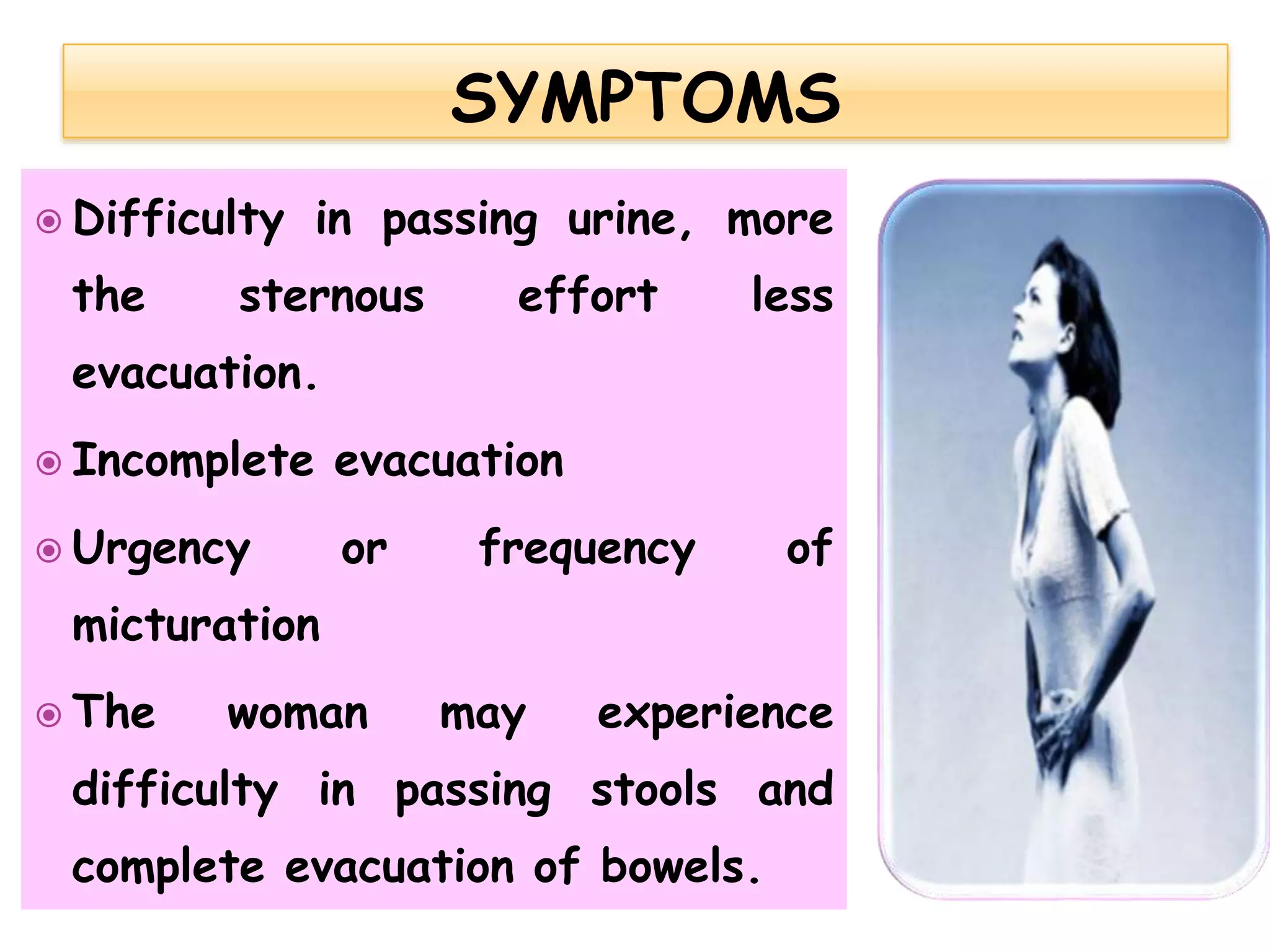
 Difficulty in passing urine, more
the sternous effort less
evacuation.
 Incomplete evacuation
 Urgency or frequency of
micturation
 The woman may experience
difficulty in passing stools and
complete evacuation of bowels.
 Inspection & palpation
Vagina, rectum & recto-
vaginal
 Pelvic examination Both
dorsal & standing
positions. The patient is
asked to strain , this
helps to demonstrate a
prolapse which may not be
seen at rest
MANAGEMENT
PREVENTIVE CONSERVATIVE SURGERY
Adequate antenatal & intranatal
care
 To avoid injury to the
supporting structures during
the time of vaginal delivery
Adequate postnatal care
 To encourage early ambulance
 To encourage pelvic floor
exercises
General measures
 To avoid strenuous activities-
heavy lifting
 To avoid pregnancies to soon
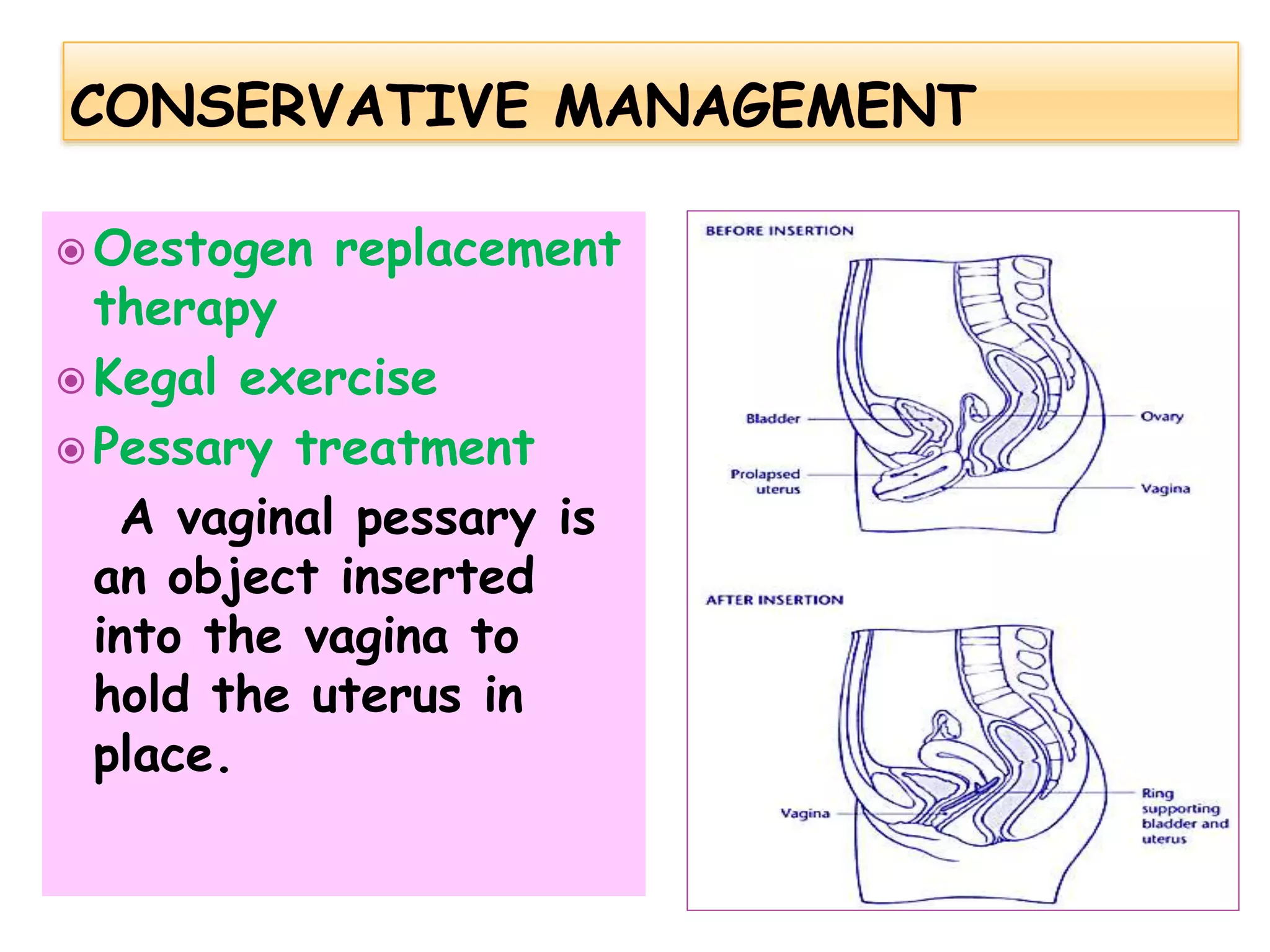
 Oestogen replacement
therapy
 Kegal exercise
 Pessary treatment
A vaginal pessary is
an object inserted
into the vagina to
hold the uterus in
place.
 Surgery should wait until
symptoms are worse than
the risks of having
surgery. The surgical
approach depends on:
Degree of prolapse
Desire for future
pregnancies
Often, a vaginal
hysterectomy is used to
correct uterine prolapse.
a) To assess the level of pain, cause, location,
intensity to get base line data
b) To provide comfortable position to the patient
to relieve discomfort i.e. lying down position
c) To provide comfort devices to patient to
promote the level of comfort
d) To provide diversion therapy to the patient to
divert the mind of the patient
e) To provide analgesics to patient as prescribed
by physician to relieve pain.
a) To assess the sign & symptoms of infection.
b) To assess the vital sign of the patient
c) To encourage the patient not to touch the
prolapsed area with unclean hands
d) Provide prescribed antibiotics to patient
a) Explain all treatment and procedures
b) Encourage verbalization of feelings by
patient and family
c) Provide information on treatment modalities.
1)Dutta D.C 'Textbook of obstetrics' 6th
edition published by new book agency (P)
limited pp -312-313,421-422.
2)Jacob annamma ‘a comprehensive textbook of
midwifery ‘1st edition published by jitender p
vij pp 539-55
3)www.Google.com
Fill in the blanks:-
 In first degree of prolapse of uterus the
prolapsed wall extends upto_______
Ans. Extends up to cervix
 Procendentia is _______
Ans. When both the vagina and uterus are
prolapsed
 Sense of something coming out per
vaginum is felt in prolapsed uterus or not
Ans. True
 Any increase in frequency or urgency of
urine is felt in prolapsed uterus
Ans. True
UTERINE DISPLACEMENT

UTERINE DISPLACEMENT

  • 3.
    Prolapse of theuterus refers to the downward displacement of the vagina and uterus.
  • 4.
  • 5.
    1.Congenital - Atbirth 2.Acquired – During Labour 1-Bearing down 2-Forceps delivery 3- Traction on cord 4- Breech extraction before fully dilatation
  • 6.
     During puerperium Lackof exercise and bodily weakness Repeated deliveries or child birth
  • 7.
    1. Increase inintra - abdominal pressure Abdominal mass Ascitis Chronic cough, constipation 2. Obesity 3. Uterine fibroid
  • 8.
    1.In first-degree prolapse-the prolapsed wall extends upto cervix 2.In second-degree prolapse- the prolapsed wall protrudes through the cervix but remains within the vagina. 3.In third-degree prolapse- the prolapsed fundus extends outside the vagina. 4. In fourth degree or total prolapse or procidentia- both the vagina and uterus are prolapsed 1 2 3 4
  • 9.
     Feeling ofsomething coming down per vaginum specially while she is moving  Backache or Dragging pain in the pelvis  Dysparenunia
  • 10.
     Difficulty inpassing urine, more the sternous effort less evacuation.  Incomplete evacuation  Urgency or frequency of micturation  The woman may experience difficulty in passing stools and complete evacuation of bowels.
  • 11.
     Inspection &palpation Vagina, rectum & recto- vaginal  Pelvic examination Both dorsal & standing positions. The patient is asked to strain , this helps to demonstrate a prolapse which may not be seen at rest
  • 12.
  • 13.
    Adequate antenatal &intranatal care  To avoid injury to the supporting structures during the time of vaginal delivery Adequate postnatal care  To encourage early ambulance  To encourage pelvic floor exercises General measures  To avoid strenuous activities- heavy lifting  To avoid pregnancies to soon
  • 14.
     Oestogen replacement therapy Kegal exercise  Pessary treatment A vaginal pessary is an object inserted into the vagina to hold the uterus in place.
  • 15.
     Surgery shouldwait until symptoms are worse than the risks of having surgery. The surgical approach depends on: Degree of prolapse Desire for future pregnancies Often, a vaginal hysterectomy is used to correct uterine prolapse.
  • 17.
    a) To assessthe level of pain, cause, location, intensity to get base line data b) To provide comfortable position to the patient to relieve discomfort i.e. lying down position c) To provide comfort devices to patient to promote the level of comfort d) To provide diversion therapy to the patient to divert the mind of the patient e) To provide analgesics to patient as prescribed by physician to relieve pain.
  • 18.
    a) To assessthe sign & symptoms of infection. b) To assess the vital sign of the patient c) To encourage the patient not to touch the prolapsed area with unclean hands d) Provide prescribed antibiotics to patient
  • 19.
    a) Explain alltreatment and procedures b) Encourage verbalization of feelings by patient and family c) Provide information on treatment modalities.
  • 20.
    1)Dutta D.C 'Textbookof obstetrics' 6th edition published by new book agency (P) limited pp -312-313,421-422. 2)Jacob annamma ‘a comprehensive textbook of midwifery ‘1st edition published by jitender p vij pp 539-55 3)www.Google.com
  • 21.
    Fill in theblanks:-  In first degree of prolapse of uterus the prolapsed wall extends upto_______ Ans. Extends up to cervix  Procendentia is _______ Ans. When both the vagina and uterus are prolapsed
  • 22.
     Sense ofsomething coming out per vaginum is felt in prolapsed uterus or not Ans. True  Any increase in frequency or urgency of urine is felt in prolapsed uterus Ans. True