S.Y.B.Sc. /{B} /{262}   SEMESTER-4
PRAVIN PRADHAN
}
   Derived from Greek words
    “Palaeon” = old and “Botany” = study
    of plants.

   Deals with the identification of plants remains of
    geological age, and its reconstruction.

   Includes the study of terrestrial
    plant fossils, as well as Marine
    ones such as seaweeds.
   Reconstruction of ancient ecological systems
    and climate, known as palaeoecology
    and palaeoclimatology
    respectively.

   Study of green plant development
    and evolution.

   Important to the field of Archaeology.
   First fossil record was found in SILURIAN
    period of PALAEOZOIC ERA.

   Spores and cuticles, were found in
    ordovician period.

   Angiosperms (flowering plants) evolved during
    the Mesozoic, and Early
    Cretaceous. (approx. 130 million years ago)
   A plant fossil is any preserved part of
    a plant that has long since died.

   Bits of charcoal that are only a few hundred
    years old.

   RHYNIE CHERT found
    in SCOTLAND bearing the
    fossils of mosses and lycopods.
    (see image beside)
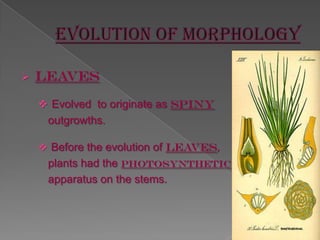
   LEAVES

     Evolved to originate as spiny
     outgrowths.

     Before the evolution of leaves,
     plants had the photosynthetic
     apparatus on the stems.
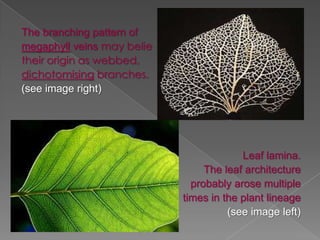
The branching pattern of
megaphyll veins may belie
their origin as webbed,
dichotomising branches.
(see image right)


                                         Leaf lamina.
                                 The leaf architecture
                              probably arose multiple
                            times in the plant lineage
                                      (see image left)
   To protect early plants from herbivory.

   Better transpiration rates and gas
    exchange.

   Helps to carry out better
    Photosynthesis.

   Figure beside shows the diversity in leaves
    evolved according to their suitable
    environmental conditions.
   ROOTS

     Organs differentiated from stems – did not arrive
      until later.
     Roots are rarely preserved in the fossil record.

     Their evolutionary origin is sparse.

     Rhizoids are prehistoric roots.

     Rhizoids probably evolved more than once.


                                                  The root of
                                             Lepidodendrales
                                              (image beside)
   provide anchorage to the substrate.
   provide a source of water and
    nutrients from the soil.

   allow plants to grow taller and faster.


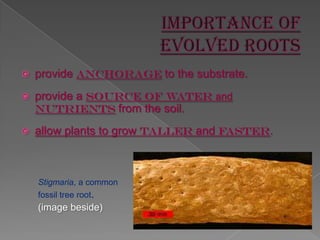
    Stigmaria, a common
    fossil tree root.
    (image beside)
   Stems

     Ferns  were the first to have a growth of
     woody habit.

     Progymnosperms were the first
     plants to develop true wood.


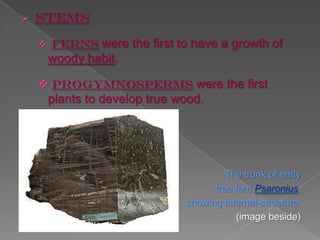
                                      The trunk of early
                                   tree fern Psaronius,
                             showing internal-structure.
                                        (image beside)
 The most obvious advantage is the harvesting
  of more sunlight for photosynthesis.
 Spores can be blown greater distances if they
  start higher.
 Provided support and water transport.


External mold of
Lepidodendron trunk.
(image beside)
   SEEDS
   Germination of microgametophytes and
    megagametophytes, paved the way for seeds.
   Seed plants from Belgium has been identified the
    earliest seed plants - about 20 million years.

   The first "spermatophytes" (seed plants) i.e. the first
    plants to bear true seeds
    are called "pteridosperms“
    (seed ferns).
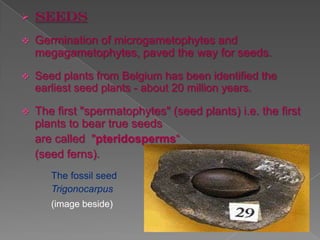
       The fossil seed
       Trigonocarpus
       (image beside)
   increased the success rate of fertilised
    gametophytes.

   increases the biodiversity of forests.

   Helps the plant to survive for
    generations.
                     The transitional
                     fossil of seed of
                        Runcaria.
                       (image beside)
THANK   U !!!!!!!!!!!

Paleobotany

  • 1.
    S.Y.B.Sc. /{B} /{262} SEMESTER-4 PRAVIN PRADHAN }
  • 3.
    Derived from Greek words “Palaeon” = old and “Botany” = study of plants.  Deals with the identification of plants remains of geological age, and its reconstruction.  Includes the study of terrestrial plant fossils, as well as Marine ones such as seaweeds.
  • 4.
    Reconstruction of ancient ecological systems and climate, known as palaeoecology and palaeoclimatology respectively.  Study of green plant development and evolution.  Important to the field of Archaeology.
  • 5.
    First fossil record was found in SILURIAN period of PALAEOZOIC ERA.  Spores and cuticles, were found in ordovician period.  Angiosperms (flowering plants) evolved during the Mesozoic, and Early Cretaceous. (approx. 130 million years ago)
  • 6.
    A plant fossil is any preserved part of a plant that has long since died.  Bits of charcoal that are only a few hundred years old.  RHYNIE CHERT found in SCOTLAND bearing the fossils of mosses and lycopods. (see image beside)
  • 7.
    LEAVES  Evolved to originate as spiny outgrowths.  Before the evolution of leaves, plants had the photosynthetic apparatus on the stems.
  • 8.
    The branching patternof megaphyll veins may belie their origin as webbed, dichotomising branches. (see image right) Leaf lamina. The leaf architecture probably arose multiple times in the plant lineage (see image left)
  • 9.
    To protect early plants from herbivory.  Better transpiration rates and gas exchange.  Helps to carry out better Photosynthesis.  Figure beside shows the diversity in leaves evolved according to their suitable environmental conditions.
  • 10.
    ROOTS  Organs differentiated from stems – did not arrive until later.  Roots are rarely preserved in the fossil record.  Their evolutionary origin is sparse.  Rhizoids are prehistoric roots.  Rhizoids probably evolved more than once. The root of Lepidodendrales (image beside)
  • 11.
    provide anchorage to the substrate.  provide a source of water and nutrients from the soil.  allow plants to grow taller and faster. Stigmaria, a common fossil tree root. (image beside)
  • 12.
    Stems  Ferns were the first to have a growth of woody habit.  Progymnosperms were the first plants to develop true wood. The trunk of early tree fern Psaronius, showing internal-structure. (image beside)
  • 13.
     The mostobvious advantage is the harvesting of more sunlight for photosynthesis.  Spores can be blown greater distances if they start higher.  Provided support and water transport. External mold of Lepidodendron trunk. (image beside)
  • 14.
    SEEDS  Germination of microgametophytes and megagametophytes, paved the way for seeds.  Seed plants from Belgium has been identified the earliest seed plants - about 20 million years.  The first "spermatophytes" (seed plants) i.e. the first plants to bear true seeds are called "pteridosperms“ (seed ferns). The fossil seed Trigonocarpus (image beside)
  • 15.
    increased the success rate of fertilised gametophytes.  increases the biodiversity of forests.  Helps the plant to survive for generations. The transitional fossil of seed of Runcaria. (image beside)
  • 16.
    THANK U !!!!!!!!!!!