
SEXUAL REPRODUCTION IN FLOWERING
PLANTS
Chapter -2
NCERT
By- Punya Mohanty
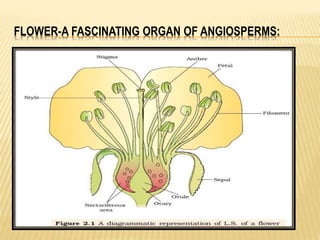
FLOWER-A FASCINATING ORGAN OF ANGIOSPERMS:
PRE FERTILIZATION: STRUCTURE AND
EVENTS:
 Hormonal and structural changes in plants leads to development
of flower,
 Androecium consists of a whorl of stamens represents male sex
organ.
 Gynoecium represents the female reproductive organ.
 Stamen, Microsporangium and Pollen grain:
 Typical stamen consists of two parts, long and slender stalk
called filament and terminal bilobed structure called anther.
 Atypical angiosperm anther is bilobed.
 Each lobe have two theca i.e. dithecous.
 Each anther contains four microsporangia located at the
corners, two in each lobe.
 Microsporangia become pollen sacs and are packed with pollen
grains
STRUCTURE OF MICROSPORANGIUM:
 Structure of microsporangium:
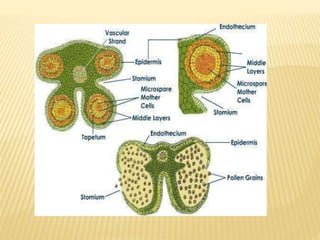
 Each microsporangium surrounded by four wall layers
 Epidermis
 Endothecium
 Middle layer.
 Tapetum.
 The innermost layer is tapetum which is
multinucleated, with dense cytoplasm; it nourishes the
developing pollen grain.
 The centers of each microsporangium contain
homogenous cells called sporogenous tissues.
MICROSPOROGENESIS:
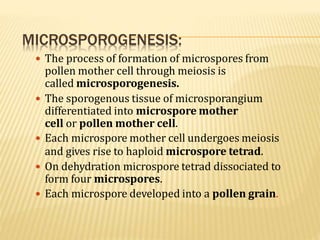
 The process of formation of microspores from
pollen mother cell through meiosis is
called microsporogenesis.
 The sporogenous tissue of microsporangium
differentiated into microspore mother
cell or pollen mother cell.
 Each microspore mother cell undergoes meiosis
and gives rise to haploid microspore tetrad.
 On dehydration microspore tetrad dissociated to
form four microspores.
 Each microspore developed into a pollen grain.
POLLEN GRAIN:
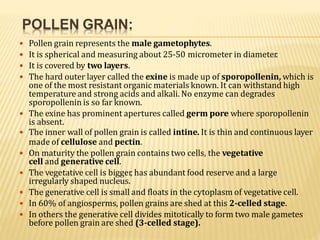
 Pollen grain represents the male gametophytes.
 It is spherical and measuring about 25-50 micrometer in diameter.
 It is covered by two layers.
 The hard outer layer called the exine is made up of sporopollenin, which is
one of the most resistant organic materials known. It can withstand high
temperature and strong acids and alkali. No enzyme can degrades
sporopollenin is so far known.
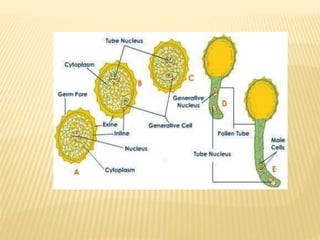
 The exine has prominent apertures called germ pore where sporopollenin
is absent.
 The inner wall of pollen grain is called intine. It is thin and continuous layer
made of cellulose and pectin.
 On maturity the pollen grain contains two cells, the vegetative
cell and generative cell.
 The vegetative cell is bigger, has abundant food reserve and a large
irregularly shaped nucleus.
 The generative cell is small and floats in the cytoplasm of vegetative cell.
 In 60% of angiosperms, pollen grains are shed at this 2-celled stage.
 In others the generative cell divides mitotically to form two male gametes
before pollen grain are shed (3-celled stage).
Economic importance of pollen grain:
 Pollen grain may cause severe allergies and bronchial afflictions.
 It may cause chronic respiratory disorders – asthma, bronchitis,
etc.
 Pollen grain of Parthenium or carrot grass causes pollen allergy.
 Pollen grains are rich in nutrients hence used as pollen tablets
for food supplements.
 Pollen consumptions increase performance of athletes and race
horses.
 After shedding the viability depends on temperature and
humidity.
 In wheat and rice the pollen grain lose viability within 30 min. of
their release.
 In Rosaceae, Leguminoseae and Solanaceae they remain viable
for months.
 Pollen grain can be preserved for years in liquid nitrogen (-
196oC).
The Pistil, Megasporangium
(ovule) and Embryo Sac:
 The Gynoecium represents the female reproductive part of the
flower.
 The Gynoecium may contain single pistil (monocarpellary) or
may have more than one pistil (multicarpellary).
 Fused pistils are called syncarpous and free pistils are
called apocarpous.
 Each pistil has three parts the stigma, style and ovary.
 Inside the ovary is the ovarian cavity (locule).
 The placenta located inside the ovarian cavity.
 Megasporongia or ovules arise from the placenta.
 The number of ovule inside the ovary may be single or many.
THE MEGASPORANGIUM (OVULE):
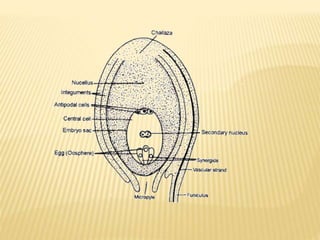
 Ovule is a small structure attached to the placenta of
locule with a stalk called funicle.
 The body of the ovule fused with the funicle in the
region called hilum.
 Hilum is the junction between the funicle and ovule.
 Each ovule has one or two protective envelops
called integuments.
 Integument covered the ovule except an opening at the
top called micropyle.
 Opposite of the micropylar end, is the chalaza,
representing the basal part of the ovule?
FEMALE GAMETOPHYTE: Out of four megaspores, one megaspore is functional and
other three degenerates.
 The functional megaspore developed into the female
gametophyte.
 Female gametophyte is known as the embryo sac.
 Development of embryo sac from a single megaspore is called
as monosporic type of embryo sac.
 The nucleus of the functional megaspore divided by mitotic
division to form two nuclei which move to the opposite
pole, 2-nucleated embryo sac.
 Two successive mitotic division leads to formation of 4-
nucleate and later 8-nucleate stages of the embryo sac.
 All mitotic divisions are free nuclear type; karyokinesis is
not followed by cytokinesis.
 Six of the eight nuclei are surrounded by cell walls and
organized into cells.
 Three cells are grouped together at the micropylar end,
constitute the egg apparatus.
 The egg apparatus, in turn consists of two synergids and
one egg cell.
 Synergids have special filiform apparatus, which play an
important role in guiding the entry of pollen tube into the
synergids.
 Three cells arranged towards chalazal end are
called antipodal cells.
 The large central cell has two polar nuclei.
 A typical angiosperm embryo sac at maturity is 8-
nucleated and 7-celled.
Pollination:
 Transfer of pollen grains from the anther to the stigma of a
pistil is termed as pollination.
 Both male and female gametes are non-motile.
 Kinds of pollination:
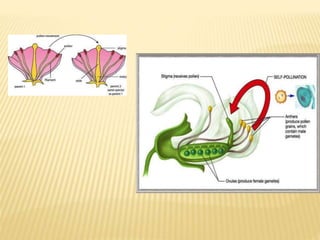
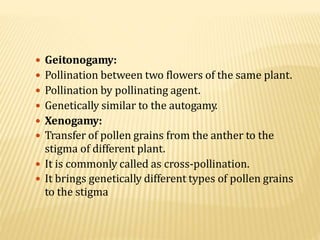
 Autogamy:
 Pollination within same flower.
 In open and exposed anthers and stigma autogamy is rare.
 Viola, Oxalis and Commelina produce two types of flowers:
 Chasmogamous: exposed anther and stigma
 Cleistogamous: closed anther and stigma.
 Cleistogamous flower is invariably autogamous and assured
seed set even in the absence of the pollinator.
Megasporogenesis:
 The process of formation of megaspores from
the megaspore mother cell is
called Megasporogenesis.
 In the centre of the ovule there is a mass of tissue
called nucellus.
 Cells of nucellus have abundant reserve food materials.
 One cell of the nucellus towards micropylar end
differentiated into megaspore mother cell (MMC).
 It is a large diploid
cell, dense cytoplasm with prominent nucleus.
 The MMC undergo meiotic division resulting four
haploid megaspores.
 Geitonogamy:
 Pollination between two flowers of the same plant.
 Pollination by pollinating agent.
 Genetically similar to the autogamy.
 Xenogamy:
 Transfer of pollen grains from the anther to the
stigma of different plant.
 It is commonly called as cross-pollination.
 It brings genetically different types of pollen grains
to the stigma
Agents of pollination:

 Plant use two abiotic agent i.e. wind and water for
pollination.
 One biotic agent for pollination such as animals.
 Majority of plant use biotic agent for pollination.
 Few plant use abiotic pollinating agent.
ANEMOPHILY:
 Pollinating agent is wind.
 Plants produces enormous amount of pollen when
compared to the number of ovules available for
pollination to compensate the uncertainties of
pollination.
 Flowers with well exposed stamens.
 Large feathery stigma to trap air-borne pollen grains.
 Most wind pollinated flower contains single ovule in
one ovary and numerous flower packed into an
inflorescence e.g. corn cob.
 Pollen grains are light and non-sticky.
HYDROPHILIC:
 Pollination by abiotic agent like water.
 This type of pollination is very rare, about 30 genera,
 mostly monocot.
 Vallisneria, Hydrilla and Zostera are the common
example for Hydrophily.
 All aquatic plants are not Hydrophily.
 Pollen grains released into the surface of water and
carried to the stigma by air current as in Vallisneria.
 In sea grass the flowers remained submerged.
 Pollen grains are long, ribbon like and carried passively
inside the water
 Pollen grains are protected from wetting
 by mucilaginous covering.
POLLINATION BY BIOTIC AGENT:
 Majority of flowering plants use a range of animals as pollinating agents.
 Among the animal, insect particularly bees are the dominant biotic agents
for pollination.
 Insect pollinating flowers are very large, colorful, fragrant and rich in nectar.
 Small flowers present in cluster to make them conspicuous.
 Flower pollinated by flies and beetles secrete foul odours.
 Nectar and pollen grains are the usual floral rewards for insects.
 In some species floral rewards are in providing safe places to lay eggs:
e.g. Amorphophallus.
 A species of moth and Yucca plant cannot complete their life cycle without
each other. The moth deposits its eggs in the locule of the ovary and the
flower in turn get pollinated by the moth.
 Many insects may consume pollen or nectar without bring about
pollination. Such floral visitors are referred as pollen/nectar robbers.
OUTBREEDING DEVICES:
 Majority of the flowering plants produce hermaphrodite
flower and undergo autogamy.
 Continuous autogamy or self-pollination results
ininbreeding depression.
 Flowering plants have developed many devices to avoid
self pollination and to encourage cross-pollination. Such
devices are called Outbreeding devices.
 Pollen released and stigma receptivity is not
synchronized.
 Spatial separation of anthers and stigmas
 Anther and stigma are placed at different positions.
 Self incompatibility.
 Production of unisexual flowers.
POLLEN PISTIL INTERACTION:
 All the events – from pollen deposition on the stigma until
pollen tubes enter the ovule – are together referred
as pollen-pistil interaction.
 Pollination does not guarantee the transfer of the right type
of pollen grain to the right type of stigma.
 The pistil has the ability to recognize the pollen whether it is
compatible or incompatible.
 If it is right type the stigma allow the pollen to germinate.
 If it is wrong type the stigma rejects the pollen, preventing
germination.
 The ability of the pistil to recognize the pollen by continuous
dialogue mediated by chemical like Boron, Inositol and
sucrose level.
 Following compatible pollination, the pollen grain produce
pollen tube through one of the germ pore.
ARTIFICIAL HYBRIDIZATION:
 One of the major approaches of crop improvement
programme.
 Only desired pollen grain used for pollination.
 Stigma is protected from contamination (from
unwanted pollen grain).
 Removal of anthers from the flower bud before the
anther dehisces is called emasculation.
 Emasculated flowers covered by bag generally made up
of butter paper, to prevent contamination of its stigma
with unwanted pollen. This step is called bagging.
 If the female flower is unisexual there is no need of
emasculation.
DOUBLE FERTILIZATION:
 After entering one of the synergids, the pollen tube releases
two male gametes into the cytoplasm of the synergids.
 Syngamy: one of the male gamete fused with egg cell, to form
a diploid zygote.
 Two polar nuclei of central cell fused to form a
diploid secondary nucleus.
 Triple fusion: The second male gamete fused with the
secondary nucleus to form a triploid primary endosperm
nucleus.
 Since two type of fusion, syngamy and triple fusion take place
in the embryo sac the phenomenon is termed asdouble
fertilization.
 The central cell after triple fusion becomes primary
endosperm cell and developed into the endosperm.
 The zygote developed into an embryo.
POST- FERTILIZATION : STRUCTURE
AND EVENTS
 Events of endosperm and embryo development, maturation of ovule into seed and
ovary into fruit, are collectively termed as post-fertilization events.
 Endosperm:
 Development of endosperm takes place before the embryo development.
 Primary endosperm cell divides repeatedly to form a triploid endosperm.
 Cells are filled with reserve food material and are used for the nutrition of the
developing embryo.
 PEN undergoes successive nuclear division to give rise to free nuclei. This is called
free-nuclear endosperm.
 Subsequently cell wall formation takes place and become cellular endosperm.
 The coconut water is free nuclear endosperm and the white kernel is the cellular
endosperm.
 Endosperm may be consumed completely during embryo developed or it may be
consumed during germination of seed.
EMBRYO:
 Zygote formed and placed at the micropylar end of
the embryo sac.
 Zygote starts its development only after some
amount of endosperm formed.
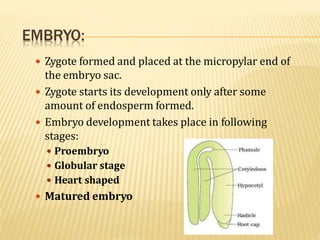
 Embryo development takes place in following
stages:
 Proembryo
 Globular stage
 Heart shaped
 Matured embryo
DICOT EMBRYO:
 A typical dicotyledonous embryo consists of
an embryonal axis and two cotyledons.
 Embryonal axis above the cotyledon is
the epicotyls.
 Terminal part of the epicotyls is the plumule (gives
rise to the shoot).
 Embryonal axis below the cotyledon is
the hypocotyl.
 The terminal part of the hypocotyl is called
the radicle (root tip).
 The root tip is covered by the root cap.
MONOCOT EMBRYO:
 Possesses only one cotyledon
 In grass family the cotyledon is called scutellum.
 Scutellum situated towards one side of the embryonal axis.
 Radicle and the root cap enclosed by a sheath
called coleorhiza.
 The portion of the embryonal axis above level of attachment
of scutellum is called epicotyls.
 Epicotyl has the shoot apex or plumule enclosed by hollow
foliar structure called coleoptile.
 Seed is the final product of the sexual reproduction.
 Seed consists of seed coat, cotyledon and an embryo axis.
 Cotyledon stores the reserve food material for development and
germination.
 Matured seed without endosperm called non-albuminous.
(Ground nut)
 A part of the endosperm retained in matured seed
is Albuminous.
 Remainants of nucellus in the matured seed is called perisperm.
E.g. black peeper, beet.
 The wall of the ovary develops into the wall of fruit
called pericarp.
 Fruit developed from the ovary is called true fruit.
 In apple, strawberry, cashew, the thalamus contributes in the
fruit formation is called false fruit.
 Fruit developed without fertilization is called Parthenocarpic
fruits.
APOMIXIS AND POLYEMBRYONY.
 Apomixis is very common in Asteraceae and grasses.
 Seeds are produced without fertilization.
 Apomixis is a type of asexual reproduction which
mimics the sexual reproduction.
 Diploid egg cell is formed without meiosis and develops
into seed without fertilization.
 In Citrusand Mango the nucellar cells starts dividing,
protrude into the embryo sac and develop into embryo.
 Ovule having more than one embryo is termed
as polyembryony.
 Hybrid plants are developed by apomixis to maintain
the genetic identity.
Thanking
you