Palynology
The science of palynomorphs is known as
palynology
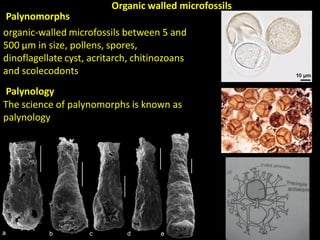
Palynomorphs
organic-walled microfossils between 5 and
500 µm in size, pollens, spores,
dinoflagellate cyst, acritarch, chitinozoans
and scolecodonts
Organic walled microfossils
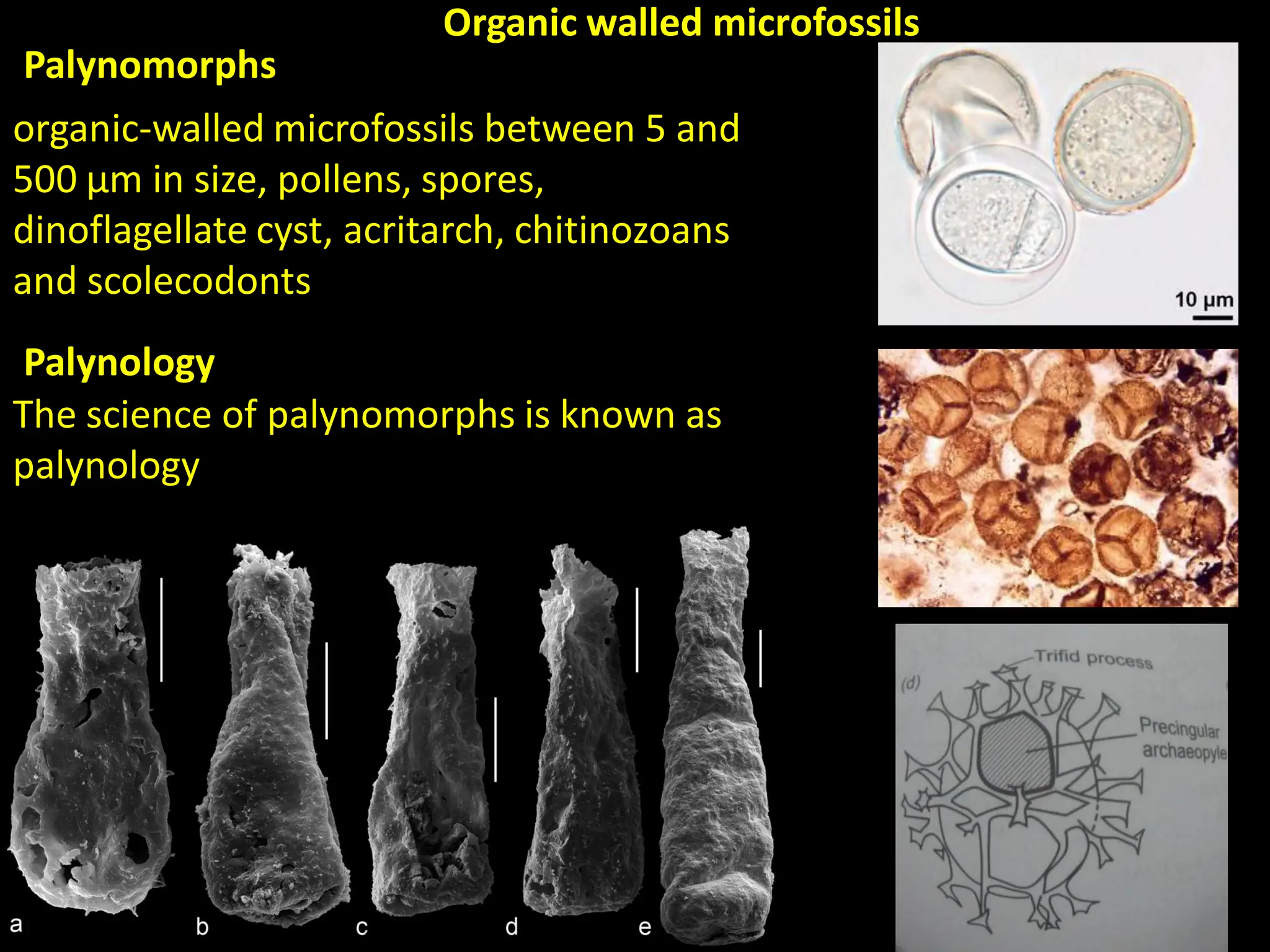
Pollens and spores
Algae Brophytes Pteridophytes
Gymnosperms
Angiosperms
Angiosperms
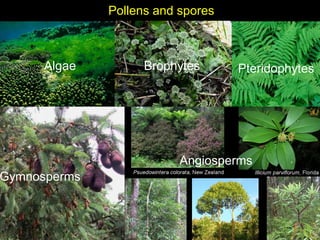
spores
Pollens
Both have walls resistant to
microbial attacks and
temperature after burial
spores are produced by
bryophytes (e.g., mosses)
Pollens are produced by
angiosperms and confers
Produced in large number
Travel rapidly and widely in
wind and water
Brophytes Pteridophytes
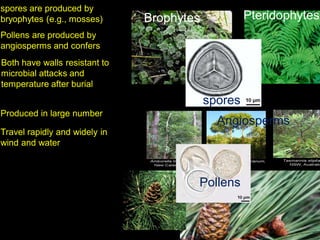
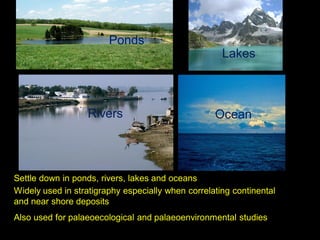
Lakes
Ponds
Rivers Ocean
Settle down in ponds, rivers, lakes and oceans
Widely used in stratigraphy especially when correlating continental
and near shore deposits
Also used for palaeoecological and palaeoenvironmental studies
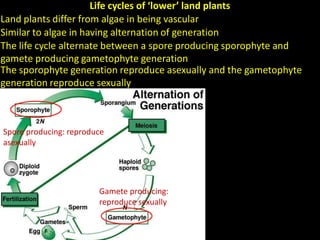
Life cycles of ‘lower’ land plants
Land plants differ from algae in being vascular
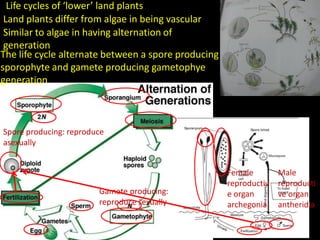
The life cycle alternate between a spore producing sporophyte and
gamete producing gametophyte generation
Spore producing: reproduce
asexually
Gamete producing:
reproduce sexually
Similar to algae in having alternation of generation
The sporophyte generation reproduce asexually and the gametophyte
generation reproduce sexually
Spore producing: reproduce
asexually
Gamete producing:
reproduce sexually
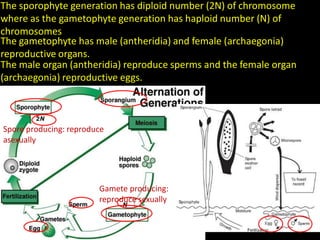
The sporophyte generation has diploid number (2N) of chromosome
where as the gametophyte generation has haploid number (N) of
chromosomes
The gametophyte has male (antheridia) and female (archaegonia)
reproductive organs.
The male organ (antheridia) reproduce sperms and the female organ
(archaegonia) reproductive eggs.
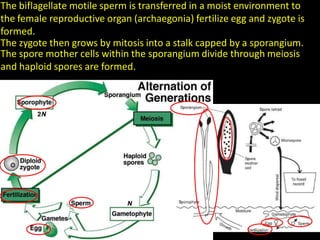
The biflagellate motile sperm is transferred in a moist environment to
the female reproductive organ (archaegonia) fertilize egg and zygote is
formed.
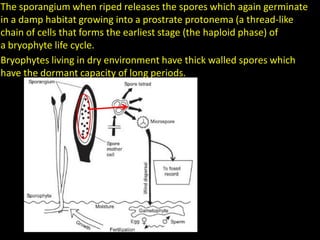
The zygote then grows by mitosis into a stalk capped by a sporangium.
The spore mother cells within the sporangium divide through meiosis
and haploid spores are formed.
The sporangium when riped releases the spores which again germinate
in a damp habitat growing into a prostrate protonema (a thread-like
chain of cells that forms the earliest stage (the haploid phase) of
a bryophyte life cycle.
Bryophytes living in dry environment have thick walled spores which
have the dormant capacity of long periods.
Life cycles of ‘lower’ land plants
Land plants differ from algae in being vascular
The life cycle alternate between a spore producing
sporophyte and gamete producing gametophye
generation
Spore producing: reproduce
asexually
Gamete producing:
reproduce sexually
Male
reproducti
ve organ
antheridia
Female
reproductiv
e organ
archegonia
Similar to algae in having alternation of
generation
Spore morphology
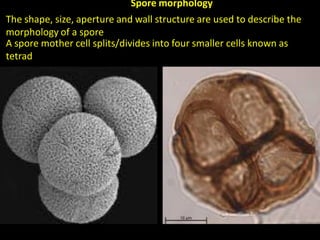
The shape, size, aperture and wall structure are used to describe the
morphology of a spore
A spore mother cell splits/divides into four smaller cells known as
tetrad
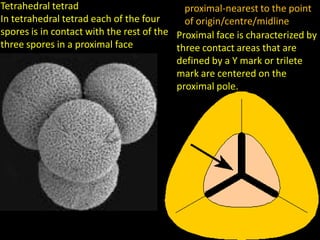
Tetrahedral tetrad
In tetrahedral tetrad each of the four
spores is in contact with the rest of the
three spores in a proximal face
proximal-nearest to the point
of origin/centre/midline
Proximal face is characterized by
three contact areas that are
defined by a Y mark or trilete
mark are centered on the
proximal pole.
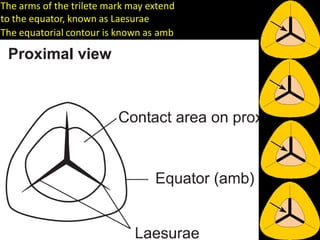
The arms of the trilete mark may extend
to the equator, known as Laesurae
The equatorial contour is known as amb
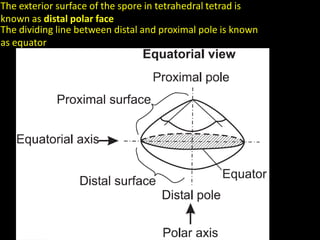
The exterior surface of the spore in tetrahedral tetrad is
known as distal polar face
The dividing line between distal and proximal pole is known
as equator
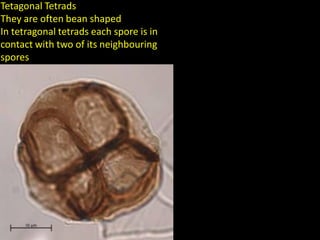
Tetagonal Tetrads
They are often bean shaped
In tetragonal tetrads each spore is in
contact with two of its neighbouring
spores
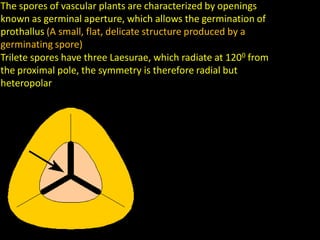
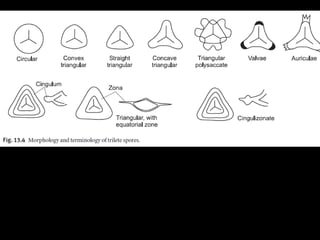
The spores of vascular plants are characterized by openings
known as germinal aperture, which allows the germination of
prothallus (A small, flat, delicate structure produced by a
germinating spore)
Trilete spores have three Laesurae, which radiate at 1200 from
the proximal pole, the symmetry is therefore radial but
heteropolar
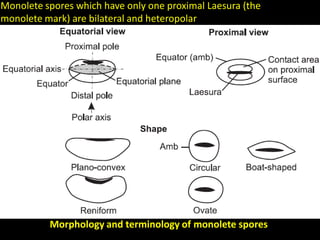
Monolete spores which have only one proximal Laesura (the
monolete mark) are bilateral and heteropolar
Morphology and terminology of monolete spores
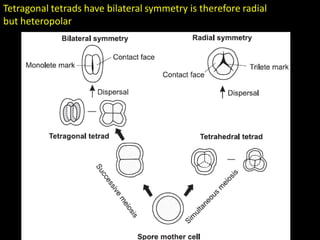
Tetragonal tetrads have bilateral symmetry is therefore radial
but heteropolar
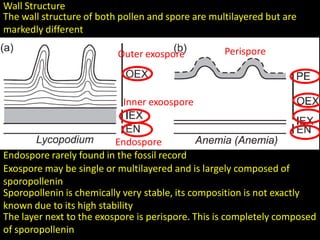
Wall Structure
The wall structure of both pollen and spore are multilayered but are
markedly different
Endospore
Inner exoospore
Outer exospore Perispore
Endospore rarely found in the fossil record
Exospore may be single or multilayered and is largely composed of
sporopollenin
Sporopollenin is chemically very stable, its composition is not exactly
known due to its high stability
The layer next to the exospore is perispore. This is completely composed
of sporopollenin
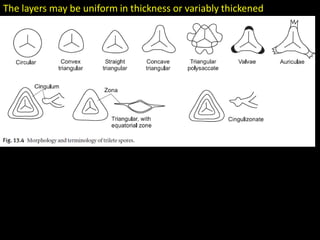
The layers may be uniform in thickness or variably thickened
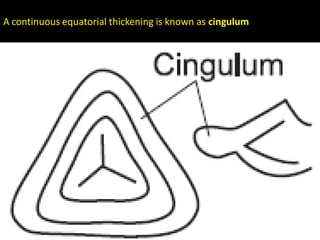
A continuous equatorial thickening is known as cingulum
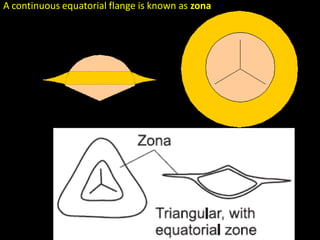
A continuous equatorial flange is known as zona
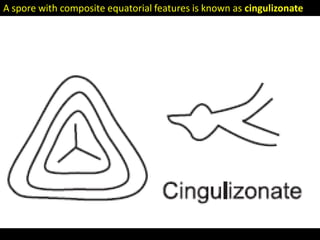
A spore with composite equatorial features is known as cingulizonate
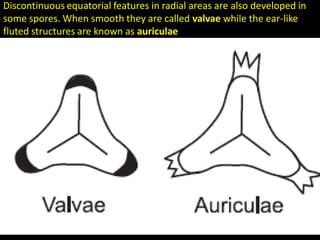
Discontinuous equatorial features in radial areas are also developed in
some spores. When smooth they are called valvae while the ear-like
fluted structures are known as auriculae
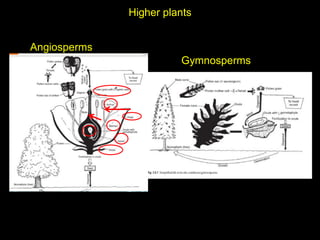
Higher plants
Angiosperms
Gymnosperms
Pollen morphology
Pollens grains are distinguished by the
aspects of their morphology. i.e, size,
shape and surface sculpture
Size
Majority of the pollen grains has size
b/w 20 to 80 µm, with rare forms less
than 10 µm and more than 200 µm.
Shape
Prolate Subspheroidal
Oblate
Pentagonal Irregular Vesiculate
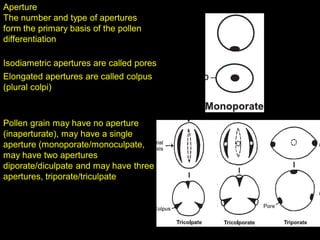
Aperture
The number and type of apertures
form the primary basis of the pollen
differentiation
Isodiametric apertures are called pores
Elongated apertures are called colpus
(plural colpi)
Pollen grain may have no aperture
(inaperturate), may have a single
aperture (monoporate/monoculpate,
may have two apertures
diporate/diculpate and may have three
apertures, triporate/triculpate
Sculpture
The ornamenting elements of the
pollen grain surface is known as
sculpture
Some twelve types of sculptures are
recognized
These include smooth, striated, pitted
etc
Applications of Pollens and Spores
Fossil pollens and spores are widely
used in correlation of terrestrial rocks.

Pollens and spores types classsification

  • 1.
    Palynology The science ofpalynomorphs is known as palynology Palynomorphs organic-walled microfossils between 5 and 500 µm in size, pollens, spores, dinoflagellate cyst, acritarch, chitinozoans and scolecodonts Organic walled microfossils
  • 2.
    Pollens and spores AlgaeBrophytes Pteridophytes Gymnosperms Angiosperms
  • 3.
    Angiosperms spores Pollens Both have wallsresistant to microbial attacks and temperature after burial spores are produced by bryophytes (e.g., mosses) Pollens are produced by angiosperms and confers Produced in large number Travel rapidly and widely in wind and water Brophytes Pteridophytes
  • 4.
    Lakes Ponds Rivers Ocean Settle downin ponds, rivers, lakes and oceans Widely used in stratigraphy especially when correlating continental and near shore deposits Also used for palaeoecological and palaeoenvironmental studies
  • 5.
    Life cycles of‘lower’ land plants Land plants differ from algae in being vascular The life cycle alternate between a spore producing sporophyte and gamete producing gametophyte generation Spore producing: reproduce asexually Gamete producing: reproduce sexually Similar to algae in having alternation of generation The sporophyte generation reproduce asexually and the gametophyte generation reproduce sexually
  • 6.
    Spore producing: reproduce asexually Gameteproducing: reproduce sexually The sporophyte generation has diploid number (2N) of chromosome where as the gametophyte generation has haploid number (N) of chromosomes The gametophyte has male (antheridia) and female (archaegonia) reproductive organs. The male organ (antheridia) reproduce sperms and the female organ (archaegonia) reproductive eggs.
  • 7.
    The biflagellate motilesperm is transferred in a moist environment to the female reproductive organ (archaegonia) fertilize egg and zygote is formed. The zygote then grows by mitosis into a stalk capped by a sporangium. The spore mother cells within the sporangium divide through meiosis and haploid spores are formed.
  • 8.
    The sporangium whenriped releases the spores which again germinate in a damp habitat growing into a prostrate protonema (a thread-like chain of cells that forms the earliest stage (the haploid phase) of a bryophyte life cycle. Bryophytes living in dry environment have thick walled spores which have the dormant capacity of long periods.
  • 9.
    Life cycles of‘lower’ land plants Land plants differ from algae in being vascular The life cycle alternate between a spore producing sporophyte and gamete producing gametophye generation Spore producing: reproduce asexually Gamete producing: reproduce sexually Male reproducti ve organ antheridia Female reproductiv e organ archegonia Similar to algae in having alternation of generation
  • 10.
    Spore morphology The shape,size, aperture and wall structure are used to describe the morphology of a spore A spore mother cell splits/divides into four smaller cells known as tetrad
  • 11.
    Tetrahedral tetrad In tetrahedraltetrad each of the four spores is in contact with the rest of the three spores in a proximal face proximal-nearest to the point of origin/centre/midline Proximal face is characterized by three contact areas that are defined by a Y mark or trilete mark are centered on the proximal pole.
  • 12.
    The arms ofthe trilete mark may extend to the equator, known as Laesurae The equatorial contour is known as amb
  • 13.
    The exterior surfaceof the spore in tetrahedral tetrad is known as distal polar face The dividing line between distal and proximal pole is known as equator
  • 14.
    Tetagonal Tetrads They areoften bean shaped In tetragonal tetrads each spore is in contact with two of its neighbouring spores
  • 15.
    The spores ofvascular plants are characterized by openings known as germinal aperture, which allows the germination of prothallus (A small, flat, delicate structure produced by a germinating spore) Trilete spores have three Laesurae, which radiate at 1200 from the proximal pole, the symmetry is therefore radial but heteropolar
  • 17.
    Monolete spores whichhave only one proximal Laesura (the monolete mark) are bilateral and heteropolar Morphology and terminology of monolete spores
  • 18.
    Tetragonal tetrads havebilateral symmetry is therefore radial but heteropolar
  • 19.
    Wall Structure The wallstructure of both pollen and spore are multilayered but are markedly different Endospore Inner exoospore Outer exospore Perispore Endospore rarely found in the fossil record Exospore may be single or multilayered and is largely composed of sporopollenin Sporopollenin is chemically very stable, its composition is not exactly known due to its high stability The layer next to the exospore is perispore. This is completely composed of sporopollenin
  • 20.
    The layers maybe uniform in thickness or variably thickened
  • 21.
    A continuous equatorialthickening is known as cingulum
  • 22.
    A continuous equatorialflange is known as zona
  • 23.
    A spore withcomposite equatorial features is known as cingulizonate
  • 24.
    Discontinuous equatorial featuresin radial areas are also developed in some spores. When smooth they are called valvae while the ear-like fluted structures are known as auriculae
  • 25.
  • 26.
    Pollen morphology Pollens grainsare distinguished by the aspects of their morphology. i.e, size, shape and surface sculpture Size Majority of the pollen grains has size b/w 20 to 80 µm, with rare forms less than 10 µm and more than 200 µm. Shape Prolate Subspheroidal Oblate Pentagonal Irregular Vesiculate
  • 27.
    Aperture The number andtype of apertures form the primary basis of the pollen differentiation Isodiametric apertures are called pores Elongated apertures are called colpus (plural colpi) Pollen grain may have no aperture (inaperturate), may have a single aperture (monoporate/monoculpate, may have two apertures diporate/diculpate and may have three apertures, triporate/triculpate
  • 28.
    Sculpture The ornamenting elementsof the pollen grain surface is known as sculpture Some twelve types of sculptures are recognized These include smooth, striated, pitted etc Applications of Pollens and Spores Fossil pollens and spores are widely used in correlation of terrestrial rocks.