FOSSILS
• Dug up; Direct way of past study.
• Excavated from sedimentary rocks; Remains preserved
in rocks.
• The remains of creatures that lived and died and were
buried in sediments and later solidified into rocks.
• The remains of animals that lived prior to recent times at
least 10-15 thousand years.
• Remains of organisms which have acquired a
physicochemical stability with regards to their
environments.
FOSSILS
Fossils are the organic remains which are
naturally preserved, have physicochemical
stability with their environments and show
the exact morphology of that organic
remains.
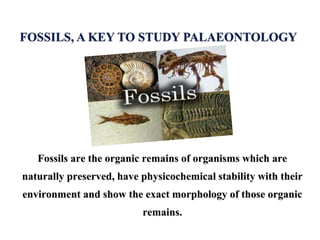
Fossils are the organic remains of organisms which are
naturally preserved, have physicochemical stability with their
environment and show the exact morphology of those organic
remains.
FOSSILIZATION
Fossilization includes all the process
occurred during the transformation of
organic remains into fossils in sediments,
or any other comparable medium.
FOSSILIZATION
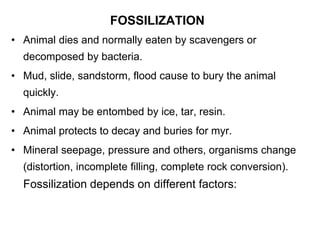
• Animal dies and normally eaten by scavengers or
decomposed by bacteria.
• Mud, slide, sandstorm, flood cause to bury the animal
quickly.
• Animal may be entombed by ice, tar, resin.
• Animal protects to decay and buries for myr.
• Mineral seepage, pressure and others, organisms change
(distortion, incomplete filling, complete rock conversion).
Fossilization depends on different factors:
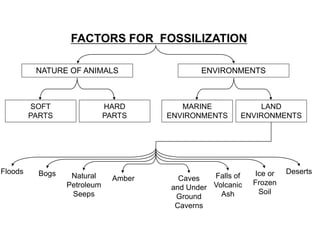
FACTORS FOR FOSSILIZATION
NATURE OF ANIMALS ENVIRONMENTS
MARINE
ENVIRONMENTS
LAND
ENVIRONMENTS
SOFT
PARTS
HARD
PARTS
Floods Bogs Natural
Petroleum
Seeps
Amber Caves
and Under
Ground
Caverns
Falls of
Volcanic
Ash
Ice or
Frozen
Soil
Deserts
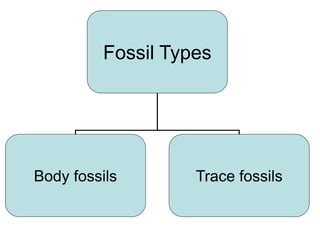
Fossil Types
Body fossils Trace fossils
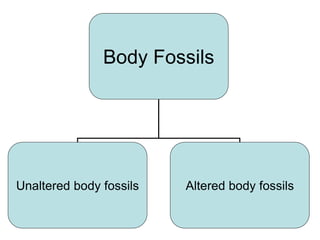
Body Fossils
Unaltered body fossils Altered body fossils
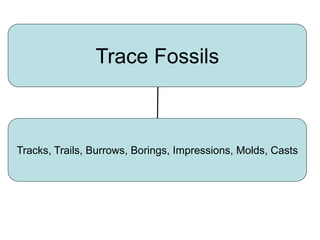
Trace Fossils
Tracks, Trails, Burrows, Borings, Impressions, Molds, Casts
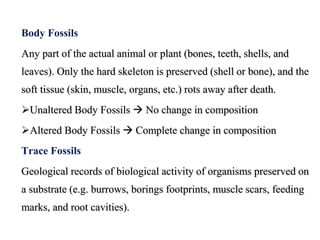
Body Fossils
Any part of the actual animal or plant (bones, teeth, shells, and
leaves). Only the hard skeleton is preserved (shell or bone), and the
soft tissue (skin, muscle, organs, etc.) rots away after death.
Unaltered Body Fossils  No change in composition
Altered Body Fossils  Complete change in composition
Trace Fossils
Geological records of biological activity of organisms preserved on
a substrate (e.g. burrows, borings footprints, muscle scars, feeding
marks, and root cavities).
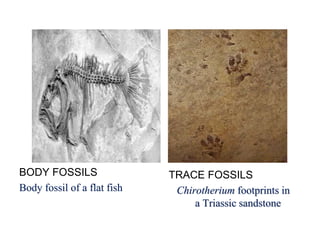
BODY FOSSILS
Body fossil of a flat fish
TRACE FOSSILS
Chirotherium footprints in
a Triassic sandstone
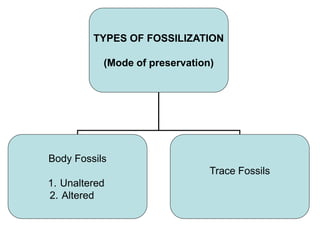
TYPES OF FOSSILIZATION
(Mode of preservation)
Body Fossils
1. Unaltered
2. Altered
Trace Fossils
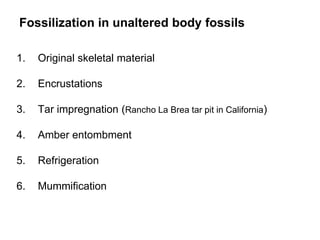
Fossilization in unaltered body fossils
1. Original skeletal material
2. Encrustations
3. Tar impregnation (Rancho La Brea tar pit in California)
4. Amber entombment
5. Refrigeration
6. Mummification
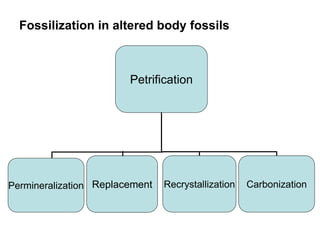
Fossilization in altered body fossils
Petrification
Permineralization Recrystallization Carbonization
Replacement
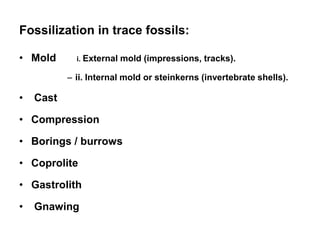
Fossilization in trace fossils:
• Mold i. External mold (impressions, tracks).
– ii. Internal mold or steinkerns (invertebrate shells).
• Cast
• Compression
• Borings / burrows
• Coprolite
• Gastrolith
• Gnawing
Other types
• Pseudo fossils
• Index fossils
• Living fossils
• Sub fossils
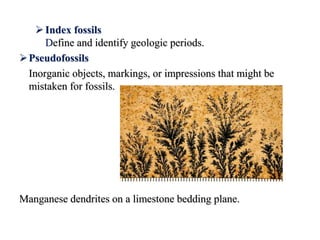
Index fossils
Define and identify geologic periods.
Pseudofossils
Inorganic objects, markings, or impressions that might be
mistaken for fossils.
Manganese dendrites on a limestone bedding plane.
Living fossil
Any living species which resembles species that is only known
from fossils and which has no close living relatives.
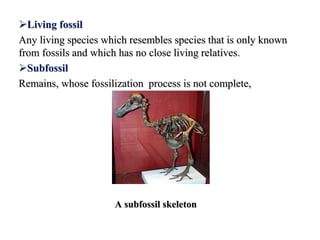
Subfossil
Remains, whose fossilization process is not complete,
A subfossil skeleton
Uses of fossils
• Prehistoric man utilized fossils in an attempt to ward off
evil spirits.
• Men of certain primitive culture use fossil bones as
medicine, believing that they have mysterious power of
healing wounds.
• The scientists, however, use fossils to recreate the
geological history of earth.
• The tracing of the development of plants and animals.
• Climatic indicators.
• Evidence of changing geographic patterns.
• Economic tools.
• Record of prehistoric life.
• Evidence of organic evolution.
• Stratigraphic indicator.
• Cultural values.
Harsh weather.
Impossible access to some dangerous areas.
Nature of the metabolism of Achaean organisms.
The early evolution of insects and microorganisms.

Fossils & Fossilization.ppt

  • 1.
    FOSSILS • Dug up;Direct way of past study. • Excavated from sedimentary rocks; Remains preserved in rocks. • The remains of creatures that lived and died and were buried in sediments and later solidified into rocks. • The remains of animals that lived prior to recent times at least 10-15 thousand years. • Remains of organisms which have acquired a physicochemical stability with regards to their environments.
  • 2.
    FOSSILS Fossils are theorganic remains which are naturally preserved, have physicochemical stability with their environments and show the exact morphology of that organic remains.
  • 3.
    Fossils are theorganic remains of organisms which are naturally preserved, have physicochemical stability with their environment and show the exact morphology of those organic remains.
  • 4.
    FOSSILIZATION Fossilization includes allthe process occurred during the transformation of organic remains into fossils in sediments, or any other comparable medium.
  • 5.
    FOSSILIZATION • Animal diesand normally eaten by scavengers or decomposed by bacteria. • Mud, slide, sandstorm, flood cause to bury the animal quickly. • Animal may be entombed by ice, tar, resin. • Animal protects to decay and buries for myr. • Mineral seepage, pressure and others, organisms change (distortion, incomplete filling, complete rock conversion). Fossilization depends on different factors:
  • 6.
    FACTORS FOR FOSSILIZATION NATUREOF ANIMALS ENVIRONMENTS MARINE ENVIRONMENTS LAND ENVIRONMENTS SOFT PARTS HARD PARTS Floods Bogs Natural Petroleum Seeps Amber Caves and Under Ground Caverns Falls of Volcanic Ash Ice or Frozen Soil Deserts
  • 7.
  • 8.
    Body Fossils Unaltered bodyfossils Altered body fossils
  • 9.
    Trace Fossils Tracks, Trails,Burrows, Borings, Impressions, Molds, Casts
  • 10.
    Body Fossils Any partof the actual animal or plant (bones, teeth, shells, and leaves). Only the hard skeleton is preserved (shell or bone), and the soft tissue (skin, muscle, organs, etc.) rots away after death. Unaltered Body Fossils  No change in composition Altered Body Fossils  Complete change in composition Trace Fossils Geological records of biological activity of organisms preserved on a substrate (e.g. burrows, borings footprints, muscle scars, feeding marks, and root cavities).
  • 11.
    BODY FOSSILS Body fossilof a flat fish TRACE FOSSILS Chirotherium footprints in a Triassic sandstone
  • 12.
    TYPES OF FOSSILIZATION (Modeof preservation) Body Fossils 1. Unaltered 2. Altered Trace Fossils
  • 13.
    Fossilization in unalteredbody fossils 1. Original skeletal material 2. Encrustations 3. Tar impregnation (Rancho La Brea tar pit in California) 4. Amber entombment 5. Refrigeration 6. Mummification
  • 14.
    Fossilization in alteredbody fossils Petrification Permineralization Recrystallization Carbonization Replacement
  • 15.
    Fossilization in tracefossils: • Mold i. External mold (impressions, tracks). – ii. Internal mold or steinkerns (invertebrate shells). • Cast • Compression • Borings / burrows • Coprolite • Gastrolith • Gnawing
  • 16.
    Other types • Pseudofossils • Index fossils • Living fossils • Sub fossils
  • 17.
    Index fossils Define andidentify geologic periods. Pseudofossils Inorganic objects, markings, or impressions that might be mistaken for fossils. Manganese dendrites on a limestone bedding plane.
  • 18.
    Living fossil Any livingspecies which resembles species that is only known from fossils and which has no close living relatives. Subfossil Remains, whose fossilization process is not complete, A subfossil skeleton
  • 19.
    Uses of fossils •Prehistoric man utilized fossils in an attempt to ward off evil spirits. • Men of certain primitive culture use fossil bones as medicine, believing that they have mysterious power of healing wounds. • The scientists, however, use fossils to recreate the geological history of earth. • The tracing of the development of plants and animals.
  • 20.
    • Climatic indicators. •Evidence of changing geographic patterns. • Economic tools. • Record of prehistoric life. • Evidence of organic evolution. • Stratigraphic indicator. • Cultural values.
  • 21.
    Harsh weather. Impossible accessto some dangerous areas. Nature of the metabolism of Achaean organisms. The early evolution of insects and microorganisms.