CONTENT:
PLANNING
ORGANIZING
LEADING
CONTROLLING
THE POLC
FRAME WORK
PRESENTED BY GROUP # 7
Students of Master in Administrative Sciences (MAS-Final),
Department of Public Administration, University Of Karachi.
GOUP MEMEBRS:
QUDSIA BIBI
NASIR KHAN
UMER QURESHI
AAMIR SHAHZAD
MUHAMMAD ASIF KHAN
PRESENTED TO:
MR. ZIA KHURSHEED
SUBJECT:
PRINCIPLES OF MANAMEMENT (612)
THE COCA COLA COMPANY AN
INTRODUCTION
Coca-Cola Company is the world's largest beverage
company,The largest manufacturer, distributor and
marketer of non-alcoholic beverage concentrates and
syrups in the world and is one of the largest
corporations in the United States.
The company is best known for its flagship product
Coca Cola invented by pharmacist John Stith
Pemberton in 1886. The Coca-Cola formula and brand
was bought in 1889 by Asa Candler who incorporated
The Coca-Cola Company in 1892.
Besides its namesake Coca-Cola beverage, Coca-Cola
currently offers nearly 400 brands in over 200 countries
or territories and serves 1.5 billion servings each day.
COCA COLA IN PAKISTAN
The Coca-Cola Company entered the
Pakistani market in 1953, and since then it
has expanded rapidly to become one of the
leading beverage companies in Pakistan. Its
operations support the bottler, distributors,
retailers, and in addition 10 vendor
industries.
OUR BUSINESS MODEL IN
PAKISTAN
Our business model, termed as the “The Coca-Cola System”
encompasses the production, marketing, sales and distribution of
our beverages. The Coca-Cola System in Pakistan comprises of:
The Coca-Cola Export Corporation, Pakistan & Afghanistan
Region (TCCEC)
Coca-Cola Beverages Pakistan Limited (CCBPL) established
in 1996 by The Coca-Cola Company. Currently almost 50%
shares, along with management rights of CCBPL lie with
Coca-Cola İçecek (CCI), the sixth largest Coca-Cola bottler in
the world.
CCI has a presence in 10 countries including Azerbaijan, Iraq,
Jordan, Kazakhstan, Kyrgyzstan, Pakistan, Tajikistan, Turkey
and Turkmenistan.
Extensive network of distributors, retailers and customers.
OUR BUSINESS MODEL
TCCEC is responsible for the manufacturing and selling
of the concentrates, beverage bases and syrups to
CCBPL. It also owns the brands and heavily partakes in
consumer brand marketing initiatives, besides having a
comprehensive public affairs and communications
responsibility.
CCBPL manufactures, packages, merchandises and
distributes the produced branded beverages. As the
bottling company, CCBPL is also responsible for
developing local networks, so that the end product
reaches the consumer in its best quality. This includes
customer development, market investment, order
collection, delivery and lastly cash collection.
We, at Coca-Cola strongly believe in delivering
sustainable growth by investing in a healthier future for
the people and our planet. We are a company committed
to making a positive difference.
COCA COLA PRODUCT LINE
Coca Cola Pakistan has a very narrow product range. It has
the following brands in Pakistan.
Coca Cola
Sprite
Fanta
Diet Coke
Minute Maid now Rani Pulpi
Kinley
These products are sold in the market in different sizes of
bottles. These sizes are available for all its products.
CONTENT:
PLANNING
ORGANIZING
LEADING
CONTROLLING
PLANNING
CEO TURNAROUND PLANING
Coca-Cola CEO Muhtar Kent has a vision for the future.
 A renewed focus on soda.
 2020 vision.
 Boost performance by new innovation and
always remain discontent.
 Coca-Cola wants to become even more global
icon, expanding its business.
 Smart investments.
 The Secret Formula
–
MISSION STATMENT
– To refresh the world and inspire...
– Moments of happiness and optimism..
– To create values and make a difference...
VISION
Our vision serves as the framework for our Roadmap and guides
every aspect of our business by describing what we need to
accomplish in order to continue achieving sustainable, quality
growth.
People: Be a great place to work where people are inspired to be
the best they can be.
Portfolio: Bring to the world a portfolio of quality beverage brands
that anticipate and satisfy people's desires and needs.
Partners: Nurture a winning network of customers and suppliers,
together we create mutual, enduring value.
Planet: Be a responsible citizen that makes a difference by helping
build and support sustainable communities.
Profit: Maximize long-term return to shareowners while being
mindful of our overall responsibilities.
Productivity: Be a highly effective, lean and fast-moving
organization.
VALUES
Our values serve as a compass for our actions and describe how
we behave in the world.
LEADERSHIP: The courage to shape a better future.
COLLABORATION: Leverage collective genius.
INTEGRITY: Be real.
ACCOUNTABILITY: If it is to be it's up to me.
PASSION: Committed in heart and mind.
DIVERSITY: As inclusive as our brands.
QUALITY: What we do, we do well.
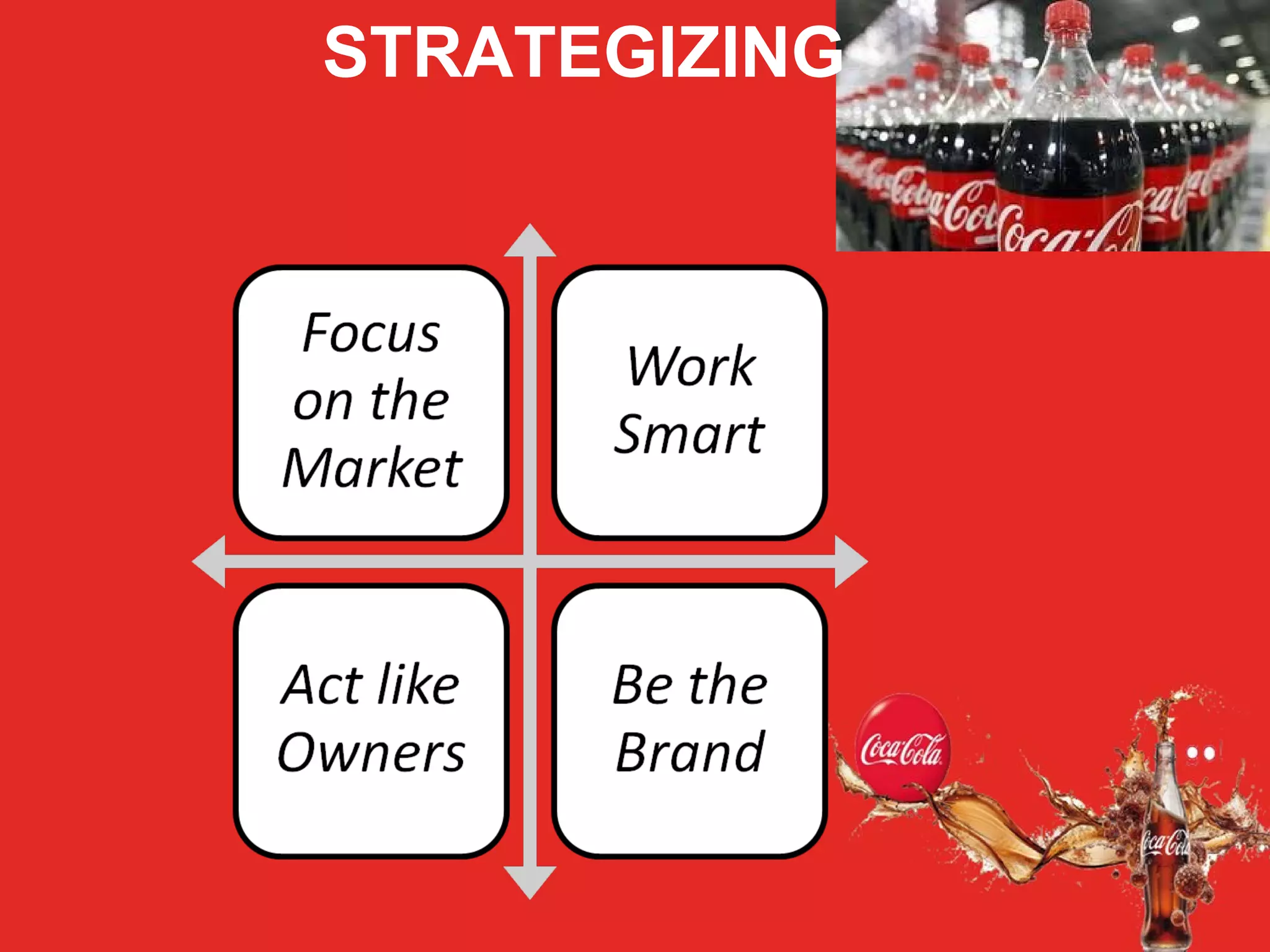
STRATEGIZING
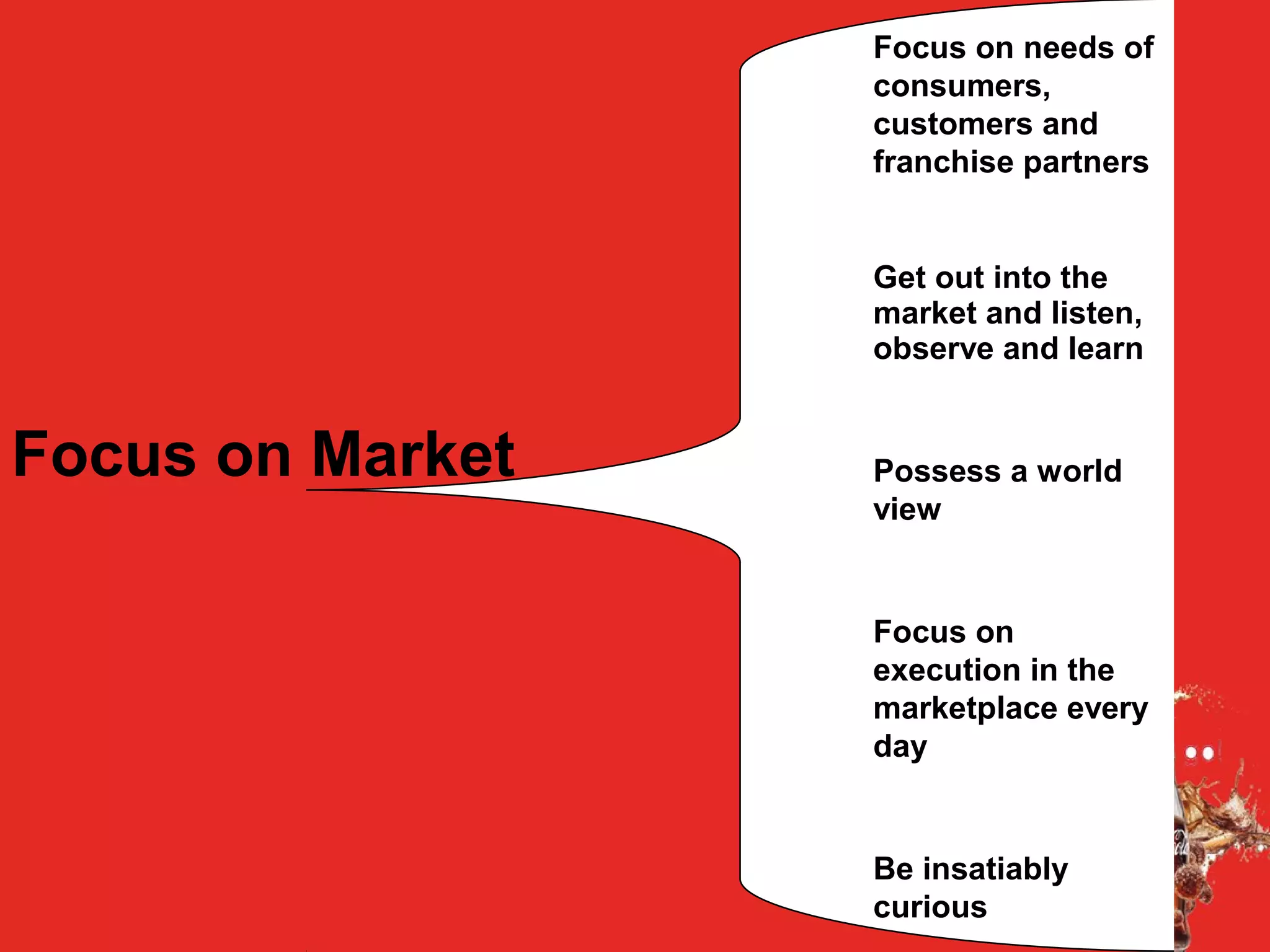
Focus on Market
Focus on needs of
consumers,
customers and
franchise partners
Get out into the
market and listen,
observe and learn
Possess a world
view
Focus on
execution in the
marketplace every
day
Be insatiably
curious
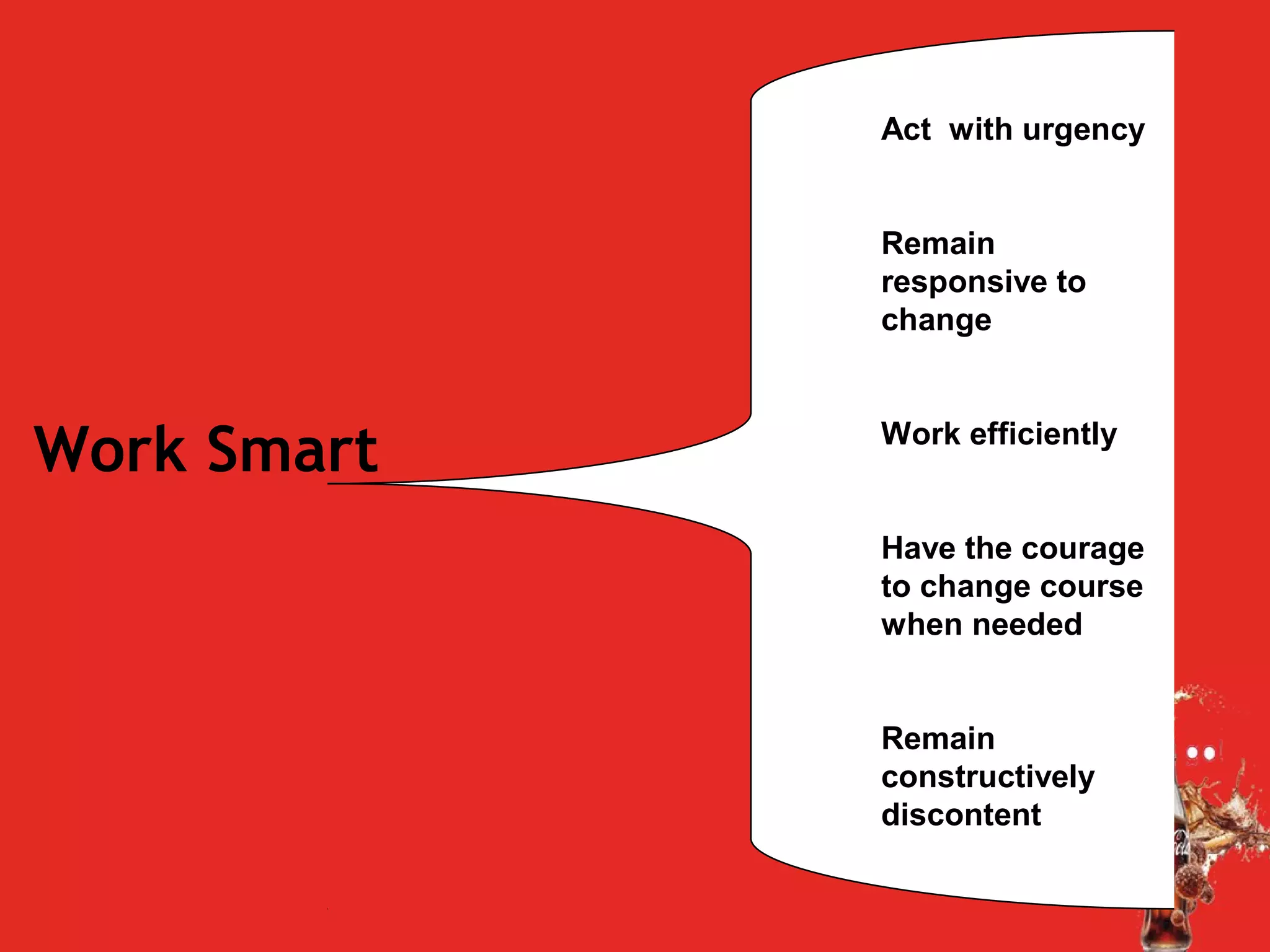
Work Smart
Act with urgency
Remain
responsive to
change
Work efficiently
Have the courage
to change course
when needed
Remain
constructively
discontent
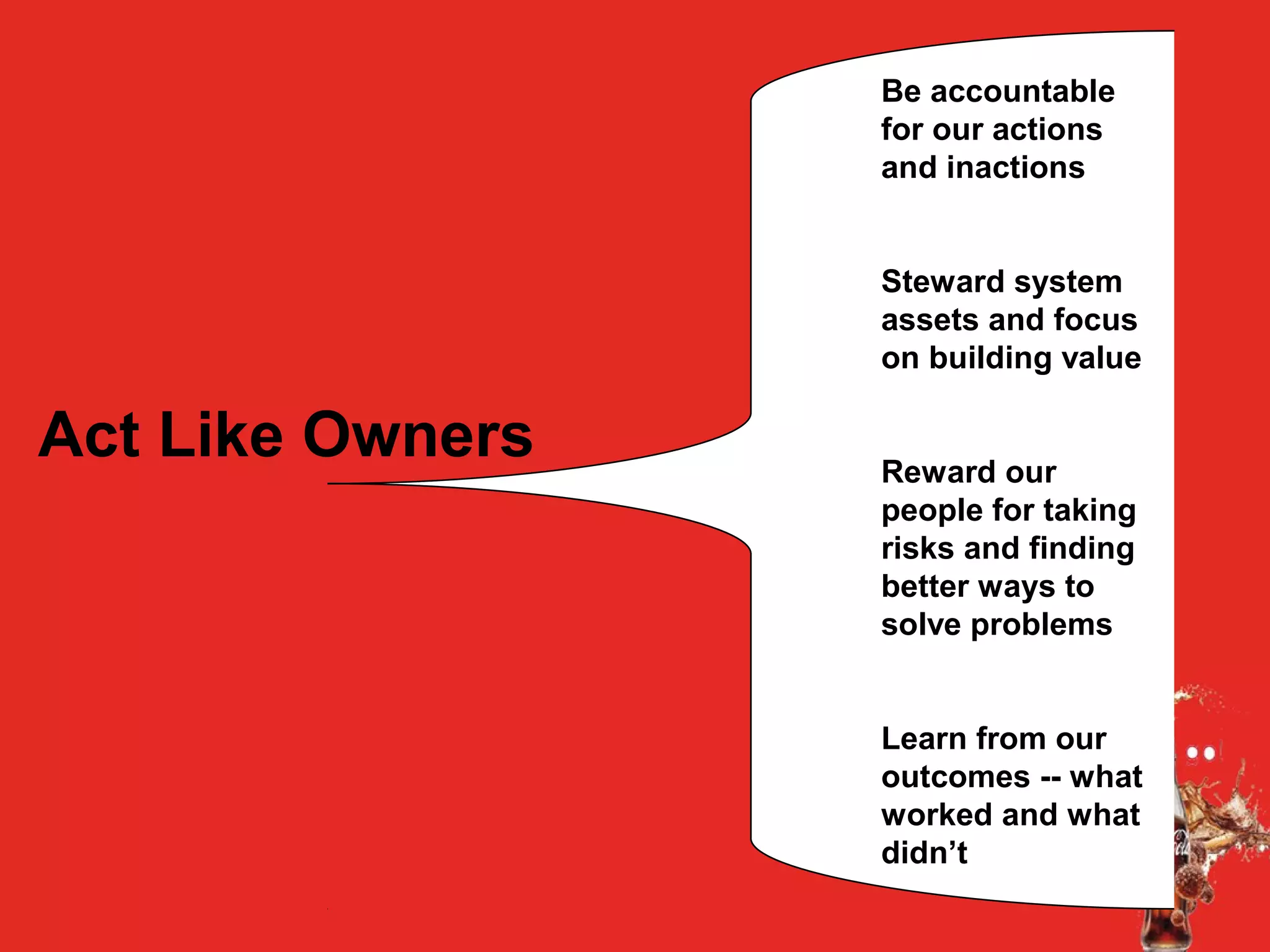
Act Like Owners
Be accountable
for our actions
and inactions
Steward system
assets and focus
on building value
Reward our
people for taking
risks and finding
better ways to
solve problems
Learn from our
outcomes -- what
worked and what
didn’t
Be the Brand
Inspire
creativity,
passion,
optimism and
fun
GOALS
Are to be globally known as a business.
Can strive towards innovation and create new
drinks.
Can continue to plan for the next five to ten
years.
Helping local communities and supporting
them financially, so they can create more
Businesses and Maximize Our Profit.
STRATEGIC GOALS
To continue to be an organization providing the
quality products to the valuable customers.
To select and retain the professional people for
the organization.
To project an outstanding corporate image.
To satisfy the customer through extra ordinary
service and an excellent service along with the
complete tactical and operational support.
OBJECTIVES
Fostering an open and inclusive environment
based on recognized workplace human rights,
where a highly motivated, productive and
committed workforce drives business success
through superior execution.
Conducting the business in ways that protect
and preserve the environment and integrating
principles of environmental stewardship and
sustainable development into the business
decisions and processes.
OBJECTIVES
Investing time, expertise and resources to
provide economic opportunity, improving the
quality of life, and fostering goodwill in
communities where the business operates,
through locally relevant initiatives.
Providing products and services that meet the
beverage needs of the consumers, while
providing sound and rewarding business
opportunities and benefits for customers,
suppliers, distributors and local communities.
TACTICAL PLANS
To increase the revenues by 20% as compared
to last year.
To increase the total retail customers by around
10%.
To increase the market share by 5%.
OPERATIONALS PLANS
To find new customers,
To retain existing ones,
To bring back the discontinued accounts.
CONTENT:
PLANNING
ORGANIZING
LEADING
CONTROLLING
ORGANIZING
ORGANIZATIONAL DESIGN
Organizing is the second management function. The
following steps are taken by the Coca Cola Company in
organizing their goals and objectives:
Departmentalization
Work Specialization
Delegation and Accountability
Resource Allocation
Organizing the Human Resources
ORGANIZING HUMAN RESOURCE
The company does the recruitment process when there
is a position empty and the recruitment is always done
on permanent basis in Coca Cola Company.
Our vision serves as the framework for our Road map
and guides every aspect of our business by describing
what we need to accomplish in order to continue
achieving sustainable, quality growth .
There is a high percentage of work specialization in the
Coca Cola Company because every manager is
appointed in the function in which he is expert so there
is no boredom or monotony.
ORGANIZING HUMAN RESOURCE
There is a high percentage of delegation in the
company. The work is done with proper authority and
responsibility.
When the issue of resource allocation comes into
action the Coca Cola Company has given the authority
to managers to use the resources of the company
where ever and whenever they are needed.
ORGANIZATION CULTURE
 Mission driven focused on refreshing mind,
inspiring, optimism.
• Role culture is the culture that Coca-Cola
adopts.
• Role culture is normally split up into a
number of functions include like accounts,
marketing and production.
• Culture works by logic and rationality rules
and procedures are the main source of
influence.
CORPORATE CULTURE
The Top management at coca cola also try to
emphasize to follow the prescribed culture of
the organization.
Coca Cola has formal and documented values
that are communicated to all the employees.
To ensure proper application of the rules and
behavior of the values, the top management act
as role models, and closely administer and
review their employees behavior
SOCIAL NETWORK
Coca Cola on e-social networks.
Facebook
Twitter
Linked In
You Tube
Flickers
Instagram
Google Plus
OTHER SOCIAL ACTIVITIES
COCA COLA FOUNDATION:
Priority Areas
Women: Economic empowerment and entrepreneurship
Water: Access to clean water, water conservation and
recycling
Well-Being: Active healthy living, education and youth
development
CONTENT:
PLANNING
ORGANIZING
LEADING
CONTROLLING
LEADING
LEADERSHIP
CEO and Chairman:
MUHTAR KENT
Leadership of TCCEC for Pakistan & Afghanistan Region:
RAZA AHMED, Director, Franchise & Commercial & Corporate
Leadership
FAHAD QADIR, Director, Public Affairs & Communications
RIZWAN ULLAH KHAN, General Manager
SARAH FAROOQ, Legal Counsel
KALEEM FAZAL, Region Finance Manager
QASIM MAHMOOD, Technical Services Manager
FAISAL HASHMI, HR-Strategic Business Partner
ALI AKBAR, Director Marketing
ATIQUE KHAWAJA, Senior Quality Environment Occupational
Safety & Health (QEOSH) Manager.
LEADERSHIP STYLE
The managers are responsible for taking major
administrative decisions.
Departmental managers are responsible for
leading and directing their subordinates.
COCA COLA
ORGANIZATION STRUCTURE:
DECISION MAKING
Decision making process is centralized the top management
takes decisions. The following are the areas where the
important decisions has been taken place:
– The Package Positioning
– Trade Discounts
– Advertisements
– Price Reductions
– Distribution
COCA COLA
ORGANIZATION STRUCTURE:
COMUNICATION
There is open environment in Coca Cola, which
discourages barriers among the members sharing
information
All Employees easily approach the Managers in any
problems.
Allows the employees to communicate with each other.
Before making decisions the top level managers
discuss it with the middle level managers shared till the
end.
Interdepartmental communication is done in the form of
formal and informal manners, to get the feedback of
the employees.
GROUPS/TEAMS
– Grouping of employees is done on the basis of
their common skills and work activities.
– Group members by promoting the interests of
the group members and by practicing social
equality.
– Group of employees are from all the levels,
functions and business units of the organization
EMPLOYEE MOTIVATION
Employee motivation is given a very
high consideration at Coca Cola. Following
tools has been applied for that
– High Attention
– Competitive Compensation Packages
– Promotions
– Bonus
– Performance Based Compensation
– Help them To Attain Individual Goals
– Safe & Healthy Working Environment
– Challenging Milestone
CONTENT:
PLANNING
ORGANIZING
LEADING
CONTROLLING
CONTROLLING
PROCESS / SYSTEM
Steward system assets and focus on building
value.
– Centralize system of control.
– System requirements that enable them to
quickly achieve scale and efficiencies bottling
system across the globe provide vital
information that is incorporated in the
strategies.
CONTROL PROCESS
Control is done through the evaluation, which is based on the
objectives. Developed different criteria and different reporting
and controlling systems.
Sales Persons Reporting system:
Every sales person directly reports to market developer of
his area
– Sales Persons Evaluation System:
Every salespersons evaluation is done on quarterly basis.
This evaluation also motivates salespeople to work hard
and get the promotion
STRATEGIC HRM
– Provide vital information to the employees that
Is incorporated in company's strategies.
– The strategic workplace programs that help
assure the success of company's strategic
goals.
– Strategic goals are made for long term.
– Change strategies after every three years set by
the CEO & Chairman of the company
QUESTIONS
&
ANSWERS
POLC Frame Work of Coca Cola Presentaion (MAS after PGDPA)

POLC Frame Work of Coca Cola Presentaion (MAS after PGDPA)

  • 1.
  • 2.
    PRESENTED BY GROUP# 7 Students of Master in Administrative Sciences (MAS-Final), Department of Public Administration, University Of Karachi. GOUP MEMEBRS: QUDSIA BIBI NASIR KHAN UMER QURESHI AAMIR SHAHZAD MUHAMMAD ASIF KHAN PRESENTED TO: MR. ZIA KHURSHEED SUBJECT: PRINCIPLES OF MANAMEMENT (612)
  • 3.
    THE COCA COLACOMPANY AN INTRODUCTION Coca-Cola Company is the world's largest beverage company,The largest manufacturer, distributor and marketer of non-alcoholic beverage concentrates and syrups in the world and is one of the largest corporations in the United States. The company is best known for its flagship product Coca Cola invented by pharmacist John Stith Pemberton in 1886. The Coca-Cola formula and brand was bought in 1889 by Asa Candler who incorporated The Coca-Cola Company in 1892. Besides its namesake Coca-Cola beverage, Coca-Cola currently offers nearly 400 brands in over 200 countries or territories and serves 1.5 billion servings each day.
  • 4.
    COCA COLA INPAKISTAN The Coca-Cola Company entered the Pakistani market in 1953, and since then it has expanded rapidly to become one of the leading beverage companies in Pakistan. Its operations support the bottler, distributors, retailers, and in addition 10 vendor industries.
  • 5.
    OUR BUSINESS MODELIN PAKISTAN Our business model, termed as the “The Coca-Cola System” encompasses the production, marketing, sales and distribution of our beverages. The Coca-Cola System in Pakistan comprises of: The Coca-Cola Export Corporation, Pakistan & Afghanistan Region (TCCEC) Coca-Cola Beverages Pakistan Limited (CCBPL) established in 1996 by The Coca-Cola Company. Currently almost 50% shares, along with management rights of CCBPL lie with Coca-Cola İçecek (CCI), the sixth largest Coca-Cola bottler in the world. CCI has a presence in 10 countries including Azerbaijan, Iraq, Jordan, Kazakhstan, Kyrgyzstan, Pakistan, Tajikistan, Turkey and Turkmenistan. Extensive network of distributors, retailers and customers.
  • 6.
    OUR BUSINESS MODEL TCCECis responsible for the manufacturing and selling of the concentrates, beverage bases and syrups to CCBPL. It also owns the brands and heavily partakes in consumer brand marketing initiatives, besides having a comprehensive public affairs and communications responsibility. CCBPL manufactures, packages, merchandises and distributes the produced branded beverages. As the bottling company, CCBPL is also responsible for developing local networks, so that the end product reaches the consumer in its best quality. This includes customer development, market investment, order collection, delivery and lastly cash collection. We, at Coca-Cola strongly believe in delivering sustainable growth by investing in a healthier future for the people and our planet. We are a company committed to making a positive difference.
  • 7.
    COCA COLA PRODUCTLINE Coca Cola Pakistan has a very narrow product range. It has the following brands in Pakistan. Coca Cola Sprite Fanta Diet Coke Minute Maid now Rani Pulpi Kinley These products are sold in the market in different sizes of bottles. These sizes are available for all its products.
  • 8.
  • 9.
    CEO TURNAROUND PLANING Coca-ColaCEO Muhtar Kent has a vision for the future.  A renewed focus on soda.  2020 vision.  Boost performance by new innovation and always remain discontent.  Coca-Cola wants to become even more global icon, expanding its business.  Smart investments.  The Secret Formula –
  • 10.
    MISSION STATMENT – Torefresh the world and inspire... – Moments of happiness and optimism.. – To create values and make a difference...
  • 11.
    VISION Our vision servesas the framework for our Roadmap and guides every aspect of our business by describing what we need to accomplish in order to continue achieving sustainable, quality growth. People: Be a great place to work where people are inspired to be the best they can be. Portfolio: Bring to the world a portfolio of quality beverage brands that anticipate and satisfy people's desires and needs. Partners: Nurture a winning network of customers and suppliers, together we create mutual, enduring value. Planet: Be a responsible citizen that makes a difference by helping build and support sustainable communities. Profit: Maximize long-term return to shareowners while being mindful of our overall responsibilities. Productivity: Be a highly effective, lean and fast-moving organization.
  • 12.
    VALUES Our values serveas a compass for our actions and describe how we behave in the world. LEADERSHIP: The courage to shape a better future. COLLABORATION: Leverage collective genius. INTEGRITY: Be real. ACCOUNTABILITY: If it is to be it's up to me. PASSION: Committed in heart and mind. DIVERSITY: As inclusive as our brands. QUALITY: What we do, we do well.
  • 13.
  • 14.
    Focus on Market Focuson needs of consumers, customers and franchise partners Get out into the market and listen, observe and learn Possess a world view Focus on execution in the marketplace every day Be insatiably curious
  • 15.
    Work Smart Act withurgency Remain responsive to change Work efficiently Have the courage to change course when needed Remain constructively discontent
  • 16.
    Act Like Owners Beaccountable for our actions and inactions Steward system assets and focus on building value Reward our people for taking risks and finding better ways to solve problems Learn from our outcomes -- what worked and what didn’t
  • 17.
  • 18.
    GOALS Are to beglobally known as a business. Can strive towards innovation and create new drinks. Can continue to plan for the next five to ten years. Helping local communities and supporting them financially, so they can create more Businesses and Maximize Our Profit.
  • 19.
    STRATEGIC GOALS To continueto be an organization providing the quality products to the valuable customers. To select and retain the professional people for the organization. To project an outstanding corporate image. To satisfy the customer through extra ordinary service and an excellent service along with the complete tactical and operational support.
  • 20.
    OBJECTIVES Fostering an openand inclusive environment based on recognized workplace human rights, where a highly motivated, productive and committed workforce drives business success through superior execution. Conducting the business in ways that protect and preserve the environment and integrating principles of environmental stewardship and sustainable development into the business decisions and processes.
  • 21.
    OBJECTIVES Investing time, expertiseand resources to provide economic opportunity, improving the quality of life, and fostering goodwill in communities where the business operates, through locally relevant initiatives. Providing products and services that meet the beverage needs of the consumers, while providing sound and rewarding business opportunities and benefits for customers, suppliers, distributors and local communities.
  • 22.
    TACTICAL PLANS To increasethe revenues by 20% as compared to last year. To increase the total retail customers by around 10%. To increase the market share by 5%.
  • 23.
    OPERATIONALS PLANS To findnew customers, To retain existing ones, To bring back the discontinued accounts.
  • 24.
  • 25.
    ORGANIZATIONAL DESIGN Organizing isthe second management function. The following steps are taken by the Coca Cola Company in organizing their goals and objectives: Departmentalization Work Specialization Delegation and Accountability Resource Allocation Organizing the Human Resources
  • 26.
    ORGANIZING HUMAN RESOURCE Thecompany does the recruitment process when there is a position empty and the recruitment is always done on permanent basis in Coca Cola Company. Our vision serves as the framework for our Road map and guides every aspect of our business by describing what we need to accomplish in order to continue achieving sustainable, quality growth . There is a high percentage of work specialization in the Coca Cola Company because every manager is appointed in the function in which he is expert so there is no boredom or monotony.
  • 27.
    ORGANIZING HUMAN RESOURCE Thereis a high percentage of delegation in the company. The work is done with proper authority and responsibility. When the issue of resource allocation comes into action the Coca Cola Company has given the authority to managers to use the resources of the company where ever and whenever they are needed.
  • 28.
    ORGANIZATION CULTURE  Missiondriven focused on refreshing mind, inspiring, optimism. • Role culture is the culture that Coca-Cola adopts. • Role culture is normally split up into a number of functions include like accounts, marketing and production. • Culture works by logic and rationality rules and procedures are the main source of influence.
  • 29.
    CORPORATE CULTURE The Topmanagement at coca cola also try to emphasize to follow the prescribed culture of the organization. Coca Cola has formal and documented values that are communicated to all the employees. To ensure proper application of the rules and behavior of the values, the top management act as role models, and closely administer and review their employees behavior
  • 30.
    SOCIAL NETWORK Coca Colaon e-social networks. Facebook Twitter Linked In You Tube Flickers Instagram Google Plus
  • 31.
    OTHER SOCIAL ACTIVITIES COCACOLA FOUNDATION: Priority Areas Women: Economic empowerment and entrepreneurship Water: Access to clean water, water conservation and recycling Well-Being: Active healthy living, education and youth development
  • 32.
  • 33.
    LEADERSHIP CEO and Chairman: MUHTARKENT Leadership of TCCEC for Pakistan & Afghanistan Region: RAZA AHMED, Director, Franchise & Commercial & Corporate Leadership FAHAD QADIR, Director, Public Affairs & Communications RIZWAN ULLAH KHAN, General Manager SARAH FAROOQ, Legal Counsel KALEEM FAZAL, Region Finance Manager QASIM MAHMOOD, Technical Services Manager FAISAL HASHMI, HR-Strategic Business Partner ALI AKBAR, Director Marketing ATIQUE KHAWAJA, Senior Quality Environment Occupational Safety & Health (QEOSH) Manager.
  • 34.
    LEADERSHIP STYLE The managersare responsible for taking major administrative decisions. Departmental managers are responsible for leading and directing their subordinates.
  • 35.
    COCA COLA ORGANIZATION STRUCTURE: DECISIONMAKING Decision making process is centralized the top management takes decisions. The following are the areas where the important decisions has been taken place: – The Package Positioning – Trade Discounts – Advertisements – Price Reductions – Distribution
  • 36.
    COCA COLA ORGANIZATION STRUCTURE: COMUNICATION Thereis open environment in Coca Cola, which discourages barriers among the members sharing information All Employees easily approach the Managers in any problems. Allows the employees to communicate with each other. Before making decisions the top level managers discuss it with the middle level managers shared till the end. Interdepartmental communication is done in the form of formal and informal manners, to get the feedback of the employees.
  • 37.
    GROUPS/TEAMS – Grouping ofemployees is done on the basis of their common skills and work activities. – Group members by promoting the interests of the group members and by practicing social equality. – Group of employees are from all the levels, functions and business units of the organization
  • 38.
    EMPLOYEE MOTIVATION Employee motivationis given a very high consideration at Coca Cola. Following tools has been applied for that – High Attention – Competitive Compensation Packages – Promotions – Bonus – Performance Based Compensation – Help them To Attain Individual Goals – Safe & Healthy Working Environment – Challenging Milestone
  • 39.
  • 40.
    PROCESS / SYSTEM Stewardsystem assets and focus on building value. – Centralize system of control. – System requirements that enable them to quickly achieve scale and efficiencies bottling system across the globe provide vital information that is incorporated in the strategies.
  • 41.
    CONTROL PROCESS Control isdone through the evaluation, which is based on the objectives. Developed different criteria and different reporting and controlling systems. Sales Persons Reporting system: Every sales person directly reports to market developer of his area – Sales Persons Evaluation System: Every salespersons evaluation is done on quarterly basis. This evaluation also motivates salespeople to work hard and get the promotion
  • 42.
    STRATEGIC HRM – Providevital information to the employees that Is incorporated in company's strategies. – The strategic workplace programs that help assure the success of company's strategic goals. – Strategic goals are made for long term. – Change strategies after every three years set by the CEO & Chairman of the company
  • 43.