The Marketing Mix
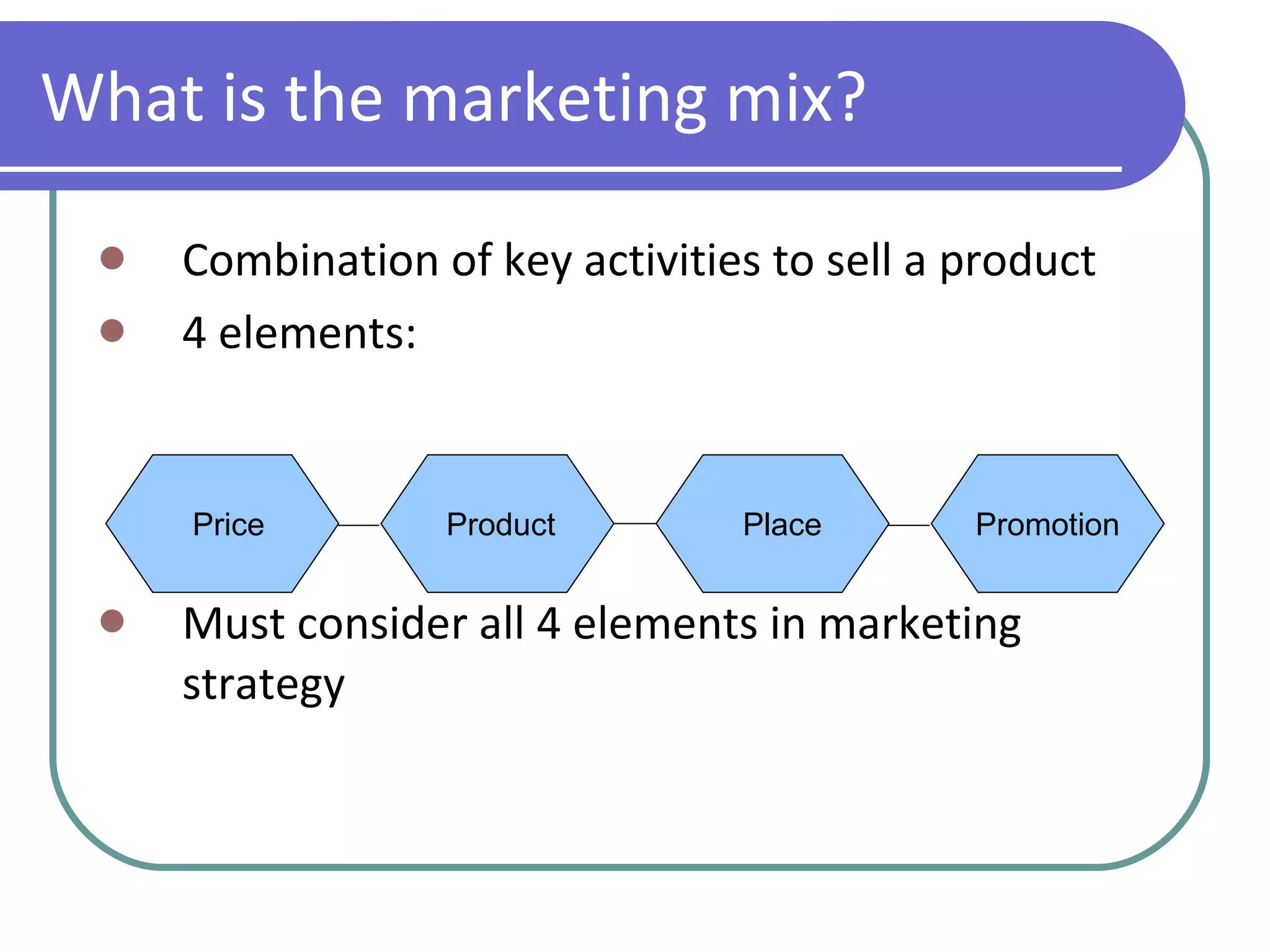
What is the marketing mix? Combination of key activities to sell a product 4 elements: Must consider all 4 elements in marketing strategy Price Product Place Promotion
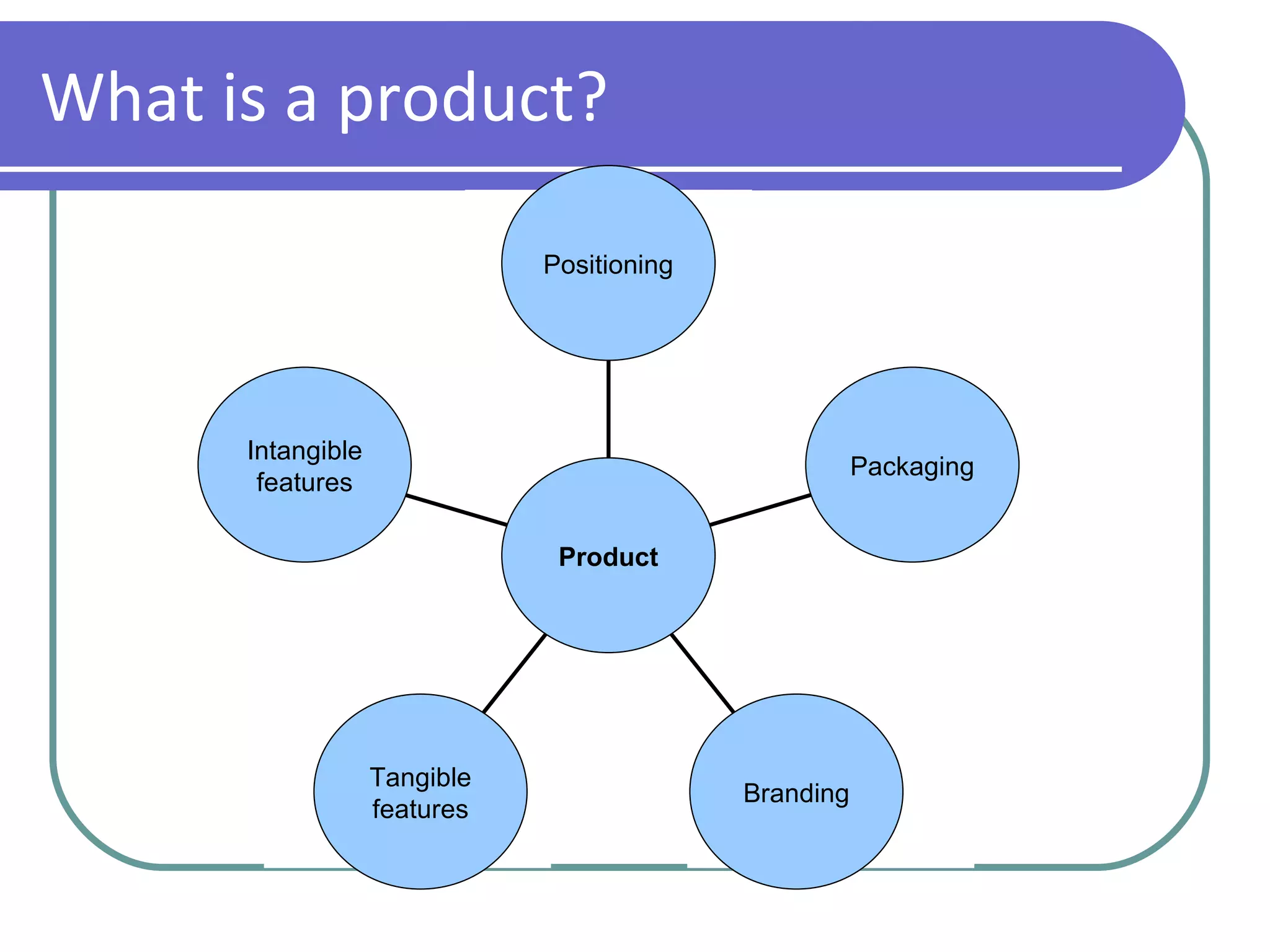
What is a product? Intangible features Tangible features Branding Packaging Positioning Product
Product A product is a good, a service, an idea or any combination of the three which can be offered in an exchange Not just an item on a shelf in a shop Consists of tangible and intangible features Ipod: a good Advertising campaign for Apple Ipod: an idea Sales assistant in Myer who sells you the Ipod: a service total product concept
Total product concept The product is a combination of tangible & intangible features Intangibles:  Service Safety Warranty Prestige Convenience Delivery
Total product concept How do consumers choose between similar, mass-produced products?  Intangibles: Reputation  Advice  Financing  Warranty Maintenance
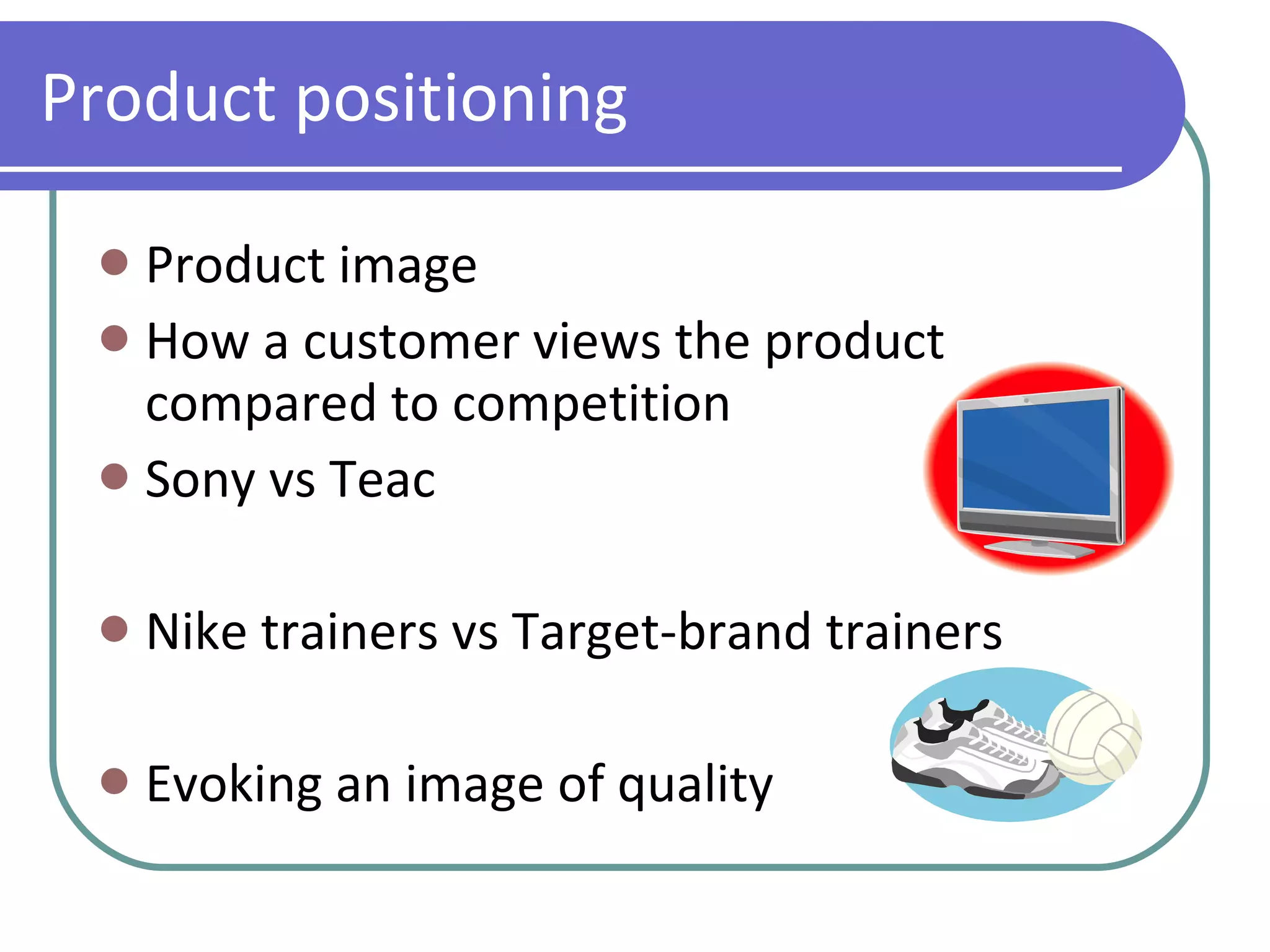
Product positioning Product image How a customer views the product compared to competition Sony vs Teac Nike trainers vs Target-brand trainers Evoking an image of quality
Branding names and images used to identify a product and distinguish it from competitors Brand = logo and/or name
Branding Powerful marketing tool Leverage for emerging products Expected level of quality
Packaging Functional – protects and stores product Branding – attracts consumer, communicates information Customers are prepared to pay for good quality packaging, even if this adds to the cost of the product.
Product life-cycle Minimal product variation, basic quality Increased product variation, improved quality Maximum product variation, excellent quality Few product variations, drop in quality
Pricing The next of the 4 Ps
What is price? Price is the value a product holds in monetary exchange Businesses use price to:  make a profit create a brand  push a competitor out of market
Price Plays an important role in influencing consumer choice Used by consumers to measure quality – price creates  perceptions  of quality. Mercedes
Product life-cycle - Price High price to recover costs. Or low to gain market share. Price softens: gain popularity and sales rise High price competition Scarce: rising prices. Saturated: falling prices.
Cost-based method Market-based method Competition-based method Methods of pricing
Amount added to cost of producing the product Profit Margin : % added on top of cost price Fixed Profit Amount : specific $ return added to cost price. Cost-based method
Determined by market forces of demand and supply Impossible to predict what the market price for a new product will be. Businesses continually alter prices to stay in touch with market forces Market-based method
Similar mass-produced products Prices set according to competitors’ products – same, higher or lower Objective:  to gain market share High degree of intangible product differentiation  Xbox, Playstation Competition-based method
Pricing strategies Price skimming New products Suppliers aim to sell to the top end of the market Set price at a high level and reduce over time Only successful with little or no competition Xbox first introduced at $999.95 in Feb 07.  Now available for $399
Pricing strategies Penetration pricing Introductory low price compared to competitors Gain sales quickly and public/media interest Encourage trial and hope for repeat purchase   Risks Enter market at a loss hoping for long term revenues  Customers get used to low price and refuse to buy when price rises Low price may create perception of low quality
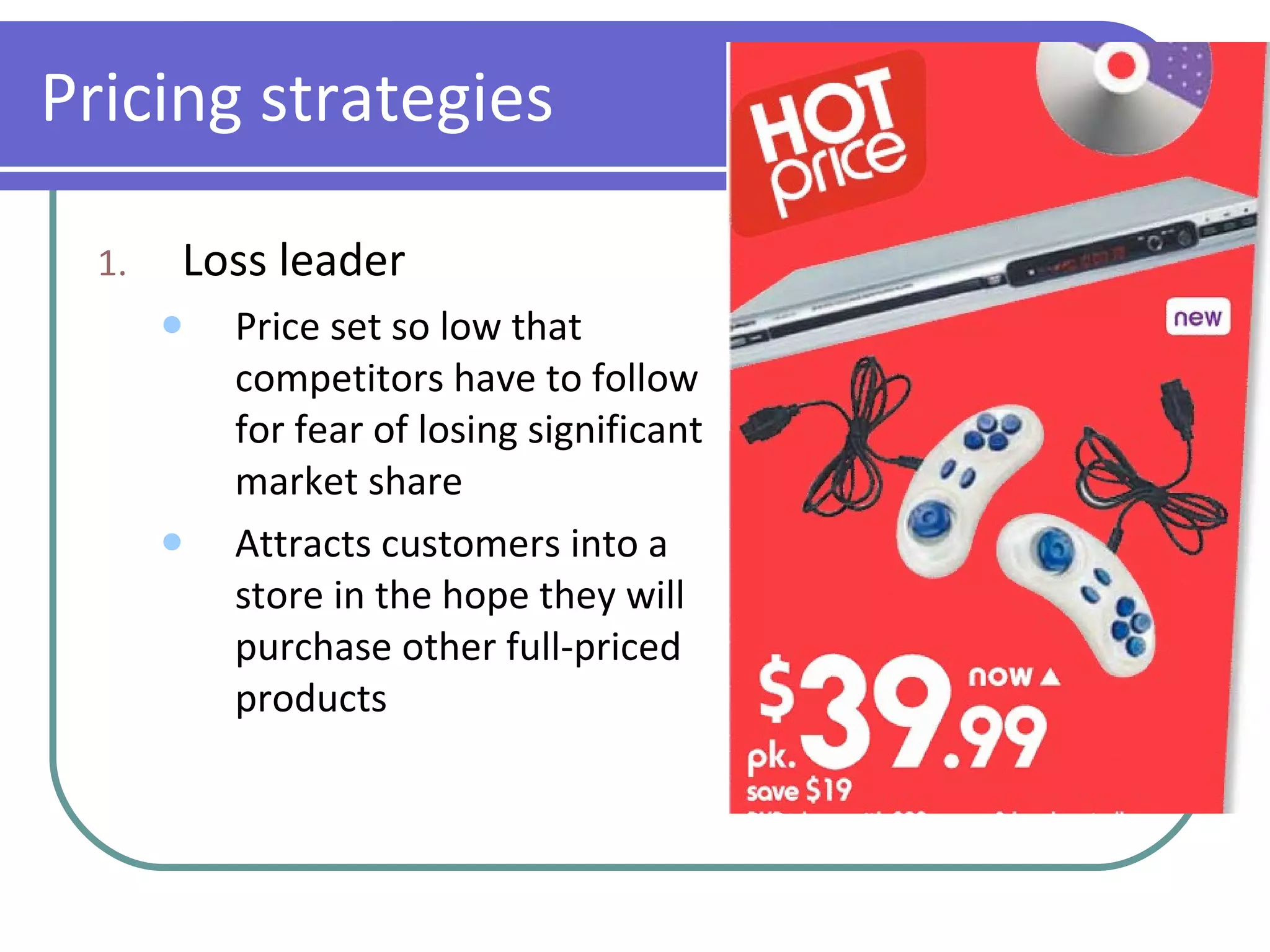
Pricing strategies Loss leader Price set so low that competitors have to follow for fear of losing significant market share Attracts customers into a store in the hope they will purchase other full-priced products
Pricing strategies Price points Used when one base product/service reaches numerous target markets. Base price set, but  additional features  offered. Higher prices charged  for extra features Suzuki Swift currently advertised at $15,990.  Optional Extras  include tinted windows, metallic paint, auto gearbox, DVD player, rear spoiler, alloy wheels
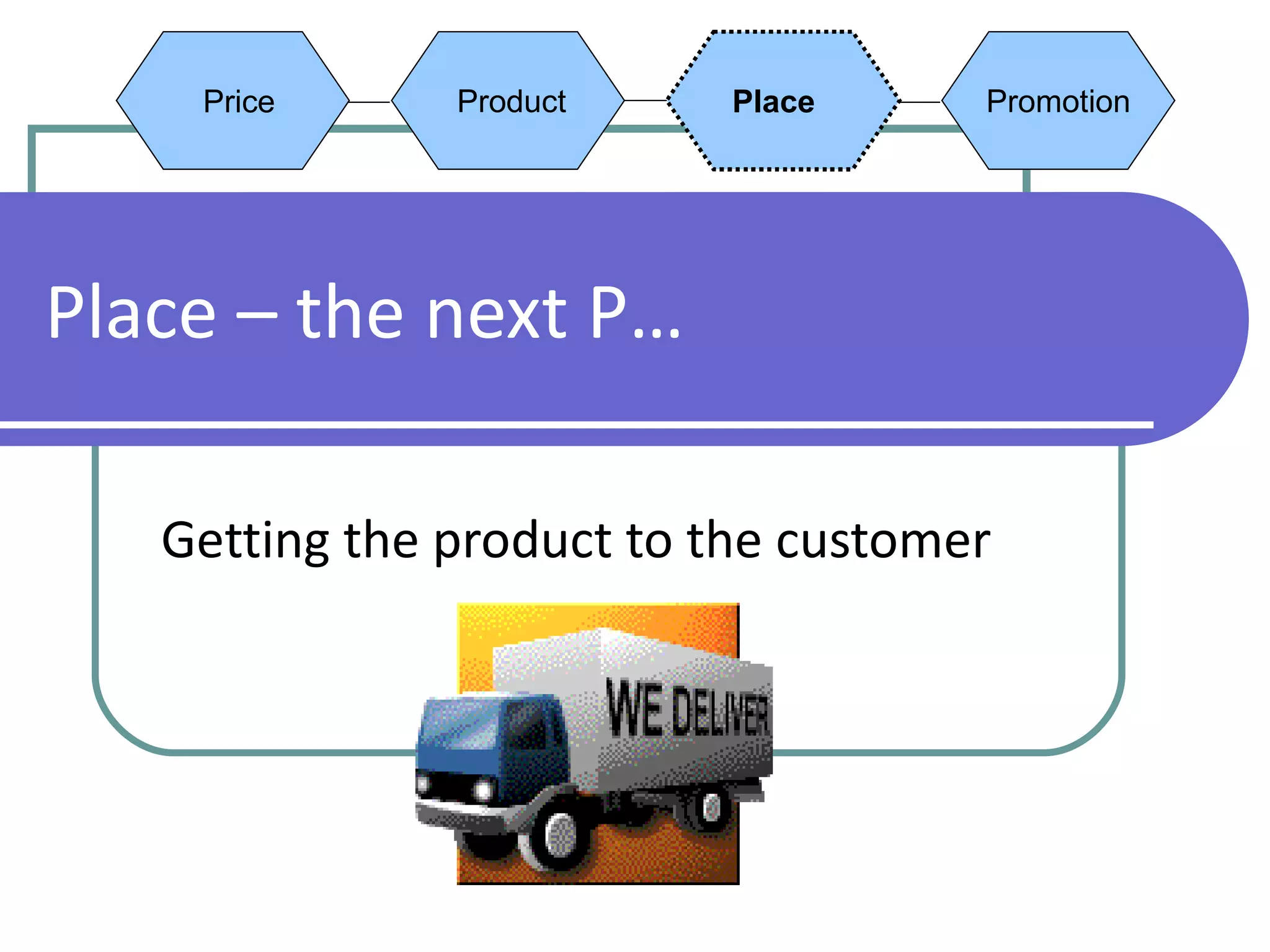
Place – the next P… Getting the product to the customer Price Product Place Promotion
Place How does a product or service get to  customers in the right place and at the right place? Another word for place: Distribution Physical distribution Distribution channels
Physical Distribution Direct:   manufacturer    consumer Manufacturer direct to consumer Indirect: manufacturer    retailer    consumer or manufacturer    wholesaler    retailer    consumer Intermediaries involved in distributing products from manufacturer to consumer Purchase goods from manufacturers to sell on to retailers. Store goods in warehouses. Deliver stock to retailers. Sell to the end customer. Department stores, supermarkets, discount shops, franchises, convenience stores, market stalls
Physical Distribution Purchase crate of apples directly from farm… DIRECT manufacturer    consumer
Physical Distribution Purchase a bag of apples from Elmer’s Fruit Barn… INDIRECT manufacturer    retailer    consumer
Physical Distribution Distance between manufacturer and consumer  What are the costs involved? Convenience for customers Is the channel appropriate to the product?
Product life-cycle - Place Sparse coverage Good coverage Wide coverage Sparse coverage
Product is available through  numerous outlets. Channels – Intensive distribution Usually used for low margin, high volume products and everyday purchases Aim:  Maximise sales through maximum market exposure Supermarket Corner store Convenience store
Product is available  through selected outlets. Channels – Selective distribution This distribution choice provides greater control over the quality of service provided at point of sale. Mambo clothing – where is it available?
Product is only available through a limited number of outlets. Channels – Exclusive distribution This choice of distribution is vital in the creation of a status or prestige related product. Bose speakers – only 1 store in Brisbane, limited stock in Myer/David Jones Ferrari Cars – can you buy a Ferrari in Brisbane?
Promotion Getting the word out about your product or service Place Promotion Price Product
Promotion is the act of communicating with markets about a product or service. Introduce Create interest Reinvigorate Promotion Advertising Public relations Sales promotion Direct Marketing
Product life-cycle - Promotion Create primary demand & awareness Develop selective demand Heavy promotion spending. Focus on intangibles Minimal promotion
Advertising Paid non-personal communication about products and services. Relatively low cost compared to other forms of promotion Hit and miss, not personal Easy for consumers to ‘switch off’
Advertising - media Advertising campaigns use media channels to communicate their messages Examples: TV, radio, newspapers, magazines, billboards, direct mail, yellow pages, internet, email, mobile phone Choosing a media channel dependant on your target market
PR is focused on improving relationships between a business and its stakeholders, and improving the business’ image.  Public Relations Serves 2 purposes: Free marketing tool through the general media – increase sales, enhance image/reputation, create  word-of-mouth . Damage control – improve business’ image in the wake of negative public opinion, and release correct information to clarify facts.
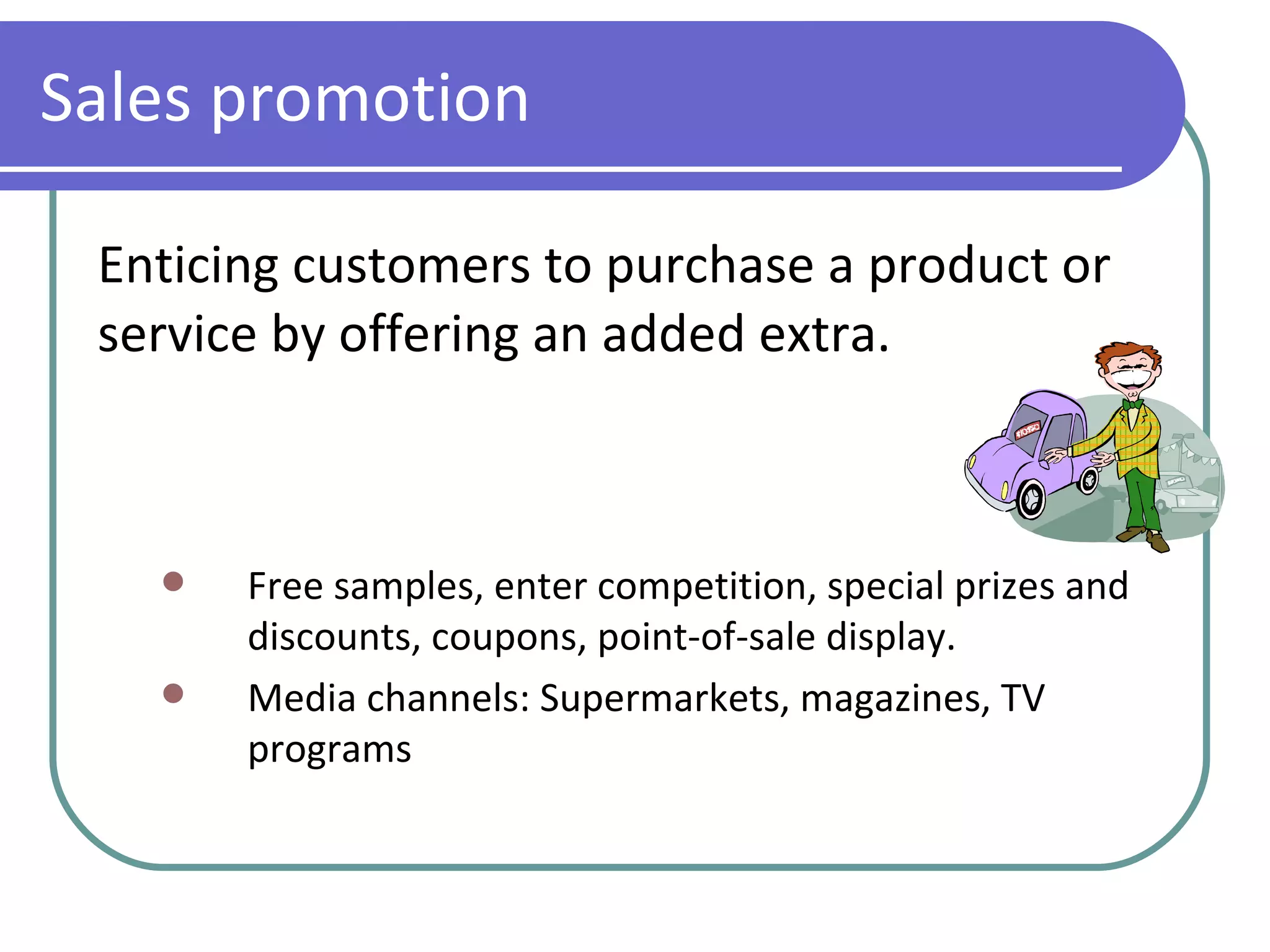
Sales promotion Enticing customers to purchase a product or service by offering an added extra. Free samples, enter competition, special prizes and discounts, coupons, point-of-sale display. Media channels: Supermarkets, magazines, TV programs
Direct marketing Uses mail, phone or email to directly contact potential customers. Mail-order catalogues, internet  shopping sites,  Promotional staff - hand out leaflets and engage customers Telemarketing Mailing lists to reach desired customers Very targeted form of promotion

The marketing mix

  • 1.
  • 2.
    What is themarketing mix? Combination of key activities to sell a product 4 elements: Must consider all 4 elements in marketing strategy Price Product Place Promotion
  • 3.
    What is aproduct? Intangible features Tangible features Branding Packaging Positioning Product
  • 4.
    Product A productis a good, a service, an idea or any combination of the three which can be offered in an exchange Not just an item on a shelf in a shop Consists of tangible and intangible features Ipod: a good Advertising campaign for Apple Ipod: an idea Sales assistant in Myer who sells you the Ipod: a service total product concept
  • 5.
    Total product conceptThe product is a combination of tangible & intangible features Intangibles: Service Safety Warranty Prestige Convenience Delivery
  • 6.
    Total product conceptHow do consumers choose between similar, mass-produced products? Intangibles: Reputation Advice Financing Warranty Maintenance
  • 7.
    Product positioning Productimage How a customer views the product compared to competition Sony vs Teac Nike trainers vs Target-brand trainers Evoking an image of quality
  • 8.
    Branding names andimages used to identify a product and distinguish it from competitors Brand = logo and/or name
  • 9.
    Branding Powerful marketingtool Leverage for emerging products Expected level of quality
  • 10.
    Packaging Functional –protects and stores product Branding – attracts consumer, communicates information Customers are prepared to pay for good quality packaging, even if this adds to the cost of the product.
  • 11.
    Product life-cycle Minimalproduct variation, basic quality Increased product variation, improved quality Maximum product variation, excellent quality Few product variations, drop in quality
  • 12.
    Pricing The nextof the 4 Ps
  • 13.
    What is price?Price is the value a product holds in monetary exchange Businesses use price to: make a profit create a brand push a competitor out of market
  • 14.
    Price Plays animportant role in influencing consumer choice Used by consumers to measure quality – price creates perceptions of quality. Mercedes
  • 15.
    Product life-cycle -Price High price to recover costs. Or low to gain market share. Price softens: gain popularity and sales rise High price competition Scarce: rising prices. Saturated: falling prices.
  • 16.
    Cost-based method Market-basedmethod Competition-based method Methods of pricing
  • 17.
    Amount added tocost of producing the product Profit Margin : % added on top of cost price Fixed Profit Amount : specific $ return added to cost price. Cost-based method
  • 18.
    Determined by marketforces of demand and supply Impossible to predict what the market price for a new product will be. Businesses continually alter prices to stay in touch with market forces Market-based method
  • 19.
    Similar mass-produced productsPrices set according to competitors’ products – same, higher or lower Objective: to gain market share High degree of intangible product differentiation Xbox, Playstation Competition-based method
  • 20.
    Pricing strategies Priceskimming New products Suppliers aim to sell to the top end of the market Set price at a high level and reduce over time Only successful with little or no competition Xbox first introduced at $999.95 in Feb 07. Now available for $399
  • 21.
    Pricing strategies Penetrationpricing Introductory low price compared to competitors Gain sales quickly and public/media interest Encourage trial and hope for repeat purchase Risks Enter market at a loss hoping for long term revenues Customers get used to low price and refuse to buy when price rises Low price may create perception of low quality
  • 22.
    Pricing strategies Lossleader Price set so low that competitors have to follow for fear of losing significant market share Attracts customers into a store in the hope they will purchase other full-priced products
  • 23.
    Pricing strategies Pricepoints Used when one base product/service reaches numerous target markets. Base price set, but additional features offered. Higher prices charged for extra features Suzuki Swift currently advertised at $15,990. Optional Extras include tinted windows, metallic paint, auto gearbox, DVD player, rear spoiler, alloy wheels
  • 24.
    Place – thenext P… Getting the product to the customer Price Product Place Promotion
  • 25.
    Place How doesa product or service get to customers in the right place and at the right place? Another word for place: Distribution Physical distribution Distribution channels
  • 26.
    Physical Distribution Direct: manufacturer  consumer Manufacturer direct to consumer Indirect: manufacturer  retailer  consumer or manufacturer  wholesaler  retailer  consumer Intermediaries involved in distributing products from manufacturer to consumer Purchase goods from manufacturers to sell on to retailers. Store goods in warehouses. Deliver stock to retailers. Sell to the end customer. Department stores, supermarkets, discount shops, franchises, convenience stores, market stalls
  • 27.
    Physical Distribution Purchasecrate of apples directly from farm… DIRECT manufacturer  consumer
  • 28.
    Physical Distribution Purchasea bag of apples from Elmer’s Fruit Barn… INDIRECT manufacturer  retailer  consumer
  • 29.
    Physical Distribution Distancebetween manufacturer and consumer What are the costs involved? Convenience for customers Is the channel appropriate to the product?
  • 30.
    Product life-cycle -Place Sparse coverage Good coverage Wide coverage Sparse coverage
  • 31.
    Product is availablethrough numerous outlets. Channels – Intensive distribution Usually used for low margin, high volume products and everyday purchases Aim: Maximise sales through maximum market exposure Supermarket Corner store Convenience store
  • 32.
    Product is available through selected outlets. Channels – Selective distribution This distribution choice provides greater control over the quality of service provided at point of sale. Mambo clothing – where is it available?
  • 33.
    Product is onlyavailable through a limited number of outlets. Channels – Exclusive distribution This choice of distribution is vital in the creation of a status or prestige related product. Bose speakers – only 1 store in Brisbane, limited stock in Myer/David Jones Ferrari Cars – can you buy a Ferrari in Brisbane?
  • 34.
    Promotion Getting theword out about your product or service Place Promotion Price Product
  • 35.
    Promotion is theact of communicating with markets about a product or service. Introduce Create interest Reinvigorate Promotion Advertising Public relations Sales promotion Direct Marketing
  • 36.
    Product life-cycle -Promotion Create primary demand & awareness Develop selective demand Heavy promotion spending. Focus on intangibles Minimal promotion
  • 37.
    Advertising Paid non-personalcommunication about products and services. Relatively low cost compared to other forms of promotion Hit and miss, not personal Easy for consumers to ‘switch off’
  • 38.
    Advertising - mediaAdvertising campaigns use media channels to communicate their messages Examples: TV, radio, newspapers, magazines, billboards, direct mail, yellow pages, internet, email, mobile phone Choosing a media channel dependant on your target market
  • 39.
    PR is focusedon improving relationships between a business and its stakeholders, and improving the business’ image. Public Relations Serves 2 purposes: Free marketing tool through the general media – increase sales, enhance image/reputation, create word-of-mouth . Damage control – improve business’ image in the wake of negative public opinion, and release correct information to clarify facts.
  • 40.
    Sales promotion Enticingcustomers to purchase a product or service by offering an added extra. Free samples, enter competition, special prizes and discounts, coupons, point-of-sale display. Media channels: Supermarkets, magazines, TV programs
  • 41.
    Direct marketing Usesmail, phone or email to directly contact potential customers. Mail-order catalogues, internet shopping sites, Promotional staff - hand out leaflets and engage customers Telemarketing Mailing lists to reach desired customers Very targeted form of promotion