Coca-cola
 Overview
 Company Perspectives
 Mission
 Goals
 Vision
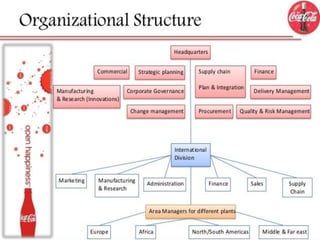
 Organizational structure
 Company system
 Principal Competitors
 Market strategy of company
 Future vision
overview
 One of the leading global brands in beverages, Coca Cola offers its
complete portfolio of products in India with drinks, energy drinks,
juices, tea, packaged water and coffee.
 Coca Cola offers more than 3,500 beverages around the world.
 It employs 25,000 people for system-related operations in India. It
also has 1,50,000 indirect employees.
 Its head offices are in Atlanta, Georgia.
 Coca-Cola's red and white trademark is probably the best-known
brand symbol in the world.
 Coca Cola has done well financially and played a major role in the
economic growth of India.
 Coca Cola was founded in 1886.
 The name refers to two of its original ingredients: kola nuts, a
source of caffeine, and coca leaves.
 The company produces concentrate, which is then sold to licensed
Coca-Cola bottlers throughout the world.
 The bottlers then sell, distribute and merchandise Coca-Cola to
retail stores, restaurants and vending machines.
 The Coca-Cola Company also sells concentrate for soda fountains
to major restaurants and food service distributors.
 It owns or licenses more than 500 nonalcoholic beverage brands”
(MintGlobal, 2014)
 In 1892, Asa Candler purchased and incorporated the Coca-Cola
Company as a Georgia Corporation (The Coca-Cola Company, 2014).
Fourteen years later, under Candler’s leadership, bottling
operations began in Canada, Cuba, and Panama.
 In 1923, Robert W. Woodruff was elected as president of the Coca -
Cola Company, who also served as a Chairman of the Board in 1939.
 The very first new product distributed by the Company was Fanta
Orange in Naples, Italy. After the success of this product,it
established a diverse portfolio through acquiring Minute Maid
Corporation and adding a line of juice products.
 In 2008, “Sprite became the third Company product to sell more
than 2 billion cases annually, joining Coca-Cola and Diet Coke”
 Company Perspectives:
 The Coca-Cola Company exists to benefit and refresh everyone it
touches.
 The basic proposition of our business is simple, solid and timeless.
When we bring refreshment, value, joy and fun to our stakeholders,
then we successfully nurture and protect our brands, particularly
Coca-Cola. That is the key to fulfilling our ultimate obligation to
provide consistently attractive returns to the owners of our
business.
 Today, the Coca-Cola Company has been serving for more than 127
years and is one of the largest beverage companies headquartered
in Atlanta, United State
 The mission statement of the Coca-Cola Company is:
 To refresh the world in mind, body and spirit.
 To inspire moments of optimism through our brands and actions.
 To create value and make a difference everywhere we engage.
 some of its goals include:
 Increase profit by cutting down costs through productive and efficient
production facilities.
 Focus on environment friendly bottling production and enforce
sustainability.
 Continue to diversify its portfolio through innovations and
partnerships,keeping consumer demands in mind.
 Increase annual operating income by 6-8% in order to double their
revenue by 2020.
 Vision :
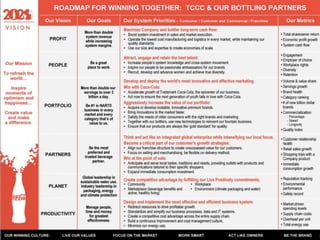
Our vision serves as the framework for our Roadmap and guides every aspect of our
business by describing what we need to accomplish in order to continue achieving
sustainable, quality growth.
 People: Be a great place to work where people are inspired to be the best they can be.
 Portfolio: Bring to the world a portfolio of quality beverage brands that anticipate and satisfy
people’s desires and needs.
 Partners: Nurture a winning network of customers and suppliers, together we create mutual,
enduring value.
 Planet: Be a responsible citizen that makes a difference by helping build and support
sustainable communities.
 Profit: Maximize long-term return to shareholders while being mindful of our overall
responsibilities.
 Productivity: Be a highly effective, lean and fast-moving organization.”
 Tagline – “Refreshing the world, one story at a time”.
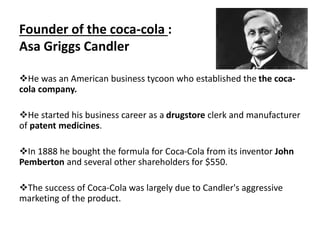
Founder of the coca-cola :
Asa Griggs Candler
He was an American business tycoon who established the the coca-
cola company.
He started his business career as a drugstore clerk and manufacturer
of patent medicines.
In 1888 he bought the formula for Coca-Cola from its inventor John
Pemberton and several other shareholders for $550.
The success of Coca-Cola was largely due to Candler's aggressive
marketing of the product.
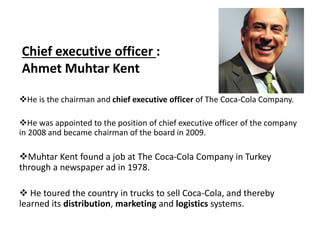
Chief executive officer :
Ahmet Muhtar Kent
He is the chairman and chief executive officer of The Coca-Cola Company.
He was appointed to the position of chief executive officer of the company
in 2008 and became chairman of the board in 2009.
Muhtar Kent found a job at The Coca-Cola Company in Turkey
through a newspaper ad in 1978.
 He toured the country in trucks to sell Coca-Cola, and thereby
learned its distribution, marketing and logistics systems.
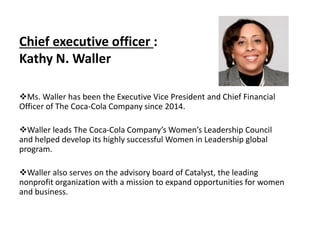
Chief executive officer :
Kathy N. Waller
Ms. Waller has been the Executive Vice President and Chief Financial
Officer of The Coca-Cola Company since 2014.
Waller leads The Coca-Cola Company’s Women’s Leadership Council
and helped develop its highly successful Women in Leadership global
program.
Waller also serves on the advisory board of Catalyst, the leading
nonprofit organization with a mission to expand opportunities for women
and business.
Overview of Coca-Cola India Private Limited
 Coca-Cola India Private Limited produces carbonated drinks.
 It offers soft drinks, juice drinks, fruit drinks, and bottled water, as
well as ice tea and cold coffees.
 The company was incorporated in 1992 and is based in Gurgaon,
India.
 Coca-Cola India Private Limited operates as a subsidiary of The
Coca-Cola Company.
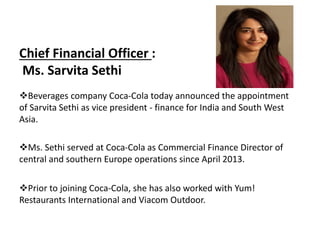
Chief Financial Officer :
Ms. Sarvita Sethi
Beverages company Coca-Cola today announced the appointment
of Sarvita Sethi as vice president - finance for India and South West
Asia.
Ms. Sethi served at Coca-Cola as Commercial Finance Director of
central and southern Europe operations since April 2013.
Prior to joining Coca-Cola, she has also worked with Yum!
Restaurants International and Viacom Outdoor.
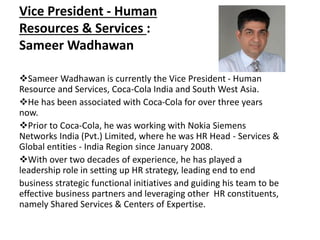
Vice President - Human
Resources & Services :
Sameer Wadhawan
Sameer Wadhawan is currently the Vice President - Human
Resource and Services, Coca-Cola India and South West Asia.
He has been associated with Coca-Cola for over three years
now.
Prior to Coca-Cola, he was working with Nokia Siemens
Networks India (Pvt.) Limited, where he was HR Head - Services &
Global entities - India Region since January 2008.
With over two decades of experience, he has played a
leadership role in setting up HR strategy, leading end to end
business strategic functional initiatives and guiding his team to be
effective business partners and leveraging other HR constituents,
namely Shared Services & Centers of Expertise.
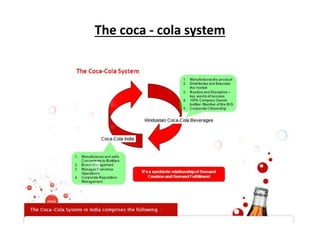
The coca - cola system
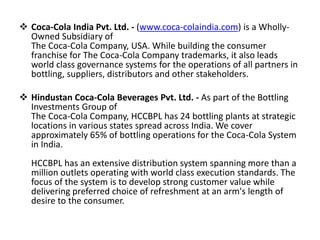
 Coca-Cola India Pvt. Ltd. - (www.coca-colaindia.com) is a Wholly-
Owned Subsidiary of
The Coca-Cola Company, USA. While building the consumer
franchise for The Coca-Cola Company trademarks, it also leads
world class governance systems for the operations of all partners in
bottling, suppliers, distributors and other stakeholders.
 Hindustan Coca-Cola Beverages Pvt. Ltd. - As part of the Bottling
Investments Group of
The Coca-Cola Company, HCCBPL has 24 bottling plants at strategic
locations in various states spread across India. We cover
approximately 65% of bottling operations for the Coca-Cola System
in India.
HCCBPL has an extensive distribution system spanning more than a
million outlets operating with world class execution standards. The
focus of the system is to develop strong customer value while
delivering preferred choice of refreshment at an arm's length of
desire to the consumer.
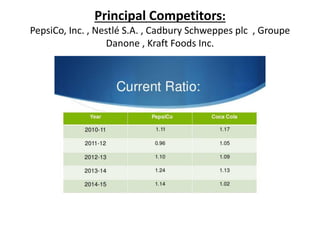
Principal Competitors:
PepsiCo, Inc. , Nestlé S.A. , Cadbury Schweppes plc , Groupe
Danone , Kraft Foods Inc.
Competitive advantage in the Marketing
strategy of Coca Cola
 Coca Cola has competitive edge over its competitors in terms of
Operations, Cost control, Brand portfolio, Channel marketing,
Collaborative customer relationship.
 Operations– Outsourcing the bottling operation to the franchisee,
FEMSA which is the largest Bottling franchisee of the Coca-Cola
trademark beverages in the world. It helps the company in
capturing important growth opportunities in under-developed non-
carbonated beverage segment and in strategic acquisitions by
entering into agreements to jointly acquire companies with The
Coca Cola Company.
 Cost control – Its diversified product portfolio, Outsourcing
operations & economies of scale helps it in cutting its operational
cost & increase its profitability.
 Strong Brand Portfolio – Company offers a powerful and wide
portfolio of beverages to its customers, and continuously explores
promising beverage categories to capture growth in its different
markets. Its beverage portfolio consist of carbonated soft drinks,
bottled water, juices, orangeades, iso-tonics, teas, energy drinks,
milk, coffee and even beer in some markets such as Brazil.
 Collaborative customer relationship – Coca Cola strongly
believes in participative marketing creating shared values for all
stakeholders. Tailoring its extensive portfolio of products and
packages for their stores based on the local market’s socioeconomic
demographics, relevant consumption occasion and the store’s
distinctive characteristics.
BCG Matrix in the Marketing strategy of Coca
Cola
 Coca Cola’s trademark brand occupies a different position in BCG matrix
based on the demand & competitive position.
 Thumps-up, Sprite, Fanta & Maaza are Stars as these brands have high
market share but high competition in their respective segment.
 Kinley is question mark reason being low sales. Company is not able to
distinctly position Kinley due to the presence of lots of local players in the
highly commoditized market resulting in low sales.
 The main brand Coca Cola is considered a cash cow because it has a single
competitor in Pepsi and has a fantastic presence across the world.
 Coke-diet, Tea & coffee brands are dogs since it’s not able to attract
customers for this segment and these are probably more long-term units
and under establishment.
Distribution strategy in the Marketing strategy
of Coca Cola
 It uses several sales and distribution models depending on market,
geographic conditions and the customer’s profile:
 The pre-sale system, which separates the sales and delivery functions, permitting
trucks to be loaded with the mix of products that retailers have previously
ordered, thereby increasing both sales and distribution efficiency.
 The conventional truck route system, in which the person in charge of the delivery
makes immediate sales from inventory available on the truck.
 A hybrid distribution system, where the same truck carries product available for
immediate sale and product previously ordered through the pre-sale system.
 The telemarketing system, which could be combined with pre-sales visits.
 Sales through third-party wholesalers of the products.
Competitive analysis in the Marketing strategy
of Coca Cola
 Big Giants in the Non-alcoholic beverages segment have similar
strategy & objectives which means innovation & creative marketing
campaigns can help the companies to differentiate from each other.
 Competition from the local players is the other major issue that
company is facing now days.
 Pepsi is the single largest main competitor of Coca-Cola having
products across the segments.
Market analysis in the Marketing strategy of
Coca Cola
 Non-alcoholic beverages market is ever-growing industry & with the
advent of growing Asian markets & developing nations the
consumption will be higher also due to the changing lifestyle,
economic conditions & changing buying habits.
 In this industry customer have got lots of options ranging from
water to tea/coffee to soft drinks, so chances of customer switching
to another brand is high.
 The only way to differentiate products & retain customers is the
strong brand building, and creating pull in the market.
customer analysis in the Marketing strategy of
Coca Cola
 Coca cola targets a mass marketing. And the customer expectation
is low price, great taste, convenience & accessibility and various
options to choose from.
Coca cola (1)

Coca cola (1)

  • 1.
  • 2.
     Overview  CompanyPerspectives  Mission  Goals  Vision  Organizational structure  Company system  Principal Competitors  Market strategy of company  Future vision
  • 3.
    overview  One ofthe leading global brands in beverages, Coca Cola offers its complete portfolio of products in India with drinks, energy drinks, juices, tea, packaged water and coffee.  Coca Cola offers more than 3,500 beverages around the world.  It employs 25,000 people for system-related operations in India. It also has 1,50,000 indirect employees.  Its head offices are in Atlanta, Georgia.  Coca-Cola's red and white trademark is probably the best-known brand symbol in the world.
  • 4.
     Coca Colahas done well financially and played a major role in the economic growth of India.  Coca Cola was founded in 1886.  The name refers to two of its original ingredients: kola nuts, a source of caffeine, and coca leaves.  The company produces concentrate, which is then sold to licensed Coca-Cola bottlers throughout the world.  The bottlers then sell, distribute and merchandise Coca-Cola to retail stores, restaurants and vending machines.  The Coca-Cola Company also sells concentrate for soda fountains to major restaurants and food service distributors.
  • 5.
     It ownsor licenses more than 500 nonalcoholic beverage brands” (MintGlobal, 2014)  In 1892, Asa Candler purchased and incorporated the Coca-Cola Company as a Georgia Corporation (The Coca-Cola Company, 2014). Fourteen years later, under Candler’s leadership, bottling operations began in Canada, Cuba, and Panama.  In 1923, Robert W. Woodruff was elected as president of the Coca - Cola Company, who also served as a Chairman of the Board in 1939.  The very first new product distributed by the Company was Fanta Orange in Naples, Italy. After the success of this product,it established a diverse portfolio through acquiring Minute Maid Corporation and adding a line of juice products.  In 2008, “Sprite became the third Company product to sell more than 2 billion cases annually, joining Coca-Cola and Diet Coke”
  • 6.
     Company Perspectives: The Coca-Cola Company exists to benefit and refresh everyone it touches.  The basic proposition of our business is simple, solid and timeless. When we bring refreshment, value, joy and fun to our stakeholders, then we successfully nurture and protect our brands, particularly Coca-Cola. That is the key to fulfilling our ultimate obligation to provide consistently attractive returns to the owners of our business.  Today, the Coca-Cola Company has been serving for more than 127 years and is one of the largest beverage companies headquartered in Atlanta, United State
  • 7.
     The missionstatement of the Coca-Cola Company is:  To refresh the world in mind, body and spirit.  To inspire moments of optimism through our brands and actions.  To create value and make a difference everywhere we engage.  some of its goals include:  Increase profit by cutting down costs through productive and efficient production facilities.  Focus on environment friendly bottling production and enforce sustainability.  Continue to diversify its portfolio through innovations and partnerships,keeping consumer demands in mind.  Increase annual operating income by 6-8% in order to double their revenue by 2020.
  • 8.
     Vision : Ourvision serves as the framework for our Roadmap and guides every aspect of our business by describing what we need to accomplish in order to continue achieving sustainable, quality growth.  People: Be a great place to work where people are inspired to be the best they can be.  Portfolio: Bring to the world a portfolio of quality beverage brands that anticipate and satisfy people’s desires and needs.  Partners: Nurture a winning network of customers and suppliers, together we create mutual, enduring value.  Planet: Be a responsible citizen that makes a difference by helping build and support sustainable communities.  Profit: Maximize long-term return to shareholders while being mindful of our overall responsibilities.  Productivity: Be a highly effective, lean and fast-moving organization.”  Tagline – “Refreshing the world, one story at a time”.
  • 9.
    Founder of thecoca-cola : Asa Griggs Candler He was an American business tycoon who established the the coca- cola company. He started his business career as a drugstore clerk and manufacturer of patent medicines. In 1888 he bought the formula for Coca-Cola from its inventor John Pemberton and several other shareholders for $550. The success of Coca-Cola was largely due to Candler's aggressive marketing of the product.
  • 10.
    Chief executive officer: Ahmet Muhtar Kent He is the chairman and chief executive officer of The Coca-Cola Company. He was appointed to the position of chief executive officer of the company in 2008 and became chairman of the board in 2009. Muhtar Kent found a job at The Coca-Cola Company in Turkey through a newspaper ad in 1978.  He toured the country in trucks to sell Coca-Cola, and thereby learned its distribution, marketing and logistics systems.
  • 11.
    Chief executive officer: Kathy N. Waller Ms. Waller has been the Executive Vice President and Chief Financial Officer of The Coca-Cola Company since 2014. Waller leads The Coca-Cola Company’s Women’s Leadership Council and helped develop its highly successful Women in Leadership global program. Waller also serves on the advisory board of Catalyst, the leading nonprofit organization with a mission to expand opportunities for women and business.
  • 13.
    Overview of Coca-ColaIndia Private Limited  Coca-Cola India Private Limited produces carbonated drinks.  It offers soft drinks, juice drinks, fruit drinks, and bottled water, as well as ice tea and cold coffees.  The company was incorporated in 1992 and is based in Gurgaon, India.  Coca-Cola India Private Limited operates as a subsidiary of The Coca-Cola Company.
  • 14.
    Chief Financial Officer: Ms. Sarvita Sethi Beverages company Coca-Cola today announced the appointment of Sarvita Sethi as vice president - finance for India and South West Asia. Ms. Sethi served at Coca-Cola as Commercial Finance Director of central and southern Europe operations since April 2013. Prior to joining Coca-Cola, she has also worked with Yum! Restaurants International and Viacom Outdoor.
  • 15.
    Vice President -Human Resources & Services : Sameer Wadhawan Sameer Wadhawan is currently the Vice President - Human Resource and Services, Coca-Cola India and South West Asia. He has been associated with Coca-Cola for over three years now. Prior to Coca-Cola, he was working with Nokia Siemens Networks India (Pvt.) Limited, where he was HR Head - Services & Global entities - India Region since January 2008. With over two decades of experience, he has played a leadership role in setting up HR strategy, leading end to end business strategic functional initiatives and guiding his team to be effective business partners and leveraging other HR constituents, namely Shared Services & Centers of Expertise.
  • 16.
    The coca -cola system
  • 17.
     Coca-Cola IndiaPvt. Ltd. - (www.coca-colaindia.com) is a Wholly- Owned Subsidiary of The Coca-Cola Company, USA. While building the consumer franchise for The Coca-Cola Company trademarks, it also leads world class governance systems for the operations of all partners in bottling, suppliers, distributors and other stakeholders.  Hindustan Coca-Cola Beverages Pvt. Ltd. - As part of the Bottling Investments Group of The Coca-Cola Company, HCCBPL has 24 bottling plants at strategic locations in various states spread across India. We cover approximately 65% of bottling operations for the Coca-Cola System in India. HCCBPL has an extensive distribution system spanning more than a million outlets operating with world class execution standards. The focus of the system is to develop strong customer value while delivering preferred choice of refreshment at an arm's length of desire to the consumer.
  • 18.
    Principal Competitors: PepsiCo, Inc., Nestlé S.A. , Cadbury Schweppes plc , Groupe Danone , Kraft Foods Inc.
  • 19.
    Competitive advantage inthe Marketing strategy of Coca Cola  Coca Cola has competitive edge over its competitors in terms of Operations, Cost control, Brand portfolio, Channel marketing, Collaborative customer relationship.  Operations– Outsourcing the bottling operation to the franchisee, FEMSA which is the largest Bottling franchisee of the Coca-Cola trademark beverages in the world. It helps the company in capturing important growth opportunities in under-developed non- carbonated beverage segment and in strategic acquisitions by entering into agreements to jointly acquire companies with The Coca Cola Company.
  • 20.
     Cost control– Its diversified product portfolio, Outsourcing operations & economies of scale helps it in cutting its operational cost & increase its profitability.  Strong Brand Portfolio – Company offers a powerful and wide portfolio of beverages to its customers, and continuously explores promising beverage categories to capture growth in its different markets. Its beverage portfolio consist of carbonated soft drinks, bottled water, juices, orangeades, iso-tonics, teas, energy drinks, milk, coffee and even beer in some markets such as Brazil.  Collaborative customer relationship – Coca Cola strongly believes in participative marketing creating shared values for all stakeholders. Tailoring its extensive portfolio of products and packages for their stores based on the local market’s socioeconomic demographics, relevant consumption occasion and the store’s distinctive characteristics.
  • 21.
    BCG Matrix inthe Marketing strategy of Coca Cola  Coca Cola’s trademark brand occupies a different position in BCG matrix based on the demand & competitive position.  Thumps-up, Sprite, Fanta & Maaza are Stars as these brands have high market share but high competition in their respective segment.  Kinley is question mark reason being low sales. Company is not able to distinctly position Kinley due to the presence of lots of local players in the highly commoditized market resulting in low sales.  The main brand Coca Cola is considered a cash cow because it has a single competitor in Pepsi and has a fantastic presence across the world.  Coke-diet, Tea & coffee brands are dogs since it’s not able to attract customers for this segment and these are probably more long-term units and under establishment.
  • 22.
    Distribution strategy inthe Marketing strategy of Coca Cola  It uses several sales and distribution models depending on market, geographic conditions and the customer’s profile:  The pre-sale system, which separates the sales and delivery functions, permitting trucks to be loaded with the mix of products that retailers have previously ordered, thereby increasing both sales and distribution efficiency.  The conventional truck route system, in which the person in charge of the delivery makes immediate sales from inventory available on the truck.  A hybrid distribution system, where the same truck carries product available for immediate sale and product previously ordered through the pre-sale system.  The telemarketing system, which could be combined with pre-sales visits.  Sales through third-party wholesalers of the products.
  • 23.
    Competitive analysis inthe Marketing strategy of Coca Cola  Big Giants in the Non-alcoholic beverages segment have similar strategy & objectives which means innovation & creative marketing campaigns can help the companies to differentiate from each other.  Competition from the local players is the other major issue that company is facing now days.  Pepsi is the single largest main competitor of Coca-Cola having products across the segments.
  • 24.
    Market analysis inthe Marketing strategy of Coca Cola  Non-alcoholic beverages market is ever-growing industry & with the advent of growing Asian markets & developing nations the consumption will be higher also due to the changing lifestyle, economic conditions & changing buying habits.  In this industry customer have got lots of options ranging from water to tea/coffee to soft drinks, so chances of customer switching to another brand is high.  The only way to differentiate products & retain customers is the strong brand building, and creating pull in the market.
  • 25.
    customer analysis inthe Marketing strategy of Coca Cola  Coca cola targets a mass marketing. And the customer expectation is low price, great taste, convenience & accessibility and various options to choose from.