RESOURCES AND
CAPABILITIES IN A COMPANY
RESOURCES
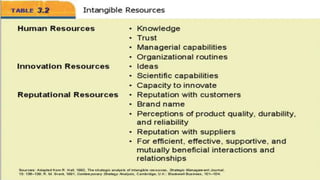
• Resources are a firm’s assets, including people, your
brand, capital equipment, skills of employees and
financial resources. There are tangible and intangible
resources.
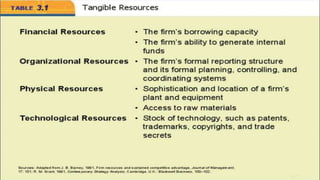
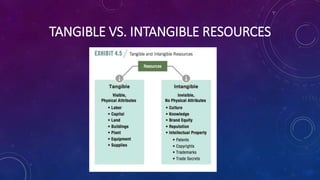
• Tangible resources (combined with intangible resources)
are components to create capabilities…which can be
structured to become core competencies.
TANGIBLE VS. INTANGIBLE RESOURCES
TANGIBLE RESOURCES
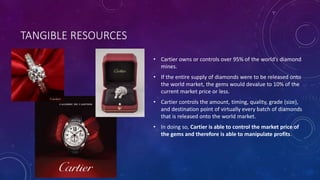
• Cartier owns or controls over 95% of the world’s diamond
mines.
• If the entire supply of diamonds were to be released onto
the world market, the gems would devalue to 10% of the
current market price or less.
• Cartier controls the amount, timing, quality, grade (size),
and destination point of virtually every batch of diamonds
that is released onto the world market.
• In doing so, Cartier is able to control the market price of
the gems and therefore is able to manipulate profits.
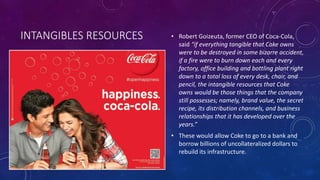
INTANGIBLES RESOURCES • Robert Goizeuta, former CEO of Coca-Cola,
said “if everything tangible that Coke owns
were to be destroyed in some bizarre accident,
if a fire were to burn down each and every
factory, office building and bottling plant right
down to a total loss of every desk, chair, and
pencil, the intangible resources that Coke
owns would be those things that the company
still possesses; namely, brand value, the secret
recipe, its distribution channels, and business
relationships that it has developed over the
years.”
• These would allow Coke to go to a bank and
borrow billions of uncollateralized dollars to
rebuild its infrastructure.
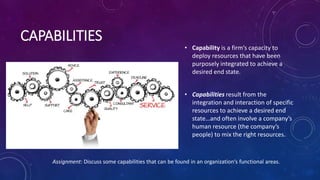
CAPABILITIES
• Capability is a firm‘s capacity to
deploy resources that have been
purposely integrated to achieve a
desired end state.
• Capabilities result from the
integration and interaction of specific
resources to achieve a desired end
state…and often involve a company’s
human resource (the company’s
people) to mix the right resources.
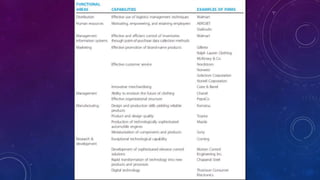
Assignment: Discuss some capabilities that can be found in an organization‘s functional areas.
CORE COMPETENCES
Core competencies are the resources and capabilities that combine to become the source of a
company’s competitive advantage.
A Core Competency is a deep proficiency that enables a company to deliver unique
value to customers.
• It embodies an organization's collective learning, particularly of how to coordinate diverse
production skills and integrate multiple technologies.
• It creates sustainable competitive advantage for a company and helps it branch into a wide
variety of related markets.
• It also contribute substantially to the benefits a company's products offer customers.
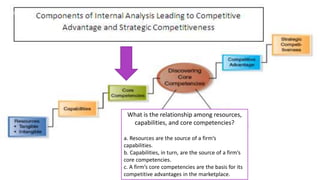
What is the relationship among resources,
capabilities, and core competencies?
a. Resources are the source of a firm‘s
capabilities.
b. Capabilities, in turn, are the source of a firm‘s
core competencies.
c. A firm‘s core competencies are the basis for its
competitive advantages in the marketplace.
To develop Core Competencies a company must:
• Isolate its key abilities and transform them into organization strengths;
• Compare itself with other companies with the same skills, to ensure that it is developing unique
capabilities;
• Develop an understanding of what capabilities its customers truly value, and invest accordingly to
develop and sustain valued strengths;
• Create an organizational road map that sets goals for competence building;
• Pursue alliances, acquisitions and licensing arrangements that will further build the organization's
strengths in core areas;
• Encourage communication and involvement in core capability development across the organization;
• Preserve core strengths even as management expands and redefines the business;
• Outsource or remove noncore capabilities to free up resources that can be used to make stornger
core capabilities.
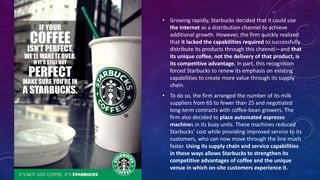
• Growing rapidly, Starbucks decided that it could use
the Internet as a distribution channel to achieve
additional growth. However, the firm quickly realized
that it lacked the capabilities required to successfully
distribute its products through this channel—and that
its unique coffee, not the delivery of that product, is
its competitive advantage. In part, this recognition
forced Starbucks to renew its emphasis on existing
capabilities to create more value through its supply
chain.
• To do so, the firm arranged the number of its milk
suppliers from 65 to fewer than 25 and negotiated
long-term contracts with coffee-bean growers. The
firm also decided to place automated espresso
machines in its busy units. These machines reduced
Starbucks’ cost while providing improved service to its
customers, who can now move through the line much
faster. Using its supply chain and service capabilities
in these ways allows Starbucks to strengthen its
competitive advantages of coffee and the unique
venue in which on-site customers experience it.
BIBLIOGRAPHY
• STRATEGIC MANAGEMENT. Hitt. Ireland. Hoskisson. Chapter 4: The Internal Organization: Resources,
Capabilities, and Core Competencies. Cengage. 2004.
• http://whattheythink.com/articles/48692-what-are-you-really-good/

Resources and capabilities in a company

  • 1.
  • 2.
    RESOURCES • Resources area firm’s assets, including people, your brand, capital equipment, skills of employees and financial resources. There are tangible and intangible resources. • Tangible resources (combined with intangible resources) are components to create capabilities…which can be structured to become core competencies.
  • 5.
  • 6.
    TANGIBLE RESOURCES • Cartierowns or controls over 95% of the world’s diamond mines. • If the entire supply of diamonds were to be released onto the world market, the gems would devalue to 10% of the current market price or less. • Cartier controls the amount, timing, quality, grade (size), and destination point of virtually every batch of diamonds that is released onto the world market. • In doing so, Cartier is able to control the market price of the gems and therefore is able to manipulate profits.
  • 7.
    INTANGIBLES RESOURCES •Robert Goizeuta, former CEO of Coca-Cola, said “if everything tangible that Coke owns were to be destroyed in some bizarre accident, if a fire were to burn down each and every factory, office building and bottling plant right down to a total loss of every desk, chair, and pencil, the intangible resources that Coke owns would be those things that the company still possesses; namely, brand value, the secret recipe, its distribution channels, and business relationships that it has developed over the years.” • These would allow Coke to go to a bank and borrow billions of uncollateralized dollars to rebuild its infrastructure.
  • 8.
    CAPABILITIES • Capability isa firm‘s capacity to deploy resources that have been purposely integrated to achieve a desired end state. • Capabilities result from the integration and interaction of specific resources to achieve a desired end state…and often involve a company’s human resource (the company’s people) to mix the right resources. Assignment: Discuss some capabilities that can be found in an organization‘s functional areas.
  • 10.
    CORE COMPETENCES Core competenciesare the resources and capabilities that combine to become the source of a company’s competitive advantage. A Core Competency is a deep proficiency that enables a company to deliver unique value to customers. • It embodies an organization's collective learning, particularly of how to coordinate diverse production skills and integrate multiple technologies. • It creates sustainable competitive advantage for a company and helps it branch into a wide variety of related markets. • It also contribute substantially to the benefits a company's products offer customers.
  • 11.
    What is therelationship among resources, capabilities, and core competencies? a. Resources are the source of a firm‘s capabilities. b. Capabilities, in turn, are the source of a firm‘s core competencies. c. A firm‘s core competencies are the basis for its competitive advantages in the marketplace.
  • 12.
    To develop CoreCompetencies a company must: • Isolate its key abilities and transform them into organization strengths; • Compare itself with other companies with the same skills, to ensure that it is developing unique capabilities; • Develop an understanding of what capabilities its customers truly value, and invest accordingly to develop and sustain valued strengths; • Create an organizational road map that sets goals for competence building; • Pursue alliances, acquisitions and licensing arrangements that will further build the organization's strengths in core areas; • Encourage communication and involvement in core capability development across the organization; • Preserve core strengths even as management expands and redefines the business; • Outsource or remove noncore capabilities to free up resources that can be used to make stornger core capabilities.
  • 13.
    • Growing rapidly,Starbucks decided that it could use the Internet as a distribution channel to achieve additional growth. However, the firm quickly realized that it lacked the capabilities required to successfully distribute its products through this channel—and that its unique coffee, not the delivery of that product, is its competitive advantage. In part, this recognition forced Starbucks to renew its emphasis on existing capabilities to create more value through its supply chain. • To do so, the firm arranged the number of its milk suppliers from 65 to fewer than 25 and negotiated long-term contracts with coffee-bean growers. The firm also decided to place automated espresso machines in its busy units. These machines reduced Starbucks’ cost while providing improved service to its customers, who can now move through the line much faster. Using its supply chain and service capabilities in these ways allows Starbucks to strengthen its competitive advantages of coffee and the unique venue in which on-site customers experience it.
  • 14.
    BIBLIOGRAPHY • STRATEGIC MANAGEMENT.Hitt. Ireland. Hoskisson. Chapter 4: The Internal Organization: Resources, Capabilities, and Core Competencies. Cengage. 2004. • http://whattheythink.com/articles/48692-what-are-you-really-good/