PRESENTED BY:
• Aleena Haqqi (15002231005)
• Noor Ul Saba (15002231004)
• Kafila Kousar (15002232001)
• Afia Nadeem (15002232004)
• Fatima Abbas (15002231009)
PRESENTED TO :
• Sir Abdul Ghaffar
DATED :
• 16th may, 2016
MANAGEMENT FINAL PROJECT
Liberty Mills Limited Karachi, Pakistan
INTRODUCTION TO COMPANY
Established in 1964
One of the largest Textile processing & production unit in Pakistan
Production capacity of about 500,000 square meters of fabric per day.
Purpose of establishment was t to cater the demanding needs of the fashion industry
and to establish its name as a producer & exporter of quality fabric.
Follows Principles of Management strictly in 90% of its departments.
SWOT ANALYSIS
STRENGHTS
Economical rates.
Production capacity
of 500,000 square
meters of fabric per
day.
Home accessories
and clothing are
necessities of
humans.
Product exposure to
people at
exhibitions.
This organization
has a well-known
reputation in
society with one of
the reasons is its an
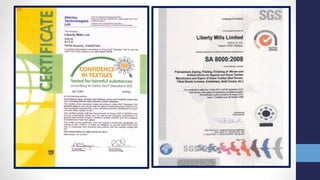
ISO 9001-2008, OCS
100/OCS Blended
Standards, Oeko-Tex
Standard 100 and SA
8000:2008 Certified
company.
CIRTIFICATES
STRENGTH
It is best from
its
competitors.
Export Quality
products
Wide range of
products
specialized in
the processing
of Woven &
Knit fabric
TexWorld: We
have been
participating
in Texworld,
Paris since
2007.
Heimtextil,
Frankfurt: We
have been
participating
in Heimtextil,
Frankfurt
since 1992.
WEAKNESSES:
• Not widely known (in all areas of Pakistan).
• Apparently not associated with any brands
• Mostly involve in export not in local business.
• Less no. of outlets in Pakistan.
• Less involvement of employees and their exposure to research and
innovations.
PRINTING: If there will be no
attention to detail of managers as
well as employees then
production will be no better.
DYEING: This weakens
organization because of
mismanagement of color scheme,
poor utilization of energy system,
ignorance of its workers.
SPINNING: Poor utilization of raw
materials, poor fibre mixing
results in low yarn qualities as a
result products will be with no
more good quality
OPPOTUNITY
Changes as per the demand of products by the customers
They find an opportunity to get more publicity when they launch
their old stock of products with affordable prices
Association with brands
More no. of outlets in Pakistan and other countries
Online access to customers and clients
Increased product range
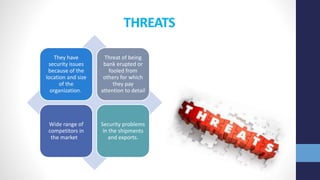
THREATS
They have
security issues
because of the
location and size
of the
organization.
Threat of being
bank erupted or
fooled from
others for which
they pay
attention to detail
Wide range of
competitors in
the market
Security problems
in the shipments
and exports.
Threats
Delayed shipments
may result in loss
due to legal or
environmental
changes.
Decreasing
economy of
Pakistan.
Increasing
terrorism in
Pakistan.
Less availability of
energy sources
due to energy
crisis in Pakistan.
PLANNING
PLANNING AND VISION
Defining goals, establishing strategy and development of Plans.
Type of Planning
In Liberty Textile Mills overall formal planning is followed but informal planning is also followed at some
managerial or sub managerial levels.
VISION
Seeing their textile-processing unit as a model of premier textile processing in the emerging
markets.
Improving its effectiveness for total customer satisfaction.
Wish to play a leading role in the textile sector.
MISSIONS (objectives)
• LONG TERM OBJECTIVES
A mission to turn around performance of company into sustainable growth for the benefit
of its stake holders
• SHORT TERM OBJECTIVES
Establish sustainable and equitable growth and prosperity of the company.
To strive hard for boosting exports of country to earn more and more foreign exchange to
rebuild economy
.PRODUCTS
Specialized in Woven & Knits, Starting from T-120 thread count to T-400 thread count
100% Cotton Satins, Cotton and Poly Cotton Percales, 100% Cotton Twill (Stretch / Non-
Stretch), Drill, Canvas, BFC, Oxford, Herringbone, Dobby etc. etc
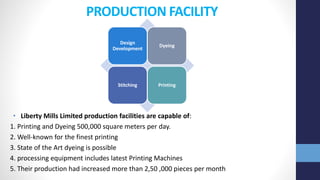
PRODUCTION FACILITY
• Liberty Mills Limited production facilities are capable of:
1. Printing and Dyeing 500,000 square meters per day.
2. Well-known for the finest printing
3. State of the Art dyeing is possible
4. processing equipment includes latest Printing Machines
5. Their production had increased more than 2,50 ,000 pieces per month
Design
Development
Dyeing
Stitching Printing
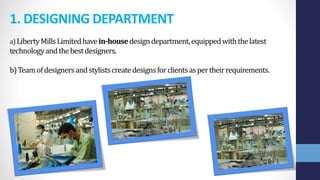
1. DESIGNING DEPARTMENT
a)LibertyMillsLimitedhavein-housedesigndepartment,equippedwiththelatest
technologyandthebestdesigners.
b)Teamofdesignersandstylistscreatedesignsforclientsaspertheirrequirements.
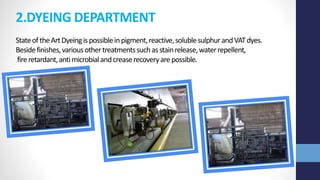
2.DYEING DEPARTMENT
StateoftheArtDyeingispossibleinpigment,reactive,solublesulphurandVATdyes.
Besidefinishes,variousothertreatmentssuchasstainrelease,waterrepellent,
fireretardant,antimicrobialandcreaserecoveryarepossible.
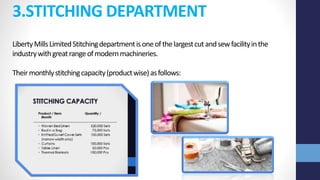
3.STITCHING DEPARTMENT
LibertyMillsLimitedStitchingdepartmentisoneofthelargestcutandsewfacilityinthe
industrywithgreatrangeofmodernmachineries.
Theirmonthlystitchingcapacity(productwise)asfollows:
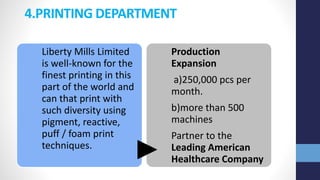
4.PRINTING DEPARTMENT
Liberty Mills Limited
is well-known for the
finest printing in this
part of the world and
can that print with
such diversity using
pigment, reactive,
puff / foam print
techniques.
Production
Expansion
a)250,000 pcs per
month.
b)more than 500
machines
Partner to the
Leading American
Healthcare Company
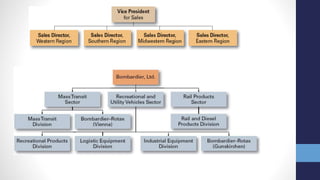
ORGANIZING
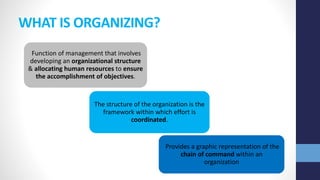
WHAT IS ORGANIZING?
Function of management that involves
developing an organizational structure
& allocating human resources to ensure
the accomplishment of objectives.
The structure of the organization is the
framework within which effort is
coordinated.
Provides a graphic representation of the
chain of command within an
organization
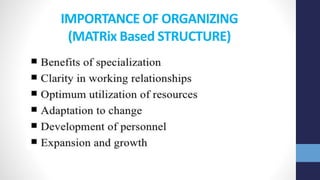
IMPORTANCE OF ORGANIZING
(MATRix Based STRUCTURE)
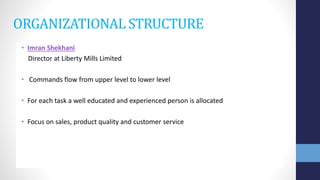
ORGANIZATIONAL STRUCTURE
• Imran Shekhani
Director at Liberty Mills Limited
• Commands flow from upper level to lower level
• For each task a well educated and experienced person is allocated
• Focus on sales, product quality and customer service
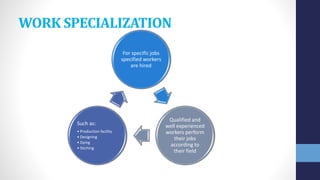
WORK SPECIALIZATION
For specific jobs
specified workers
are hired
Qualified and
well experienced
workers perform
their jobs
according to
their field
Such as:
• Production facility
• Designing
• Dying
• Stiching
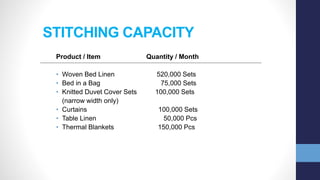
STITCHING CAPACITY
Product / Item Quantity / Month
• Woven Bed Linen 520,000 Sets
• Bed in a Bag 75,000 Sets
• Knitted Duvet Cover Sets 100,000 Sets
(narrow width only)
• Curtains 100,000 Sets
• Table Linen 50,000 Pcs
• Thermal Blankets 150,000 Pcs
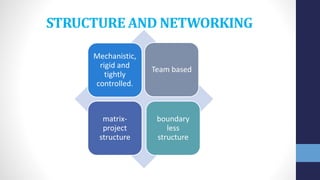
STRUCTURE AND NETWORKING
Mechanistic,
rigid and
tightly
controlled.
Team based
matrix-
project
structure
boundary
less
structure
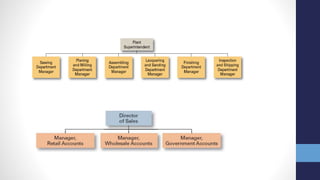
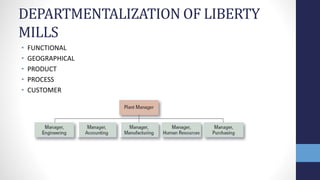
DEPARTMENTALIZATION OF LIBERTY
MILLS
• FUNCTIONAL
• GEOGRAPHICAL
• PRODUCT
• PROCESS
• CUSTOMER
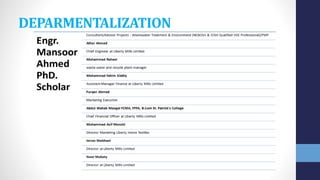
DEPARMENTALIZATION
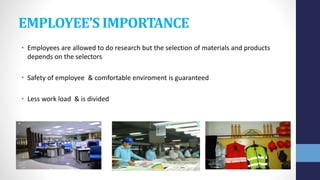
EMPLOYEE’S IMPORTANCE
• Employees are allowed to do research but the selection of materials and products
depends on the selectors
• Safety of employee & comfortable enviroment is guaranteed
• Less work load & is divided
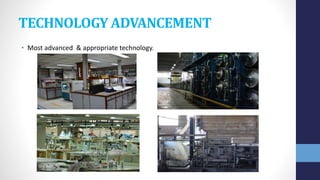
TECHNOLOGY ADVANCEMENT
• Most advanced & appropriate technology.
CUSTOMER SERVICE
• Customer service & demands are on the top priority list
• Changing Customer demands are a necessary part of their organization
• Company provides facilities & product exposure to customers
• Most of the products are of export quality
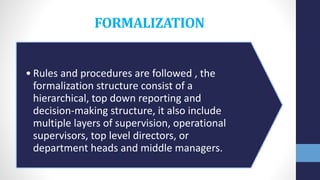
FORMALIZATION
• Rules and procedures are followed , the
formalization structure consist of a
hierarchical, top down reporting and
decision-making structure, it also include
multiple layers of supervision, operational
supervisors, top level directors, or
department heads and middle managers.
LEADING
LEADING
A process of who have
authority to influence others
STYLE OF LEADERSHIP
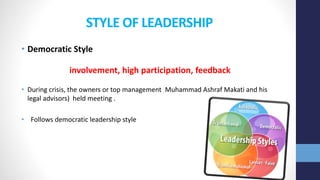
• Democratic Style
involvement, high participation, feedback
• During crisis, the owners or top management Muhammad Ashraf Makati and his
legal advisors) held meeting .
• Follows democratic leadership style
LEADERSHIP PARTICIPATION MODEL
• DECIDE :
• CONSULT INDIVIDUALLY:
• CONSULT TO WHOLE GROUP:
• DELEGATING TO GROUP:
• They pay special attention to following terms
• Decision significance
• Importance of commitment
• Group support
• Likelihood of commitment
• Team competence
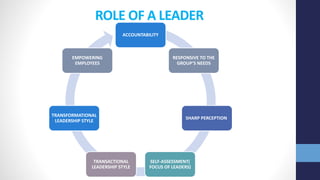
ROLE OF A LEADER
ACCOUNTABILITY
RESPONSIVE TO THE
GROUP’S NEEDS
SHARP PERCEPTION
SELF-ASSESSMENT(
FOCUS OF LEADERS)
TRANSACTIONAL
LEADERSHIP STYLE
TRANSFORMATIONAL
LEADERSHIP STYLE
EMPOWERING
EMPLOYEES
CONTROLLING
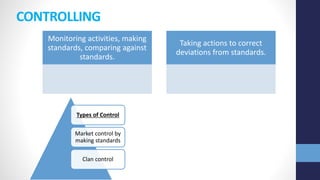
CONTROLLING
Monitoring activities, making
standards, comparing against
standards.
Taking actions to correct
deviations from standards.
Types of Control
Market control by
making standards
Clan control
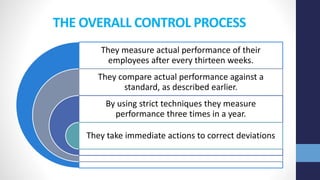
THE OVERALL CONTROL PROCESS
They measure actual performance of their
employees after every thirteen weeks.
They compare actual performance against a
standard, as described earlier.
By using strict techniques they measure
performance three times in a year.
They take immediate actions to correct deviations
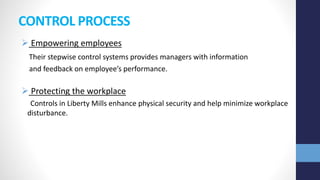
CONTROL PROCESS
 Empowering employees
Their stepwise control systems provides managers with information
and feedback on employee’s performance.
 Protecting the workplace
Controls in Liberty Mills enhance physical security and help minimize workplace
disturbance.
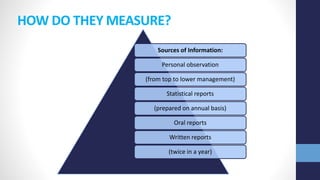
HOW DO THEY MEASURE?
Sources of Information:
Personal observation
(from top to lower management)
Statistical reports
(prepared on annual basis)
Oral reports
Written reports
(twice in a year)
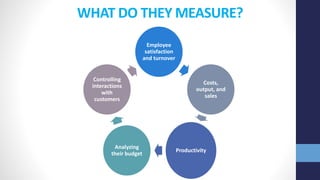
WHAT DO THEY MEASURE?
Employee
satisfaction
and turnover
Costs,
output, and
sales
Productivity
Analyzing
their budget
Controlling
interactions
with
customers
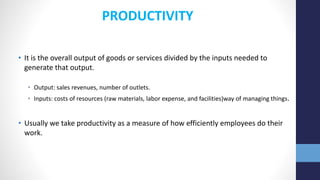
PRODUCTIVITY
• It is the overall output of goods or services divided by the inputs needed to
generate that output.
• Output: sales revenues, number of outlets.
• Inputs: costs of resources (raw materials, labor expense, and facilities)way of managing things.
• Usually we take productivity as a measure of how efficiently employees do their
work.
ANALYZING THEIR BUDGET
• An ideal Budget Analysis includes following terms:
• Quantitative standards
• Deviations
• Other Measures
• Such as improving performance etc.
• Economic Value Added (EVA)
• How much they can invest financially.
• Market Value Added (MVA)
• How much they are demanded by market (international level).
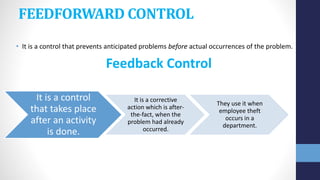
FEEDFORWARD CONTROL
• It is a control that prevents anticipated problems before actual occurrences of the problem.
Feedback Control
It is a control
that takes place
after an activity
is done.
It is a corrective
action which is after-
the-fact, when the
problem had already
occurred.
They use it when
employee theft
occurs in a
department.

SWOT AND POLC ANALYSIS

  • 1.
    PRESENTED BY: • AleenaHaqqi (15002231005) • Noor Ul Saba (15002231004) • Kafila Kousar (15002232001) • Afia Nadeem (15002232004) • Fatima Abbas (15002231009) PRESENTED TO : • Sir Abdul Ghaffar DATED : • 16th may, 2016 MANAGEMENT FINAL PROJECT
  • 2.
    Liberty Mills LimitedKarachi, Pakistan
  • 3.
    INTRODUCTION TO COMPANY Establishedin 1964 One of the largest Textile processing & production unit in Pakistan Production capacity of about 500,000 square meters of fabric per day. Purpose of establishment was t to cater the demanding needs of the fashion industry and to establish its name as a producer & exporter of quality fabric. Follows Principles of Management strictly in 90% of its departments.
  • 4.
  • 5.
    STRENGHTS Economical rates. Production capacity of500,000 square meters of fabric per day. Home accessories and clothing are necessities of humans. Product exposure to people at exhibitions. This organization has a well-known reputation in society with one of the reasons is its an ISO 9001-2008, OCS 100/OCS Blended Standards, Oeko-Tex Standard 100 and SA 8000:2008 Certified company.
  • 6.
  • 8.
    STRENGTH It is bestfrom its competitors. Export Quality products Wide range of products specialized in the processing of Woven & Knit fabric TexWorld: We have been participating in Texworld, Paris since 2007. Heimtextil, Frankfurt: We have been participating in Heimtextil, Frankfurt since 1992.
  • 9.
    WEAKNESSES: • Not widelyknown (in all areas of Pakistan). • Apparently not associated with any brands • Mostly involve in export not in local business. • Less no. of outlets in Pakistan. • Less involvement of employees and their exposure to research and innovations. PRINTING: If there will be no attention to detail of managers as well as employees then production will be no better. DYEING: This weakens organization because of mismanagement of color scheme, poor utilization of energy system, ignorance of its workers. SPINNING: Poor utilization of raw materials, poor fibre mixing results in low yarn qualities as a result products will be with no more good quality
  • 10.
    OPPOTUNITY Changes as perthe demand of products by the customers They find an opportunity to get more publicity when they launch their old stock of products with affordable prices Association with brands More no. of outlets in Pakistan and other countries Online access to customers and clients Increased product range
  • 11.
    THREATS They have security issues becauseof the location and size of the organization. Threat of being bank erupted or fooled from others for which they pay attention to detail Wide range of competitors in the market Security problems in the shipments and exports.
  • 12.
    Threats Delayed shipments may resultin loss due to legal or environmental changes. Decreasing economy of Pakistan. Increasing terrorism in Pakistan. Less availability of energy sources due to energy crisis in Pakistan.
  • 13.
  • 14.
    PLANNING AND VISION Defininggoals, establishing strategy and development of Plans. Type of Planning In Liberty Textile Mills overall formal planning is followed but informal planning is also followed at some managerial or sub managerial levels. VISION Seeing their textile-processing unit as a model of premier textile processing in the emerging markets. Improving its effectiveness for total customer satisfaction. Wish to play a leading role in the textile sector.
  • 15.
    MISSIONS (objectives) • LONGTERM OBJECTIVES A mission to turn around performance of company into sustainable growth for the benefit of its stake holders • SHORT TERM OBJECTIVES Establish sustainable and equitable growth and prosperity of the company. To strive hard for boosting exports of country to earn more and more foreign exchange to rebuild economy .PRODUCTS Specialized in Woven & Knits, Starting from T-120 thread count to T-400 thread count 100% Cotton Satins, Cotton and Poly Cotton Percales, 100% Cotton Twill (Stretch / Non- Stretch), Drill, Canvas, BFC, Oxford, Herringbone, Dobby etc. etc
  • 16.
    PRODUCTION FACILITY • LibertyMills Limited production facilities are capable of: 1. Printing and Dyeing 500,000 square meters per day. 2. Well-known for the finest printing 3. State of the Art dyeing is possible 4. processing equipment includes latest Printing Machines 5. Their production had increased more than 2,50 ,000 pieces per month Design Development Dyeing Stitching Printing
  • 17.
  • 18.
  • 19.
  • 20.
    4.PRINTING DEPARTMENT Liberty MillsLimited is well-known for the finest printing in this part of the world and can that print with such diversity using pigment, reactive, puff / foam print techniques. Production Expansion a)250,000 pcs per month. b)more than 500 machines Partner to the Leading American Healthcare Company
  • 21.
  • 22.
    WHAT IS ORGANIZING? Functionof management that involves developing an organizational structure & allocating human resources to ensure the accomplishment of objectives. The structure of the organization is the framework within which effort is coordinated. Provides a graphic representation of the chain of command within an organization
  • 23.
  • 24.
    ORGANIZATIONAL STRUCTURE • ImranShekhani Director at Liberty Mills Limited • Commands flow from upper level to lower level • For each task a well educated and experienced person is allocated • Focus on sales, product quality and customer service
  • 25.
    WORK SPECIALIZATION For specificjobs specified workers are hired Qualified and well experienced workers perform their jobs according to their field Such as: • Production facility • Designing • Dying • Stiching
  • 26.
    STITCHING CAPACITY Product /Item Quantity / Month • Woven Bed Linen 520,000 Sets • Bed in a Bag 75,000 Sets • Knitted Duvet Cover Sets 100,000 Sets (narrow width only) • Curtains 100,000 Sets • Table Linen 50,000 Pcs • Thermal Blankets 150,000 Pcs
  • 27.
    STRUCTURE AND NETWORKING Mechanistic, rigidand tightly controlled. Team based matrix- project structure boundary less structure
  • 28.
    DEPARTMENTALIZATION OF LIBERTY MILLS •FUNCTIONAL • GEOGRAPHICAL • PRODUCT • PROCESS • CUSTOMER
  • 31.
  • 32.
    EMPLOYEE’S IMPORTANCE • Employeesare allowed to do research but the selection of materials and products depends on the selectors • Safety of employee & comfortable enviroment is guaranteed • Less work load & is divided
  • 33.
    TECHNOLOGY ADVANCEMENT • Mostadvanced & appropriate technology.
  • 34.
    CUSTOMER SERVICE • Customerservice & demands are on the top priority list • Changing Customer demands are a necessary part of their organization • Company provides facilities & product exposure to customers • Most of the products are of export quality
  • 35.
    FORMALIZATION • Rules andprocedures are followed , the formalization structure consist of a hierarchical, top down reporting and decision-making structure, it also include multiple layers of supervision, operational supervisors, top level directors, or department heads and middle managers.
  • 36.
  • 37.
    LEADING A process ofwho have authority to influence others
  • 38.
    STYLE OF LEADERSHIP •Democratic Style involvement, high participation, feedback • During crisis, the owners or top management Muhammad Ashraf Makati and his legal advisors) held meeting . • Follows democratic leadership style
  • 39.
    LEADERSHIP PARTICIPATION MODEL •DECIDE : • CONSULT INDIVIDUALLY: • CONSULT TO WHOLE GROUP: • DELEGATING TO GROUP: • They pay special attention to following terms • Decision significance • Importance of commitment • Group support • Likelihood of commitment • Team competence
  • 40.
    ROLE OF ALEADER ACCOUNTABILITY RESPONSIVE TO THE GROUP’S NEEDS SHARP PERCEPTION SELF-ASSESSMENT( FOCUS OF LEADERS) TRANSACTIONAL LEADERSHIP STYLE TRANSFORMATIONAL LEADERSHIP STYLE EMPOWERING EMPLOYEES
  • 41.
  • 42.
    CONTROLLING Monitoring activities, making standards,comparing against standards. Taking actions to correct deviations from standards. Types of Control Market control by making standards Clan control
  • 43.
    THE OVERALL CONTROLPROCESS They measure actual performance of their employees after every thirteen weeks. They compare actual performance against a standard, as described earlier. By using strict techniques they measure performance three times in a year. They take immediate actions to correct deviations
  • 44.
    CONTROL PROCESS  Empoweringemployees Their stepwise control systems provides managers with information and feedback on employee’s performance.  Protecting the workplace Controls in Liberty Mills enhance physical security and help minimize workplace disturbance.
  • 45.
    HOW DO THEYMEASURE? Sources of Information: Personal observation (from top to lower management) Statistical reports (prepared on annual basis) Oral reports Written reports (twice in a year)
  • 46.
    WHAT DO THEYMEASURE? Employee satisfaction and turnover Costs, output, and sales Productivity Analyzing their budget Controlling interactions with customers
  • 47.
    PRODUCTIVITY • It isthe overall output of goods or services divided by the inputs needed to generate that output. • Output: sales revenues, number of outlets. • Inputs: costs of resources (raw materials, labor expense, and facilities)way of managing things. • Usually we take productivity as a measure of how efficiently employees do their work.
  • 48.
    ANALYZING THEIR BUDGET •An ideal Budget Analysis includes following terms: • Quantitative standards • Deviations • Other Measures • Such as improving performance etc. • Economic Value Added (EVA) • How much they can invest financially. • Market Value Added (MVA) • How much they are demanded by market (international level).
  • 49.
    FEEDFORWARD CONTROL • Itis a control that prevents anticipated problems before actual occurrences of the problem. Feedback Control It is a control that takes place after an activity is done. It is a corrective action which is after- the-fact, when the problem had already occurred. They use it when employee theft occurs in a department.