Lake Charles Harbor and Terminal District 150 Marine St.  Lake Charles, LA  70602 (337) 439-3661
Merchant Ships   There are several different types of cargo vessels which are used to transport various commodities over the oceans and seas of the world. These vessel designs vary based upon the type of cargo they carry, and what part of the world they operate in. Each ship type has classifications based on the vessels size and capabilities.
Commercial Ships Bulk Carriers General Cargo Carriers Container Ships Tankers Car Carriers Livestock Carriers Liquefied Natural Gas (LNG) Carriers
Merchant Ships Bulk Carrier Size Classifications DWT = Deadweight Tonnage Handysize: Smallest classification. 15,000 to 50,000 DWT Handymax:40,000 DWT to 60,000 DWT Panamax: 60,000 DWT - 100,000 DWT, maximum size ship which will fit through the locks of the Panama Canal.  Post Panamax: 75,000 DWT – 125,000 DWT and will not fit through the Panama Canal. Capesize: 100,000 DWT and larger. Too large to fit through the Suez or Panama Canals. Capesize vessels must travel around the Cape of Good Hope or Cape Horn in order to circumnavigate the world..
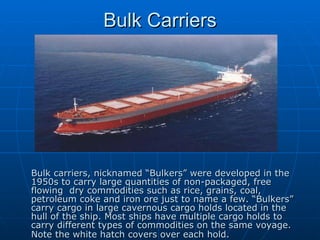
Bulk Carriers Bulk carriers, nicknamed “Bulkers” were developed in the 1950s to carry large quantities of non-packaged, free flowing  dry commodities such as rice, grains, coal, petroleum coke and iron ore just to name a few. “Bulkers” carry cargo in large cavernous cargo holds located in the hull of the ship. Most ships have multiple cargo holds to carry different types of commodities on the same voyage. Note the white hatch covers over each hold.
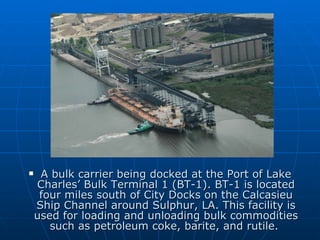
A bulk carrier being docked at the Port of Lake Charles’ Bulk Terminal 1 (BT-1). BT-1 is located four miles south of City Docks on the Calcasieu Ship Channel around Sulphur, LA. This facility is used for loading and unloading bulk commodities such as petroleum coke, barite, and rutile.
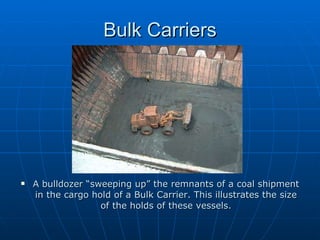
Bulk Carriers A bulldozer “sweeping up” the remnants of a coal shipment in the cargo hold of a Bulk Carrier. This illustrates the size of the holds of these vessels.
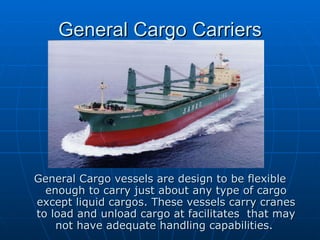
General Cargo Carriers General Cargo vessels are design to be flexible enough to carry just about any type of cargo except liquid cargos. These vessels carry cranes to load and unload cargo at facilitates  that may not have adequate handling capabilities.
The Port of Lake Charles’ City Docks is a facility designed to handle general cargo. These are cargos such as steel and aluminum products, forest products such as lumber, plywood, wood pulp.
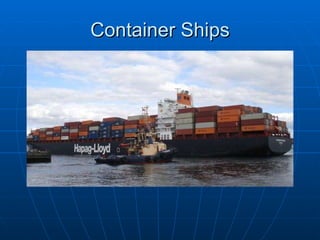
Container  Ships Container vessels are designed for one purpose only, to transport ocean containers.  Container vessels utilize standard size containers to increase efficiency and reduce costs. Steamship companies utilize five basic container sizes: 20-ft, 40-ft, 45-ft, 48-ft, and 53-ft. However, 20 ft & 40 ft are the most common sizes used. Containers are loaded and unloaded onto ships by specialized  shore based cranes which use a “Twistlock” mechanism to grab and lift the container.  Container ship sizes are typically measured in twenty foot equivalent units or “TEU” for short, but can also be measured in forty foot equivalent units or “FEU” for short.  Containers allow for quicker transportation of goods due to being able to take advantage of multimodal transportation. A container can be offloaded from a ship and placed directly onto a truck trailer or railcar.
Container Ships
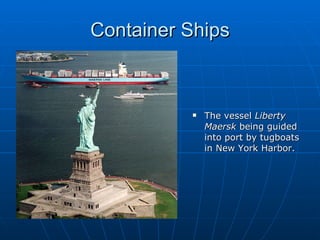
Container Ships The vessel  Liberty   Maersk  being guided into port by tugboats in New York Harbor.
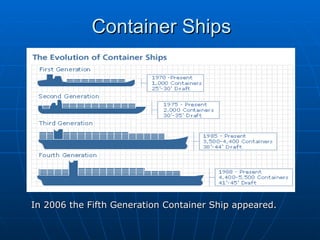
Container Ships In 2006 the Fifth Generation Container Ship appeared.
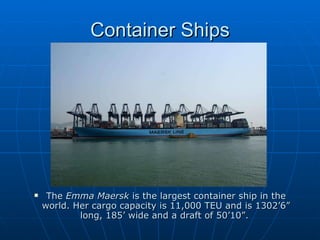
Container Ships The  Emma Maersk  is the largest container ship in the world. Her cargo capacity is 11,000 TEU and is 1302’6” long, 185’ wide and a draft of 50’10”.
Tankers Ships Tankers ships are designed to carry most types of liquid cargoes with the majority number of Tankers today carry petroleum products. Tankers come in a wide range of sizes from small bunkering tankers with a 1000 DWT that refuel other ships to Ultra Large Crude Carriers (ULCC’s) with over 300,000 DWT. Over 60% of the world’s oil supply is transported via tankers. Despite much criticism about the tanker industry, these ships continue to deliver 99% of their cargo safely without any pollution issues. As a safety requirement, tanker ships are required to have double hulls for added impact protection.
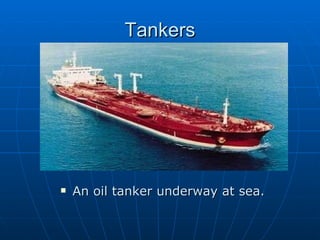
Tankers An oil tanker underway at sea.
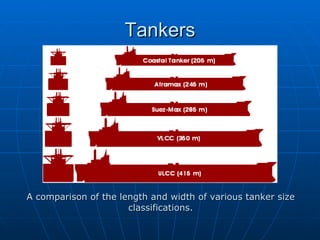
Tankers A comparison of the length and width of various tanker size classifications.
Tankers To ensure that oil tankers transport to all parts of the world, there is a system called WORLDSCALE. This system ensures that net freight earnings for tanker owners are the same, regardless of length of voyage and varying costs (such as bunkers and port dues). The tanker will earn (net) as much per day on a route that is long and arduous as they will on a short and low cost voyage. This ensures that tankers take their goods to all parts of the world and don't just concentrate on the lucrative Middle East to Western Europe or USA routes.
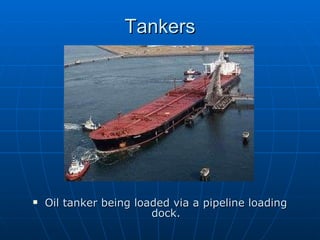
Tankers Oil tanker being loaded via a pipeline loading dock.
Liquefied Natural Gas Carriers Liquefied Natural Gas (LNG) carriers are designed to strictly transport only LNG. They are characterized by utilizing storage tanks that extend well above the deck of the ship.
Liquefied Natural Gas (LNG) LNG is natural gas, primarily methane gas, that has been liquefied by being cooled to -160 o  Celsius (-260 o  Fahrenheit). At this temperature the gas is transformed to a liquid state and is 1/600 of its original volume. By transforming the gas to a liquid state, it make it economical to transport large volumes of gas to other parts of the world. Once the liquid gas arrives at its destination, the gas is transferred from the vessel to a plant on shore that turns the liquid back into a gas to be transported through under ground lines to industry and holes for heating.
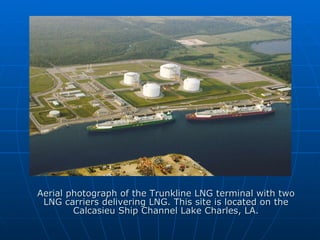
Aerial photograph of the Trunkline LNG terminal with two LNG carriers delivering LNG. This site is located on the Calcasieu Ship Channel Lake Charles, LA.
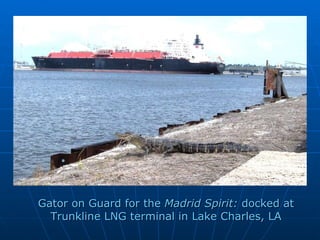
Gator on Guard for the  Madrid Spirit:  docked at Trunkline LNG terminal in Lake Charles, LA
Liquefied Natural Gas (LNG) In 1959, a converted cargo ship named the  Methane Pioneer  was the first ship ever strictly devote to the transportation of Liquefied Natural Gas. Its trade route was from Lake Charles, LA to the United Kingdom. LNG is an integral part of Southwest Louisiana’s commerce because of the location of Trunkline and Cameron LNG terminals on Port of Lake Charles Property.
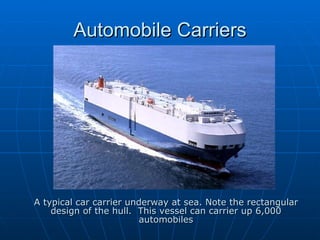
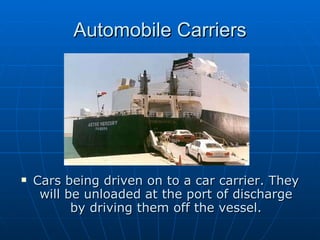
Automobile Carriers The Auto Carrier is a Roll On/Roll Off (Ro/Ro) ship. These vessels are designed to transport large amounts of vehicles or other types of wheeled cargo such as buses, trucks or construction equipment. These ships are designed to be loaded and unloaded by literally driving cargo on and off the ship. They are typically characterized by their large rectangular design that are used to house different levels of parking lots. The vast majority of foreign cars you see in the United States arrived from Europe or Asia via these ships.
Automobile Carriers A typical car carrier underway at sea. Note the rectangular design of the hull.  This vessel can carrier up 6,000 automobiles
Automobile Carriers Cars being driven on to a car carrier. They will be unloaded at the port of discharge by driving them off the vessel.
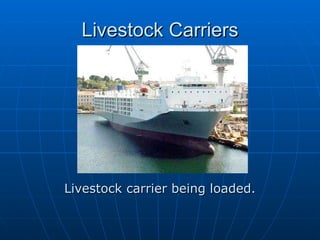
Livestock Carriers The carriage of live animals around the world is performed by specialized vessels that are designed to transport large numbers of cattle, sheep, and other farm animals in secure and humane conditions. These ships are equipped with specially designed ventilation and feeding systems.  The transport of live animals requires experienced and specialized operators and ship personnel. The dangers of disease, rejection, injury, or death to the animal can be high onboard these ships if they are not cared for properly during transport.
Livestock Carriers Livestock carrier being loaded.
Livestock Carriers The trade routes of these ships are largely from Australia to the Middle East and/or Southeast Asia. A single modern vessel may carry up to 125,000 sheep. In 2003, Australia exported over 4,500,000 sheep and nearly 800,000 cattle. Livestock carriers typically sail through the warm climates of the world.
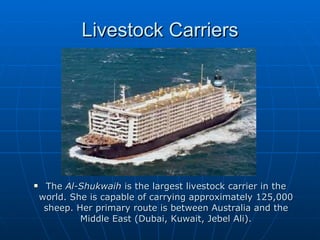
Livestock Carriers The  Al-Shukwaih  is the largest livestock carrier in the world. She is capable of carrying approximately 125,000 sheep. Her primary route is between Australia and the Middle East (Dubai, Kuwait, Jebel Ali).

Polc Ship Curriculum

  • 1.
    Lake Charles Harborand Terminal District 150 Marine St. Lake Charles, LA 70602 (337) 439-3661
  • 2.
    Merchant Ships There are several different types of cargo vessels which are used to transport various commodities over the oceans and seas of the world. These vessel designs vary based upon the type of cargo they carry, and what part of the world they operate in. Each ship type has classifications based on the vessels size and capabilities.
  • 3.
    Commercial Ships BulkCarriers General Cargo Carriers Container Ships Tankers Car Carriers Livestock Carriers Liquefied Natural Gas (LNG) Carriers
  • 4.
    Merchant Ships BulkCarrier Size Classifications DWT = Deadweight Tonnage Handysize: Smallest classification. 15,000 to 50,000 DWT Handymax:40,000 DWT to 60,000 DWT Panamax: 60,000 DWT - 100,000 DWT, maximum size ship which will fit through the locks of the Panama Canal. Post Panamax: 75,000 DWT – 125,000 DWT and will not fit through the Panama Canal. Capesize: 100,000 DWT and larger. Too large to fit through the Suez or Panama Canals. Capesize vessels must travel around the Cape of Good Hope or Cape Horn in order to circumnavigate the world..
  • 5.
    Bulk Carriers Bulkcarriers, nicknamed “Bulkers” were developed in the 1950s to carry large quantities of non-packaged, free flowing dry commodities such as rice, grains, coal, petroleum coke and iron ore just to name a few. “Bulkers” carry cargo in large cavernous cargo holds located in the hull of the ship. Most ships have multiple cargo holds to carry different types of commodities on the same voyage. Note the white hatch covers over each hold.
  • 6.
    A bulk carrierbeing docked at the Port of Lake Charles’ Bulk Terminal 1 (BT-1). BT-1 is located four miles south of City Docks on the Calcasieu Ship Channel around Sulphur, LA. This facility is used for loading and unloading bulk commodities such as petroleum coke, barite, and rutile.
  • 7.
    Bulk Carriers Abulldozer “sweeping up” the remnants of a coal shipment in the cargo hold of a Bulk Carrier. This illustrates the size of the holds of these vessels.
  • 8.
    General Cargo CarriersGeneral Cargo vessels are design to be flexible enough to carry just about any type of cargo except liquid cargos. These vessels carry cranes to load and unload cargo at facilitates that may not have adequate handling capabilities.
  • 9.
    The Port ofLake Charles’ City Docks is a facility designed to handle general cargo. These are cargos such as steel and aluminum products, forest products such as lumber, plywood, wood pulp.
  • 10.
    Container ShipsContainer vessels are designed for one purpose only, to transport ocean containers. Container vessels utilize standard size containers to increase efficiency and reduce costs. Steamship companies utilize five basic container sizes: 20-ft, 40-ft, 45-ft, 48-ft, and 53-ft. However, 20 ft & 40 ft are the most common sizes used. Containers are loaded and unloaded onto ships by specialized shore based cranes which use a “Twistlock” mechanism to grab and lift the container. Container ship sizes are typically measured in twenty foot equivalent units or “TEU” for short, but can also be measured in forty foot equivalent units or “FEU” for short. Containers allow for quicker transportation of goods due to being able to take advantage of multimodal transportation. A container can be offloaded from a ship and placed directly onto a truck trailer or railcar.
  • 11.
  • 12.
    Container Ships Thevessel Liberty Maersk being guided into port by tugboats in New York Harbor.
  • 13.
    Container Ships In2006 the Fifth Generation Container Ship appeared.
  • 14.
    Container Ships The Emma Maersk is the largest container ship in the world. Her cargo capacity is 11,000 TEU and is 1302’6” long, 185’ wide and a draft of 50’10”.
  • 15.
    Tankers Ships Tankersships are designed to carry most types of liquid cargoes with the majority number of Tankers today carry petroleum products. Tankers come in a wide range of sizes from small bunkering tankers with a 1000 DWT that refuel other ships to Ultra Large Crude Carriers (ULCC’s) with over 300,000 DWT. Over 60% of the world’s oil supply is transported via tankers. Despite much criticism about the tanker industry, these ships continue to deliver 99% of their cargo safely without any pollution issues. As a safety requirement, tanker ships are required to have double hulls for added impact protection.
  • 16.
    Tankers An oiltanker underway at sea.
  • 17.
    Tankers A comparisonof the length and width of various tanker size classifications.
  • 18.
    Tankers To ensurethat oil tankers transport to all parts of the world, there is a system called WORLDSCALE. This system ensures that net freight earnings for tanker owners are the same, regardless of length of voyage and varying costs (such as bunkers and port dues). The tanker will earn (net) as much per day on a route that is long and arduous as they will on a short and low cost voyage. This ensures that tankers take their goods to all parts of the world and don't just concentrate on the lucrative Middle East to Western Europe or USA routes.
  • 19.
    Tankers Oil tankerbeing loaded via a pipeline loading dock.
  • 20.
    Liquefied Natural GasCarriers Liquefied Natural Gas (LNG) carriers are designed to strictly transport only LNG. They are characterized by utilizing storage tanks that extend well above the deck of the ship.
  • 21.
    Liquefied Natural Gas(LNG) LNG is natural gas, primarily methane gas, that has been liquefied by being cooled to -160 o Celsius (-260 o Fahrenheit). At this temperature the gas is transformed to a liquid state and is 1/600 of its original volume. By transforming the gas to a liquid state, it make it economical to transport large volumes of gas to other parts of the world. Once the liquid gas arrives at its destination, the gas is transferred from the vessel to a plant on shore that turns the liquid back into a gas to be transported through under ground lines to industry and holes for heating.
  • 22.
    Aerial photograph ofthe Trunkline LNG terminal with two LNG carriers delivering LNG. This site is located on the Calcasieu Ship Channel Lake Charles, LA.
  • 23.
    Gator on Guardfor the Madrid Spirit: docked at Trunkline LNG terminal in Lake Charles, LA
  • 24.
    Liquefied Natural Gas(LNG) In 1959, a converted cargo ship named the Methane Pioneer was the first ship ever strictly devote to the transportation of Liquefied Natural Gas. Its trade route was from Lake Charles, LA to the United Kingdom. LNG is an integral part of Southwest Louisiana’s commerce because of the location of Trunkline and Cameron LNG terminals on Port of Lake Charles Property.
  • 25.
    Automobile Carriers TheAuto Carrier is a Roll On/Roll Off (Ro/Ro) ship. These vessels are designed to transport large amounts of vehicles or other types of wheeled cargo such as buses, trucks or construction equipment. These ships are designed to be loaded and unloaded by literally driving cargo on and off the ship. They are typically characterized by their large rectangular design that are used to house different levels of parking lots. The vast majority of foreign cars you see in the United States arrived from Europe or Asia via these ships.
  • 26.
    Automobile Carriers Atypical car carrier underway at sea. Note the rectangular design of the hull. This vessel can carrier up 6,000 automobiles
  • 27.
    Automobile Carriers Carsbeing driven on to a car carrier. They will be unloaded at the port of discharge by driving them off the vessel.
  • 28.
    Livestock Carriers Thecarriage of live animals around the world is performed by specialized vessels that are designed to transport large numbers of cattle, sheep, and other farm animals in secure and humane conditions. These ships are equipped with specially designed ventilation and feeding systems. The transport of live animals requires experienced and specialized operators and ship personnel. The dangers of disease, rejection, injury, or death to the animal can be high onboard these ships if they are not cared for properly during transport.
  • 29.
    Livestock Carriers Livestockcarrier being loaded.
  • 30.
    Livestock Carriers Thetrade routes of these ships are largely from Australia to the Middle East and/or Southeast Asia. A single modern vessel may carry up to 125,000 sheep. In 2003, Australia exported over 4,500,000 sheep and nearly 800,000 cattle. Livestock carriers typically sail through the warm climates of the world.
  • 31.
    Livestock Carriers The Al-Shukwaih is the largest livestock carrier in the world. She is capable of carrying approximately 125,000 sheep. Her primary route is between Australia and the Middle East (Dubai, Kuwait, Jebel Ali).